MUTATION
Mutation is a sudden change in
physical and chemical properties
of gene/genetic material of an
organism.
Mutation result in a DNA base
pair change or chromosome
change.
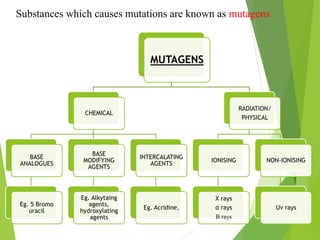
Substances which causes mutations are known as mutagens
MUTAGENS
CHEMICAL
BASE
ANALOGUES
Eg. 5 Bromo
uracil
BASE
MODIFYING
AGENTS
Eg. Alkytaing
agents,
hydroxylating
agents
INTERCALATING
AGENTS
Eg. Acridine,
RADIATION/
PHYSICAL
IONISING
X rays
α rays
Β rays
NON-IONISING
Uv rays
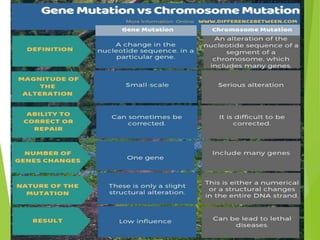
MUTATIONS
Gene
mutations
Chromosomal
mutations
CHROMOSOMAL
MUTATIONS
Morphological mutations
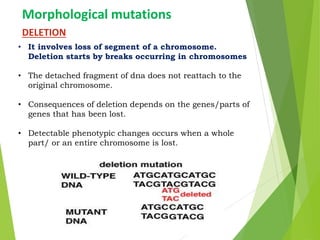
DELETION
• It involves loss of segment of a chromosome.
Deletion starts by breaks occurring in chromosomes
• The detached fragment of dna does not reattach to the
original chromosome.
• Consequences of deletion depends on the genes/parts of
genes that has been lost.
• Detectable phenotypic changes occurs when a whole
part/ or an entire chromosome is lost.
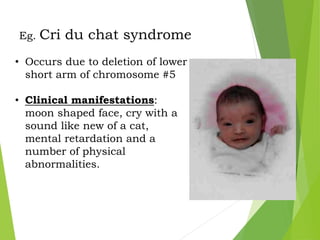
Eg. Cri du chat syndrome
• Occurs due to deletion of lower
short arm of chromosome #5
• Clinical manifestations:
moon shaped face, cry with a
sound like new of a cat,
mental retardation and a
number of physical
abnormalities.
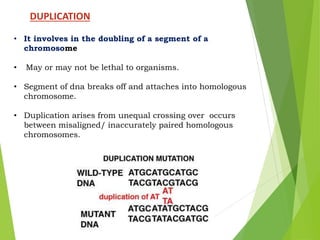
DUPLICATION
• It involves in the doubling of a segment of a
chromosome
• May or may not be lethal to organisms.
• Segment of dna breaks off and attaches into homologous
chromosome.
• Duplication arises from unequal crossing over occurs
between misaligned/ inaccurately paired homologous
chromosomes.
Eg. Chromosome 1q21.1 duplication syndrome
Clinical manifestations :
large head size, autistic behavior, heart
problems, mental retardation.
INVERSION
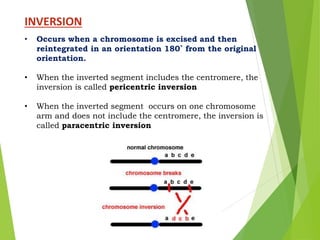
• Occurs when a chromosome is excised and then
reintegrated in an orientation 180˚ from the original
orientation.
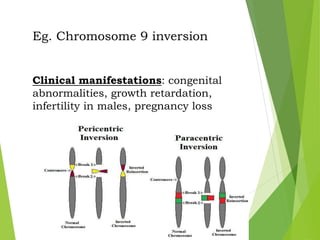
• When the inverted segment includes the centromere, the
inversion is called pericentric inversion
• When the inverted segment occurs on one chromosome
arm and does not include the centromere, the inversion is
called paracentric inversion
Eg. Chromosome 9 inversion
Clinical manifestations: congenital
abnormalities, growth retardation,
infertility in males, pregnancy loss
TRANSLOCATION
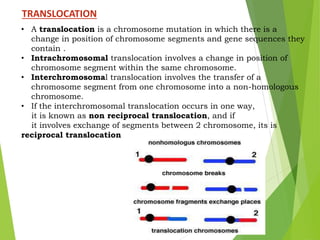
• A translocation is a chromosome mutation in which there is a
change in position of chromosome segments and gene sequences they
contain .
• Intrachromosomal translocation involves a change in position of
chromosome segment within the same chromosome.
• Interchromosomal translocation involves the transfer of a
chromosome segment from one chromosome into a non-homologous
chromosome.
• If the interchromosomal translocation occurs in one way,
it is known as non reciprocal translocation, and if
it involves exchange of segments between 2 chromosome, its is
reciprocal translocation
Eg. Chronic myeloginous
leukemia
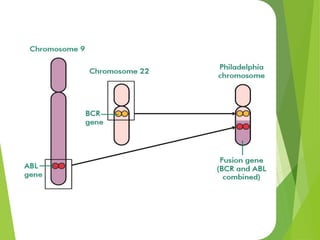
• Due to mutation in leukemic cells called
Philadelphia chromosome, which results from
reciprocal translocation of part of long arm of
chromosome no. 22 and a small part of tip of
chromosome no. 9. this results in activation
of oncogenes (c-myc)
Numeric mutation
EUPLOIDY
• Mutations which results in changes in
complete sets of chromosomes.
• Monoploidy and polyploidy are lethal for
animals but are tolerated by plants.
• They have played a significant role in plant
speciation.
• In humans, most common polyploidy is
triploidy. Triploidy is always lethal and seen in
15-20% of spontaneous abortions. About 1 in
10,000 live births is triploid, but most die
within one month.
• Triploid infants have many abnormalities,
including characteristic large head
ANEUPLOIDY (±1/±2)
• One to a few whole chromosomes are lost from or
added to the normal set of chromosomes.
• Aneuploidy occurs mainly due to non-disjunction of
chromosomes during meiosis.
• Non-disjuntion is the irregular distribution to the cell
poles of sister chromatids in mitosis or of homologous
chromosome in meiosis.
• In non-disjunction , one progeny nucleus with more
than and one with less than the normal no. of
chromosomes are produced.
• Unpaired chromosomes may be lost during anaphase
and not included in one of the daughter nucleus.
NULLISOMY
• A loss of one homologous chromosome
pair results in a nullisomic cell.
• The nullisomic cell is 2n-2.
MONOSOMY
• A loss of a single chromosome results in
monosomic cell.
• The monosomic cell is 2n-1
• Autosomal monosomy in human is only found
rarely in spontaneous abortions and live births.
• Monosomic embryos do not develop significantly
and are lost during pregnancy
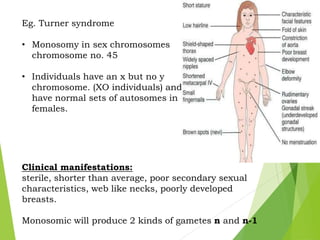
Eg. Turner syndrome
• Monosomy in sex chromosomes
chromosome no. 45
• Individuals have an x but no y
chromosome. (XO individuals) and
have normal sets of autosomes in
females.
Clinical manifestations:
sterile, shorter than average, poor secondary sexual
characteristics, web like necks, poorly developed
breasts.
Monosomic will produce 2 kinds of gametes n and n-1
TRISOMY
• A trisomic cell contains a single extra
chromosome so the cell
• has 3 copies of one chromosome type and 2
copies of every other chromosome type.
• A trisomic cell is 2n+1
trisomy of #8,#13,#18 do not survive long
• Only one in trisomy #21 does survival to adulthood
occur
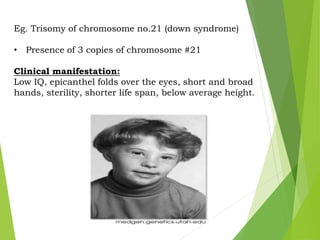
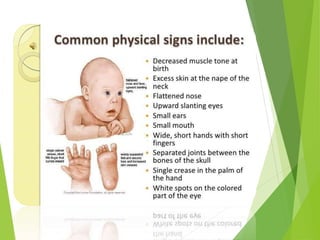
Eg. Trisomy of chromosome no.21 (down syndrome)
• Presence of 3 copies of chromosome #21
Clinical manifestation:
Low IQ, epicanthel folds over the eyes, short and broad
hands, sterility, shorter life span, below average height.
TETRASOMY
• A tetrasomic cell contains an extra
chromosome pair, resulting in the presence of 4
copies of one chromosome type and 2 copies of
every other chromosome type.
• A tetrasomic cell is 2n+2
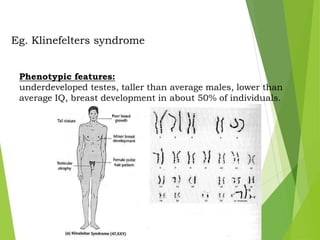
Eg. Klinefelters syndrome
Phenotypic features:
underdeveloped testes, taller than average males, lower than
average IQ, breast development in about 50% of individuals.
GENE MUTATIONS
• A mutation in a gene sequences is called
gene mutation.
• It can involve any one of a number of
alteration of DNA sequences of the gene,
including base-pair substitutions and addition
/deletions of one or more base-pair.
• Those gene mutations which affects a singe
base-pairs of DNA are called point mutations.
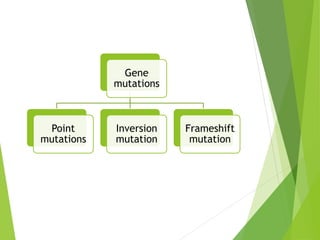
Gene
mutations
Point
mutations
Inversion
mutation
Frameshift
mutation
POINT MUTATIONS
It is a specific type of base- pair
substitution mutation involving a change
from one base pair change to another.
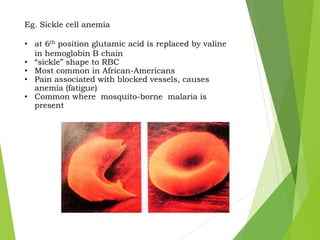
Eg. Sickle cell anemia
• at 6th position glutamic acid is replaced by valine
in hemoglobin B chain
• “sickle” shape to RBC
• Most common in African-Americans
• Pain associated with blocked vessels, causes
anemia (fatigue)
• Common where mosquito-borne malaria is
present
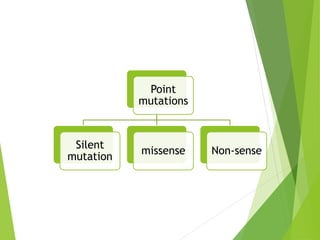
Point
mutations
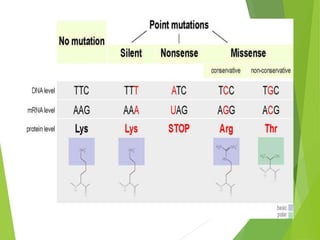
Silent
mutation
missense Non-sense
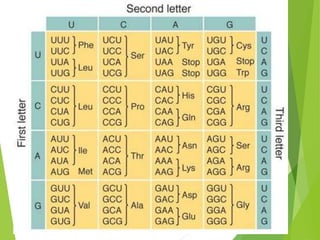
SILENT
It is a base pair change that alters a
codon in the mrna such that the same
amino acid is inserted in the protein.
It has no effect on the function of
protein.
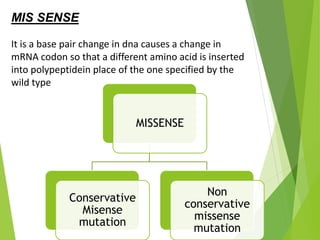
MIS SENSE
It is a base pair change in dna causes a change in
mRNA codon so that a different amino acid is inserted
into polypeptidein place of the one specified by the
wild type
MISSENSE
Conservative
Misense
mutation
Non
conservative
missense
mutation
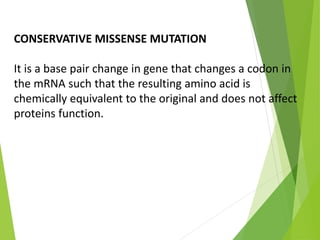
CONSERVATIVE MISSENSE MUTATION
It is a base pair change in gene that changes a codon in
the mRNA such that the resulting amino acid is
chemically equivalent to the original and does not affect
proteins function.
NON CONSERVATIVE MISSENSE MUTATION
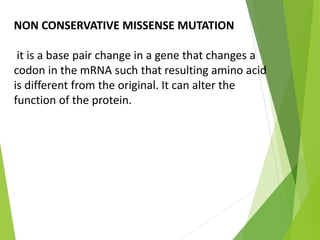
it is a base pair change in a gene that changes a
codon in the mRNA such that resulting amino acid
is different from the original. It can alter the
function of the protein.
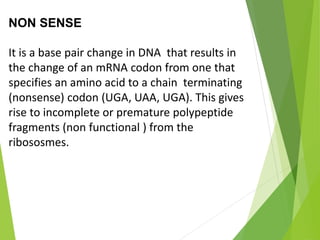
NON SENSE
It is a base pair change in DNA that results in
the change of an mRNA codon from one that
specifies an amino acid to a chain terminating
(nonsense) codon (UGA, UAA, UGA). This gives
rise to incomplete or premature polypeptide
fragments (non functional ) from the
ribososmes.
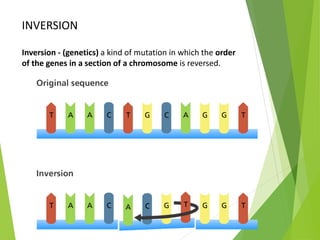
INVERSION
Inversion - (genetics) a kind of mutation in which the order
of the genes in a section of a chromosome is reversed.
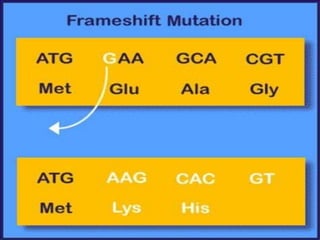
FRAMESHIFT MUTATION
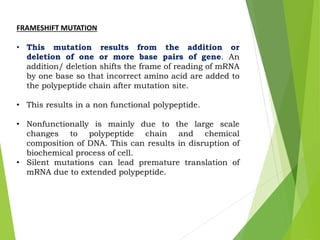
• This mutation results from the addition or
deletion of one or more base pairs of gene. An
addition/ deletion shifts the frame of reading of mRNA
by one base so that incorrect amino acid are added to
the polypeptide chain after mutation site.
• This results in a non functional polypeptide.
• Nonfunctionally is mainly due to the large scale
changes to polypeptide chain and chemical
composition of DNA. This can results in disruption of
biochemical process of cell.
• Silent mutations can lead premature translation of
mRNA due to extended polypeptide.
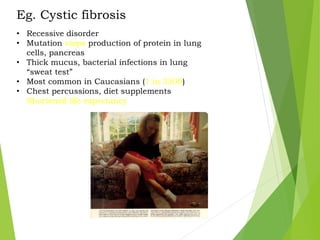
• Recessive disorder
• Mutation stops production of protein in lung
cells, pancreas
• Thick mucus, bacterial infections in lung
“sweat test”
• Most common in Caucasians (1 in 3300)
• Chest percussions, diet supplements
Shortened life expectancy
Eg. Cystic fibrosis
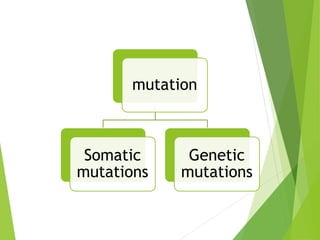
mutation
Somatic
mutations
Genetic
mutations
mutations
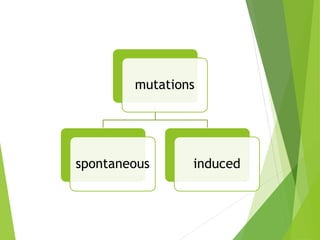
spontaneous induced
Mutation gene and chromosomal

Mutation gene and chromosomal

  • 1.
  • 2.
    Mutation is asudden change in physical and chemical properties of gene/genetic material of an organism. Mutation result in a DNA base pair change or chromosome change.
  • 3.
    Substances which causesmutations are known as mutagens MUTAGENS CHEMICAL BASE ANALOGUES Eg. 5 Bromo uracil BASE MODIFYING AGENTS Eg. Alkytaing agents, hydroxylating agents INTERCALATING AGENTS Eg. Acridine, RADIATION/ PHYSICAL IONISING X rays α rays Β rays NON-IONISING Uv rays
  • 4.
  • 5.
  • 6.
    Morphological mutations DELETION • Itinvolves loss of segment of a chromosome. Deletion starts by breaks occurring in chromosomes • The detached fragment of dna does not reattach to the original chromosome. • Consequences of deletion depends on the genes/parts of genes that has been lost. • Detectable phenotypic changes occurs when a whole part/ or an entire chromosome is lost.
  • 7.
    Eg. Cri duchat syndrome • Occurs due to deletion of lower short arm of chromosome #5 • Clinical manifestations: moon shaped face, cry with a sound like new of a cat, mental retardation and a number of physical abnormalities.
  • 8.
    DUPLICATION • It involvesin the doubling of a segment of a chromosome • May or may not be lethal to organisms. • Segment of dna breaks off and attaches into homologous chromosome. • Duplication arises from unequal crossing over occurs between misaligned/ inaccurately paired homologous chromosomes.
  • 9.
    Eg. Chromosome 1q21.1duplication syndrome Clinical manifestations : large head size, autistic behavior, heart problems, mental retardation.
  • 10.
    INVERSION • Occurs whena chromosome is excised and then reintegrated in an orientation 180˚ from the original orientation. • When the inverted segment includes the centromere, the inversion is called pericentric inversion • When the inverted segment occurs on one chromosome arm and does not include the centromere, the inversion is called paracentric inversion
  • 11.
    Eg. Chromosome 9inversion Clinical manifestations: congenital abnormalities, growth retardation, infertility in males, pregnancy loss
  • 12.
    TRANSLOCATION • A translocationis a chromosome mutation in which there is a change in position of chromosome segments and gene sequences they contain . • Intrachromosomal translocation involves a change in position of chromosome segment within the same chromosome. • Interchromosomal translocation involves the transfer of a chromosome segment from one chromosome into a non-homologous chromosome. • If the interchromosomal translocation occurs in one way, it is known as non reciprocal translocation, and if it involves exchange of segments between 2 chromosome, its is reciprocal translocation
  • 13.
    Eg. Chronic myeloginous leukemia •Due to mutation in leukemic cells called Philadelphia chromosome, which results from reciprocal translocation of part of long arm of chromosome no. 22 and a small part of tip of chromosome no. 9. this results in activation of oncogenes (c-myc)
  • 15.
    Numeric mutation EUPLOIDY • Mutationswhich results in changes in complete sets of chromosomes. • Monoploidy and polyploidy are lethal for animals but are tolerated by plants. • They have played a significant role in plant speciation. • In humans, most common polyploidy is triploidy. Triploidy is always lethal and seen in 15-20% of spontaneous abortions. About 1 in 10,000 live births is triploid, but most die within one month. • Triploid infants have many abnormalities, including characteristic large head
  • 16.
    ANEUPLOIDY (±1/±2) • Oneto a few whole chromosomes are lost from or added to the normal set of chromosomes. • Aneuploidy occurs mainly due to non-disjunction of chromosomes during meiosis. • Non-disjuntion is the irregular distribution to the cell poles of sister chromatids in mitosis or of homologous chromosome in meiosis. • In non-disjunction , one progeny nucleus with more than and one with less than the normal no. of chromosomes are produced. • Unpaired chromosomes may be lost during anaphase and not included in one of the daughter nucleus.
  • 17.
    NULLISOMY • A lossof one homologous chromosome pair results in a nullisomic cell. • The nullisomic cell is 2n-2.
  • 18.
    MONOSOMY • A lossof a single chromosome results in monosomic cell. • The monosomic cell is 2n-1 • Autosomal monosomy in human is only found rarely in spontaneous abortions and live births. • Monosomic embryos do not develop significantly and are lost during pregnancy
  • 19.
    Eg. Turner syndrome •Monosomy in sex chromosomes chromosome no. 45 • Individuals have an x but no y chromosome. (XO individuals) and have normal sets of autosomes in females. Clinical manifestations: sterile, shorter than average, poor secondary sexual characteristics, web like necks, poorly developed breasts. Monosomic will produce 2 kinds of gametes n and n-1
  • 20.
    TRISOMY • A trisomiccell contains a single extra chromosome so the cell • has 3 copies of one chromosome type and 2 copies of every other chromosome type. • A trisomic cell is 2n+1 trisomy of #8,#13,#18 do not survive long • Only one in trisomy #21 does survival to adulthood occur
  • 21.
    Eg. Trisomy ofchromosome no.21 (down syndrome) • Presence of 3 copies of chromosome #21 Clinical manifestation: Low IQ, epicanthel folds over the eyes, short and broad hands, sterility, shorter life span, below average height.
  • 23.
    TETRASOMY • A tetrasomiccell contains an extra chromosome pair, resulting in the presence of 4 copies of one chromosome type and 2 copies of every other chromosome type. • A tetrasomic cell is 2n+2
  • 24.
    Eg. Klinefelters syndrome Phenotypicfeatures: underdeveloped testes, taller than average males, lower than average IQ, breast development in about 50% of individuals.
  • 25.
    GENE MUTATIONS • Amutation in a gene sequences is called gene mutation. • It can involve any one of a number of alteration of DNA sequences of the gene, including base-pair substitutions and addition /deletions of one or more base-pair. • Those gene mutations which affects a singe base-pairs of DNA are called point mutations.
  • 26.
  • 27.
    POINT MUTATIONS It isa specific type of base- pair substitution mutation involving a change from one base pair change to another.
  • 28.
    Eg. Sickle cellanemia • at 6th position glutamic acid is replaced by valine in hemoglobin B chain • “sickle” shape to RBC • Most common in African-Americans • Pain associated with blocked vessels, causes anemia (fatigue) • Common where mosquito-borne malaria is present
  • 29.
  • 30.
    SILENT It is abase pair change that alters a codon in the mrna such that the same amino acid is inserted in the protein. It has no effect on the function of protein.
  • 32.
    MIS SENSE It isa base pair change in dna causes a change in mRNA codon so that a different amino acid is inserted into polypeptidein place of the one specified by the wild type MISSENSE Conservative Misense mutation Non conservative missense mutation
  • 34.
    CONSERVATIVE MISSENSE MUTATION Itis a base pair change in gene that changes a codon in the mRNA such that the resulting amino acid is chemically equivalent to the original and does not affect proteins function.
  • 35.
    NON CONSERVATIVE MISSENSEMUTATION it is a base pair change in a gene that changes a codon in the mRNA such that resulting amino acid is different from the original. It can alter the function of the protein.
  • 36.
    NON SENSE It isa base pair change in DNA that results in the change of an mRNA codon from one that specifies an amino acid to a chain terminating (nonsense) codon (UGA, UAA, UGA). This gives rise to incomplete or premature polypeptide fragments (non functional ) from the ribososmes.
  • 37.
    INVERSION Inversion - (genetics)a kind of mutation in which the order of the genes in a section of a chromosome is reversed.
  • 38.
    FRAMESHIFT MUTATION • Thismutation results from the addition or deletion of one or more base pairs of gene. An addition/ deletion shifts the frame of reading of mRNA by one base so that incorrect amino acid are added to the polypeptide chain after mutation site. • This results in a non functional polypeptide. • Nonfunctionally is mainly due to the large scale changes to polypeptide chain and chemical composition of DNA. This can results in disruption of biochemical process of cell. • Silent mutations can lead premature translation of mRNA due to extended polypeptide.
  • 40.
    • Recessive disorder •Mutation stops production of protein in lung cells, pancreas • Thick mucus, bacterial infections in lung “sweat test” • Most common in Caucasians (1 in 3300) • Chest percussions, diet supplements Shortened life expectancy Eg. Cystic fibrosis
  • 42.
  • 43.