GENOMICS AP Biology Chap 21
Genomes – set of genes and their interactions Bioinformatics – computational methods of gene analysis -  NCBI National Center Biotechnology  Information – database of DNA  sequences and proteins (proteomes) NCBI  HomePage
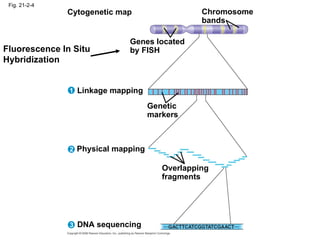
The most ambitious mapping project to date has been the sequencing of the human genome Officially begun as the  Human Genome Project   in 1990, the sequencing was largely completed by 2003 The project had three stages: Genetic (or linkage) mapping Physical mapping DNA sequencing
Fig. 21-2-4 Cytogenetic map Genes located by FISH Chromosome bands Linkage mapping 1 2 3 Genetic markers Physical mapping Overlapping fragments DNA sequencing Fluorescence In Situ Hybridization
A  linkage map  (genetic map) maps the location of several thousand genetic markers on each chromosome A genetic marker is a gene or other identifiable DNA sequence Recombination frequencies  are used to determine the order and relative distances between genetic markers
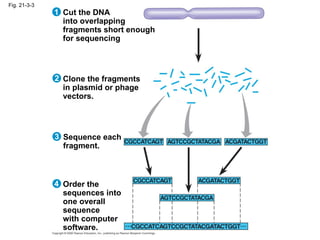
Fig. 21-3-3 Cut the DNA into overlapping fragments short enough for sequencing 1 2 3 4 Clone the fragments in plasmid or phage vectors. Sequence each fragment. Order the sequences into one overall sequence with computer  software.
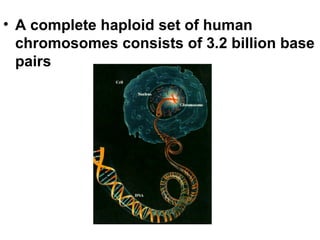
A complete haploid set of human chromosomes consists of 3.2 billion base pairs
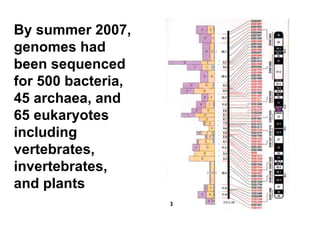
By summer 2007, genomes had been sequenced for 500 bacteria, 45 archaea, and 65 eukaryotes including vertebrates, invertebrates, and plants
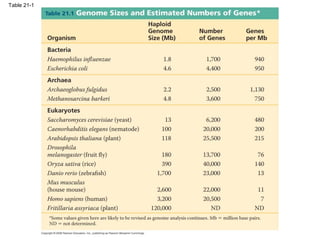
What do we know? Humans have 20,488 genes With alternate gene splicing, we can make 75,000 polypeptides Genomes of most bacteria and archaea range from 1 to 6 million base pairs (Mb); genomes of eukaryotes are usually larger
Free-living bacteria and archaea have 1,500 to 7,500 genes Unicellular fungi have from about 5,000 genes and multicellular eukaryotes from 40,000 genes Number of genes is not correlated to genome size Humans and other mammals have the lowest gene density , or number of genes, in a given length of DNA
Table 21-1
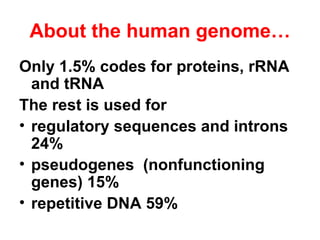
About the human genome… Only 1.5% codes for proteins, rRNA and tRNA The rest is used for  regulatory sequences and introns 24%  pseudogenes  (nonfunctioning genes) 15%  repetitive DNA 59%
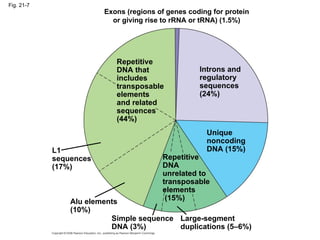
Fig. 21-7 Exons (regions of genes coding for protein or giving rise to rRNA or tRNA) (1.5%) Repetitive DNA that includes transposable elements and related sequences (44%) Introns and regulatory sequences (24%) Unique noncoding DNA (15%) Repetitive DNA unrelated to transposable elements (15%) L1 sequences (17%) Alu elements (10%) Simple sequence DNA (3%) Large-segment duplications (5–6%)
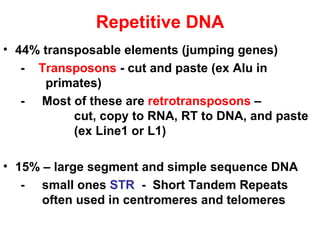
Repetitive DNA 44% transposable elements (jumping genes)  -  Transposons  - cut and paste (ex Alu in    primates) -  Most of these are  retrotransposons  –      cut, copy to RNA, RT to DNA, and paste      (ex Line1 or L1) 15% – large segment and simple sequence DNA -  small ones  STR  -  Short Tandem Repeats    often used in centromeres and telomeres
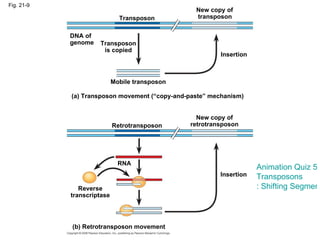
Fig. 21-9 Transposon New copy of transposon Insertion Transposon is copied Mobile transposon DNA of genome (a) Transposon movement (“copy-and-paste” mechanism) Retrotransposon New copy of retrotransposon Insertion Reverse transcriptase RNA (b) Retrotransposon movement Animation Quiz 5 -  Transposons : Shifting Segments of the Genome
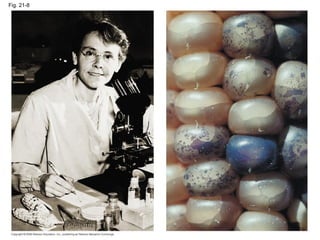
“ Jumping Genes” The first evidence for wandering DNA segments came from geneticist Barbara McClintock’s breeding experiments with Indian corn
Fig. 21-8
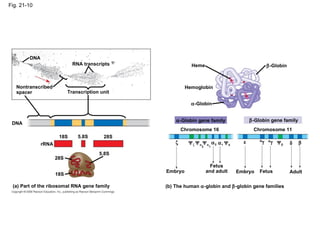
Genes Many eukaryotic genes are present in one copy per haploid set of chromosomes More than ½ occur in multigene families – such as for RNA products and hemoglobin
Fig. 21-10 DNA RNA transcripts Nontranscribed spacer Transcription unit 18S 28S 5.8S 28S 5.8S rRNA 18S DNA (a) Part of the ribosomal RNA gene family Heme Hemoglobin  -Globin  -Globin  -Globin gene family  -Globin gene family Chromosome 16 Chromosome 11      2   1  2  1    G  A      Adult Fetus Embryo Fetus and adult Embryo (b) The human   -globin and   -globin gene families
Genomic Evolution Duplication of chromosome sets (polyploidy) Chromosome alteration – duplications, inversions Exon shuffling Transposons
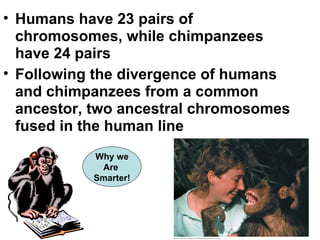
Humans have 23 pairs of chromosomes, while chimpanzees have 24 pairs Following the divergence of humans and chimpanzees from a common ancestor, two ancestral chromosomes fused in the human line Why we Are  Smarter!
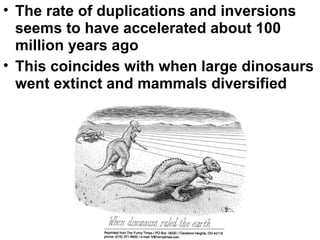
The rate of duplications and inversions seems to have accelerated about 100 million years ago This coincides with when large dinosaurs went extinct and mammals diversified
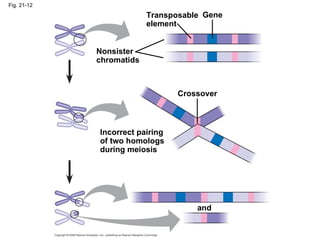
How transposons affect genomes Multiple copies may facilitate crossing-over Insertion may block protein sequence Insertion may affect promoters Insertion may carry new genes to an area May create new sites for alternative splicing in RNA
Fig. 21-12 Transposable element Gene Nonsister chromatids Crossover Incorrect pairing of two homologs during meiosis and
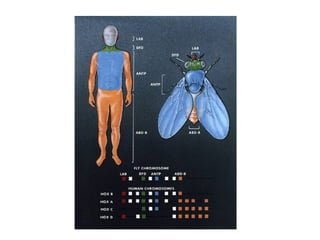
Comparing evolutionary developmental processes  “evo-devo” Homeobox – 180 nucleotides that regulate gene expression during development Found in many organisms, both inverts and verts Called “hox genes” in mammals You should read “Our Inner Fish”!
 
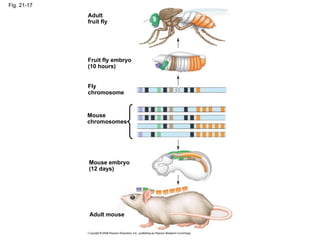
Fig. 21-17 Adult fruit fly Fruit fly embryo (10 hours) Fly chromosome Mouse chromosomes Mouse embryo (12 days) Adult mouse
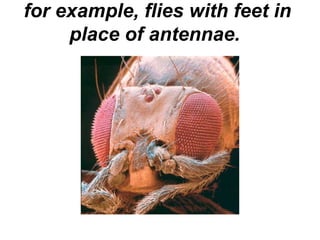
Sometimes small changes in regulatory sequences of certain genes lead to major changes in body form. For example, variation in  Hox  gene expression controls variation in leg-bearing segments of crustaceans and insects
for example, flies with feet in place of antennae.

Ap Chapter 21

  • 1.
  • 2.
    Genomes – setof genes and their interactions Bioinformatics – computational methods of gene analysis - NCBI National Center Biotechnology Information – database of DNA sequences and proteins (proteomes) NCBI HomePage
  • 3.
    The most ambitiousmapping project to date has been the sequencing of the human genome Officially begun as the Human Genome Project in 1990, the sequencing was largely completed by 2003 The project had three stages: Genetic (or linkage) mapping Physical mapping DNA sequencing
  • 4.
    Fig. 21-2-4 Cytogeneticmap Genes located by FISH Chromosome bands Linkage mapping 1 2 3 Genetic markers Physical mapping Overlapping fragments DNA sequencing Fluorescence In Situ Hybridization
  • 5.
    A linkagemap (genetic map) maps the location of several thousand genetic markers on each chromosome A genetic marker is a gene or other identifiable DNA sequence Recombination frequencies are used to determine the order and relative distances between genetic markers
  • 6.
    Fig. 21-3-3 Cutthe DNA into overlapping fragments short enough for sequencing 1 2 3 4 Clone the fragments in plasmid or phage vectors. Sequence each fragment. Order the sequences into one overall sequence with computer software.
  • 7.
    A complete haploidset of human chromosomes consists of 3.2 billion base pairs
  • 8.
    By summer 2007,genomes had been sequenced for 500 bacteria, 45 archaea, and 65 eukaryotes including vertebrates, invertebrates, and plants
  • 9.
    What do weknow? Humans have 20,488 genes With alternate gene splicing, we can make 75,000 polypeptides Genomes of most bacteria and archaea range from 1 to 6 million base pairs (Mb); genomes of eukaryotes are usually larger
  • 10.
    Free-living bacteria andarchaea have 1,500 to 7,500 genes Unicellular fungi have from about 5,000 genes and multicellular eukaryotes from 40,000 genes Number of genes is not correlated to genome size Humans and other mammals have the lowest gene density , or number of genes, in a given length of DNA
  • 11.
  • 12.
    About the humangenome… Only 1.5% codes for proteins, rRNA and tRNA The rest is used for regulatory sequences and introns 24% pseudogenes (nonfunctioning genes) 15% repetitive DNA 59%
  • 13.
    Fig. 21-7 Exons(regions of genes coding for protein or giving rise to rRNA or tRNA) (1.5%) Repetitive DNA that includes transposable elements and related sequences (44%) Introns and regulatory sequences (24%) Unique noncoding DNA (15%) Repetitive DNA unrelated to transposable elements (15%) L1 sequences (17%) Alu elements (10%) Simple sequence DNA (3%) Large-segment duplications (5–6%)
  • 14.
    Repetitive DNA 44%transposable elements (jumping genes) - Transposons - cut and paste (ex Alu in primates) - Most of these are retrotransposons – cut, copy to RNA, RT to DNA, and paste (ex Line1 or L1) 15% – large segment and simple sequence DNA - small ones STR - Short Tandem Repeats often used in centromeres and telomeres
  • 15.
    Fig. 21-9 TransposonNew copy of transposon Insertion Transposon is copied Mobile transposon DNA of genome (a) Transposon movement (“copy-and-paste” mechanism) Retrotransposon New copy of retrotransposon Insertion Reverse transcriptase RNA (b) Retrotransposon movement Animation Quiz 5 - Transposons : Shifting Segments of the Genome
  • 16.
    “ Jumping Genes”The first evidence for wandering DNA segments came from geneticist Barbara McClintock’s breeding experiments with Indian corn
  • 17.
  • 18.
    Genes Many eukaryoticgenes are present in one copy per haploid set of chromosomes More than ½ occur in multigene families – such as for RNA products and hemoglobin
  • 19.
    Fig. 21-10 DNARNA transcripts Nontranscribed spacer Transcription unit 18S 28S 5.8S 28S 5.8S rRNA 18S DNA (a) Part of the ribosomal RNA gene family Heme Hemoglobin  -Globin  -Globin  -Globin gene family  -Globin gene family Chromosome 16 Chromosome 11      2   1  2  1    G  A      Adult Fetus Embryo Fetus and adult Embryo (b) The human  -globin and  -globin gene families
  • 20.
    Genomic Evolution Duplicationof chromosome sets (polyploidy) Chromosome alteration – duplications, inversions Exon shuffling Transposons
  • 21.
    Humans have 23pairs of chromosomes, while chimpanzees have 24 pairs Following the divergence of humans and chimpanzees from a common ancestor, two ancestral chromosomes fused in the human line Why we Are Smarter!
  • 22.
    The rate ofduplications and inversions seems to have accelerated about 100 million years ago This coincides with when large dinosaurs went extinct and mammals diversified
  • 23.
    How transposons affectgenomes Multiple copies may facilitate crossing-over Insertion may block protein sequence Insertion may affect promoters Insertion may carry new genes to an area May create new sites for alternative splicing in RNA
  • 24.
    Fig. 21-12 Transposableelement Gene Nonsister chromatids Crossover Incorrect pairing of two homologs during meiosis and
  • 25.
    Comparing evolutionary developmentalprocesses “evo-devo” Homeobox – 180 nucleotides that regulate gene expression during development Found in many organisms, both inverts and verts Called “hox genes” in mammals You should read “Our Inner Fish”!
  • 26.
  • 27.
    Fig. 21-17 Adultfruit fly Fruit fly embryo (10 hours) Fly chromosome Mouse chromosomes Mouse embryo (12 days) Adult mouse
  • 28.
    Sometimes small changesin regulatory sequences of certain genes lead to major changes in body form. For example, variation in Hox gene expression controls variation in leg-bearing segments of crustaceans and insects
  • 29.
    for example, flieswith feet in place of antennae.