DISSOLUTION
AS A TOOL IN PHARMACEUTICS
PRESENTED BY: TANMAY MOHANTA
GUIDED BY:SUJIT DAS
M.PHARM (PHARMACEUTICS) 1ST
YEAR 2ND SEM
ROLL NO:18HMPS11
HIMALAYAN PHARMACY INSTITUTE
DEFINITION:
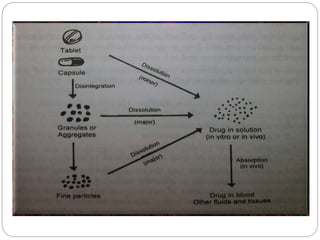
• Dissolution is aprocessin which asolid substance
solubilizes in agiven solvent i.e. masstransfer from
the solid surface to the liquidphase.
• Dissolution is the rate determining step for
hydrophobic, poorly aqueous solubledrugs.
E.g.Griseofulvin, spironolactone
1. Diffusion layermodel
2. Danckwert’s model
3. Interfacial barriermodel
Mechanism ofDissolution
1.DiffusionLayerModel
• Also called ‘film theory’.
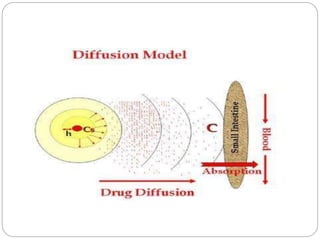
• Formation of a thin film at the interface, called as
stagnant layer.
• 2 steps are involved:
1) Interaction of solvent with drug surface toform a
saturated drug layer , called stagnant layer.
2) Diffusion of drug molecules from stagnantlayer
into bulk of thesystem.
Diagram Representing Diffusion through the StagnantLayer
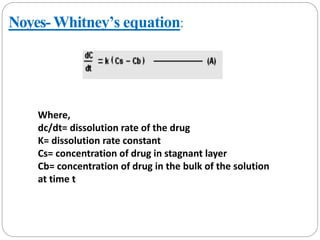
Noyes- Whitney’s equation:
Where,
dc/dt= dissolution rate of the drug
K= dissolution rate constant
Cs= concentration of drug in stagnant layer
Cb= concentration of drug in the bulk of the solution
at time t
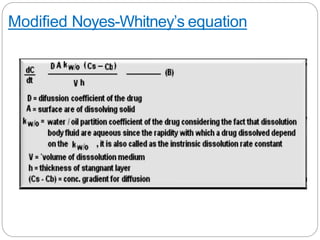
Modified Noyes-Whitney’s equation
3.Danckwert’s model/Penetration or surface renewal
Theory
Dankwert takes into account the eddies or packets that are
present in the agitated fluid which reach the solid-liquid
interface, absorb the solute by diffusion and carry it into the bulk
of solution
These packets get continuously replaced by new ones and
expose to new solid surface each time, thus the theory is called
as surface renewal theory.
The Danckwert’s model is expressed by equation
3. Interfacial barrier model/Double barrier or
Limited solvation theory
The Diffusion layer model and the Dankwert’s model were based
on two assumptions:
1) The rate determining step that controls dissolution is the
mass transport.
2) Solid solution equilibrium is achieved at the solid/liquid
interface.
According to interfacial barrier model, an intermediate conc. can
exist at the interface as a result of solvation mechanism and is a
function of solubility rather than diffusion.
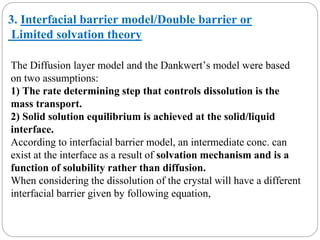
When considering the dissolution of the crystal will have a different
interfacial barrier given by following equation,
G = ki (Cs – Cb)
Where ,
G = dissolution per unit area
Ki = effective interfacial transport constant
In this theory, the diffusivity D may not be independent
of saturation conc. Cs .
The interfacial barrier model can be extended to both
Diffusion
layer model and the Dankwert’s model.
FACTORS INFLUENCING DISSOLUTION
AND DISSOLUTION STUDIES
1. Physicochemical Properties of Drug
2.Factors Relating DissolutionApparatus
3.Factors Relating Dissolution media
1. PHYSICOCHEMICAL PROPERTIES OFDRUG
1) DRUG SOLUBILITY
 Solubility of drug plays a prime role in controlling its dissolution
from dosage form.
 Minimum aqueous solubility of 1% is required to avoid potential
solubility limited absorption problems.
2) PARTICLE SIZE:
 There is a direct relationship between surface area of drug and its
dissolution rate.
 Since, surface area increases with decrease in particle size, higher
dissolution rates may be achieved through reduction of particle
size.
 Micronization of sparingly soluble drug to reduce particle size is
by no means a guarantee of better dissolution and bioavailability.
3)SALT FORMATION
 It is one of the common approaches used to increase drug solubility
and dissolution rate.
 It has always been assumed that sodium salts dissolve faster than
their corresponding insoluble acids.
 Eg. sodium and potassium salts of Pencillin- G, sulfa drugs,
phenytoin, barbiturates etc.
4)SOLVATESAND HYDRATES:
 A solvate is a molecular complex that has incorporated the
crystallizing solvent molecules into specific sites within the crystal
lattice.
 If the solvent is water, it is called a hydrate.
 Anhydrous compounds are highly soluble than hydrate
compounds.eg: anhydrous and hydrate forms of ampicillin.
5) pH EFFECT:
 The solubility of a weak acidic drug or weak basic drug is
influenced by the pH of the fluid.
 Therefore, differences are expected in the solubility and the
dissolution rate of such drugs in different regions of the GIT.
 Rate of dissolution is increases while increasing the pH solution.
Ex: Pencillin , Aspirin alkaline buffered tabletsdissolution
6)ADSORBENTS:
 The concurrent administration of drugs and medicinal products
containing solids adsorbents (eg:antidiarrhoeal mixtures) may result
in the adsorbents interfering with the absorption of such drugs from
the GIT.eg: Promazine adsorbs on to attapulgite decreases
absorption.
7)POLYMORPHISM ANDAMORPHISM:
 When a substance exists in more than one crystalline form, the
different forms are designated as polymorphs and the
phenomenon as Polymorphism.
 Stable polymorphs has lower energy state, higher M.P. and least
aqueous solubility.
 Metastable polymorphs has higher energy state, lower M.P. and
higher aqueous solubility.
8)CO-PRECIPITATION:
 Dissolution rate of sulfathiazole could be significantly increased
by co-precipitating the drug with povidone.
9)COMPLEXATION:
 Complexation of a drug in GIT fluids may alter the rate and the
extent of absorption.eg: streptomycin, tetracyclines.
Eg:Diakylamides -prednisone
2.FACTORS RELATED TO THE APPARATUS
 Size and shape:
 Stirring device:
 Vibrations:
 Alignment of the stirring elements:
 Temperature
3.FACTORS RELATED TO DISSOLUTION MEDIA
 pH of dissolution media:
 Surface tension:
 Viscosity :
 Nature of medium:
DISSOLUTION TESTING
 Dissolution and drug release tests are in-vitro tests that measure the
rate and extent of dissolution or release of the drug substance from
a drug product, usually aq.medium under specified conditions.
 It is an important QC procedure for the drug product and linked to
product performance in-vivo.
 NEED FOR DISSOLUTION TESTING:
 Evaluation of bioavailability.
 Batch to batch drug release uniformity.
 Development of more efficacious and therapeutically optical
dosage forms.
 Ensures quality and stability of the product.
 Product development, quality control, research and application.
USP.APPARATUS DESCRIPTION ROT.SPEED DOSAGE FORM
TYPE 1 Basket apparatus 50-120 rpm IDR,DR,ER
TYPE 2 Paddle apparatus 25-50 rpm IDR,DR,ER
TYPE 3 Reciprocating
cylinder
6-35 rpm IDR,ER
TYPE 4 Flow through cell N/A ER,Poorly soluble
API
TYPE 5 Paddle over disk 25-50 rpm TRANSDERMAL
TYPE 6 Rotating cylinder N/A TRANSDERMAL
TYPE 7 Reciprocating
holder
30 rpm ER
APPARATUS-1(ROTATING BASKET)
DESIGN:
 Vessel: -Made of borosilicate glass.
-Semi hemispherical bottom
-Capacity 1000ml
 Shaft : -Stainless steel 316
-Rotates smoothly without
significance wobble(100 rpm)
-Speed regulator
 Water bath:-Maintained at 37±0.5ºC
 USE: Tablets, capsules, delayed release
suppositories, floating dosage forms.
METHOD(Rotating basket):
 Place the stated volume of the dissolution medium(±1 %) in the
vessel and equilibrate dissolution medium to 37±0.5°C.
 Place 1 tablet or capsule in the apparatus ,taking care to excludeair
bubbles from the surface of the dosage form unit and immediately
operate the apparatus at the rate specified(100rpm).
 Withdraw a specimen from a zone midway between the surface of the
dissolution medium and the top of the rotating basket,not less than
1cm from the vessel wall at each times stated.
 Replace the aliquots withdrawn for analysis with equal volumes of
fresh dissolution medium at 37°C.
 Keep the vessel covered for the duration of the test and verify the
temperature of the mixture under test at suitable times.
 Perform the analysis as directed in individual monograph and repeat
the test with additional dosage form units.
Apparatus 1 - Basket
 Advantages
 Full pH change during the test
 Can be easily automated
which is important for routine
investigations.
 Disadvantages
 Basket screen is clogged with
gummy particles.
 Hydrodynamic „dead zone“
under the basket
 Degassing is particularly
important
 Mesh gets corroded by HCl solution.
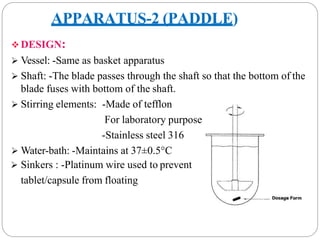
APPARATUS-2 (PADDLE)
 DESIGN:
 Vessel: -Same as basket apparatus
 Shaft: -The blade passes through the shaft so that the bottom of the
blade fuses with bottom of the shaft.
 Stirring elements: -Made of tefflon
For laboratory purpose
-Stainless steel 316
 Water-bath: -Maintains at 37±0.5°C
 Sinkers : -Platinum wire used to prevent
tablet/capsule from floating
METHOD
 It consists of a special coated paddle formed from a blade and a
shaft that minimizes turbulence due to stirring.
 The coated material is inert.
 The paddle is attached vertically to a variable -speed motor that
rotates at a controlled speed.
 The tablet or capsule is placed into a round-bottom dissolution
flask and the apparatus is housed in a constant temperature water
bath maintained at 37°C.
 Most common operating speeds are 50rpm for solid oral dosage
forms and 25 rpm for suspensions.
 A sinker ,such as few turns of platinum wire may be used to
prevent a capsule or tablet from floating
 Used for film coated tablets that stick to the vessel walls or to
help to position tablet/capsule under the paddle.
 Advantages
 Easy to use
 Robust
 pH change possible
 Can be easily automated which is important for
routine investigations
 Disadvantages
 pH/media change is often difficult
 Hydrodynamics are complex, they vary with site of the dosage
form in the vessel (sticking,floating) and therefore may
significantly affect drug dissolution
 Sinkers for floating dosage forms
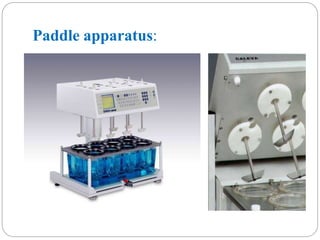
Paddle apparatus:
Sinker Types:
Coning:
APPARATUS-3(RECIPROCATING CYLINDER)
 DESIGN:
 Vessel: -Set of cylindrical flat bottom glass vessels
-Set of reciprocating cylinders
-stainless steel fittings(type 316) and
screens made of nonsorbing or
non-reactive materials.
 Agitation type: -Reciprocating
-5-35 rpm
 Volume of dissolution medium:-200-250ml
 Water bath:- Maintain at 37±0.5°C
 USE: Tablets, beads, controlled and
extended release formulations
METHOD(Reciprocating cylinder):
 Place the stated volume of dissolution medium in each vessel of the
apparatus, assemble the apparatus, equilibrate the dissolution
medium to 37±0.5 and remove the thermometer
 Place one dosage form unit in each of the cylinders taking careto
exclude the air bubbles from the surface of each dosage unit and
immediately operate the apparatus as specified in the monograph.
 During the upward and downward stroke, the reciprocating cylinder
moves through a total distance of 9.9 to 10.1cm.
 Within the time interval specified raise the cylinders and withdraw a
portion of the solution under test from a zone midway between the
surface of the dissolution medium and bottom of each vessel.
 Advantages
 Easy to change the pH
 pH-profiles
 Hydrodynamics can be
directly influenced by
varying the dip rate
 Disadvantages
 Small volume (max. 250 ml)
 Little experience
 Limited data
APPARATUS-4 (FLOW THROUGH CELL)
 DESIGN:
 Reservoir : -For dissolution medium
 Pump : -Forces dissolution medium through cell
-Holding a sample
-Flow rate 10-100ml/min
-Laminar flow is maintained
-Peristaltic/centrifugal pumps are not recommended
 Water bath:- Maintain at 37±0.5°C
 USE:
Low solubility drugs ,micro particulates ,implants, suppositories
controlled release formulations
METHOD(Flow through cell):
 The flow through cell is transparent & inert mounted vertically
with filters.
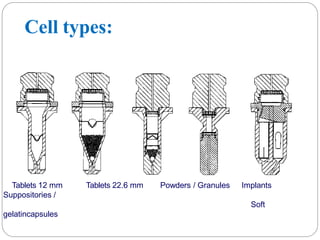
 Standard cell diameters are 12 & 22.6 mm.
 The bottom cone usually filled with glass beads of 1 mm
diameter.
 Tablet holder used for positioning special dosage form e.g. inlay
tablets.
 Place the glass beads into the cell as specified in the monograph.
 Place one dosage unit on top of the beads or on a wire carrier.
 Assemble the filter head and fix the parts together by means of a
suitable clamping device.
 Introduce by the pump of the dissolution medium warmed to
37±0.5 through the bottom of the cell to obtain the flow rate
specified and measured with an accuracy of 5%.
 Collect the eluate by fractions at each of the times stated.
d.
 Advantages
 easy to change media pH
 pH-profile possible
 Sink conditions maintaine
 different modes
a) open system
b) closed system
 Disadvantages
 Deaeration necessary
 high volumes of media
 labor intensive
Cell types:
Tablets 22.6 mm Powders / Granules ImplantsTablets 12 mm
Suppositories /
Soft
gelatincapsules
Flow-Through Cell:
APPARATUS-5(PADDLE-OVER-DISK)
 DESIGN:
 Vessel
 Shaft
 Stirring elements- rotating speed 25-50 rpm
 Sample holder:-disk assembly that hold a product in such a way
that release surface is parallel with paddle
-Paddle is directly attached over disk assembly
-Samples are drawn between surface off the medium
and top of the paddle blade
 Volume:900ml
 Temperature:32°C
 USE: Transdermal patches, ointments, floaters , emulsions.
 Modification: Disk design and volume
 Advantages:
 Easy to handle
 Sink conditions are maintained.
 Membrane effect is minimum.
i.e. drug is placed on a disc at the bottom.
 Disadvantages:
 Disk assembly restricts the patch size
 Borosilicate glass
 17 mesh is standard(others available)
 Accommodates patches up to 90mm.
METHOD(Paddle over disk)
 This method is used for testing the release of drugs from
transdermal products.
 The apparatus consists of a sample holder or disc assembly that
holds the product.
 The entire preparation is placed in a dissolution flask filledwith
specified medium maintained at 32ºC.
 The paddle is placed directly over the disc assembly.
 The disk assembly holds the system flat and is positioned such that
release surface is placed parallel with the bottom of the paddle
blade. Vessel is covered to minimize evaporation during test.
 Samples are drawn midway between the surface of dissolution
medium and the top of the paddle blade at specified times.
APPARATUS-6(ROTATING CYLINDER)
 DESIGN:
 Vessel:- In place of basket, cylinder is used.
 Shaft :-Stainless steel 316
 Sample :- Mounted to cuprophan (inner porous cellulosic material)
an entire system adheres to cylinder.
- Dosage unit is placed in cylinder and release from side out.
 Water-bath: maintained at 32±0.5°C
 USE:
 Transdermal patches cannot be cut into small size.
 Solid dosage forms, pH profile , small volumes
 METHOD( Rotating cylinder):
 Use the assembly from apparatus 1 except to replace the basket and
shaft with a stainless steel cylinder stirring element.
 The temperature is maintained at 32±0.5°C.
 The dosage unit is placed on the cylinder with side out .
 The dosage unit is placed to the exterior of the cylinder such that
long axis of the system fits around the circumference of the cylinder
and removes trapped air bubbles.
 Place the cylinder in the apparatus and immediately rotate at the rate
specified in the individual monograph.
 Samples are drawn midway between the surface of the dissolution
medium and the top of the rotating cylinder for analysis.
Rotating cylinder:
 Advantages: -Equipment (apparatus 1)available with the
manufacturers can be used with modification as apparatus 6.
 Disadvantages:-Large volume of medium is required.
-Drug gets diluted & causes difficulties in analysis
-Difficult to clean the cylinder.
APPARATUS-7(RECIPROCATING-DISK)
 DESIGN:
 Vessel:-Flat bottomed cylindrical vessel
-Volume of dissolution medium
 Shaft :
 Sample : -Placed on disk shaped holders
 Agitation :-Reciprocation
-Reciprocating frequency 30 cycle/sec
 Water-bath:-Maintain at 32±0.5°C
 USE:
 Transdermal patches
shaft
disk
dissolution medium
constanttemp
water bath
METHOD(Reciprocating disk):
 The assembly consists of a set of volumetrically calibrated solution
containers made of glass or suitable inert material, a motor , a drive
assembly used to reciprocate the system vertically.
 The samples are placed on the disk shaped holders using cuprophan
supports
 The test is carried out at 32°C.
 The reciprocating frequency is 30cycles/min.
 Advantages:-Convenient method for selecting the volume of the
medium.
-sink conditions can be maintained.
-more sensitivity
 Disadvantages: -Investment is high because the design is totally
different from standard equipment already available in industry.
UNOFFICIAL METHODS
1.ROTATING/STATIC DISK METHOD
 Developed by late Eino nelson and described by Levy and Sahli.
 In this method ,the drug is compressed in a non-disintegrating disc
without excipients.
 The disc is mounted in a holder so that only one face of the disc is
exposed to the dissolution medium.
 The holder and disc are immersed in medium and held in a fixed
position as in static disc method and rotated at a given speed in
rotating disc method.
 Samples are collected at predetermined times.
 Surface area of the drug through which dissolution
occurs is kept constant –intrinsic dissolution rate.
2.BEAKER METHOD:
 Reported by Levy and Hayes(1960).
 Dissolution medium, 250ml of 0.1N HCl at 37°C placed
in a 400ml beaker.
 Agitation by three blade polyethylene stirrer,5cm diameter and
rotates at 60 rpm.
 Stirrer immersed to a depth of 2.7 cm in medium and in the center.
 Tablets are placed in a beaker and test was carried out.
 Samples are removed and assayed for the content.
3.FLASK STIRRER METHOD
 Developed by Poole(1969).It includes RBF and a stirring element
similar to that of beaker method.
 RBF used to avoid the formation of moulds of particles in different
positions on the flat bottom of a beaker.
4.PERISTALSIS METHOD:
 To stimulate hydrodynamic condition of GIT tract in an in-vitro
dissolution device.
 It consists of rigid plastic cylindrical tubing fitted with septumand
rubber stopper at both ends.
 Dissolution chamber consists of a space between septum and lower
stopper.
 Dissolution medium is pumped with peristaltic action through the
dosage form.
5.ROTATING BOTTLE METHOD:
 It consists of rotating rack to hold sample drug products in bottles
and they are capped tightly & rotated in 37°C temperature bath.
 Sample are decanted through a 40 mesh screen and residue are
assayed.
6.DIALYSIS METHOD:
 Cell consist of 32mm inflated membrane.
 Plugged at the lower end by tight fitting cylindrical perspex box.
 Upper end of the tube held by thin perspex ring inserted into the
tube and secured by an elastic band.
 The cell suspended , from the arm of the tablet disintegration
apparatus and containing the dosage form in 150ml of distilled
water at 37°C.
 The cell is raised or lowered 30times a min, into 150ml of distilled
water at same temperature.
 Agitation by slight flexing and stretching of the dialysis membrane
as it enters and leaves the bath. Rotated at 60rpm.
.
7.DIFFUSION CELL
 Static or flow through diffusion cells are used to characterize in-
vitro drug release and drug permeation kinetics from a topical drug
product eg: Ointment, cream or transdermal drug product.
 The Franz diffusion cell is static diffusion system used to
characterize drug permeation through skin model.
 The skin is mounted on the Franz diffusion cell and the drug
product is placed on the skin surface.
 The drug permeates across the skin into a receptor fluid
compartment that may be sampled at various times.
 This system is used for selection of appropriate formulation that
has optimum drug delivery.
CONCLUSION:
 By studying various factors influencing the rate of dissolution, we
can optimize the different properties of the formulation.
 By conducting dissolution studies we can know the batch to batch
reproducibility.
 We can estimate the solubilty profiles of the drug.
 The best available tool today which can atleast quantitatively
assure about the biological availability of drug from its formulation
is its invitro dissolution.
REFERENCES
 Aulton M.E. Pharmaceutics “The Science of Dosage
Form Design”, 2nd Ed.; ChurchillLivingstone.
D.M.Brahmankar “Biopharmaceutics and Pharmacokinetics a
Treatise”
 Venkateshwarlu “Biopharmaceutics and Pharmaceutics”,
2nd Ed.
Leon Shargel “Applied Biopharmaceutics and
Pharmacokinetics”,5th Edition.
 The Science And Practice of Pharmacy by REMINGTON , 21 st
Edition
C.V.S.Subrahmanyam “Biopharmaceutics and pharmacokinetics”,
-concepts and applications.
 http://wiki.answers.com/ http://en.wikipedia.org
Thankyou!!!

dissolution

  • 1.
    DISSOLUTION AS A TOOLIN PHARMACEUTICS PRESENTED BY: TANMAY MOHANTA GUIDED BY:SUJIT DAS M.PHARM (PHARMACEUTICS) 1ST YEAR 2ND SEM ROLL NO:18HMPS11 HIMALAYAN PHARMACY INSTITUTE
  • 2.
    DEFINITION: • Dissolution isaprocessin which asolid substance solubilizes in agiven solvent i.e. masstransfer from the solid surface to the liquidphase. • Dissolution is the rate determining step for hydrophobic, poorly aqueous solubledrugs. E.g.Griseofulvin, spironolactone
  • 5.
    1. Diffusion layermodel 2.Danckwert’s model 3. Interfacial barriermodel Mechanism ofDissolution
  • 6.
    1.DiffusionLayerModel • Also called‘film theory’. • Formation of a thin film at the interface, called as stagnant layer. • 2 steps are involved: 1) Interaction of solvent with drug surface toform a saturated drug layer , called stagnant layer. 2) Diffusion of drug molecules from stagnantlayer into bulk of thesystem.
  • 7.
    Diagram Representing Diffusionthrough the StagnantLayer
  • 8.
    Noyes- Whitney’s equation: Where, dc/dt=dissolution rate of the drug K= dissolution rate constant Cs= concentration of drug in stagnant layer Cb= concentration of drug in the bulk of the solution at time t
  • 9.
  • 12.
    3.Danckwert’s model/Penetration orsurface renewal Theory Dankwert takes into account the eddies or packets that are present in the agitated fluid which reach the solid-liquid interface, absorb the solute by diffusion and carry it into the bulk of solution These packets get continuously replaced by new ones and expose to new solid surface each time, thus the theory is called as surface renewal theory.
  • 14.
    The Danckwert’s modelis expressed by equation
  • 15.
    3. Interfacial barriermodel/Double barrier or Limited solvation theory The Diffusion layer model and the Dankwert’s model were based on two assumptions: 1) The rate determining step that controls dissolution is the mass transport. 2) Solid solution equilibrium is achieved at the solid/liquid interface. According to interfacial barrier model, an intermediate conc. can exist at the interface as a result of solvation mechanism and is a function of solubility rather than diffusion. When considering the dissolution of the crystal will have a different interfacial barrier given by following equation,
  • 16.
    G = ki(Cs – Cb) Where , G = dissolution per unit area Ki = effective interfacial transport constant In this theory, the diffusivity D may not be independent of saturation conc. Cs . The interfacial barrier model can be extended to both Diffusion layer model and the Dankwert’s model.
  • 17.
    FACTORS INFLUENCING DISSOLUTION ANDDISSOLUTION STUDIES 1. Physicochemical Properties of Drug 2.Factors Relating DissolutionApparatus 3.Factors Relating Dissolution media
  • 18.
    1. PHYSICOCHEMICAL PROPERTIESOFDRUG 1) DRUG SOLUBILITY  Solubility of drug plays a prime role in controlling its dissolution from dosage form.  Minimum aqueous solubility of 1% is required to avoid potential solubility limited absorption problems. 2) PARTICLE SIZE:  There is a direct relationship between surface area of drug and its dissolution rate.  Since, surface area increases with decrease in particle size, higher dissolution rates may be achieved through reduction of particle size.  Micronization of sparingly soluble drug to reduce particle size is by no means a guarantee of better dissolution and bioavailability.
  • 19.
    3)SALT FORMATION  Itis one of the common approaches used to increase drug solubility and dissolution rate.  It has always been assumed that sodium salts dissolve faster than their corresponding insoluble acids.  Eg. sodium and potassium salts of Pencillin- G, sulfa drugs, phenytoin, barbiturates etc. 4)SOLVATESAND HYDRATES:  A solvate is a molecular complex that has incorporated the crystallizing solvent molecules into specific sites within the crystal lattice.  If the solvent is water, it is called a hydrate.  Anhydrous compounds are highly soluble than hydrate compounds.eg: anhydrous and hydrate forms of ampicillin.
  • 20.
    5) pH EFFECT: The solubility of a weak acidic drug or weak basic drug is influenced by the pH of the fluid.  Therefore, differences are expected in the solubility and the dissolution rate of such drugs in different regions of the GIT.  Rate of dissolution is increases while increasing the pH solution. Ex: Pencillin , Aspirin alkaline buffered tabletsdissolution 6)ADSORBENTS:  The concurrent administration of drugs and medicinal products containing solids adsorbents (eg:antidiarrhoeal mixtures) may result in the adsorbents interfering with the absorption of such drugs from the GIT.eg: Promazine adsorbs on to attapulgite decreases absorption.
  • 21.
    7)POLYMORPHISM ANDAMORPHISM:  Whena substance exists in more than one crystalline form, the different forms are designated as polymorphs and the phenomenon as Polymorphism.  Stable polymorphs has lower energy state, higher M.P. and least aqueous solubility.  Metastable polymorphs has higher energy state, lower M.P. and higher aqueous solubility. 8)CO-PRECIPITATION:  Dissolution rate of sulfathiazole could be significantly increased by co-precipitating the drug with povidone. 9)COMPLEXATION:  Complexation of a drug in GIT fluids may alter the rate and the extent of absorption.eg: streptomycin, tetracyclines. Eg:Diakylamides -prednisone
  • 22.
    2.FACTORS RELATED TOTHE APPARATUS  Size and shape:  Stirring device:  Vibrations:  Alignment of the stirring elements:  Temperature 3.FACTORS RELATED TO DISSOLUTION MEDIA  pH of dissolution media:  Surface tension:  Viscosity :  Nature of medium:
  • 23.
    DISSOLUTION TESTING  Dissolutionand drug release tests are in-vitro tests that measure the rate and extent of dissolution or release of the drug substance from a drug product, usually aq.medium under specified conditions.  It is an important QC procedure for the drug product and linked to product performance in-vivo.  NEED FOR DISSOLUTION TESTING:  Evaluation of bioavailability.  Batch to batch drug release uniformity.  Development of more efficacious and therapeutically optical dosage forms.  Ensures quality and stability of the product.  Product development, quality control, research and application.
  • 24.
    USP.APPARATUS DESCRIPTION ROT.SPEEDDOSAGE FORM TYPE 1 Basket apparatus 50-120 rpm IDR,DR,ER TYPE 2 Paddle apparatus 25-50 rpm IDR,DR,ER TYPE 3 Reciprocating cylinder 6-35 rpm IDR,ER TYPE 4 Flow through cell N/A ER,Poorly soluble API TYPE 5 Paddle over disk 25-50 rpm TRANSDERMAL TYPE 6 Rotating cylinder N/A TRANSDERMAL TYPE 7 Reciprocating holder 30 rpm ER
  • 25.
    APPARATUS-1(ROTATING BASKET) DESIGN:  Vessel:-Made of borosilicate glass. -Semi hemispherical bottom -Capacity 1000ml  Shaft : -Stainless steel 316 -Rotates smoothly without significance wobble(100 rpm) -Speed regulator  Water bath:-Maintained at 37±0.5ºC  USE: Tablets, capsules, delayed release suppositories, floating dosage forms.
  • 26.
    METHOD(Rotating basket):  Placethe stated volume of the dissolution medium(±1 %) in the vessel and equilibrate dissolution medium to 37±0.5°C.  Place 1 tablet or capsule in the apparatus ,taking care to excludeair bubbles from the surface of the dosage form unit and immediately operate the apparatus at the rate specified(100rpm).  Withdraw a specimen from a zone midway between the surface of the dissolution medium and the top of the rotating basket,not less than 1cm from the vessel wall at each times stated.  Replace the aliquots withdrawn for analysis with equal volumes of fresh dissolution medium at 37°C.  Keep the vessel covered for the duration of the test and verify the temperature of the mixture under test at suitable times.  Perform the analysis as directed in individual monograph and repeat the test with additional dosage form units.
  • 27.
  • 28.
     Advantages  FullpH change during the test  Can be easily automated which is important for routine investigations.  Disadvantages  Basket screen is clogged with gummy particles.  Hydrodynamic „dead zone“ under the basket  Degassing is particularly important  Mesh gets corroded by HCl solution.
  • 29.
    APPARATUS-2 (PADDLE)  DESIGN: Vessel: -Same as basket apparatus  Shaft: -The blade passes through the shaft so that the bottom of the blade fuses with bottom of the shaft.  Stirring elements: -Made of tefflon For laboratory purpose -Stainless steel 316  Water-bath: -Maintains at 37±0.5°C  Sinkers : -Platinum wire used to prevent tablet/capsule from floating
  • 30.
    METHOD  It consistsof a special coated paddle formed from a blade and a shaft that minimizes turbulence due to stirring.  The coated material is inert.  The paddle is attached vertically to a variable -speed motor that rotates at a controlled speed.  The tablet or capsule is placed into a round-bottom dissolution flask and the apparatus is housed in a constant temperature water bath maintained at 37°C.  Most common operating speeds are 50rpm for solid oral dosage forms and 25 rpm for suspensions.  A sinker ,such as few turns of platinum wire may be used to prevent a capsule or tablet from floating  Used for film coated tablets that stick to the vessel walls or to help to position tablet/capsule under the paddle.
  • 31.
     Advantages  Easyto use  Robust  pH change possible  Can be easily automated which is important for routine investigations  Disadvantages  pH/media change is often difficult  Hydrodynamics are complex, they vary with site of the dosage form in the vessel (sticking,floating) and therefore may significantly affect drug dissolution  Sinkers for floating dosage forms
  • 32.
  • 33.
  • 34.
  • 35.
    APPARATUS-3(RECIPROCATING CYLINDER)  DESIGN: Vessel: -Set of cylindrical flat bottom glass vessels -Set of reciprocating cylinders -stainless steel fittings(type 316) and screens made of nonsorbing or non-reactive materials.  Agitation type: -Reciprocating -5-35 rpm  Volume of dissolution medium:-200-250ml  Water bath:- Maintain at 37±0.5°C  USE: Tablets, beads, controlled and extended release formulations
  • 36.
    METHOD(Reciprocating cylinder):  Placethe stated volume of dissolution medium in each vessel of the apparatus, assemble the apparatus, equilibrate the dissolution medium to 37±0.5 and remove the thermometer  Place one dosage form unit in each of the cylinders taking careto exclude the air bubbles from the surface of each dosage unit and immediately operate the apparatus as specified in the monograph.  During the upward and downward stroke, the reciprocating cylinder moves through a total distance of 9.9 to 10.1cm.  Within the time interval specified raise the cylinders and withdraw a portion of the solution under test from a zone midway between the surface of the dissolution medium and bottom of each vessel.
  • 37.
     Advantages  Easyto change the pH  pH-profiles  Hydrodynamics can be directly influenced by varying the dip rate  Disadvantages  Small volume (max. 250 ml)  Little experience  Limited data
  • 38.
    APPARATUS-4 (FLOW THROUGHCELL)  DESIGN:  Reservoir : -For dissolution medium  Pump : -Forces dissolution medium through cell -Holding a sample -Flow rate 10-100ml/min -Laminar flow is maintained -Peristaltic/centrifugal pumps are not recommended  Water bath:- Maintain at 37±0.5°C  USE: Low solubility drugs ,micro particulates ,implants, suppositories controlled release formulations
  • 39.
    METHOD(Flow through cell): The flow through cell is transparent & inert mounted vertically with filters.  Standard cell diameters are 12 & 22.6 mm.  The bottom cone usually filled with glass beads of 1 mm diameter.  Tablet holder used for positioning special dosage form e.g. inlay tablets.  Place the glass beads into the cell as specified in the monograph.  Place one dosage unit on top of the beads or on a wire carrier.  Assemble the filter head and fix the parts together by means of a suitable clamping device.  Introduce by the pump of the dissolution medium warmed to 37±0.5 through the bottom of the cell to obtain the flow rate specified and measured with an accuracy of 5%.  Collect the eluate by fractions at each of the times stated.
  • 40.
    d.  Advantages  easyto change media pH  pH-profile possible  Sink conditions maintaine  different modes a) open system b) closed system  Disadvantages  Deaeration necessary  high volumes of media  labor intensive
  • 41.
    Cell types: Tablets 22.6mm Powders / Granules ImplantsTablets 12 mm Suppositories / Soft gelatincapsules
  • 42.
  • 43.
    APPARATUS-5(PADDLE-OVER-DISK)  DESIGN:  Vessel Shaft  Stirring elements- rotating speed 25-50 rpm  Sample holder:-disk assembly that hold a product in such a way that release surface is parallel with paddle -Paddle is directly attached over disk assembly -Samples are drawn between surface off the medium and top of the paddle blade  Volume:900ml  Temperature:32°C
  • 44.
     USE: Transdermalpatches, ointments, floaters , emulsions.  Modification: Disk design and volume  Advantages:  Easy to handle  Sink conditions are maintained.  Membrane effect is minimum. i.e. drug is placed on a disc at the bottom.  Disadvantages:  Disk assembly restricts the patch size  Borosilicate glass  17 mesh is standard(others available)  Accommodates patches up to 90mm.
  • 45.
    METHOD(Paddle over disk) This method is used for testing the release of drugs from transdermal products.  The apparatus consists of a sample holder or disc assembly that holds the product.  The entire preparation is placed in a dissolution flask filledwith specified medium maintained at 32ºC.  The paddle is placed directly over the disc assembly.  The disk assembly holds the system flat and is positioned such that release surface is placed parallel with the bottom of the paddle blade. Vessel is covered to minimize evaporation during test.  Samples are drawn midway between the surface of dissolution medium and the top of the paddle blade at specified times.
  • 46.
    APPARATUS-6(ROTATING CYLINDER)  DESIGN: Vessel:- In place of basket, cylinder is used.  Shaft :-Stainless steel 316  Sample :- Mounted to cuprophan (inner porous cellulosic material) an entire system adheres to cylinder. - Dosage unit is placed in cylinder and release from side out.  Water-bath: maintained at 32±0.5°C  USE:  Transdermal patches cannot be cut into small size.  Solid dosage forms, pH profile , small volumes
  • 47.
     METHOD( Rotatingcylinder):  Use the assembly from apparatus 1 except to replace the basket and shaft with a stainless steel cylinder stirring element.  The temperature is maintained at 32±0.5°C.  The dosage unit is placed on the cylinder with side out .  The dosage unit is placed to the exterior of the cylinder such that long axis of the system fits around the circumference of the cylinder and removes trapped air bubbles.  Place the cylinder in the apparatus and immediately rotate at the rate specified in the individual monograph.  Samples are drawn midway between the surface of the dissolution medium and the top of the rotating cylinder for analysis.
  • 48.
    Rotating cylinder:  Advantages:-Equipment (apparatus 1)available with the manufacturers can be used with modification as apparatus 6.  Disadvantages:-Large volume of medium is required. -Drug gets diluted & causes difficulties in analysis -Difficult to clean the cylinder.
  • 49.
    APPARATUS-7(RECIPROCATING-DISK)  DESIGN:  Vessel:-Flatbottomed cylindrical vessel -Volume of dissolution medium  Shaft :  Sample : -Placed on disk shaped holders  Agitation :-Reciprocation -Reciprocating frequency 30 cycle/sec  Water-bath:-Maintain at 32±0.5°C  USE:  Transdermal patches shaft disk dissolution medium constanttemp water bath
  • 50.
    METHOD(Reciprocating disk):  Theassembly consists of a set of volumetrically calibrated solution containers made of glass or suitable inert material, a motor , a drive assembly used to reciprocate the system vertically.  The samples are placed on the disk shaped holders using cuprophan supports  The test is carried out at 32°C.  The reciprocating frequency is 30cycles/min.  Advantages:-Convenient method for selecting the volume of the medium. -sink conditions can be maintained. -more sensitivity  Disadvantages: -Investment is high because the design is totally different from standard equipment already available in industry.
  • 53.
    UNOFFICIAL METHODS 1.ROTATING/STATIC DISKMETHOD  Developed by late Eino nelson and described by Levy and Sahli.  In this method ,the drug is compressed in a non-disintegrating disc without excipients.  The disc is mounted in a holder so that only one face of the disc is exposed to the dissolution medium.  The holder and disc are immersed in medium and held in a fixed position as in static disc method and rotated at a given speed in rotating disc method.  Samples are collected at predetermined times.  Surface area of the drug through which dissolution occurs is kept constant –intrinsic dissolution rate.
  • 54.
    2.BEAKER METHOD:  Reportedby Levy and Hayes(1960).  Dissolution medium, 250ml of 0.1N HCl at 37°C placed in a 400ml beaker.  Agitation by three blade polyethylene stirrer,5cm diameter and rotates at 60 rpm.  Stirrer immersed to a depth of 2.7 cm in medium and in the center.  Tablets are placed in a beaker and test was carried out.  Samples are removed and assayed for the content. 3.FLASK STIRRER METHOD  Developed by Poole(1969).It includes RBF and a stirring element similar to that of beaker method.  RBF used to avoid the formation of moulds of particles in different positions on the flat bottom of a beaker.
  • 55.
    4.PERISTALSIS METHOD:  Tostimulate hydrodynamic condition of GIT tract in an in-vitro dissolution device.  It consists of rigid plastic cylindrical tubing fitted with septumand rubber stopper at both ends.  Dissolution chamber consists of a space between septum and lower stopper.  Dissolution medium is pumped with peristaltic action through the dosage form. 5.ROTATING BOTTLE METHOD:  It consists of rotating rack to hold sample drug products in bottles and they are capped tightly & rotated in 37°C temperature bath.  Sample are decanted through a 40 mesh screen and residue are assayed.
  • 56.
    6.DIALYSIS METHOD:  Cellconsist of 32mm inflated membrane.  Plugged at the lower end by tight fitting cylindrical perspex box.  Upper end of the tube held by thin perspex ring inserted into the tube and secured by an elastic band.  The cell suspended , from the arm of the tablet disintegration apparatus and containing the dosage form in 150ml of distilled water at 37°C.  The cell is raised or lowered 30times a min, into 150ml of distilled water at same temperature.  Agitation by slight flexing and stretching of the dialysis membrane as it enters and leaves the bath. Rotated at 60rpm. .
  • 57.
    7.DIFFUSION CELL  Staticor flow through diffusion cells are used to characterize in- vitro drug release and drug permeation kinetics from a topical drug product eg: Ointment, cream or transdermal drug product.  The Franz diffusion cell is static diffusion system used to characterize drug permeation through skin model.  The skin is mounted on the Franz diffusion cell and the drug product is placed on the skin surface.  The drug permeates across the skin into a receptor fluid compartment that may be sampled at various times.  This system is used for selection of appropriate formulation that has optimum drug delivery.
  • 59.
    CONCLUSION:  By studyingvarious factors influencing the rate of dissolution, we can optimize the different properties of the formulation.  By conducting dissolution studies we can know the batch to batch reproducibility.  We can estimate the solubilty profiles of the drug.  The best available tool today which can atleast quantitatively assure about the biological availability of drug from its formulation is its invitro dissolution.
  • 60.
    REFERENCES  Aulton M.E.Pharmaceutics “The Science of Dosage Form Design”, 2nd Ed.; ChurchillLivingstone. D.M.Brahmankar “Biopharmaceutics and Pharmacokinetics a Treatise”  Venkateshwarlu “Biopharmaceutics and Pharmaceutics”, 2nd Ed. Leon Shargel “Applied Biopharmaceutics and Pharmacokinetics”,5th Edition.  The Science And Practice of Pharmacy by REMINGTON , 21 st Edition C.V.S.Subrahmanyam “Biopharmaceutics and pharmacokinetics”, -concepts and applications.  http://wiki.answers.com/ http://en.wikipedia.org
  • 61.