Drug absorption from the gastrointestinal (GI) tract depends on several physiological factors:
1) Gastric emptying and intestinal transit time influence drug absorption by determining how long drugs remain in areas where absorption can occur. Faster emptying and transit generally increase absorption rate.
2) Water fluxes in the GI tract can impact drug dissolution and movement within the lumen, affecting absorption. Considerable water is secreted in the small intestine and mostly reabsorbed.
3) The permeability of drugs is affected by their solubility, ionization state, and lipophilicity, which determine how well drugs can pass through membranes according to the pH partition hypothesis. However, the microclimate pH at the membrane surface can differ
Presentation by Pallerla Naveen Reddy focusing on drug absorption and factors influencing it.
Highlights properties of the GI tract such as permeability, pH partition hypothesis, gastric emptying, intestinal transit time, and other absorption factors.
Discusses the importance of water fluxes due to secretion and reabsorption on drug absorption rates.
Focuses on Fick's first law, influencing factors of drug permeability, and the impact of charge state on drug absorption.
Details the pH partition hypothesis, emphasizing drug ionization, pKa values, and the impact on absorption.Examines the relationship between drug lipophilicity, oil/water partition coefficient, and bioavailability.
Analyzes pH-absorption curves for drug types and highlights deviations from theoretical expectations due to physiological conditions. Explains the concept of the microclimate pH at drug absorption sites and the implications on absorption efficiency.
Properties of GITract
Permeation-solubility-charge state
pH partition hypothesis
Microclimate
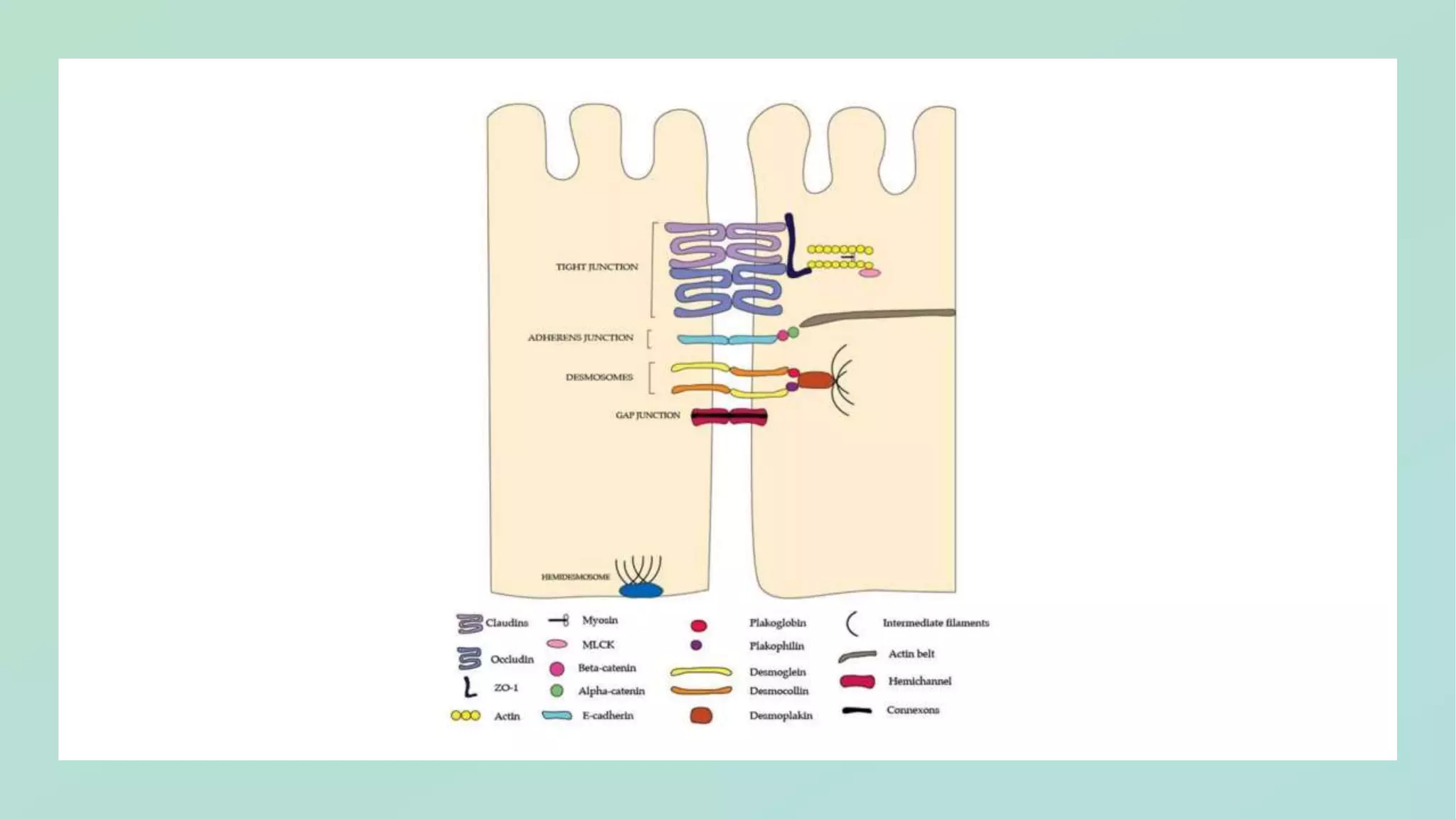
Tight junction complex
3.
PHYSIOLOGICAL ASPECTS /PROPERTIES OF GI TRACT
1)GASTRIC EMPTYING:
*Few drugs are absorbed from the stomach.
*Most of the drugs are retained in stomach temporarily,largely in solution, and
are progressively delivered to the small intestine where they are absorbed.*For
this reason gastric emptying is a critical factor in drug absorption.
*The emptying time of stomach through the pylorus is proportional to the volume
remaining in thestomach.
*This constitutes a first order process which can be characterized by a single
half-life value.
*The diferent type of food shows different values of gastric emptying time. The
order ofgastric emptying can be summarized as follows.
Carbohydrates < Proteins< Water< Lipids
Example: paracetamol absorption is rate limited due to gastric emptying.
4.
2)Intestinal transit time:
*Theintestinal transit rate also has a significant influence on the drug absorption, since it
determines the residence time of the drug in the absorption site.
*Increasing the rate of gastric emptying and gastro-intestinal motility increases the rate of
absorption of a drug but, for digoxin and riboflavin, increased gastrointestinal motility is
associated with a decrease in the rate of absorption.
*Since, intestine is the major site of absorption of most of the drugs, Long intestinal transit time is
desirable for the complete absorptionof drugs.Delayed intestinal transit is desirable for:
*Drugs that dissolve only in intestine (enteric coated)
*Drugs absorbed from specific sites in the intestine.
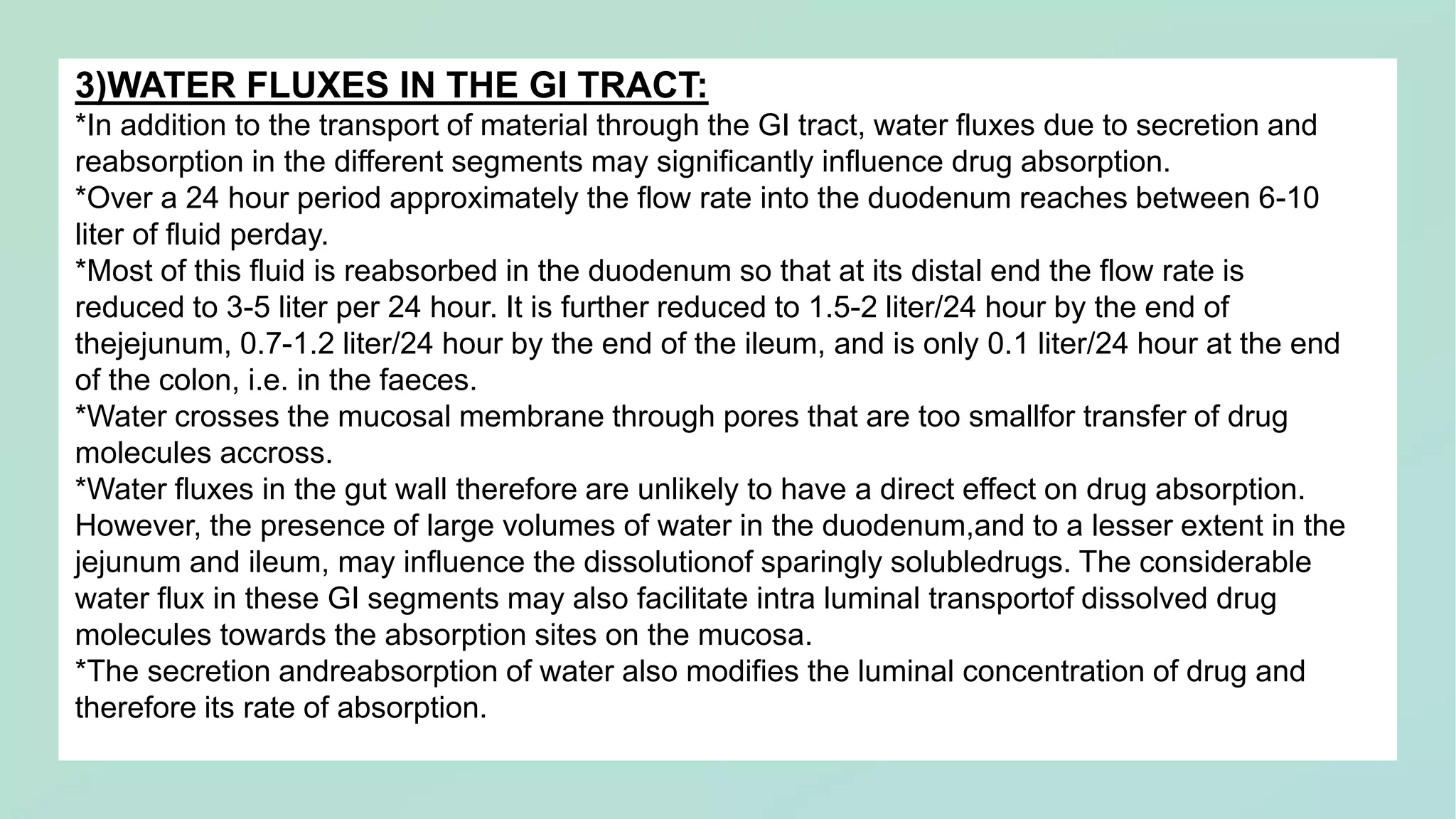
3)WATER FLUXES INTHE GI TRACT:
*In addition to the transport of material through the GI tract, water fluxes due to secretion and
reabsorption in the different segments may significantly influence drug absorption.
*Over a 24 hour period approximately the flow rate into the duodenum reaches between 6-10
liter of fluid perday.
*Most of this fluid is reabsorbed in the duodenum so that at its distal end the flow rate is
reduced to 3-5 liter per 24 hour. It is further reduced to 1.5-2 liter/24 hour by the end of
thejejunum, 0.7-1.2 liter/24 hour by the end of the ileum, and is only 0.1 liter/24 hour at the end
of the colon, i.e. in the faeces.
*Water crosses the mucosal membrane through pores that are too smallfor transfer of drug
molecules accross.
*Water fluxes in the gut wall therefore are unlikely to have a direct effect on drug absorption.
However, the presence of large volumes of water in the duodenum,and to a lesser extent in the
jejunum and ileum, may influence the dissolutionof sparingly solubledrugs. The considerable
water flux in these GI segments may also facilitate intra luminal transportof dissolved drug
molecules towards the absorption sites on the mucosa.
*The secretion andreabsorption of water also modifies the luminal concentration of drug and
therefore its rate of absorption.
7.
Permeability-Solubility-Charge State:
*According toFicks first law, passive diffusion of a solute is the product of
diffusivity and concentration gradient of the solute inside the membrane.
*The membrane/water apparent partition coefficient relates the latter internal
gradient to the external bulk- water concentration difference between the two
solutions separated by the membrane.
*For an ionizable molecule to permeate by passive diffusion
most efficiently, the molecule needs to be in its uncharged form at the membrane
surface.
*The amount of the uncharged form present at a given pH, which directly
contributes to the flux, depends on several important factors, such as pH, binding
to protein and bile acids, self-binding, and solubility.
* This theorydepends on some assumptions are as follows:-
i) The GIT is simple lipoidal barrier for transport of drug.
ii) Larger the fraction of unionized drug, faster the absorption
ii) Greater the lipophilicity of unionized drug, better the absorption.
a) Pka of drug:-
Amount of drug that exist in unionized form and in ionized form is a function of
pKa of drug & pH of the fluid at the absorption site and it can be determined by
Henderson-hesselbach equation:
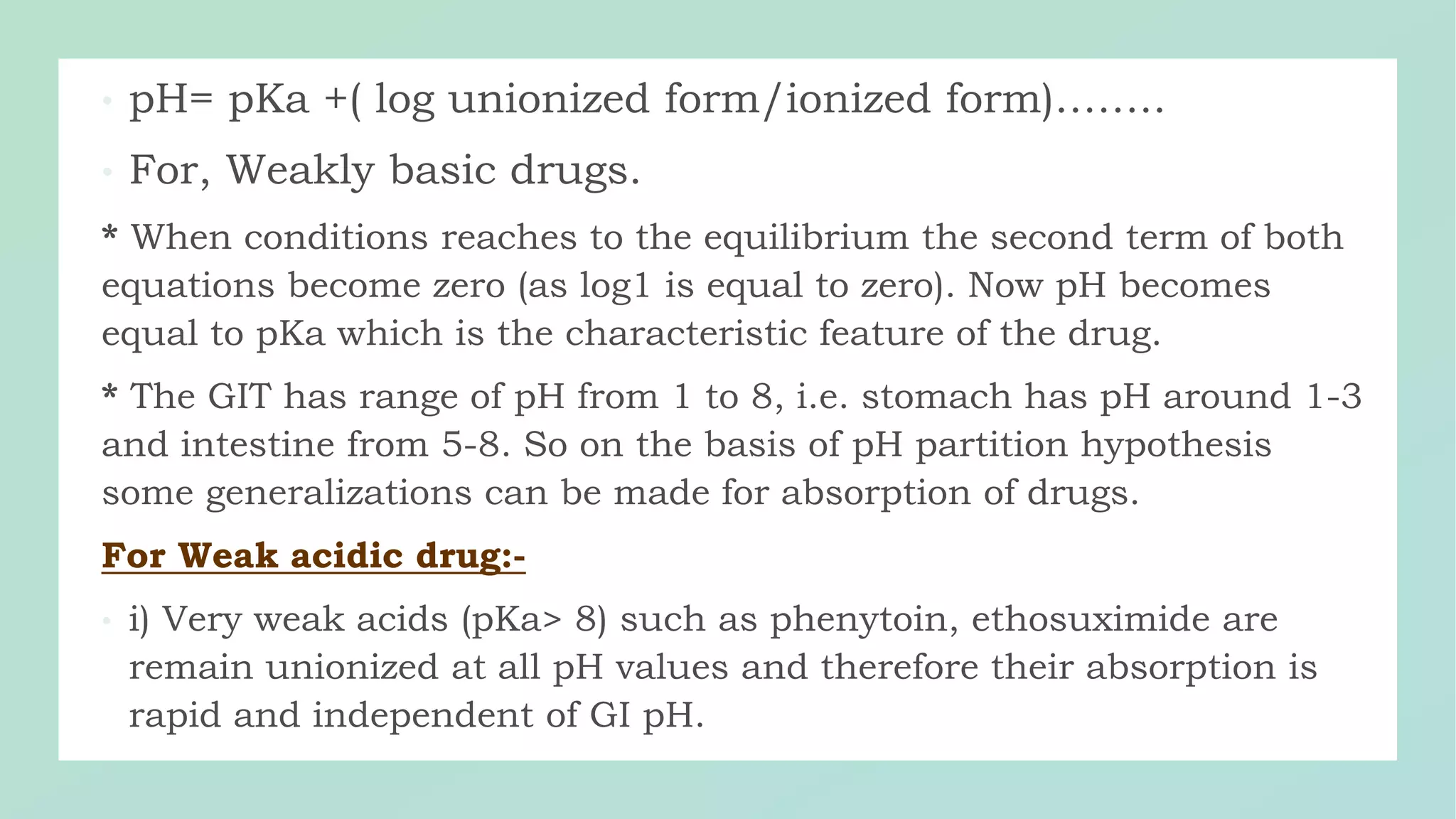
* pH = pKa + log [lionized form/ unionised form ]……….For, weakly acidic
drugs
ii)Acids in thepKa range 2.5 to 7 .5 are greatly affected by changes in pH and
therefore their absorption is pH-dependent; e.g. several NSAIDs like aspirin,
ibuprofen, phenylbutazone, and a number of penicillin analogs. Such drugs are
better absorbed from acidic conditions of stomach.
iii)Stronger acids with pKa < 2.5 such as cromolyn sodium are
ionized in the entire pH range of GIT and therefore remain poorly
absorbed.
For Basic drugs:
i) Very weak basesi (pKa< 5) such as caffeine, diazepam etc are remain non
ionized at all the ph values therefore their absorption is rapid and pH
independent.
ii)Bases in the pKa range 5 to 11.0 are greatly affected by changes in pH and
hence their absorption is pH-dependent; e.g. Several morphine analogs,
chloroquine, imipramine and amitriptyline. Such drugs are better absorbed from
the relatively alkaline conditions of the intestine
12.
Lipophilicity and DrugAbsorption
*As mentioned earlier, it is the pKa of a drug that determines the
degree of ionization at a particular pH and that only the unionized drug, if
sufficiently lipid soluble, is absorbed into the systemic circulation.
*Thus, even if ithe drug exists in the unionized form, it will be poorly absorbed if
it has poor lipid solubility (or low Ko/w).
*Ideally, for optimum absorption, drug should have sufficient aqueous solubility
to dissolve in the fluids at the absorption site and lipid solubility (Ko/w) high
enough to facilitate the partitioning of the drug in the lipoidal biomembrane and
into the systemic circulation.
* In other words, a perfect hydrophilic -lipophilic balance (HLB) should be there
in the structure of the drug for optimum bioavailability.
13.
*The lipid solubilityof a drug is determined from its oil/water partition coefficient
(K0/w) value.
*This value is a measure of the degree of distribution of drug between one of
the several organic, water immiscible,
lipophilic solvents such as n-octanol, etc. and an aqueous phase.
*In general, the octanol/pH 7.4, buffer partition coefficient value in the range of I
to 2 of a drug is sufficient for passive absorption across lipoidal membranes.
*In yet another study by Schanker on a series of barbituric acid derivatives
having .same pKa, the percent absorbed increased with an increase in the
partition coefficient of the drug.
*Thus, to enhance the bioavailability of a drug, not only its dissolution rate but
also its rate of permeability should be considered
15.
pH-absorption curve foracidic and basic drugs. Dotted lines
indicate curves predicted by pH-partition hypothesis
And bold lines indicate that practical curves.
16.
iv) In generalpH absorption curves are less steep then expected and are
shifted to higher pH values for acids and to lower pH values for bases.
I. Presence of virtual membrane pH
2. Absorption of ionized drug
3. Influence of GI surface area and residence time of drug
4. Presence of aqueous unstirred diffusion layer
The experimental pH-absorption curves are less steep and shift to the left
(lower pH values) for a basic drug and to the right (higher pH values) for an
acidic drug. This led to the suggestion that a virtual pH, also called as the
microclimate pH, different from the lumenal pH exists at the membrane
surface.
* The absorption of short-chain weak acids in the rat intestine, as a function
of pH, appears not to confirm to the pH-partition hypothesis
Ph MICROCLIMATE
17.
*Similar anomalies werefound with weak bases.
* The apparent pKa values observed in the absorption pH curve were
shifted to higher values for acid sand to lower values for bases,
compared with the true pKa values.
*Such deviations could be explained by the effect of an acid layer on
the apical side of cells, the so-called acid Ph microclimate.
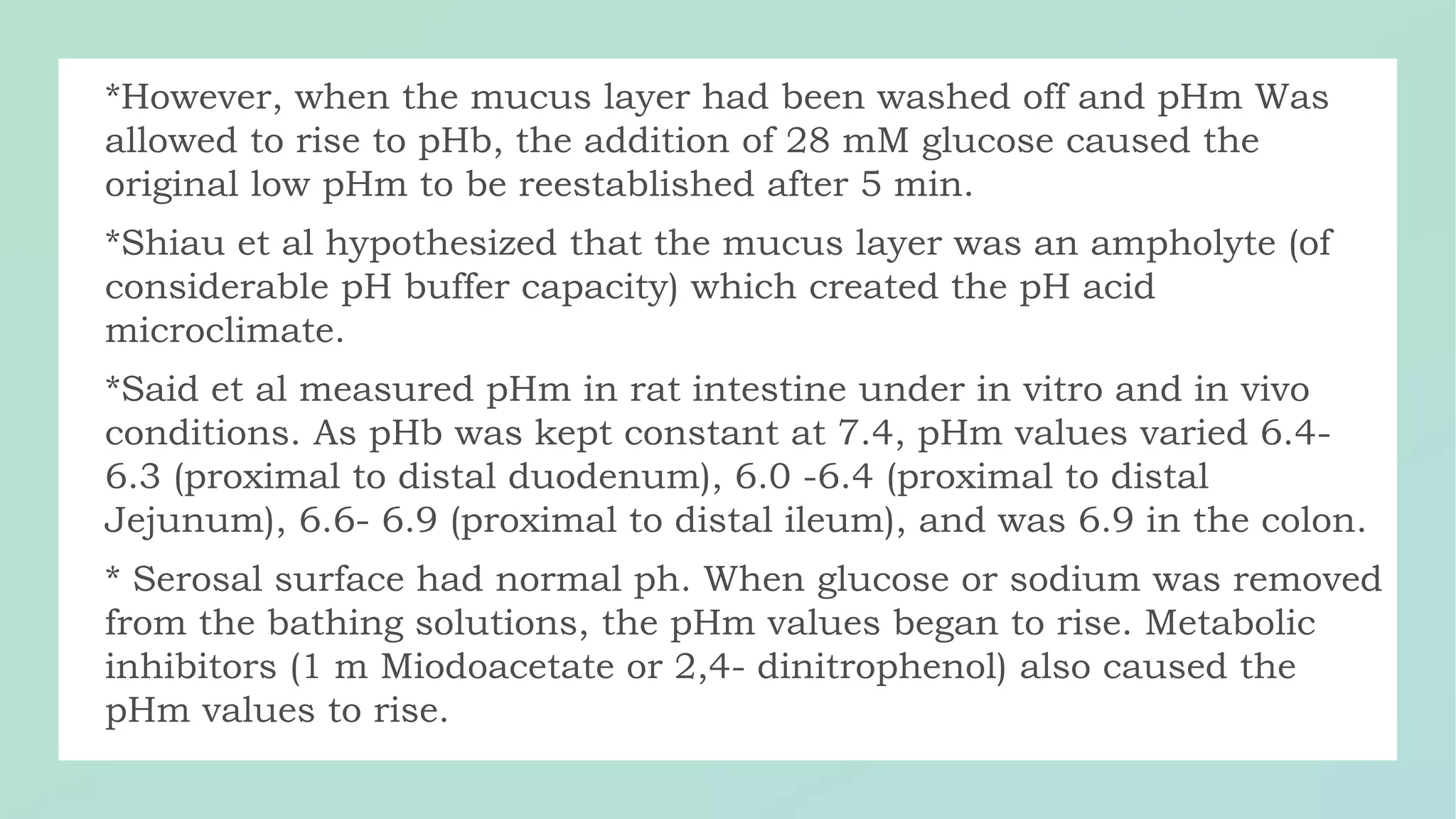
* Shiau et al directly measured the microclimate pH, pHm, to be 5.2 -
6.7 in different sections of the intestine (very reproducible values in a
given segment) covered with the normal mucus layer, as the luminal
(bulk) pH,pHb, was kept at 7.2.
*Good controls ruled out pH electrode artifacts. With the mucus layer
washed off, pHm rise from 5.4 to 7.2. Values of pHb as low as 3 and as
high as 10 remarkably did not affect values of pHm.
* Glucose did not affect pHm when the microclimate was established.