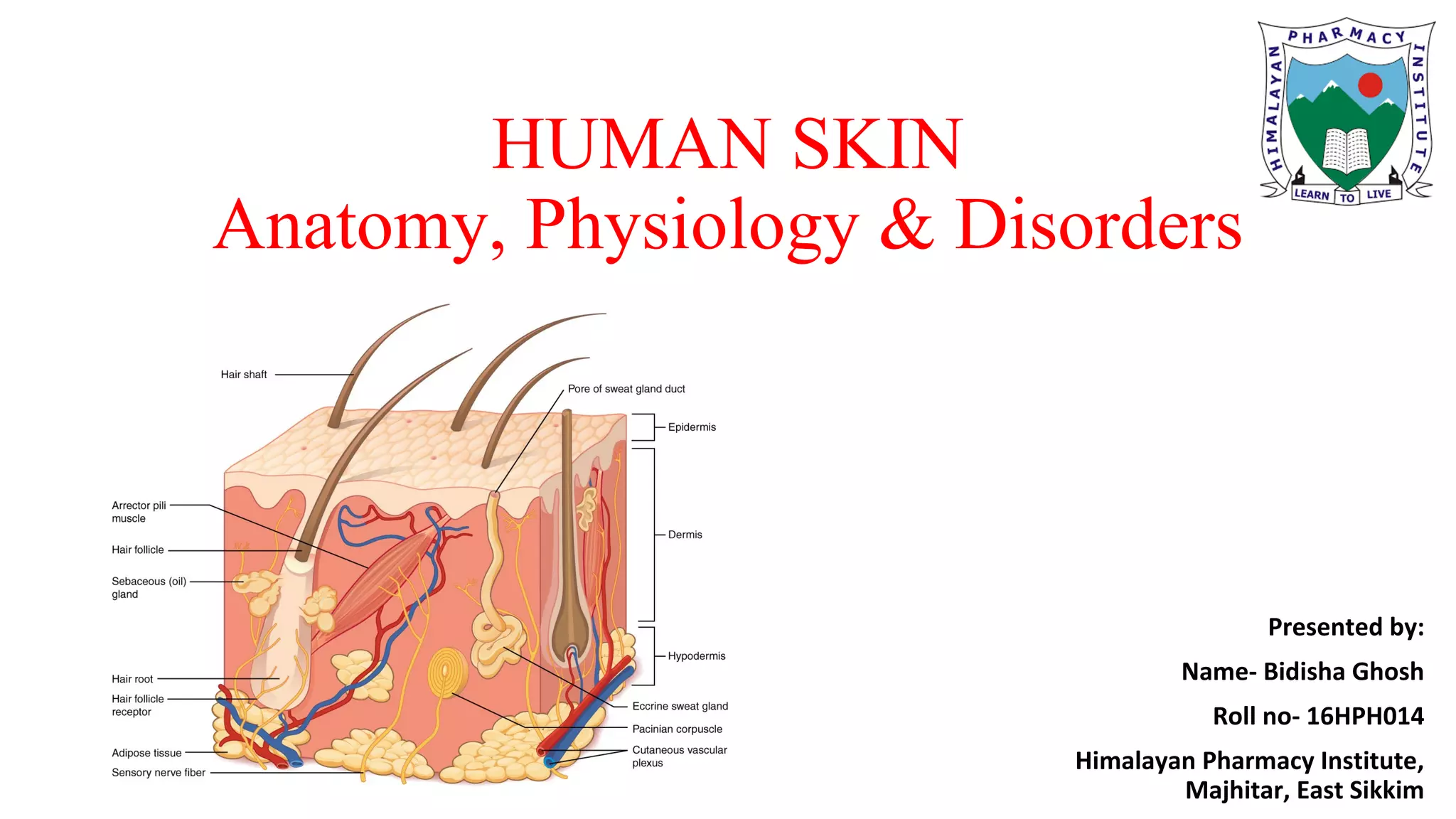
HUMAN SKIN
Anatomy, Physiology & Disorders
Presented by:
Name- Bidisha Ghosh
Roll no- 16HPH014
Himalayan Pharmacy Institute,
Majhitar, East Sikkim
Skin:
Its definition & functions
 The skin is the outermost protective covering.
 The functions of skin are:
1.controls loss of valuable fluids
2.prevents penetration of noxious foreign materials & radiation.
3.cushions against mechanical shock
4.regulates heat loss
5. transduces incoming stimuli &
6.Its colour, odour, & texture allows it to transmit social & sexual
signals.
Skin Components & its Functions
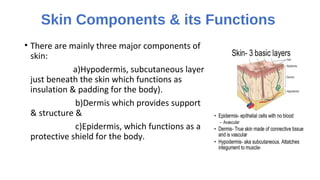
• There are mainly three major components of
skin:
a)Hypodermis, subcutaneous layer
just beneath the skin which functions as
insulation & padding for the body).
b)Dermis which provides support
& structure &
c)Epidermis, which functions as a
protective shield for the body.
Epidermis:
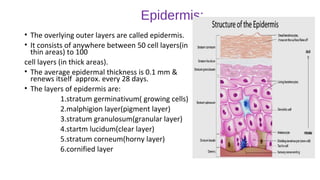
• The overlying outer layers are called epidermis.
• It consists of anywhere between 50 cell layers(in
thin areas) to 100
cell layers (in thick areas).
• The average epidermal thickness is 0.1 mm &
renews itself approx. every 28 days.
• The layers of epidermis are:
1.stratum germinativum( growing cells)
2.malphigion layer(pigment layer)
3.stratum granulosum(granular layer)
4.startm lucidum(clear layer)
5.stratum corneum(horny layer)
6.cornified layer
Stratum granulosum/basale
• Deepest layer of epidermis, single layer of cube shaped cells.
• New epidermal skin cells called keratinocytes are formed here through
cell division.
• Melanocytes are found in this layer which contains a skin pigment
called melanin which is photo protective & helps protect the skin
against ultraviolet radiation (sun exposure).
Stratum spinosum or Malphigion layer
• It is also called prickle cell layer.
• Composed of 7-8 layers of polygonal keratinocytes, where the
keratinocytes begin to become flattened.
Stratum granulosum
• Third layer of epidermis.
• Composed of 3-5 layers of flattened keratin.
• Cells die in this region as they remain far from the dermis to receive
nutrients.
Stratum Lucidum
• Present only in finger tips, palms & feet.
• 3-5 layers of extremely flattened cells.
Stratum Corneum
• Fifth layer or horny layer.
• Top, outermost layer of epidermis.
Consists of 25-30 layers of dead keratinocytes.
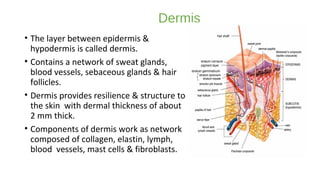
Dermis
• The layer between epidermis &
hypodermis is called dermis.
• Contains a network of sweat glands,
blood vessels, sebaceous glands & hair
follicles.
• Dermis provides resilience & structure to
the skin with dermal thickness of about
2 mm thick.
• Components of dermis work as network
composed of collagen, elastin, lymph,
blood vessels, mast cells & fibroblasts.
• The most common structural component within the dermis is the
protein collagen which gives the strength & flexibility of the skin.
• Blood vessels help in thermoregulation of the body by constricting or
dilating to conserve or release heat. They also aid in immune function
& provide oxygen & nutrients to the lower layers of the epidermis.
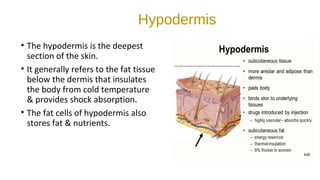
Hypodermis
• The hypodermis is the deepest
section of the skin.
• It generally refers to the fat tissue
below the dermis that insulates
the body from cold temperature
& provides shock absorption.
• The fat cells of hypodermis also
stores fat & nutrients.
Disorders of Skin
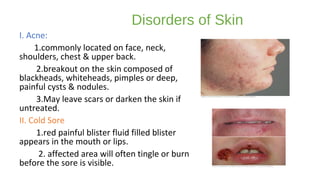
I. Acne:
1.commonly located on face, neck,
shoulders, chest & upper back.
2.breakout on the skin composed of
blackheads, whiteheads, pimples or deep,
painful cysts & nodules.
3.May leave scars or darken the skin if
untreated.
II. Cold Sore
1.red painful blister fluid filled blister
appears in the mouth or lips.
2. affected area will often tingle or burn
before the sore is visible.
3.outbreaks may also be accompanied by
mild, flu like symptoms such as low fever,
body aches & swollen lymph nodes.
III. Blister
1.Characterized by watery, clear, fluid
filled areas on skin.
2.May be smaller than 1 cm(vesicle) or
larger than 1 cm(bulla) & occur alone or in
groups.
3.can be found anywhere on the body.
IV. Hives
1. itchy, raised welts that occurs after
exposure to an allergen.
2.red, warm & mildly painful to the
touch.
3. can be small, round & ring shaped or
large & randomly shaped.
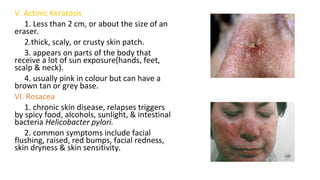
V. Actinic Keratosis
1. Less than 2 cm, or about the size of an
eraser.
2.thick, scaly, or crusty skin patch.
3. appears on parts of the body that
receive a lot of sun exposure(hands, feet,
scalp & neck).
4. usually pink in colour but can have a
brown tan or grey base.
VI. Rosacea
1. chronic skin disease, relapses triggers
by spicy food, alcohols, sunlight, & intestinal
bacteria Helicobacter pylori.
2. common symptoms include facial
flushing, raised, red bumps, facial redness,
skin dryness & skin sensitivity.
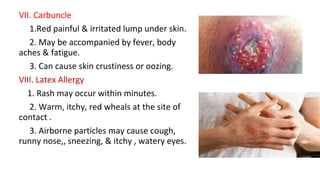
VII. Carbuncle
1.Red painful & irritated lump under skin.
2. May be accompanied by fever, body
aches & fatigue.
3. Can cause skin crustiness or oozing.
VIII. Latex Allergy
1. Rash may occur within minutes.
2. Warm, itchy, red wheals at the site of
contact .
3. Airborne particles may cause cough,
runny nose,, sneezing, & itchy , watery eyes.
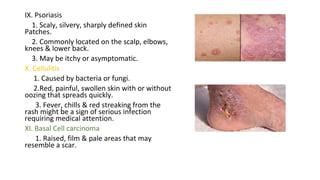
IX. Psoriasis
1. Scaly, silvery, sharply defined skin
Patches.
2. Commonly located on the scalp, elbows,
knees & lower back.
3. May be itchy or asymptomatic.
X. Cellulitis
1. Caused by bacteria or fungi.
2.Red, painful, swollen skin with or without
oozing that spreads quickly.
3. Fever, chills & red streaking from the
rash might be a sign of serious infection
requiring medical attention.
XI. Basal Cell carcinoma
1. Raised, film & pale areas that may
resemble a scar.
2.Dome like pink or red, shiny & pearly
areas that may have a sunk in centre, like a
crater.
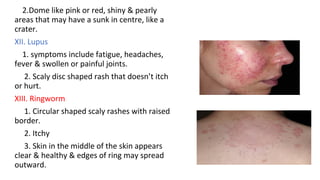
XII. Lupus
1. symptoms include fatigue, headaches,
fever & swollen or painful joints.
2. Scaly disc shaped rash that doesn’t itch
or hurt.
XIII. Ringworm
1. Circular shaped scaly rashes with raised
border.
2. Itchy
3. Skin in the middle of the skin appears
clear & healthy & edges of ring may spread
outward.
XIV. Measles
1. Symptoms include fever, sore throat, red &
watery eyes, loss of appetite, cough & runny nose.
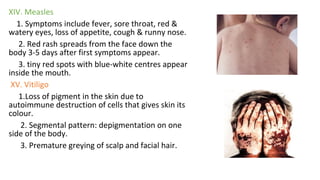
2. Red rash spreads from the face down the
body 3-5 days after first symptoms appear.
3. tiny red spots with blue-white centres appear
inside the mouth.
XV. Vitiligo
1.Loss of pigment in the skin due to
autoimmune destruction of cells that gives skin its
colour.
2. Segmental pattern: depigmentation on one
side of the body.
3. Premature greying of scalp and facial hair.
Treating Skin Disorders
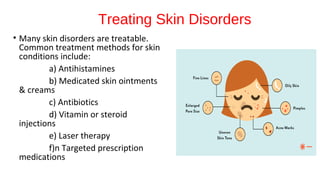
• Many skin disorders are treatable.
Common treatment methods for skin
conditions include:
a) Antihistamines
b) Medicated skin ointments
& creams
c) Antibiotics
d) Vitamin or steroid
injections
e) Laser therapy
f)n Targeted prescription
medications
Skin structure function and disease

Skin structure function and disease

  • 1.
    HUMAN SKIN Anatomy, Physiology& Disorders Presented by: Name- Bidisha Ghosh Roll no- 16HPH014 Himalayan Pharmacy Institute, Majhitar, East Sikkim
  • 2.
    Skin: Its definition &functions  The skin is the outermost protective covering.  The functions of skin are: 1.controls loss of valuable fluids 2.prevents penetration of noxious foreign materials & radiation. 3.cushions against mechanical shock 4.regulates heat loss 5. transduces incoming stimuli & 6.Its colour, odour, & texture allows it to transmit social & sexual signals.
  • 3.
    Skin Components &its Functions • There are mainly three major components of skin: a)Hypodermis, subcutaneous layer just beneath the skin which functions as insulation & padding for the body). b)Dermis which provides support & structure & c)Epidermis, which functions as a protective shield for the body.
  • 4.
    Epidermis: • The overlyingouter layers are called epidermis. • It consists of anywhere between 50 cell layers(in thin areas) to 100 cell layers (in thick areas). • The average epidermal thickness is 0.1 mm & renews itself approx. every 28 days. • The layers of epidermis are: 1.stratum germinativum( growing cells) 2.malphigion layer(pigment layer) 3.stratum granulosum(granular layer) 4.startm lucidum(clear layer) 5.stratum corneum(horny layer) 6.cornified layer
  • 5.
    Stratum granulosum/basale • Deepestlayer of epidermis, single layer of cube shaped cells. • New epidermal skin cells called keratinocytes are formed here through cell division. • Melanocytes are found in this layer which contains a skin pigment called melanin which is photo protective & helps protect the skin against ultraviolet radiation (sun exposure). Stratum spinosum or Malphigion layer • It is also called prickle cell layer. • Composed of 7-8 layers of polygonal keratinocytes, where the keratinocytes begin to become flattened. Stratum granulosum • Third layer of epidermis.
  • 6.
    • Composed of3-5 layers of flattened keratin. • Cells die in this region as they remain far from the dermis to receive nutrients. Stratum Lucidum • Present only in finger tips, palms & feet. • 3-5 layers of extremely flattened cells. Stratum Corneum • Fifth layer or horny layer. • Top, outermost layer of epidermis. Consists of 25-30 layers of dead keratinocytes.
  • 7.
    Dermis • The layerbetween epidermis & hypodermis is called dermis. • Contains a network of sweat glands, blood vessels, sebaceous glands & hair follicles. • Dermis provides resilience & structure to the skin with dermal thickness of about 2 mm thick. • Components of dermis work as network composed of collagen, elastin, lymph, blood vessels, mast cells & fibroblasts.
  • 8.
    • The mostcommon structural component within the dermis is the protein collagen which gives the strength & flexibility of the skin. • Blood vessels help in thermoregulation of the body by constricting or dilating to conserve or release heat. They also aid in immune function & provide oxygen & nutrients to the lower layers of the epidermis.
  • 9.
    Hypodermis • The hypodermisis the deepest section of the skin. • It generally refers to the fat tissue below the dermis that insulates the body from cold temperature & provides shock absorption. • The fat cells of hypodermis also stores fat & nutrients.
  • 10.
    Disorders of Skin I.Acne: 1.commonly located on face, neck, shoulders, chest & upper back. 2.breakout on the skin composed of blackheads, whiteheads, pimples or deep, painful cysts & nodules. 3.May leave scars or darken the skin if untreated. II. Cold Sore 1.red painful blister fluid filled blister appears in the mouth or lips. 2. affected area will often tingle or burn before the sore is visible.
  • 11.
    3.outbreaks may alsobe accompanied by mild, flu like symptoms such as low fever, body aches & swollen lymph nodes. III. Blister 1.Characterized by watery, clear, fluid filled areas on skin. 2.May be smaller than 1 cm(vesicle) or larger than 1 cm(bulla) & occur alone or in groups. 3.can be found anywhere on the body. IV. Hives 1. itchy, raised welts that occurs after exposure to an allergen. 2.red, warm & mildly painful to the touch. 3. can be small, round & ring shaped or large & randomly shaped.
  • 12.
    V. Actinic Keratosis 1.Less than 2 cm, or about the size of an eraser. 2.thick, scaly, or crusty skin patch. 3. appears on parts of the body that receive a lot of sun exposure(hands, feet, scalp & neck). 4. usually pink in colour but can have a brown tan or grey base. VI. Rosacea 1. chronic skin disease, relapses triggers by spicy food, alcohols, sunlight, & intestinal bacteria Helicobacter pylori. 2. common symptoms include facial flushing, raised, red bumps, facial redness, skin dryness & skin sensitivity.
  • 13.
    VII. Carbuncle 1.Red painful& irritated lump under skin. 2. May be accompanied by fever, body aches & fatigue. 3. Can cause skin crustiness or oozing. VIII. Latex Allergy 1. Rash may occur within minutes. 2. Warm, itchy, red wheals at the site of contact . 3. Airborne particles may cause cough, runny nose,, sneezing, & itchy , watery eyes.
  • 14.
    IX. Psoriasis 1. Scaly,silvery, sharply defined skin Patches. 2. Commonly located on the scalp, elbows, knees & lower back. 3. May be itchy or asymptomatic. X. Cellulitis 1. Caused by bacteria or fungi. 2.Red, painful, swollen skin with or without oozing that spreads quickly. 3. Fever, chills & red streaking from the rash might be a sign of serious infection requiring medical attention. XI. Basal Cell carcinoma 1. Raised, film & pale areas that may resemble a scar.
  • 15.
    2.Dome like pinkor red, shiny & pearly areas that may have a sunk in centre, like a crater. XII. Lupus 1. symptoms include fatigue, headaches, fever & swollen or painful joints. 2. Scaly disc shaped rash that doesn’t itch or hurt. XIII. Ringworm 1. Circular shaped scaly rashes with raised border. 2. Itchy 3. Skin in the middle of the skin appears clear & healthy & edges of ring may spread outward.
  • 16.
    XIV. Measles 1. Symptomsinclude fever, sore throat, red & watery eyes, loss of appetite, cough & runny nose. 2. Red rash spreads from the face down the body 3-5 days after first symptoms appear. 3. tiny red spots with blue-white centres appear inside the mouth. XV. Vitiligo 1.Loss of pigment in the skin due to autoimmune destruction of cells that gives skin its colour. 2. Segmental pattern: depigmentation on one side of the body. 3. Premature greying of scalp and facial hair.
  • 17.
    Treating Skin Disorders •Many skin disorders are treatable. Common treatment methods for skin conditions include: a) Antihistamines b) Medicated skin ointments & creams c) Antibiotics d) Vitamin or steroid injections e) Laser therapy f)n Targeted prescription medications