DISSOLUTION
PRESENTED BY,
PAYEL MUKHERJEE
M.PHARM , PHARMACEUTICS
CONTENTS
 INTRODUCTION
 RATE OF DISSOLUTION
 MECHANISM OF DISSOLUTION
 THEORIES OF DISSOLUTION
 FACTORS AFFECTING THE RATE OF DISSOLUTION
 APPARATUS
 CONCLUSION
 REFERENCE
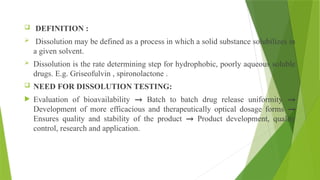
 DEFINITION :
 Dissolution may be defined as a process in which a solid substance solubilizes in
a given solvent.
 Dissolution is the rate determining step for hydrophobic, poorly aqueous soluble
drugs. E.g. Griseofulvin , spironolactone .
 NEED FOR DISSOLUTION TESTING:
 Evaluation of bioavailability → Batch to batch drug release uniformity →
Development of more efficacious and therapeutically optical dosage forms →
Ensures quality and stability of the product → Product development, quality
control, research and application.
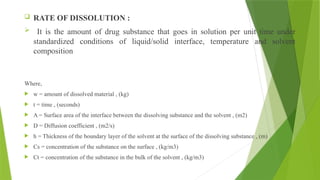
 RATE OF DISSOLUTION :
 It is the amount of drug substance that goes in solution per unit time under
standardized conditions of liquid/solid interface, temperature and solvent
composition
Where,
 w = amount of dissolved material , (kg)
 t = time , (seconds)
 A = Surface area of the interface between the dissolving substance and the solvent , (m2)
 D = Diffusion coefficient , (m2/s)
 h = Thickness of the boundary layer of the solvent at the surface of the dissolving substance , (m)
 Cs = concentration of the substance on the surface , (kg/m3)
 Ct = concentration of the substance in the bulk of the solvent , (kg/m3)
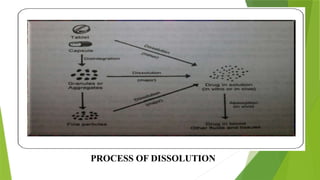
PROCESS OF DISSOLUTION
MECHANISM OF DISSOLUTION
Dissolution test determines the cumulative amount of drug that goes into solution as
a function of time.
 Steps involved: liberation of the solute or drug from the formulation matrix
(disintegration)
 Dissolution of the drug (solubilization of the drug particles) in the liquid medium
 The overall rate of dissolution depends on the slower of these two steps :
 First Step : Cohesive properties of the formulated solid dosage form of the drug
play a key role in disintegration and erosion. If the first step of dissolution is rate-
limiting, then the rate of dissolution is considered to be disintegration controlled.
 Second Step : Solubilization of the drug particles depends on the
physicochemical properties of the drug such as its chemical form (e.g., salt, free
acid, free base) and physical attributes.
THEORIES OF DISSOLUTION :
1. Diffusion Layer Model (Film Theory)
2. Danckwert’s Model (Surface Renewal Theory)
3. Interfacial Barrier Model (Limited Solvation Theory)
1. DIFFUSION LAYER MODEL :
 Also called ‘film theory’.
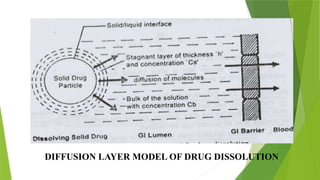
 Formation of a thin film at the interface, called as stagnant layer…
 2 steps are generally involved:
I. Interaction of solvent with drug surface to form a saturated drug layer , called stagnant layer.
II. Diffusion of drug molecules from stagnant layer into bulk of the system.
DIFFUSION LAYER MODEL OF DRUG DISSOLUTION
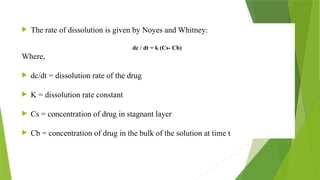
 The rate of dissolution is given by Noyes and Whitney:
dc / dt = k (Cs- Cb)
Where,
 dc/dt = dissolution rate of the drug
 K = dissolution rate constant
 Cs = concentration of drug in stagnant layer
 Cb = concentration of drug in the bulk of the solution at time t
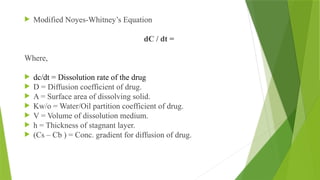
 Modified Noyes-Whitney’s Equation
dC / dt =
Where,
 dc/dt = Dissolution rate of the drug
 D = Diffusion coefficient of drug.
 A = Surface area of dissolving solid.
 Kw/o = Water/Oil partition coefficient of drug.
 V = Volume of dissolution medium.
 h = Thickness of stagnant layer.
 (Cs – Cb ) = Conc. gradient for diffusion of drug.
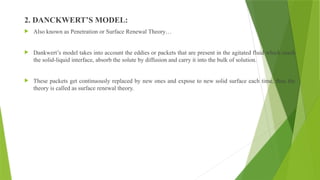
2. DANCKWERT’S MODEL:
 Also known as Penetration or Surface Renewal Theory…
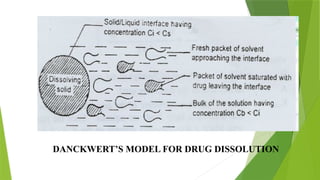
 Dankwert’s model takes into account the eddies or packets that are present in the agitated fluid which reach
the solid-liquid interface, absorb the solute by diffusion and carry it into the bulk of solution.
 These packets get continuously replaced by new ones and expose to new solid surface each time, thus the
theory is called as surface renewal theory.
DANCKWERT’S MODEL FOR DRUG DISSOLUTION
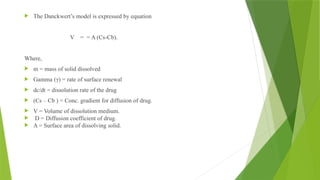
 The Danckwert’s model is expressed by equation
V = = A (Cs-Cb).
Where,
 m = mass of solid dissolved
 Gamma (γ) = rate of surface renewal
 dc/dt = dissolution rate of the drug
 (Cs – Cb ) = Conc. gradient for diffusion of drug.
 V = Volume of dissolution medium.
 D = Diffusion coefficient of drug.
 A = Surface area of dissolving solid.
3. INTERFACIAL BARRIER MODEL/DOUBLE BARRIER :
 Also known as Limited Solvation Theory
 The Diffusion layer model and the Dankwert’s model were based on two assumptions:
1) The rate determining step that controls dissolution is the mass transport.
2) Solid solution equilibrium is achieved at the solid/liquid interface.
 According to interfacial barrier model, an intermediate concentration can exist at the interface as a result of
solvation mechanism and is a function of solubility rather than diffusion.
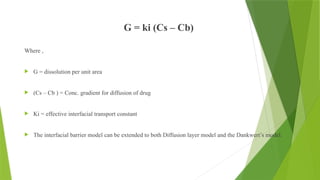
G = ki (Cs – Cb)
Where ,
 G = dissolution per unit area
 (Cs – Cb ) = Conc. gradient for diffusion of drug
 Ki = effective interfacial transport constant
 The interfacial barrier model can be extended to both Diffusion layer model and the Dankwert’s model.
FACTORS AFFECTING DISSOLUTION RATE:
1. Factors related to Physicochemical Properties of Drug
2. Factors related to Drug Product Formulation
3. Factors Relating Dissolution Test Parameters
1. PHYSICOCHEMICAL PROPERTIES OF DRUG:
I. Particle Size:
 Surface area increases with decrease in particle size, higher dissolution rates
may be achieved through reduction of particle size.
II. Solubility:
 Minimum aqueous solubility of 1% is required to avoid potential solubility
limited absorption problems.
 Studies on several compound of different chemical classes and a wide range of
solubility revealed that initial dissolution rate of these substances is directly
proportional to their respective solubility.
III. Solvates And Hydrates:
 A solvate is a molecular complex that has incorporated the crystallizing solvent
molecules into specific sites within the crystal lattice.
 If the solvent is water, it is called a hydrate.
 Anhydrous compounds are highly soluble than hydrate.
IV. Salt Formation :
 It is one of the common approaches used to increase drug solubility and
dissolution rate.
 It has always been assumed that sodium salts dissolve faster than their
corresponding insoluble acids.
V. pH EFFECT:
 The solubility of a weak acidic drug or weak basic drug is influenced by the pH of the fluid.
 Therefore, differences are expected in the solubility and the dissolution rate of such drugs in
different regions of the GIT.
 Rate of dissolution is increases while increasing the pH solution.
VI. Polymorphism And Amorphism:
 When a substance exists in more than one crystalline form, the different forms are designated as
polymorphs and the phenomenon as Polymorphism.
 Stable polymorphs has lower energy state, higher Melting point and least aqueous solubility.
 Metastable polymorphs has higher energy state, lower Melting point and higher aqueous
solubility.
2. FACTORS RELATED TO DRUG PRODUCT FORMULATION
I. Binders:
 The hydrophilic binders like gelatin increase dissolution rate of poorly wettable drug.
 Non aqueous binders such as ethyl cellulose retard the drug dissolution.
II. Disintegrants:
 Disintegrating agent added before & after the granulation affects the dissolution rate.
 Microcrystalline cellulose is a very good disintegrating agent but at high compression
force, it may retard drug dissolution.
III. Effect Of Lubricants:
 Lubricants are hydrophobic in nature (metallic stearates) and prolong the tablet
disintegration time by forming water repellent coat around individual granules. This
retarding the rate of dissolution of solid dosage forms.
 Both amount and method of addition affect the property. It should be added in small amount
(1% or less) and should be tumbled or mixed gently for only very short time. Prolonged
mixing affect the dissolution time.
IV. Surfactants:
 They enhance the dissolution rate of poorly soluble drug. This is due to lowering of
interfacial tension, increasing effective surface area, which in turn results in faster
dissolution rate.
3. FACTORS RELATING DISSOLUTION TEST PARAMETERS
I. Temperature:
 Drug solubility is temperature dependent, therefore careful temperature control during
dissolution process is extremely important. Generally, a temperature of 37º ± 0.5 is
maintained during dissolution.
II. pH Of Dissolution Medium:
 Weak acids, dissolution rate increases with increase in pH where as for weak bases,
increase with decrease in pH.
III. Vibration:
 The excessive vibration of dissolution apparatus increases dissolution rates.
IV. Vessel Design And Construction:
 Plastic vessels provide more perfect hemisphere than glass vessels.
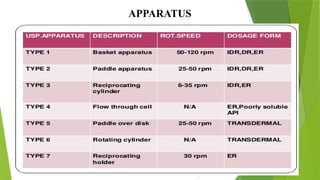
APPARATUS
CONCLUSION
 By studying various factors influencing the rate of dissolution, we can optimize the different properties of
the formulation.
 By conducting dissolution studies we can know the batch to batch reproducibility.
 We can estimate the solubility profiles of the drug.
 The best available tool today which can at least quantitatively assure about the biological availability of
drug from its formulation is its in-vitro dissolution.
REFERENCES
1. Aulton M.E. Pharmaceutics “The Science of Dosage Form Design”, 2nd Ed.; Churchill
Livingstone.
2. D.M. Brahmankar “Biopharmaceutics and Pharmacokinetics a Treatise”
3. Venkateshwarlu “Biopharmaceutics and Pharmaceutics”, 2nd Ed. Leon Shargel “Applied
Biopharmaceutics and Pharmacokinetics”,5th Edition.
4. The Science And Practice of Pharmacy by REMINGTON , 21 st Edition
5. C.V.S. Subrahmanyam “Biopharmaceutics and pharmacokinetics”, -concepts and applications.
THANK YOU

DISSOLUTION FOR TABLET CAPSULE DOSAGE FORM

  • 1.
  • 2.
    CONTENTS  INTRODUCTION  RATEOF DISSOLUTION  MECHANISM OF DISSOLUTION  THEORIES OF DISSOLUTION  FACTORS AFFECTING THE RATE OF DISSOLUTION  APPARATUS  CONCLUSION  REFERENCE
  • 3.
     DEFINITION : Dissolution may be defined as a process in which a solid substance solubilizes in a given solvent.  Dissolution is the rate determining step for hydrophobic, poorly aqueous soluble drugs. E.g. Griseofulvin , spironolactone .  NEED FOR DISSOLUTION TESTING:  Evaluation of bioavailability → Batch to batch drug release uniformity → Development of more efficacious and therapeutically optical dosage forms → Ensures quality and stability of the product → Product development, quality control, research and application.
  • 4.
     RATE OFDISSOLUTION :  It is the amount of drug substance that goes in solution per unit time under standardized conditions of liquid/solid interface, temperature and solvent composition Where,  w = amount of dissolved material , (kg)  t = time , (seconds)  A = Surface area of the interface between the dissolving substance and the solvent , (m2)  D = Diffusion coefficient , (m2/s)  h = Thickness of the boundary layer of the solvent at the surface of the dissolving substance , (m)  Cs = concentration of the substance on the surface , (kg/m3)  Ct = concentration of the substance in the bulk of the solvent , (kg/m3)
  • 5.
  • 6.
    MECHANISM OF DISSOLUTION Dissolutiontest determines the cumulative amount of drug that goes into solution as a function of time.  Steps involved: liberation of the solute or drug from the formulation matrix (disintegration)  Dissolution of the drug (solubilization of the drug particles) in the liquid medium  The overall rate of dissolution depends on the slower of these two steps :  First Step : Cohesive properties of the formulated solid dosage form of the drug play a key role in disintegration and erosion. If the first step of dissolution is rate- limiting, then the rate of dissolution is considered to be disintegration controlled.  Second Step : Solubilization of the drug particles depends on the physicochemical properties of the drug such as its chemical form (e.g., salt, free acid, free base) and physical attributes.
  • 7.
    THEORIES OF DISSOLUTION: 1. Diffusion Layer Model (Film Theory) 2. Danckwert’s Model (Surface Renewal Theory) 3. Interfacial Barrier Model (Limited Solvation Theory)
  • 8.
    1. DIFFUSION LAYERMODEL :  Also called ‘film theory’.  Formation of a thin film at the interface, called as stagnant layer…  2 steps are generally involved: I. Interaction of solvent with drug surface to form a saturated drug layer , called stagnant layer. II. Diffusion of drug molecules from stagnant layer into bulk of the system.
  • 9.
    DIFFUSION LAYER MODELOF DRUG DISSOLUTION
  • 10.
     The rateof dissolution is given by Noyes and Whitney: dc / dt = k (Cs- Cb) Where,  dc/dt = dissolution rate of the drug  K = dissolution rate constant  Cs = concentration of drug in stagnant layer  Cb = concentration of drug in the bulk of the solution at time t
  • 11.
     Modified Noyes-Whitney’sEquation dC / dt = Where,  dc/dt = Dissolution rate of the drug  D = Diffusion coefficient of drug.  A = Surface area of dissolving solid.  Kw/o = Water/Oil partition coefficient of drug.  V = Volume of dissolution medium.  h = Thickness of stagnant layer.  (Cs – Cb ) = Conc. gradient for diffusion of drug.
  • 12.
    2. DANCKWERT’S MODEL: Also known as Penetration or Surface Renewal Theory…  Dankwert’s model takes into account the eddies or packets that are present in the agitated fluid which reach the solid-liquid interface, absorb the solute by diffusion and carry it into the bulk of solution.  These packets get continuously replaced by new ones and expose to new solid surface each time, thus the theory is called as surface renewal theory.
  • 13.
    DANCKWERT’S MODEL FORDRUG DISSOLUTION
  • 14.
     The Danckwert’smodel is expressed by equation V = = A (Cs-Cb). Where,  m = mass of solid dissolved  Gamma (γ) = rate of surface renewal  dc/dt = dissolution rate of the drug  (Cs – Cb ) = Conc. gradient for diffusion of drug.  V = Volume of dissolution medium.  D = Diffusion coefficient of drug.  A = Surface area of dissolving solid.
  • 15.
    3. INTERFACIAL BARRIERMODEL/DOUBLE BARRIER :  Also known as Limited Solvation Theory  The Diffusion layer model and the Dankwert’s model were based on two assumptions: 1) The rate determining step that controls dissolution is the mass transport. 2) Solid solution equilibrium is achieved at the solid/liquid interface.  According to interfacial barrier model, an intermediate concentration can exist at the interface as a result of solvation mechanism and is a function of solubility rather than diffusion.
  • 16.
    G = ki(Cs – Cb) Where ,  G = dissolution per unit area  (Cs – Cb ) = Conc. gradient for diffusion of drug  Ki = effective interfacial transport constant  The interfacial barrier model can be extended to both Diffusion layer model and the Dankwert’s model.
  • 17.
    FACTORS AFFECTING DISSOLUTIONRATE: 1. Factors related to Physicochemical Properties of Drug 2. Factors related to Drug Product Formulation 3. Factors Relating Dissolution Test Parameters
  • 18.
    1. PHYSICOCHEMICAL PROPERTIESOF DRUG: I. Particle Size:  Surface area increases with decrease in particle size, higher dissolution rates may be achieved through reduction of particle size. II. Solubility:  Minimum aqueous solubility of 1% is required to avoid potential solubility limited absorption problems.  Studies on several compound of different chemical classes and a wide range of solubility revealed that initial dissolution rate of these substances is directly proportional to their respective solubility.
  • 19.
    III. Solvates AndHydrates:  A solvate is a molecular complex that has incorporated the crystallizing solvent molecules into specific sites within the crystal lattice.  If the solvent is water, it is called a hydrate.  Anhydrous compounds are highly soluble than hydrate. IV. Salt Formation :  It is one of the common approaches used to increase drug solubility and dissolution rate.  It has always been assumed that sodium salts dissolve faster than their corresponding insoluble acids.
  • 20.
    V. pH EFFECT: The solubility of a weak acidic drug or weak basic drug is influenced by the pH of the fluid.  Therefore, differences are expected in the solubility and the dissolution rate of such drugs in different regions of the GIT.  Rate of dissolution is increases while increasing the pH solution. VI. Polymorphism And Amorphism:  When a substance exists in more than one crystalline form, the different forms are designated as polymorphs and the phenomenon as Polymorphism.  Stable polymorphs has lower energy state, higher Melting point and least aqueous solubility.  Metastable polymorphs has higher energy state, lower Melting point and higher aqueous solubility.
  • 21.
    2. FACTORS RELATEDTO DRUG PRODUCT FORMULATION I. Binders:  The hydrophilic binders like gelatin increase dissolution rate of poorly wettable drug.  Non aqueous binders such as ethyl cellulose retard the drug dissolution. II. Disintegrants:  Disintegrating agent added before & after the granulation affects the dissolution rate.  Microcrystalline cellulose is a very good disintegrating agent but at high compression force, it may retard drug dissolution.
  • 22.
    III. Effect OfLubricants:  Lubricants are hydrophobic in nature (metallic stearates) and prolong the tablet disintegration time by forming water repellent coat around individual granules. This retarding the rate of dissolution of solid dosage forms.  Both amount and method of addition affect the property. It should be added in small amount (1% or less) and should be tumbled or mixed gently for only very short time. Prolonged mixing affect the dissolution time. IV. Surfactants:  They enhance the dissolution rate of poorly soluble drug. This is due to lowering of interfacial tension, increasing effective surface area, which in turn results in faster dissolution rate.
  • 23.
    3. FACTORS RELATINGDISSOLUTION TEST PARAMETERS I. Temperature:  Drug solubility is temperature dependent, therefore careful temperature control during dissolution process is extremely important. Generally, a temperature of 37º ± 0.5 is maintained during dissolution. II. pH Of Dissolution Medium:  Weak acids, dissolution rate increases with increase in pH where as for weak bases, increase with decrease in pH. III. Vibration:  The excessive vibration of dissolution apparatus increases dissolution rates. IV. Vessel Design And Construction:  Plastic vessels provide more perfect hemisphere than glass vessels.
  • 24.
  • 25.
    CONCLUSION  By studyingvarious factors influencing the rate of dissolution, we can optimize the different properties of the formulation.  By conducting dissolution studies we can know the batch to batch reproducibility.  We can estimate the solubility profiles of the drug.  The best available tool today which can at least quantitatively assure about the biological availability of drug from its formulation is its in-vitro dissolution.
  • 26.
    REFERENCES 1. Aulton M.E.Pharmaceutics “The Science of Dosage Form Design”, 2nd Ed.; Churchill Livingstone. 2. D.M. Brahmankar “Biopharmaceutics and Pharmacokinetics a Treatise” 3. Venkateshwarlu “Biopharmaceutics and Pharmaceutics”, 2nd Ed. Leon Shargel “Applied Biopharmaceutics and Pharmacokinetics”,5th Edition. 4. The Science And Practice of Pharmacy by REMINGTON , 21 st Edition 5. C.V.S. Subrahmanyam “Biopharmaceutics and pharmacokinetics”, -concepts and applications.
  • 27.