DISSOLUTION
Presented by : Mr. Pradipkumar G. Rathod
M. Pharm 1st year (2nd sem.) (Pharmaceutics)
University department of pharmaceutical sciences, R.T.M. Nagpur
university, Nagpur.
Contents :
 Introduction
 Dissolution process
 Noyes-Whitney equation and drug dissolution
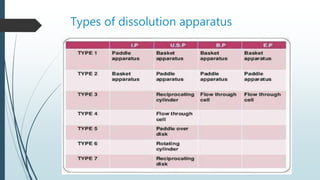
 Types of dissolution apparatus
 Compendial methods of dissolution
 Factors affecting the dissolution rate
 References
Introduction :
Definations
 Dissolution
It is a process in which a solid substances solubilises in a given solvent i.e. mass
transfer from the solid to the liquid phase.
 Dissolution rate
Is the amount of solid substance that goes in to solution per unit time under
standard condition of temperature, pH and solvent composition and constant solid
surface area.
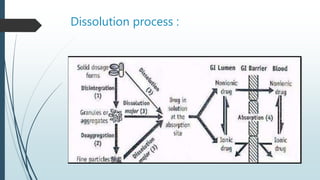
Dissolution process :
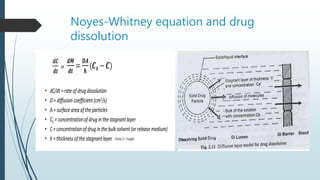
Noyes-Whitney equation and drug
dissolution
Types of dissolution apparatus
Compendial methods of dissolution
 Apparatus 1: Rotating Basket
 Apparatus 2: Paddle Method
 Apparatus 3: Reciprocating cylinder
 Apparatus 4: Flow through cell
 Apparatus 5: Paddle over disk
 Apparatus 6: Rotating Cylinder
 Apparatus 7: Reciprocating disk
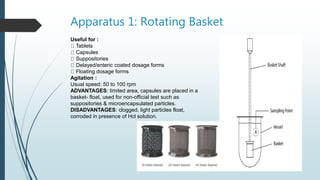
Apparatus 1: Rotating Basket
Useful for :
Tablets
Capsules
Suppositories
Delayed/enteric coated dosage forms
Floating dosage forms
Agitation :
Usual speed: 50 to 100 rpm
ADVANTAGES: limited area, capsules are placed in a
basket- float, used for non-official test such as
suppositories & microencapsulated particles.
DISADVANTAGES: clogged, light particles float,
corroded in presence of Hcl solution.
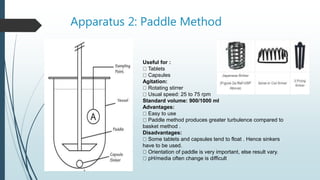
Apparatus 2: Paddle Method
Useful for :
Tablets
Capsules
Agitation:
Rotating stirrer
Usual speed: 25 to 75 rpm
Standard volume: 900/1000 ml
Advantages:
Easy to use
Paddle method produces greater turbulence compared to
basket method .
Disadvantages:
Some tablets and capsules tend to float . Hence sinkers
have to be used.
Orientation of paddle is very important, else result vary.
pH/media often change is difficult
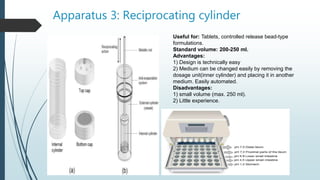
Apparatus 3: Reciprocating cylinder
Useful for: Tablets, controlled release bead-type
formulations.
Standard volume: 200-250 ml.
Advantages:
1) Design is technically easy
2) Medium can be changed easily by removing the
dosage unit(inner cylinder) and placing it in another
medium. Easily automated.
Disadvantages:
1) small volume (max. 250 ml).
2) Little experience.
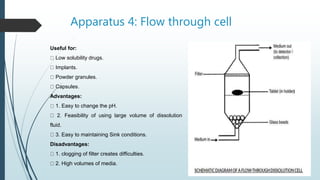
Apparatus 4: Flow through cell
Useful for:
Low solubility drugs.
Implants.
Powder granules.
Capsules.
Advantages:
1. Easy to change the pH.
2. Feasibility of using large volume of dissolution
fluid.
3. Easy to maintaining Sink conditions.
Disadvantages:
1. clogging of filter creates difficulties.
2. High volumes of media.
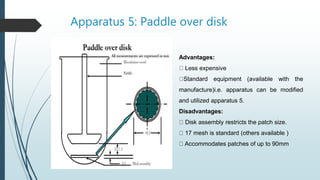
Apparatus 5: Paddle over disk
Advantages:
Less expensive
Standard equipment (available with the
manufacture)i.e. apparatus can be modified
and utilized apparatus 5.
Disadvantages:
Disk assembly restricts the patch size.
17 mesh is standard (others available )
Accommodates patches of up to 90mm
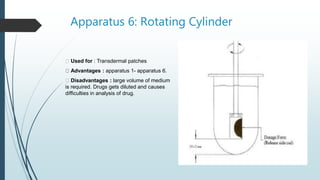
Apparatus 6: Rotating Cylinder
Used for : Transdermal patches
Advantages : apparatus 1- apparatus 6.
Disadvantages : large volume of medium
is required. Drugs gets diluted and causes
difficulties in analysis of drug.
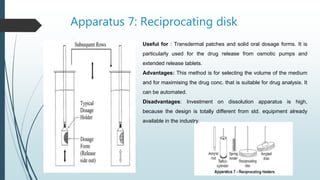
Apparatus 7: Reciprocating disk
Useful for : Transdermal patches and solid oral dosage forms. It is
particularly used for the drug release from osmotic pumps and
extended release tablets.
Advantages: This method is for selecting the volume of the medium
and for maximising the drug conc. that is suitable for drug analysis. It
can be automated.
Disadvantages: Investment on dissolution apparatus is high,
because the design is totally different from std. equipment already
available in the industry.
Factors affecting the dissolution rate
 1) Physicochemical properties of drug
 2) Drug product formulation factors
 3) Processing factors
 4) Factors relating dissolution apparatus
 5) Factors relating dissolution test parameters
Physicochemical properties of drug
 Drug solubility
 Salt formation
 Particle size
 Solid State characteristics
 Co-precipitation
Drug product formulation factors
 Diluents
 Disintegrants
 Binders and granulating agents
 Lubricants
 Surfactants
 Water soluble dyes
 Coating polymers
Processing factors
 Methods of granulation
 Compression force
 Drug excipient interaction
 Storage conditions
Factors relating dissolution apparatus
 Agitation
 Stirring element alignment
 Sampling probe position and filter
Factors relating dissolution test parameters
 Temperature
 Effect of pH
 Volume of dissolution medium and sink conditions
 Deaeration of Dissolution medium
References :
1) Subrahmanyam CVS. Text book of physical pharmaceutics. 2nd edition. Vallabh
prakashan. Delhi. 2000.
2) Brahmankar D. M., Sunil B. Jaiswal, Biopharmaceutics and pharmcokinetcs. 3rd
edition. Vallabh prakashan. Delhi 2015.

Dissolution

  • 1.
    DISSOLUTION Presented by :Mr. Pradipkumar G. Rathod M. Pharm 1st year (2nd sem.) (Pharmaceutics) University department of pharmaceutical sciences, R.T.M. Nagpur university, Nagpur.
  • 2.
    Contents :  Introduction Dissolution process  Noyes-Whitney equation and drug dissolution  Types of dissolution apparatus  Compendial methods of dissolution  Factors affecting the dissolution rate  References
  • 3.
    Introduction : Definations  Dissolution Itis a process in which a solid substances solubilises in a given solvent i.e. mass transfer from the solid to the liquid phase.  Dissolution rate Is the amount of solid substance that goes in to solution per unit time under standard condition of temperature, pH and solvent composition and constant solid surface area.
  • 4.
  • 5.
  • 6.
  • 7.
    Compendial methods ofdissolution  Apparatus 1: Rotating Basket  Apparatus 2: Paddle Method  Apparatus 3: Reciprocating cylinder  Apparatus 4: Flow through cell  Apparatus 5: Paddle over disk  Apparatus 6: Rotating Cylinder  Apparatus 7: Reciprocating disk
  • 8.
    Apparatus 1: RotatingBasket Useful for : Tablets Capsules Suppositories Delayed/enteric coated dosage forms Floating dosage forms Agitation : Usual speed: 50 to 100 rpm ADVANTAGES: limited area, capsules are placed in a basket- float, used for non-official test such as suppositories & microencapsulated particles. DISADVANTAGES: clogged, light particles float, corroded in presence of Hcl solution.
  • 9.
    Apparatus 2: PaddleMethod Useful for : Tablets Capsules Agitation: Rotating stirrer Usual speed: 25 to 75 rpm Standard volume: 900/1000 ml Advantages: Easy to use Paddle method produces greater turbulence compared to basket method . Disadvantages: Some tablets and capsules tend to float . Hence sinkers have to be used. Orientation of paddle is very important, else result vary. pH/media often change is difficult
  • 10.
    Apparatus 3: Reciprocatingcylinder Useful for: Tablets, controlled release bead-type formulations. Standard volume: 200-250 ml. Advantages: 1) Design is technically easy 2) Medium can be changed easily by removing the dosage unit(inner cylinder) and placing it in another medium. Easily automated. Disadvantages: 1) small volume (max. 250 ml). 2) Little experience.
  • 11.
    Apparatus 4: Flowthrough cell Useful for: Low solubility drugs. Implants. Powder granules. Capsules. Advantages: 1. Easy to change the pH. 2. Feasibility of using large volume of dissolution fluid. 3. Easy to maintaining Sink conditions. Disadvantages: 1. clogging of filter creates difficulties. 2. High volumes of media.
  • 12.
    Apparatus 5: Paddleover disk Advantages: Less expensive Standard equipment (available with the manufacture)i.e. apparatus can be modified and utilized apparatus 5. Disadvantages: Disk assembly restricts the patch size. 17 mesh is standard (others available ) Accommodates patches of up to 90mm
  • 13.
    Apparatus 6: RotatingCylinder Used for : Transdermal patches Advantages : apparatus 1- apparatus 6. Disadvantages : large volume of medium is required. Drugs gets diluted and causes difficulties in analysis of drug.
  • 14.
    Apparatus 7: Reciprocatingdisk Useful for : Transdermal patches and solid oral dosage forms. It is particularly used for the drug release from osmotic pumps and extended release tablets. Advantages: This method is for selecting the volume of the medium and for maximising the drug conc. that is suitable for drug analysis. It can be automated. Disadvantages: Investment on dissolution apparatus is high, because the design is totally different from std. equipment already available in the industry.
  • 15.
    Factors affecting thedissolution rate  1) Physicochemical properties of drug  2) Drug product formulation factors  3) Processing factors  4) Factors relating dissolution apparatus  5) Factors relating dissolution test parameters
  • 16.
    Physicochemical properties ofdrug  Drug solubility  Salt formation  Particle size  Solid State characteristics  Co-precipitation Drug product formulation factors  Diluents  Disintegrants  Binders and granulating agents  Lubricants  Surfactants  Water soluble dyes  Coating polymers
  • 17.
    Processing factors  Methodsof granulation  Compression force  Drug excipient interaction  Storage conditions Factors relating dissolution apparatus  Agitation  Stirring element alignment  Sampling probe position and filter Factors relating dissolution test parameters  Temperature  Effect of pH  Volume of dissolution medium and sink conditions  Deaeration of Dissolution medium
  • 18.
    References : 1) SubrahmanyamCVS. Text book of physical pharmaceutics. 2nd edition. Vallabh prakashan. Delhi. 2000. 2) Brahmankar D. M., Sunil B. Jaiswal, Biopharmaceutics and pharmcokinetcs. 3rd edition. Vallabh prakashan. Delhi 2015.