Invitro dissolution of drugs
M.SIMRANA FATHIMA
M.PHARMACY
(˘PHARMACEUTICS)
DEFINITION
• DISSOLUTION RATE
The physiochemical properties of most of
the drugs that has greater influence on
their absorption characteristics from the
GIT.
• INVITRO DISSOLUTION TEST
Test used to qualitatively assure the
biological availability of a drug from its
formulation.
INTRODUCTION
• Dissolution and drug release tests are in-vitro test s that
measure the rate and extent of dissolution or release of
the drug substance from a drug prod uct, usually in an
aqueous medium under specifie d conditions
• The dissolution test is an important quality control
procedure for the drug product and is often linked to
product performance in vivo.
• In-vitro drug dissolution studies are most often us ed for
monitoring drug product stability and manu facturing
process
• Drug dissolution is important test used to evaluate drug
release of solid and semisolid dosage forms. This test
also quantifies the amount and extent of drug release
from dosage forms.
• The values that are obtained from the
dissolution study can be quantitatively analyzed
by using different mathematical formulae,
Because qualitative and quantitative changes in
a formulation may alter release of drug and in
vivo performance
• Thus mathematical models can be developed.
This development requires the comprehension
of all phenomena affecting drug release kinetics
and this has a very important value in the
formulation optimization.
• Once a suitable function has been selected, the
dissolution profiles are evaluated depending on
the derived model parameters.
IMPORTANCE OF DISSOLUTION
TESTING
• As reliable predictor of in vivo dissolution
performance of drug.
• A rate limiting factor in determining the
physiological availability of drug.
• As quatity control tool for monitoring the
uniformity and reproducibility of production
batches.
• As research tool in optimizing parameter and
ingredients in new drug formulation.
• It is widely accepted in animal experimentation.
WHY DISSOLUTION TESTING
• Results from in-vitro dissolution rate experiments
can be used to explain the observed differences
in in-vivo availability.
• Dissolution testing provides the means to
evaluate critical parameters such as adequate
bioavailability and provides information
necessary to formulator in development of more
efficacious and therapeutically optimal
dosageforms.
• Most sensitive and reliable predictors of in-vivo
availability.
• Dissolution analysis of pharmaceutical dosage
forms has emerged as single most important
test that will ensure quality of product.
• It can ensure bioavailability of product between batches
that meet dissolution criteria.
• Ensure batch-to-batch quality equivalence both in-vitro
and in-vivo, but also to screen formulations during
product development to arrive at optimally effective
products.
• Physicochemical properties of model can be understood
needed to mimic in-vivo environment.
• Such models can be used to screen potential drug and
their associated formulations for dissolution and
absorption characteristics.
• Serve as quality control procedures, once the form of
drug and its formulation have been finalized
FACTORS FOR DESINGING THE
DISSOLUTION TEST
1. FACTORS RELATING TO THE DISSOLUTION APPARATUS
• the design
• size of the container
• shape of the container
• nature of agitation
• speed of agitation
• performance precision of the apparatus
1. FACTORS RELATING TO THE DISSOLUTION FLUID
• composition
• viscosity
• volume
• temperature
• maintainance of sink and non-sink condition
1. PROCESS PARAMETERS
• introduction of dosage form
• sampling technique
1. changing the dissolution fluid
IDEAL FEATURES OF A DISSOLUTION
APPARATUS
• simple in design, easy to operate and unstable
under a variety of conditions.
• provides an easy way of introducting the dosage
form into the dissolution medium and once
immersed, holding it in a regular and reliable
fashion.
• eliminates evaporation of the dissolution media
and maintains it at a fixed temperature within a
specific narrow range. (apparatus
thermostatically controlled at 37˚C).
• sensitive enough to reveal process changes and
formulation differences but still yield repeatable
results under identical condition.
COMMON DISSOLUTION MEDIA
• purified water
• diluted acid(0.1N Hcl)
• buffered aqueous solution
• simulated gastric fluid(with or without
enzyme)
• simulated intestinal fluid(with or without
enzyme)
FACTORS AFFECTING SELECTION OF
DISSOLUTION MEDIA
• DISSOLVED GASES - these sholud be removed prior
dissolution testing
dissolved gas can alter the ph of media
distilled water ph : 6
deaerated water ph : 7.2
• COMPOSITION OF DISSOLUTION MEDIA - enzymes,
surfactant etc
ENZYMES : pancreatin, pepsin are added for degradation
of gelatin which otherwise develop cross-links and with
aging becomes insoluble in media slowing down the
dissolution rate
SURFACTANT
NATURAL SURFACTANT : bile salt, phospholipids
INTESTINAL SURFACTANT :fatty acid, monoglycerides.
• PH OF DISSOLUTION MEDIA
ph of dissolution media should be greater than
pka of drug for complete dissolution of drug.
• VISCOSITY OF DISSOLUTION MEDIA
dissolution rate decreases with increase in
viscosity of dissolution media.
• SURFACTANT
the surfactant are added into dissolution
media for improving the wetting characteristics
of the drug Eg : tween80
• TEMPERATURE
37˚C for all dosage form except transdermal
which is 32˚C
TYPES OF DISSOLUTION APPARATUS
1. CLOSED COMPARTMENT APPARATUS
USP TYPE-I basket type
USP TYPE-II paddle type
1. OPEN COMPARTMENT APPARATUS(continous flow
through)
USP TYPE-III reciprocating cylinder
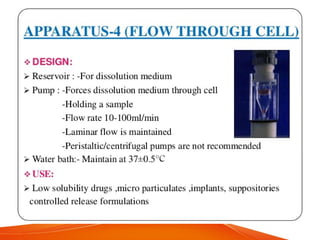
USP TYPE-IV flow through cell
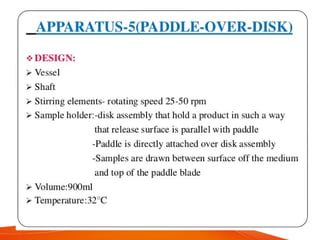
USP TYPE-V paddle over disk
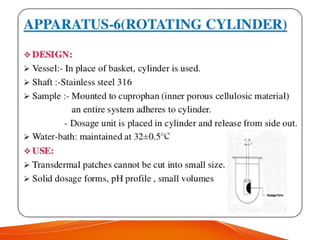
USP TYPE-VI rotating cylinder
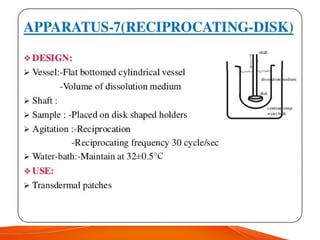
USP TYPE-VII reciprocating holder
3. DIALYSIS SYSTEM
official or compendial methods
DISSOLUTION METHODS
TWO METHOD
• OFFICIAL METHODS
 Rotating basket method
 Paddle method 
 Flow-through method 
 Reciprocating cylinder method 
 Paddle over disk method 
 Rotating cylinder method 
 Reciprocating disk method
• NON-OFFICIAL METHODS.
 rotating static disk method
 beaker method
 flask stirrer method
 peristalsis method
 rotating bottle method
 dialysis method
 diffusion cell
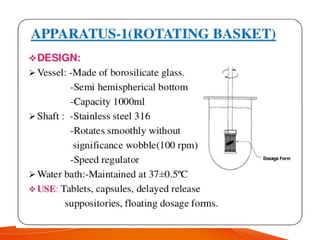
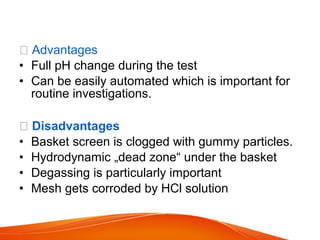
 Advantages
• Full pH change during the test
• Can be easily automated which is important for
routine investigations.
 Disadvantages
• Basket screen is clogged with gummy particles.
• Hydrodynamic „dead zone“ under the basket
• Degassing is particularly important
• Mesh gets corroded by HCl solution
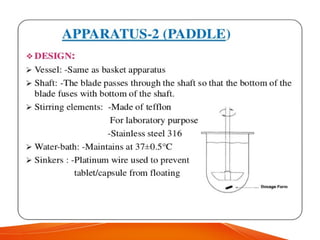
Advantages
• Easy to use
• Robust
• pH change possible
• Can be easily automated which is important for
routine investigations 
Disadvantages
• pH/media change is often difficult
• Hydrodynamics are complex, they vary with site
of the dosage form in the vessel
(sticking,floating) and therefore may significantly
affect drug dissolution
• Sinkers for floating dosage forms
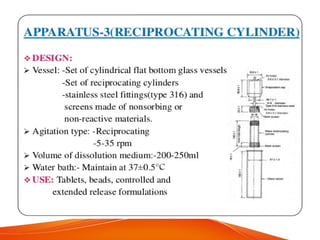
Advantages
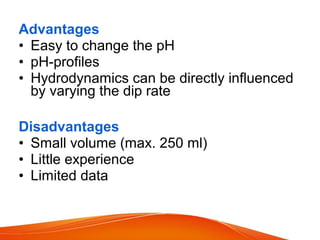
• Easy to change the pH
• pH-profiles
• Hydrodynamics can be directly influenced
by varying the dip rate
Disadvantages
• Small volume (max. 250 ml)
• Little experience
• Limited data
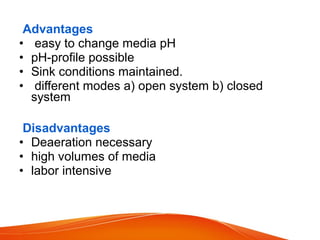
Advantages
• easy to change media pH
• pH-profile possible
• Sink conditions maintained.
• different modes a) open system b) closed
system
Disadvantages
• Deaeration necessary
• high volumes of media
• labor intensive
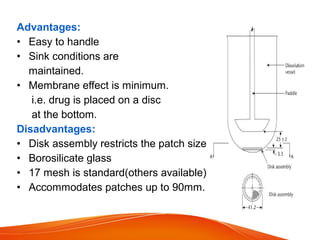
Advantages:
• Easy to handle
• Sink conditions are
maintained.
• Membrane effect is minimum.
i.e. drug is placed on a disc
at the bottom.
Disadvantages:
• Disk assembly restricts the patch size
• Borosilicate glass
• 17 mesh is standard(others available)
• Accommodates patches up to 90mm.
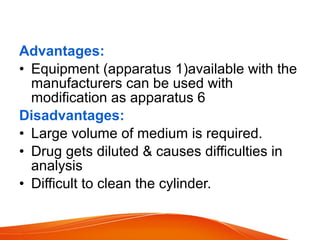
Advantages:
• Equipment (apparatus 1)available with the
manufacturers can be used with
modification as apparatus 6
Disadvantages:
• Large volume of medium is required.
• Drug gets diluted & causes difficulties in
analysis
• Difficult to clean the cylinder.
Advantages:
• Convenient method for selecting the
volume of the medium.
• sink conditions can be maintained. -more
sensitivity 
Disadvantages:
• Investment is high because the design is
totally different from standard equipment
already available in industry.
UNOFFICIAL METHOD
1.ROTATING/STATIC DISK METHOD
• Developed by late Eino nelson and described by Levy
and Sahli.
• In this method ,the drug is compressed in a non-
disintegrating disc without excipients.
• The disc is mounted in a holder so that only one face of
the disc is exposed to the dissolution medium.
• The holder and disc are immersed in medium and held in
a fixed position as in static disc method and rotated at a
given speed in rotating disc method.
• Samples are collected at predetermined times.
• Surface area of the drug through which dissolution
occurs is kept constant –intrinsic dissolution rate
2.BEAKER METHOD:
• Reported by Levy and Hayes(1960).
• Dissolution medium, 250ml of 0.1N HCl at 37°C placed
in a 400ml beaker.
• Agitation by three blade polyethylene stirrer,5cm
diameter and rotates at 60 rpm.
• Stirrer immersed to a depth of 2.7 cm in medium and in
the center.
• Tablets are placed in a beaker and test was carried out.
• Samples are removed and assayed for the content.
3.FLASK STIRRER METHOD
• Developed by Poole(1969).It includes RBF and a stirring
element similar to that of beaker method.
• RBF used to avoid the formation of moulds of particles in
different positions on the flat bottom of a beaker.
4.PERISTALSIS METHOD:
• To stimulate hydrodynamic condition of GIT tract in an in-
vitro dissolution device.
• It consists of rigid plastic cylindrical tubing fitted with
septum and rubber stopper at both ends.
• Dissolution chamber consists of a space between
septum and lower stopper.
• Dissolution medium is pumped with peristaltic action
through the dosage form.
5.ROTATING BOTTLE METHOD:
• It consists of rotating rack to hold sample drug products
in bottles and they are capped tightly & rotated in 37°C
temperature bath.
• Sample are decanted through a 40 mesh screen and
residue are assayed.
6.DIALYSIS METHOD:
• Cell consist of 32mm inflated membrane.
• Plugged at the lower end by tight fitting cylindrical
perspex box.
• Upper end of the tube held by thin perspex ring inserted
into the tube and secured by an elastic band.
• The cell suspended , from the arm of the tablet
disintegration apparatus and containing the dosage form
in 150ml of distilled water at 37°C.
7.DIFFUSION CELL :
• Static or flow through diffusion cells are used to
characterize invitro drug release and drug permeation
kinetics from a topical drug product eg: Ointment, cream
or transdermal drug product.
• The Franz diffusion cell is static diffusion system used to
characterize drug permeation through skin model.
• The skin is mounted on the Franz diffusion cell and the
drug product is placed on the skin surface.
CONCLUSION
• By studying various factors influencing the rate of
dissolution, we can optimize the different properties of
the formulation.
• By conducting dissolution studies we can know the batch
to batch reproducibility.
• We can estimate the solubilty profiles of the drug.
• The best available tool today which can atleast
quantitatively assure about the biological availability of
drug from its formulation is its invitro dissolution.
REFERENCE
• Aulton M.E. Pharmaceutics “The Science of
Dosage Form Design”, 2nd Ed.; Churchill
Livingstone.
• D.M.Brahmankar “Biopharmaceutics and
Pharmacokinetics a Treatise”
• Venkateshwarlu “Biopharmaceutics and
Pharmaceutics”, 2nd Ed.
• Leon Shargel “Applied Biopharmaceutics and
Pharmacokinetics”,5th Edition.
• The Science And Practice of Pharmacy by
REMINGTON , 21 st Edition
• C.V.S.Subrahmanyam “Biopharmaceutics and
pharmacokinetics”, -concepts and applications.
Invitro dissolution

Invitro dissolution

  • 1.
    Invitro dissolution ofdrugs M.SIMRANA FATHIMA M.PHARMACY (˘PHARMACEUTICS)
  • 2.
    DEFINITION • DISSOLUTION RATE Thephysiochemical properties of most of the drugs that has greater influence on their absorption characteristics from the GIT. • INVITRO DISSOLUTION TEST Test used to qualitatively assure the biological availability of a drug from its formulation.
  • 3.
    INTRODUCTION • Dissolution anddrug release tests are in-vitro test s that measure the rate and extent of dissolution or release of the drug substance from a drug prod uct, usually in an aqueous medium under specifie d conditions • The dissolution test is an important quality control procedure for the drug product and is often linked to product performance in vivo. • In-vitro drug dissolution studies are most often us ed for monitoring drug product stability and manu facturing process • Drug dissolution is important test used to evaluate drug release of solid and semisolid dosage forms. This test also quantifies the amount and extent of drug release from dosage forms.
  • 4.
    • The valuesthat are obtained from the dissolution study can be quantitatively analyzed by using different mathematical formulae, Because qualitative and quantitative changes in a formulation may alter release of drug and in vivo performance • Thus mathematical models can be developed. This development requires the comprehension of all phenomena affecting drug release kinetics and this has a very important value in the formulation optimization. • Once a suitable function has been selected, the dissolution profiles are evaluated depending on the derived model parameters.
  • 5.
    IMPORTANCE OF DISSOLUTION TESTING •As reliable predictor of in vivo dissolution performance of drug. • A rate limiting factor in determining the physiological availability of drug. • As quatity control tool for monitoring the uniformity and reproducibility of production batches. • As research tool in optimizing parameter and ingredients in new drug formulation. • It is widely accepted in animal experimentation.
  • 6.
    WHY DISSOLUTION TESTING •Results from in-vitro dissolution rate experiments can be used to explain the observed differences in in-vivo availability. • Dissolution testing provides the means to evaluate critical parameters such as adequate bioavailability and provides information necessary to formulator in development of more efficacious and therapeutically optimal dosageforms. • Most sensitive and reliable predictors of in-vivo availability. • Dissolution analysis of pharmaceutical dosage forms has emerged as single most important test that will ensure quality of product.
  • 7.
    • It canensure bioavailability of product between batches that meet dissolution criteria. • Ensure batch-to-batch quality equivalence both in-vitro and in-vivo, but also to screen formulations during product development to arrive at optimally effective products. • Physicochemical properties of model can be understood needed to mimic in-vivo environment. • Such models can be used to screen potential drug and their associated formulations for dissolution and absorption characteristics. • Serve as quality control procedures, once the form of drug and its formulation have been finalized
  • 8.
    FACTORS FOR DESINGINGTHE DISSOLUTION TEST 1. FACTORS RELATING TO THE DISSOLUTION APPARATUS • the design • size of the container • shape of the container • nature of agitation • speed of agitation • performance precision of the apparatus 1. FACTORS RELATING TO THE DISSOLUTION FLUID • composition • viscosity • volume • temperature • maintainance of sink and non-sink condition 1. PROCESS PARAMETERS • introduction of dosage form • sampling technique 1. changing the dissolution fluid
  • 9.
    IDEAL FEATURES OFA DISSOLUTION APPARATUS • simple in design, easy to operate and unstable under a variety of conditions. • provides an easy way of introducting the dosage form into the dissolution medium and once immersed, holding it in a regular and reliable fashion. • eliminates evaporation of the dissolution media and maintains it at a fixed temperature within a specific narrow range. (apparatus thermostatically controlled at 37˚C). • sensitive enough to reveal process changes and formulation differences but still yield repeatable results under identical condition.
  • 10.
    COMMON DISSOLUTION MEDIA •purified water • diluted acid(0.1N Hcl) • buffered aqueous solution • simulated gastric fluid(with or without enzyme) • simulated intestinal fluid(with or without enzyme)
  • 11.
    FACTORS AFFECTING SELECTIONOF DISSOLUTION MEDIA • DISSOLVED GASES - these sholud be removed prior dissolution testing dissolved gas can alter the ph of media distilled water ph : 6 deaerated water ph : 7.2 • COMPOSITION OF DISSOLUTION MEDIA - enzymes, surfactant etc ENZYMES : pancreatin, pepsin are added for degradation of gelatin which otherwise develop cross-links and with aging becomes insoluble in media slowing down the dissolution rate SURFACTANT NATURAL SURFACTANT : bile salt, phospholipids INTESTINAL SURFACTANT :fatty acid, monoglycerides.
  • 12.
    • PH OFDISSOLUTION MEDIA ph of dissolution media should be greater than pka of drug for complete dissolution of drug. • VISCOSITY OF DISSOLUTION MEDIA dissolution rate decreases with increase in viscosity of dissolution media. • SURFACTANT the surfactant are added into dissolution media for improving the wetting characteristics of the drug Eg : tween80 • TEMPERATURE 37˚C for all dosage form except transdermal which is 32˚C
  • 13.
    TYPES OF DISSOLUTIONAPPARATUS 1. CLOSED COMPARTMENT APPARATUS USP TYPE-I basket type USP TYPE-II paddle type 1. OPEN COMPARTMENT APPARATUS(continous flow through) USP TYPE-III reciprocating cylinder USP TYPE-IV flow through cell USP TYPE-V paddle over disk USP TYPE-VI rotating cylinder USP TYPE-VII reciprocating holder 3. DIALYSIS SYSTEM official or compendial methods
  • 14.
    DISSOLUTION METHODS TWO METHOD •OFFICIAL METHODS  Rotating basket method  Paddle method   Flow-through method   Reciprocating cylinder method   Paddle over disk method   Rotating cylinder method   Reciprocating disk method • NON-OFFICIAL METHODS.  rotating static disk method  beaker method  flask stirrer method  peristalsis method  rotating bottle method  dialysis method  diffusion cell
  • 16.
     Advantages • FullpH change during the test • Can be easily automated which is important for routine investigations.  Disadvantages • Basket screen is clogged with gummy particles. • Hydrodynamic „dead zone“ under the basket • Degassing is particularly important • Mesh gets corroded by HCl solution
  • 18.
    Advantages • Easy touse • Robust • pH change possible • Can be easily automated which is important for routine investigations  Disadvantages • pH/media change is often difficult • Hydrodynamics are complex, they vary with site of the dosage form in the vessel (sticking,floating) and therefore may significantly affect drug dissolution • Sinkers for floating dosage forms
  • 20.
    Advantages • Easy tochange the pH • pH-profiles • Hydrodynamics can be directly influenced by varying the dip rate Disadvantages • Small volume (max. 250 ml) • Little experience • Limited data
  • 22.
    Advantages • easy tochange media pH • pH-profile possible • Sink conditions maintained. • different modes a) open system b) closed system Disadvantages • Deaeration necessary • high volumes of media • labor intensive
  • 24.
    Advantages: • Easy tohandle • Sink conditions are maintained. • Membrane effect is minimum. i.e. drug is placed on a disc at the bottom. Disadvantages: • Disk assembly restricts the patch size • Borosilicate glass • 17 mesh is standard(others available) • Accommodates patches up to 90mm.
  • 26.
    Advantages: • Equipment (apparatus1)available with the manufacturers can be used with modification as apparatus 6 Disadvantages: • Large volume of medium is required. • Drug gets diluted & causes difficulties in analysis • Difficult to clean the cylinder.
  • 28.
    Advantages: • Convenient methodfor selecting the volume of the medium. • sink conditions can be maintained. -more sensitivity  Disadvantages: • Investment is high because the design is totally different from standard equipment already available in industry.
  • 29.
    UNOFFICIAL METHOD 1.ROTATING/STATIC DISKMETHOD • Developed by late Eino nelson and described by Levy and Sahli. • In this method ,the drug is compressed in a non- disintegrating disc without excipients. • The disc is mounted in a holder so that only one face of the disc is exposed to the dissolution medium. • The holder and disc are immersed in medium and held in a fixed position as in static disc method and rotated at a given speed in rotating disc method. • Samples are collected at predetermined times. • Surface area of the drug through which dissolution occurs is kept constant –intrinsic dissolution rate
  • 30.
    2.BEAKER METHOD: • Reportedby Levy and Hayes(1960). • Dissolution medium, 250ml of 0.1N HCl at 37°C placed in a 400ml beaker. • Agitation by three blade polyethylene stirrer,5cm diameter and rotates at 60 rpm. • Stirrer immersed to a depth of 2.7 cm in medium and in the center. • Tablets are placed in a beaker and test was carried out. • Samples are removed and assayed for the content. 3.FLASK STIRRER METHOD • Developed by Poole(1969).It includes RBF and a stirring element similar to that of beaker method. • RBF used to avoid the formation of moulds of particles in different positions on the flat bottom of a beaker.
  • 31.
    4.PERISTALSIS METHOD: • Tostimulate hydrodynamic condition of GIT tract in an in- vitro dissolution device. • It consists of rigid plastic cylindrical tubing fitted with septum and rubber stopper at both ends. • Dissolution chamber consists of a space between septum and lower stopper. • Dissolution medium is pumped with peristaltic action through the dosage form. 5.ROTATING BOTTLE METHOD: • It consists of rotating rack to hold sample drug products in bottles and they are capped tightly & rotated in 37°C temperature bath. • Sample are decanted through a 40 mesh screen and residue are assayed.
  • 32.
    6.DIALYSIS METHOD: • Cellconsist of 32mm inflated membrane. • Plugged at the lower end by tight fitting cylindrical perspex box. • Upper end of the tube held by thin perspex ring inserted into the tube and secured by an elastic band. • The cell suspended , from the arm of the tablet disintegration apparatus and containing the dosage form in 150ml of distilled water at 37°C. 7.DIFFUSION CELL : • Static or flow through diffusion cells are used to characterize invitro drug release and drug permeation kinetics from a topical drug product eg: Ointment, cream or transdermal drug product. • The Franz diffusion cell is static diffusion system used to characterize drug permeation through skin model. • The skin is mounted on the Franz diffusion cell and the drug product is placed on the skin surface.
  • 33.
    CONCLUSION • By studyingvarious factors influencing the rate of dissolution, we can optimize the different properties of the formulation. • By conducting dissolution studies we can know the batch to batch reproducibility. • We can estimate the solubilty profiles of the drug. • The best available tool today which can atleast quantitatively assure about the biological availability of drug from its formulation is its invitro dissolution.
  • 34.
    REFERENCE • Aulton M.E.Pharmaceutics “The Science of Dosage Form Design”, 2nd Ed.; Churchill Livingstone. • D.M.Brahmankar “Biopharmaceutics and Pharmacokinetics a Treatise” • Venkateshwarlu “Biopharmaceutics and Pharmaceutics”, 2nd Ed. • Leon Shargel “Applied Biopharmaceutics and Pharmacokinetics”,5th Edition. • The Science And Practice of Pharmacy by REMINGTON , 21 st Edition • C.V.S.Subrahmanyam “Biopharmaceutics and pharmacokinetics”, -concepts and applications.