ANKIT RAJ
M.PHARM 2ND SEM.
AMITY UNIVERSITY, HARYANA
CONTENT
1. Introduction
2. Mechanism of dissolution
3. Theories of dissolution
4. Apparatus used in dissolution
5. Factor affecting dissolution
6. Problem of variable Control in dissolution testing
performance of drug product.
1. INTRODUCTION
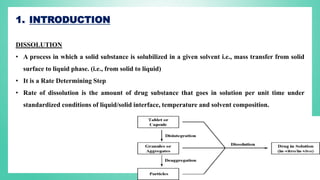
DISSOLUTION
• A process in which a solid substance is solubilized in a given solvent i.e., mass transfer from solid
surface to liquid phase. (i.e., from solid to liquid)
• It is a Rate Determining Step
• Rate of dissolution is the amount of drug substance that goes in solution per unit time under
standardized conditions of liquid/solid interface, temperature and solvent composition.
2. MECHANISM OF DISSOLUTION
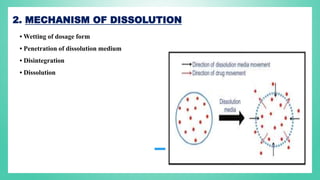
• Wetting of dosage form
• Penetration of dissolution medium
• Disintegration
• Dissolution
3. THEORY OF DISSOLUTION
• Diffusion Layer Model/ Film theory
• Danckwerts’s Model/ Penetration or Surface Renewal Theory
• Interfacial Barrier Model/ Double Barrier Theory
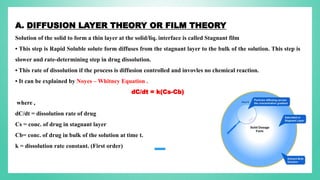
A. DIFFUSION LAYER THEORY OR FILM THEORY
Solution of the solid to form a thin layer at the solid/liq. interface is called Stagnant film
• This step is Rapid Soluble solute form diffuses from the stagnant layer to the bulk of the solution. This step is
slower and rate-determining step in drug dissolution.
• This rate of dissolution if the process is diffusion controlled and invovles no chemical reaction.
• It can be explained by Noyes – Whitney Equation .
dC/dt = k(Cs-Cb)
where ,
dC/dt = dissolution rate of drug
Cs = conc. of drug in stagnant layer
Cb= conc. of drug in bulk of the solution at time t.
k = dissolution rate constant. (First order)
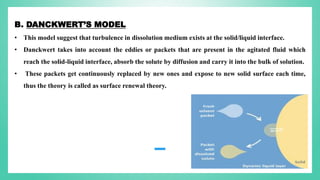
B. DANCKWERT’S MODEL
• This model suggest that turbulence in dissolution medium exists at the solid/liquid interface.
• Danckwert takes into account the eddies or packets that are present in the agitated fluid which
reach the solid-liquid interface, absorb the solute by diffusion and carry it into the bulk of solution.
• These packets get continuously replaced by new ones and expose to new solid surface each time,
thus the theory is called as surface renewal theory.
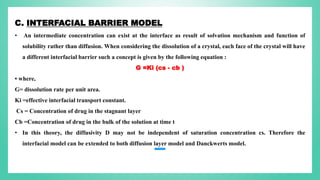
C. INTERFACIAL BARRIER MODEL
• An intermediate concentration can exist at the interface as result of solvation mechanism and function of
solubility rather than diffusion. When considering the dissolution of a crystal, each face of the crystal will have
a different interfacial barrier such a concept is given by the following equation :
G =Ki (cs - cb )
• where,
G= dissolution rate per unit area.
Ki =effective interfacial transport constant.
Cs = Concentration of drug in the stagnant layer
Cb =Concentration of drug in the bulk of the solution at time t
• In this theory, the diffusivity D may not be independent of saturation concentration cs. Therefore the
interfacial model can be extended to both diffusion layer model and Danckwerts model.
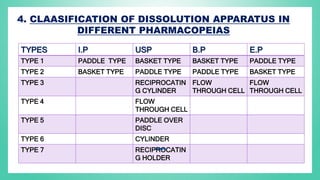
4. CLAASIFICATION OF DISSOLUTION APPARATUS IN
DIFFERENT PHARMACOPEIAS
TYPES I.P USP B.P E.P
TYPE 1 PADDLE TYPE BASKET TYPE BASKET TYPE PADDLE TYPE
TYPE 2 BASKET TYPE PADDLE TYPE PADDLE TYPE BASKET TYPE
TYPE 3 RECIPROCATIN
G CYLINDER
FLOW
THROUGH CELL
FLOW
THROUGH CELL
TYPE 4 FLOW
THROUGH CELL
TYPE 5 PADDLE OVER
DISC
TYPE 6 CYLINDER
TYPE 7 RECIPROCATIN
G HOLDER
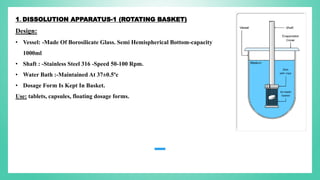
1. DISSOLUTION APPARATUS-1 (ROTATING BASKET)
Design:
• Vessel: -Made Of Borosilicate Glass. Semi Hemispherical Bottom-capacity
1000ml
• Shaft : -Stainless Steel 316 -Speed 50-100 Rpm.
• Water Bath :-Maintained At 37±0.5ºc
• Dosage Form Is Kept In Basket.
Use: tablets, capsules, floating dosage forms.
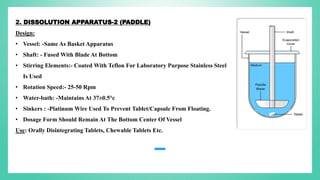
2. DISSOLUTION APPARATUS-2 (PADDLE)
Design:
• Vessel: -Same As Basket Apparatus
• Shaft: - Fused With Blade At Bottom
• Stirring Elements:- Coated With Teflon For Laboratory Purpose Stainless Steel
Is Used
• Rotation Speed:- 25-50 Rpm
• Water-bath: -Maintains At 37±0.5°c
• Sinkers : -Platinum Wire Used To Prevent Tablet/Capsule From Floating.
• Dosage Form Should Remain At The Bottom Center Of Vessel
Use: Orally Disintegrating Tablets, Chewable Tablets Etc.
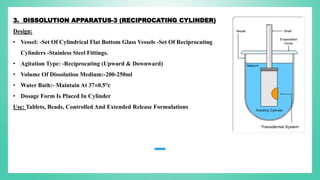
3. DISSOLUTION APPARATUS-3 (RECIPROCATING CYLINDER)
Design:
• Vessel: -Set Of Cylindrical Flat Bottom Glass Vessels -Set Of Reciprocating
Cylinders -Stainless Steel Fittings.
• Agitation Type: -Reciprocating (Upward & Downward)
• Volume Of Dissolution Medium:-200-250ml
• Water Bath:- Maintain At 37±0.5°c
• Dosage Form Is Placed In Cylinder
Use: Tablets, Beads, Controlled And Extended Release Formulations
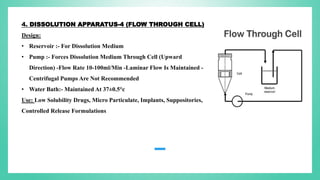
4. DISSOLUTION APPARATUS-4 (FLOW THROUGH CELL)
Design:
• Reservoir :- For Dissolution Medium
• Pump :- Forces Dissolution Medium Through Cell (Upward
Direction) -Flow Rate 10-100ml/Min -Laminar Flow Is Maintained -
Centrifugal Pumps Are Not Recommended
• Water Bath:- Maintained At 37±0.5°c
Use: Low Solubility Drugs, Micro Particulate, Implants, Suppositories,
Controlled Release Formulations
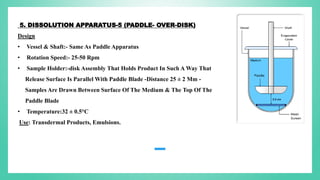
5. DISSOLUTION APPARATUS-5 (PADDLE- OVER-DISK)
Design
• Vessel & Shaft:- Same As Paddle Apparatus
• Rotation Speed:- 25-50 Rpm
• Sample Holder:-disk Assembly That Holds Product In Such A Way That
Release Surface Is Parallel With Paddle Blade -Distance 25 ± 2 Mm -
Samples Are Drawn Between Surface Of The Medium & The Top Of The
Paddle Blade
• Temperature:32 ± 0.5°C
Use: Transdermal Products, Emulsions.
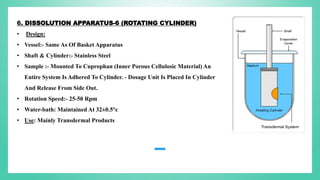
6. DISSOLUTION APPARATUS-6 (ROTATING CYLINDER)
• Design:
• Vessel:- Same As Of Basket Apparatus
• Shaft & Cylinder:- Stainless Steel
• Sample :- Mounted To Cuprophan (Inner Porous Cellulosic Material) An
Entire System Is Adhered To Cylinder. - Dosage Unit Is Placed In Cylinder
And Release From Side Out.
• Rotation Speed:- 25-50 Rpm
• Water-bath: Maintained At 32±0.5°c
• Use: Mainly Transdermal Products
5. COMMONLY USED DISSOLUTION MEDIA
1. Purified water
2. Dilute acid (0.001N – 0.1N HCl)
3. Stimulated gastric fluid
4. Stimulated intestinal fluid
5. Surfactants (e.g. Polysorbate, SLS)
6. Aqueous buffers (pH 5-7)
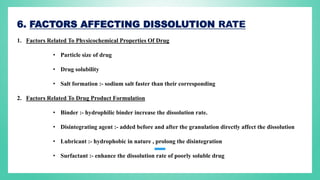
6. FACTORS AFFECTING DISSOLUTION RATE
1. Factors Related To Physicochemical Properties Of Drug
• Particle size of drug
• Drug solubility
• Salt formation :- sodium salt faster than their corresponding
2. Factors Related To Drug Product Formulation
• Binder :- hydrophilic binder increase the dissolution rate.
• Disintegrating agent :- added before and after the granulation directly affect the dissolution
• Lubricant :- hydrophobic in nature , prolong the disintegration
• Surfactant :- enhance the dissolution rate of poorly soluble drug
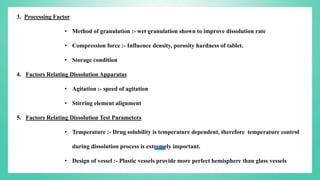
3. Processing Factor
• Method of granulation :- wet granulation shown to improve dissolution rate
• Compression force :- Influence density, porosity hardness of tablet.
• Storage condition
4. Factors Relating Dissolution Apparatus
• Agitation :- speed of agitation
• Stirring element alignment
5. Factors Relating Dissolution Test Parameters
• Temperature :- Drug solubility is temperature dependent, therefore temperature control
during dissolution process is extremely important.
• Design of vessel :- Plastic vessels provide more perfect hemisphere than glass vessels
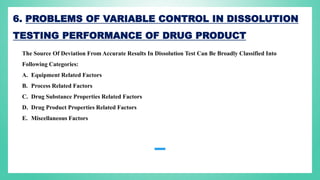
6. PROBLEMS OF VARIABLE CONTROL IN DISSOLUTION
TESTING PERFORMANCE OF DRUG PRODUCT
The Source Of Deviation From Accurate Results In Dissolution Test Can Be Broadly Classified Into
Following Categories:
A. Equipment Related Factors
B. Process Related Factors
C. Drug Substance Properties Related Factors
D. Drug Product Properties Related Factors
E. Miscellaneous Factors
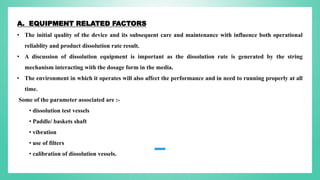
A. EQUIPMENT RELATED FACTORS
• The initial quality of the device and its subsequent care and maintenance with influence both operational
reliablity and product dissolution rate result.
• A discussion of dissolution equipment is important as the dissolution rate is generated by the string
mechanism interacting with the dosage form in the media.
• The environment in which it operates will also affect the performance and in need to running properly at all
time.
Some of the parameter associated are :-
• dissolution test vessels
• Paddle/ baskets shaft
• vibration
• use of filters
• calibration of dissolution vessels.
B. PROCESS RELATED FACTOR
• Various factor associated with dissolution test procedure may lead to errors.
• use of water as dissolution media.
• Sample introduction
• single point versus multi point sampling
• control Release doses form.
C. DRUG SUBSTANCE PROPERTIES RELATED FACTOR
• Knowledge of drug properties like solubility of drug effect of PH change, crystalline structure is important.
One could anticipate precipitation of drug as the pH change in solution, or if release from the dosage from
lead to supersaturation of the test media.
• Example, preparation of the standard solution may is an important step. It is customary to use a small
amount of alcohol to dissolve the standard completely.
D. DRUG PRODUCT PROPERTIES RELATED FACTOR
• Dissolution profile may help in identifying trains and effect of formulation changes when the result are
highly variable.
• It indicate that the method is not robust.
 Two major casual factor influence viability.
• mechanical :- Mechanical causes can arise from the dissolution condition chosen. E.g :- an apparatus or
speed change may change the result.
• Formulation :- e.g The film coating may cause sticking to the vessel wall.
In-vitro Dissolution apparatus and equation used for dissolution.pptx

In-vitro Dissolution apparatus and equation used for dissolution.pptx

  • 1.
    ANKIT RAJ M.PHARM 2NDSEM. AMITY UNIVERSITY, HARYANA
  • 2.
    CONTENT 1. Introduction 2. Mechanismof dissolution 3. Theories of dissolution 4. Apparatus used in dissolution 5. Factor affecting dissolution 6. Problem of variable Control in dissolution testing performance of drug product.
  • 3.
    1. INTRODUCTION DISSOLUTION • Aprocess in which a solid substance is solubilized in a given solvent i.e., mass transfer from solid surface to liquid phase. (i.e., from solid to liquid) • It is a Rate Determining Step • Rate of dissolution is the amount of drug substance that goes in solution per unit time under standardized conditions of liquid/solid interface, temperature and solvent composition.
  • 4.
    2. MECHANISM OFDISSOLUTION • Wetting of dosage form • Penetration of dissolution medium • Disintegration • Dissolution
  • 5.
    3. THEORY OFDISSOLUTION • Diffusion Layer Model/ Film theory • Danckwerts’s Model/ Penetration or Surface Renewal Theory • Interfacial Barrier Model/ Double Barrier Theory
  • 6.
    A. DIFFUSION LAYERTHEORY OR FILM THEORY Solution of the solid to form a thin layer at the solid/liq. interface is called Stagnant film • This step is Rapid Soluble solute form diffuses from the stagnant layer to the bulk of the solution. This step is slower and rate-determining step in drug dissolution. • This rate of dissolution if the process is diffusion controlled and invovles no chemical reaction. • It can be explained by Noyes – Whitney Equation . dC/dt = k(Cs-Cb) where , dC/dt = dissolution rate of drug Cs = conc. of drug in stagnant layer Cb= conc. of drug in bulk of the solution at time t. k = dissolution rate constant. (First order)
  • 7.
    B. DANCKWERT’S MODEL •This model suggest that turbulence in dissolution medium exists at the solid/liquid interface. • Danckwert takes into account the eddies or packets that are present in the agitated fluid which reach the solid-liquid interface, absorb the solute by diffusion and carry it into the bulk of solution. • These packets get continuously replaced by new ones and expose to new solid surface each time, thus the theory is called as surface renewal theory.
  • 8.
    C. INTERFACIAL BARRIERMODEL • An intermediate concentration can exist at the interface as result of solvation mechanism and function of solubility rather than diffusion. When considering the dissolution of a crystal, each face of the crystal will have a different interfacial barrier such a concept is given by the following equation : G =Ki (cs - cb ) • where, G= dissolution rate per unit area. Ki =effective interfacial transport constant. Cs = Concentration of drug in the stagnant layer Cb =Concentration of drug in the bulk of the solution at time t • In this theory, the diffusivity D may not be independent of saturation concentration cs. Therefore the interfacial model can be extended to both diffusion layer model and Danckwerts model.
  • 9.
    4. CLAASIFICATION OFDISSOLUTION APPARATUS IN DIFFERENT PHARMACOPEIAS TYPES I.P USP B.P E.P TYPE 1 PADDLE TYPE BASKET TYPE BASKET TYPE PADDLE TYPE TYPE 2 BASKET TYPE PADDLE TYPE PADDLE TYPE BASKET TYPE TYPE 3 RECIPROCATIN G CYLINDER FLOW THROUGH CELL FLOW THROUGH CELL TYPE 4 FLOW THROUGH CELL TYPE 5 PADDLE OVER DISC TYPE 6 CYLINDER TYPE 7 RECIPROCATIN G HOLDER
  • 10.
    1. DISSOLUTION APPARATUS-1(ROTATING BASKET) Design: • Vessel: -Made Of Borosilicate Glass. Semi Hemispherical Bottom-capacity 1000ml • Shaft : -Stainless Steel 316 -Speed 50-100 Rpm. • Water Bath :-Maintained At 37±0.5ºc • Dosage Form Is Kept In Basket. Use: tablets, capsules, floating dosage forms.
  • 11.
    2. DISSOLUTION APPARATUS-2(PADDLE) Design: • Vessel: -Same As Basket Apparatus • Shaft: - Fused With Blade At Bottom • Stirring Elements:- Coated With Teflon For Laboratory Purpose Stainless Steel Is Used • Rotation Speed:- 25-50 Rpm • Water-bath: -Maintains At 37±0.5°c • Sinkers : -Platinum Wire Used To Prevent Tablet/Capsule From Floating. • Dosage Form Should Remain At The Bottom Center Of Vessel Use: Orally Disintegrating Tablets, Chewable Tablets Etc.
  • 12.
    3. DISSOLUTION APPARATUS-3(RECIPROCATING CYLINDER) Design: • Vessel: -Set Of Cylindrical Flat Bottom Glass Vessels -Set Of Reciprocating Cylinders -Stainless Steel Fittings. • Agitation Type: -Reciprocating (Upward & Downward) • Volume Of Dissolution Medium:-200-250ml • Water Bath:- Maintain At 37±0.5°c • Dosage Form Is Placed In Cylinder Use: Tablets, Beads, Controlled And Extended Release Formulations
  • 13.
    4. DISSOLUTION APPARATUS-4(FLOW THROUGH CELL) Design: • Reservoir :- For Dissolution Medium • Pump :- Forces Dissolution Medium Through Cell (Upward Direction) -Flow Rate 10-100ml/Min -Laminar Flow Is Maintained - Centrifugal Pumps Are Not Recommended • Water Bath:- Maintained At 37±0.5°c Use: Low Solubility Drugs, Micro Particulate, Implants, Suppositories, Controlled Release Formulations
  • 14.
    5. DISSOLUTION APPARATUS-5(PADDLE- OVER-DISK) Design • Vessel & Shaft:- Same As Paddle Apparatus • Rotation Speed:- 25-50 Rpm • Sample Holder:-disk Assembly That Holds Product In Such A Way That Release Surface Is Parallel With Paddle Blade -Distance 25 ± 2 Mm - Samples Are Drawn Between Surface Of The Medium & The Top Of The Paddle Blade • Temperature:32 ± 0.5°C Use: Transdermal Products, Emulsions.
  • 15.
    6. DISSOLUTION APPARATUS-6(ROTATING CYLINDER) • Design: • Vessel:- Same As Of Basket Apparatus • Shaft & Cylinder:- Stainless Steel • Sample :- Mounted To Cuprophan (Inner Porous Cellulosic Material) An Entire System Is Adhered To Cylinder. - Dosage Unit Is Placed In Cylinder And Release From Side Out. • Rotation Speed:- 25-50 Rpm • Water-bath: Maintained At 32±0.5°c • Use: Mainly Transdermal Products
  • 16.
    5. COMMONLY USEDDISSOLUTION MEDIA 1. Purified water 2. Dilute acid (0.001N – 0.1N HCl) 3. Stimulated gastric fluid 4. Stimulated intestinal fluid 5. Surfactants (e.g. Polysorbate, SLS) 6. Aqueous buffers (pH 5-7)
  • 17.
    6. FACTORS AFFECTINGDISSOLUTION RATE 1. Factors Related To Physicochemical Properties Of Drug • Particle size of drug • Drug solubility • Salt formation :- sodium salt faster than their corresponding 2. Factors Related To Drug Product Formulation • Binder :- hydrophilic binder increase the dissolution rate. • Disintegrating agent :- added before and after the granulation directly affect the dissolution • Lubricant :- hydrophobic in nature , prolong the disintegration • Surfactant :- enhance the dissolution rate of poorly soluble drug
  • 18.
    3. Processing Factor •Method of granulation :- wet granulation shown to improve dissolution rate • Compression force :- Influence density, porosity hardness of tablet. • Storage condition 4. Factors Relating Dissolution Apparatus • Agitation :- speed of agitation • Stirring element alignment 5. Factors Relating Dissolution Test Parameters • Temperature :- Drug solubility is temperature dependent, therefore temperature control during dissolution process is extremely important. • Design of vessel :- Plastic vessels provide more perfect hemisphere than glass vessels
  • 19.
    6. PROBLEMS OFVARIABLE CONTROL IN DISSOLUTION TESTING PERFORMANCE OF DRUG PRODUCT The Source Of Deviation From Accurate Results In Dissolution Test Can Be Broadly Classified Into Following Categories: A. Equipment Related Factors B. Process Related Factors C. Drug Substance Properties Related Factors D. Drug Product Properties Related Factors E. Miscellaneous Factors
  • 20.
    A. EQUIPMENT RELATEDFACTORS • The initial quality of the device and its subsequent care and maintenance with influence both operational reliablity and product dissolution rate result. • A discussion of dissolution equipment is important as the dissolution rate is generated by the string mechanism interacting with the dosage form in the media. • The environment in which it operates will also affect the performance and in need to running properly at all time. Some of the parameter associated are :- • dissolution test vessels • Paddle/ baskets shaft • vibration • use of filters • calibration of dissolution vessels.
  • 21.
    B. PROCESS RELATEDFACTOR • Various factor associated with dissolution test procedure may lead to errors. • use of water as dissolution media. • Sample introduction • single point versus multi point sampling • control Release doses form. C. DRUG SUBSTANCE PROPERTIES RELATED FACTOR • Knowledge of drug properties like solubility of drug effect of PH change, crystalline structure is important. One could anticipate precipitation of drug as the pH change in solution, or if release from the dosage from lead to supersaturation of the test media. • Example, preparation of the standard solution may is an important step. It is customary to use a small amount of alcohol to dissolve the standard completely.
  • 22.
    D. DRUG PRODUCTPROPERTIES RELATED FACTOR • Dissolution profile may help in identifying trains and effect of formulation changes when the result are highly variable. • It indicate that the method is not robust.  Two major casual factor influence viability. • mechanical :- Mechanical causes can arise from the dissolution condition chosen. E.g :- an apparatus or speed change may change the result. • Formulation :- e.g The film coating may cause sticking to the vessel wall.