DISSOLUTION
Presented by: Muhammed Fahad
DISSOLUTION
Definition:
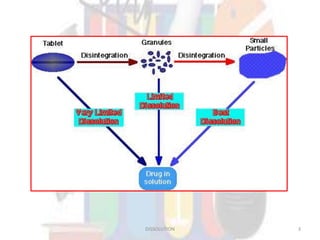
• Dissolution is a process in which a solid substance
solubilizes in a given solvent i.e. mass transfer from
the solid surface to the liquid phase.
• Dissolution is the rate determining step for
hydrophobic, poorly aqueous soluble drugs.
E.g. Griseofulvin, spironolactone
2DISSOLUTION
DISSOLUTION 3
Why dissolution studies?
1. To show that the release of drug from the tablet is
close to 100%.
2. To show that the rate of drug release is uniform
batch to batch.
3. And to show that release is equivalent to those
batches proven to be bioavailable and clinically
effective.
DISSOLUTION 4
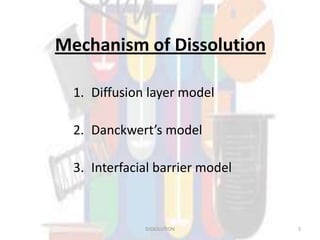
Mechanism of Dissolution
1. Diffusion layer model
2. Danckwert’s model
3. Interfacial barrier model
5DISSOLUTION
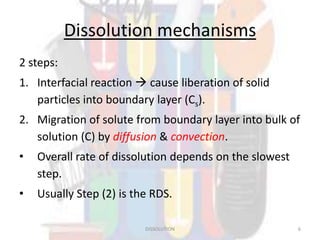
Dissolution mechanisms
2 steps:
1. Interfacial reaction  cause liberation of solid
particles into boundary layer (Cs).
2. Migration of solute from boundary layer into bulk of
solution (C) by diffusion & convection.
• Overall rate of dissolution depends on the slowest
step.
• Usually Step (2) is the RDS.
6DISSOLUTION
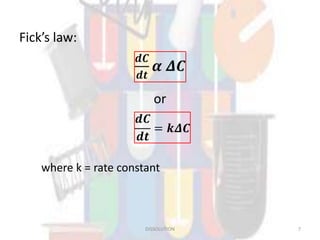
Fick’s law:
or
where k = rate constant
DISSOLUTION 7
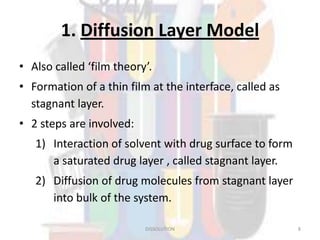
1. Diffusion Layer Model
• Also called ‘film theory’.
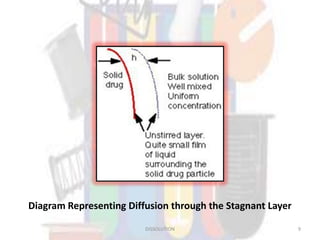
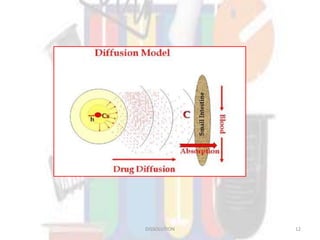
• Formation of a thin film at the interface, called as
stagnant layer.
• 2 steps are involved:
1) Interaction of solvent with drug surface to form
a saturated drug layer , called stagnant layer.
2) Diffusion of drug molecules from stagnant layer
into bulk of the system.
8DISSOLUTION
Diagram Representing Diffusion through the Stagnant Layer
9DISSOLUTION
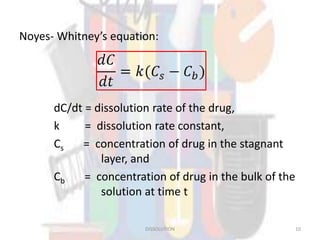
Noyes- Whitney’s equation:
dC/dt = dissolution rate of the drug,
k = dissolution rate constant,
Cs = concentration of drug in the stagnant
layer, and
Cb = concentration of drug in the bulk of the
solution at time t
10DISSOLUTION
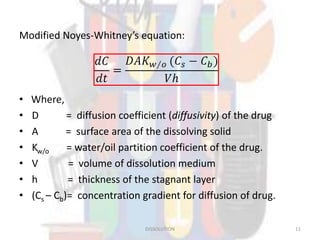
Modified Noyes-Whitney’s equation:
• Where,
• D = diffusion coefficient (diffusivity) of the drug
• A = surface area of the dissolving solid
• Kw/o = water/oil partition coefficient of the drug.
• V = volume of dissolution medium
• h = thickness of the stagnant layer
• (Cs – Cb)= concentration gradient for diffusion of drug.
11DISSOLUTION
12DISSOLUTION
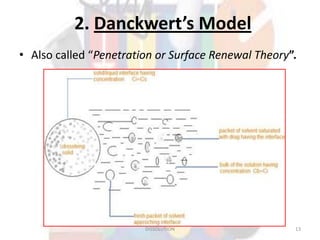
2. Danckwert’s Model
• Also called “Penetration or Surface Renewal Theory”.
13DISSOLUTION
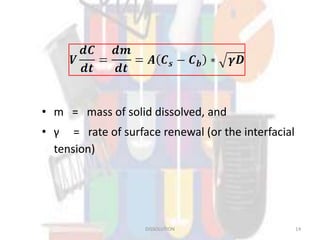
• m = mass of solid dissolved, and
• γ = rate of surface renewal (or the interfacial
tension)
14DISSOLUTION
3. Interfacial Barrier Model
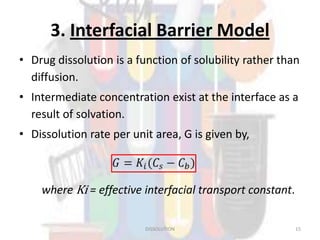
• Drug dissolution is a function of solubility rather than
diffusion.
• Intermediate concentration exist at the interface as a
result of solvation.
• Dissolution rate per unit area, G is given by,
where Ki = effective interfacial transport constant.
15DISSOLUTION
Powder Dissolution:
The Hixson-Crowell Cube Root Law
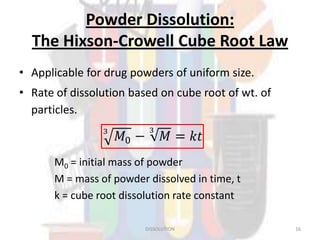
• Applicable for drug powders of uniform size.
• Rate of dissolution based on cube root of wt. of
particles.
M0 = initial mass of powder
M = mass of powder dissolved in time, t
k = cube root dissolution rate constant
DISSOLUTION 16
Particulate Dissolution
• Used to study influence of particle size & surface
area on dissolution.
• Here, surface area is not made constant.
• Weighed powder introduced in dissolution medium
 agitated by propeller.
• Rate of dissolution increases with decrease in
particle size.
• Effective and absolute surface area.
17DISSOLUTION
PROCESS OF DISSOLUTION
States of matter:
• Solid, liquid & gaseous states.
• Dissolution involves relocation of a solute molecule
from an environment where it is surrounded by other
identical molecules, into a cavity in a liquid.
18DISSOLUTION
Energy changes:
• For spontaneous reactions, ΔG must be –ve.
• ‘G’ is a measure of the energy available to a system
to perform work.
ΔG = ΔH – TΔS
Where
ΔH = change in enthalpy of the system
ΔS = change in entropy of the system
T = temperature
• ΔS is usually positive for spontaneous reactions.
19DISSOLUTION
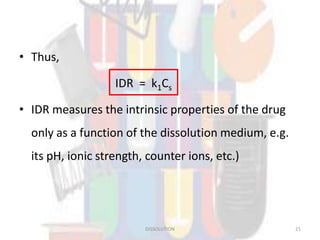
Intrinsic Dissolution rate
• Rate which is independent of rate of agitation, area
of solute available, etc.
• Intrinsic Dissolution Rate (IDR): rate of mass
transfer per area of dissolving surface.
• It is independent of boundary layer thickness and
volume of slolvent .
DISSOLUTION 20
• Thus,
IDR = k1Cs
• IDR measures the intrinsic properties of the drug
only as a function of the dissolution medium, e.g.
its pH, ionic strength, counter ions, etc.)
DISSOLUTION 21
Measurement of dissolution rates
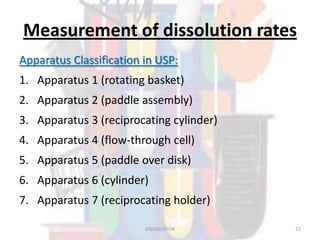
Apparatus Classification in USP:
1. Apparatus 1 (rotating basket)
2. Apparatus 2 (paddle assembly)
3. Apparatus 3 (reciprocating cylinder)
4. Apparatus 4 (flow-through cell)
5. Apparatus 5 (paddle over disk)
6. Apparatus 6 (cylinder)
7. Apparatus 7 (reciprocating holder)
DISSOLUTION 22
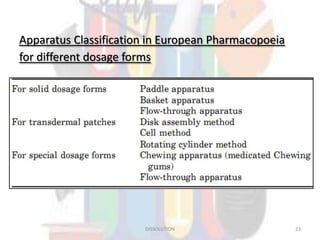
Apparatus Classification in European Pharmacopoeia
for different dosage forms
DISSOLUTION 23
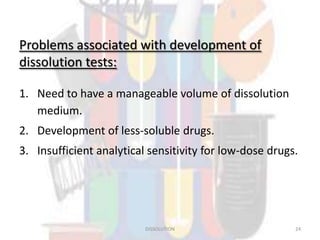
Problems associated with development of
dissolution tests:
1. Need to have a manageable volume of dissolution
medium.
2. Development of less-soluble drugs.
3. Insufficient analytical sensitivity for low-dose drugs.
DISSOLUTION 24
According to USP:
A drug product is considered rapidly dissolving when no
less than 85% of the labeled amount of the drug
substance dissolves within 30 minutes, using USP
Apparatus I at 100 rpm (or Apparatus II at 50 rpm) in a
volume of 900 ml or less in each of the following media:
(1) 0.1 N HCl or Simulated Gastric Fluid USP without
enzymes;
(2) a pH 4.5 buffer; and
(3) a pH 6.8 buffer.
DISSOLUTION 25
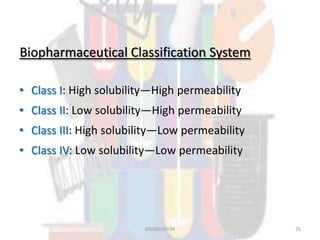
Biopharmaceutical Classification System
• Class I: High solubility—High permeability
• Class II: Low solubility—High permeability
• Class III: High solubility—Low permeability
• Class IV: Low solubility—Low permeability
DISSOLUTION 26
Measurement of dissolution rates
Beaker method:
• Developed by Levy and Hayes.
• Consist of 400 ml beaker with 250 ml dissolution
medium.
• Medium is agitated by a 3-bladed polyethylene
stirrer of 50 mm diameter.
• Stirrer is immersed to a depth of 27 mm into the
dissolution medium and rotated at 60 rpm.
DISSOLUTION 27
Flask-stirrer method:
• R.B. flask is used instead of beaker.
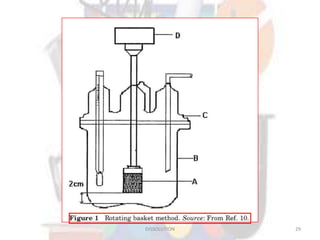
Rotating Basket method:
• USP Apparatus I
• Small wire mesh basket fastened to end of shaft
connected to a motor.
• Immersed in a flask maintained at 370C ± 0.50C.
• Samples are withdrawn at regular intervals.
DISSOLUTION 28
DISSOLUTION 29
Paddle Assembly method
• USP Apparatus II
• Basket in above method is replaced by paddle.
• Paddle is continuous with the shaft.
• Tablet is placed at the bottom of the medium.
Disadvantages:
• Since dissolution volume is limited, use of poorly
soluble drugs is limited.
DISSOLUTION 30
Variables in USP Apparatus I & II
• Type of dissolution medium & its volume.
• Type of apparatus to be used.
• Speed (rpm) of rotation.
• Total time of the test.
• Further assay procedures.
DISSOLUTION 31
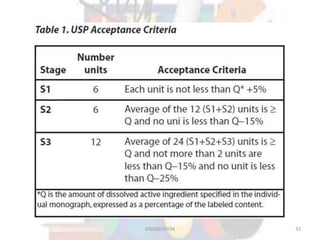
USP Testing methods:
• 6 tablets  monograph tolerance limit, Q + 5%
• If fail, 6 more tablets are used  avg. of 12 tabs ≥ Q,
and none is < Q-15%.
• If failed, 12 more tablets used  avg. of 24 tabs ≥ Q,
and no 2 tab is < Q-15% & none is < Q-25%.
• Usual tolerance in USP / NF is “not less than 75%
dissolved in 45 min”.
DISSOLUTION 32
DISSOLUTION 33
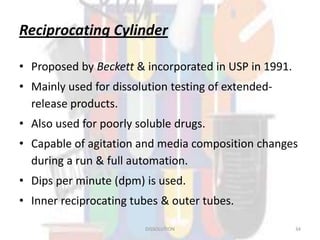
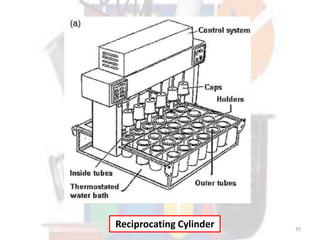
Reciprocating Cylinder
• Proposed by Beckett & incorporated in USP in 1991.
• Mainly used for dissolution testing of extended-
release products.
• Also used for poorly soluble drugs.
• Capable of agitation and media composition changes
during a run & full automation.
• Dips per minute (dpm) is used.
• Inner reciprocating tubes & outer tubes.
DISSOLUTION 34
DISSOLUTION 35
Reciprocating Cylinder
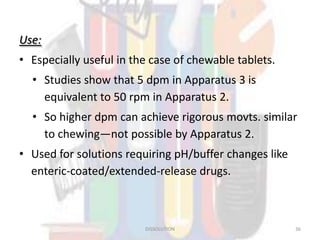
Use:
• Especially useful in the case of chewable tablets.
• Studies show that 5 dpm in Apparatus 3 is
equivalent to 50 rpm in Apparatus 2.
• So higher dpm can achieve rigorous movts. similar
to chewing—not possible by Apparatus 2.
• Used for solutions requiring pH/buffer changes like
enteric-coated/extended-release drugs.
DISSOLUTION 36
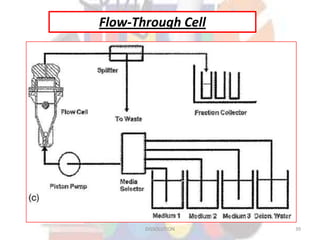
Flow-Through Cell
• Introduced by Langenbucher.
• Open system—offer unlimited medium supply—
especially useful for poorly soluble drugs.
• Also used for dissolution test of sugar-coated tabs,
suppositories, soft gelatin capsules, semi-solids,
granules, implants, etc.
• Small volume cell is subjected to continuous stream
of dissolution media  flow from bottom to top.
DISSOLUTION 37
• Agitation is achieved by pulsating movement of
piston.
• Results obtained as fraction dissolved per unit time
(due to continuous media flow).
• Data is transformed to the usual cumulative amt.
dissolved vs. time.
Advantages:
• Maintenance of sink conditions.
• Minimizing downtime between tests.
DISSOLUTION 38
DISSOLUTION 39
Flow-Through Cell
Qualification & Validation of the
Apparatus
• To maintain “quality by design”.
• Physical & chemical calibrations—geometrical &
dimensional accuracy & precision.
• Vibration or undesired agitation to be avoided.
• Temperature, rotation speed/flow rate, volume,
sampling probe, procedures, etc. need to be
monitored periodically.
• Use of USP calibrator tablets for App. 1 & 2 (to be
performed not less than twice a year)
DISSOLUTION 40
Factors Affecting Dissolution
Surface area & undissolved solid
• Surface area α dissolution.
• Coherent masses may reduce total surface area
available  overcome by using wetting agent.
• Presence of pores.
 E.g. dissolution of phenacetin (hydrophobic) is
enhanced by adding diluent gelatin (hydrophilic)
during granulation.
DISSOLUTION 41
 Addition of Tween 80 to dissolution medium
(0.1 N HCl) for phenacetin increased the
dissolution rate by increasing effective
surface area.
DISSOLUTION 42
Solubility of solid in dissolution medium
 Temp. of dissolution medium
 pH of the medium
 Solubility of the drug in dissolution medium
 Presence of cosolvents
DISSOLUTION 43
Concentration of solute in solution
• Should simulate sink conditions present in GI tract.
• Larger volume of dissolution medium helps to
maintain ‘C’ negligible compared to ‘Cs’.
• Removal of dissolved solute from dissolution
medium enhances rate of dissolution.
 Eg. Adsorption onto another substance
 Partition to another immiscible liquid
 Removal of solute by dialysis
 Cont. replacement of dissolution medium
DISSOLUTION 44
Dissolution rate constant
Depend upon
 Thickness of boundary layer
 Degree of agitation
 Speed of stirring
 Shape, size & position of stirrer
 Vol. of dissolution medium
 Shape & size of container
 Viscosity of dissolution medium
DISSOLUTION 45
Disintegration & Deaggregation
• Disintegration and subsequent deaggregation may
also be RDS for dissolution.
o E.g. coated dosage forms
• After disintegration, larger aggregates need to
deaggregate to yield fine particles.
DISSOLUTION 46
Effect of manufacturing processes
Addition of lubricants
E.g.: 325-mg salicylic acid dissolved rapidly in 0.1 N
HCl when SLS was added to it.
Dissolution rate decreases with addition of
hydrophobic lubricants like Mg. stearate.
• Most effective lubricants are hydrophobic  act by
particle coating  hence mfg. process is imp.
DISSOLUTION 47
Addition of disintegrating agents like starch  swell
& enhance dissolution.
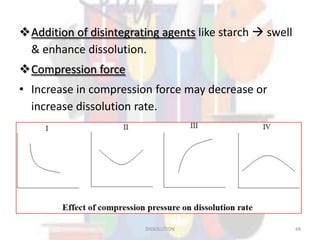
Compression force
• Increase in compression force may decrease or
increase dissolution rate.
DISSOLUTION 48
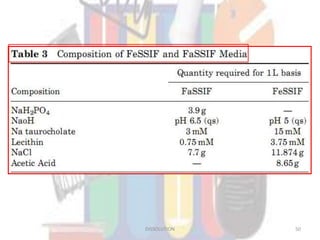
Recent developments in dissolution testing
• Use of more biorelevant media—FaSSIF & FeSSIF
media.
• FaSSIF—Fasted State Simulated Intestinal Fluid
• FeSSIF—Fed State Simulated Intestinal Fluid
Advantages:
• Provide physicochemical properties similar to human
GIT.
DISSOLUTION 49
DISSOLUTION 50
REFERENCE
1. Fonner. D. E, Banker. G. S., Granulation & Tablet Characteristics,
In Pharmaceutical Dosage Forms: Tablets. Vol. 2. Edited by H.
Lieberman & L. Lachman, Dekker, New York, 1982, p. 202
2. Leon Lachman, Herbert. A. Lieberman, The Theory and Practice
of Industrial Pharmacy, 3rd edition, Varghese Publishing House,
Bombay, 1991, pp. 301-303
3. Brahmankar. D. M., Sunil Jaiswal. B, Biopharmaceutics and
Pharmacokinetics—A Treatise, 1st edition, Vallabh Prakashan,
New Delhi, 2006, pp. 19-25
4. Alfred Martin, James Swarbrick, Physical Pharmacy, 3rd edition,
Varghese Publishing House, Bombay, 1991, pp. 408-412
DISSOLUTION 51
DISSOLUTION 52