
DRUG DISSOLUTION
SUBMITTED TO –
Dr. D.C. Bhatt Sir
(Director & Dean)
Institute of Pharmaceutical Sciences
SUBMITTED BY-
Sidharth
Roll no.190121220005
M.Pharmacy (Pharmaceutics)
2nd Semester
DEPARTMENT OF PHARMACEUTICAL SCIENCES,
GURU JAMBHESHWAR UNIVERSITY OF SCIENCES & TECHNOLOGY, HISAR
CONTENTS
 Introduction
 Factors Affecting GI Absorption of a Drug
 Definition
 Mechanism of Dissolution
 Biopharmaceutics classification system for
Drugs
 Theories Of Dissolution
 Factors Affecting Dissolution Rate
Introduction
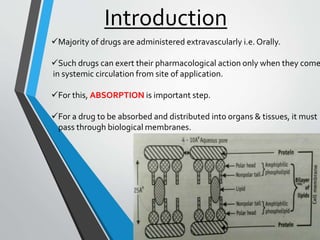
Majority of drugs are administered extravascularly i.e. Orally.
Such drugs can exert their pharmacological action only when they come
in systemic circulation from site of application.
For this, ABSORPTION is important step.
For a drug to be absorbed and distributed into organs & tissues, it must
pass through biological membranes.
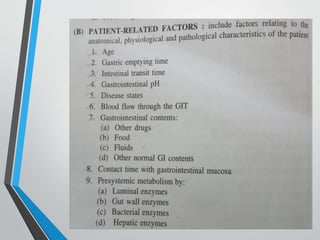
FACTORS AFFECTING GI ABSORPTION OF A DRUG-
Definition-
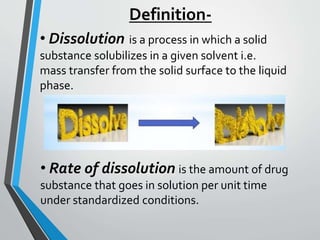
• Dissolution is a process in which a solid
substance solubilizes in a given solvent i.e.
mass transfer from the solid surface to the liquid
phase.
• Rate of dissolution is the amount of drug
substance that goes in solution per unit time
under standardized conditions.
Fig.The rate-determining steps in absorption of drugs
Eg. of Lipophilic Drugs-Griseofulvin & Spironolactone
Eg. of Hydrophilic Drugs-Cromolyn sod. & Neomycin
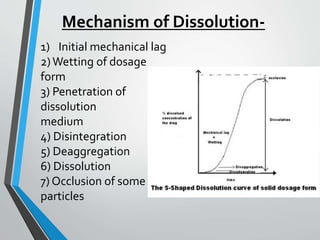
Mechanism of Dissolution-
1) Initial mechanical lag
2)Wetting of dosage
form
3) Penetration of
dissolution
medium
4) Disintegration
5) Deaggregation
6) Dissolution
7) Occlusion of some
particles
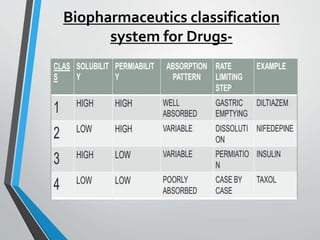
Biopharmaceutics classification
system for Drugs-
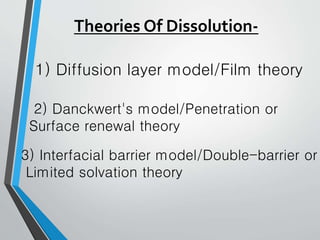
Theories Of Dissolution-
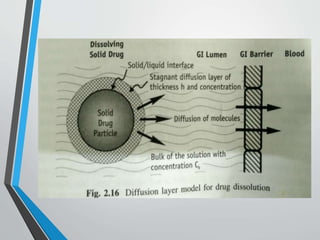
1) Diffusion layer model/Film theory
2) Danckwert's model/Penetration or
Surface renewal theory
3) Interfacial barrier model/Double-barrier or
Limited solvation theory
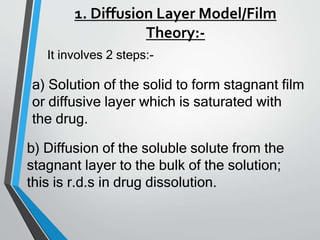
1. Diffusion Layer Model/Film
Theory:-
It involves 2 steps:-
a) Solution of the solid to form stagnant film
or diffusive layer which is saturated with
the drug.
b) Diffusion of the soluble solute from the
stagnant layer to the bulk of the solution;
this is r.d.s in drug dissolution.
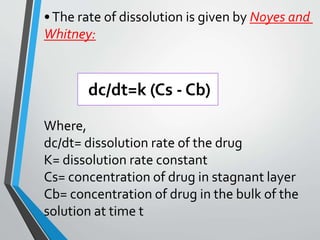
•The rate of dissolution is given by Noyes and
Whitney:
dc/dt=k (Cs - Cb)
Where,
dc/dt= dissolution rate of the drug
K= dissolution rate constant
Cs= concentration of drug in stagnant layer
Cb= concentration of drug in the bulk of the
solution at time t
dc/dt=k (Cs - Cb)
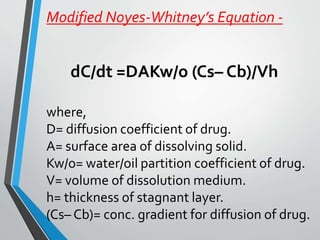
Modified Noyes-Whitney’s Equation -
dC/dt =DAKw/o (Cs– Cb)/Vh
where,
D= diffusion coefficient of drug.
A= surface area of dissolving solid.
Kw/o= water/oil partition coefficient of drug.
V= volume of dissolution medium.
h= thickness of stagnant layer.
(Cs– Cb)= conc. gradient for diffusion of drug.
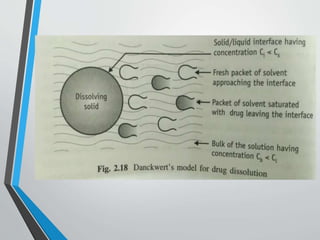
2) Danckwert’s model/Penetration or
surface renewalTheory:-
• Dankwert takes into account the eddies or
packets that are present in the agitated fluid
which reach the solid-liquid interface, absorb
the solute by diffusion and carry it into the bulk
of solution.
•These packets get continuously replaced by
new ones and expose to new solid surface
each time, thus the theory is called as surface
renewal theory.
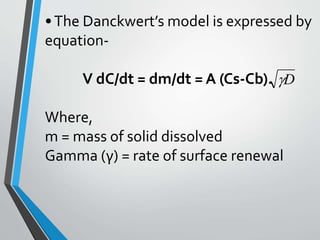
•The Danckwert’s model is expressed by
equation-
V dC/dt = dm/dt = A (Cs-Cb).
Where,
m = mass of solid dissolved
Gamma (γ) = rate of surface renewal
D
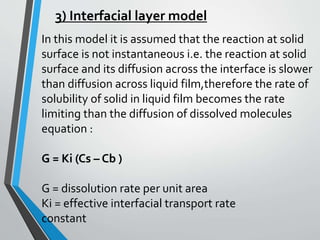
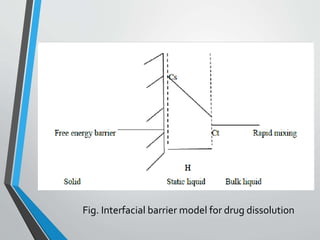
3) Interfacial layer model
In this model it is assumed that the reaction at solid
surface is not instantaneous i.e. the reaction at solid
surface and its diffusion across the interface is slower
than diffusion across liquid film,therefore the rate of
solubility of solid in liquid film becomes the rate
limiting than the diffusion of dissolved molecules
equation :
G = Ki (Cs – Cb )
G = dissolution rate per unit area
Ki = effective interfacial transport rate
constant
Fig. Interfacial barrier model for drug dissolution
FACTORS AFFECTING DISSOLUTION
RATE:-
1. Factors related to Physicochemical
Properties of Drug
2. Factors related to Drug Product
Formulation
3. Processing Factor
4. Factors Relating Dissolution
Apparatus
5. Factors Relating DissolutionTest
Parameters
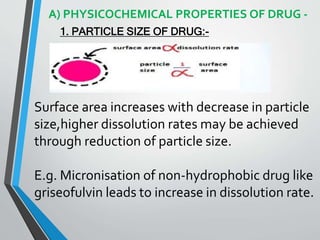
A) PHYSICOCHEMICAL PROPERTIES OF DRUG -
1. PARTICLE SIZE OF DRUG:-
Surface area increases with decrease in particle
size,higher dissolution rates may be achieved
through reduction of particle size.
E.g. Micronisation of non-hydrophobic drug like
griseofulvin leads to increase in dissolution rate.
2. DRUG SOLUBILITY:-
Minimum aqueous solubility of 1% is required.
Eg.Poorly soluble drug : griseofulvin, spironolactone
- Anhydrous forms dissolve faster than hydrated form
because they are thermodynamically more active than
hydrates.
E.g. Ampicillin anhydrate faster dissolution rate than
trihydrate.
- Amorphous forms of drug tend to dissolve faster than
crystalline materials.
E.g. Novobiocin , Griseofulvin.
3. SOLID STATE CHARACTERISTICS:-
- Metastable (high activation energy) polymorphic form have
better dissolution than stable form. Eg. Methyl prednisone.
4. SALT FORMATION:-
- It is one of the common approaches used to increase drug
solubility and dissolution rate.
- It has always been assumed that sodium salts dissolve faster
than their corresponding insoluble acids.
- E.g. sodium and potassium salts of Penicillin G, phenytoin,
barbiturates, tolbutamide etc.
B) FACTORS RELATEDTO DRUG PRODUCT FORMULATION-
1. BINDERS:-
-The hydrophilic binders like gelatin increase dissolution rate of
poorly wettable drug.
- Non aqueous binders such as ethyl cellulose retard the drug
dissolution.
- Phenobarbital tablet granulated with gelatin solution provide a
faster dissolution rate in human gastric juice than those prepared
using Na – carboxymethyl cellulose or polyethylene glycol 6000
as binder.
Note:- Large amount of binder increase hardness & decrease
disintegration /dissolution rate of tablet.
- Disintegrating agent added before & after the
granulation affects the dissolution rate.
- Studies of various disintegrating agents on
Phenobarbital tablet showed that when copagel
(low viscosity grade of Na CMC) added before
granulation decreased dissolution rate but if added
after did not had any effect on dissolution rate.
2. DISINTEGRANTS:-
3. EFFECT OF LUBRICANTS:-
- Lubricants are hydrophobic in nature and prolong the tablet
disintegration time by forming water repellent coat around
individual granules.This retarding the rate of dissolution of
solid dosage forms.
- However, if an enhancing effect in dissolution of
hydrophobic granules is desired, water soluble lubricant
such as SLS or CARBOWAXES may be used.
4. SURFACTANTS:-
They enhance the dissolution rate of poorly soluble drug.
This is due to lowering of interfacial tension, increasing
effective surface area, which in turn results in faster
dissolution rate.
E.g Non-ionic surfactant Polysorbate 80 increase
dissolution rate of phenacetin granules.
Tablets with MC coating were found to exhibit lower dissolution
profiles than those coated with HPMC at 37ºC.The differences
are attributed to thermal gelation of MC at temp near 37º,
which creates a barrier to dissolution process.
5. COATING POLYMERS:-
C) PROCESSING FACTORS-
1. METHOD OF GRANULATION:-
-Wet granulation has been shown to improve the dissolution
rate of poorly soluble drugs by imparting hydrophilic
properties to the surface of granules.
- A newer technology called as APOC “Agglomerative Phase of
Comminution” was found to produce mechanically stronger
tablets with higher dissolution rates than those made by wet
granulation. A possible mechanism is increased internal surface
area of granules produced by APOC method.
2. COMPRESSION FORCE:-
The compression process influence density, porosity, hardness,
disintegration time & dissolution of tablet.
3. DRUG EXCIPIENT INTERACTION:-
-These interactions occur during any unit operation such as mixing,
milling, blending, drying or granulating result change in
dissolution.
- Increase in mixing time of formulation containing 97 to 99%
microcrystalline cellulose (slightly swelling disintegrant) result in
enhance dissolution rate of prednisolone.
- Polysorbate-80 used as excipient in capsules causes formation of
formaldehyde by autoxidation which causes film formation by
denaturing the inner surface of capsule.This causes decrease in
dissolution rate of capsules.
4) STORAGE CONDITIONS:-
- Dissolution rate of Hydrochlorthiazide tablets
granulated with acacia exhibited decrease in
dissolution rate during 1 yr of aging at RoomTemperature.
- A similar decrease was observed in tablets stored for 14 days
at 50-80ºC or for 4 weeks at 37ºC.
-Tablets with starch gave no change in dissolution
rate either at RoomTemperature or at elevated temperature.
D) FACTORS RELATED TO DISSOLUTION APPARATUS
1) AGITATION:-
In order to prevent turbulence and sustain a reproducible
laminar flow, which is essential for obtaining reliable results,
agitation should be maintained at a relatively low rate.
Thus, in general relatively low agitation should be applied.
I. BASKET METHOD- 100 rpm
II. PADDLE METHOD- 50-75 rpm
2. SAMPLING PROBE POSITION:-
USP states that sample should be removed at
approximately half the distance from the upper surface of
basket or paddle and surface of dissolution medium and not
closer than 1 cm to the side of the flask.
3. STIRRING ELEMENT ALIGNMENT:-
-The USP states that the axis of the stirring element must
not deviate more than 0.2 mm from the axis of the
dissolution vessel.
-Tilt in excess of 1.5◦ may increase dissolution rate from 2
to 25%.
E) FACTORS RELATING DISSOLUTIONTEST PARAMETERS:-
1) TEMPERATURE:-
- Drug solubility is temperature dependent, therefore
careful temperature control during dissolution process is
extremely important.
- Generally, a temperature of 37º ± 0.5 is maintained
during dissolution determination of oral dosage forms and
suppositories.
2) VIBRATION:-
The excessive vibration of dissolution apparatus increases
dissolution rates.
3) VESSEL DESIGN AND CONSTRUCTION:-
Plastic vessels provide more perfect hemisphere than glass
vessels.
4) pH OF DISSOLUTION MEDIUM:-
Weak acids---dissolution rate increases with increase in pH
whereas, for weak bases---increase with decrease in pH.
References:
1) SubrahmanyamCVS.Text book of physical pharmaceutics.
2nd edition,Vallabh prakashan, Delhi, 2000.
2) Brahmankar DM, Sunil BJ. Biopharmaceutics and
pharmacokinetics. 3rd edition,Vallabh prakashan, Delhi, 2015.
3) Shahebaz N.G, Jigar R.Vyas, Umesh M. Upadhyay and Aiyub
A.Patel. Study of processing parameters affecting dissolution
profile of highly water soluble drug. Scholars Research
Library. 2013;5(3):211-222.
Drug Dissolution

Drug Dissolution

  • 1.
    DRUG DISSOLUTION SUBMITTED TO– Dr. D.C. Bhatt Sir (Director & Dean) Institute of Pharmaceutical Sciences SUBMITTED BY- Sidharth Roll no.190121220005 M.Pharmacy (Pharmaceutics) 2nd Semester DEPARTMENT OF PHARMACEUTICAL SCIENCES, GURU JAMBHESHWAR UNIVERSITY OF SCIENCES & TECHNOLOGY, HISAR
  • 2.
    CONTENTS  Introduction  FactorsAffecting GI Absorption of a Drug  Definition  Mechanism of Dissolution  Biopharmaceutics classification system for Drugs  Theories Of Dissolution  Factors Affecting Dissolution Rate
  • 3.
    Introduction Majority of drugsare administered extravascularly i.e. Orally. Such drugs can exert their pharmacological action only when they come in systemic circulation from site of application. For this, ABSORPTION is important step. For a drug to be absorbed and distributed into organs & tissues, it must pass through biological membranes.
  • 4.
    FACTORS AFFECTING GIABSORPTION OF A DRUG-
  • 6.
    Definition- • Dissolution isa process in which a solid substance solubilizes in a given solvent i.e. mass transfer from the solid surface to the liquid phase. • Rate of dissolution is the amount of drug substance that goes in solution per unit time under standardized conditions.
  • 7.
    Fig.The rate-determining stepsin absorption of drugs Eg. of Lipophilic Drugs-Griseofulvin & Spironolactone Eg. of Hydrophilic Drugs-Cromolyn sod. & Neomycin
  • 8.
    Mechanism of Dissolution- 1)Initial mechanical lag 2)Wetting of dosage form 3) Penetration of dissolution medium 4) Disintegration 5) Deaggregation 6) Dissolution 7) Occlusion of some particles
  • 9.
  • 10.
    Theories Of Dissolution- 1)Diffusion layer model/Film theory 2) Danckwert's model/Penetration or Surface renewal theory 3) Interfacial barrier model/Double-barrier or Limited solvation theory
  • 11.
    1. Diffusion LayerModel/Film Theory:- It involves 2 steps:- a) Solution of the solid to form stagnant film or diffusive layer which is saturated with the drug. b) Diffusion of the soluble solute from the stagnant layer to the bulk of the solution; this is r.d.s in drug dissolution.
  • 13.
    •The rate ofdissolution is given by Noyes and Whitney: dc/dt=k (Cs - Cb) Where, dc/dt= dissolution rate of the drug K= dissolution rate constant Cs= concentration of drug in stagnant layer Cb= concentration of drug in the bulk of the solution at time t dc/dt=k (Cs - Cb)
  • 14.
    Modified Noyes-Whitney’s Equation- dC/dt =DAKw/o (Cs– Cb)/Vh where, D= diffusion coefficient of drug. A= surface area of dissolving solid. Kw/o= water/oil partition coefficient of drug. V= volume of dissolution medium. h= thickness of stagnant layer. (Cs– Cb)= conc. gradient for diffusion of drug.
  • 15.
    2) Danckwert’s model/Penetrationor surface renewalTheory:- • Dankwert takes into account the eddies or packets that are present in the agitated fluid which reach the solid-liquid interface, absorb the solute by diffusion and carry it into the bulk of solution. •These packets get continuously replaced by new ones and expose to new solid surface each time, thus the theory is called as surface renewal theory.
  • 17.
    •The Danckwert’s modelis expressed by equation- V dC/dt = dm/dt = A (Cs-Cb). Where, m = mass of solid dissolved Gamma (γ) = rate of surface renewal D
  • 18.
    3) Interfacial layermodel In this model it is assumed that the reaction at solid surface is not instantaneous i.e. the reaction at solid surface and its diffusion across the interface is slower than diffusion across liquid film,therefore the rate of solubility of solid in liquid film becomes the rate limiting than the diffusion of dissolved molecules equation : G = Ki (Cs – Cb ) G = dissolution rate per unit area Ki = effective interfacial transport rate constant
  • 19.
    Fig. Interfacial barriermodel for drug dissolution
  • 20.
    FACTORS AFFECTING DISSOLUTION RATE:- 1.Factors related to Physicochemical Properties of Drug 2. Factors related to Drug Product Formulation 3. Processing Factor 4. Factors Relating Dissolution Apparatus 5. Factors Relating DissolutionTest Parameters
  • 21.
    A) PHYSICOCHEMICAL PROPERTIESOF DRUG - 1. PARTICLE SIZE OF DRUG:- Surface area increases with decrease in particle size,higher dissolution rates may be achieved through reduction of particle size. E.g. Micronisation of non-hydrophobic drug like griseofulvin leads to increase in dissolution rate.
  • 22.
    2. DRUG SOLUBILITY:- Minimumaqueous solubility of 1% is required. Eg.Poorly soluble drug : griseofulvin, spironolactone - Anhydrous forms dissolve faster than hydrated form because they are thermodynamically more active than hydrates. E.g. Ampicillin anhydrate faster dissolution rate than trihydrate. - Amorphous forms of drug tend to dissolve faster than crystalline materials. E.g. Novobiocin , Griseofulvin. 3. SOLID STATE CHARACTERISTICS:-
  • 23.
    - Metastable (highactivation energy) polymorphic form have better dissolution than stable form. Eg. Methyl prednisone. 4. SALT FORMATION:- - It is one of the common approaches used to increase drug solubility and dissolution rate. - It has always been assumed that sodium salts dissolve faster than their corresponding insoluble acids. - E.g. sodium and potassium salts of Penicillin G, phenytoin, barbiturates, tolbutamide etc.
  • 24.
    B) FACTORS RELATEDTODRUG PRODUCT FORMULATION- 1. BINDERS:- -The hydrophilic binders like gelatin increase dissolution rate of poorly wettable drug. - Non aqueous binders such as ethyl cellulose retard the drug dissolution. - Phenobarbital tablet granulated with gelatin solution provide a faster dissolution rate in human gastric juice than those prepared using Na – carboxymethyl cellulose or polyethylene glycol 6000 as binder. Note:- Large amount of binder increase hardness & decrease disintegration /dissolution rate of tablet.
  • 25.
    - Disintegrating agentadded before & after the granulation affects the dissolution rate. - Studies of various disintegrating agents on Phenobarbital tablet showed that when copagel (low viscosity grade of Na CMC) added before granulation decreased dissolution rate but if added after did not had any effect on dissolution rate. 2. DISINTEGRANTS:-
  • 26.
    3. EFFECT OFLUBRICANTS:- - Lubricants are hydrophobic in nature and prolong the tablet disintegration time by forming water repellent coat around individual granules.This retarding the rate of dissolution of solid dosage forms. - However, if an enhancing effect in dissolution of hydrophobic granules is desired, water soluble lubricant such as SLS or CARBOWAXES may be used. 4. SURFACTANTS:- They enhance the dissolution rate of poorly soluble drug. This is due to lowering of interfacial tension, increasing effective surface area, which in turn results in faster dissolution rate. E.g Non-ionic surfactant Polysorbate 80 increase dissolution rate of phenacetin granules.
  • 27.
    Tablets with MCcoating were found to exhibit lower dissolution profiles than those coated with HPMC at 37ºC.The differences are attributed to thermal gelation of MC at temp near 37º, which creates a barrier to dissolution process. 5. COATING POLYMERS:-
  • 28.
    C) PROCESSING FACTORS- 1.METHOD OF GRANULATION:- -Wet granulation has been shown to improve the dissolution rate of poorly soluble drugs by imparting hydrophilic properties to the surface of granules. - A newer technology called as APOC “Agglomerative Phase of Comminution” was found to produce mechanically stronger tablets with higher dissolution rates than those made by wet granulation. A possible mechanism is increased internal surface area of granules produced by APOC method.
  • 29.
    2. COMPRESSION FORCE:- Thecompression process influence density, porosity, hardness, disintegration time & dissolution of tablet. 3. DRUG EXCIPIENT INTERACTION:- -These interactions occur during any unit operation such as mixing, milling, blending, drying or granulating result change in dissolution. - Increase in mixing time of formulation containing 97 to 99% microcrystalline cellulose (slightly swelling disintegrant) result in enhance dissolution rate of prednisolone. - Polysorbate-80 used as excipient in capsules causes formation of formaldehyde by autoxidation which causes film formation by denaturing the inner surface of capsule.This causes decrease in dissolution rate of capsules.
  • 30.
    4) STORAGE CONDITIONS:- -Dissolution rate of Hydrochlorthiazide tablets granulated with acacia exhibited decrease in dissolution rate during 1 yr of aging at RoomTemperature. - A similar decrease was observed in tablets stored for 14 days at 50-80ºC or for 4 weeks at 37ºC. -Tablets with starch gave no change in dissolution rate either at RoomTemperature or at elevated temperature.
  • 31.
    D) FACTORS RELATEDTO DISSOLUTION APPARATUS 1) AGITATION:- In order to prevent turbulence and sustain a reproducible laminar flow, which is essential for obtaining reliable results, agitation should be maintained at a relatively low rate. Thus, in general relatively low agitation should be applied. I. BASKET METHOD- 100 rpm II. PADDLE METHOD- 50-75 rpm
  • 32.
    2. SAMPLING PROBEPOSITION:- USP states that sample should be removed at approximately half the distance from the upper surface of basket or paddle and surface of dissolution medium and not closer than 1 cm to the side of the flask. 3. STIRRING ELEMENT ALIGNMENT:- -The USP states that the axis of the stirring element must not deviate more than 0.2 mm from the axis of the dissolution vessel. -Tilt in excess of 1.5◦ may increase dissolution rate from 2 to 25%.
  • 33.
    E) FACTORS RELATINGDISSOLUTIONTEST PARAMETERS:- 1) TEMPERATURE:- - Drug solubility is temperature dependent, therefore careful temperature control during dissolution process is extremely important. - Generally, a temperature of 37º ± 0.5 is maintained during dissolution determination of oral dosage forms and suppositories. 2) VIBRATION:- The excessive vibration of dissolution apparatus increases dissolution rates.
  • 34.
    3) VESSEL DESIGNAND CONSTRUCTION:- Plastic vessels provide more perfect hemisphere than glass vessels. 4) pH OF DISSOLUTION MEDIUM:- Weak acids---dissolution rate increases with increase in pH whereas, for weak bases---increase with decrease in pH.
  • 35.
    References: 1) SubrahmanyamCVS.Text bookof physical pharmaceutics. 2nd edition,Vallabh prakashan, Delhi, 2000. 2) Brahmankar DM, Sunil BJ. Biopharmaceutics and pharmacokinetics. 3rd edition,Vallabh prakashan, Delhi, 2015. 3) Shahebaz N.G, Jigar R.Vyas, Umesh M. Upadhyay and Aiyub A.Patel. Study of processing parameters affecting dissolution profile of highly water soluble drug. Scholars Research Library. 2013;5(3):211-222.