DISSOLUTION TEST
APPARATUS
Guided by :-
Prof. Dr. H. S.Mahajan
H.O.D. Pharmaceutics
Prepared by :-
Nilesh K. Bornare
M.Pharm 1st year
R.C.PATEL INSTITUTE OF PHARMACEUTICAL EDUCATION AND RESEARCH,
SHIRPUR.
1
CONTENTS
• INTRODUCTION:
• NEED FOR DISSOLUTION TESTING
• THEORIES OF DISSOLUTION
• TYPES OF DISSOLUTION TEST APPARATUS
• CONCLUSION
• REFERENCES
2
INTRODUCTION
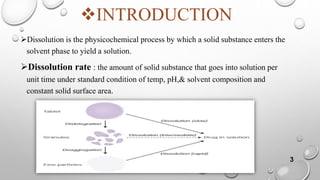
Dissolution is the physicochemical process by which a solid substance enters the
solvent phase to yield a solution.
Dissolution rate : the amount of solid substance that goes into solution per
unit time under standard condition of temp, pH,& solvent composition and
constant solid surface area.
3
NEED FOR DISSOLUTION
TESTING
Batch to batch drug release uniformity .
Development and optimization of dosage forms .
Ensures quality, safety, efficacy and stability of the product .
Evaluation of IVIVC correlation / bioavailability.
To support waiver for bioequivalence requirement.
For assessing pre and post approval changes in manufacturing process or
formulation .
4
THEORIES OF DRUG DISSOLUTION
Three type of dissolution model are proposed depending on the relative
significance and the means by which the transport is effected . these models which
can be used to describe the dissolution rate mechanism .
The three models are:
1.Diffusion layer model / film theory.
2.Danckwert’s model / penetration or surface renewal theory .
3.Interfacial barrier model /double barrier or limited solvation theory.
5
1.DIFFUSION LAYER MODEL / FILM THEORY:
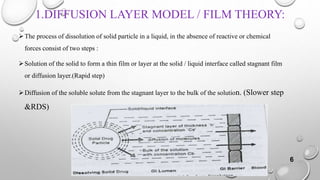
The process of dissolution of solid particle in a liquid, in the absence of reactive or chemical
forces consist of two steps :
Solution of the solid to form a thin film or layer at the solid / liquid interface called stagnant film
or diffusion layer.(Rapid step)
Diffusion of the soluble solute from the stagnant layer to the bulk of the solution. (Slower step
&RDS)
6
 The rate of dissolution when the process is diffusion controlled and involves no chemical reaction was given by noyes and
whitney equation
Dc/d t = k (cs - cb)
Where,
Dc/ dt = dissolution rate of the drug .
K = dissolution rate constant .
(cs –cb) =conc gradient for diffusion of drug.
 Nernst and brunner ( fick’s first law diffusion ) modified the noyes and whitney equation
I.E. Dc/d t = dakw/o ( cs –cb)/vh
Where,
D = diffusion coefficient (diffusivity) of drug .
A= surface area of dissolving solid .
kw/o = water/oil partition coefficient.
V = volume of dissolution medium.
H = thickness of the stagnant layer.
7
2.DANCKWERT’S MODEL (PENETRATION OR SURFACE
RENEWAL THEORY )
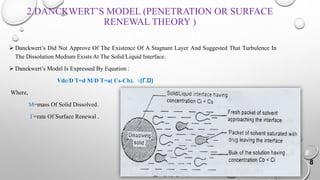
 Danckwert’s Did Not Approve Of The Existence Of A Stagnant Layer And Suggested That Turbulence In
The Dissolution Medium Exists At The Solid/Liquid Interface.
 Danckwert’s Model Is Expressed By Equation :
Vdc/D T=d M/D T=a( Cs-Cb). √(Γ.D)
Where,
M=mass Of Solid Dissolved.
Γ=rate Of Surface Renewal .
8
3. INTERFACIAL BARRIER MODEL (DOUBLE
BARRIER OR LIMITED SOLVATION THEORY)
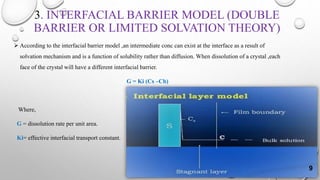
 According to the interfacial barrier model ,an intermediate conc can exist at the interface as a result of
solvation mechanism and is a function of solubility rather than diffusion. When dissolution of a crystal ,each
face of the crystal will have a different interfacial barrier.
G = Ki (Cs –Cb)
Where,
G = dissolution rate per unit area.
Ki= effective interfacial transport constant.
9
USPAPPARATUS (COMPENDIAL METHOD)
1.ROTATING BASKET APPARATUS
2.ROTATING PADDLE APPARATUS
3.RECIPROCATING CYLINDER APPARATUS
4.FLOW THROUGH CELL APPARATUS
5.PADDLE OVER DISC APPARATUS
6.CYLINDER APPARATUS
7.RECIPROCATING HOLDER APPARATUS
10
11
12
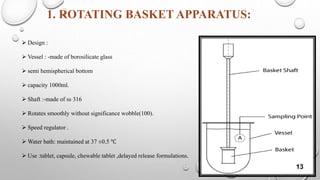
1. ROTATING BASKET APPARATUS:
 Design :
 Vessel : -made of borosilicate glass
 semi hemispherical bottom
 capacity 1000ml.
 Shaft :-made of ss 316
 Rotates smoothly without significance wobble(100).
 Speed regulator .
 Water bath: maintained at 37 ±0.5 ℃
 Use :tablet, capsule, chewable tablet ,delayed release formulations.
13
 Advantages:
• Full pH change during the test .
• can be easily automated which is imp for routine investigation .
Disadvantages:
• Basket screen is clogged with gummy particle .
• degassing is particularly important .
• mess gets corroded by HCL solution .
14
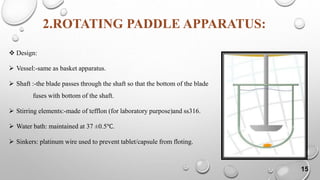
2.ROTATING PADDLE APPARATUS:
 Design:
 Vessel:-same as basket apparatus.
 Shaft :-the blade passes through the shaft so that the bottom of the blade
fuses with bottom of the shaft.
 Stirring elements:-made of tefflon (for laboratory purpose)and ss316.
 Water bath: maintained at 37 ±0.5℃.
 Sinkers: platinum wire used to prevent tablet/capsule from floting.
15
 Use: tablet, orally disintegration tab, chewable tab, controlled release products, suspension.
 Advantages:
• Easy to use
• Robust
• pH change possible
• can be easily automated which is imp for routine investigation.
 Disadvantages:
• Sinkers for floating dosage form
• Hydrodynamic are complex ,they vary with site of the dosage form in the vessel(sticking, floting)and
therefore may significantly affect drug dissolution .
16
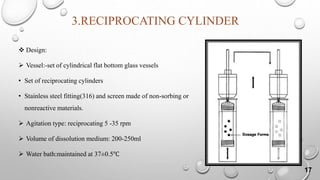
3.RECIPROCATING CYLINDER
 Design:
 Vessel:-set of cylindrical flat bottom glass vessels
• Set of reciprocating cylinders
• Stainless steel fitting(316) and screen made of non-sorbing or
nonreactive materials.
 Agitation type: reciprocating 5 -35 rpm
 Volume of dissolution medium: 200-250ml
 Water bath:maintained at 37±0.5℃
17
Uses: tablets, controlled release bead(pellet) type
formulations.
Advantages:-easy to change the pH
- Hydrodynamic can be directly influenced by varying the
dip rate.
Disadvantage:-small volume (max .250ml)
- Little experience
- Limited data 18
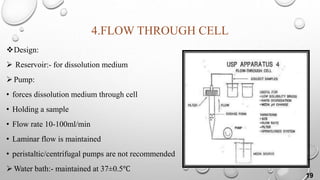
4.FLOW THROUGH CELL
Design:
 Reservoir:- for dissolution medium
Pump:
• forces dissolution medium through cell
• Holding a sample
• Flow rate 10-100ml/min
• Laminar flow is maintained
• peristaltic/centrifugal pumps are not recommended
Water bath:- maintained at 37±0.5℃
19
Uses: low solubility drugs, powders and granules, microparticles, implants .
 advantages:
• Easy to change media pH
• PH profile possible
• sink condition maintained
• different mode i.e. open system and closed system.
Disadvantages:
• De-aeration necessary
• high volume of media
• Labor intensive
20
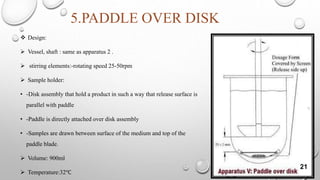
5.PADDLE OVER DISK
 Design:
 Vessel, shaft : same as apparatus 2 .
 stirring elements:-rotating speed 25-50rpm
 Sample holder:
• -Disk assembly that hold a product in such a way that release surface is
parallel with paddle
• -Paddle is directly attached over disk assembly
• -Samples are drawn between surface of the medium and top of the
paddle blade.
 Volume: 900ml
 Temperature:32℃
21
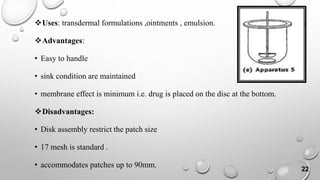
Uses: transdermal formulations ,ointments , emulsion.
Advantages:
• Easy to handle
• sink condition are maintained
• membrane effect is minimum i.e. drug is placed on the disc at the bottom.
Disadvantages:
• Disk assembly restrict the patch size
• 17 mesh is standard .
• accommodates patches up to 90mm. 22
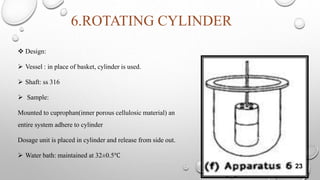
6.ROTATING CYLINDER
 Design:
 Vessel : in place of basket, cylinder is used.
 Shaft: ss 316
 Sample:
Mounted to cuprophan(inner porous cellulosic material) an
entire system adhere to cylinder
Dosage unit is placed in cylinder and release from side out.
 Water bath: maintained at 32±0.5℃
23
Uses: transdermal formulations
Advantages:
-Equipment (apparatus 1) available with the manufactures can be used with
modification as apparatus 6.
Disadvantages:
- Large volume of medium is required
- Drug gets diluted and causes difficulties in analysis
- Difficult to clean the cylinder
24
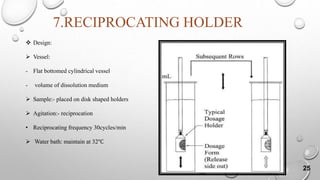
7.RECIPROCATING HOLDER
 Design:
 Vessel:
- Flat bottomed cylindrical vessel
- volume of dissolution medium
 Sample:- placed on disk shaped holders
 Agitation:- reciprocation
• Reciprocating frequency 30cycles/min
 Water bath: maintain at 32℃
25
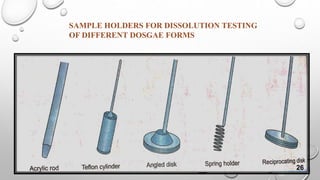
SAMPLE HOLDERS FOR DISSOLUTION TESTING
OF DIFFERENT DOSGAE FORMS
26
Uses: controlled release formulations ,non disintegration and transdermal
formulations.
Advantages:
-Convenient method for selecting the volume of the medium
-Sink conditions can be maintained
-More sensitivity
Disadvantages: investment is high because the design is totally different from
standard equipment already available in industry.
27
CONCLUSION
• Dissolution research started to develop in 1897 when Noyes and Whitney derived
their equation in the course of their dissolution studies on benzoic acid and lead
chloride.
• The goal of dissolution testing is to assure the pharmaceutical quality of the
product (manufacturing of product, release property and biopharmaceutical
characteristics e.g. Rate and extent of absorption ).
• Dissolution testing is a routine work for pharmaceutical quality control for oral
solid dosage forms like tablets, capsules and transdermal drug delivery systems.
• The science of dissolution testing is developing every day.
28
REFERENCES
 G.S. Banker And C.T. Rhodes “ Modern Pharmaceutics Revised And Extended
4th Edition, Page No 53-101.
 Lachman And Liberman The Theory And Practice Of “Industrial Pharmacy 4th
Edition, Page No 182-213.
 D.M. Brahmankar And S.B. Jaiswal “Biopharmaceutics And Pharmacokinetics
–A Treatise” 3rd Edition, Page No 328-345
 C.V.S. Subrahmanyam “Biopharmaceutics And Pharmacokinetics -Concept And
Applications , 3rd Edition, Page No 152-165.
29
30

Dissolution Test Apparatus

  • 1.
    DISSOLUTION TEST APPARATUS Guided by:- Prof. Dr. H. S.Mahajan H.O.D. Pharmaceutics Prepared by :- Nilesh K. Bornare M.Pharm 1st year R.C.PATEL INSTITUTE OF PHARMACEUTICAL EDUCATION AND RESEARCH, SHIRPUR. 1
  • 2.
    CONTENTS • INTRODUCTION: • NEEDFOR DISSOLUTION TESTING • THEORIES OF DISSOLUTION • TYPES OF DISSOLUTION TEST APPARATUS • CONCLUSION • REFERENCES 2
  • 3.
    INTRODUCTION Dissolution is thephysicochemical process by which a solid substance enters the solvent phase to yield a solution. Dissolution rate : the amount of solid substance that goes into solution per unit time under standard condition of temp, pH,& solvent composition and constant solid surface area. 3
  • 4.
    NEED FOR DISSOLUTION TESTING Batchto batch drug release uniformity . Development and optimization of dosage forms . Ensures quality, safety, efficacy and stability of the product . Evaluation of IVIVC correlation / bioavailability. To support waiver for bioequivalence requirement. For assessing pre and post approval changes in manufacturing process or formulation . 4
  • 5.
    THEORIES OF DRUGDISSOLUTION Three type of dissolution model are proposed depending on the relative significance and the means by which the transport is effected . these models which can be used to describe the dissolution rate mechanism . The three models are: 1.Diffusion layer model / film theory. 2.Danckwert’s model / penetration or surface renewal theory . 3.Interfacial barrier model /double barrier or limited solvation theory. 5
  • 6.
    1.DIFFUSION LAYER MODEL/ FILM THEORY: The process of dissolution of solid particle in a liquid, in the absence of reactive or chemical forces consist of two steps : Solution of the solid to form a thin film or layer at the solid / liquid interface called stagnant film or diffusion layer.(Rapid step) Diffusion of the soluble solute from the stagnant layer to the bulk of the solution. (Slower step &RDS) 6
  • 7.
     The rateof dissolution when the process is diffusion controlled and involves no chemical reaction was given by noyes and whitney equation Dc/d t = k (cs - cb) Where, Dc/ dt = dissolution rate of the drug . K = dissolution rate constant . (cs –cb) =conc gradient for diffusion of drug.  Nernst and brunner ( fick’s first law diffusion ) modified the noyes and whitney equation I.E. Dc/d t = dakw/o ( cs –cb)/vh Where, D = diffusion coefficient (diffusivity) of drug . A= surface area of dissolving solid . kw/o = water/oil partition coefficient. V = volume of dissolution medium. H = thickness of the stagnant layer. 7
  • 8.
    2.DANCKWERT’S MODEL (PENETRATIONOR SURFACE RENEWAL THEORY )  Danckwert’s Did Not Approve Of The Existence Of A Stagnant Layer And Suggested That Turbulence In The Dissolution Medium Exists At The Solid/Liquid Interface.  Danckwert’s Model Is Expressed By Equation : Vdc/D T=d M/D T=a( Cs-Cb). √(Γ.D) Where, M=mass Of Solid Dissolved. Γ=rate Of Surface Renewal . 8
  • 9.
    3. INTERFACIAL BARRIERMODEL (DOUBLE BARRIER OR LIMITED SOLVATION THEORY)  According to the interfacial barrier model ,an intermediate conc can exist at the interface as a result of solvation mechanism and is a function of solubility rather than diffusion. When dissolution of a crystal ,each face of the crystal will have a different interfacial barrier. G = Ki (Cs –Cb) Where, G = dissolution rate per unit area. Ki= effective interfacial transport constant. 9
  • 10.
    USPAPPARATUS (COMPENDIAL METHOD) 1.ROTATINGBASKET APPARATUS 2.ROTATING PADDLE APPARATUS 3.RECIPROCATING CYLINDER APPARATUS 4.FLOW THROUGH CELL APPARATUS 5.PADDLE OVER DISC APPARATUS 6.CYLINDER APPARATUS 7.RECIPROCATING HOLDER APPARATUS 10
  • 11.
  • 12.
  • 13.
    1. ROTATING BASKETAPPARATUS:  Design :  Vessel : -made of borosilicate glass  semi hemispherical bottom  capacity 1000ml.  Shaft :-made of ss 316  Rotates smoothly without significance wobble(100).  Speed regulator .  Water bath: maintained at 37 ±0.5 ℃  Use :tablet, capsule, chewable tablet ,delayed release formulations. 13
  • 14.
     Advantages: • FullpH change during the test . • can be easily automated which is imp for routine investigation . Disadvantages: • Basket screen is clogged with gummy particle . • degassing is particularly important . • mess gets corroded by HCL solution . 14
  • 15.
    2.ROTATING PADDLE APPARATUS: Design:  Vessel:-same as basket apparatus.  Shaft :-the blade passes through the shaft so that the bottom of the blade fuses with bottom of the shaft.  Stirring elements:-made of tefflon (for laboratory purpose)and ss316.  Water bath: maintained at 37 ±0.5℃.  Sinkers: platinum wire used to prevent tablet/capsule from floting. 15
  • 16.
     Use: tablet,orally disintegration tab, chewable tab, controlled release products, suspension.  Advantages: • Easy to use • Robust • pH change possible • can be easily automated which is imp for routine investigation.  Disadvantages: • Sinkers for floating dosage form • Hydrodynamic are complex ,they vary with site of the dosage form in the vessel(sticking, floting)and therefore may significantly affect drug dissolution . 16
  • 17.
    3.RECIPROCATING CYLINDER  Design: Vessel:-set of cylindrical flat bottom glass vessels • Set of reciprocating cylinders • Stainless steel fitting(316) and screen made of non-sorbing or nonreactive materials.  Agitation type: reciprocating 5 -35 rpm  Volume of dissolution medium: 200-250ml  Water bath:maintained at 37±0.5℃ 17
  • 18.
    Uses: tablets, controlledrelease bead(pellet) type formulations. Advantages:-easy to change the pH - Hydrodynamic can be directly influenced by varying the dip rate. Disadvantage:-small volume (max .250ml) - Little experience - Limited data 18
  • 19.
    4.FLOW THROUGH CELL Design: Reservoir:- for dissolution medium Pump: • forces dissolution medium through cell • Holding a sample • Flow rate 10-100ml/min • Laminar flow is maintained • peristaltic/centrifugal pumps are not recommended Water bath:- maintained at 37±0.5℃ 19
  • 20.
    Uses: low solubilitydrugs, powders and granules, microparticles, implants .  advantages: • Easy to change media pH • PH profile possible • sink condition maintained • different mode i.e. open system and closed system. Disadvantages: • De-aeration necessary • high volume of media • Labor intensive 20
  • 21.
    5.PADDLE OVER DISK Design:  Vessel, shaft : same as apparatus 2 .  stirring elements:-rotating speed 25-50rpm  Sample holder: • -Disk assembly that hold a product in such a way that release surface is parallel with paddle • -Paddle is directly attached over disk assembly • -Samples are drawn between surface of the medium and top of the paddle blade.  Volume: 900ml  Temperature:32℃ 21
  • 22.
    Uses: transdermal formulations,ointments , emulsion. Advantages: • Easy to handle • sink condition are maintained • membrane effect is minimum i.e. drug is placed on the disc at the bottom. Disadvantages: • Disk assembly restrict the patch size • 17 mesh is standard . • accommodates patches up to 90mm. 22
  • 23.
    6.ROTATING CYLINDER  Design: Vessel : in place of basket, cylinder is used.  Shaft: ss 316  Sample: Mounted to cuprophan(inner porous cellulosic material) an entire system adhere to cylinder Dosage unit is placed in cylinder and release from side out.  Water bath: maintained at 32±0.5℃ 23
  • 24.
    Uses: transdermal formulations Advantages: -Equipment(apparatus 1) available with the manufactures can be used with modification as apparatus 6. Disadvantages: - Large volume of medium is required - Drug gets diluted and causes difficulties in analysis - Difficult to clean the cylinder 24
  • 25.
    7.RECIPROCATING HOLDER  Design: Vessel: - Flat bottomed cylindrical vessel - volume of dissolution medium  Sample:- placed on disk shaped holders  Agitation:- reciprocation • Reciprocating frequency 30cycles/min  Water bath: maintain at 32℃ 25
  • 26.
    SAMPLE HOLDERS FORDISSOLUTION TESTING OF DIFFERENT DOSGAE FORMS 26
  • 27.
    Uses: controlled releaseformulations ,non disintegration and transdermal formulations. Advantages: -Convenient method for selecting the volume of the medium -Sink conditions can be maintained -More sensitivity Disadvantages: investment is high because the design is totally different from standard equipment already available in industry. 27
  • 28.
    CONCLUSION • Dissolution researchstarted to develop in 1897 when Noyes and Whitney derived their equation in the course of their dissolution studies on benzoic acid and lead chloride. • The goal of dissolution testing is to assure the pharmaceutical quality of the product (manufacturing of product, release property and biopharmaceutical characteristics e.g. Rate and extent of absorption ). • Dissolution testing is a routine work for pharmaceutical quality control for oral solid dosage forms like tablets, capsules and transdermal drug delivery systems. • The science of dissolution testing is developing every day. 28
  • 29.
    REFERENCES  G.S. BankerAnd C.T. Rhodes “ Modern Pharmaceutics Revised And Extended 4th Edition, Page No 53-101.  Lachman And Liberman The Theory And Practice Of “Industrial Pharmacy 4th Edition, Page No 182-213.  D.M. Brahmankar And S.B. Jaiswal “Biopharmaceutics And Pharmacokinetics –A Treatise” 3rd Edition, Page No 328-345  C.V.S. Subrahmanyam “Biopharmaceutics And Pharmacokinetics -Concept And Applications , 3rd Edition, Page No 152-165. 29
  • 30.