DRUG DISSOLUTION
Definition- 
• Dissolution is a process in which a solid 
substance solubilizes in a given solvent i.e. 
mass transfer from the solid surface to the liquid 
phase. 
• Rate of dissolution is the amount of drug 
substance that goes in solution per unit time 
under standardized conditions of liquid/solid 
interface, temperature and solvent composition. 
2
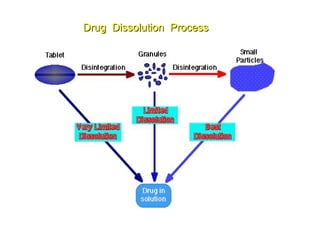
DDrruugg DDiissssoolluuttiioonn PPrroocceessss
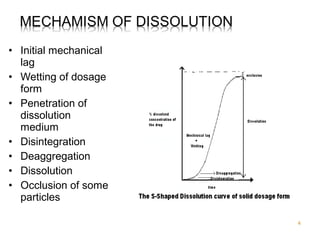
• Initial mechanical 
lag 
• Wetting of dosage 
form 
• Penetration of 
dissolution 
medium 
• Disintegration 
• Deaggregation 
• Dissolution 
• Occlusion of some 
particles 
4
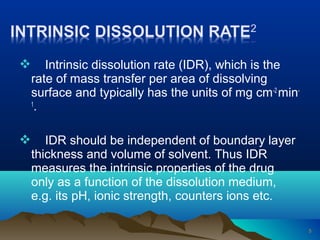
 Intrinsic dissolution rate (IDR), which is the 
rate of mass transfer per area of dissolving 
surface and typically has the units of mg cm-2 min- 
1. 
 IDR should be independent of boundary layer 
thickness and volume of solvent. Thus IDR 
measures the intrinsic properties of the drug 
only as a function of the dissolution medium, 
e.g. its pH, ionic strength, counters ions etc. 
5
Where: 
 m - Amount of dissolved material, kg 
 t - Time, seconds 
 A - Surface area of the interface between the dissolving 
substance and the solvent,m2 
 D - DDiiffffuussiioonn ccooeeffffiicciieenntt, m2/s 
 d - Thickness of the boundary layer of the solvent at the 
surface of the dissolving substance, m 
 Cs - concentration of the substance on the surface, 
kg/m3 
 Cb - concentration of the substance in the bulk of the 
solvent, kg/m3 
6
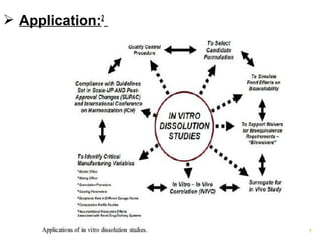
 Application:2 
7
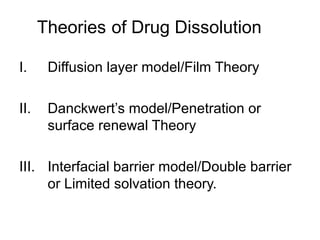
Theories of Drug Dissolution 
I. Diffusion layer model/Film Theory 
II. Danckwert’s model/Penetration or 
surface renewal Theory 
III. Interfacial barrier model/Double barrier 
or Limited solvation theory.
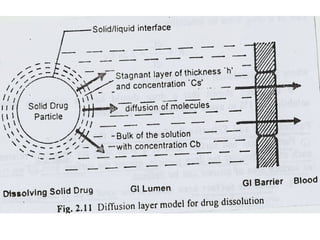
I. Diffusion layer model/Film Theory :- 
• It involves two steps :- 
a. Solution of the solid to form stagnant film or 
diffusive layer which is saturated with the drug 
b. Diffusion of the soluble solute from the stagnant 
layer to the bulk of the solution; this is r.d.s in 
drug dissolution.
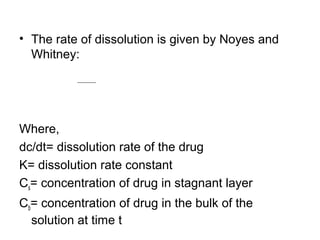
• The rate of dissolution is given by Noyes and 
Whitney: 
= k (Cs- Cb) dc 
dt 
Where, 
dc/dt= dissolution rate of the drug 
K= dissolution rate constant 
Cs= concentration of drug in stagnant layer 
Cb= concentration of drug in the bulk of the 
solution at time t
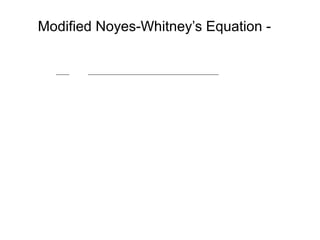
Modified Noyes-Whitney’s Equation - 
dC 
dt 
DAKw/o (Cs – Cb ) 
Vh 
= 
Where, 
D= diffusion coefficient of drug. 
A= surface area of dissolving solid. 
Kw/o= water/oil partition coefficient of drug. 
V= volume of dissolution medium. 
h= thickness of stagnant layer. 
(Cs – Cb )= conc. gradient for diffusion of drug.
Sink condition 
A Sink conditions describe a dissolution system that is sufficiently 
dilute so that the dissolution process is not impeded by approach 
to saturation of the compound of interest. 
Sink conditions affect the production of the sample but not the 
condition of the solution upon sampling. 
In vivo condition, there is no conc. build up in the bulk of the 
solution and hence no retarding effect on the dissolution rate of the 
drug i.e. Cs>>Cb and sink condition maintain. 
13
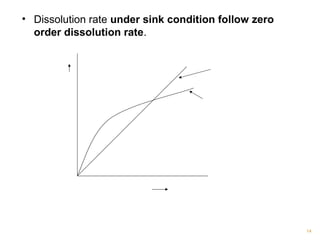
• Dissolution rate under sink condition follow zero 
order dissolution rate. 
Conc of disslove drug 
Time 
Zero order dissolution 
Under sink condition 
First order under non 
sink condition 
14
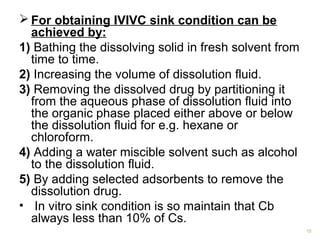
For obtaining IVIVC sink condition can be 
achieved by: 
1) Bathing the dissolving solid in fresh solvent from 
time to time. 
2) Increasing the volume of dissolution fluid. 
3) Removing the dissolved drug by partitioning it 
from the aqueous phase of dissolution fluid into 
the organic phase placed either above or below 
the dissolution fluid for e.g. hexane or 
chloroform. 
4) Adding a water miscible solvent such as alcohol 
to the dissolution fluid. 
5) By adding selected adsorbents to remove the 
dissolution drug. 
• In vitro sink condition is so maintain that Cb 
always less than 10% of Cs. 
15
 HIXON-CROWELL CUBE ROOT RELATIONSHIP 
• Major assumptions in Noyes-Whitney relationship is that the 
S.A.(A) term remains constant throughout dissolution process. 
This is true for some formulations, such as transdermal 
patches. 
• However, size of drug particles from tablets, capsules and 
suspensions will decrease as drug dissolves. 
• This decrease in size of particles changes the effective S.A. 
• Thus, Hixon & Crowell modified the eq to represent rate of 
appearance of solute by weight in solution by multiplying both 
sides of volume term. 
W01/3– W1/3 = kt 
W0 = original mass of drug 
W = mass of drug remaining to dissolve at time t 
K = dissolution rate constant 16
• This is first order dissolution rate process, for 
which the driving force is concentration gradient. 
• This is true for in-vitro dissolution which is 
characterized by non-sink conditions. 
• The in-vivo dissolution is rapid as sink conditions 
are maintained by absorption of drug in systemic 
circulation i.e. Cb=0 and rate of dissolution is 
maximum.
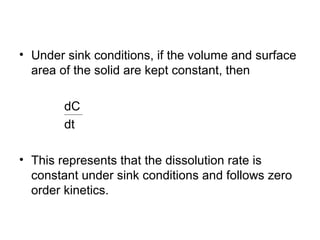
• Under sink conditions, if the volume and surface 
area of the solid are kept constant, then 
dC 
dt 
= K 
• This represents that the dissolution rate is 
constant under sink conditions and follows zero 
order kinetics.
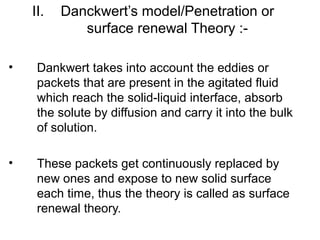
II. Danckwert’s model/Penetration or 
surface renewal Theory :- 
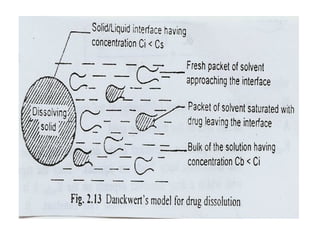
• Dankwert takes into account the eddies or 
packets that are present in the agitated fluid 
which reach the solid-liquid interface, absorb 
the solute by diffusion and carry it into the bulk 
of solution. 
• These packets get continuously replaced by 
new ones and expose to new solid surface 
each time, thus the theory is called as surface 
renewal theory.
• The Danckwert’s model is expressed by 
equation 
dC 
dt = dm 
V = A (Cs-Cb). γ D 
dt 
Where, 
m = mass of solid dissolved 
Gamma (γ) = rate of surface renewal
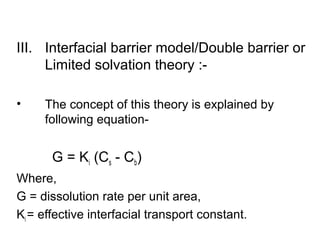
III. Interfacial barrier model/Double barrier or 
Limited solvation theory :- 
• The concept of this theory is explained by 
following equation- 
G = Ki (Cs - Cb) 
Where, 
G = dissolution rate per unit area, 
Ki = effective interfacial transport constant.
3) Interfacial layer model 
S 
Film boundary 
Bulk solution 
Cs 
C 
Stagnant layer 
In this model it is assumed that the reaction at solid surface is not 
instantaneous i.e. the reaction at solid surface and its diffusion across the 
interface is slower than diffusion across liquid film. 
therefore the rate of solubility of solid in liquid film becomes the rate 
limiting than the diffusion of dissolved molecules 
equation : dm/dt = Ki (Cs – C ) K = effective interfacial transport rate 
constant
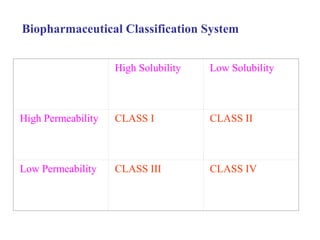
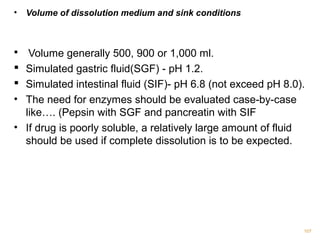
Biopharmaceutical Classification System 
High Solubility 
(Dose Vol. NMT 
250 mL) 
Low Solubility 
(Dose Vol. >250 
mL) 
High Permeability 
(Fract. Abs. NLT 
90%) 
CLASS І 
e.g. Propranolol 
metoprolol 
CLASS II 
e.g. piroxicam, 
naproxen 
Low Permeability 
(Fract. Abs. 
<90%) 
CLASS III 
e.g. ranitidine 
cimetidine 
CLASS IV 
e.g. furosemide 
hydrochlorothiazide
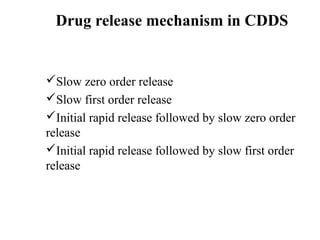
Drug release mechanism in CDDS 
Slow zero order release 
Slow first order release 
Initial rapid release followed by slow zero order 
release 
Initial rapid release followed by slow first order 
release
• Zero order kinetics 
• First order kinetics 
• Hixoncrowell cube-root model 
• Higuchi model 
• Korsmeyer peppas model
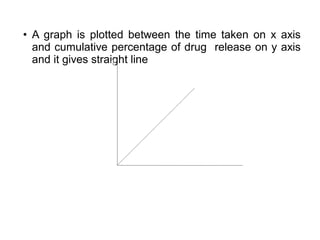
• The equation for zero order kinetics is 
Qt=Qo+Kot 
Qo=initial amount of drug 
Qt=cumulative drug released at t 
Ko=zero order release constant 
t= time in hours 
• It describes the system where the drug release rate is 
independent of its concentration of the dissolved 
substance.
• A graph is plotted between the time taken on x axis 
and cumulative percentage of drug release on y axis 
and it gives straight line 
Time(hours) 
Cummulative %of drug release
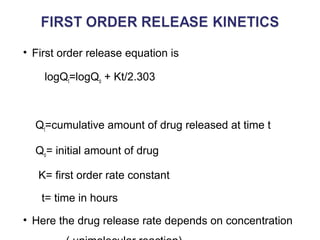
• First order release equation is 
logQt=logQo + Kt/2.303 
Qt=cumulative amount of drug released at time t 
Qo= initial amount of drug 
K= first order rate constant 
t= time in hours 
• Here the drug release rate depends on concentration 
( unimolecular reaction)
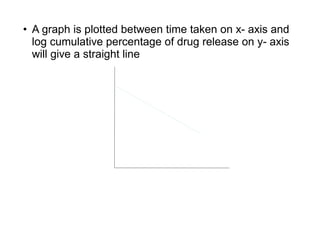
• A graph is plotted between time taken on x- axis and 
log cumulative percentage of drug release on y- axis 
will give a straight line 
Time(hours) 
Log % of drug release
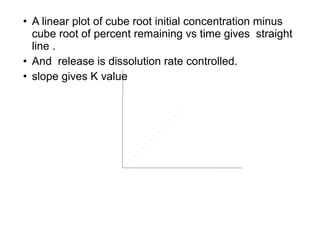
• THE HIXSON-CROWELL RELEASE EQUATION IS 
∛Qo-∛Qt=KHCt 
Qo=initial amount of drug 
Qt= cumulative amount of drug released at time t 
KHC= hixson crowell release constant 
t= time in hours 
• It describes the drug releases by dissolution and 
with the change in surface area and diameter of 
particle.
• A linear plot of cube root initial concentration minus 
cube root of percent remaining vs time gives straight 
line . 
• And release is dissolution rate controlled. 
• slope gives K value 
Time (hours) 
∛Qo-∛Qt
• Higuchi equation is 
Q=[Dt/Ƭ (2A-tCs)Cst]1/2 
or Q=Kt1/2 
Q=cumulative drug release at time t 
D= diffusion coefficient of drug in in matrix 
Cs=solubility of drug in polymeric matrix 
Ƭ= tortuosity of capillary system 
A=total amount of drug in unit volume matrix 
K= higuchi release constant 
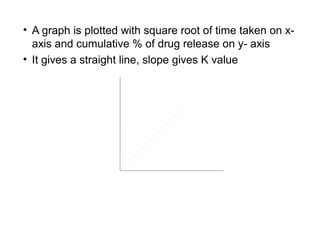
• Higuchi equation suggest s that the drug release is by diffusion
• A graph is plotted with square root of time taken on x-axis 
and cumulative % of drug release on y- axis 
• It gives a straight line, slope gives K value 
√Time ( hours) 
cumulative % of drug release
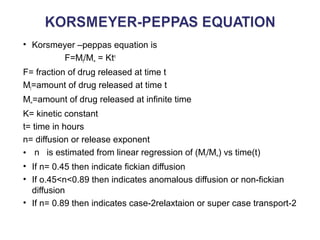
• Korsmeyer –peppas equation is 
F=Mt/M∞ = Ktn 
F= fraction of drug released at time t 
Mt=amount of drug released at time t 
M∞=amount of drug released at infinite time 
K= kinetic constant 
t= time in hours 
n= diffusion or release exponent 
• n is estimated from linear regression of (Mt/M∞) vs time(t) 
• If n= 0.45 then indicate fickian diffusion 
• If o.45<n<0.89 then indicates anomalous diffusion or non-fickian 
diffusion 
• If n= 0.89 then indicates case-2relaxtaion or super case transport-2
• A graph is plotted between log time taken on x-axis 
and log of cumulative percentage of drug release at y-axis 
it gives a straight line. 
Log time 
cumulative % of drug release
Classification 
• There are basically three general 
categories of dissolution apparatus : 
1. Beaker methods 
2. Open flow-through compartment system 
3. Dialysis concept
1. BEAKER METHODS
to accessing therapeutic efficacy. 
Monitoring batch to batch consistency. 
High cost of in vitro dissolution test. 
Assessment of bioequivalence. 
Requirement for regulatory approval for 
product marketing and is a vital 
component of the quality control program. 
40
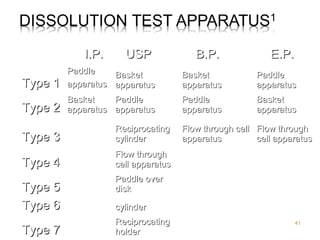
II..PP.. UUSSPP BB..PP.. EE..PP.. 
TTyyppee 11 
PPaaddddllee 
aappppaarraattuuss BBaasskkeett 
aappppaarraattuuss 
BBaasskkeett 
aappppaarraattuuss 
PPaaddddllee 
aappppaarraattuuss 
TTyyppee 22 BBaasskkeett 
aappppaarraattuuss 
PPaaddddllee 
aappppaarraattuuss 
PPaaddddllee 
aappppaarraattuuss 
BBaasskkeett 
aappppaarraattuuss 
TTyyppee 33 RReecciipprrooccaattiinngg 
ccyylliinnddeerr 
FFllooww tthhrroouugghh cceellll 
aappppaarraattuuss 
FFllooww tthhrroouugghh 
cceellll aappppaarraattuuss 
TTyyppee 44 FFllooww tthhrroouugghh 
cceellll aappppaarraattuuss 
TTyyppee 55 PPaaddddllee oovveerr 
ddiisskk 
TTyyppee 66 ccyylliinnddeerr 
TTyyppee 77 RReecciipprrooccaattiinngg 
hhoollddeerr 
41
Design: 
Vessel:- 
 Made up of borosilicate glass 
 semi hemispherical bottom 
 Capacity: 1000ml 
Shaft:- 
 Stainless steel 316 
 Rotates smoothly without significance wooble 
Basket:- 
 Stainless steel 316 
 Gold coatings up to 0.0001 inch 
Water bath:- Maintained at 37± 0.5˚c 
42
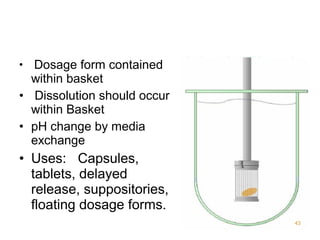
• Dosage form contained 
within basket 
• Dissolution should occur 
within Basket 
• pH change by media 
exchange 
• Uses: Capsules, 
tablets, delayed 
release, suppositories, 
floating dosage forms. 
43
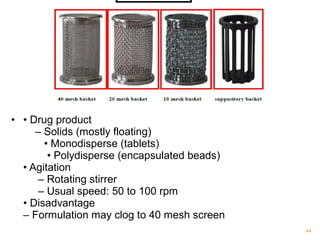
• • Drug product 
– Solids (mostly floating) 
• Monodisperse (tablets) 
• Polydisperse (encapsulated beads) 
• Agitation 
– Rotating stirrer 
– Usual speed: 50 to 100 rpm 
• Disadvantage 
– Formulation may clog to 40 mesh screen 
44
45
• Dosage form should 
remain at the bottom centre 
of the vessel 
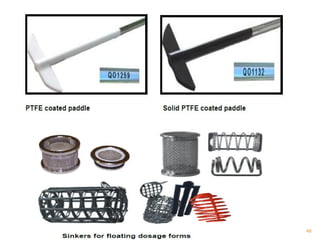
• Sinkers used for floaters 
• Useful for : 
• – Tablets 
• – Capsules 
• pH change by media 
addition 
46
• • Drug product 
– Solids (mostly non floating) 
• Monodisperse (tablets) 
• Polydisperse (encapsulated beads) 
• • Agitation 
– Rotating stirrer 
– Usual speed: 25 to 100 rpm 
• Standard volume: 900/1000 ml 
• Advantages: 
1. Easy to use and robust 
2. Ph change possible 
3. Can be easily adapted to apparatus 5 
• Disadvantages 
– Floating dosage forms require sinker 
– Positioning of tablet 
47
48
Design: 
1.vessel: cylindrical flat bottom glass vessel. 
2.Agitation type: -reciprocating 
-generally 5-35 rpm 
3. Volume of dissolution fluids: 200-250 ml 
4. Water bath: maintain at 37±0.5˚c 
5. Use: extended release 
49
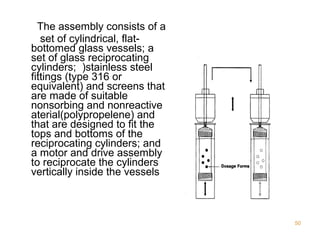
The assembly consists of a 
set of cylindrical, flat-bottomed 
glass vessels; a 
set of glass reciprocating 
cylinders; )stainless steel 
fittings (type 316 or 
equivalent) and screens that 
are made of suitable 
nonsorbing and nonreactive 
aterial(polypropelene) and 
that are designed to fit the 
tops and bottoms of the 
reciprocating cylinders; and 
a motor and drive assembly 
to reciprocate the cylinders 
vertically inside the vessels 
50
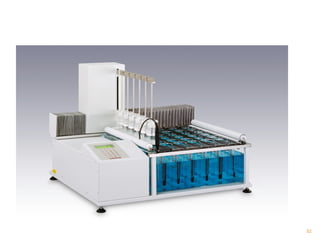
• The vessels are partially immersed in a suitable water 
bath of any convenient size that permits holding the 
temperature at 37 ± 0.5 during the test. 
• The dosage unit is placed in reciprocating cylinder & the 
cylinder is allowed to move in upward and downward 
direction constantly. Release of drug into solvent within 
the cylinder measured. 
• Useful for: Tablets, Beads, controlled release 
formulations 
• Standard volume: 200-250 ml/station 
• Advantages: 1) Easy to change the pH-profiles 
2) Hydrodynamics can be directly influenced by varying 
the dip rate. 
• Disadvantages: 1) small volume (max. 250 ml) 
2) Little experience 
3) Limited data 
51
Apparatus 3 – Reciprocating cylinder 
52
53
USP APPARATUS 4 - FLOW THROUGH 
CELL 
54
• The assembly consists of a reservoir and a pump for the 
Dissolution Medium; a flow-through cell; a water bath 
that maintains the Dissolution Medium at 37 ± 0.5 
• The pump forces the Dissolution Medium upwards 
through the flow-through cell. 
• Assemble the filter head, and fix the parts together by 
means of a suitable clamping device. 
• Introduce by the pump the Dissolution Medium warmed 
to 37 ± 0.5 through the bottom of the cell to obtain the 
flow rate specified in the individual monograph. 
• Collect the elute by fractions at each of the times stated. 
• Perform the analysis as directed in the individual 
monograph 
55
Tablets 12 mm Tablets 22,6 mm Powders / Granules Implants Suppositories / 
Soft gelatine capsules 
• Useful for: Low solubility drugs, Micro particulates, 
Implants, Suppositories, Controlledrelease formulations 
• Variations: (A) Open system & (B) Closed system 
• Advantages: 
• 1. Easy to change media pH2. PH-profile possible 
• 3. Sink conditions 
• Disadvantages: 
• 1. Deaeration necessary 
• 2. High volumes of media 
• 3. Labor intensive 
56
APPARATUS 4 – FLOW-THROUGH 
CELL 
57
Design 
1. Vessel: 
2. Shaft: 
3. Stirring elements 
4. Sample holder: - Disk assembly that hold the 
product in such a way that release surface is 
parallel with paddle. 
5. Paddle is directly attached over disk assembly. 
6. Samples are drawn away b/w the surface of 
medium and top of paddle blade. 
7. Volume; 900ml 
8. Temperature; 32˚c 
58
USP APPARATUS 5 - PADDLE OVER 
DISK 
59
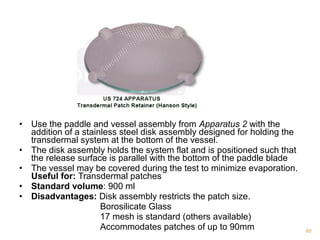
• Use the paddle and vessel assembly from Apparatus 2 with the 
addition of a stainless steel disk assembly designed for holding the 
transdermal system at the bottom of the vessel. 
• The disk assembly holds the system flat and is positioned such that 
the release surface is parallel with the bottom of the paddle blade 
• The vessel may be covered during the test to minimize evaporation. 
Useful for: Transdermal patches 
• Standard volume: 900 ml 
• Disadvantages: Disk assembly restricts the patch size. 
Borosilicate Glass 
17 mesh is standard (others available) 
Accommodates patches of up to 90mm 60
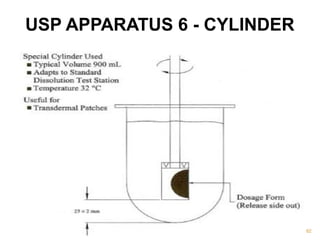
Design; 
1. Vessel: in place of basket cylinder is used. 
2. Cylinder : stainless steel 316. 
3.Sample: - mounted to cuprophan(inner porous 
cellulosic material) an entire system is adhere to 
cylinder. 
-Dosage unit is place in cylinder and 
released from outside. 
4. Water bath : maintain at 32±.0.5˚c 
Use : transdermal patches can not be cut into small 
size. 
61
USP APPARATUS 6 - CYLINDER 
62
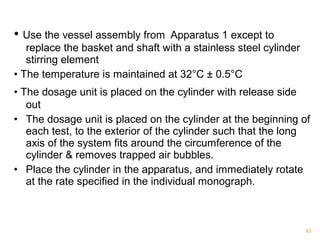
• Use the vessel assembly from Apparatus 1 except to 
replace the basket and shaft with a stainless steel cylinder 
stirring element 
• The temperature is maintained at 32°C ± 0.5°C 
• The dosage unit is placed on the cylinder with release side 
out 
• The dosage unit is placed on the cylinder at the beginning of 
each test, to the exterior of the cylinder such that the long 
axis of the system fits around the circumference of the 
cylinder & removes trapped air bubbles. 
• Place the cylinder in the apparatus, and immediately rotate 
at the rate specified in the individual monograph. 
63
64
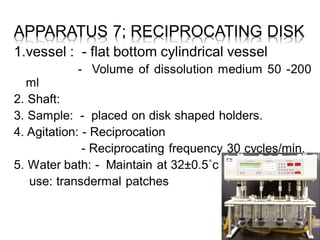
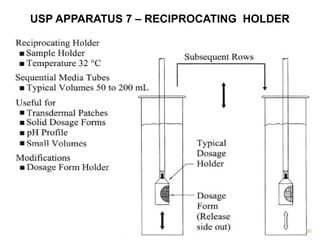
USP APPARATUS 7 – RECIPROCATING HOLDER 
65
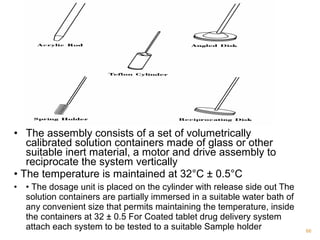
• The assembly consists of a set of volumetrically 
calibrated solution containers made of glass or other 
suitable inert material, a motor and drive assembly to 
reciprocate the system vertically 
• The temperature is maintained at 32°C ± 0.5°C 
• • The dosage unit is placed on the cylinder with release side out The 
solution containers are partially immersed in a suitable water bath of 
any convenient size that permits maintaining the temperature, inside 
the containers at 32 ± 0.5 For Coated tablet drug delivery system 
attach each system to be tested to a suitable Sample holder 66
•For Transdermal drug delivery system attach the system to a suitable sized sample 
holder with a suitable O-ring such that the back of the system is adjacent to and 
centered on the bottom of the disk-shaped sample holder or centered around the 
circumference of the cylindrical-shaped sample holder. Trim the excess substrate with a 
sharp blade. 
67
Advantages of the Beaker 
Methods 
The basket method is the most widely used 
procedure which confines the solid dosage 
form to a limited area which is essential for 
better reproducibility. 
It is advantageous for capsules as they tend 
to float at the surface thus minimizing the 
area exposed to the dissolution fluid.
Limitation of the Beaker Methods 
Clogging of the basket screen by gummy particles. 
Tendency of the light particles to float. 
Sensitivity of the apparatus to variables such as 
vibration, eccentricity, etc. 
Rapid corrosion of the SS mesh in presence of 
HCl. 
Sensitivity of the apparatus to any slight changes 
in the paddle orientation. 
Non-reproducible position of the tablets at the 
bottom of the flask.
2. OPEN FLOW-THROUGH 
COMPARTMENT SYSTEM 
The dosage form is contained in a small vertical 
glass column with built in filter through which a 
continuous flow of the dissolution medium is 
circulated upward at a specific rate from an 
outside reservoir using a peristaltic or centrifugal 
pump. 
Dissolution fluid is collected in a separate 
reservoir. 
E.g. lipid filled soft Gelatin capsule
Advantages 
No stirring and drug particles are exposed 
to homogeneous, laminar flow that can be 
precisely controlled. All the problems of 
wobbling, shaft eccentricity, vibration, 
stirrer position don’t exist. 
There is no physical abrasion of solids. 
Perfect sink conditions can be maintained.
Disadvantages 
Tendency of the filter to clog because of 
the unidirectional flow. 
Different types of pumps, such as 
peristaltic and centrifugal, have been 
shown to give different dissolution results. 
Temperature control is also much more 
difficult to achieve in column type flow 
through system than in the conventional 
stirred vessel type.
3. DIALYSIS SYSTEM 
Here, dialysis membrane used as a 
selective barrier between fresh solvent 
compartment and the cell compartment 
containing dosage form. 
It can be used in case of very poorly 
soluble rugs and dosage form such as 
ointments, creams and suspensions.
THE ROTATING FILTER METHOD 
It consists of a magnetically driven rotating 
filter assembly and a 12 mesh wire cloth 
basket. 
The sample is withdrawn through the 
spinning filter for analysis.
ROTATING FLASK DISSOLUTION 
METHOD 
This consists of a spherical flask made of 
glass and supported by a horizontal glass 
shaft that is fused to its sides. 
The shaft is connected to a constant 
speed driving motor. 
The flask is placed in a constant 
temperature water bath and rotates about 
its horizontal axis.
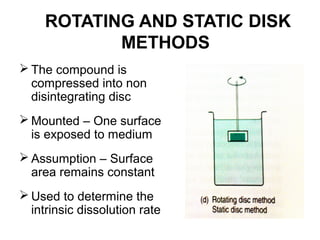
ROTATING AND STATIC DISK 
METHODS 
The compound is 
compressed into non 
disintegrating disc 
Mounted – One surface 
is exposed to medium 
Assumption – Surface 
area remains constant 
Used to determine the 
intrinsic dissolution rate
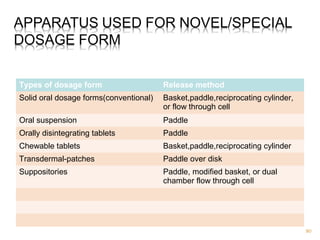
Types of dosage form Release method 
Solid oral dosage forms(conventional) Basket,paddle,reciprocating cylinder, 
or flow through cell 
Oral suspension Paddle 
Orally disintegrating tablets Paddle 
Chewable tablets Basket,paddle,reciprocating cylinder 
Transdermal-patches Paddle over disk 
Suppositories Paddle, modified basket, or dual 
chamber flow through cell 
80
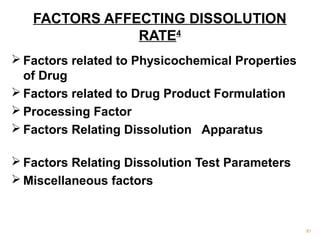
FACTORS AFFECTING DISSOLUTION 
RATE4 
Factors related to Physicochemical Properties 
of Drug 
Factors related to Drug Product Formulation 
Processing Factor 
Factors Relating Dissolution Apparatus 
Factors Relating Dissolution Test Parameters 
Miscellaneous factors 
81
FACTORS RELATED TO PHYSICOCHEMICAL PROPERTIES 
OF DRUG 
1) DRUG SOLUBILITY 
• Solubility of drug plays a prime role in controlling its 
dissolution from dosage form. Aqueous solubility of drug 
is a major factor that determines its dissolution rate. 
Minimum aqueous solubility of 1% is required to avoid 
potential solubility limited absorption problems. 
• Studies of 45 compound of different chemical classes 
and a wide range of solubility revealed that initial 
dissolution rate of these substances is directly 
proportional to their respective solubility. 
• Ex. Poorly soluble drug :griseofulvin, spironolactone 
hydrophilic drug :neomycin 
82
2 ) SALT FORMATION 
• It is one of the common approaches used to increase 
drug solubility and dissolution rate. It has always been 
assumed that sodium salts dissolve faster than their 
corresponding insoluble acids. Eg.sodium and potassium 
salts of Peniciilin G, sulfa drugs, phenytoin, barbiturates 
etc. 
• While in case of Phenobarbital dissolution of sodium salt 
was slower than that of weak acid. Same is the case for 
weak base drug, strong acid salts, such as 
hydrochlorides and sulphates of weak bases such as 
epinephrine, tetracycline are commonly used due to high 
solubility. However, free bases of chlortetracycline, 
methacycline were more soluble than corresponding 
hydrochloride salt at gastric pH values, due to common 
ion suppression. 83
3) PARTICLE SIZE 
There is a direct relationship between surface area of 
drug and its dissolution rate. Since, surface area 
increases with decrease in particle size, higher 
dissolution rates may be achieved through reduction of 
particle size. 
• Micronization of sparingly soluble drug to reduce particle 
size is by no means a guarantee of better dissolution 
and bioavailability. 
• Micronization of hydrophobic powders can lead to 
aggregation and floatation. when powder is dispersed 
into dissolution medium. So, mere increase in S.A. of 
drug does not always guarantee an equivalent increase 
in dissolution rate. Rather, it is increase in the “effective” 
S.A., or area exposed to dissolution medium and not the 
absolute S.A. that is directly proportional to dissolution 
rate. 84
• Hydrophobic drugs like phenacetin, aspirin shows 
decrease in dissoln. rate as they tend to adsorb air at the 
surface and inhibit their wettability. Problem eliminated 
by evacuating surface from adsorbed air or by use of 
surfactants. So these drugs in-vivo exhibit excellent 
wetting due to presence of natural surfactants such as 
bile salts 
• Eg. therapeutic conc. of griseofulvin was reduced to half 
by micronization 
85
• 4) SOLID STATE CHARACTERISTICS 
• Solid phase characteristics of drug, such as amorphicity, 
crystallinity, state of hydration and polymorphic 
structures have significant influence on dissolution rate. 
• Anhydrous forms dissolve faster than hydrated form 
because they are thermodynamically more active than 
hydrates. Eg. Ampicillin anhydrate faster dissolution rate 
than trihydrate. 
• Amorphous forms of drug tend to dissolve faster than 
crystalline materials. E.g.Novobiocin suspension, 
Griseofulvin. 
86
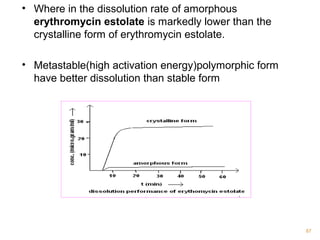
• Where in the dissolution rate of amorphous 
erythromycin estolate is markedly lower than the 
crystalline form of erythromycin estolate. 
• Metastable(high activation energy)polymorphic form 
have better dissolution than stable form 
87
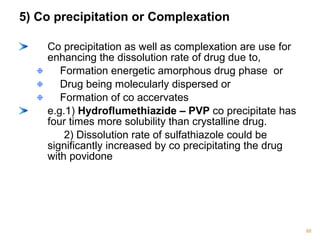
5) Co precipitation or Complexation 
Co precipitation as well as complexation are use for 
enhancing the dissolution rate of drug due to, 
Formation energetic amorphous drug phase or 
Drug being molecularly dispersed or 
Formation of co accervates 
e.g.1) Hydroflumethiazide – PVP co precipitate has 
four times more solubility than crystalline drug. 
2) Dissolution rate of sulfathiazole could be 
significantly increased by co precipitating the drug 
with povidone 
88
FACTORS RELATED TO DRUG 
PRODUCT 1)DILUENTS 
• Studies of starch on dissolution rate of salicylic acid 
tablet by dry double compression process shows three 
times increase in dissolution rate when the starch 
content increase from the 5 – 20 %. 
• Here starch particles form a layer on the outer surface of 
hydrophobic drug particles resulting in imparting 
hydrophilic character to granules & thus increase in 
effective surface area & rate of dissolution 
89 
FACTORS RELATED TO DRUG 
PRODUCT FORMULATION
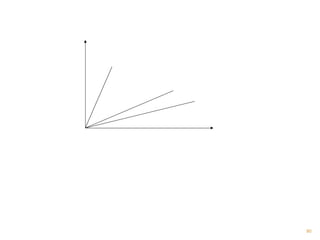
10 20 30 40 50 
Time in min. 
100 
80 
60 
40 
20 
Amt of dissolved mg 
10% starch 
5% starch 
The dissolution rate is not only affected by nature of the diluent but 
also affected by excipient dilution (drug/excipient ratio). 
90
2)DISINTEGRANTS 
• Disintegrating agent added before & after the granulation affects the 
dissolution rate. 
• Studies of various disintegrating agents on Phenobarbital tablet 
showed that when copagel (low viscosity grade of Na CMC) added 
before granulation decreased dissolution rate but if added after 
did not had any effect on dissolution rate. 
• Microcrystalline cellulose is a very good disintegrating agent but at 
high compression force, it may retard drug dissolution. 
• Starch is not only an excellent diluent but also superior disintegrant 
due to its hydrophilicity and swelling property. 
91
3)BINDERS AND GRANULATING AGENTS 
• The hydrophilic binder increase dissolution rate of poorly 
wettable drug. 
• Large amt. of binder increase hardness & decrease 
disintegration /dissolution rate of tablet. 
• Non aqueous binders such as ethyl cellulose also retard 
the drug dissolution. 
92
• Phenobarbital tablet granulated with gelatin solution provide a 
faster dissolution rate in human gastric juice than those prepared 
using Na –carboxymethyl cellulose or polyethylene glycol 6000 
as binder. 
• In Phenobarbital tablet, faster dissolution rate was observed with 
10% gelatin whereas decrease in dissolution rate with 20% gelatin. 
This was due to higher concentration which formed a thick film 
around tablet. 
• Water soluble granulating agent Plasdone gives faster dissolution 
rate compared to gelatin. 
93
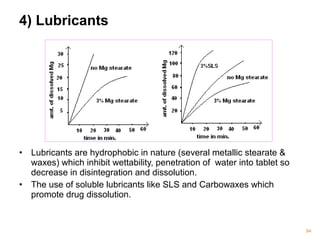
4) Lubricants 
• Lubricants are hydrophobic in nature (several metallic stearate & 
waxes) which inhibit wettability, penetration of water into tablet so 
decrease in disintegration and dissolution. 
• The use of soluble lubricants like SLS and Carbowaxes which 
promote drug dissolution. 
94
5)SURFACTANTS 
• They enhance the dissolution rate of poorly soluble drug. 
This is due to lowering of interfacial tension, increasing 
effective surface area, which in turn results in faster 
dissolution rate. 
• E.g. Non-ionic surfactant Polysorbate 80 increase 
dissolution rate of phenacetin granules. 
95
6)WATER-SOLUBLE DYES 
• Dissolution rate of single crystal of sulphathiazole was 
found to decrease significantly in presence of FD&C 
Blue No.1. 
• The inhibiting effect was related to preferential 
adsorption of dye molecules on primary dissolution 
sources of crystal surfaces. They inhibit the micellar 
solubilization effect of bile salts on drug. 
• Riboflavin tablet decrease when used FD & C Red no.3 
dye in film coat 
96
7)Effect of coating component on tablet 
dissolution 
• Coating ingredient especially shellac & CAP etc. Also 
have significant effect on the dissolution rate of coated 
tablet. Tablets with MC coating were found to exhibit 
lower dissolution profiles than those coated with HPMC 
at 37ºC. 
97
PROCESSING FACTORS 
1) METHOD OF GRANULATION 
• Granulation process in general enhances dissolution rate of 
poorly soluble drug. 
• Wet granulation is traditionally considered superior. But 
exception is the dissolution profile of sodium salicylate tablets 
prepared by both wet granulation and direct compression 
where the dissolution was found more complete and rapid in 
latter case. 
• A newer technology called as APOC “Agglomerative Phase 
of Comminution” was found to produce mechanically 
stronger tablets with higher dissolution rates than those made 
by wet granulation. A possible mechanism is increased internal 
surface area of granules produced by APOC method. 
98
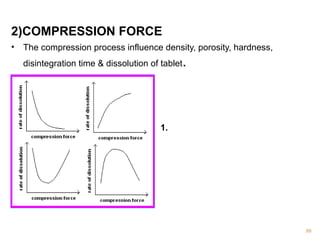
2)COMPRESSION FORCE 
• The compression process influence density, porosity, hardness, 
disintegration time & dissolution of tablet. 
1. tighter bonding 
2 . higher compression force cause 
deformation crushing or fracture 
of drug particle or convert a 
spherical granules into disc 
Shaped particle 
3.& 4. both condition 
99
3) DRUG EXCIPIENT INTERACTION 
• These interactions occur during any unit operation such 
as mixing, milling ,blending, drying, and/or granulating 
result change in dissolution. 
• The dissolution of prednisolone found to depend on the 
length of mixing time with Mg-stearate 
• Similarly as increase in mixing time of formulation 
containing 97 to 99% microcrystalline cellulose or 
another slightly swelling disintegrant result in enhance 
dissolution rate. 
100