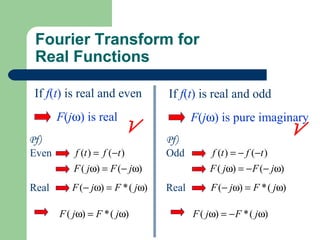
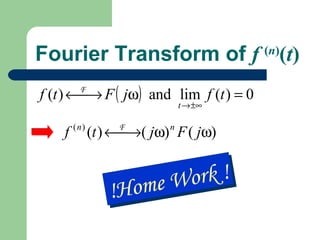
The document provides an overview of Fourier transforms. It begins by introducing Fourier series which deals with continuous-time periodic signals and results in discrete frequency spectra. It then discusses how the Fourier integral and continuous Fourier transform can deal with aperiodic signals by providing continuous spectra. The continuous Fourier transform represents a function as an integral of its frequencies, while the inverse transform uses this representation to recover the original function. The properties of the Fourier transform discussed include linearity, time scaling, time reversal, time shifting, and frequency shifting. Real functions have special properties where the Fourier transform is always real or pure imaginary. Examples are provided to illustrate how to calculate the Fourier transform of simple functions.



![Example
F(ω
F(ω) )
33
22
11
00
-1
1
-1
f(t)
-10
-10
-5
-5
00
55
33
22
t
|F(ω
|F(ω)|)|
-1
10
10
11 1
00
-10
-10
1
44
− jω t
arg[F(ω
arg[F(ω)])]
1 − jωt
F ( jω) = ∫ f (t )e dt = ∫ e dt =
e
−∞
−1
− jω
22
j − jω
2 sin ω
jω
00
= (e − e ) = -10 -5-5 00 55 10
-10
10
ω
ω
∞
-5
-5
− jωt
00
55
10
10
1
−1](https://image.slidesharecdn.com/cft-140220232502-phpapp02/85/fourier-transforms-17-320.jpg)

![Example
f(t)
1
1
|F(jω)|
|F(jω)|
=2
αα =2
0.5
0.5
0
0
2
2
∞
−∞
∞
=∫ e
0
arg[F(jω)]
arg[F(jω)]
F ( jω) = ∫ f (t )e
-10
-10
− jω t
0
0
-2
-2
− ( α + jω ) t
e−αt
-5
-5
0
0
5
5
t 10
10
∞
dt = ∫ e −αt e − jωt dt
0
1
dt =
α + jω
-10
-10
-5
-5
0
0
5
5
10
10](https://image.slidesharecdn.com/cft-140220232502-phpapp02/85/fourier-transforms-19-320.jpg)

![Notation
F [ f (t )] = F ( jω)
F [ F ( jω)] = f (t )
-1
f (t ) ←
→ F ( jω)
F](https://image.slidesharecdn.com/cft-140220232502-phpapp02/85/fourier-transforms-21-320.jpg)


![Time Reversal
f ( −t ) ←
→ F ( − jω)
F
Pf) F [ f (−t )] = ∞ f (−t )e − jωt dt = t =∞ f (−t )e − jωt dt
∫−∞
∫t =−∞
=∫
− t =∞
−t = −∞
= −∫
=∫
f (t )e jωt d ( −t )
f (t )e d ( −t )
−t = −∞
t = −∞
t =∞
∞
− t =∞
j ωt
f (t )e dt = ∫
j ωt
t =∞
t = −∞
f (t )e jωt dt
= ∫ f (t )e jωt dt = F (− jω)
−∞](https://image.slidesharecdn.com/cft-140220232502-phpapp02/85/fourier-transforms-24-320.jpg)
![Time Shifting
f (t − t0 ) ←
→ F ( jω) e
F
− jωt 0
Pf) F [ f (t − t )] = ∞ f (t − t )e − jωt dt = t =∞ f (t − t )e − jωt dt
0
0
0
∫−∞
∫t =−∞
=∫
t +t0 =∞
=e
− j ωt 0
=e
− j ωt 0
t + t 0 = −∞
f (t )e − jω(t +t0 ) d (t + t0 )
∫
t =∞
∫
∞
t = −∞
−∞
f (t )e − jωt dt
− jω t
f (t )e − jωt dt = F ( jω)e 0](https://image.slidesharecdn.com/cft-140220232502-phpapp02/85/fourier-transforms-25-320.jpg)
![Frequency Shifting (Modulation)
f (t )e
Pf)
jω0t
¬ F [ j (ω − ω0 ) ]
→
F [ f (t )e
F
jω 0 t
∞
] = ∫ f (t )e jω0t e − jωt dt
−∞
∞
= ∫ f (t )e − j ( ω−ω0 )t dt
−∞
= F [ j (ω − ω0 )]](https://image.slidesharecdn.com/cft-140220232502-phpapp02/85/fourier-transforms-26-320.jpg)
![Symmetry Property
F [ F ( jt )] = 2πf (−ω)
Proof
∞
2πf (t ) = ∫ F ( jω)e jωt dω
−∞
∞
2πf (−t ) = ∫ F ( jω)e − jωt dω
−∞
Interchange symbols ω and t
∞
2πf (−ω) = ∫ F ( jt )e − jωt dt = F [ F ( jt )]
−∞](https://image.slidesharecdn.com/cft-140220232502-phpapp02/85/fourier-transforms-27-320.jpg)


![Example:
F [ f (t )] = F ( jω)
Sol)
F [ f (t ) cos ω0t ] = ?
1
f (t ) cos ω0t = f (t )(e jω0t + e − jω0t )
2
1
1
jω 0 t
F [ f (t ) cos ω0t ] = F [ f (t )e ] + F [ f (t )e − jω0t ]
2
2
1
1
= F [ j (ω − ω0 )] + F [ j (ω + ω0 )]
2
2](https://image.slidesharecdn.com/cft-140220232502-phpapp02/85/fourier-transforms-31-320.jpg)
![Example:
1
−d/2
f(t)=wd(t)cosω0t
wd(t)
t
d/2
−d/2
d/2
t
2 ωd
Wd ( jω) = F [ wd (t )] = ∫ e dt = sin
−d / 2
ω 2
d
d
sin (ω − ω0 ) sin (ω + ω0 )
2
2
=
+
F ( jω) = F [ wd (t ) cos ω0t ]
ω − ω0
ω + ω0
d /2
− jωt](https://image.slidesharecdn.com/cft-140220232502-phpapp02/85/fourier-transforms-32-320.jpg)
![1.5
1.5
d=2
d=2
ω0=5ππ
ω =5
1
1
0
F(jω)
F(jω)
Example:
0.5
0.5
0
0
-0.5
-0.5 -60
-60
1
−d/2
-40
-40
-20
-20
0
0
20
20
40
40
ω
ω
60
60
f(t)=wd(t)cosω0t
wd(t)
t
d/2
−d/2
d/2
t
2 ωd
Wd ( jω) = F [ wd (t )] = ∫ e dt = sin
−d / 2
ω 2
d
d
sin (ω − ω0 ) sin (ω + ω0 )
2
2
=
+
F ( jω) = F [ wd (t ) cos ω0t ]
ω − ω0
ω + ω0
d /2
− jωt](https://image.slidesharecdn.com/cft-140220232502-phpapp02/85/fourier-transforms-33-320.jpg)
![1
Example:
sin at
f (t ) =
πt
Sol)
wd(t)
t
−d/2
d/2
F ( jω) = ?
2 ωd
Answer is
Wd ( jω) = sin
just
ω 2
opposite to
as expected
2 td
F [Wd ( jt )] = F sin = 2πwd (−ω)
2
t
0 ω <| a |
sin at
F [ f (t )] = F
= w2 a (−ω) = 1 ω >| a |
πt
](https://image.slidesharecdn.com/cft-140220232502-phpapp02/85/fourier-transforms-34-320.jpg)
![Fourier Transform of f’(t)
f (t ) ←
→ F ( jω) and lim f (t ) = 0
F
t → ±∞
f ' (t ) ←F jωF ( jω)
→
Pf) F [ f ' (t )] = ∞ f ' (t )e − jωt dt
∫−∞
= f (t )e
− j ωt ∞
−∞
= jωF ( jω)
∞
+ jω∫ f (t )e − jωt dt
−∞](https://image.slidesharecdn.com/cft-140220232502-phpapp02/85/fourier-transforms-35-320.jpg)

![Fourier Transform of Integral
f (t ) ←
→ F ( jω) and
F
∫
∞
−∞
f (t )dt = F ( 0 ) = 0
t f ( x)dx = 1 F ( jω)
F ∫
−∞
jω
Let φ(t ) =
∫
t
−∞
f ( x)dx
lim φ(t ) = 0
t →∞
F [φ' (t )] = F [ f (t )] = F ( jω) = jωΦ ( jω)
1
Φ ( jω) =
F ( jω)
jω](https://image.slidesharecdn.com/cft-140220232502-phpapp02/85/fourier-transforms-38-320.jpg)
![The Derivative of Fourier Transform
dF ( jω)
F [− jtf (t )] ←
→
dω
F
Pf)
∞
F ( jω) = ∫ f (t )e − jωt dt
−∞
∞
dF ( jω) d ∞
∂ − j ωt
− j ωt
=
∫−∞ f (t )e dt = ∫−∞ f (t ) ∂ω e dt
dω
dω
∞
= ∫ [− jtf (t )]e − jωt dt = F [− jtf (t )]
−∞](https://image.slidesharecdn.com/cft-140220232502-phpapp02/85/fourier-transforms-39-320.jpg)


