Methods and algorithms of speech recognition
                   course

             Nikolay V. Karpov

              nkarpov(а)hse.ru

                 Lection 2
   This lecture is concerned with the spectrogram as a
    representation of how the frequency components within a
    signal vary with time.
   Define what we mean by normalised time and frequency
   Define the short-term discrete Fourier transformaton
   Look at the effect of different window lengths on time and
    frequency resolution
   Derive a quantitative description of the frequency
    resolution of the short term DFT and compare the
    performance of common windows
   Derive a quantitative description of the time resolution of
    the short term DFT
   Explain the uncertainty principle and illustrate its effects
    with some examples
   Review some of the properties of the DFT
Sampling
theorem says
that when the
analog signal
x(t) is band-
restricted
between 0 and
W[Hz] and when
x(t) is sampled
at every T =
1/2W, the
original signal
can be
completely
reproduced by
For those signals the
frequency bandwidths of
which are not known, a
low-pass filter is used to
restrict the bandwidths
before sampling. When a
signal is sampled
contrary to the sampling
theorem, aliasing
distortion occurs, which
distorts the high-
frequency components of
the signal, as shown
Designate
           sin(2 wt )
  g (t )
              2 wt


                    i          i         i       i
  x(t )          x( ) g (t       )    x( )     x( )   x(iT )   x(i )
           i 1     2w         2w        2w       Fs

Simple continuous signal               x(t )
                                   A cos(2 ft )
                  i                        k
 x(t ) A cos(2 f ( ) ) A cos( i ) A cos(2     i )
                  Fs                       N
                                             1    k
Normalised radian frequency 0          2 f( ) 2     (1)                0.5
                                            Fs    N
                             Normalised time     i
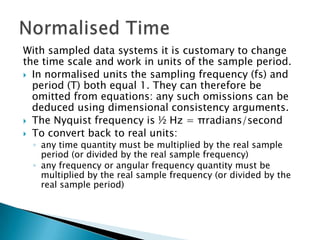
With sampled data systems it is customary to change
the time scale and work in units of the sample period.
 In normalised units the sampling frequency (fs) and
  period (T) both equal 1. They can therefore be
  omitted from equations: any such omissions can be
  deduced using dimensional consistency arguments.
 The Nyquist frequency is ½ Hz = πradians/second
 To convert back to real units:
 ◦ any time quantity must be multiplied by the real sample
   period (or divided by the real sample frequency)
 ◦ any frequency or angular frequency quantity must be
   multiplied by the real sample frequency (or divided by the
   real sample period)
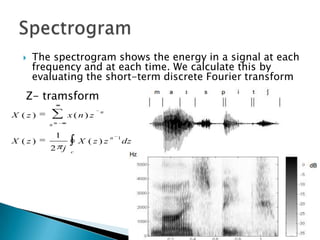
   The spectrogram shows the energy in a signal at each
      frequency and at each time. We calculate this by
      evaluating the short-term discrete Fourier transform
   Z- tramsform
                          n
X ( z)         x ( n) z
         n

          1
X ( z)             X ( z ) z n 1dz
         2 j   c
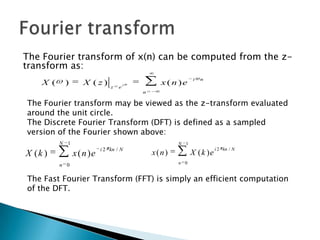
The Fourier transform of x(n) can be computed from the z-
transform as:
                                                           i n
    X( )          X ( z)      z e   i          x ( n )e
                                        n

The Fourier transform may be viewed as the z-transform evaluated
around the unit circle.
The Discrete Fourier Transform (DFT) is defined as a sampled
version of the Fourier shown above:
         N 1                                         N 1
                          i 2 kn / N
X (k )         x ( n )e                     x ( n)         X ( k )e i 2   kn / N

         n 0                                         n 0


The Fast Fourier Transform (FFT) is simply an efficient computation
of the DFT.
   The Discrete Cosine Transform (DCT) is simply a
    DFT of a signal that is assumed to be real and
    even (real and even signals have real spectra!)
                      N 1
    X (k )   x(0) 2         x(n) cos(2 kn / N ); k   0,1,..., N 1
                      n 0

    Note that these are not the only transforms used in
    speech processing
     Wavelets;
     Fractals;
     Wigner distributions;
     etc.
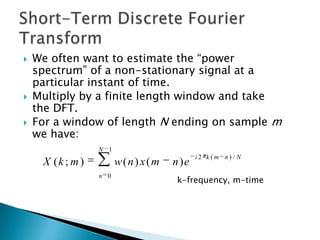
   We often want to estimate the “power
    spectrum” of a non-stationary signal at a
    particular instant of time.
   Multiply by a finite length window and take
    the DFT.
   For a window of length N ending on sample m
    we have:
                  N 1
                                       i 2 k (m n) / N
     X ( k ; m)         w(n) x(m n)e
                  n 0
                                 k-frequency, m-time
2
   X (k , m)       X (k , m) X * (k , m) gives the power at a frequency of
    k/N Hz (normalized) for a window centred at m-0.5(N-1).
   the (m-i) term in the exponent means that the phase origin
    remains consistent by cancelling out the linear phase shift
    introduced by a delay of m samples.
   the window samples are numbered backwards in time (for
    convenience later) hence the summation is performed backwards
    in time.
   The values X(k;m) are based on the N signal values from m–N+1
    to m.
   the frequency resolution is 1/N Hz (normalised units)
   the spectrum is periodic and (since w and x are real) conjugate
    symmetric:
     X (k )     X (N    k)   X *( k)
   there are only 0.5N+1independent frequency values
Sound «is»


Hamming window of length
401 samples centred on 400
Line spectrum from larynx oscillation (at about 0.01
normalised Hz) is superimposed on vocal tract resonances
   Wide window (N=400)
   Independent frequency
    values=N/2+1=201


   Short window eliminates the fine
    detail (N=30)
   N/2+1=16


   Zero padded window gives more
    spectrum points and an illusion of
    more detail (N=480=30×16). This is
    the normal case for a spectrogram
   N/2+1=241
N 1
X ( k ; m)         w(n) x(m n) exp   i 2 k ( m n) / N
             n 0
By setting r= N–1–i we can rewrite this as:
                  2 j (m N 1) N 1
X ( k ; m)   exp(               ) * ym (r ) exp 2 jkr / N
                        N          r 0

                        ym (r ) w( N 1 r ) x(m N 1 r )
This is a standard DFT multiplied by a phase-shift term that
is proportional to k: this compensates for the starting time
of the window: m–N+1

y(r) is a product of two signals so its DFT is the convolution
of the DFT’s of w(N–1–r) and x(m–N+1+r)
Rectangle window
w(n) 1
Slidelobe -13.3 dB
Mainlobe width(-3dB) 0.027
Leakage factor 9.14%
a=1.21, b=2


                       N
ck    cos(2k (n          ) / N)
                       2
Hamming window
w(n) 0.54 046 c1
Slidelobe -42.5 dB
Mainlobe width 0.039
Linkage factor 0.03%
a=1.81, b=4
Bartlett(L)
Blackman(L)
Rectwin(L)
Chebwin(L,R)
Hamming(L)
Hann(L)
Kaiser(L,beta)
taylorwin(L)
triang(L)
Спектр сигнала при использовании окна Блэкмана   Спектр сигнала при использовании окна Блэкмана -
                                                 Наттала
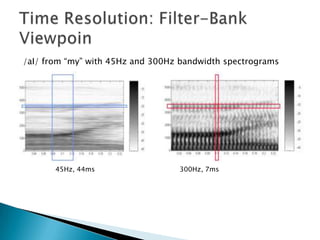
BW = 45 Hz
NT = 44 ms


BW = 300 Hz
NT = 7 ms
/aI/ from “my” with 45Hz and 300Hz bandwidth spectrograms


       45Hz, 44ms                 300Hz, 7ms
 Vertical slice through
  spectrogram:
 mT= 0.1s.
45 Hz gives finer frequency
resolution


 Horizontal slice through
  spectrogram:
 k/NT= 3.5 kHz
300 Hz gives finer time
resolution
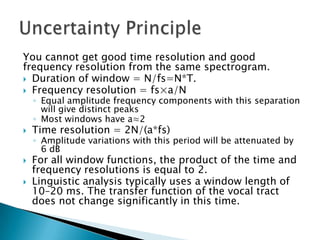
You cannot get good time resolution and good
frequency resolution from the same spectrogram.
 Duration of window = N/fs=N*T.
 Frequency resolution = fs×a/N
    ◦ Equal amplitude frequency components with this separation
      will give distinct peaks
    ◦ Most windows have a≈2
   Time resolution = 2N/(a*fs)
    ◦ Amplitude variations with this period will be attenuated by
      6 dB
   For all window functions, the product of the time and
    frequency resolutions is equal to 2.
   Linguistic analysis typically uses a window length of
    10–20 ms. The transfer function of the vocal tract
    does not change significantly in this time.
   To keep all the information about time variation
    of spectral components, you need only sample
    the spectrum twice as fast as the spectral
    magnitudes are varying. Using normalised
    frequencies:
   –∞ dB bandwidth for an N-point window = b/N
    ◦ b = 4 for a Hamming window
   Significant variation of spectral components
    occurs at frequencies below 2b/N
   we must sample the spectrum at a frequency of
    b/N
    ◦ the separation between spectral samples is the window
      width divided by b
   Exact line-spectrum of a periodic signal {xm}
   Sampled continuous spectrum of zero-extended {xm}
   Sampled continuous spectrum of infinite {xm} convolved with spectrum of
    rectangular window
   FFT is an algorithm for calculating DFT

   Energy Conservation (Parseval’s theorem)

   Symmetries {xm} ⇒ {Xk}
   Discrete⇒Periodic:Xk+N=Xk
   Real⇒Hermitian: X–k= X*k
   Periodic:xm+N/r = x
   m ⇒Discrete:Xk= 0for k ≠ir
   Skew Periodic:xm+N/2r = –xm ⇒Odd Harmonics:
   Even:xm= x N–m ⇒Real
   Odd:xm= –x N–m ⇒Purely Imaginary
   Real & Even⇒Real & Even
   Real & Odd⇒Purely Imaginary and Odd

Speech signal time frequency representation

  • 1.
    Methods and algorithmsof speech recognition course Nikolay V. Karpov nkarpov(а)hse.ru Lection 2
  • 2.
    This lecture is concerned with the spectrogram as a representation of how the frequency components within a signal vary with time.  Define what we mean by normalised time and frequency  Define the short-term discrete Fourier transformaton  Look at the effect of different window lengths on time and frequency resolution  Derive a quantitative description of the frequency resolution of the short term DFT and compare the performance of common windows  Derive a quantitative description of the time resolution of the short term DFT  Explain the uncertainty principle and illustrate its effects with some examples  Review some of the properties of the DFT
  • 3.
    Sampling theorem says that whenthe analog signal x(t) is band- restricted between 0 and W[Hz] and when x(t) is sampled at every T = 1/2W, the original signal can be completely reproduced by
  • 4.
    For those signalsthe frequency bandwidths of which are not known, a low-pass filter is used to restrict the bandwidths before sampling. When a signal is sampled contrary to the sampling theorem, aliasing distortion occurs, which distorts the high- frequency components of the signal, as shown
  • 5.
    Designate sin(2 wt ) g (t ) 2 wt i i i i x(t ) x( ) g (t ) x( ) x( ) x(iT ) x(i ) i 1 2w 2w 2w Fs Simple continuous signal x(t ) A cos(2 ft ) i k x(t ) A cos(2 f ( ) ) A cos( i ) A cos(2 i ) Fs N 1 k Normalised radian frequency 0 2 f( ) 2 (1) 0.5 Fs N Normalised time i
  • 6.
    With sampled datasystems it is customary to change the time scale and work in units of the sample period.  In normalised units the sampling frequency (fs) and period (T) both equal 1. They can therefore be omitted from equations: any such omissions can be deduced using dimensional consistency arguments.  The Nyquist frequency is ½ Hz = πradians/second  To convert back to real units: ◦ any time quantity must be multiplied by the real sample period (or divided by the real sample frequency) ◦ any frequency or angular frequency quantity must be multiplied by the real sample frequency (or divided by the real sample period)
  • 7.
    The spectrogram shows the energy in a signal at each frequency and at each time. We calculate this by evaluating the short-term discrete Fourier transform Z- tramsform n X ( z) x ( n) z n 1 X ( z) X ( z ) z n 1dz 2 j c
  • 8.
    The Fourier transformof x(n) can be computed from the z- transform as: i n X( ) X ( z) z e i x ( n )e n The Fourier transform may be viewed as the z-transform evaluated around the unit circle. The Discrete Fourier Transform (DFT) is defined as a sampled version of the Fourier shown above: N 1 N 1 i 2 kn / N X (k ) x ( n )e x ( n) X ( k )e i 2 kn / N n 0 n 0 The Fast Fourier Transform (FFT) is simply an efficient computation of the DFT.
  • 9.
    The Discrete Cosine Transform (DCT) is simply a DFT of a signal that is assumed to be real and even (real and even signals have real spectra!) N 1 X (k ) x(0) 2 x(n) cos(2 kn / N ); k 0,1,..., N 1 n 0 Note that these are not the only transforms used in speech processing  Wavelets;  Fractals;  Wigner distributions;  etc.
  • 10.
    We often want to estimate the “power spectrum” of a non-stationary signal at a particular instant of time.  Multiply by a finite length window and take the DFT.  For a window of length N ending on sample m we have: N 1 i 2 k (m n) / N X ( k ; m) w(n) x(m n)e n 0 k-frequency, m-time
  • 11.
    2  X (k , m) X (k , m) X * (k , m) gives the power at a frequency of k/N Hz (normalized) for a window centred at m-0.5(N-1).  the (m-i) term in the exponent means that the phase origin remains consistent by cancelling out the linear phase shift introduced by a delay of m samples.  the window samples are numbered backwards in time (for convenience later) hence the summation is performed backwards in time.  The values X(k;m) are based on the N signal values from m–N+1 to m.  the frequency resolution is 1/N Hz (normalised units)  the spectrum is periodic and (since w and x are real) conjugate symmetric: X (k ) X (N k) X *( k)  there are only 0.5N+1independent frequency values
  • 12.
    Sound «is» Hamming windowof length 401 samples centred on 400
  • 13.
    Line spectrum fromlarynx oscillation (at about 0.01 normalised Hz) is superimposed on vocal tract resonances
  • 14.
    Wide window (N=400)  Independent frequency values=N/2+1=201  Short window eliminates the fine detail (N=30)  N/2+1=16  Zero padded window gives more spectrum points and an illusion of more detail (N=480=30×16). This is the normal case for a spectrogram  N/2+1=241
  • 15.
    N 1 X (k ; m) w(n) x(m n) exp i 2 k ( m n) / N n 0 By setting r= N–1–i we can rewrite this as: 2 j (m N 1) N 1 X ( k ; m) exp( ) * ym (r ) exp 2 jkr / N N r 0 ym (r ) w( N 1 r ) x(m N 1 r ) This is a standard DFT multiplied by a phase-shift term that is proportional to k: this compensates for the starting time of the window: m–N+1 y(r) is a product of two signals so its DFT is the convolution of the DFT’s of w(N–1–r) and x(m–N+1+r)
  • 17.
    Rectangle window w(n) 1 Slidelobe-13.3 dB Mainlobe width(-3dB) 0.027 Leakage factor 9.14% a=1.21, b=2 N ck cos(2k (n ) / N) 2 Hamming window w(n) 0.54 046 c1 Slidelobe -42.5 dB Mainlobe width 0.039 Linkage factor 0.03% a=1.81, b=4
  • 18.
  • 19.
    Спектр сигнала прииспользовании окна Блэкмана Спектр сигнала при использовании окна Блэкмана - Наттала
  • 20.
    BW = 45Hz NT = 44 ms BW = 300 Hz NT = 7 ms
  • 21.
    /aI/ from “my”with 45Hz and 300Hz bandwidth spectrograms 45Hz, 44ms 300Hz, 7ms
  • 22.
     Vertical slicethrough spectrogram:  mT= 0.1s. 45 Hz gives finer frequency resolution  Horizontal slice through spectrogram:  k/NT= 3.5 kHz 300 Hz gives finer time resolution
  • 23.
    You cannot getgood time resolution and good frequency resolution from the same spectrogram.  Duration of window = N/fs=N*T.  Frequency resolution = fs×a/N ◦ Equal amplitude frequency components with this separation will give distinct peaks ◦ Most windows have a≈2  Time resolution = 2N/(a*fs) ◦ Amplitude variations with this period will be attenuated by 6 dB  For all window functions, the product of the time and frequency resolutions is equal to 2.  Linguistic analysis typically uses a window length of 10–20 ms. The transfer function of the vocal tract does not change significantly in this time.
  • 24.
    To keep all the information about time variation of spectral components, you need only sample the spectrum twice as fast as the spectral magnitudes are varying. Using normalised frequencies:  –∞ dB bandwidth for an N-point window = b/N ◦ b = 4 for a Hamming window  Significant variation of spectral components occurs at frequencies below 2b/N  we must sample the spectrum at a frequency of b/N ◦ the separation between spectral samples is the window width divided by b
  • 25.
    Exact line-spectrum of a periodic signal {xm}  Sampled continuous spectrum of zero-extended {xm}  Sampled continuous spectrum of infinite {xm} convolved with spectrum of rectangular window  FFT is an algorithm for calculating DFT  Energy Conservation (Parseval’s theorem)  Symmetries {xm} ⇒ {Xk}  Discrete⇒Periodic:Xk+N=Xk  Real⇒Hermitian: X–k= X*k  Periodic:xm+N/r = x  m ⇒Discrete:Xk= 0for k ≠ir  Skew Periodic:xm+N/2r = –xm ⇒Odd Harmonics:  Even:xm= x N–m ⇒Real  Odd:xm= –x N–m ⇒Purely Imaginary  Real & Even⇒Real & Even  Real & Odd⇒Purely Imaginary and Odd