Department of Microelectronics,
Indian Institute of Information Technology, Allahabad
SUBMITTED BY:
Prashant singh(imi2011003)
Rahul Patidar(imi2011011)
 Introduction
 Classification
 Types
 Structures
 Digital Vs Analog filters
 Refrences
 Electronic circuits which perform signal processing functions,
remove unwanted frequency component, to enhance wanted ones,
or both.
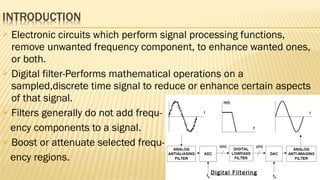
 Digital filter-Performs mathematical operations on a
sampled,discrete time signal to reduce or enhance certain aspects
of that signal.
 Filters generally do not add frequ-
ency components to a signal.
 Boost or attenuate selected frequ-
ency regions.
Digital Filtering
 Magnitude response consideration.
 Four basic types of ideal filters with magnitude responses as shown
below
π
1
ω
0 ωc–ωc
HLP(e jω
)
− π π
ω
0 ωc–ωc
1
HHP (e jω
)
− π
π− π
ω
11–
–ωc1 ωc1–ωc2 ωc2
HBP (e jω)
− π π
ω
1
–ωc1 ωc1–ωc2 ωc2
HBS(e jω
)
 Depending on the form of the filter equation
(a) Linear filters versus nonlinear filters.
(b) Time-invariant filters versus time-varying filters.
(c) Adaptive filters versus non-adaptive filters.
(d) Recursive versus non-recursive filters.
 Depending on the structure of implementation
(a) Direct-form, cascade-form, parallel-form and lattice structures.
 A class of linear filters whose behavior does not change over time
- Linearity implies that the filter meets the scaling and superposition properties.
 Two types
1.FIR filter
-Operate only on previous values of the input
2.IIR filter
-Operates on previous values of input & output both
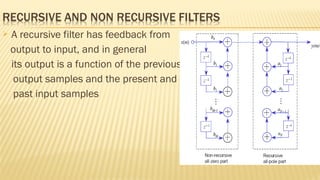
 A recursive filter has feedback from
output to input, and in general
its output is a function of the previous
output samples and the present and
past input samples
 A non recursive filter has no feedback from output to input, and
in general its output is a function of the present and past input
samples
 Direct Form
Direct Filter Structure
 Cascade Form
Cascade Filter Structure
 Parallel Form
Parallel Form Structure
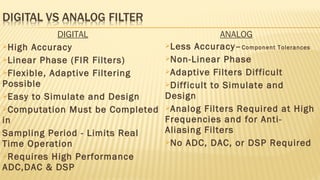
DIGITAL
High Accuracy
Linear Phase (FIR Filters)
Flexible, Adaptive Filtering
Possible
Easy to Simulate and Design
Computation Must be Completed
in
Sampling Period - Limits Real
Time Operation
Requires High Performance
ADC,DAC & DSP
ANALOG
Less Accuracy–Component Tolerances
Non-Linear Phase
Adaptive Filters Difficult
Difficult to Simulate and
Design
Analog Filters Required at High
Frequencies and for Anti-
Aliasing Filters
No ADC, DAC, or DSP Required
 Introduction to Speech Processing | Ricardo Gutierrez-Osuna | CSE@TAMU, chapter 10 of [Taylor, TTS synthesis, 2009].
 An Introduction to Digital Filters,application note,january1999, Intersil and Design is a trademark of Intersil Corporation. |
Copyright©Intersil Corporation 2000
 Digital Filters and Z Transforms,Copyright © Richard C. Bailey and David M. Harrison, 1998, 1999
 http://en.wikipedia.org/wiki/Digital_filter
digital filters

digital filters

  • 1.
    Department of Microelectronics, IndianInstitute of Information Technology, Allahabad SUBMITTED BY: Prashant singh(imi2011003) Rahul Patidar(imi2011011)
  • 2.
     Introduction  Classification Types  Structures  Digital Vs Analog filters  Refrences
  • 3.
     Electronic circuitswhich perform signal processing functions, remove unwanted frequency component, to enhance wanted ones, or both.  Digital filter-Performs mathematical operations on a sampled,discrete time signal to reduce or enhance certain aspects of that signal.  Filters generally do not add frequ- ency components to a signal.  Boost or attenuate selected frequ- ency regions. Digital Filtering
  • 4.
     Magnitude responseconsideration.  Four basic types of ideal filters with magnitude responses as shown below π 1 ω 0 ωc–ωc HLP(e jω ) − π π ω 0 ωc–ωc 1 HHP (e jω ) − π π− π ω 11– –ωc1 ωc1–ωc2 ωc2 HBP (e jω) − π π ω 1 –ωc1 ωc1–ωc2 ωc2 HBS(e jω )
  • 5.
     Depending onthe form of the filter equation (a) Linear filters versus nonlinear filters. (b) Time-invariant filters versus time-varying filters. (c) Adaptive filters versus non-adaptive filters. (d) Recursive versus non-recursive filters.  Depending on the structure of implementation (a) Direct-form, cascade-form, parallel-form and lattice structures.
  • 6.
     A classof linear filters whose behavior does not change over time - Linearity implies that the filter meets the scaling and superposition properties.  Two types 1.FIR filter -Operate only on previous values of the input 2.IIR filter -Operates on previous values of input & output both
  • 7.
     A recursivefilter has feedback from output to input, and in general its output is a function of the previous output samples and the present and past input samples
  • 8.
     A nonrecursive filter has no feedback from output to input, and in general its output is a function of the present and past input samples
  • 9.
     Direct Form DirectFilter Structure
  • 10.
     Cascade Form CascadeFilter Structure
  • 11.
  • 12.
    DIGITAL High Accuracy Linear Phase(FIR Filters) Flexible, Adaptive Filtering Possible Easy to Simulate and Design Computation Must be Completed in Sampling Period - Limits Real Time Operation Requires High Performance ADC,DAC & DSP ANALOG Less Accuracy–Component Tolerances Non-Linear Phase Adaptive Filters Difficult Difficult to Simulate and Design Analog Filters Required at High Frequencies and for Anti- Aliasing Filters No ADC, DAC, or DSP Required
  • 13.
     Introduction toSpeech Processing | Ricardo Gutierrez-Osuna | CSE@TAMU, chapter 10 of [Taylor, TTS synthesis, 2009].  An Introduction to Digital Filters,application note,january1999, Intersil and Design is a trademark of Intersil Corporation. | Copyright©Intersil Corporation 2000  Digital Filters and Z Transforms,Copyright © Richard C. Bailey and David M. Harrison, 1998, 1999  http://en.wikipedia.org/wiki/Digital_filter