Downloaded 181 times
![familiar example of vector space is the Euclidean space R3 . Any set of objects
with operations addition and multiplication which are closed under linear com-
bination forms a vector space. Under this definition polynomials, matrices and
functions also form vector space.
We can generalize familiar concepts in the Euclidean space to the more
general vector space. The length or norm of vector v is given by
n
v = 2
vi
i=0
The distance between two vectors v1 and v2 is the norm of the difference
vector v1 − v2 . The angle between two vectors is closely related to the inner
product < v1, v2 > due to the following relation.
< v1, v2 >
cosθ =
v1 ∗ v2
Two vectors are said to be orthogonal if their inner product is zero.
The concepts of length, distance and angle can be defined on any vector
space. For instance, in the space of functions, the integral f (x).g(x) gen-
eralizes the dot product in which summation is replaced by integration. The
b
functions f (x) and g(x) are said to be orthogonal on [a, b] if a f (x).g(x) = 0.
For example the set of functions { ejn2πf t } n=0,1,2... are orthogonal.
A basis is a minimal set of vectors that spans the entire space. If the elements
in basis are orthogonal and have unit length , then they form orthonormal basis
as formed by (i, j, k) in the euclidean space. A point in the euclidean space given
by u = xi + yj + zk. The values x,y and z gives the magnitude of projection on
these basis. To compute the magnitude of projection along i, we compute the
inner product of u and i, thus x = u.i.
A function s(t) can be viewed as a point in the space of functions. The
fourier decomposition of the function given by
∞
s(t) = An ejn2πf0 t
n=−∞
can be viewed as projection of the function onto orthonormal basis given by the
complex exponential functions ejn2πf0 t . Finding the magnitude of projection is
3](https://image.slidesharecdn.com/signal-130125143117-phpapp01/85/Signal-Processing-Introduction-using-Fourier-Transforms-3-320.jpg)
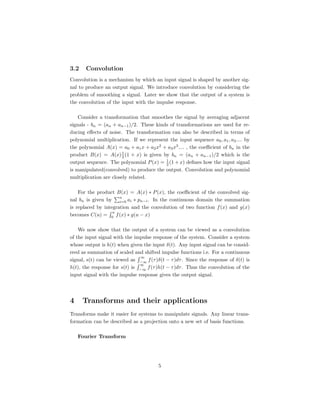
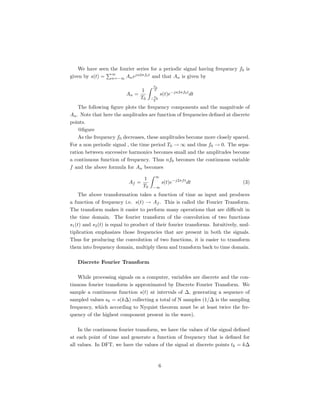
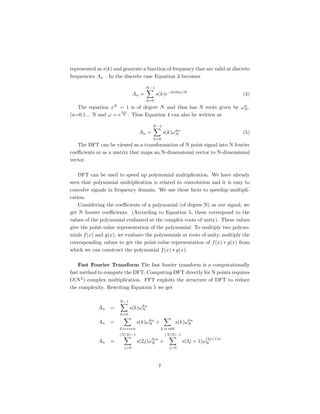
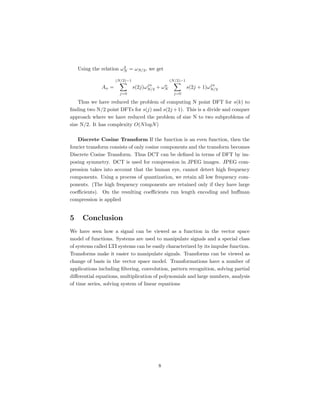

1) The document introduces signal processing by discussing signals, systems, and transforms. It defines signals as functions of time or space and systems as maps that manipulate signals. Transforms represent signals in different domains like frequency to simplify operations. 2) Signals can be represented in the frequency domain using Fourier transforms. This makes operations like filtering easier. Low frequencies represent overall shape while high frequencies are details like noise or edges. 3) Linear and time-invariant systems can be characterized by their impulse response. The output is the convolution of the input and impulse response. Convolution is a mechanism that shapes signals to produce outputs.


