The Discrete Fourier
Transform
Mr. HIMANSHU DIWAKAR JRTGI 1
Mr. HIMANSHU DIWAKAR
Assistant Professor
JETGI
Mr. HIMANSHU DIWAKAR JRTGI 2
Sampling the Fourier Transform
• Consider an aperiodic sequence with a Fourier transform
• Assume that a sequence is obtained by sampling the DTFT
• Since the DTFT is periodic resulting sequence is also periodic
• We can also write it in terms of the z-transform
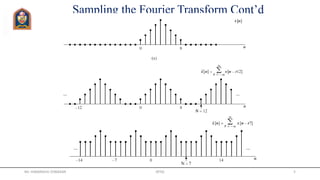
• The sampling points are shown in figure
• could be the DFS of a sequence
• Write the corresponding sequence
     
 
 kN/2j
kN/2
j
eXeXkX
~ 



 
  jDTFT
eX]n[x
     
 
 kN/2j
ez
eXzXkX
~
kN/2


 
 kX
~
   





1N
0k
knN/2j
ekX
~
N
1
]n[x~
Mr. HIMANSHU DIWAKAR JRTGI 3
Sampling the Fourier Transform Cont’d
• The only assumption made on the sequence is that DTFT exist
• Combine equation to get
• Term in the parenthesis is
• So we get
   




m
mjj
emxeX    





1N
0k
knN/2j
ekX
~
N
1
]n[x~
   
 kN/2j
eXkX
~ 

     
     
    
 



























mm
1N
0k
mnkN/2j
1N
0k
knN/2j
m
kmN/2j
mnp~mxe
N
1
mx
eemx
N
1
]n[x~
     
 






r
1N
0k
mnkN/2j
rNmne
N
1
mnp~
     





rr
rNnxrNnnx]n[x~
Mr. HIMANSHU DIWAKAR JRTGI 4
Sampling the Fourier Transform Cont’d
Mr. HIMANSHU DIWAKAR JRTGI 5
Sampling the Fourier Transform Cont’d
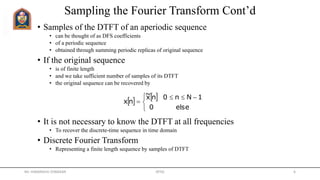
• Samples of the DTFT of an aperiodic sequence
• can be thought of as DFS coefficients
• of a periodic sequence
• obtained through summing periodic replicas of original sequence
• If the original sequence
• is of finite length
• and we take sufficient number of samples of its DTFT
• the original sequence can be recovered by
• It is not necessary to know the DTFT at all frequencies
• To recover the discrete-time sequence in time domain
• Discrete Fourier Transform
• Representing a finite length sequence by samples of DTFT
   


 

else0
1Nn0nx~
nx
Mr. HIMANSHU DIWAKAR JRTGI 6
The Discrete Fourier Transform
• Consider a finite length sequence x[n] of length N
• For given length-N sequence associate a periodic sequence
• The DFS coefficients of the periodic sequence are samples of the DTFT of x[n]
• Since x[n] is of length N there is no overlap between terms of x[n-rN] and we can
write the periodic sequence as
• To maintain duality between time and frequency
• We choose one period of as the Fourier transform of x[n]
  1Nn0ofoutside0nx 
   



r
rNnxnx~
        NkXNmodkXkX
~

 kX
~
   



 

else0
1Nk0kX
~
kX
        NnxNmodnxnx~ 
Mr. HIMANSHU DIWAKAR JRTGI 7
The Discrete Fourier Transform Cont’d
• The DFS pair
• The equations involve only on period so we can write
• The Discrete Fourier Transform
• The DFT pair can also be written as
   





1N
0k
knN/2j
ekX
~
N
1
]n[x~
   





1N
0n
knN/2j
e]n[x~kX
~
 
 





 



else0
1Nk0e]n[x~
kX
1N
0n
knN/2j
   





 



else0
1Nk0ekX
~
N
1
]n[x
1N
0k
knN/2j
   





1N
0n
knN/2j
e]n[xkX    





1N
0k
knN/2j
ekX
N
1
]n[x
  ]n[xkX DFT
 
Mr. HIMANSHU DIWAKAR JRTGI 8
Example
• The DFT of a rectangular pulse
• x[n] is of length 5
• We can consider x[n] of any
length greater than 5
• Let’s pick N=5
• Calculate the DFS of the
periodic form of x[n]
   
 


 










else0
,...10,5,0k5
e1
e1
ekX
~
5/k2j
k2j
4
0n
n5/k2j
Mr. HIMANSHU DIWAKAR JRTGI 9
Example Cont’d
• If we consider x[n] of length 10
• We get a different set of DFT
coefficients
• Still samples of the DTFT but in
different places
Mr. HIMANSHU DIWAKAR JRTGI 10
Properties of DFT
• Linearity
• Duality
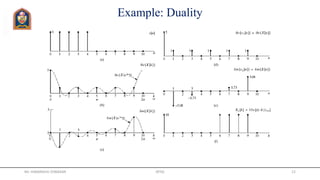
• Circular Shift of a Sequence
   
   
       kbXkaXnbxnax
kXnx
kXnx
21
DFT
21
2
DFT
2
1
DFT
1
 
 
 
   
       mN/k2jDFT
N
DFT
ekX1-Nn0mnx
kXnx

 
 
   
     N
DFT
DFT
kNxnX
kXnx
 
 
Mr. HIMANSHU DIWAKAR JRTGI 11
Example: Duality
Mr. HIMANSHU DIWAKAR JRTGI 12
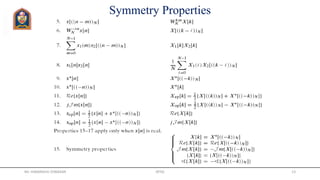
Symmetry Properties
Mr. HIMANSHU DIWAKAR JRTGI 13
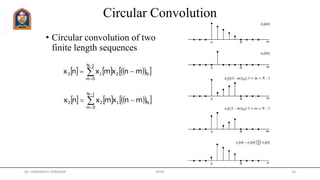
Circular Convolution
• Circular convolution of two
finite length sequences
       



1N
0m
N213 mnxmxnx
       



1N
0m
N123 mnxmxnx
Mr. HIMANSHU DIWAKAR JRTGI 14
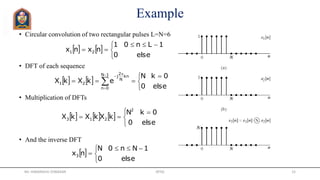
Example
• Circular convolution of two rectangular pulses L=N=6
• DFT of each sequence
• Multiplication of DFTs
• And the inverse DFT
   


 

else0
1Ln01
nxnx 21
   


 
 




else0
0kN
ekXkX
1N
0n
kn
N
2
j
21
     


 

else0
0kN
kXkXkX
2
213
 


 

else0
1Nn0N
nx3
Mr. HIMANSHU DIWAKAR JRTGI 15
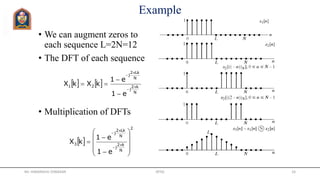
Example
• We can augment zeros to
each sequence L=2N=12
• The DFT of each sequence
• Multiplication of DFTs
   
N
k2
j
N
Lk2
j
21
e1
e1
kXkX 






 
2
N
k2
j
N
Lk2
j
3
e1
e1
kX












 



Mr. HIMANSHU DIWAKAR JRTGI 16
THANK YOU
Mr. HIMANSHU DIWAKAR JRTGI 17

The discrete fourier transform (dsp) 4

  • 1.
    The Discrete Fourier Transform Mr.HIMANSHU DIWAKAR JRTGI 1 Mr. HIMANSHU DIWAKAR Assistant Professor JETGI
  • 2.
  • 3.
    Sampling the FourierTransform • Consider an aperiodic sequence with a Fourier transform • Assume that a sequence is obtained by sampling the DTFT • Since the DTFT is periodic resulting sequence is also periodic • We can also write it in terms of the z-transform • The sampling points are shown in figure • could be the DFS of a sequence • Write the corresponding sequence          kN/2j kN/2 j eXeXkX ~         jDTFT eX]n[x          kN/2j ez eXzXkX ~ kN/2      kX ~          1N 0k knN/2j ekX ~ N 1 ]n[x~ Mr. HIMANSHU DIWAKAR JRTGI 3
  • 4.
    Sampling the FourierTransform Cont’d • The only assumption made on the sequence is that DTFT exist • Combine equation to get • Term in the parenthesis is • So we get         m mjj emxeX          1N 0k knN/2j ekX ~ N 1 ]n[x~      kN/2j eXkX ~                                                 mm 1N 0k mnkN/2j 1N 0k knN/2j m kmN/2j mnp~mxe N 1 mx eemx N 1 ]n[x~               r 1N 0k mnkN/2j rNmne N 1 mnp~            rr rNnxrNnnx]n[x~ Mr. HIMANSHU DIWAKAR JRTGI 4
  • 5.
    Sampling the FourierTransform Cont’d Mr. HIMANSHU DIWAKAR JRTGI 5
  • 6.
    Sampling the FourierTransform Cont’d • Samples of the DTFT of an aperiodic sequence • can be thought of as DFS coefficients • of a periodic sequence • obtained through summing periodic replicas of original sequence • If the original sequence • is of finite length • and we take sufficient number of samples of its DTFT • the original sequence can be recovered by • It is not necessary to know the DTFT at all frequencies • To recover the discrete-time sequence in time domain • Discrete Fourier Transform • Representing a finite length sequence by samples of DTFT          else0 1Nn0nx~ nx Mr. HIMANSHU DIWAKAR JRTGI 6
  • 7.
    The Discrete FourierTransform • Consider a finite length sequence x[n] of length N • For given length-N sequence associate a periodic sequence • The DFS coefficients of the periodic sequence are samples of the DTFT of x[n] • Since x[n] is of length N there is no overlap between terms of x[n-rN] and we can write the periodic sequence as • To maintain duality between time and frequency • We choose one period of as the Fourier transform of x[n]   1Nn0ofoutside0nx         r rNnxnx~         NkXNmodkXkX ~   kX ~           else0 1Nk0kX ~ kX         NnxNmodnxnx~  Mr. HIMANSHU DIWAKAR JRTGI 7
  • 8.
    The Discrete FourierTransform Cont’d • The DFS pair • The equations involve only on period so we can write • The Discrete Fourier Transform • The DFT pair can also be written as          1N 0k knN/2j ekX ~ N 1 ]n[x~          1N 0n knN/2j e]n[x~kX ~               else0 1Nk0e]n[x~ kX 1N 0n knN/2j               else0 1Nk0ekX ~ N 1 ]n[x 1N 0k knN/2j          1N 0n knN/2j e]n[xkX          1N 0k knN/2j ekX N 1 ]n[x   ]n[xkX DFT   Mr. HIMANSHU DIWAKAR JRTGI 8
  • 9.
    Example • The DFTof a rectangular pulse • x[n] is of length 5 • We can consider x[n] of any length greater than 5 • Let’s pick N=5 • Calculate the DFS of the periodic form of x[n]                     else0 ,...10,5,0k5 e1 e1 ekX ~ 5/k2j k2j 4 0n n5/k2j Mr. HIMANSHU DIWAKAR JRTGI 9
  • 10.
    Example Cont’d • Ifwe consider x[n] of length 10 • We get a different set of DFT coefficients • Still samples of the DTFT but in different places Mr. HIMANSHU DIWAKAR JRTGI 10
  • 11.
    Properties of DFT •Linearity • Duality • Circular Shift of a Sequence                kbXkaXnbxnax kXnx kXnx 21 DFT 21 2 DFT 2 1 DFT 1                  mN/k2jDFT N DFT ekX1-Nn0mnx kXnx               N DFT DFT kNxnX kXnx     Mr. HIMANSHU DIWAKAR JRTGI 11
  • 12.
  • 13.
  • 14.
    Circular Convolution • Circularconvolution of two finite length sequences            1N 0m N213 mnxmxnx            1N 0m N123 mnxmxnx Mr. HIMANSHU DIWAKAR JRTGI 14
  • 15.
    Example • Circular convolutionof two rectangular pulses L=N=6 • DFT of each sequence • Multiplication of DFTs • And the inverse DFT          else0 1Ln01 nxnx 21               else0 0kN ekXkX 1N 0n kn N 2 j 21            else0 0kN kXkXkX 2 213        else0 1Nn0N nx3 Mr. HIMANSHU DIWAKAR JRTGI 15
  • 16.
    Example • We canaugment zeros to each sequence L=2N=12 • The DFT of each sequence • Multiplication of DFTs     N k2 j N Lk2 j 21 e1 e1 kXkX          2 N k2 j N Lk2 j 3 e1 e1 kX                  Mr. HIMANSHU DIWAKAR JRTGI 16
  • 17.
    THANK YOU Mr. HIMANSHUDIWAKAR JRTGI 17