Multirate Digital Signal Processing
Zena Mohammed
Multirate Digital Signal Processing
• systems that employ multiple sampling rates in
the processing of digital signals are called
multirate digital signal processing systems.
• Multirate systems are sometimes used for
sampling-rate conversion
In most applications multirate systems are used
to improve the performance, or for increased
computational efficiency.
Multirate Digital Signal Processing
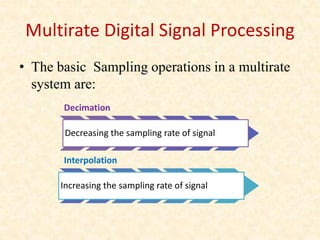
• The basic Sampling operations in a multirate
system are:
Decimation
Decreasing the sampling rate of signal
Interpolation
Increasing the sampling rate of signal
Sampling Rate Reduction by Integer Factor
D
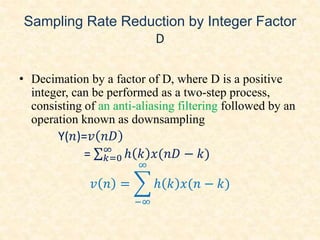
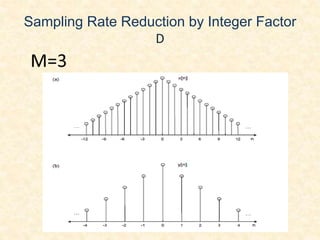
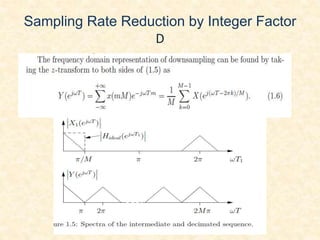
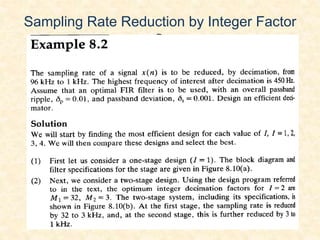
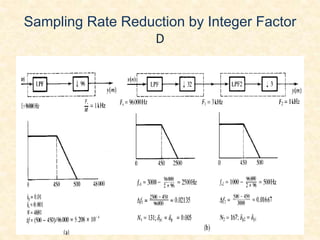
• Decimation by a factor of D, where D is a positive
integer, can be performed as a two-step process,
consisting of an anti-aliasing filtering followed by an
operation known as downsampling
Y(𝑛)=𝑣 𝑛𝐷
= 𝑘=0
∞
ℎ 𝑘 𝑥(𝑛𝐷 − 𝑘)
𝑣 𝑛 =
−∞
∞
ℎ 𝑘 𝑥(𝑛 − 𝑘)
Sampling Rate Reduction by Integer Factor
D
H(n)
Downsampler
D
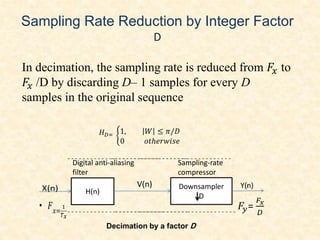
In decimation, the sampling rate is reduced from 𝐹𝑥 to
𝐹𝑥 /D by discarding D– 1 samples for every D
samples in the original sequence
𝐻 𝐷= 1, 𝑊 ≤ 𝜋/𝐷
0 𝑜𝑡ℎ𝑒𝑟𝑤𝑖𝑠𝑒
Digital anti-aliasing
filter
Sampling-rate
compressor
Sampling Rate Reduction by Integer Factor
D
Sampling Rate Reduction by Integer Factor
D
Sampling Rate Reduction by Integer Factor
D
Sampling Rate Reduction by Integer Factor
D
Sampling Rate Increase by Integer
Factor I
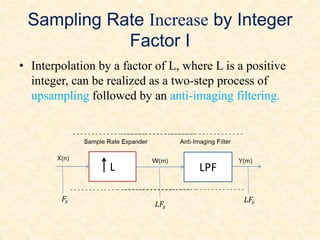
• Interpolation by a factor of L, where L is a positive
integer, can be realized as a two-step process of
upsampling followed by an anti-imaging filtering.
L LPF
Sampling Rate Increase by Integer
Factor I
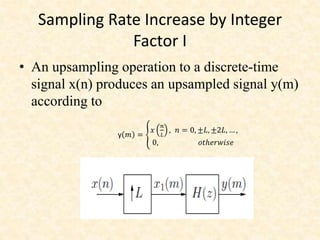
• An upsampling operation to a discrete-time
signal x(n) produces an upsampled signal y(m)
according to
y 𝑚 =
𝑥
𝑛
𝐿
, 𝑛 = 0, ±𝐿, ±2𝐿, … ,
0, 𝑜𝑡ℎ𝑒𝑟𝑤𝑖𝑠𝑒
Sampling Rate Increase by Integer
Factor I
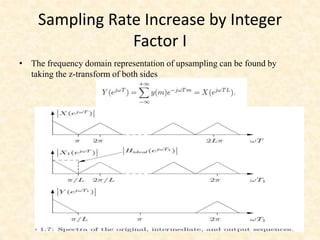
• The frequency domain representation of upsampling can be found by
taking the z-transform of both sides
Sampling Rate Increase by Integer Factor I
1
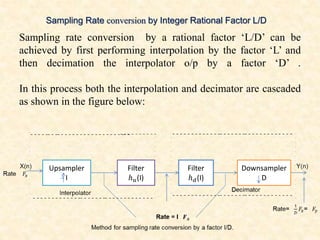
Sampling rate conversion by a rational factor ‘L/D’ can be
achieved by first performing interpolation by the factor ‘L’ and
then decimation the interpolator o/p by a factor ‘D’ .
In this process both the interpolation and decimator are cascaded
as shown in the figure below:
Upsampler
I
Filter
ℎ 𝑢(I)
Downsampler
D
Filter
ℎ 𝑑(I)
Sampling Rate conversion by Integer Rational Factor L/D
• Example:
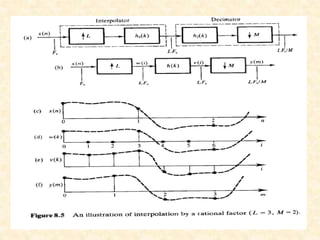
Consider a multirate signal processing problem:
i. State with the aid of block diagrams the process
of changing sampling rate by a non-integer
factor.
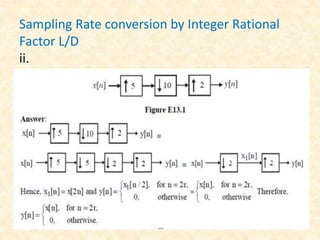
ii. Develop an expression for the output y[n] and
g[n] as a function of input x[n] for the multirate
structure of fig .
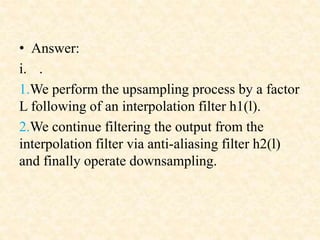
• Answer:
i. .
1.We perform the upsampling process by a factor
L following of an interpolation filter h1(l).
2.We continue filtering the output from the
interpolation filter via anti-aliasing filter h2(l)
and finally operate downsampling.
Sampling Rate conversion by Integer Rational
Factor L/D
ii.
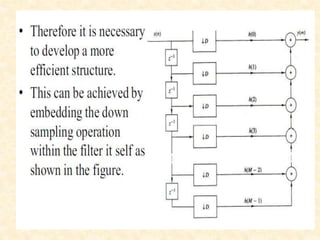
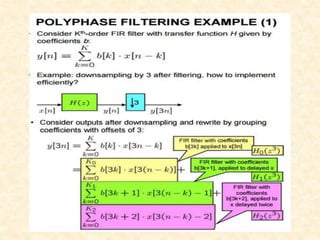
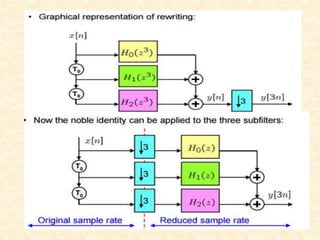
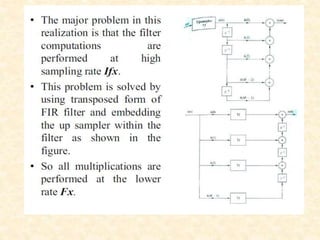
Polyphase filters
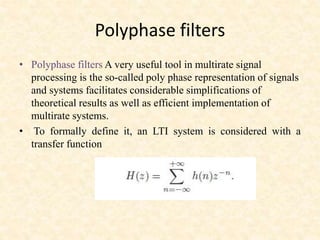
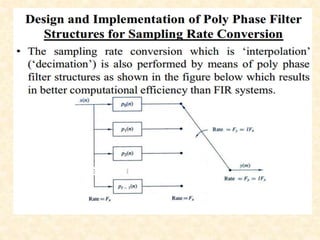
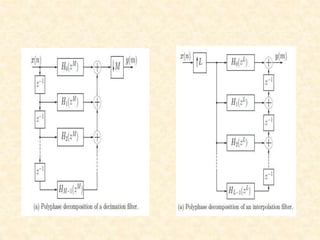
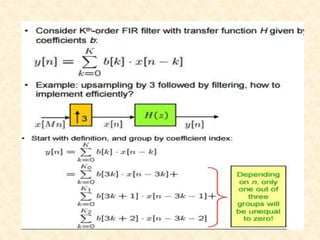
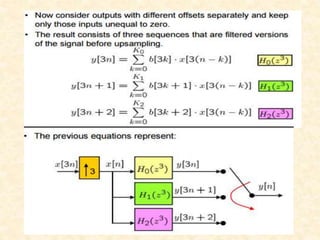
• Polyphase filters A very useful tool in multirate signal
processing is the so-called poly phase representation of signals
and systems facilitates considerable simplifications of
theoretical results as well as efficient implementation of
multirate systems.
• To formally define it, an LTI system is considered with a
transfer function
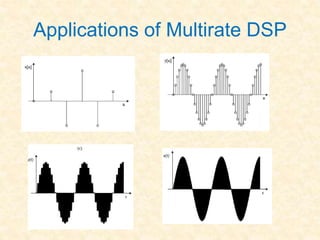
Applications of Multirate DSP
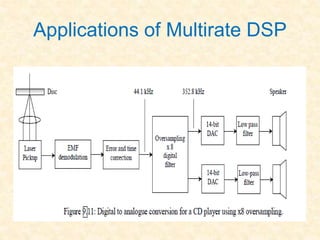
• Multirate systems are used in a CD player when the
music signal is converted from digital into analog
(DAC).
Applications of Multirate DSP
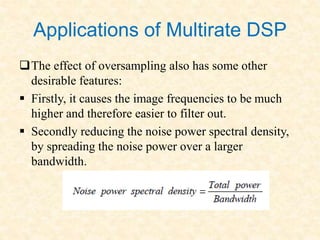
The effect of oversampling also has some other
desirable features:
 Firstly, it causes the image frequencies to be much
higher and therefore easier to filter out.
 Secondly reducing the noise power spectral density,
by spreading the noise power over a larger
bandwidth.
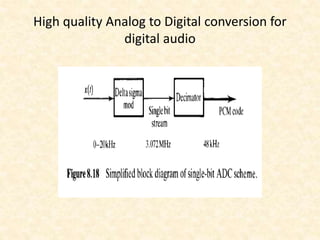
High quality Analog to Digital conversion for
digital audio
Thanks>>>>

Multirate DSP

  • 1.
    Multirate Digital SignalProcessing Zena Mohammed
  • 2.
    Multirate Digital SignalProcessing • systems that employ multiple sampling rates in the processing of digital signals are called multirate digital signal processing systems. • Multirate systems are sometimes used for sampling-rate conversion
  • 3.
    In most applicationsmultirate systems are used to improve the performance, or for increased computational efficiency. Multirate Digital Signal Processing
  • 4.
    Multirate Digital SignalProcessing • The basic Sampling operations in a multirate system are: Decimation Decreasing the sampling rate of signal Interpolation Increasing the sampling rate of signal
  • 5.
    Sampling Rate Reductionby Integer Factor D • Decimation by a factor of D, where D is a positive integer, can be performed as a two-step process, consisting of an anti-aliasing filtering followed by an operation known as downsampling Y(𝑛)=𝑣 𝑛𝐷 = 𝑘=0 ∞ ℎ 𝑘 𝑥(𝑛𝐷 − 𝑘) 𝑣 𝑛 = −∞ ∞ ℎ 𝑘 𝑥(𝑛 − 𝑘)
  • 6.
    Sampling Rate Reductionby Integer Factor D H(n) Downsampler D In decimation, the sampling rate is reduced from 𝐹𝑥 to 𝐹𝑥 /D by discarding D– 1 samples for every D samples in the original sequence 𝐻 𝐷= 1, 𝑊 ≤ 𝜋/𝐷 0 𝑜𝑡ℎ𝑒𝑟𝑤𝑖𝑠𝑒 Digital anti-aliasing filter Sampling-rate compressor
  • 7.
    Sampling Rate Reductionby Integer Factor D
  • 8.
    Sampling Rate Reductionby Integer Factor D
  • 9.
    Sampling Rate Reductionby Integer Factor D
  • 10.
    Sampling Rate Reductionby Integer Factor D
  • 11.
    Sampling Rate Increaseby Integer Factor I • Interpolation by a factor of L, where L is a positive integer, can be realized as a two-step process of upsampling followed by an anti-imaging filtering. L LPF
  • 12.
    Sampling Rate Increaseby Integer Factor I • An upsampling operation to a discrete-time signal x(n) produces an upsampled signal y(m) according to y 𝑚 = 𝑥 𝑛 𝐿 , 𝑛 = 0, ±𝐿, ±2𝐿, … , 0, 𝑜𝑡ℎ𝑒𝑟𝑤𝑖𝑠𝑒
  • 13.
    Sampling Rate Increaseby Integer Factor I • The frequency domain representation of upsampling can be found by taking the z-transform of both sides
  • 14.
    Sampling Rate Increaseby Integer Factor I
  • 15.
  • 16.
    Sampling rate conversionby a rational factor ‘L/D’ can be achieved by first performing interpolation by the factor ‘L’ and then decimation the interpolator o/p by a factor ‘D’ . In this process both the interpolation and decimator are cascaded as shown in the figure below: Upsampler I Filter ℎ 𝑢(I) Downsampler D Filter ℎ 𝑑(I) Sampling Rate conversion by Integer Rational Factor L/D
  • 18.
    • Example: Consider amultirate signal processing problem: i. State with the aid of block diagrams the process of changing sampling rate by a non-integer factor. ii. Develop an expression for the output y[n] and g[n] as a function of input x[n] for the multirate structure of fig .
  • 19.
    • Answer: i. . 1.Weperform the upsampling process by a factor L following of an interpolation filter h1(l). 2.We continue filtering the output from the interpolation filter via anti-aliasing filter h2(l) and finally operate downsampling.
  • 20.
    Sampling Rate conversionby Integer Rational Factor L/D ii.
  • 21.
    Polyphase filters • Polyphasefilters A very useful tool in multirate signal processing is the so-called poly phase representation of signals and systems facilitates considerable simplifications of theoretical results as well as efficient implementation of multirate systems. • To formally define it, an LTI system is considered with a transfer function
  • 31.
    Applications of MultirateDSP • Multirate systems are used in a CD player when the music signal is converted from digital into analog (DAC).
  • 32.
  • 33.
  • 34.
    Applications of MultirateDSP The effect of oversampling also has some other desirable features:  Firstly, it causes the image frequencies to be much higher and therefore easier to filter out.  Secondly reducing the noise power spectral density, by spreading the noise power over a larger bandwidth.
  • 35.
    High quality Analogto Digital conversion for digital audio
  • 36.