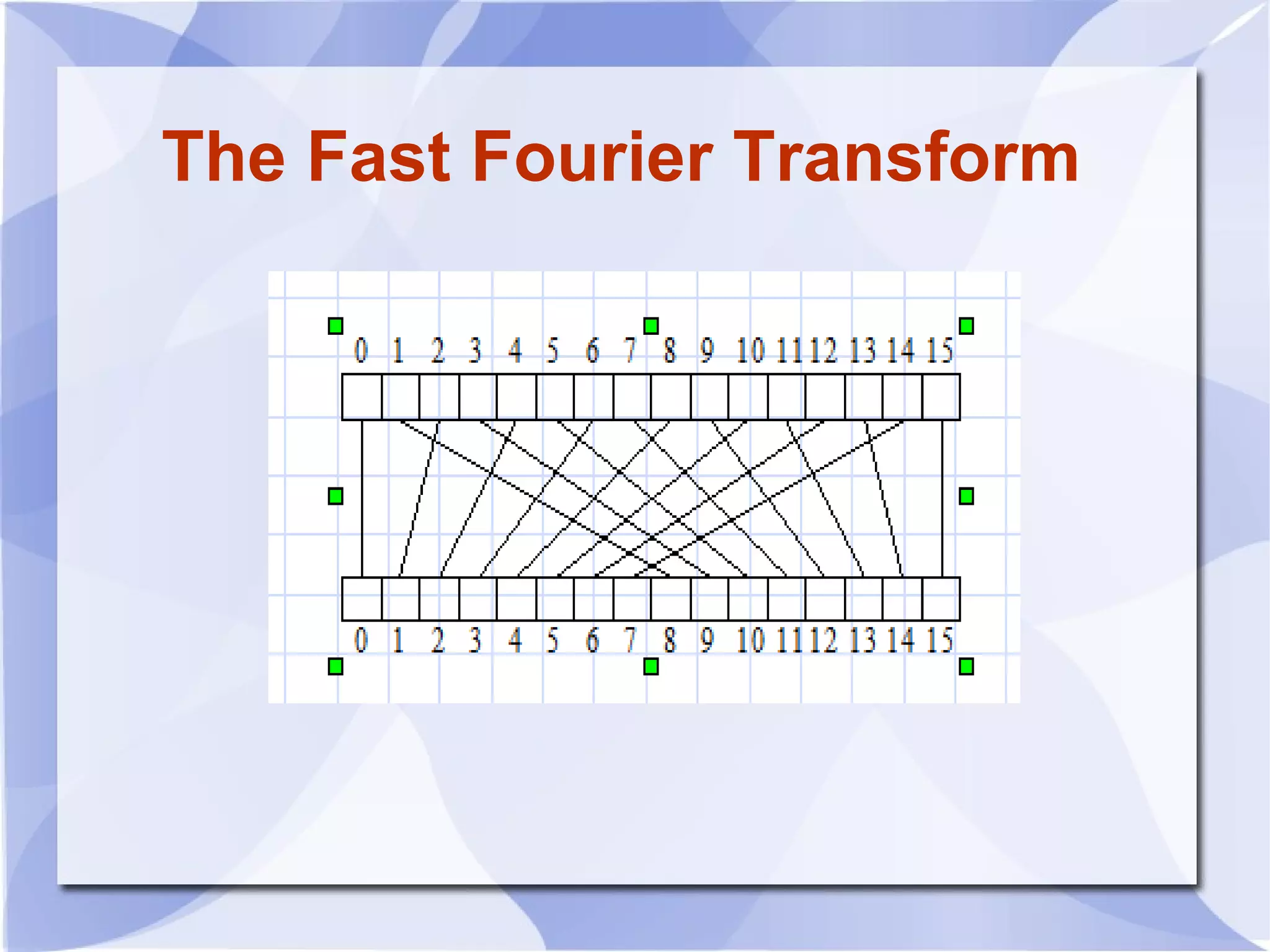
The Fast Fourier Transform Title
Introduction What is the FFT? - A collection of “tricks” that exploit the  symmetryof the DFT calculation to make its  execution muchfaster . - Speedup increases with DFT size.
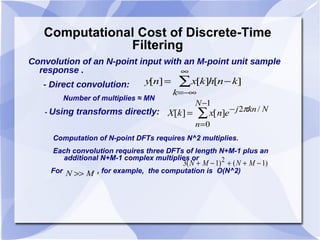
Computational Cost of Discrete-Time Filtering Convolution of an  N -point input with an  M -point unit sample response . - Direct convolution: Number of multiplies ≈ MN -  Using transforms directly : Computation of N-point DFTs requires N^2 multiplies. Each convolution requires three DFTs of length N+M-1 plus an  additional N+M-1 complex multiplies or  For  , for example,  the computation is  O(N^2)
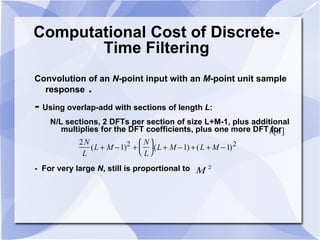
Computational Cost of Discrete-Time Filtering Convolution of an  N -point input with an  M -point unit sample response  . -  Using overlap-add with sections of length  L : N/L sections, 2 DFTs per section of size L+M-1, plus additional  multiplies for the DFT coefficients, plus one more DFT for -  For very large  N , still is proportional to
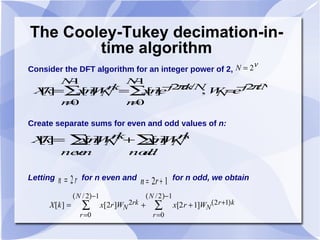
The Cooley-Tukey decimation-in-time algorithm Consider the DFT algorithm for an integer power of 2,  Create separate sums for even and odd values of  n: Letting  for n even and  for n odd, we obtain
The Cooley-Tukey decimation-in-time algorithm Splitting indices in time , we have obtained But  and So  N/2 -point DFT of  x[2r]   N/2 -point DFT of  x[2r+1]
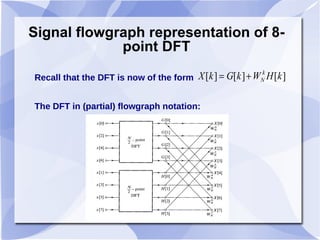
Signal flowgraph representation of 8- point DFT Recall that the DFT is now of the form The DFT in (partial) flowgraph notation:
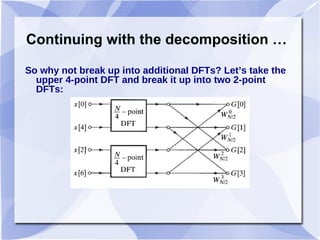
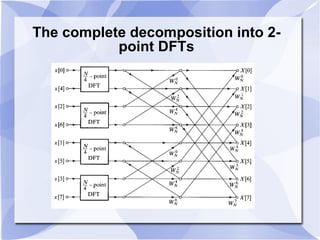
Continuing with the decomposition … So why not break up into additional DFTs? Let’s take the upper 4-point DFT and break it up into two 2-point DFTs:
The complete decomposition into 2-point DFTs
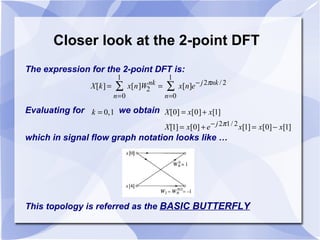
Closer look at the 2-point DFT The expression for the 2-point DFT is: Evaluating for  we obtain which in signal flow graph notation looks like … This topology is referred as the  BASIC BUTTERFLY
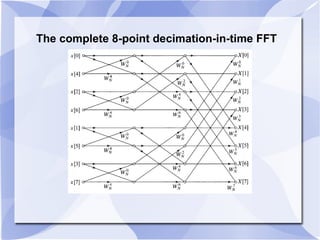
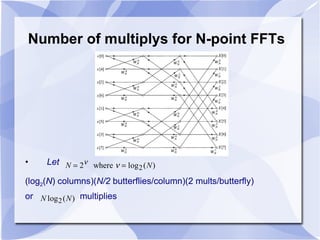
The complete 8-point decimation-in-time FFT
Number of multiplys for N-point FFTs Let (log 2 ( N ) columns)( N/2  butterflies/column)(2 mults/butterfly) or  multiplies
CONCLUSION Use of the FFT algorithm reduces the number of multiplys required to perform the DFT by a factor of more than 100 for 1024-point DFTs, with the advantage increasing with increasing DFT size.

Fft ppt

  • 1.
    The Fast FourierTransform Title
  • 2.
    Introduction What isthe FFT? - A collection of “tricks” that exploit the symmetryof the DFT calculation to make its execution muchfaster . - Speedup increases with DFT size.
  • 3.
    Computational Cost ofDiscrete-Time Filtering Convolution of an N -point input with an M -point unit sample response . - Direct convolution: Number of multiplies ≈ MN - Using transforms directly : Computation of N-point DFTs requires N^2 multiplies. Each convolution requires three DFTs of length N+M-1 plus an additional N+M-1 complex multiplies or For , for example, the computation is O(N^2)
  • 4.
    Computational Cost ofDiscrete-Time Filtering Convolution of an N -point input with an M -point unit sample response . - Using overlap-add with sections of length L : N/L sections, 2 DFTs per section of size L+M-1, plus additional multiplies for the DFT coefficients, plus one more DFT for - For very large N , still is proportional to
  • 5.
    The Cooley-Tukey decimation-in-timealgorithm Consider the DFT algorithm for an integer power of 2, Create separate sums for even and odd values of n: Letting for n even and for n odd, we obtain
  • 6.
    The Cooley-Tukey decimation-in-timealgorithm Splitting indices in time , we have obtained But and So N/2 -point DFT of x[2r] N/2 -point DFT of x[2r+1]
  • 7.
    Signal flowgraph representationof 8- point DFT Recall that the DFT is now of the form The DFT in (partial) flowgraph notation:
  • 8.
    Continuing with thedecomposition … So why not break up into additional DFTs? Let’s take the upper 4-point DFT and break it up into two 2-point DFTs:
  • 9.
    The complete decompositioninto 2-point DFTs
  • 10.
    Closer look atthe 2-point DFT The expression for the 2-point DFT is: Evaluating for we obtain which in signal flow graph notation looks like … This topology is referred as the BASIC BUTTERFLY
  • 11.
    The complete 8-pointdecimation-in-time FFT
  • 12.
    Number of multiplysfor N-point FFTs Let (log 2 ( N ) columns)( N/2 butterflies/column)(2 mults/butterfly) or multiplies
  • 13.
    CONCLUSION Use ofthe FFT algorithm reduces the number of multiplys required to perform the DFT by a factor of more than 100 for 1024-point DFTs, with the advantage increasing with increasing DFT size.