Discrete Time Fourier Transform
• Why Fourier Transform
• General Properties & Symmetry relations
• Formula and steps
• magnitude and phase spectra
• Convergence Condition
• mean-square convergence
• Gibbs phenomenon
• Direct Delta
• Energy Density Spectrum
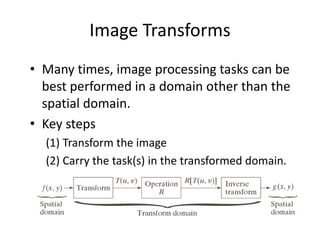
Image Transforms
• Many times, image processing tasks can be
best performed in a domain other than the
spatial domain.
• Key steps
(1) Transform the image
(2) Carry the task(s) in the transformed domain.
(3) Apply inverse transform to return to the
spatial domain.
Why is FT Useful?
• Easier to remove undesirable frequencies in
the frequency domain.
• Faster to perform certain operations in the
frequency domain than in the spatial domain.
– i.e., using the Fast Fourier Transform (FFT)
Frequency Filtering: Main Steps
1. Take the FT of f(x):
2. Remove undesired frequencies:
3. Convert back to a signal:
x
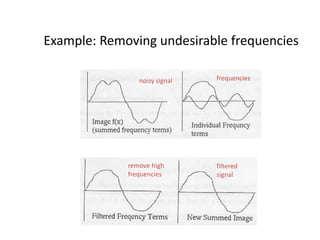
Example: Removing undesirable frequencies
remove high
frequencies
filtered
signal
frequencies
noisy signal
FT - Definitions
• F(u) is a complex function:
• Magnitude of FT (or spectrum):
• Phase of FT:
• Magnitude-Phase representation:
• Power of f(x): P(u)=|F(u)|2=
Discrete-Time Fourier Transform
• Definition - The Discrete-Time Fourier
Transform (DTFT) of a sequence
x[n] is given by
• In general, is a complex function of
the real variable w and can be written as
)
( w
j
e
X
)
( w
j
e
X






n
n
j
j
e
n
x
e
X ω
ω
]
[
)
(
)
(
)
(
)
( im
re
w
w
w j
j
j
e
X
j
e
X
e
X 

Discrete-Time Fourier Transform
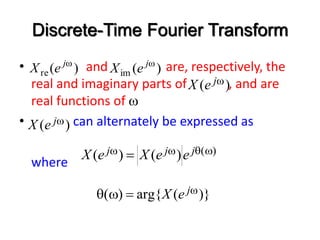
• and are, respectively, the
real and imaginary parts of , and are
real functions of w
• can alternately be expressed as
where
)
( w
j
e
X
)
( ω
re
j
e
X )
( ω
im
j
e
X
)
( w
j
e
X
)
(
)
(
)
( w

w
w  j
j
j e
e
X
e
X
)}
(
arg{
)
( w

w
 j
e
X
Discrete-Time Fourier Transform
• is called the magnitude function
• is called the phase function
• Both quantities are again real functions of w
• In many applications, the DTFT is called the
Fourier spectrum
• Likewise, and are called the
magnitude and phase spectra
)
( w
j
e
X
)
(w

)
( w
j
e
X )
(w

Discrete-Time Fourier Transform
• Inverse Discrete-Time Fourier Transform:
 w





w
w
d
e
e
X
n
x n
j
j
)
(
2
1
]
[
General Properties of DTFT
Symmetry relations of the DTFT of a
complex sequence
Symmetry relations of the DTFT
of a real sequence
x[n]: A real sequence
DTFT of unit Impulse Sequence
• Example - The DTFT of the unit sample
sequence d[n] is given by
1
]
0
[
]
[
)
( 
d

d

w
 w




n
j
n
e
n






n
n
j
j
e
n
x
e
X ω
ω
]
[
)
(
DTFT of Causal Sequence
• Example - Consider the causal sequence


 



otherwise
0
0
1
]
[
,
1
],
[
]
[
n
n
n
n
x n










n
n
j
j
e
n
x
e
X ω
ω
]
[
)
(


 




w




w

w
0
]
[
)
(
n
n
j
n
n
n
j
n
j
e
e
n
e
X
w





w


 
 j
e
n
n
j
e
1
1
0
)
(
DTFT of Causal Sequence
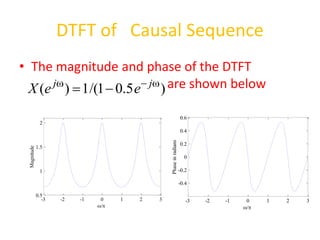
• The magnitude and phase of the DTFT
are shown below
)
5
.
0
1
/(
1
)
( w

w

 j
j
e
e
X
-3 -2 -1 0 1 2 3
0.5
1
1.5
2
w/
Magnitude
-3 -2 -1 0 1 2 3
-0.4
-0.2
0
0.2
0.4
0.6
w/
Phase
in
radians
Convergence Condition
• - An infinite series of the form
may or may not converge
• Consider the following approximation





w

w
n
n
j
j
e
n
x
e
X ]
[
)
(




w

w
K
K
n
n
j
j
K e
n
x
e
X ]
[
)
(
Convergence Condition
• Then for uniform convergence of ,
• If x[n] is an absolutely summable sequence, i.e., if
for all values of w
• Thus, the absolute summability of x[n] is a sufficient
condition for the existence of the DTFT
)
( w
j
e
X
0
)
(
)
(
lim 
 w
w


j
K
j
K
e
X
e
X






n
n
x ]
[












w

w
n
n
n
j
j
n
x
e
n
x
e
X ]
[
]
[
)
(
Convergence Condition
• Example - The sequence for
is absolutely summable as
and therefore its DTFT converges to
uniformly
]
[
]
[ n
n
x n



1







 

 





 1
1
]
[
0
n
n
n
n
n
)
( w
j
e
X
)
1
/(
1 w


 j
e
Convergence Condition
• Since
an absolutely summable sequence has always
a finite energy
• However, a finite-energy sequence is not
necessarily absolutely summable
,
]
[
]
[
2
2














 n
n
n
x
n
x
• - The sequence
has a finite energy equal to
• However, x[n] is not absolutely summable since the
summation
does not converge.
Example




]
[n
x 0
0
1
1


n
n
n
,
,
/
6
1 2
1
2


 








n
x
n
E







1
1
1
1
n
n n
n
Mean Square Convergence
• To represent a finite energy sequence that is not
absolutely summable by a DTFT, it is necessary to
consider a mean-square convergence of
where
)
( w
j
e
X
0
)
(
)
(
lim
2

w
 



w
w


d
e
X
e
X j
K
j
K




w

w
K
K
n
n
j
j
K e
n
x
e
X ]
[
)
(
Mean Square Convergence
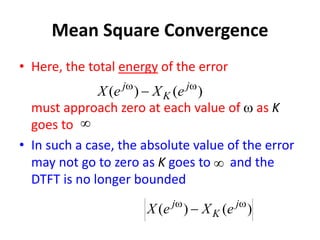
• Here, the total energy of the error
must approach zero at each value of w as K
goes to
• In such a case, the absolute value of the error
may not go to zero as K goes to and the
DTFT is no longer bounded


)
(
)
( w
w
 j
K
j
e
X
e
X
)
(
)
( w
w
 j
K
j
e
X
e
X
Example
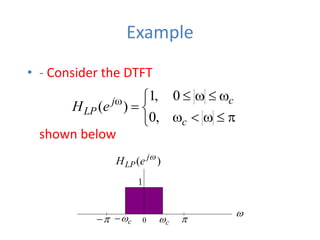
• - Consider the DTFT
shown below





w

w
w

w


w
c
c
j
LP e
H
,
0
0
,
1
)
(
)
( w
j
LP e
H
c
w 
0
1

 c
w

w
Example
• The inverse DTFT of is given by
• The energy of is given by
• is a finite-energy sequence, but
it is not absolutely summable
)
( w
j
LP e
H
]
[n
hLP
,
sin
2
1
n
n
jn
e
jn
e c
n
j
n
j c
c

w












w

w
w



w
w

w
d
e
n
h
c
c
n
j
LP
2
1
]
[




 n

w /
c
]
[n
hLP
Example
• As a result
does not uniformly converge to for all
values of w, but converges to in the
mean-square sense
)
( w
j
LP e
H
)
( w
j
LP e
H
 
w




w



w

K
K
n
n
j
c
K
K
n
n
j
LP e
n
n
e
n
h
sin
]
[
Example
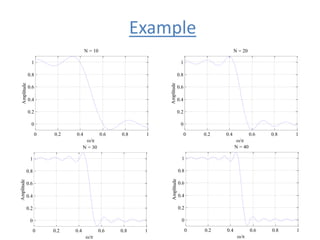
• The mean-square convergence property of the
sequence can be further illustrated by
examining the plot of the function
for various values of K as shown next
 
w



w

w
K
K
n
n
j
c
j
K
LP e
n
n
e
H
sin
)
(
,
]
[n
hLP
Example
0 0.2 0.4 0.6 0.8 1
0
0.2
0.4
0.6
0.8
1
w/
Amplitude
N = 20
0 0.2 0.4 0.6 0.8 1
0
0.2
0.4
0.6
0.8
1
w/
Amplitude
N = 30
0 0.2 0.4 0.6 0.8 1
0
0.2
0.4
0.6
0.8
1
w/
Amplitude
N = 10
0 0.2 0.4 0.6 0.8 1
0
0.2
0.4
0.6
0.8
1
w/
Amplitude
N = 40
Example
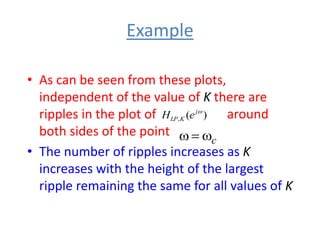
• As can be seen from these plots,
independent of the value of K there are
ripples in the plot of around
both sides of the point
• The number of ripples increases as K
increases with the height of the largest
ripple remaining the same for all values of K
)
(
,
w
j
K
LP e
H
c
w

w
Gibbs Phenomenon
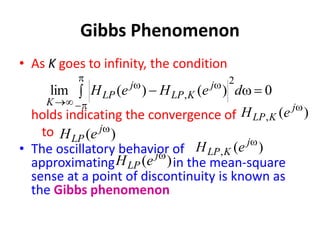
• As K goes to infinity, the condition
holds indicating the convergence of
to
• The oscillatory behavior of
approximating in the mean-square
sense at a point of discontinuity is known as
the Gibbs phenomenon
)
(
,
w
j
K
LP e
H
)
( w
j
LP e
H
0
)
(
)
(
lim
2
, 
w
 



w
w


d
e
H
e
H j
K
LP
j
LP
K
)
(
,
w
j
K
LP e
H
)
( w
j
LP e
H
Dirac delta function d(w)
• The DTFT can also be defined for a certain
class of sequences which are neither
absolutely summable nor square summable
• Examples of such sequences are the unit step
sequence [n], the sinusoidal sequence
and the exponential sequence
• For this type of sequences, a DTFT
representation is possible using the Dirac delta
function d(w)
)
cos( 

w n
o
n
A
Dirac delta function d(w)
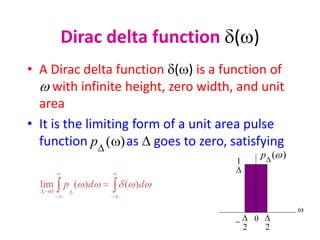
• A Dirac delta function d(w) is a function of
w with infinite height, zero width, and unit
area
• It is the limiting form of a unit area pulse
function as  goes to zero, satisfying
)
(w

p











 w
w
d
w
w d
d
p )
(
)
(
lim
0
w
2


2

0

1
)
(w

p
Example
• Example - Consider the complex exponential
sequence
• Its DTFT is given by
where is an impulse function of w and
n
j o
e
n
x w

]
[
 

w

w
d




w
k
o
j
k
e
X )
2
(
2
)
(
)
(w
d


w


 o
Example
• The function
is a periodic function of w with a period 2
and is called a periodic impulse train
• To verify that given above is indeed
the DTFT of we compute the
inverse DTFT of
 

w

w
d




w
k
o
j
k
e
X )
2
(
2
)
(
)
( w
j
e
X
n
j o
e
n
x w

]
[
)
( w
j
e
X
Example
• Thus
where we have used the sampling property of
the impulse function )
(w
d
  w


w

w
d








w
k
n
j
o d
e
k
n
x )
2
(
2
2
1
]
[
n
j
n
j
o
o
e
d
e w



w

w
 w

w
d
 )
(
Energy Density Spectrum
• The total energy of a finite-energy sequence
g[n] is given by
• From Parseval’s relation given above we
observe that





n
g n
g
2
]
[
E
 w







w



d
e
G
n
g j
n
g
2
2
2
1
)
(
]
[
E
Energy Density Spectrum
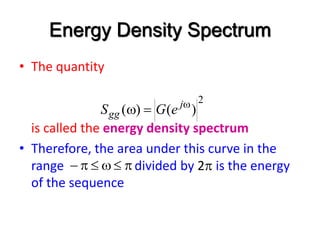
• The quantity
is called the energy density spectrum
• Therefore, the area under this curve in the
range divided by 2 is the energy
of the sequence


w



2
)
(
)
( w

w j
gg e
G
S
Example
• - Compute the energy of the sequence
• Here
where






w
 n
n
n
n
h c
LP ,
sin
]
[
 w






w



d
e
H
n
h j
LP
n
LP
2
2
)
(
2
1
]
[





w

w
w

w


w
c
c
j
LP e
H
,
0
0
,
1
)
(
Energy Density Spectrum
• Therefore
• Hence, is a finite-energy sequence



w

 w



w
w




c
n
LP
c
c
d
n
h
2
1
]
[
2
]
[n
hLP

Discrete Time Fourier Transform

  • 1.
    Discrete Time FourierTransform • Why Fourier Transform • General Properties & Symmetry relations • Formula and steps • magnitude and phase spectra • Convergence Condition • mean-square convergence • Gibbs phenomenon • Direct Delta • Energy Density Spectrum
  • 2.
    Image Transforms • Manytimes, image processing tasks can be best performed in a domain other than the spatial domain. • Key steps (1) Transform the image (2) Carry the task(s) in the transformed domain. (3) Apply inverse transform to return to the spatial domain.
  • 3.
    Why is FTUseful? • Easier to remove undesirable frequencies in the frequency domain. • Faster to perform certain operations in the frequency domain than in the spatial domain. – i.e., using the Fast Fourier Transform (FFT)
  • 4.
    Frequency Filtering: MainSteps 1. Take the FT of f(x): 2. Remove undesired frequencies: 3. Convert back to a signal: x
  • 5.
    Example: Removing undesirablefrequencies remove high frequencies filtered signal frequencies noisy signal
  • 6.
    FT - Definitions •F(u) is a complex function: • Magnitude of FT (or spectrum): • Phase of FT: • Magnitude-Phase representation: • Power of f(x): P(u)=|F(u)|2=
  • 7.
    Discrete-Time Fourier Transform •Definition - The Discrete-Time Fourier Transform (DTFT) of a sequence x[n] is given by • In general, is a complex function of the real variable w and can be written as ) ( w j e X ) ( w j e X       n n j j e n x e X ω ω ] [ ) ( ) ( ) ( ) ( im re w w w j j j e X j e X e X  
  • 8.
    Discrete-Time Fourier Transform •and are, respectively, the real and imaginary parts of , and are real functions of w • can alternately be expressed as where ) ( w j e X ) ( ω re j e X ) ( ω im j e X ) ( w j e X ) ( ) ( ) ( w  w w  j j j e e X e X )} ( arg{ ) ( w  w  j e X
  • 9.
    Discrete-Time Fourier Transform •is called the magnitude function • is called the phase function • Both quantities are again real functions of w • In many applications, the DTFT is called the Fourier spectrum • Likewise, and are called the magnitude and phase spectra ) ( w j e X ) (w  ) ( w j e X ) (w 
  • 10.
    Discrete-Time Fourier Transform •Inverse Discrete-Time Fourier Transform:  w      w w d e e X n x n j j ) ( 2 1 ] [
  • 11.
  • 12.
    Symmetry relations ofthe DTFT of a complex sequence
  • 13.
    Symmetry relations ofthe DTFT of a real sequence x[n]: A real sequence
  • 14.
    DTFT of unitImpulse Sequence • Example - The DTFT of the unit sample sequence d[n] is given by 1 ] 0 [ ] [ ) (  d  d  w  w     n j n e n       n n j j e n x e X ω ω ] [ ) (
  • 15.
    DTFT of CausalSequence • Example - Consider the causal sequence        otherwise 0 0 1 ] [ , 1 ], [ ] [ n n n n x n           n n j j e n x e X ω ω ] [ ) (         w     w  w 0 ] [ ) ( n n j n n n j n j e e n e X w      w      j e n n j e 1 1 0 ) (
  • 16.
    DTFT of CausalSequence • The magnitude and phase of the DTFT are shown below ) 5 . 0 1 /( 1 ) ( w  w   j j e e X -3 -2 -1 0 1 2 3 0.5 1 1.5 2 w/ Magnitude -3 -2 -1 0 1 2 3 -0.4 -0.2 0 0.2 0.4 0.6 w/ Phase in radians
  • 17.
    Convergence Condition • -An infinite series of the form may or may not converge • Consider the following approximation      w  w n n j j e n x e X ] [ ) (     w  w K K n n j j K e n x e X ] [ ) (
  • 18.
    Convergence Condition • Thenfor uniform convergence of , • If x[n] is an absolutely summable sequence, i.e., if for all values of w • Thus, the absolute summability of x[n] is a sufficient condition for the existence of the DTFT ) ( w j e X 0 ) ( ) ( lim   w w   j K j K e X e X       n n x ] [             w  w n n n j j n x e n x e X ] [ ] [ ) (
  • 19.
    Convergence Condition • Example- The sequence for is absolutely summable as and therefore its DTFT converges to uniformly ] [ ] [ n n x n    1                   1 1 ] [ 0 n n n n n ) ( w j e X ) 1 /( 1 w    j e
  • 20.
    Convergence Condition • Since anabsolutely summable sequence has always a finite energy • However, a finite-energy sequence is not necessarily absolutely summable , ] [ ] [ 2 2                n n n x n x
  • 21.
    • - Thesequence has a finite energy equal to • However, x[n] is not absolutely summable since the summation does not converge. Example     ] [n x 0 0 1 1   n n n , , / 6 1 2 1 2             n x n E        1 1 1 1 n n n n
  • 22.
    Mean Square Convergence •To represent a finite energy sequence that is not absolutely summable by a DTFT, it is necessary to consider a mean-square convergence of where ) ( w j e X 0 ) ( ) ( lim 2  w      w w   d e X e X j K j K     w  w K K n n j j K e n x e X ] [ ) (
  • 23.
    Mean Square Convergence •Here, the total energy of the error must approach zero at each value of w as K goes to • In such a case, the absolute value of the error may not go to zero as K goes to and the DTFT is no longer bounded   ) ( ) ( w w  j K j e X e X ) ( ) ( w w  j K j e X e X
  • 24.
    Example • - Considerthe DTFT shown below      w  w w  w   w c c j LP e H , 0 0 , 1 ) ( ) ( w j LP e H c w  0 1   c w  w
  • 25.
    Example • The inverseDTFT of is given by • The energy of is given by • is a finite-energy sequence, but it is not absolutely summable ) ( w j LP e H ] [n hLP , sin 2 1 n n jn e jn e c n j n j c c  w             w  w w    w w  w d e n h c c n j LP 2 1 ] [      n  w / c ] [n hLP
  • 26.
    Example • As aresult does not uniformly converge to for all values of w, but converges to in the mean-square sense ) ( w j LP e H ) ( w j LP e H   w     w    w  K K n n j c K K n n j LP e n n e n h sin ] [
  • 27.
    Example • The mean-squareconvergence property of the sequence can be further illustrated by examining the plot of the function for various values of K as shown next   w    w  w K K n n j c j K LP e n n e H sin ) ( , ] [n hLP
  • 28.
    Example 0 0.2 0.40.6 0.8 1 0 0.2 0.4 0.6 0.8 1 w/ Amplitude N = 20 0 0.2 0.4 0.6 0.8 1 0 0.2 0.4 0.6 0.8 1 w/ Amplitude N = 30 0 0.2 0.4 0.6 0.8 1 0 0.2 0.4 0.6 0.8 1 w/ Amplitude N = 10 0 0.2 0.4 0.6 0.8 1 0 0.2 0.4 0.6 0.8 1 w/ Amplitude N = 40
  • 29.
    Example • As canbe seen from these plots, independent of the value of K there are ripples in the plot of around both sides of the point • The number of ripples increases as K increases with the height of the largest ripple remaining the same for all values of K ) ( , w j K LP e H c w  w
  • 30.
    Gibbs Phenomenon • AsK goes to infinity, the condition holds indicating the convergence of to • The oscillatory behavior of approximating in the mean-square sense at a point of discontinuity is known as the Gibbs phenomenon ) ( , w j K LP e H ) ( w j LP e H 0 ) ( ) ( lim 2 ,  w      w w   d e H e H j K LP j LP K ) ( , w j K LP e H ) ( w j LP e H
  • 31.
    Dirac delta functiond(w) • The DTFT can also be defined for a certain class of sequences which are neither absolutely summable nor square summable • Examples of such sequences are the unit step sequence [n], the sinusoidal sequence and the exponential sequence • For this type of sequences, a DTFT representation is possible using the Dirac delta function d(w) ) cos(   w n o n A
  • 32.
    Dirac delta functiond(w) • A Dirac delta function d(w) is a function of w with infinite height, zero width, and unit area • It is the limiting form of a unit area pulse function as  goes to zero, satisfying ) (w  p             w w d w w d d p ) ( ) ( lim 0 w 2   2  0  1 ) (w  p
  • 33.
    Example • Example -Consider the complex exponential sequence • Its DTFT is given by where is an impulse function of w and n j o e n x w  ] [    w  w d     w k o j k e X ) 2 ( 2 ) ( ) (w d   w    o
  • 34.
    Example • The function isa periodic function of w with a period 2 and is called a periodic impulse train • To verify that given above is indeed the DTFT of we compute the inverse DTFT of    w  w d     w k o j k e X ) 2 ( 2 ) ( ) ( w j e X n j o e n x w  ] [ ) ( w j e X
  • 35.
    Example • Thus where wehave used the sampling property of the impulse function ) (w d   w   w  w d         w k n j o d e k n x ) 2 ( 2 2 1 ] [ n j n j o o e d e w    w  w  w  w d  ) (
  • 36.
    Energy Density Spectrum •The total energy of a finite-energy sequence g[n] is given by • From Parseval’s relation given above we observe that      n g n g 2 ] [ E  w        w    d e G n g j n g 2 2 2 1 ) ( ] [ E
  • 37.
    Energy Density Spectrum •The quantity is called the energy density spectrum • Therefore, the area under this curve in the range divided by 2 is the energy of the sequence   w    2 ) ( ) ( w  w j gg e G S
  • 38.
    Example • - Computethe energy of the sequence • Here where       w  n n n n h c LP , sin ] [  w       w    d e H n h j LP n LP 2 2 ) ( 2 1 ] [      w  w w  w   w c c j LP e H , 0 0 , 1 ) (
  • 39.
    Energy Density Spectrum •Therefore • Hence, is a finite-energy sequence    w   w    w w     c n LP c c d n h 2 1 ] [ 2 ] [n hLP