

PRESENTATION TOPIC:
COORDINATION
Presented To,
Dr. Robina Bhatti
Presented By;
Allah Ditta
Roll #, 18
Bs (2010-2014), 5th Semester
Department of library & information science
The Islamia University Bahawalpur
INTRODUCTION TO COORDINATION
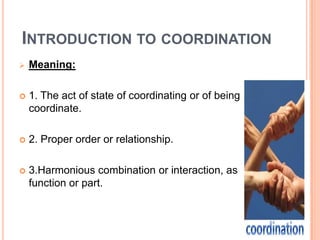
 Meaning:
 1. The act of state of coordinating or of being
coordinate.
 2. Proper order or relationship.
 3.Harmonious combination or interaction, as of
function or part.
WHAT IS COORDINATION?
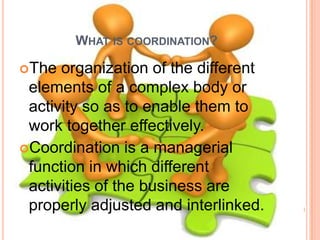
The organization of the different
elements of a complex body or
activity so as to enable them to
work together effectively.
Coordination is a managerial
function in which different
activities of the business are
properly adjusted and interlinked.
FEATURES OF COORDINATION
Essence of management.
Managerial responsibility.
Deliberate effort.
Creativity.
Continue process.
Required in group activity.
Different cooperation.
System concept.
IMPORTANCE OF COORDINATION
 Coordination encourages team spirit.
 Coordination gives proper direction.
 Coordination facilitates motivation.
 Coordination makes optimum utilization of
resources.
 Coordination helps to achieve objectives quickly.
 Coordination improves relations in the
organization.
 Coordination leads to higher efficiency.
 Coordination improves goodwill of the
organization.
METHODS OF COORDINATION
 Various administration tool.
 Delegation.
 Evaluation.
 Financial statement.
 Performance management.
 Policies and procedures.
 Quality control and operation management.
 Risk, safety and liabilities.
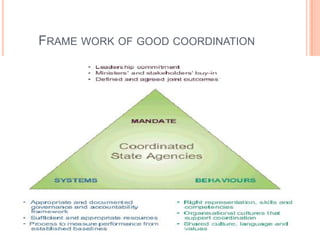
FRAME WORK OF GOOD COORDINATION
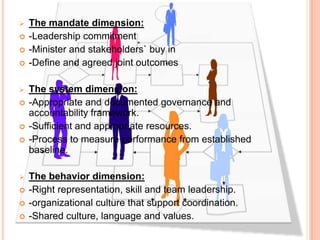
ELEMENT OF SUCCESSFUL COORDINATION
 The mandate dimension:
 -Leadership commitment
 -Minister and stakeholders` buy in
 -Define and agreed joint outcomes
 The system dimension:
 -Appropriate and documented governance and
accountability framework.
 -Sufficient and appropriate resources.
 -Process to measure performance from established
baseline.
 The behavior dimension:
 -Right representation, skill and team leadership.
 -organizational culture that support coordination.
 -Shared culture, language and values.
CONCLUSION
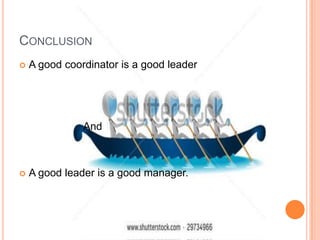
 A good coordinator is a good leader
And
 A good leader is a good manager.
REFERENCE
 http://www.authorstream.com/Presentation/marium-
85593-coordination-co-ordination-education-ppt-
powerpoint/
 http://en.wikipedia.org/wiki/Coordination
 http://kalyan-city.blogspot.com/2011/05/importance-
of-coordination-why-co.html
Coordination presentation

Coordination presentation

  • 1.
    PRESENTATION TOPIC: COORDINATION Presented To, Dr.Robina Bhatti Presented By; Allah Ditta Roll #, 18 Bs (2010-2014), 5th Semester Department of library & information science The Islamia University Bahawalpur
  • 2.
    INTRODUCTION TO COORDINATION Meaning:  1. The act of state of coordinating or of being coordinate.  2. Proper order or relationship.  3.Harmonious combination or interaction, as of function or part.
  • 3.
    WHAT IS COORDINATION? Theorganization of the different elements of a complex body or activity so as to enable them to work together effectively. Coordination is a managerial function in which different activities of the business are properly adjusted and interlinked.
  • 4.
    FEATURES OF COORDINATION Essenceof management. Managerial responsibility. Deliberate effort. Creativity. Continue process. Required in group activity. Different cooperation. System concept.
  • 5.
    IMPORTANCE OF COORDINATION Coordination encourages team spirit.  Coordination gives proper direction.  Coordination facilitates motivation.  Coordination makes optimum utilization of resources.  Coordination helps to achieve objectives quickly.  Coordination improves relations in the organization.  Coordination leads to higher efficiency.  Coordination improves goodwill of the organization.
  • 6.
    METHODS OF COORDINATION Various administration tool.  Delegation.  Evaluation.  Financial statement.  Performance management.  Policies and procedures.  Quality control and operation management.  Risk, safety and liabilities.
  • 7.
    FRAME WORK OFGOOD COORDINATION
  • 8.
    ELEMENT OF SUCCESSFULCOORDINATION  The mandate dimension:  -Leadership commitment  -Minister and stakeholders` buy in  -Define and agreed joint outcomes  The system dimension:  -Appropriate and documented governance and accountability framework.  -Sufficient and appropriate resources.  -Process to measure performance from established baseline.  The behavior dimension:  -Right representation, skill and team leadership.  -organizational culture that support coordination.  -Shared culture, language and values.
  • 9.
    CONCLUSION  A goodcoordinator is a good leader And  A good leader is a good manager.
  • 10.