1
2
Assignment on:
Word Proximity &
Reserved word
Presented to:
Sir Aamir Rasool
Presented by:
Shafiq-ur-rehman
Roll.04
BS (Hons)
8th Semester (Morning)
Department of library and information science
The Islamia University of Bahawalpur
3
4
Proximity Searching
It looks for documents where two or
more separately matching term
occurrences are within a specified
distance, where distance is the number
of intermediate words or characters
 For example
 Term A NEAR Term B
 Term A fby Term B
Word Proximity
A proximity search allows you to specify
how close two (or more) words must be
to each other in order to register a
match. There are three types of
proximity searches:
 Word proximity
 Sentence proximity
 Paragraph proximity
Word Proximity
A word proximity search specifies a
range that all terms in the
proximity search must appear in.
The terms must be contained in
the same document. The first
word from the proximity search
that is found begins the count for
the range.
 For example, a search could be used to
find "red brick house", and match
phrases such as "red house of brick" or
"house made of red brick". By limiting
the proximity, these phrases can be
matched while avoiding documents
where the words are scattered or
spread across a page or in unrelated
articles in an anthology.
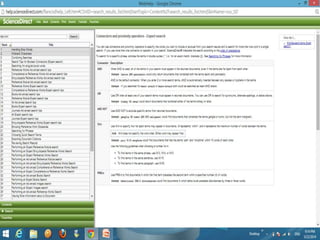
Use proximity operators
 The near operator is used when no word order is
needed; i.e.: rose near blooming
 If the words should be within a specified number
of words, use: sly near.6 fox (include the period
between near & 6) to locate both words within 6
words of each other.
 The proximity operator, fby (followed by), is used
when word order is important: i.e.: heart fby head,
and, young fby.5 in love (young must appear
within 5 words of the phrase, in love, and be in
that order.
In Google (suggestions
from their Help Screen)
 For Proximity or Wildcard search: use
an asterisk (*) to locate two words
close together: i.e., red * blue will
locate documents with the words
separated by only one or two words.
Additional asterisks may be added if
needed for possible intervening words.
Emerald
 Proximity searches
 A proximity search allows you to find words
that are a within a specific distance. To do a
proximity search, use the tilde "~" symbol at
the end of a phrase. For example to search
for "stimulate" and "growth" within 10 words
of each other in a document the search term
would be "stimulate growth"~10
Reserved word
 A word within a program or
programming language that is reserved
for special use that cannot be used.
Reserved words are often found in
programming languages
 The list of reserved words in a language
are defined when a language is
developed.
 Reserved word are one type of
grammatical construct in programming
languages. These words have special
meaning within the language and are
predefined in the language’s formal
specifications.
Reference
 Articles
1. PROXIMITY SEARCHING AND INTERNET SEARCHING HINTS
2. Visual word proximity and linguistics for semantic video
indexing and near-duplicate retrieval
3. Query refinement by word proximity and position
Book:
1. Information Storage Retrieval Computational and theoretical
aspect
Website:
http://help.sciencedirect.com/flare/sdhelp_Left.htm#CSHID=searc
h_results_list.htm|StartTopic=Content%2Fsearch_results_list.
htm|SkinName=svs_SD
Proximity word and Reserved word

Proximity word and Reserved word

  • 1.
  • 2.
  • 3.
    Assignment on: Word Proximity& Reserved word Presented to: Sir Aamir Rasool Presented by: Shafiq-ur-rehman Roll.04 BS (Hons) 8th Semester (Morning) Department of library and information science The Islamia University of Bahawalpur 3
  • 4.
    4 Proximity Searching It looksfor documents where two or more separately matching term occurrences are within a specified distance, where distance is the number of intermediate words or characters  For example  Term A NEAR Term B  Term A fby Term B
  • 5.
    Word Proximity A proximitysearch allows you to specify how close two (or more) words must be to each other in order to register a match. There are three types of proximity searches:  Word proximity  Sentence proximity  Paragraph proximity
  • 6.
    Word Proximity A wordproximity search specifies a range that all terms in the proximity search must appear in. The terms must be contained in the same document. The first word from the proximity search that is found begins the count for the range.
  • 7.
     For example,a search could be used to find "red brick house", and match phrases such as "red house of brick" or "house made of red brick". By limiting the proximity, these phrases can be matched while avoiding documents where the words are scattered or spread across a page or in unrelated articles in an anthology.
  • 8.
    Use proximity operators The near operator is used when no word order is needed; i.e.: rose near blooming  If the words should be within a specified number of words, use: sly near.6 fox (include the period between near & 6) to locate both words within 6 words of each other.  The proximity operator, fby (followed by), is used when word order is important: i.e.: heart fby head, and, young fby.5 in love (young must appear within 5 words of the phrase, in love, and be in that order.
  • 9.
    In Google (suggestions fromtheir Help Screen)  For Proximity or Wildcard search: use an asterisk (*) to locate two words close together: i.e., red * blue will locate documents with the words separated by only one or two words. Additional asterisks may be added if needed for possible intervening words.
  • 10.
    Emerald  Proximity searches A proximity search allows you to find words that are a within a specific distance. To do a proximity search, use the tilde "~" symbol at the end of a phrase. For example to search for "stimulate" and "growth" within 10 words of each other in a document the search term would be "stimulate growth"~10
  • 12.
    Reserved word  Aword within a program or programming language that is reserved for special use that cannot be used. Reserved words are often found in programming languages
  • 13.
     The listof reserved words in a language are defined when a language is developed.  Reserved word are one type of grammatical construct in programming languages. These words have special meaning within the language and are predefined in the language’s formal specifications.
  • 14.
    Reference  Articles 1. PROXIMITYSEARCHING AND INTERNET SEARCHING HINTS 2. Visual word proximity and linguistics for semantic video indexing and near-duplicate retrieval 3. Query refinement by word proximity and position Book: 1. Information Storage Retrieval Computational and theoretical aspect Website: http://help.sciencedirect.com/flare/sdhelp_Left.htm#CSHID=searc h_results_list.htm|StartTopic=Content%2Fsearch_results_list. htm|SkinName=svs_SD