Assignment topic:
Digital library
Submitted to:
Sir Mazhar hayat
Submitted by:
Muhammad Munir
Programme:
BS-4year
Roll. No.
06

The Islamia University of Bahawalpur
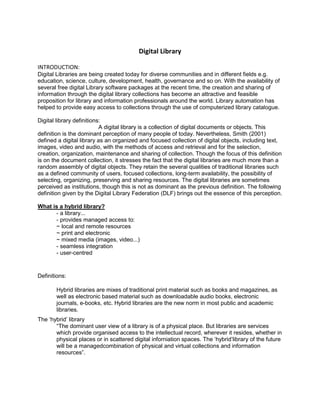
Digital Library
INTRODUCTION:
Digital Libraries are being created today for diverse communities and in different fields e.g.
education, science, culture, development, health, governance and so on. With the availability of
several free digital Library software packages at the recent time, the creation and sharing of
information through the digital library collections has become an attractive and feasible
proposition for library and information professionals around the world. Library automation has
helped to provide easy access to collections through the use of computerized library catalogue.
Digital library definitions:
A digital library is a collection of digital documents or objects. This
definition is the dominant perception of many people of today. Nevertheless, Smith (2001)
defined a digital library as an organized and focused collection of digital objects, including text,
images, video and audio, with the methods of access and retrieval and for the selection,
creation, organization, maintenance and sharing of collection. Though the focus of this definition
is on the document collection, it stresses the fact that the digital libraries are much more than a
random assembly of digital objects. They retain the several qualities of traditional libraries such
as a defined community of users, focused collections, long-term availability, the possibility of
selecting, organizing, preserving and sharing resources. The digital libraries are sometimes
perceived as institutions, though this is not as dominant as the previous definition. The following
definition given by the Digital Library Federation (DLF) brings out the essence of this perception.
What is a hybrid library?
- a library...
- provides managed access to:
~ local and remote resources
~ print and electronic
~ mixed media (images, video...)
- seamless integration
- user-centred

Definitions:
Hybrid libraries are mixes of traditional print material such as books and magazines, as
well as electronic based material such as downloadable audio books, electronic
journals, e-books, etc. Hybrid libraries are the new norm in most public and academic
libraries.
The „hybrid‟ library
“The dominant user view of a library is of a physical place. But libraries are services
which provide organised access to the intellectual record, wherever it resides, whether in
physical places or in scattered digital inforniation spaces. The „hybrid‟library of the future
will be a managedcombination of physical and virtual collections and information
resources”.
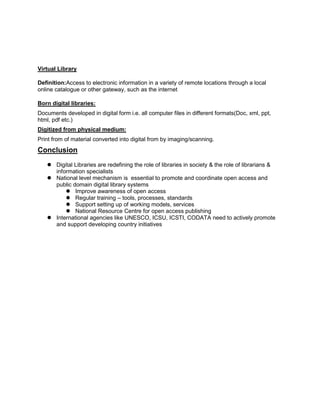
Virtual Library
Definition:Access to electronic information in a variety of remote locations through a local
online catalogue or other gateway, such as the internet
Born digital libraries:
Documents developed in digital form i.e. all computer files in different formats(Doc, xml, ppt,
html, pdf etc.)
Digitized from physical medium:
Print from of material converted into digital from by imaging/scanning.

Conclusion
 Digital Libraries are redefining the role of libraries in society & the role of librarians &
information specialists
 National level mechanism is essential to promote and coordinate open access and
public domain digital library systems
 Improve awareness of open access
 Regular training – tools, processes, standards
 Support setting up of working models, services
 National Resource Centre for open access publishing
 International agencies like UNESCO, ICSU, ICSTI, CODATA need to actively promote
and support developing country initiatives
References:
1) http://www.clir.org
2) www.paklag.org/Presentation%20Digital,%20Hybrid,%20Virtual%20Lib
3) en.wikipedia.org/wiki/Digital_library
4) www.diglib.org/about/dldefinition.htm

-

Digital library Assignment

  • 1.
    Assignment topic: Digital library Submittedto: Sir Mazhar hayat Submitted by: Muhammad Munir Programme: BS-4year Roll. No. 06 The Islamia University of Bahawalpur
  • 2.
    Digital Library INTRODUCTION: Digital Librariesare being created today for diverse communities and in different fields e.g. education, science, culture, development, health, governance and so on. With the availability of several free digital Library software packages at the recent time, the creation and sharing of information through the digital library collections has become an attractive and feasible proposition for library and information professionals around the world. Library automation has helped to provide easy access to collections through the use of computerized library catalogue. Digital library definitions: A digital library is a collection of digital documents or objects. This definition is the dominant perception of many people of today. Nevertheless, Smith (2001) defined a digital library as an organized and focused collection of digital objects, including text, images, video and audio, with the methods of access and retrieval and for the selection, creation, organization, maintenance and sharing of collection. Though the focus of this definition is on the document collection, it stresses the fact that the digital libraries are much more than a random assembly of digital objects. They retain the several qualities of traditional libraries such as a defined community of users, focused collections, long-term availability, the possibility of selecting, organizing, preserving and sharing resources. The digital libraries are sometimes perceived as institutions, though this is not as dominant as the previous definition. The following definition given by the Digital Library Federation (DLF) brings out the essence of this perception. What is a hybrid library? - a library... - provides managed access to: ~ local and remote resources ~ print and electronic ~ mixed media (images, video...) - seamless integration - user-centred Definitions: Hybrid libraries are mixes of traditional print material such as books and magazines, as well as electronic based material such as downloadable audio books, electronic journals, e-books, etc. Hybrid libraries are the new norm in most public and academic libraries. The „hybrid‟ library “The dominant user view of a library is of a physical place. But libraries are services which provide organised access to the intellectual record, wherever it resides, whether in physical places or in scattered digital inforniation spaces. The „hybrid‟library of the future will be a managedcombination of physical and virtual collections and information resources”.
  • 3.
    Virtual Library Definition:Access toelectronic information in a variety of remote locations through a local online catalogue or other gateway, such as the internet Born digital libraries: Documents developed in digital form i.e. all computer files in different formats(Doc, xml, ppt, html, pdf etc.) Digitized from physical medium: Print from of material converted into digital from by imaging/scanning. Conclusion  Digital Libraries are redefining the role of libraries in society & the role of librarians & information specialists  National level mechanism is essential to promote and coordinate open access and public domain digital library systems  Improve awareness of open access  Regular training – tools, processes, standards  Support setting up of working models, services  National Resource Centre for open access publishing  International agencies like UNESCO, ICSU, ICSTI, CODATA need to actively promote and support developing country initiatives
  • 4.
    References: 1) http://www.clir.org 2) www.paklag.org/Presentation%20Digital,%20Hybrid,%20Virtual%20Lib 3)en.wikipedia.org/wiki/Digital_library 4) www.diglib.org/about/dldefinition.htm -