A Comparison
Definition
 “Administration means the overall determination of
policies, setting of major objectives, the identification
of general purposes and laying down of broad
programmes and projects.” – Theo Haimann
 “…[It is] guidance, leadership and control of the efforts
of the groups towards some common goals.” – William
H. Newman
 The activities that relate to running an organization
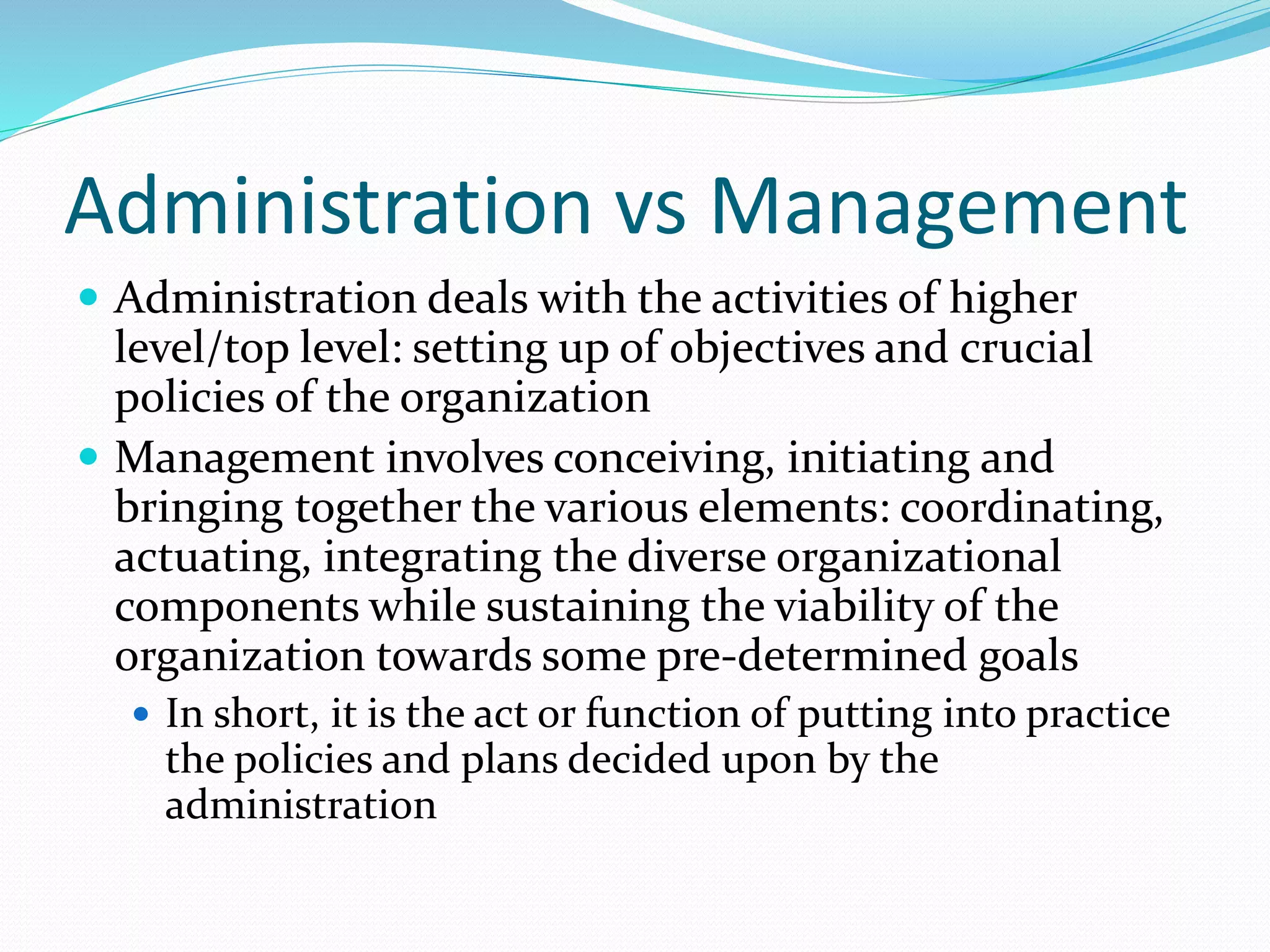
Administration vs Management
 Administration deals with the activities of higher
level/top level: setting up of objectives and crucial
policies of the organization
 Management involves conceiving, initiating and
bringing together the various elements: coordinating,
actuating, integrating the diverse organizational
components while sustaining the viability of the
organization towards some pre-determined goals
 In short, it is the act or function of putting into practice
the policies and plans decided upon by the
administration
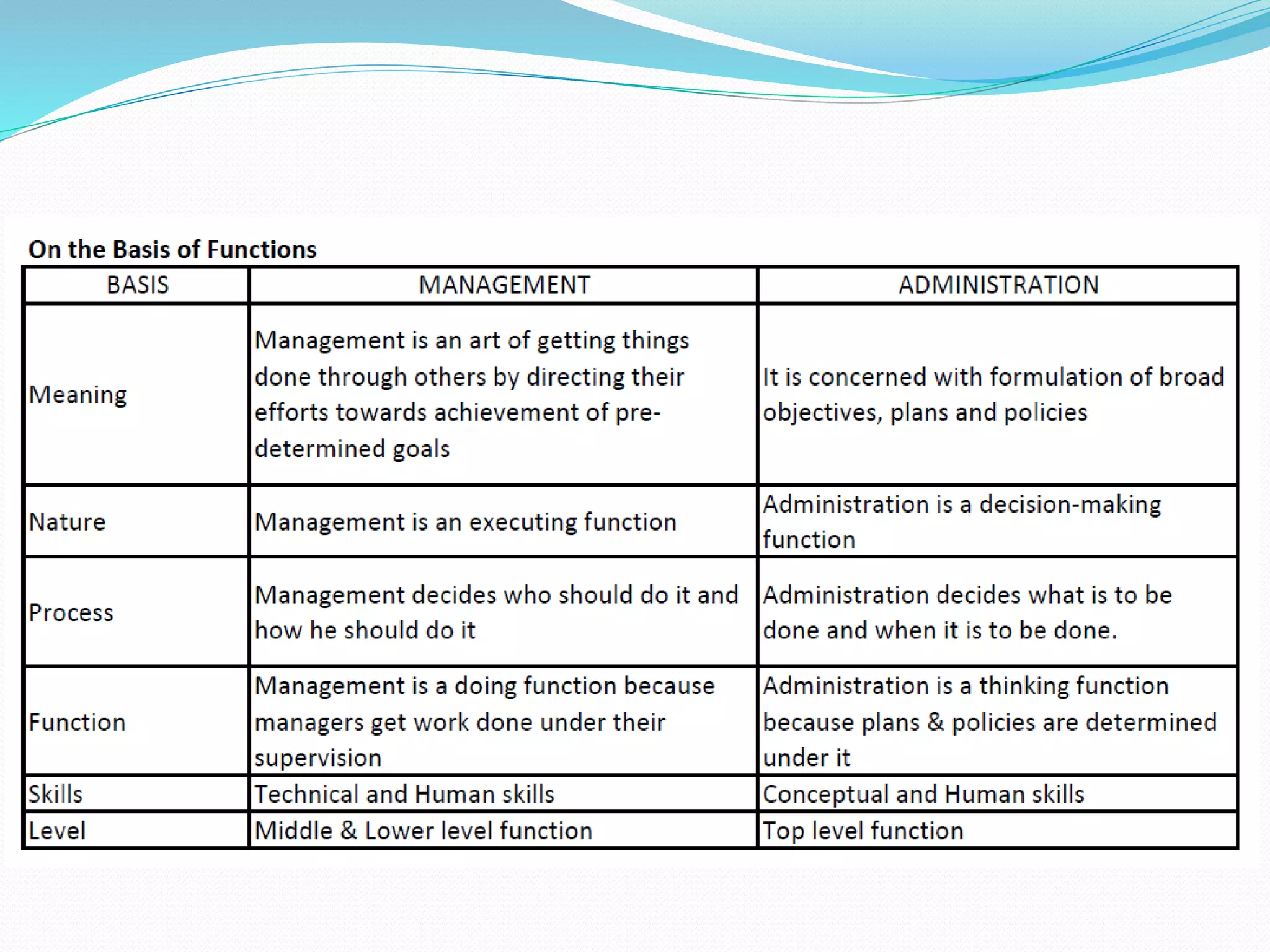
Administration vs Management
 The difference can be summarized under two
categories:
Functions and Usage/Applicability
 Practically, there is no difference between
management and administration. Every manager is
concerned with both—administrative and
management function and operative function.
However,
the managers who are higher in the hierarchy
denote more time on administrative function and
the lower level denote more time on directing and
controlling worker’s performance.
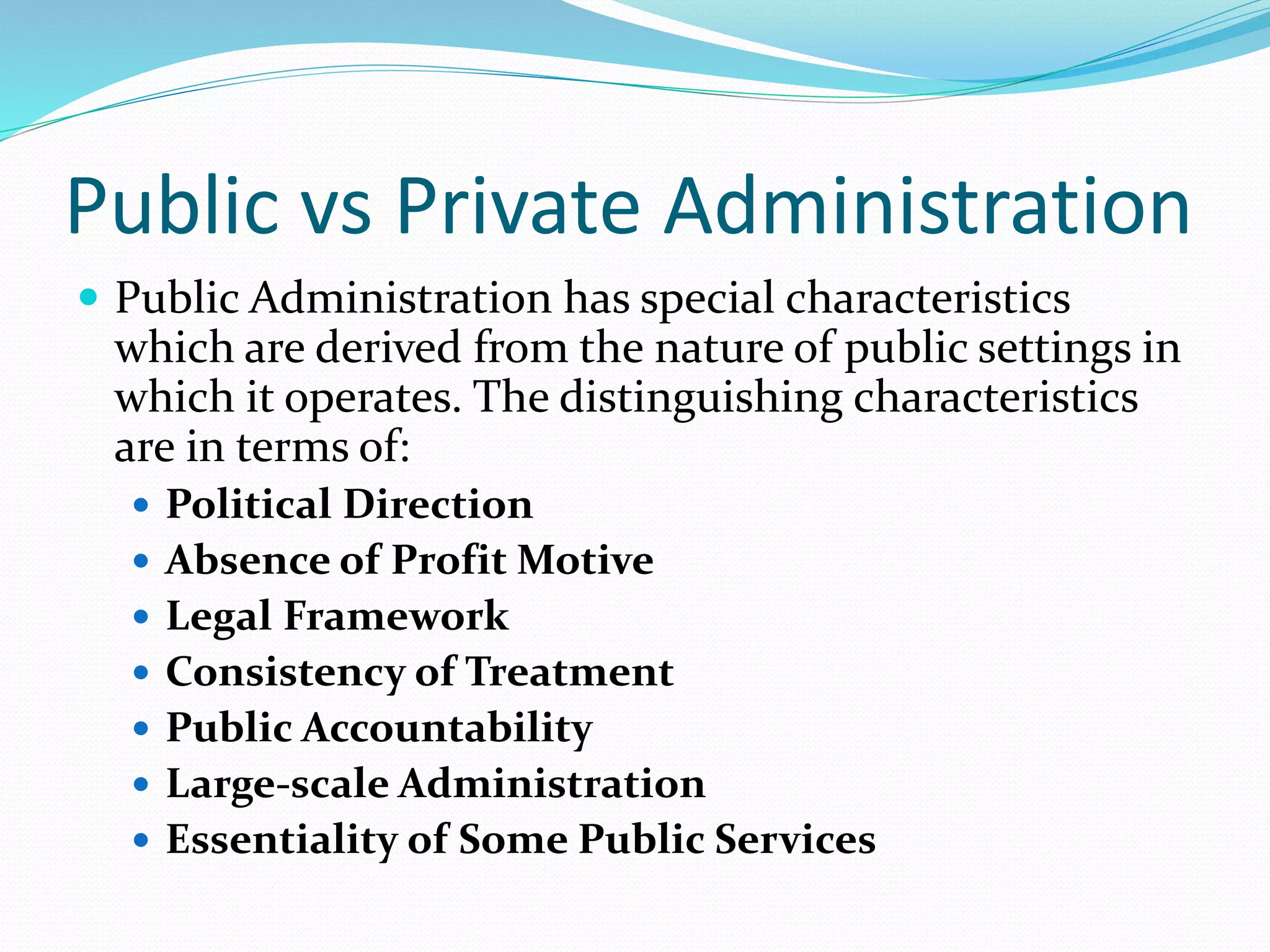
Public vs Private Administration
 Public Administration has special characteristics
which are derived from the nature of public settings in
which it operates. The distinguishing characteristics
are in terms of:
 Political Direction
 Absence of Profit Motive
 Legal Framework
 Consistency of Treatment
 Public Accountability
 Large-scale Administration
 Essentiality of Some Public Services
Political Direction
 Public Administration is political. It takes place in
a political context and work under political direction
and scrutiny—putting into effect the policies made by
the elected members of the legislature & political
executive.
 Business/Private Administration is non political.
It is not subject to political direction except in times of
emergency. It functions largely under the influence of
market economic conditions.
Absence of Profit Motive
 The primary purpose of government organization is to
provide services to the people to promote social good.
 The ends of public administration is communal.
 The major aim of private business organization is to
make profit for their owners. Services to the public is
only an incidental benefit of business activity.
 The ends of private business is personal.
Legal Framework
 The activities of Public Administration are fixed by a set of
constitutional practices, law, rules & regulations.
 Gov’t officials must not act outside the law and their actions
must be supported by reasonably clear statutory authority.
 Legal constraints are essential to prevent officials from
abusing their powers.
 Activities of business administration are subject to less
legal constraints.
 Business executives can usually do anything which is not
forbidden by law, giving them the freedom to select and carry
on only profitable activities.
Consistency of Treatment
 A government official is required by law to maintain a
high degree of consistency in his dealing with the
public
 He has to observe the principle of equality of treatment
in serving the people; discrimination is prohibited
 Private businesses are not legally obliged to treat the
small and big customers alike.
Public Accountability
 Public accountability is the hallmark of Public
Administration in democracy.
 A public servant’s activities must be guided by public
needs and public opinion.
 In a democracy, Public Administration is held
accountable for its activities through legislative
oversight and judicial review.
 Public accountability is not a value effecting business
administration.
 Business administration is not accountable to the public
for what they do and what they fail to do
Large-scale Administration
 Public administration is larger than any big business in
terms of size, complexity and diversity of activities.
 The activities and policies of governments affect the
entire socioeconomic structure of society.
Essentiality of Some Public Services
 Certain public services are vital to the existence of the
community itself.
 Examples: national security, law and order, health care,
transport, and communications.
 Service provided by the business organization such as
supply of costly clothes, shoes and other luxury items
are not essentials for the existence of society.
REFERENCES
 Google Sites. Distinction between Public and Private
Administration. N/A N/A N/A.
<https://sites.google.com/site/dheerajbpsc/home/public-
private-administration/1-distinction-between-public-and-
private-administration>.
 Kumar, Manisha. Difference Between Management and
Administration. 12 October 2011.
<http://www.differencebetween.net/business/difference-
between-management-and-administration/>.
 Management Study Guide. Management and Administration.
2013.
<http://www.managementstudyguide.com/management_ad
ministration.htm>.

Administration Vs. Management

  • 1.
  • 2.
    Definition  “Administration meansthe overall determination of policies, setting of major objectives, the identification of general purposes and laying down of broad programmes and projects.” – Theo Haimann  “…[It is] guidance, leadership and control of the efforts of the groups towards some common goals.” – William H. Newman  The activities that relate to running an organization
  • 3.
    Administration vs Management Administration deals with the activities of higher level/top level: setting up of objectives and crucial policies of the organization  Management involves conceiving, initiating and bringing together the various elements: coordinating, actuating, integrating the diverse organizational components while sustaining the viability of the organization towards some pre-determined goals  In short, it is the act or function of putting into practice the policies and plans decided upon by the administration
  • 4.
    Administration vs Management The difference can be summarized under two categories: Functions and Usage/Applicability
  • 7.
     Practically, thereis no difference between management and administration. Every manager is concerned with both—administrative and management function and operative function. However, the managers who are higher in the hierarchy denote more time on administrative function and the lower level denote more time on directing and controlling worker’s performance.
  • 8.
    Public vs PrivateAdministration  Public Administration has special characteristics which are derived from the nature of public settings in which it operates. The distinguishing characteristics are in terms of:  Political Direction  Absence of Profit Motive  Legal Framework  Consistency of Treatment  Public Accountability  Large-scale Administration  Essentiality of Some Public Services
  • 9.
    Political Direction  PublicAdministration is political. It takes place in a political context and work under political direction and scrutiny—putting into effect the policies made by the elected members of the legislature & political executive.  Business/Private Administration is non political. It is not subject to political direction except in times of emergency. It functions largely under the influence of market economic conditions.
  • 10.
    Absence of ProfitMotive  The primary purpose of government organization is to provide services to the people to promote social good.  The ends of public administration is communal.  The major aim of private business organization is to make profit for their owners. Services to the public is only an incidental benefit of business activity.  The ends of private business is personal.
  • 11.
    Legal Framework  Theactivities of Public Administration are fixed by a set of constitutional practices, law, rules & regulations.  Gov’t officials must not act outside the law and their actions must be supported by reasonably clear statutory authority.  Legal constraints are essential to prevent officials from abusing their powers.  Activities of business administration are subject to less legal constraints.  Business executives can usually do anything which is not forbidden by law, giving them the freedom to select and carry on only profitable activities.
  • 12.
    Consistency of Treatment A government official is required by law to maintain a high degree of consistency in his dealing with the public  He has to observe the principle of equality of treatment in serving the people; discrimination is prohibited  Private businesses are not legally obliged to treat the small and big customers alike.
  • 13.
    Public Accountability  Publicaccountability is the hallmark of Public Administration in democracy.  A public servant’s activities must be guided by public needs and public opinion.  In a democracy, Public Administration is held accountable for its activities through legislative oversight and judicial review.  Public accountability is not a value effecting business administration.  Business administration is not accountable to the public for what they do and what they fail to do
  • 14.
    Large-scale Administration  Publicadministration is larger than any big business in terms of size, complexity and diversity of activities.  The activities and policies of governments affect the entire socioeconomic structure of society.
  • 15.
    Essentiality of SomePublic Services  Certain public services are vital to the existence of the community itself.  Examples: national security, law and order, health care, transport, and communications.  Service provided by the business organization such as supply of costly clothes, shoes and other luxury items are not essentials for the existence of society.
  • 16.
    REFERENCES  Google Sites.Distinction between Public and Private Administration. N/A N/A N/A. <https://sites.google.com/site/dheerajbpsc/home/public- private-administration/1-distinction-between-public-and- private-administration>.  Kumar, Manisha. Difference Between Management and Administration. 12 October 2011. <http://www.differencebetween.net/business/difference- between-management-and-administration/>.  Management Study Guide. Management and Administration. 2013. <http://www.managementstudyguide.com/management_ad ministration.htm>.

Editor's Notes

  • #11 “PROFIT” serves as a simple criterion to judge the efficient or inefficient performance of a business firm. But the abstract value of “social good” promoted by public organization can not be measured in terms of monetary gain or loss.