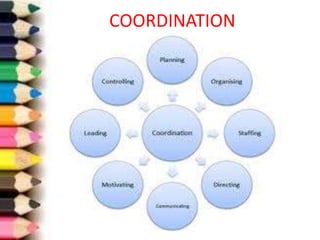
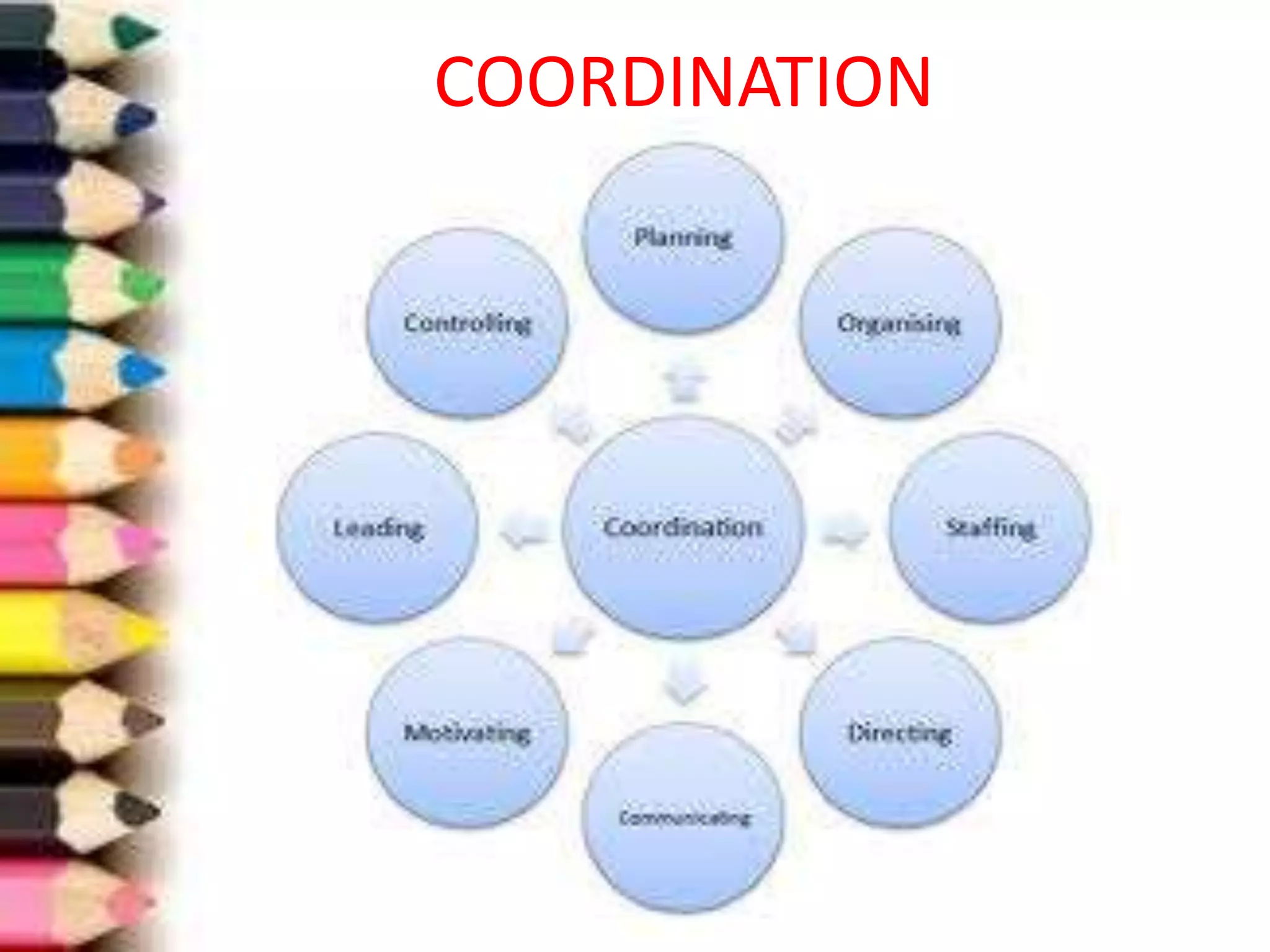
COORDINATION
• Coordination is all about synchronizing the
operations of units and people working
therein so that they contribute their maximum
to achieve organizational objectives.
BASIC FEATURES
• Relevant for group efforts and not individual
efforts.
• Coordination is a continuous and dynamic
process.
– Continuous because it is achieved through the
performance of functions
– Dynamic because functions may change over a period
of time.

• Emphasizes unity of efforts.
• Responsibility of every manager.
ESSENCE OF MANAGEMENT
• Coordination tries to synchronize group efforts
for achieving organizational goals. Each such
effort should tend to help others in the group
in achieving the composite effort deemed
essential for goal accomplishment.
• Coordination on the other hand, involves the
integration of human efforts for achieving the
goals which are not functions but the basic
objective of all managerial functions.
NEED OF COORDINATION
•
•
•
•

Large number of personnel.
Specialization.
Functional differentiation.
Interdependence
– Sequential interdependence.
– Reciprocal interdependence.

• Individual versus organisational interest.
ROLE OF COORDINATION IN
ORGANIZATIONAL PERFORMANCE
• Proper coordination pulls all the functions and
activities together so that each function and
activity becomes complimentary to each other
and contribute positively to the performance
of others.
• Coordination brings satisfaction to the people
of the organisation.
• Coordination ensures the smooth flow of
information.
TYPES OF COORDINATION
• INTERNAL COORDINATION
– Vertical coordination.
• Superior-subordinate.

– Horizontal coordination.
• Synchronization between departments.

– Substantial
• How interrelated activities should be divided so that
they are performed in a synchronized way.

– Procedural coordination.
• Prescribing the procedure for performing activities.

• EXTERNAL COORDINATION
TECHNIQUES OF EFFECTIVE
COORDINATION
• Coordination by chain of command.
– Vertical coordination ensures that various levels
do not act out of accord with each other or with
policies and objectives of the organization.

• Coordination by leadership
– Managers should bring identity of interests and
outlook in group efforts by using leadership skills
and motivation.
• Coordination by committees.
– Horizontal coordination. Solve problems which
arise out of relationship between different units.

• Staff Meetings
– Gives everyone a sense of unity.
– To learn from superior manager about problems.
– To provide subordinates an opportunity to bring up
questions which superior manager should know
about.
– To provide a forum in which friction points or areas
of inadequate coordination

• Self coordination.
ESSENTIALS OF EFFECTIVE
COORDINATION
•
•
•
•
•
•

Well defined authority and responsibility
Well defined work procedures.
Effective communication system.
Provisions of check and inspection.
Effective organisation structure.
Proper organization climate.
PRINCIPLES OF COORDINATION
• Principle of direct contact
– Coordination achieved through direct contact
among people whose activities are to be
coordinated.

• Coordination at early stages
– Coordination at early stages of work cycle.
Involving members in decision making process
regarding objective setting, strategy and policy
formation.
• Principle of continuity.
– Coordination should be treated as a continuous
process.

• Principle of dynamism.
– Coordination do not work on rigid and fixed basis
but on dynamic basis. Dynamism is required
because changes occur in external factors and the
organisation has to incorporate change
• Principle of timing.
– Members should synchronize the timing of their
work performance.

• Principle of reciprocal relationship.
– Reciprocal relationship exists between two or
more parties in which each party effects the
functioning of others and, in turn, is effected by
others.

Coordination

  • 1.
  • 2.
    • Coordination isall about synchronizing the operations of units and people working therein so that they contribute their maximum to achieve organizational objectives.
  • 3.
    BASIC FEATURES • Relevantfor group efforts and not individual efforts. • Coordination is a continuous and dynamic process. – Continuous because it is achieved through the performance of functions – Dynamic because functions may change over a period of time. • Emphasizes unity of efforts. • Responsibility of every manager.
  • 4.
    ESSENCE OF MANAGEMENT •Coordination tries to synchronize group efforts for achieving organizational goals. Each such effort should tend to help others in the group in achieving the composite effort deemed essential for goal accomplishment. • Coordination on the other hand, involves the integration of human efforts for achieving the goals which are not functions but the basic objective of all managerial functions.
  • 5.
    NEED OF COORDINATION • • • • Largenumber of personnel. Specialization. Functional differentiation. Interdependence – Sequential interdependence. – Reciprocal interdependence. • Individual versus organisational interest.
  • 6.
    ROLE OF COORDINATIONIN ORGANIZATIONAL PERFORMANCE • Proper coordination pulls all the functions and activities together so that each function and activity becomes complimentary to each other and contribute positively to the performance of others. • Coordination brings satisfaction to the people of the organisation. • Coordination ensures the smooth flow of information.
  • 7.
    TYPES OF COORDINATION •INTERNAL COORDINATION – Vertical coordination. • Superior-subordinate. – Horizontal coordination. • Synchronization between departments. – Substantial • How interrelated activities should be divided so that they are performed in a synchronized way. – Procedural coordination. • Prescribing the procedure for performing activities. • EXTERNAL COORDINATION
  • 8.
    TECHNIQUES OF EFFECTIVE COORDINATION •Coordination by chain of command. – Vertical coordination ensures that various levels do not act out of accord with each other or with policies and objectives of the organization. • Coordination by leadership – Managers should bring identity of interests and outlook in group efforts by using leadership skills and motivation.
  • 9.
    • Coordination bycommittees. – Horizontal coordination. Solve problems which arise out of relationship between different units. • Staff Meetings – Gives everyone a sense of unity. – To learn from superior manager about problems. – To provide subordinates an opportunity to bring up questions which superior manager should know about. – To provide a forum in which friction points or areas of inadequate coordination • Self coordination.
  • 10.
    ESSENTIALS OF EFFECTIVE COORDINATION • • • • • • Welldefined authority and responsibility Well defined work procedures. Effective communication system. Provisions of check and inspection. Effective organisation structure. Proper organization climate.
  • 11.
    PRINCIPLES OF COORDINATION •Principle of direct contact – Coordination achieved through direct contact among people whose activities are to be coordinated. • Coordination at early stages – Coordination at early stages of work cycle. Involving members in decision making process regarding objective setting, strategy and policy formation.
  • 12.
    • Principle ofcontinuity. – Coordination should be treated as a continuous process. • Principle of dynamism. – Coordination do not work on rigid and fixed basis but on dynamic basis. Dynamism is required because changes occur in external factors and the organisation has to incorporate change
  • 13.
    • Principle oftiming. – Members should synchronize the timing of their work performance. • Principle of reciprocal relationship. – Reciprocal relationship exists between two or more parties in which each party effects the functioning of others and, in turn, is effected by others.