

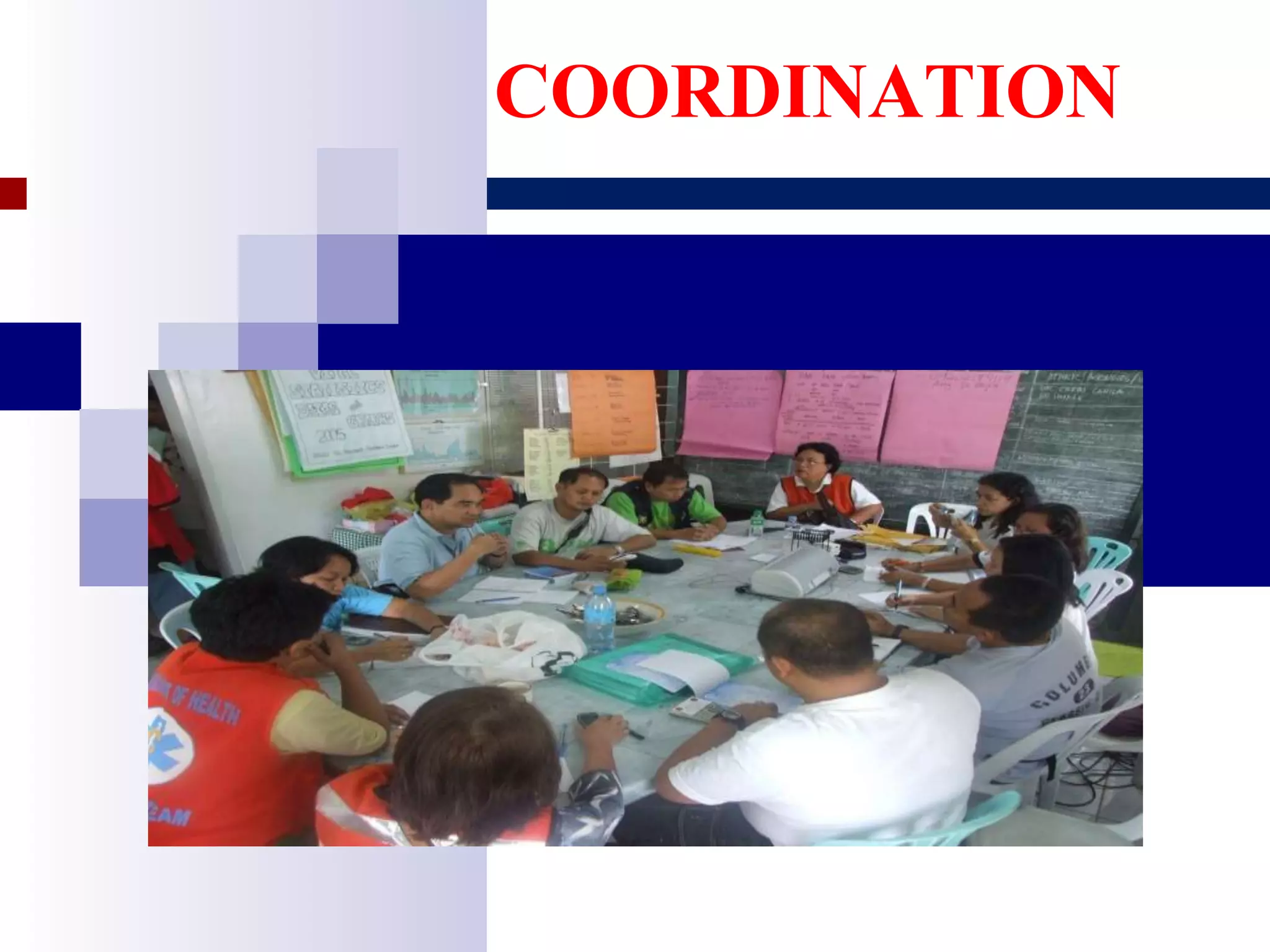
COORDINATION
Introduction
• Coordination is considered as an essential element
of administration.
• Coordination is the integration, synchronisation or
orderly pattern of group efforts in the institution
towards the accomplishment of common
objectives.
• The concept of co-ordination is much broader than
that of co-operation.
Presented By: Mr. Manjunath.
Coordination
Introduction
 Co-ordination is a process which ensures smooth interplay of the functions of
management. Common objectives are achieved without much wastage of
time, efforts and money with the help of co-ordination.
 Co-ordination is the essence of management (because it permeates all levels of
management). It is implicit and inherent in all functions of management.
 Co-ordination is not a separate function of management, because achieving
coordination leads to the achievement of group goals, which is a key to success
of management.
 All management seeks to achieve co-ordination through its basic functions such
as planning, organizing, staffing, directing and controlling.
 Co-ordination is an integral element or key ingredient of all the managerial
functions
Coordination
Meaning of Coordination
 Co-ordination implies an orderly pattern or arrangement of group efforts to
ensure unity of action in the pursuit of commonobjectives.
 Co-ordination requires unification of diverse and specialised activities.
 Coordination is a process to establish harmony among the different activities
of an organisation, so that the desired objectives can be achieved.
 Co-ordination as a function of management refers to the task of integrating the
activities of separate units of an organization to accomplish the goals
efficiently.
 Co-ordination is the unification, integration, synchronization of the efforts
of group members so as to provide unity of action in the pursuit of common
goals.
 It is a hidden force which binds all the other functions of management.
Coordination
Meaning of Coordination….
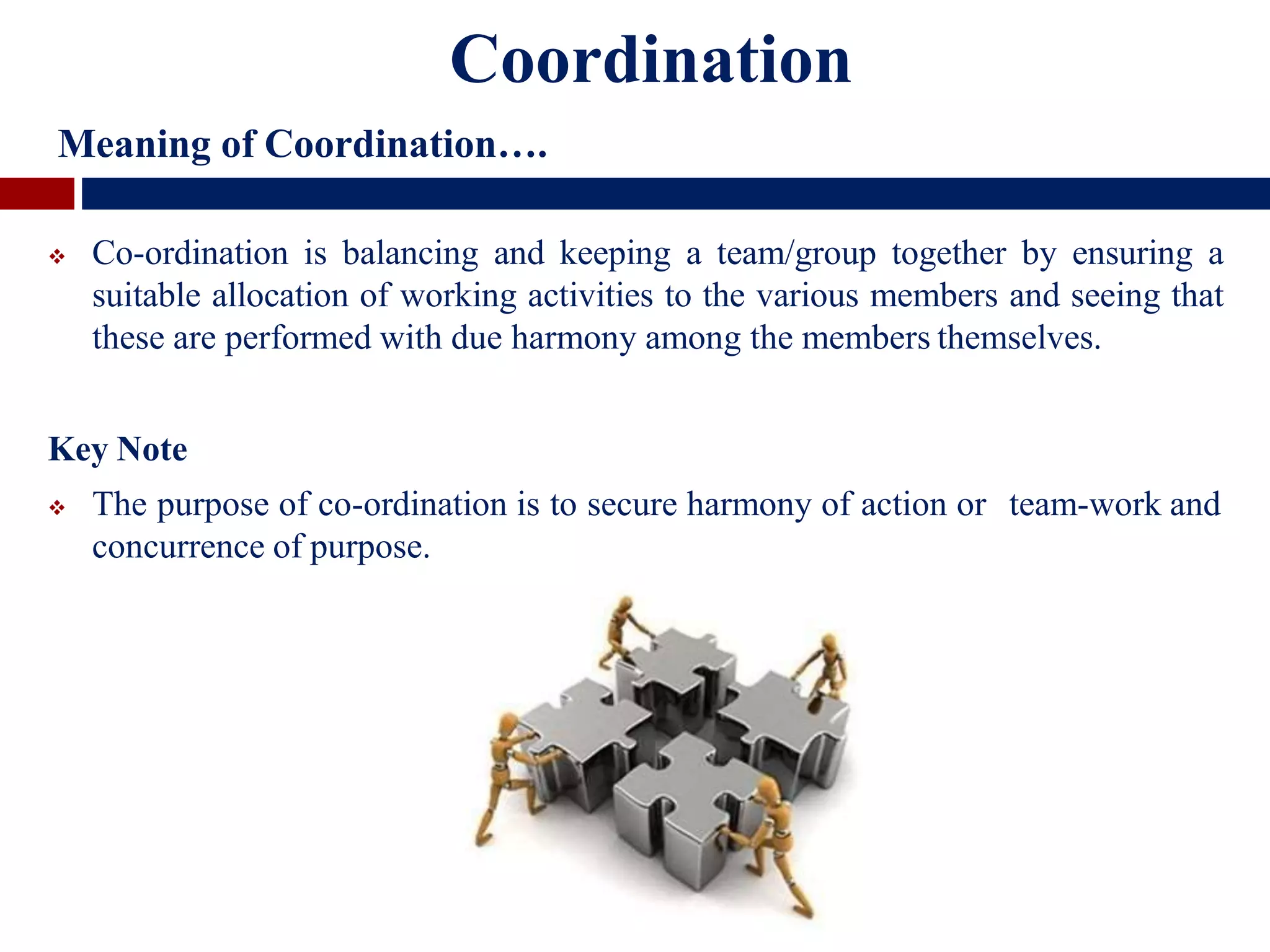
 Co-ordination is balancing and keeping a team/group together by ensuring a
suitable allocation of working activities to the various members and seeing that
these are performed with due harmony among the members themselves.
Key Note
 The purpose of co-ordination is to secure harmony of action or team-work and
concurrence of purpose.
Coordination
Definition of Coordination by differentAuthors
 According to Henry Fayol “ to co-ordinate is to harmonize all the
activities of a concern so as to facilitate its working and its
success”
 Mooney and Reelay, define coordination as the orderly
arrangement of group efforts to provide unity of action in the
pursuit of common goals”.
 Charles Worth opined that, “Co-ordination is the integration of
several parts into an orderly hole to achieve the purpose of
understanding”.
 According to G.R. Terry, “Co-ordination is the orderly
synchronization of efforts to provide the proper amount, timing
,and directing of execution in harmonious and unified actions to a
stated objective.”
Coordination
Key note: Viewing coordination as a Pyramid
Coordination
Elements of Coordination
 According to Allen, “A manager in managing must co-ordinate the
work for which he is accountable by balancing ,timing and
integrating.”
 The three elements of Co-ordination are :-
 Balancing
 Timing
 Integrating
Coordination
Features /Characteristics of Coordination
 It is not a distinct/separate function but the very essence of management.
 It is the basic responsibility of management
 It does not arise spontaneously or by force.
 The heart of co-ordination is unity of action/purpose.
 It is a dynamic process (continuous or an ongoing process).
 It is required in group efforts, not in individualeffort.
 It has a common purpose of getting organisational objectives accomplished.
 It is necessary to all levels of organization
 It is a system concept
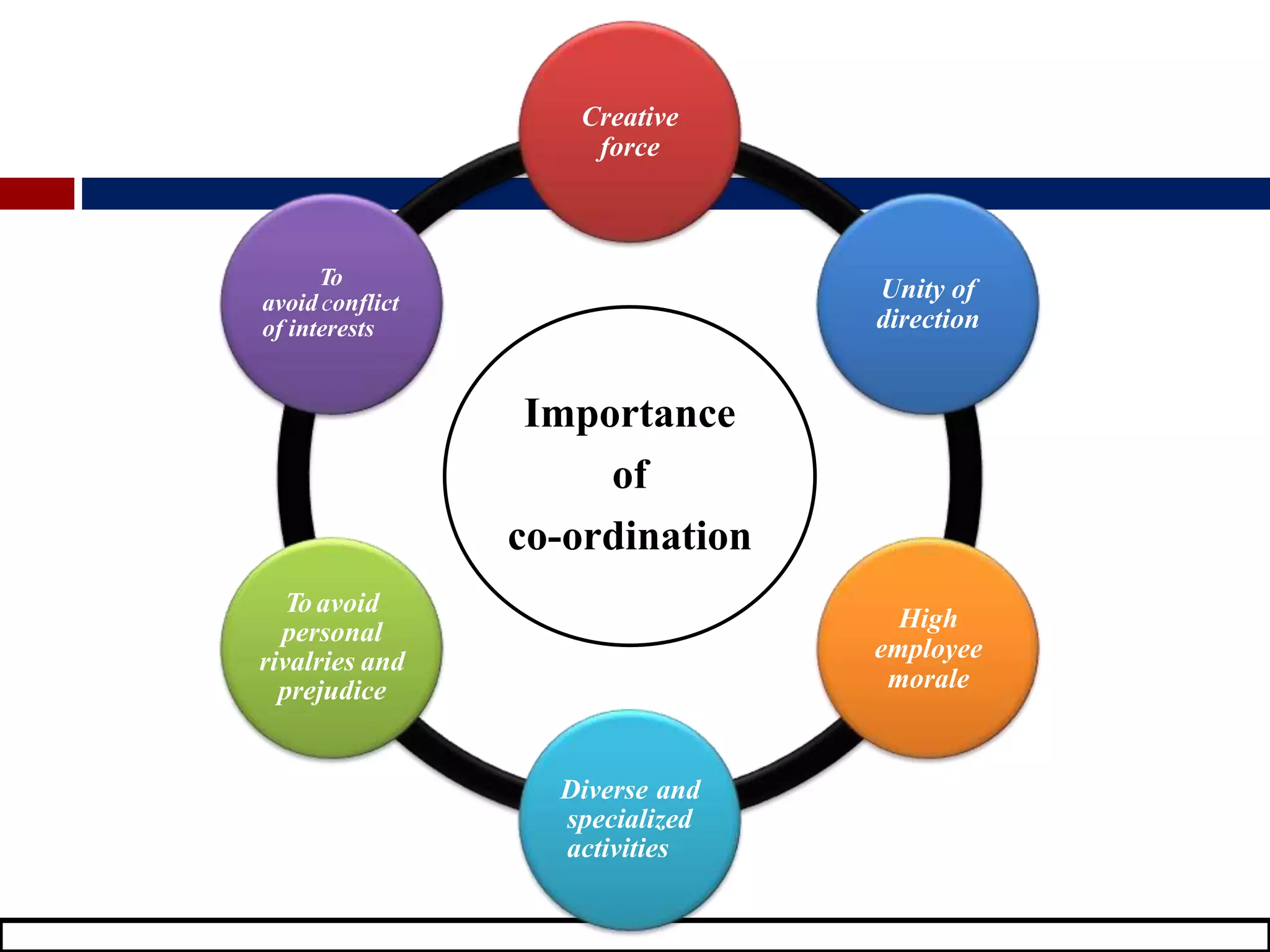
Importance
of
co-ordination
Creative
force
Unity of
direction
High
employee
morale
Diverse and
specialized
activities
To avoid
personal
rivalries and
prejudice
To
avoid conflict
of interests
Importanceofco-ordination
1. Creative force
• Group efforts when coordinated create a result greater than
the sum total of the individual and isolated.
2. Unity of direction
• co-ordination ensures unity if direction by way of securing
spontaneous collaboration on the part of different
departments.
3. High employee morale
• co-ordination enhances the general level of employee
morale and provides satisfaction
4. Diverse and specialized activities
• Total activities of an organisation are divided into several
units and subunits on the basis of either product
specialisation.
5. To avoid personal rivalries and prejudice
• human organisation give rise in course of time to the
development of personality politics among members.
6. To avoid conflict of interests
• Subordination of individual interest to general interest
often happen in organizations. There is need for
coordination to avoid conflicts or overlapping in the work
of employees or units or as organisation.
Coordination
Need/Importance of Coordination
Increase in size and complexity of operations: Need for coordination arises
as soon as the operations become multiple and complex.
Specialisation: Division of work into specialized functions and departments leads
to diversity and lack of uniformity.
Clash of interests – Coordination helps to avoid conflict between individual
and organisational goals.
Efficiency and Effectiveness: Coordination helps to improve the efficiency of
operations by avoiding overlapping efforts and duplication of work. Quality of
coordination determines the effectiveness of organized efforts.
Unity of Direction/Team work: Coordination helps to ensure unity of action in the
face of disruptive forces. It helps unity of action and helps to avoid conflicts
between line and staff elements
Coordination
Need/Importance of Coordination….
Human Relation: Coordination helps to improve team spirit and morale of employees. In a well
coordinated organization, organizational goals and personal goals of people are reconciled.
Essence Of Management: Coordination is all inclusive concept and the end result of
management process. Coordination helps in the accomplishment of organizational goals.
Different outlook :It becomes imperative to reconcile differences in approach ,timing and
effort to secure unity of action.
Conflicts :Co-ordination avoids potential sources of conflict.
Others
 Unity in diversity
 Term work or unity of directions
 Functional differentiation
Moreover on the basis of organizational structure, there are three
types of coordination
Pooled,
Sequential,
Reciprocal Co-ordination
Coordination
Types of Coordination
On the basis of scope or coverage, there are two types, namely:
Internal (the basis of flow there two types of internalcoordination)
 Vertical
 horizontal
External Co-ordination
Coordination
Types of Coordination….
Internal Coordination
 It is the establishment of relationship of among managers, executives, divisions,
subdivisions, and other workers. This type of coordination happens within the
organisation
Managerial functions which require Internal Co-ordinationinclude:
 Planning
 Organizing
 Staffing
 Directing
 Controlling
Internal Coordination….
Horizontal coordination:
status.
 Horizontal Coordination refers between the persons of the same
Coordination between the departmental heads, supervisors, co-workers
Vertical coordination:
 Superior coordinates his work with his sub coordinates and vice versa.Sales
manager coordinates his work with the activities of the sales supervisor.
Coordination
Types of Coordination….
Internal Coordination….
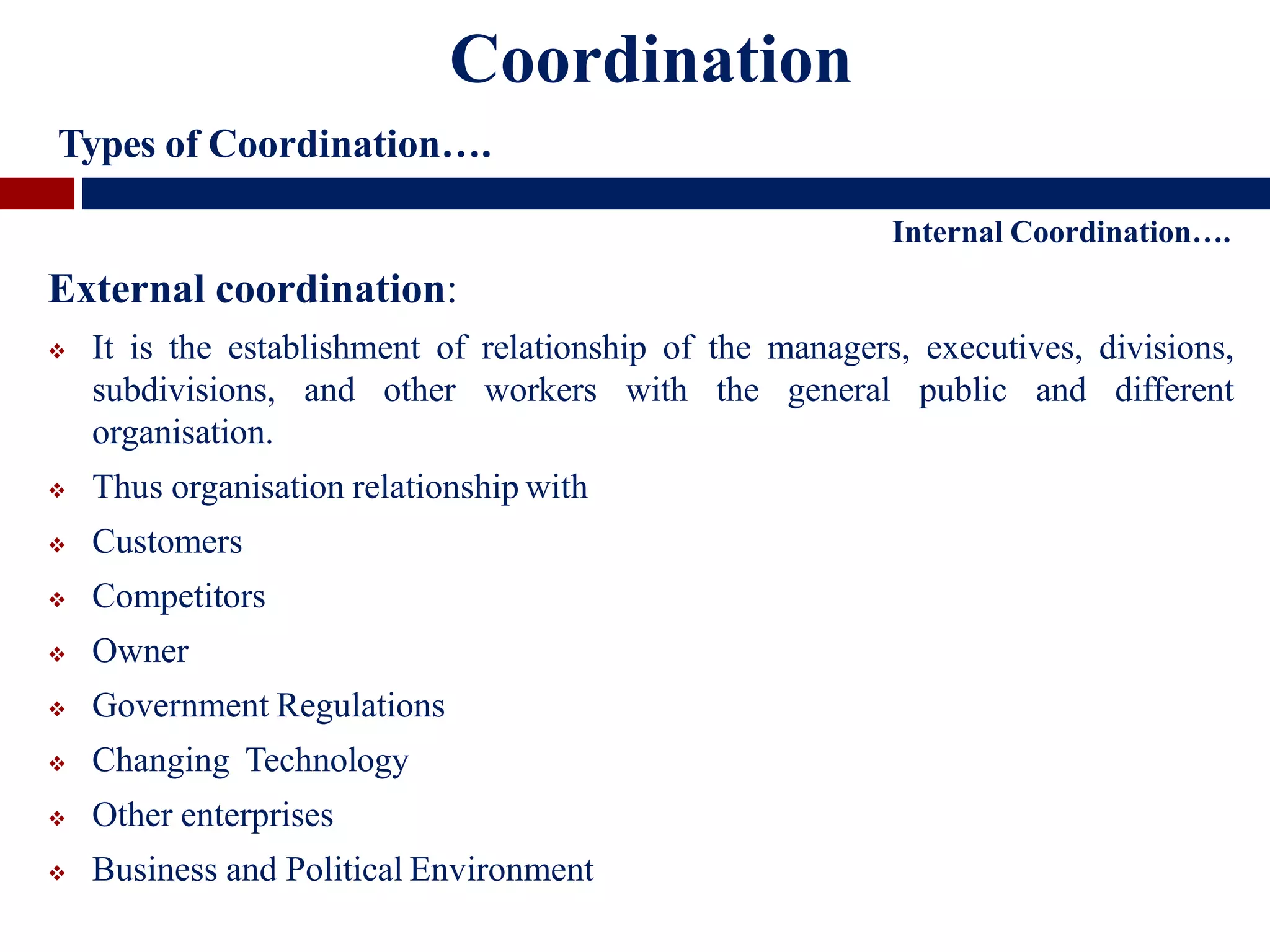
External coordination:
 It is the establishment of relationship of the managers, executives, divisions,
subdivisions, and other workers with the general public and different
organisation.
 Thus organisation relationship with
 Customers
 Competitors
 Owner
 Government Regulations
 Changing Technology
 Other enterprises
 Business and Political Environment
Coordination
Types of Coordination….
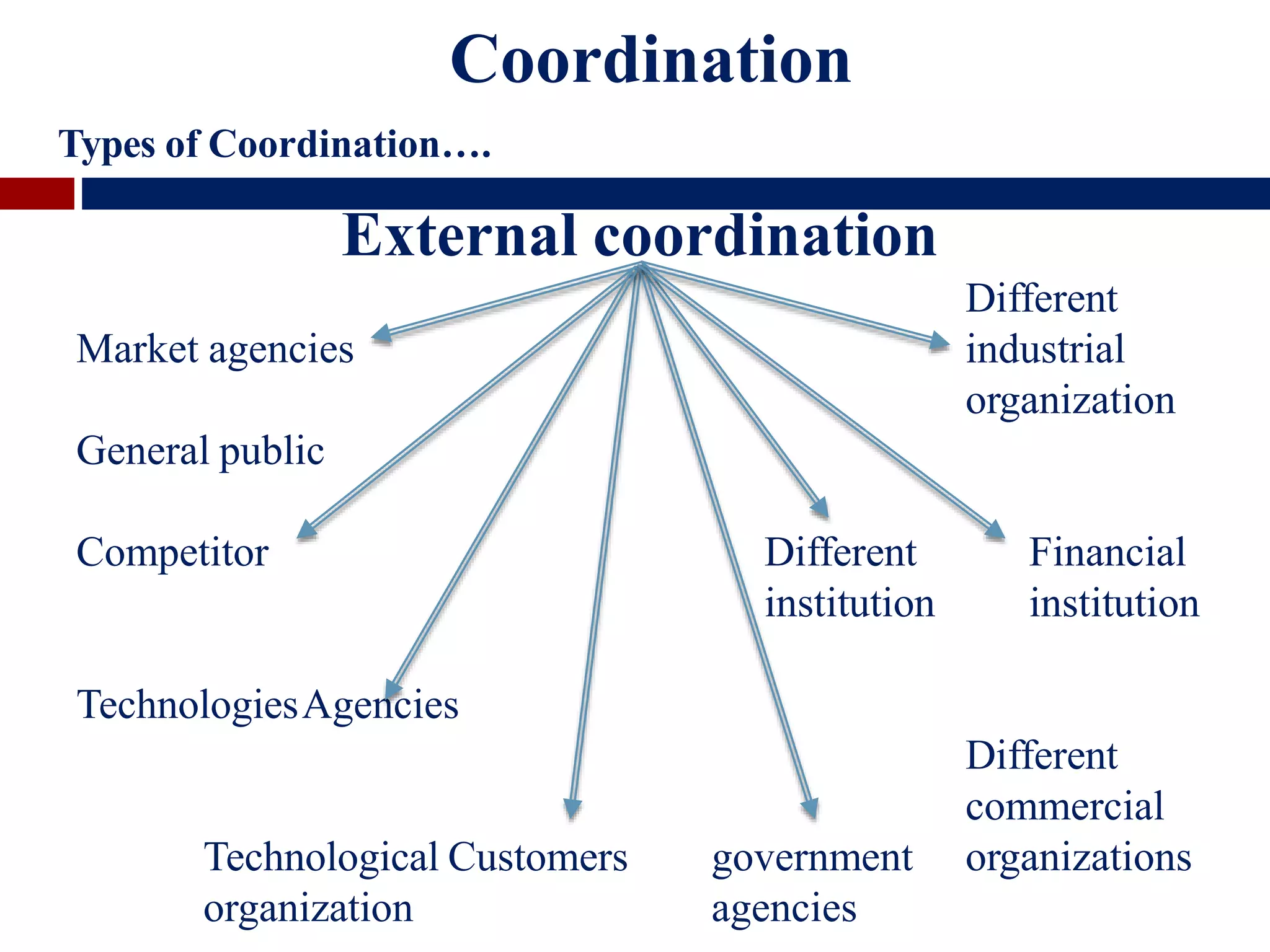
Coordination
Types of Coordination….
External coordination
Market agencies
Different
industrial
organization
General public
Competitor Different
institution
Financial
institution
TechnologiesAgencies
Different
commercial
organizations
Technological Customers
organization
government
agencies
PRINCIPLES OF COORDINATION
According to Mary Parker Follet, there are four
principles for effective coordination:
Principles of coordination…
 Principles of direct contact
It states that coordination can be
achieved by direct contact among people
whose activities are to be coordinated
through effective communication system
and mutual understanding.
Coordination at early stages…
 At planning stage coordination can be
sought from organizational members.This
may be done through participation in
decision making process.
Principleof continuity………..
 It states that coordination should be treated
as continuous process. it is done on regular
basis. It is treated never ceasing and never
ending exercise.
Principleof dynamism…….
 Changes occur in
external factors which
necessitate changes
in organisation.when
organisational
changes take place,
many old
organisational
practices do not
remain workable.
Principleof timing…………..
 One member of the organisation facilitates
the working of another if he synchronizes
the timing of his work with the working of
another.
Principleof reciprocalrelationship….
 It exists between two
or more parties in
which each party
affects the functioning
of others. The
functions and way of
performing such
functions are altered
in such away that
these affect others
positively.
Coordination
Principles of Coordination….
Principles of Coordination
Principles of
Co-ordination
Personal
contact
Continuity
Self
coordination
Effective
supervision
Simplified
organization
Effectives
communication
Reciprocal
relationship
Dynamism
Early Start
Clear cut
objectives
Clear definition
of authority and
responsibility
Effective
leadership
Coordination
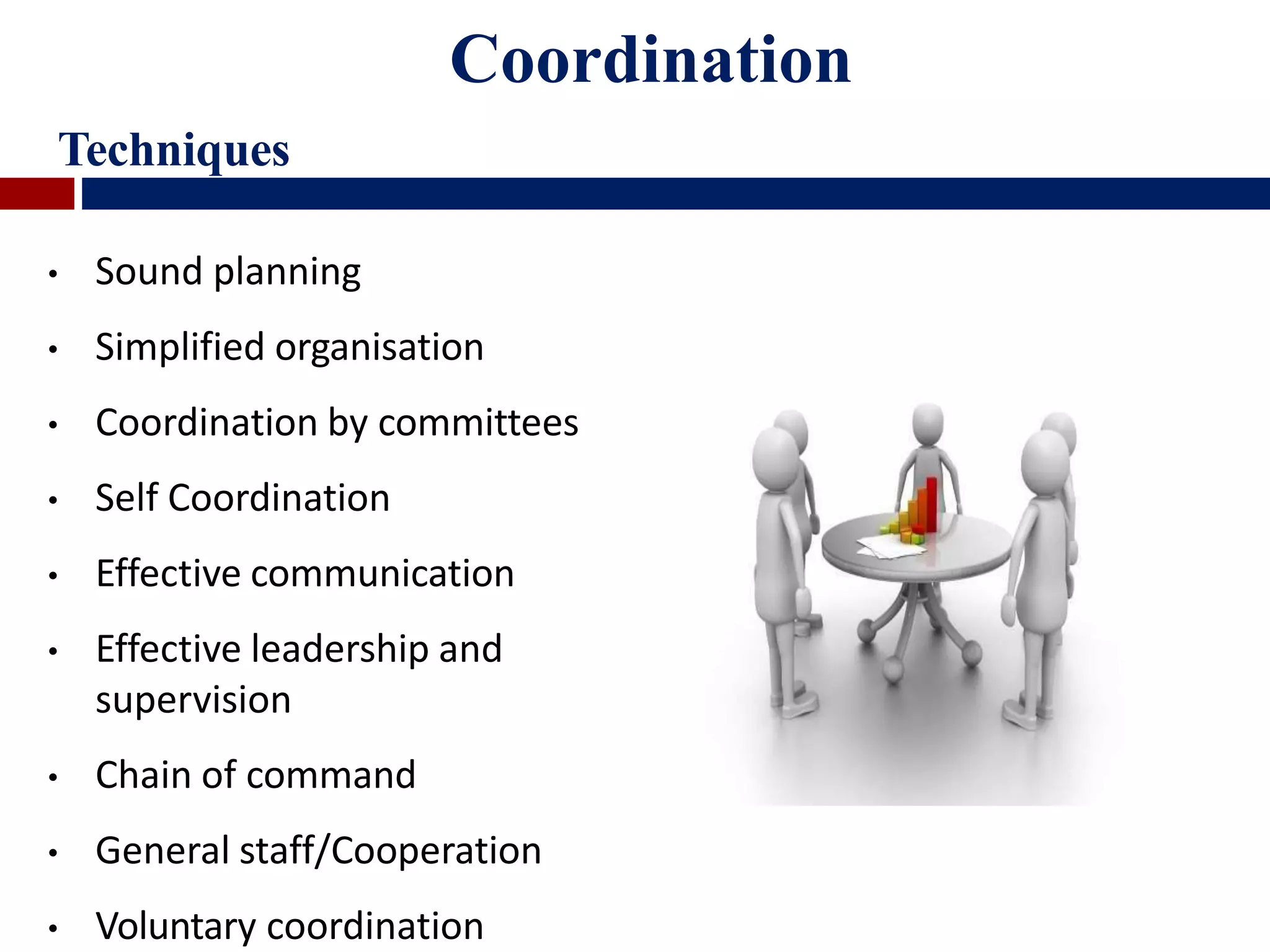
Techniques
• Sound planning
• Simplified organisation
• Coordination by committees
• Self Coordination
• Effective communication
• Effective leadership and
supervision
• Chain of command
• General staff/Cooperation
• Voluntary coordination
Coordination
Techniques of Coordination
Sound planning
Planning is the ideal stage for coordination. Clear cut objectives, harmonized
policies and unified procedures and rules ensure uniformity ofaction.
Simplified organisation
A simple and sound organization is an important means ofcoordination.
Clear cut authority relationships help to reduce conflicts and to hold people
responsible.
Coordination by committees
Committee is a body of persons entrusted with discharge of some functions
collectively as a group. it is significant in achieving horizontal coordination.
committee ensures that problems which arises out of relationships among various
units can be solved by group decisions.
Coordination
Techniques of Coordination…..
Self Coordination
Modification of functioning of department in such a way that each department
coordinates with other departments. it can be done by horizontal
communication.
Effective Communication
Open and regular communication is the key to coordination.
Effective interchange of opinions and information helps in resolving difference
and in creation mutual understanding.
Effective Leadership and Supervision
Effective leadership ensures coordination both at the planning and the execution
stage.
Sound leadership can influence subordinates to have identity of interest andtoo
adopt a common outlook.
General staff/Cooperation
A general staff is very helpful in achieving interdepartmental or horizontal
coordination.
Voluntary coordination
Voluntary coordination is possible in a climate of dedication and mutual co-
operation.
Coordination
Techniques of Coordination…..
Chain of Command
Authority is the supreme coordinating power in an organization.
Exercise of authority through the chain of command or hierarchy is the traditional
means of coordination.
Coordination
Problems of Coordination
In practice coordination faces certain problems, These include:
 Natural hindrance (e.g. bad weather, poor health situation, etc)
 Inadequate /lack of administrative talent
 Lack/Inadequate of techniques of coordination
 Misunderstanding
 Competition for resources
 Threats to autonomy
 Disagreement on objectives and idea
 Differing expectations of coordination
 Lack of trust
 Cost/benefit perceived as unsatisfactory
 Unilateral donor actions and agendas
 Rapid staff turnover
 Poor transition preparations
 ESSENTIALS OF COORDINATION…..
Essentials for effective coordination…….
 Well defined authority
and
responsibility…...peop
le are not clear about
what is expected of
them and they
experience role
ambiguity
Effective communication
system….
 It is the means for sharing ideas and
information. communication performs
different types of functions-
informative,command,and instructive,
influence and persuasive.
Well definedwork procedures…….
 It facilitate procedural coordination.when
the work procedures are well defined and
adhered properly……….this help to
achieve coordination easily.
Provisions of check and introspection……
 It help to correct
those factors which
create problem in
coordination.
 It leads to effective
organization
structure.
 It leads to proper
organizational
climate.
should be divided into
 Proper delegation of authority and responsibility
 Whole or entire activities of the organization
department/section/units
 There should be to rigid rules and regulations, procedures, policies, etc.
 Adherence to rigid rules and regulations, procedures, policies, etc. must be
maintained
 Establishment of an effective communication system
 Establishment of employees’ grievancescell.
Coordination
Steps of effective of Coordination
Coordination
Steps of effective of Coordination…..
 There should be a proper system for reporting.
 Skilled workers must be rewarded adequately.
 The management should induce the employees to take active part in meeting.
 The management should encourage the employees to have friendly relationship
with others.
 Managers should have opportunities to get training in the area of leadership,
coordination, planning staffing and the like.
Coordination
Process of Coordination
Clearer Goals
Proper Allocation ofWork
Sound Organization Structure
Clearer Responsibility Relationship
Proper Communication
Sound Leadership
Coordination
Coordination and Cooperation
 Co-ordination is an orderly arrangement of efforts to provide unity of actionin
the fulfillment of common objective
whereas
 Co-operation denotes collective efforts of persons working in an enterprise
voluntarily for the achievement of a particular purpose. It is the willingnessof
individuals to help each other.
 Therefore, existence of co-operation may prove to be effective condition or requisite for
co-ordination. But it does not mean that co-ordination originates automatically from the
voluntary efforts of the group of members. It has to be achieved through conscious &
deliberate efforts of managers, therefore it can be concluded that co-operation without
co-ordination has no fruit and co-ordination without co-operation has no root.
Coordination
Coordination and Cooperation
Co-ordination Co-operation
It is not a function of management.
Cooperation is willingness to work with others or
help others
Co-ordination is the basis for co-ordination.
It is the function of management.
Coordination is an orderly arrangement of group
efforts.
The early success of an organization depends upon
the degree of co-ordination.
Co-ordination is obtained officially.
It establishes both formal and informal relationship
There is a direct link between the achievement of
objectives and co-ordination.
Co-ordination is a voluntary service.
It establishes informal relationship.
There is no such direct connection between co-
operation and the achievement of objectives.

coordination.pptx

  • 2.
  • 3.
  • 4.
    Introduction • Coordination isconsidered as an essential element of administration. • Coordination is the integration, synchronisation or orderly pattern of group efforts in the institution towards the accomplishment of common objectives. • The concept of co-ordination is much broader than that of co-operation. Presented By: Mr. Manjunath.
  • 5.
    Coordination Introduction  Co-ordination isa process which ensures smooth interplay of the functions of management. Common objectives are achieved without much wastage of time, efforts and money with the help of co-ordination.  Co-ordination is the essence of management (because it permeates all levels of management). It is implicit and inherent in all functions of management.  Co-ordination is not a separate function of management, because achieving coordination leads to the achievement of group goals, which is a key to success of management.  All management seeks to achieve co-ordination through its basic functions such as planning, organizing, staffing, directing and controlling.  Co-ordination is an integral element or key ingredient of all the managerial functions
  • 6.
    Coordination Meaning of Coordination Co-ordination implies an orderly pattern or arrangement of group efforts to ensure unity of action in the pursuit of commonobjectives.  Co-ordination requires unification of diverse and specialised activities.  Coordination is a process to establish harmony among the different activities of an organisation, so that the desired objectives can be achieved.  Co-ordination as a function of management refers to the task of integrating the activities of separate units of an organization to accomplish the goals efficiently.  Co-ordination is the unification, integration, synchronization of the efforts of group members so as to provide unity of action in the pursuit of common goals.  It is a hidden force which binds all the other functions of management.
  • 7.
    Coordination Meaning of Coordination…. Co-ordination is balancing and keeping a team/group together by ensuring a suitable allocation of working activities to the various members and seeing that these are performed with due harmony among the members themselves. Key Note  The purpose of co-ordination is to secure harmony of action or team-work and concurrence of purpose.
  • 8.
    Coordination Definition of Coordinationby differentAuthors  According to Henry Fayol “ to co-ordinate is to harmonize all the activities of a concern so as to facilitate its working and its success”  Mooney and Reelay, define coordination as the orderly arrangement of group efforts to provide unity of action in the pursuit of common goals”.  Charles Worth opined that, “Co-ordination is the integration of several parts into an orderly hole to achieve the purpose of understanding”.  According to G.R. Terry, “Co-ordination is the orderly synchronization of efforts to provide the proper amount, timing ,and directing of execution in harmonious and unified actions to a stated objective.”
  • 9.
    Coordination Key note: Viewingcoordination as a Pyramid
  • 10.
    Coordination Elements of Coordination According to Allen, “A manager in managing must co-ordinate the work for which he is accountable by balancing ,timing and integrating.”  The three elements of Co-ordination are :-  Balancing  Timing  Integrating
  • 11.
    Coordination Features /Characteristics ofCoordination  It is not a distinct/separate function but the very essence of management.  It is the basic responsibility of management  It does not arise spontaneously or by force.  The heart of co-ordination is unity of action/purpose.  It is a dynamic process (continuous or an ongoing process).  It is required in group efforts, not in individualeffort.  It has a common purpose of getting organisational objectives accomplished.  It is necessary to all levels of organization  It is a system concept
  • 12.
  • 13.
    Importanceofco-ordination 1. Creative force •Group efforts when coordinated create a result greater than the sum total of the individual and isolated. 2. Unity of direction • co-ordination ensures unity if direction by way of securing spontaneous collaboration on the part of different departments. 3. High employee morale • co-ordination enhances the general level of employee morale and provides satisfaction
  • 14.
    4. Diverse andspecialized activities • Total activities of an organisation are divided into several units and subunits on the basis of either product specialisation. 5. To avoid personal rivalries and prejudice • human organisation give rise in course of time to the development of personality politics among members. 6. To avoid conflict of interests • Subordination of individual interest to general interest often happen in organizations. There is need for coordination to avoid conflicts or overlapping in the work of employees or units or as organisation.
  • 15.
    Coordination Need/Importance of Coordination Increasein size and complexity of operations: Need for coordination arises as soon as the operations become multiple and complex. Specialisation: Division of work into specialized functions and departments leads to diversity and lack of uniformity. Clash of interests – Coordination helps to avoid conflict between individual and organisational goals. Efficiency and Effectiveness: Coordination helps to improve the efficiency of operations by avoiding overlapping efforts and duplication of work. Quality of coordination determines the effectiveness of organized efforts. Unity of Direction/Team work: Coordination helps to ensure unity of action in the face of disruptive forces. It helps unity of action and helps to avoid conflicts between line and staff elements
  • 16.
    Coordination Need/Importance of Coordination…. HumanRelation: Coordination helps to improve team spirit and morale of employees. In a well coordinated organization, organizational goals and personal goals of people are reconciled. Essence Of Management: Coordination is all inclusive concept and the end result of management process. Coordination helps in the accomplishment of organizational goals. Different outlook :It becomes imperative to reconcile differences in approach ,timing and effort to secure unity of action. Conflicts :Co-ordination avoids potential sources of conflict. Others  Unity in diversity  Term work or unity of directions  Functional differentiation
  • 17.
    Moreover on thebasis of organizational structure, there are three types of coordination Pooled, Sequential, Reciprocal Co-ordination Coordination Types of Coordination On the basis of scope or coverage, there are two types, namely: Internal (the basis of flow there two types of internalcoordination)  Vertical  horizontal External Co-ordination
  • 18.
    Coordination Types of Coordination…. InternalCoordination  It is the establishment of relationship of among managers, executives, divisions, subdivisions, and other workers. This type of coordination happens within the organisation Managerial functions which require Internal Co-ordinationinclude:  Planning  Organizing  Staffing  Directing  Controlling
  • 19.
    Internal Coordination…. Horizontal coordination: status. Horizontal Coordination refers between the persons of the same Coordination between the departmental heads, supervisors, co-workers Vertical coordination:  Superior coordinates his work with his sub coordinates and vice versa.Sales manager coordinates his work with the activities of the sales supervisor. Coordination Types of Coordination….
  • 20.
    Internal Coordination…. External coordination: It is the establishment of relationship of the managers, executives, divisions, subdivisions, and other workers with the general public and different organisation.  Thus organisation relationship with  Customers  Competitors  Owner  Government Regulations  Changing Technology  Other enterprises  Business and Political Environment Coordination Types of Coordination….
  • 21.
    Coordination Types of Coordination…. Externalcoordination Market agencies Different industrial organization General public Competitor Different institution Financial institution TechnologiesAgencies Different commercial organizations Technological Customers organization government agencies
  • 22.
    PRINCIPLES OF COORDINATION Accordingto Mary Parker Follet, there are four principles for effective coordination:
  • 23.
    Principles of coordination… Principles of direct contact It states that coordination can be achieved by direct contact among people whose activities are to be coordinated through effective communication system and mutual understanding.
  • 24.
    Coordination at earlystages…  At planning stage coordination can be sought from organizational members.This may be done through participation in decision making process.
  • 25.
    Principleof continuity………..  Itstates that coordination should be treated as continuous process. it is done on regular basis. It is treated never ceasing and never ending exercise.
  • 26.
    Principleof dynamism…….  Changesoccur in external factors which necessitate changes in organisation.when organisational changes take place, many old organisational practices do not remain workable.
  • 27.
    Principleof timing…………..  Onemember of the organisation facilitates the working of another if he synchronizes the timing of his work with the working of another.
  • 28.
    Principleof reciprocalrelationship….  Itexists between two or more parties in which each party affects the functioning of others. The functions and way of performing such functions are altered in such away that these affect others positively.
  • 29.
    Coordination Principles of Coordination…. Principlesof Coordination Principles of Co-ordination Personal contact Continuity Self coordination Effective supervision Simplified organization Effectives communication Reciprocal relationship Dynamism Early Start Clear cut objectives Clear definition of authority and responsibility Effective leadership
  • 30.
    Coordination Techniques • Sound planning •Simplified organisation • Coordination by committees • Self Coordination • Effective communication • Effective leadership and supervision • Chain of command • General staff/Cooperation • Voluntary coordination
  • 31.
    Coordination Techniques of Coordination Soundplanning Planning is the ideal stage for coordination. Clear cut objectives, harmonized policies and unified procedures and rules ensure uniformity ofaction. Simplified organisation A simple and sound organization is an important means ofcoordination. Clear cut authority relationships help to reduce conflicts and to hold people responsible. Coordination by committees Committee is a body of persons entrusted with discharge of some functions collectively as a group. it is significant in achieving horizontal coordination. committee ensures that problems which arises out of relationships among various units can be solved by group decisions.
  • 32.
    Coordination Techniques of Coordination….. SelfCoordination Modification of functioning of department in such a way that each department coordinates with other departments. it can be done by horizontal communication. Effective Communication Open and regular communication is the key to coordination. Effective interchange of opinions and information helps in resolving difference and in creation mutual understanding. Effective Leadership and Supervision Effective leadership ensures coordination both at the planning and the execution stage. Sound leadership can influence subordinates to have identity of interest andtoo adopt a common outlook.
  • 33.
    General staff/Cooperation A generalstaff is very helpful in achieving interdepartmental or horizontal coordination. Voluntary coordination Voluntary coordination is possible in a climate of dedication and mutual co- operation. Coordination Techniques of Coordination….. Chain of Command Authority is the supreme coordinating power in an organization. Exercise of authority through the chain of command or hierarchy is the traditional means of coordination.
  • 34.
    Coordination Problems of Coordination Inpractice coordination faces certain problems, These include:  Natural hindrance (e.g. bad weather, poor health situation, etc)  Inadequate /lack of administrative talent  Lack/Inadequate of techniques of coordination  Misunderstanding  Competition for resources  Threats to autonomy  Disagreement on objectives and idea  Differing expectations of coordination  Lack of trust  Cost/benefit perceived as unsatisfactory  Unilateral donor actions and agendas  Rapid staff turnover  Poor transition preparations
  • 35.
     ESSENTIALS OFCOORDINATION…..
  • 36.
    Essentials for effectivecoordination…….  Well defined authority and responsibility…...peop le are not clear about what is expected of them and they experience role ambiguity
  • 37.
    Effective communication system….  Itis the means for sharing ideas and information. communication performs different types of functions- informative,command,and instructive, influence and persuasive.
  • 38.
    Well definedwork procedures……. It facilitate procedural coordination.when the work procedures are well defined and adhered properly……….this help to achieve coordination easily.
  • 39.
    Provisions of checkand introspection……  It help to correct those factors which create problem in coordination.  It leads to effective organization structure.  It leads to proper organizational climate.
  • 40.
    should be dividedinto  Proper delegation of authority and responsibility  Whole or entire activities of the organization department/section/units  There should be to rigid rules and regulations, procedures, policies, etc.  Adherence to rigid rules and regulations, procedures, policies, etc. must be maintained  Establishment of an effective communication system  Establishment of employees’ grievancescell. Coordination Steps of effective of Coordination
  • 41.
    Coordination Steps of effectiveof Coordination…..  There should be a proper system for reporting.  Skilled workers must be rewarded adequately.  The management should induce the employees to take active part in meeting.  The management should encourage the employees to have friendly relationship with others.  Managers should have opportunities to get training in the area of leadership, coordination, planning staffing and the like.
  • 42.
    Coordination Process of Coordination ClearerGoals Proper Allocation ofWork Sound Organization Structure Clearer Responsibility Relationship Proper Communication Sound Leadership
  • 43.
    Coordination Coordination and Cooperation Co-ordination is an orderly arrangement of efforts to provide unity of actionin the fulfillment of common objective whereas  Co-operation denotes collective efforts of persons working in an enterprise voluntarily for the achievement of a particular purpose. It is the willingnessof individuals to help each other.
  • 44.
     Therefore, existenceof co-operation may prove to be effective condition or requisite for co-ordination. But it does not mean that co-ordination originates automatically from the voluntary efforts of the group of members. It has to be achieved through conscious & deliberate efforts of managers, therefore it can be concluded that co-operation without co-ordination has no fruit and co-ordination without co-operation has no root. Coordination Coordination and Cooperation Co-ordination Co-operation It is not a function of management. Cooperation is willingness to work with others or help others Co-ordination is the basis for co-ordination. It is the function of management. Coordination is an orderly arrangement of group efforts. The early success of an organization depends upon the degree of co-ordination. Co-ordination is obtained officially. It establishes both formal and informal relationship There is a direct link between the achievement of objectives and co-ordination. Co-ordination is a voluntary service. It establishes informal relationship. There is no such direct connection between co- operation and the achievement of objectives.