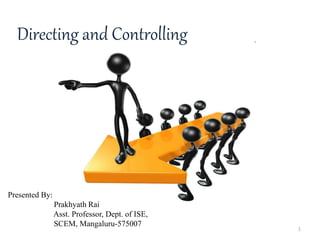
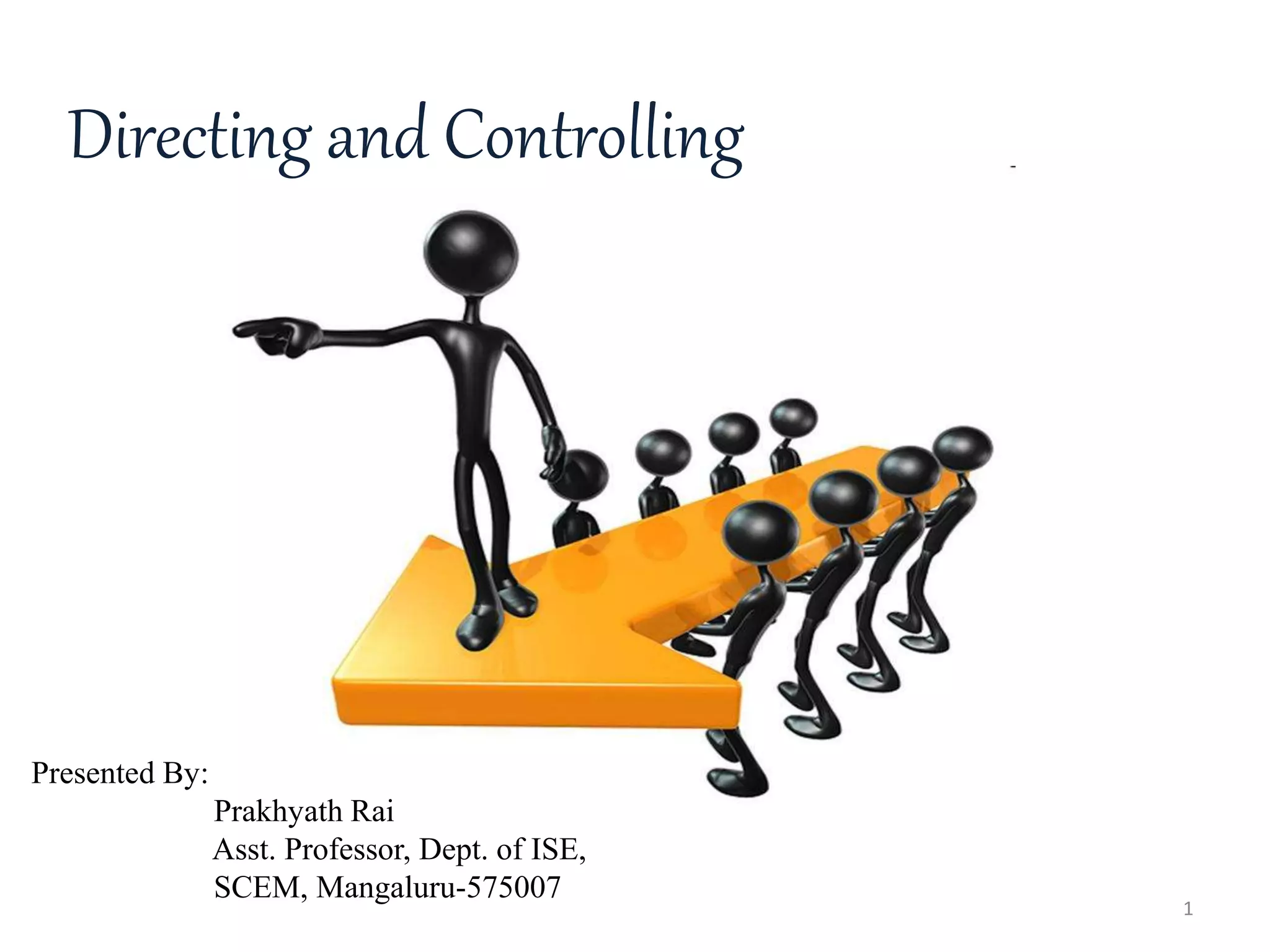
Directing and Controlling
Presented By:
Prakhyath Rai
Asst. Professor, Dept. of ISE,
SCEM, Mangaluru-575007
1
Directing
Leadership
Communication
Controlling
Coordination
2
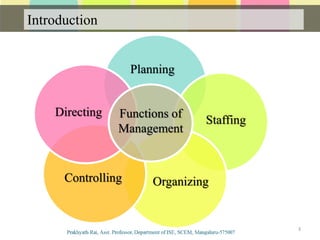
Introduction
Planning
Staffing
OrganizingControlling
Directing Functions of
Management
3
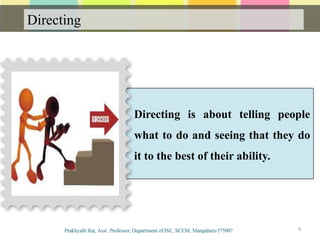
Directing is about telling people
what to do and seeing that they do
it to the best of their ability.
Directing
4
Directing as a Function of Management
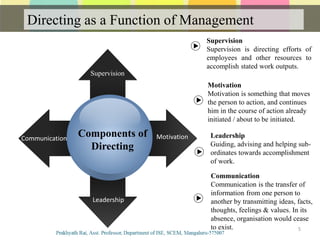
Components of
Directing
Communication
Leadership
Supervision
Motivation
Supervision
Supervision is directing efforts of
employees and other resources to
accomplish stated work outputs.
Motivation
Motivation is something that moves
the person to action, and continues
him in the course of action already
initiated / about to be initiated.
Leadership
Guiding, advising and helping sub-
ordinates towards accomplishment
of work.
Communication
Communication is the transfer of
information from one person to
another by transmitting ideas, facts,
thoughts, feelings & values. In its
absence, organisation would cease
to exist. 5
Nature and Features of Directing
Communication
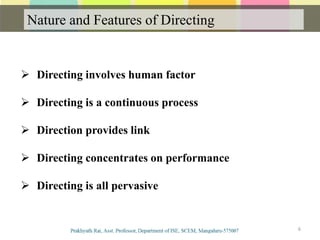
 Directing involves human factor
 Directing is a continuous process
 Direction provides link
 Directing concentrates on performance
 Directing is all pervasive
6
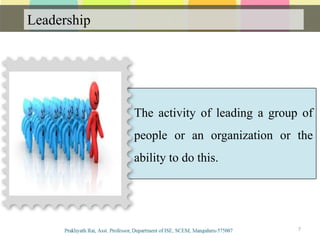
The activity of leading a group of
people or an organization or the
ability to do this.
Leadership
7
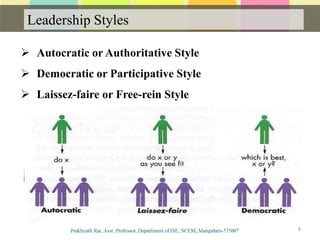
Leadership Styles
Communication
 Autocratic or Authoritative Style
 Democratic or Participative Style
 Laissez-faire or Free-rein Style
8
Autocratic or Authoritative Style
Communication
9
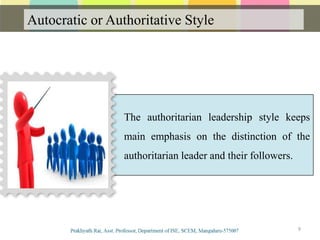
The authoritarian leadership style keeps
main emphasis on the distinction of the
authoritarian leader and their followers.
Democratic or Participative Style
Communication
10
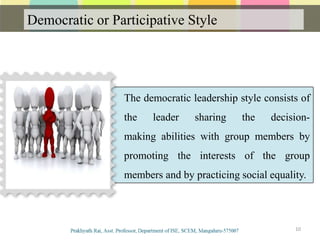
The democratic leadership style consists of
the leader sharing the decision-
making abilities with group members by
promoting the interests of the group
members and by practicing social equality..
Laissez-Faire or Free-Rein Style
Communication
11
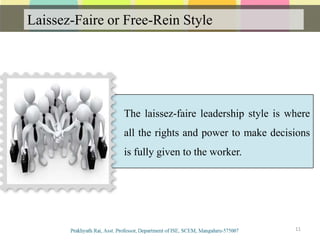
The laissez-faire leadership style is where
all the rights and power to make decisions
is fully given to the worker.
Motivation
Communication
12
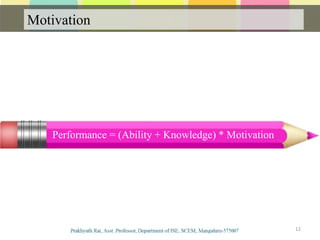
Performance = (Ability + Knowledge) * Motivation
Motivation
Communication
13
 Motivation is the process of attempting to influence others to
do your work through the possibility of gain or reward.
- Edwin B. Flippo
 Motivation means a process of stimulating people to action
to accomplish desired goals. - Scott
 Motivation is a general term applying to the entire class of
drives, desires, needs, wishes and similar forces that induces
an individual or a group of people to work. – Koontz and
O’Donnel
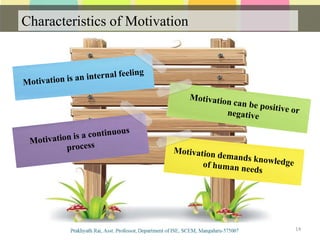
Characteristics of Motivation
Communication
14
Theories of Human Motivation
Communication
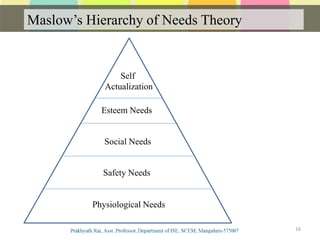
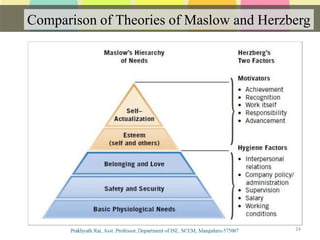
 Maslow’s Hierarchyof Needs Theory
 Herzberg’s Motivation – Hygiene Theory
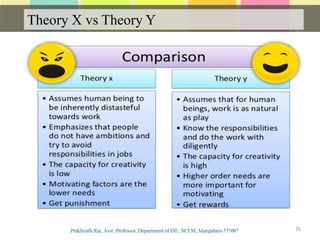
 McGregor’s Theory X and Theory Y
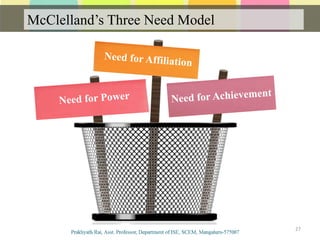
 McClelland’s Three Need Model
 Vroom’s Valence – Expectancy Theory
 Porter and Lawler – Model of Motivation
15
Maslow’s Hierarchy of Needs Theory
Communication
16
Self
Actualization
Esteem Needs
Social Needs
Safety Needs
Physiological Needs
Maslow’s Hierarchy of Needs Theory
Communication
17
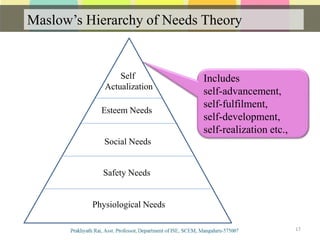
Self
Actualization
Esteem Needs
Social Needs
Safety Needs
Physiological Needs
Includes
self-advancement,
self-fulfilment,
self-development,
self-realization etc.,
Maslow’s Hierarchy of Needs Theory
Communication
18
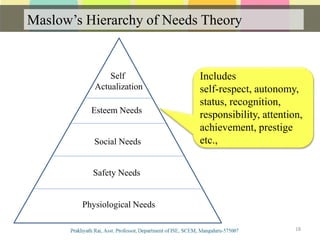
Self
Actualization
Esteem Needs
Social Needs
Safety Needs
Physiological Needs
Includes
self-respect, autonomy,
status, recognition,
responsibility, attention,
achievement, prestige
etc.,
Maslow’s Hierarchy of Needs Theory
Communication
19
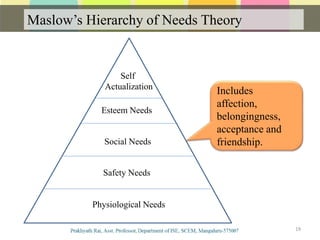
Self
Actualization
Esteem Needs
Social Needs
Safety Needs
Physiological Needs
Includes
affection,
belongingness,
acceptance and
friendship.
Maslow’s Hierarchy of Needs Theory
Communication
20
Self
Actualization
Esteem Needs
Social Needs
Safety Needs
Physiological Needs
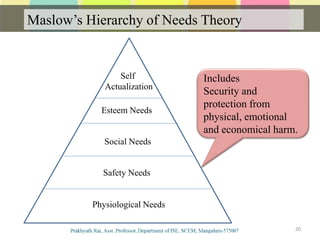
Includes
Security and
protection from
physical, emotional
and economical harm.
Maslow’s Hierarchy of Needs Theory
Communication
21
Self
Actualization
Esteem Needs
Social Needs
Safety Needs
Physiological Needs
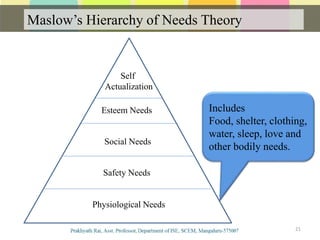
Includes
Food, shelter, clothing,
water, sleep, love and
other bodily needs.
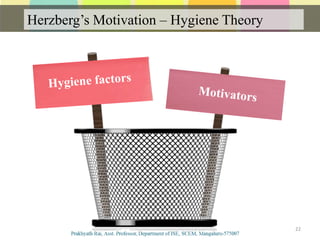
Herzberg’s Motivation – Hygiene Theory
Communication
22
Herzberg’s Motivation – Hygiene Theory
Communication
23
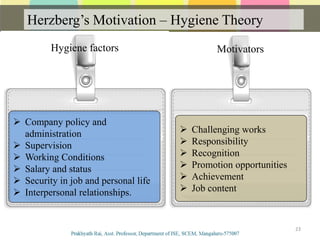
 Company policy and
administration
 Supervision
 Working Conditions
 Salary and status
 Security in job and personal life
 Interpersonal relationships.
 Challenging works
 Responsibility
 Recognition
 Promotion opportunities
 Achievement
 Job content
Hygiene factors Motivators
Comparison of Theories of Maslow and Herzberg
Communication
24
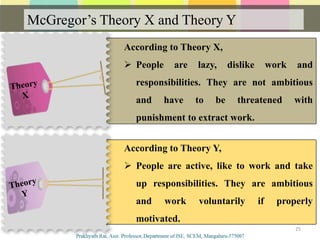
According to Theory Y,
 People are active, like to work and take
up responsibilities. They are ambitious
and work voluntarily if properly
motivated.
According to Theory X,
 People are lazy, dislike work and
responsibilities. They are not ambitious
and have to be threatened with
punishment to extract work.
McGregor’s Theory X and Theory Y
25
Theory X vs Theory Y
Communication
26
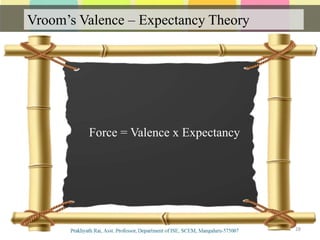
Force = Valence x Expectancy
McClelland’s Three Need Model
Communication
27
Vroom’s Valence – Expectancy Theory
Communication
28
Force = Valence x Expectancy
Vroom’s Valence – Expectancy Theory
Communication
29
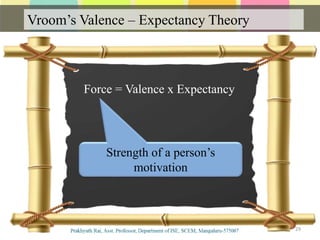
Force = Valence x Expectancy
Strength of a person’s
motivation
Vroom’s Valence – Expectancy Theory
Communication
30
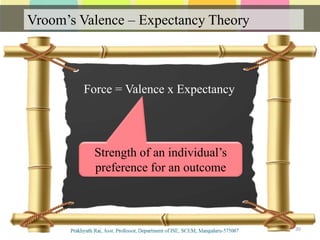
Force = Valence x Expectancy
Strength of an individual’s
preference for an outcome
Vroom’s Valence – Expectancy Theory
Communication
31
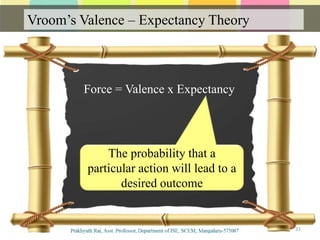
Force = Valence x Expectancy
The probability that a
particular action will lead to a
desired outcome
Porter and Lawler – Model of Motivation
Communication
32
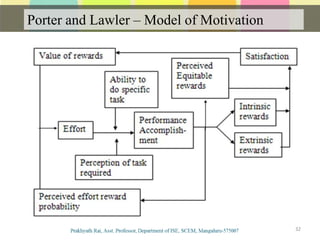
Porter and Lawler – Model of Motivation
Communication
33
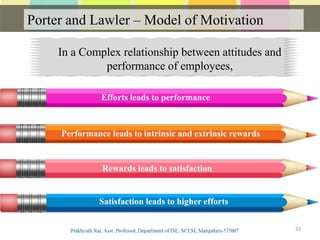
Efforts leads to performance
Performance leads to intrinsic and extrinsic rewards
Rewards leads to satisfaction
Satisfaction leads to higher efforts
In a Complex relationship between attitudes and
performance of employees,
Communication
Communication
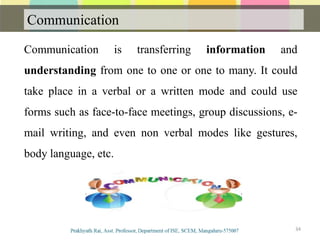
Communication is transferring information and
understanding from one to one or one to many. It could
take place in a verbal or a written mode and could use
forms such as face-to-face meetings, group discussions, e-
mail writing, and even non verbal modes like gestures,
body language, etc.
34
#
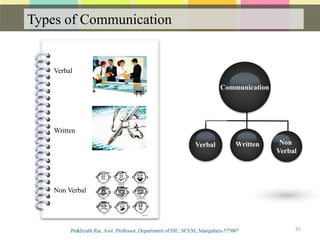
Verbal Written Non
Verbal
Communication
Verbal
Written
Non Verbal
Types of Communication
35
Importance of Communication
Communication
36
7
6
5
4
3
2
1
Communication is not just about speaking,
its also about listening, reading, writing etc.
The importance of communication can be
elaborate as follows:
Importance of Communication
Communication
37
7
6
5
4
3
2
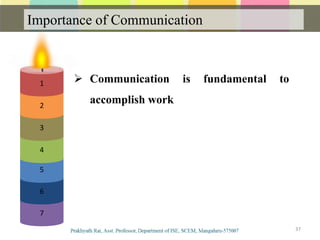
1  Communication is fundamental to
accomplish work
Importance of Communication
Communication
38
7
6
5
4
3
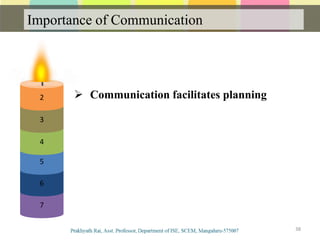
2  Communication facilitates planning
Importance of Communication
Communication
39
7
6
5
4
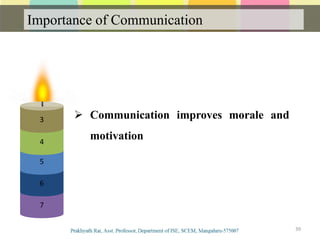
3  Communication improves morale and
motivation
Importance of Communication
Communication
40
7
6
5
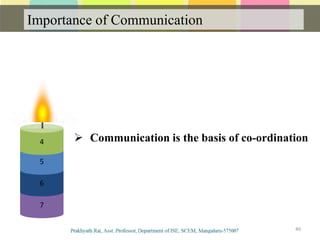
4  Communication is the basis of co-ordination
Importance of Communication
Communication
41
7
6
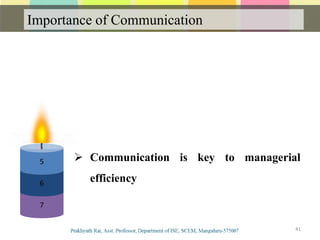
5  Communication is key to managerial
efficiency
Importance of Communication
Communication
42
7
6  Communication helps in decision making
Importance of Communication
Communication
43
7  Communication improves relationships
Co-ordination
44
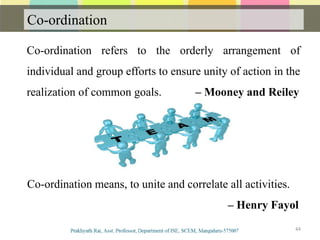
Co-ordination refers to the orderly arrangement of
individual and group efforts to ensure unity of action in the
realization of common goals. – Mooney and Reiley
Co-ordination means, to unite and correlate all activities.
– Henry Fayol
Features of Co-ordination
Communication
45
 Co-ordination implies deliberate actions on the part of
managers to bring about harmony and unity of actions.
 Co-ordination applies to group efforts, and not to individual
effort. It involves the orderly arrangement of group efforts.
 Co-ordination does not result in a one-shot action. It is
continuous action.
 Co-ordination is all pervasive.
 Co-ordination is necessary not only within organization but
also of the organization with the outside environment.
Importance of Co-ordination
Communication
46
6
5
4
3
2
1  Co-ordination increases efficiency
Importance of Co-ordination
Communication
47
6
5
4
3
2  Co-ordination makes all departments
focus together
Importance of Co-ordination
Communication
48
6
5
4
3  Co-ordination helps sharing of resources
Importance of Co-ordination
Communication
49
6
5
4  Co-ordination improves human relations
Importance of Co-ordination
Communication
50
6
5  Co-ordination resolves conflicts
Importance of Co-ordination
Communication
51
6  Co-ordination retains and attracts talent
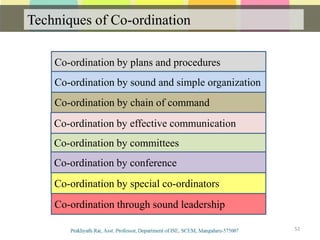
Techniques of Co-ordination
52
Co-ordination by plans and procedures
Co-ordination by chain of command
Co-ordination by committees
Co-ordination by effective communication
Co-ordination by sound and simple organization
Co-ordination by conference
Co-ordination by special co-ordinators
Co-ordination through sound leadership
Controlling
53
Control consists in verifying whether everything occurs in
conformity with the plans, instructions and principles
established. – Henry Fayol
Control is checking current performance against pre-
determined standards contained in the plans, in order to
ensure adequate progress and satisfactory performance.
– E F L Brech
Features of Controlling
54
 Controlling is a positive force.
 Controlling is a dynamic and continuous process.
 Controlling is goal-oriented.
 Controlling is forward looking.
 Control process is universal.
 Control is based on planning.
 Delegation is key to control.
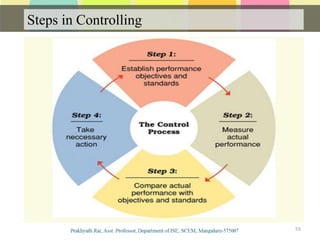
Steps in Controlling
55
Steps in Controlling
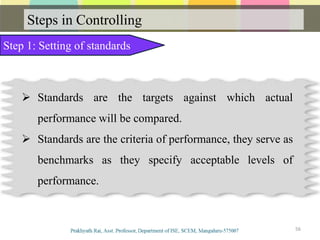
Step 1: Setting of standards
Communication
 Standards are the targets against which actual
performance will be compared.
 Standards are the criteria of performance, they serve as
benchmarks as they specify acceptable levels of
performance.
56
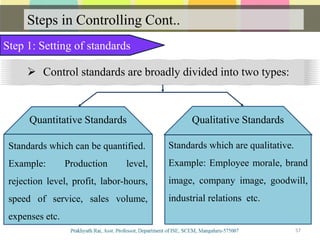
Steps in Controlling Cont..
Step 1: Setting of standards
Standards which can be quantified.
Example: Production level,
rejection level, profit, labor-hours,
speed of service, sales volume,
expenses etc.
Standards which are qualitative.
Example: Employee morale, brand
image, company image, goodwill,
industrial relations etc.
Quantitative Standards Qualitative Standards
 Control standards are broadly divided into two types:
57
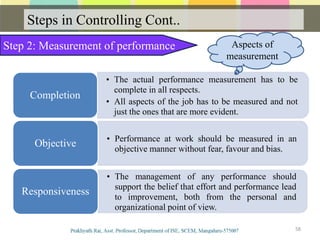
Steps in Controlling Cont..
58
Step 2: Measurement of performance
• The actual performance measurement has to be
complete in all respects.
• All aspects of the job has to be measured and not
just the ones that are more evident.
Completion
• Performance at work should be measured in an
objective manner without fear, favour and bias.
Objective
• The management of any performance should
support the belief that effort and performance lead
to improvement, both from the personal and
organizational point of view.
Responsiveness
Aspects of
measurement
Steps in Controlling Cont..
59
Step 3: Comparison of actual performance with standards
 The third step in control process is to compare the actual
performances with established standards and
ascertaining the causes of deviation.
 Deviations are thoroughly analyzed and properly
presented.
 Statistical methods are usually adopted to look at
deviation from a border perspective.
Steps in Controlling Cont..
60
Step 4: Taking corrective measures
 The final step in control process consists of taking
remedial actions so that deviation may not occur again in
future.
 Corrective steps are initiated so that any defects in the
actual performance may be rectified.
Steps in Controlling Cont..
61
Step 4: Taking corrective measures
 Corrective actions may include the following activities:
 Change in methods, rules, procedures, strategies etc.
 Introduce training programs.
 Job redesign or Replacement of personnel.
 Re-establishing budgets and standards.
 Better compensation packages to employees.
 Changing machinery and processes.
 Identifying recurring bottle necks and avoiding them.
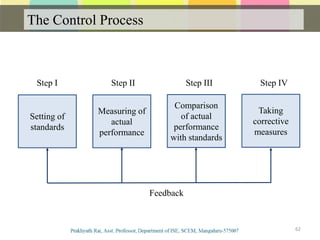
The Control Process
62
Comparison
of actual
performance
with standards
Measuring of
actual
performance
Setting of
standards
Taking
corrective
measures
Step I Step II Step III Step IV
Feedback
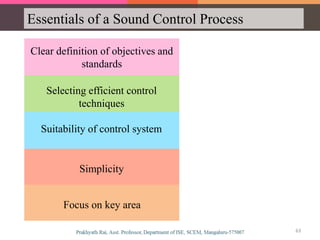
Essentials of a Sound Control Process
Clear definition of objectives and
standards
Suitability of control system
Selecting efficient control
techniques
Simplicity
Focus on key area
63
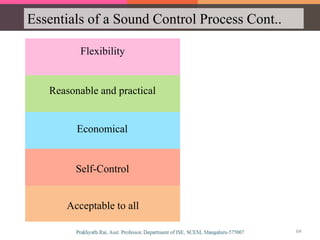
Essentials of a Sound Control Process Cont..
Flexibility
Economical
Reasonable and practical
Self-Control
Acceptable to all
64
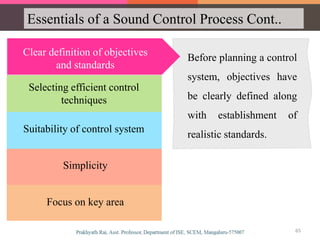
Essentials of a Sound Control Process Cont..
Clear definition of objectives and
standards
Suitability of control system
Selecting efficient control
techniques
Simplicity
Focus on key area
Before planning a control
system, objectives have
be clearly defined along
with establishment of
realistic standards.
Clear definition of objectives
and standards
65
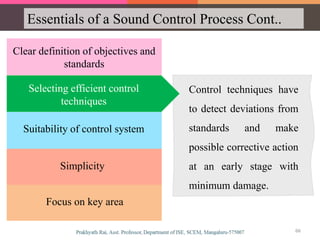
Essentials of a Sound Control Process Cont..
Clear definition of objectives and
standards
Suitability of control system
Selecting efficient control
techniques
Simplicity
Focus on key area
Control techniques have
to detect deviations from
standards and make
possible corrective action
at an early stage with
minimum damage.
Selecting efficient control
techniques
66
Essentials of a Sound Control Process Cont..
Clear definition of objectives and
standards
Suitability of control system
Selecting efficient control
techniques
Simplicity
Focus on key area
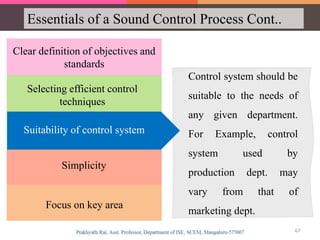
Control system should be
suitable to the needs of
any given department.
For Example, control
system used by
production dept. may
vary from that of
marketing dept.
Suitability of control system
67
Essentials of a Sound Control Process Cont..
Clear definition of objectives and
standards
Suitability of control system
Selecting efficient control
techniques
Simplicity
Focus on key area
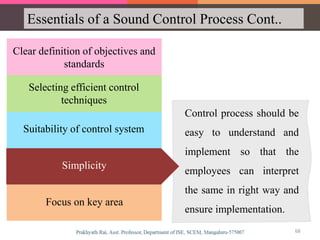
Control process should be
easy to understand and
implement so that the
employees can interpret
the same in right way and
ensure implementation.
Simplicity
68
Essentials of a Sound Control Process Cont..
Clear definition of objectives and
standards
Suitability of control system
Selecting efficient control
techniques
Simplicity
Focus on key area
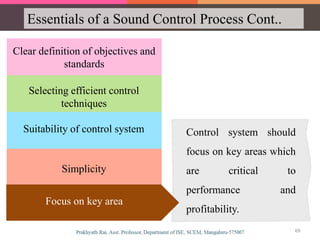
Control system should
focus on key areas which
are critical to
performance and
profitability.
Focus on key area
69
Essentials of a Sound Control Process Cont..
Flexibility
Economical
Reasonable and practical
Self-Control
Acceptable to all
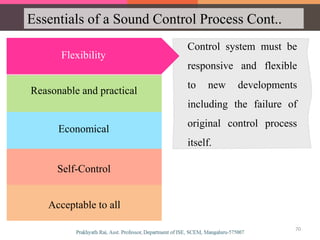
Control system must be
responsive and flexible
to new developments
including the failure of
original control process
itself.
Flexibility
70
Essentials of a Sound Control Process Cont..
Flexibility
Economical
Reasonable and practical
Self-Control
Acceptable to all
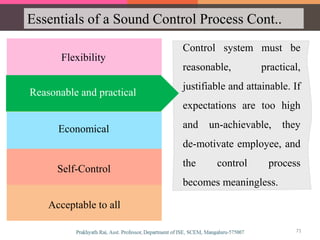
Control system must be
reasonable, practical,
justifiable and attainable. If
expectations are too high
and un-achievable, they
de-motivate employee, and
the control process
becomes meaningless.
Reasonable and practical
71
Essentials of a Sound Control Process Cont..
Flexibility
Economical
Reasonable and practical
Self-Control
Acceptable to all
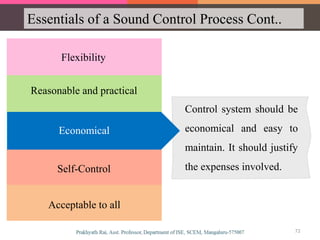
Control system should be
economical and easy to
maintain. It should justify
the expenses involved.
Economical
72
Essentials of a Sound Control Process Cont..
Flexibility
Economical
Reasonable and practical
Self-Control
Acceptable to all
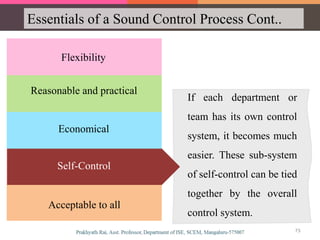
If each department or
team has its own control
system, it becomes much
easier. These sub-system
of self-control can be tied
together by the overall
control system.
Self-Control
73
Essentials of a Sound Control Process Cont..
Flexibility
Economical
Reasonable and practical
Self-Control
Acceptable to all
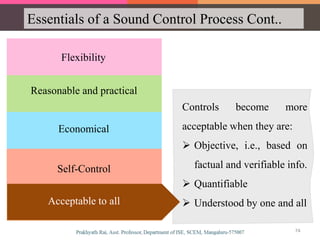
Controls become more
acceptable when they are:
 Objective, i.e., based on
factual and verifiable info.
 Quantifiable
 Understood by one and allAcceptable to all
74
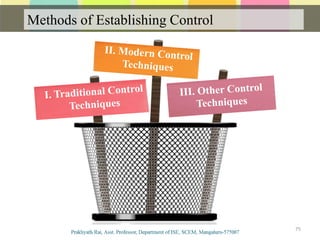
Methods of Establishing Control
Communication
75
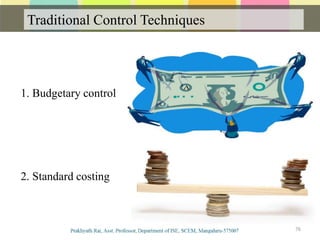
Traditional Control Techniques
Communication
76
1. Budgetary control
2. Standard costing
Budgetary Control
77
 Budgets are nothing but written plans or programs of
the future activities expressed in monetary terms.
 Budgetary control is used to control the costs through
continuous appraisals of actual expenditures as against
planned costs expressed in a budget.
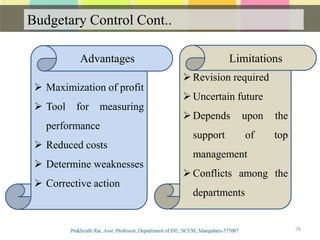
Budgetary Control Cont..
78
 Maximization of profit
 Tool for measuring
performance
 Reduced costs
 Determine weaknesses
 Corrective action
Revision required
Uncertain future
Depends upon the
support of top
management
Conflicts among the
departments
Advantages Limitations
Standard Costing
79
 Standard costing is a method of estimating the right
cost or the most efficient cost of manufacturing a
product.
 Standard costing is an important activity to determine
the efficiency of cost controlling in an industry.
Modern Control Techniques
Communication
1. Break-even analysis.
2. PERT - Program Evaluation Review Technique
3. CPM - Critical Path Method
4. SQC - Statistical Quality Control
5. Internal audit
6. MIS - Management Information System
7. Quality circles
80
Break-Even Analysis
81
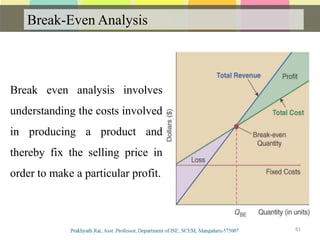
Break even analysis involves
understanding the costs involved
in producing a product and
thereby fix the selling price in
order to make a particular profit.
Break-Even Analysis Cont..
82
Break even analysis is used:
 To find the effect of varying selling price upon profit.
 To find the effect of fixed costs and variable cost upon
profit.
 To find the minimum production required to break-even
i.e., no loss-no profit.
 To compare two or more products with respect to their
profitability and cost of production.
 To find what quantity of production leads to what costs.
PERT – Program Evaluation Review Technique
83
 In PERT activities are shown as a network of
precedence relationships using activity-on-arrow
network construction
 Multiple time estimates
 Probabilistic activity times
 Used in: Project management - for non-repetitive jobs
(research and development work), where the time and
cost estimates tend to be quite uncertain. This
technique uses probabilistic time estimates.
CPM – Critical Path Method
84
 In CPM activities are shown as a network of
precedence relationships using activity-on-node
network construction
 Single estimate of activity time
 Deterministic activity times
 Used in : Production management - for the jobs of
repetitive in nature where the activity time estimates
can be predicted with considerable certainty due to the
existence of past experience.
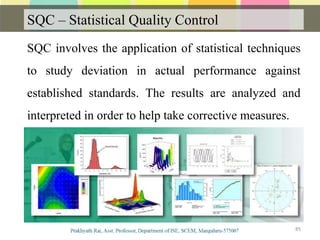
SQC – Statistical Quality Control
85
SQC involves the application of statistical techniques
to study deviation in actual performance against
established standards. The results are analyzed and
interpreted in order to help take corrective measures.
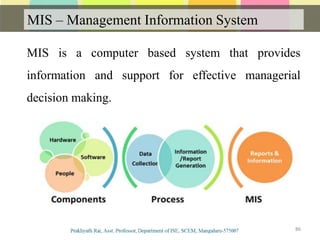
MIS – Management Information System
86
MIS is a computer based system that provides
information and support for effective managerial
decision making.
Internal Audit
87
 An audit is a systematic and impartial examination,
analysis and appraisal of management’s overall
performance.
 It is an independent and critical evaluation of the entire
management process.
 An audit may be undertaken by the management itself
or it may be carried out with the help of management
consultants.
Quality Circles
88
A quality circle is a small group of employees who
meet periodically to identify, analyze and solve quality
and other work related problems in their area of
operation.
Other Control Techniques
Communication
1. Policies and procedures
2. Standing rules, limitation and orders
3. Self-control
4. Group control
5. Personal observations or MBWA
6. Disciplinary action
89
Policies
Communication
 Policies are guidelines set up by the company for
managerial decision making.
 ‘A policy is a verbal, written or implied overall guide
setting up boundaries that supply the general limits and
directions in which managerial actions will take place’.
 For Example,
 Policy of recruiting only MBA’s from top 10 institutes.
 Policy of promotion of in-house employees.
 Policy on selling goods only for cash and not credit.
90
Procedures
Communication
 Procedures are action guidelines which specify how
particular activity has to take place.
 Procedures provide chronological step-by-step
sequence of required actions in order to achieve a
certain goal or policy.
 A procedure lays down the manner and method by
which work is to be performed in a standard or uniform
way.
91
Standing Rules, Limitation and Orders
Communication
92
 These act as important control devices. When sub -ordinates
are given freedom to make certain decisions on behalf of
superiors, it beomes necessary to lay down limits for them.
 Standing orders are those which apply to every one in the
organization and which are helpful in having
discipline.
 For Example: No smoking, No walking on the lawn etc.
Self Control
Communication
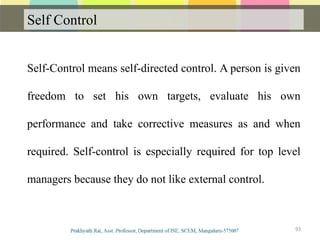
Self-Control means self-directed control. A person is given
freedom to set his own targets, evaluate his own
performance and take corrective measures as and when
required. Self-control is especially required for top level
managers because they do not like external control.
93
Group Control
Communication
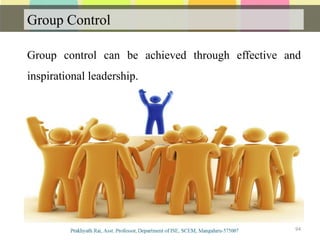
Group control can be achieved through effective and
inspirational leadership.
94
Personal Observations or MBWA
Communication
 MBWA refers to a controlling techniques in which a
manager spends a significant amount of his time
regularly in the work area, and interacts directly with
employees.
 Managing by walking around requires, personal
involvement, good listening skills, and the recognition
that most people in an organization want to contribute
to its success.
95
Disciplinary Action
Communication
 Disciplinary action is a negative approach to
controlling function but nevertheless necessary.
 Disciplinary action becomes effective when the
employees controlled are unskilled, rustic, brash, and
unweilding.
96
PERT and CPM Network Scheduling Problem
97
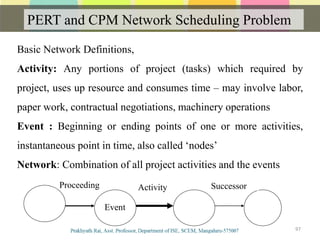
Basic Network Definitions,
Activity: Any portions of project (tasks) which required by
project, uses up resource and consumes time – may involve labor,
paper work, contractual negotiations, machinery operations
Event : Beginning or ending points of one or more activities,
instantaneous point in time, also called ‘nodes’
Network: Combination of all project activities and the events
ActivityProceeding Successor
Event
Scheduling Activity: Problem 1
98
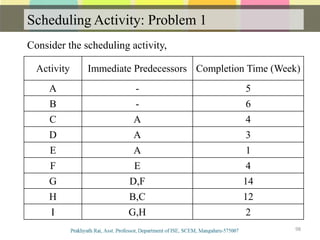
Consider the scheduling activity,
Activity Immediate Predecessors Completion Time (Week)
A - 5
B - 6
C A 4
D A 3
E A 1
F E 4
G D,F 14
H B,C 12
I G,H 2
Calculation of ES and EF Time (Problem 1)
99
 Starting at the network’s origin (node 1) and using a
starting time of 0, we compute an earliest start (ES)
and earliest finish (EF) time for each activity in the
network.
 The expression EF = ES + t can be used to find
the earliest finish time for a given activity.
For example, for activity A, ES = 0 and t = 5; thus the
earliest finish time for activity A is, EF = 0 + 5 = 5
Arc with ES and EF Time (Problem 1)
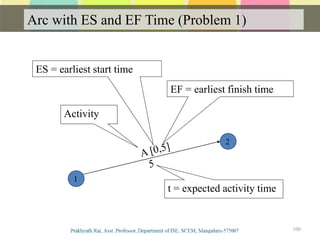
100
1
2
Activity
ES = earliest start time
EF = earliest finish time
t = expected activity time
Network with ES and EF time (Problem 1)
101
1
3
4
2
5
7
6
D[5,8]
3
Earliest start time rule: The earliest start time for an
activity leaving a particular node is equal to the largest of
the earliest finish times for all activities entering the node.
Calculation of LS and LF (Problem 1)
102
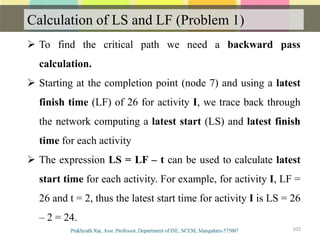
 To find the critical path we need a backward pass
calculation.
 Starting at the completion point (node 7) and using a latest
finish time (LF) of 26 for activity I, we trace back through
the network computing a latest start (LS) and latest finish
time for each activity
 The expression LS = LF – t can be used to calculate latest
start time for each activity. For example, for activity I, LF =
26 and t = 2, thus the latest start time for activity I is LS = 26
– 2 = 24.
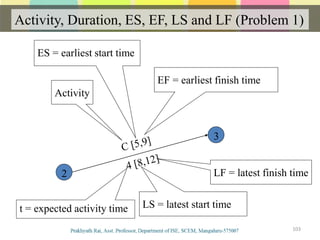
Activity, Duration, ES, EF, LS and LF (Problem 1)
103
2
3
Activity
ES = earliest start time
EF = earliest finish time
LF = latest finish time
LS = latest start timet = expected activity time
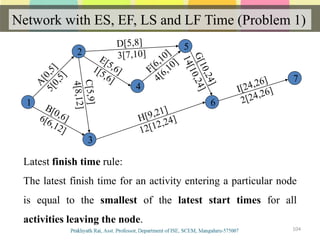
Network with ES, EF, LS and LF Time (Problem 1)
104
1
3
4
2
5
7
6
Latest finish time rule:
The latest finish time for an activity entering a particular node
is equal to the smallest of the latest start times for all
activities leaving the node.
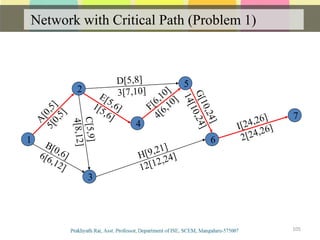
Network with Critical Path (Problem 1)
105
1
3
4
2
5
7
6
Slack or Free Time or Float (Problem 1)
106
ES
5
LS
8
EF
9
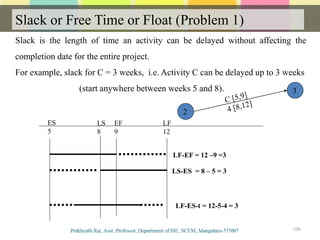
LF-EF = 12 –9 =3
LS-ES = 8 – 5 = 3
LF-ES-t = 12-5-4 = 3
LF
12
2
3
Slack is the length of time an activity can be delayed without affecting the
completion date for the entire project.
For example, slack for C = 3 weeks, i.e. Activity C can be delayed up to 3 weeks
(start anywhere between weeks 5 and 8).
Activity Schedule (Problem 1)
107
Activity Earliest
Start
(ES)
Latest
Start
(LS)
Earliest
Finish
(EF)
Latest
Finish
(LF)
Slack
(LS-ES)
Critical
Path
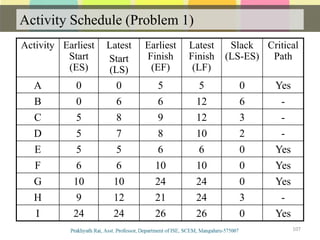
A 0 0 5 5 0 Yes
B 0 6 6 12 6 -
C 5 8 9 12 3 -
D 5 7 8 10 2 -
E 5 5 6 6 0 Yes
F 6 6 10 10 0 Yes
G 10 10 24 24 0 Yes
H 9 12 21 24 3 -
I 24 24 26 26 0 Yes
Scheduling Activity: Problem 2
108
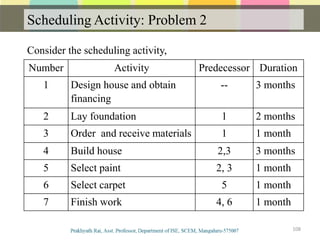
Consider the scheduling activity,
Number Activity Predecessor Duration
1 Design house and obtain
financing
-- 3 months
2 Lay foundation 1 2 months
3 Order and receive materials 1 1 month
4 Build house 2,3 3 months
5 Select paint 2, 3 1 month
6 Select carpet 5 1 month
7 Finish work 4, 6 1 month
Scheduling Activity (Problem 2)
109
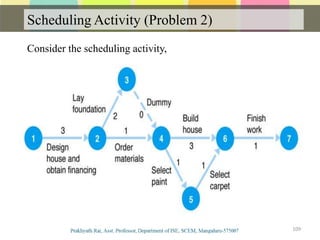
Consider the scheduling activity,
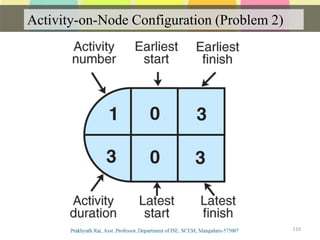
Activity-on-Node Configuration (Problem 2)
110
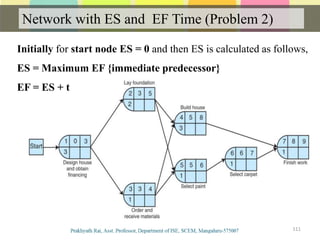
Network with ES and EF Time (Problem 2)
111
Initially for start node ES = 0 and then ES is calculated as follows,
ES = Maximum EF {immediate predecessor}
EF = ES + t
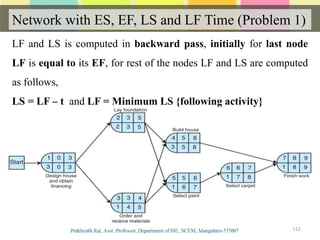
Network with ES, EF, LS and LF Time (Problem 1)
112
LF and LS is computed in backward pass, initially for last node
LF is equal to its EF, for rest of the nodes LF and LS are computed
as follows,
LS = LF – t and LF = Minimum LS {following activity}
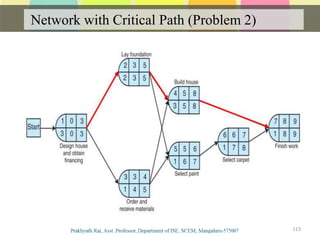
Network with Critical Path (Problem 2)
113
Activity Schedule (Problem 2)
114
Activity Latest
Start
(ES)
Earliest
Start
(LS)
Latest
Finish
(EF)
Earliest
Finish
(LF)
Slack
(LS-ES)
Critical
Path
1 0 0 3 3 0 Yes
2 3 3 5 5 0 Yes
3 4 3 5 4 1 -
4 5 5 8 8 0 Yes
5 6 5 7 6 1 -
6 7 6 8 7 1 -
7 8 8 9 9 0 Yes
115
Thank You

Directing and Controlling

  • 1.
    Directing and Controlling PresentedBy: Prakhyath Rai Asst. Professor, Dept. of ISE, SCEM, Mangaluru-575007 1
  • 2.
  • 3.
  • 4.
    Directing is abouttelling people what to do and seeing that they do it to the best of their ability. Directing 4
  • 5.
    Directing as aFunction of Management Components of Directing Communication Leadership Supervision Motivation Supervision Supervision is directing efforts of employees and other resources to accomplish stated work outputs. Motivation Motivation is something that moves the person to action, and continues him in the course of action already initiated / about to be initiated. Leadership Guiding, advising and helping sub- ordinates towards accomplishment of work. Communication Communication is the transfer of information from one person to another by transmitting ideas, facts, thoughts, feelings & values. In its absence, organisation would cease to exist. 5
  • 6.
    Nature and Featuresof Directing Communication  Directing involves human factor  Directing is a continuous process  Direction provides link  Directing concentrates on performance  Directing is all pervasive 6
  • 7.
    The activity ofleading a group of people or an organization or the ability to do this. Leadership 7
  • 8.
    Leadership Styles Communication  Autocraticor Authoritative Style  Democratic or Participative Style  Laissez-faire or Free-rein Style 8
  • 9.
    Autocratic or AuthoritativeStyle Communication 9 The authoritarian leadership style keeps main emphasis on the distinction of the authoritarian leader and their followers.
  • 10.
    Democratic or ParticipativeStyle Communication 10 The democratic leadership style consists of the leader sharing the decision- making abilities with group members by promoting the interests of the group members and by practicing social equality..
  • 11.
    Laissez-Faire or Free-ReinStyle Communication 11 The laissez-faire leadership style is where all the rights and power to make decisions is fully given to the worker.
  • 12.
  • 13.
    Motivation Communication 13  Motivation isthe process of attempting to influence others to do your work through the possibility of gain or reward. - Edwin B. Flippo  Motivation means a process of stimulating people to action to accomplish desired goals. - Scott  Motivation is a general term applying to the entire class of drives, desires, needs, wishes and similar forces that induces an individual or a group of people to work. – Koontz and O’Donnel
  • 14.
  • 15.
    Theories of HumanMotivation Communication  Maslow’s Hierarchyof Needs Theory  Herzberg’s Motivation – Hygiene Theory  McGregor’s Theory X and Theory Y  McClelland’s Three Need Model  Vroom’s Valence – Expectancy Theory  Porter and Lawler – Model of Motivation 15
  • 16.
    Maslow’s Hierarchy ofNeeds Theory Communication 16 Self Actualization Esteem Needs Social Needs Safety Needs Physiological Needs
  • 17.
    Maslow’s Hierarchy ofNeeds Theory Communication 17 Self Actualization Esteem Needs Social Needs Safety Needs Physiological Needs Includes self-advancement, self-fulfilment, self-development, self-realization etc.,
  • 18.
    Maslow’s Hierarchy ofNeeds Theory Communication 18 Self Actualization Esteem Needs Social Needs Safety Needs Physiological Needs Includes self-respect, autonomy, status, recognition, responsibility, attention, achievement, prestige etc.,
  • 19.
    Maslow’s Hierarchy ofNeeds Theory Communication 19 Self Actualization Esteem Needs Social Needs Safety Needs Physiological Needs Includes affection, belongingness, acceptance and friendship.
  • 20.
    Maslow’s Hierarchy ofNeeds Theory Communication 20 Self Actualization Esteem Needs Social Needs Safety Needs Physiological Needs Includes Security and protection from physical, emotional and economical harm.
  • 21.
    Maslow’s Hierarchy ofNeeds Theory Communication 21 Self Actualization Esteem Needs Social Needs Safety Needs Physiological Needs Includes Food, shelter, clothing, water, sleep, love and other bodily needs.
  • 22.
    Herzberg’s Motivation –Hygiene Theory Communication 22
  • 23.
    Herzberg’s Motivation –Hygiene Theory Communication 23  Company policy and administration  Supervision  Working Conditions  Salary and status  Security in job and personal life  Interpersonal relationships.  Challenging works  Responsibility  Recognition  Promotion opportunities  Achievement  Job content Hygiene factors Motivators
  • 24.
    Comparison of Theoriesof Maslow and Herzberg Communication 24
  • 25.
    According to TheoryY,  People are active, like to work and take up responsibilities. They are ambitious and work voluntarily if properly motivated. According to Theory X,  People are lazy, dislike work and responsibilities. They are not ambitious and have to be threatened with punishment to extract work. McGregor’s Theory X and Theory Y 25
  • 26.
    Theory X vsTheory Y Communication 26 Force = Valence x Expectancy
  • 27.
    McClelland’s Three NeedModel Communication 27
  • 28.
    Vroom’s Valence –Expectancy Theory Communication 28 Force = Valence x Expectancy
  • 29.
    Vroom’s Valence –Expectancy Theory Communication 29 Force = Valence x Expectancy Strength of a person’s motivation
  • 30.
    Vroom’s Valence –Expectancy Theory Communication 30 Force = Valence x Expectancy Strength of an individual’s preference for an outcome
  • 31.
    Vroom’s Valence –Expectancy Theory Communication 31 Force = Valence x Expectancy The probability that a particular action will lead to a desired outcome
  • 32.
    Porter and Lawler– Model of Motivation Communication 32
  • 33.
    Porter and Lawler– Model of Motivation Communication 33 Efforts leads to performance Performance leads to intrinsic and extrinsic rewards Rewards leads to satisfaction Satisfaction leads to higher efforts In a Complex relationship between attitudes and performance of employees,
  • 34.
    Communication Communication Communication is transferringinformation and understanding from one to one or one to many. It could take place in a verbal or a written mode and could use forms such as face-to-face meetings, group discussions, e- mail writing, and even non verbal modes like gestures, body language, etc. 34
  • 35.
  • 36.
    Importance of Communication Communication 36 7 6 5 4 3 2 1 Communicationis not just about speaking, its also about listening, reading, writing etc. The importance of communication can be elaborate as follows:
  • 37.
    Importance of Communication Communication 37 7 6 5 4 3 2 1 Communication is fundamental to accomplish work
  • 38.
    Importance of Communication Communication 38 7 6 5 4 3 2 Communication facilitates planning
  • 39.
    Importance of Communication Communication 39 7 6 5 4 3 Communication improves morale and motivation
  • 40.
    Importance of Communication Communication 40 7 6 5 4 Communication is the basis of co-ordination
  • 41.
    Importance of Communication Communication 41 7 6 5 Communication is key to managerial efficiency
  • 42.
    Importance of Communication Communication 42 7 6 Communication helps in decision making
  • 43.
    Importance of Communication Communication 43 7 Communication improves relationships
  • 44.
    Co-ordination 44 Co-ordination refers tothe orderly arrangement of individual and group efforts to ensure unity of action in the realization of common goals. – Mooney and Reiley Co-ordination means, to unite and correlate all activities. – Henry Fayol
  • 45.
    Features of Co-ordination Communication 45 Co-ordination implies deliberate actions on the part of managers to bring about harmony and unity of actions.  Co-ordination applies to group efforts, and not to individual effort. It involves the orderly arrangement of group efforts.  Co-ordination does not result in a one-shot action. It is continuous action.  Co-ordination is all pervasive.  Co-ordination is necessary not only within organization but also of the organization with the outside environment.
  • 46.
    Importance of Co-ordination Communication 46 6 5 4 3 2 1 Co-ordination increases efficiency
  • 47.
    Importance of Co-ordination Communication 47 6 5 4 3 2 Co-ordination makes all departments focus together
  • 48.
    Importance of Co-ordination Communication 48 6 5 4 3 Co-ordination helps sharing of resources
  • 49.
    Importance of Co-ordination Communication 49 6 5 4 Co-ordination improves human relations
  • 50.
    Importance of Co-ordination Communication 50 6 5 Co-ordination resolves conflicts
  • 51.
    Importance of Co-ordination Communication 51 6 Co-ordination retains and attracts talent
  • 52.
    Techniques of Co-ordination 52 Co-ordinationby plans and procedures Co-ordination by chain of command Co-ordination by committees Co-ordination by effective communication Co-ordination by sound and simple organization Co-ordination by conference Co-ordination by special co-ordinators Co-ordination through sound leadership
  • 53.
    Controlling 53 Control consists inverifying whether everything occurs in conformity with the plans, instructions and principles established. – Henry Fayol Control is checking current performance against pre- determined standards contained in the plans, in order to ensure adequate progress and satisfactory performance. – E F L Brech
  • 54.
    Features of Controlling 54 Controlling is a positive force.  Controlling is a dynamic and continuous process.  Controlling is goal-oriented.  Controlling is forward looking.  Control process is universal.  Control is based on planning.  Delegation is key to control.
  • 55.
  • 56.
    Steps in Controlling Step1: Setting of standards Communication  Standards are the targets against which actual performance will be compared.  Standards are the criteria of performance, they serve as benchmarks as they specify acceptable levels of performance. 56
  • 57.
    Steps in ControllingCont.. Step 1: Setting of standards Standards which can be quantified. Example: Production level, rejection level, profit, labor-hours, speed of service, sales volume, expenses etc. Standards which are qualitative. Example: Employee morale, brand image, company image, goodwill, industrial relations etc. Quantitative Standards Qualitative Standards  Control standards are broadly divided into two types: 57
  • 58.
    Steps in ControllingCont.. 58 Step 2: Measurement of performance • The actual performance measurement has to be complete in all respects. • All aspects of the job has to be measured and not just the ones that are more evident. Completion • Performance at work should be measured in an objective manner without fear, favour and bias. Objective • The management of any performance should support the belief that effort and performance lead to improvement, both from the personal and organizational point of view. Responsiveness Aspects of measurement
  • 59.
    Steps in ControllingCont.. 59 Step 3: Comparison of actual performance with standards  The third step in control process is to compare the actual performances with established standards and ascertaining the causes of deviation.  Deviations are thoroughly analyzed and properly presented.  Statistical methods are usually adopted to look at deviation from a border perspective.
  • 60.
    Steps in ControllingCont.. 60 Step 4: Taking corrective measures  The final step in control process consists of taking remedial actions so that deviation may not occur again in future.  Corrective steps are initiated so that any defects in the actual performance may be rectified.
  • 61.
    Steps in ControllingCont.. 61 Step 4: Taking corrective measures  Corrective actions may include the following activities:  Change in methods, rules, procedures, strategies etc.  Introduce training programs.  Job redesign or Replacement of personnel.  Re-establishing budgets and standards.  Better compensation packages to employees.  Changing machinery and processes.  Identifying recurring bottle necks and avoiding them.
  • 62.
    The Control Process 62 Comparison ofactual performance with standards Measuring of actual performance Setting of standards Taking corrective measures Step I Step II Step III Step IV Feedback
  • 63.
    Essentials of aSound Control Process Clear definition of objectives and standards Suitability of control system Selecting efficient control techniques Simplicity Focus on key area 63
  • 64.
    Essentials of aSound Control Process Cont.. Flexibility Economical Reasonable and practical Self-Control Acceptable to all 64
  • 65.
    Essentials of aSound Control Process Cont.. Clear definition of objectives and standards Suitability of control system Selecting efficient control techniques Simplicity Focus on key area Before planning a control system, objectives have be clearly defined along with establishment of realistic standards. Clear definition of objectives and standards 65
  • 66.
    Essentials of aSound Control Process Cont.. Clear definition of objectives and standards Suitability of control system Selecting efficient control techniques Simplicity Focus on key area Control techniques have to detect deviations from standards and make possible corrective action at an early stage with minimum damage. Selecting efficient control techniques 66
  • 67.
    Essentials of aSound Control Process Cont.. Clear definition of objectives and standards Suitability of control system Selecting efficient control techniques Simplicity Focus on key area Control system should be suitable to the needs of any given department. For Example, control system used by production dept. may vary from that of marketing dept. Suitability of control system 67
  • 68.
    Essentials of aSound Control Process Cont.. Clear definition of objectives and standards Suitability of control system Selecting efficient control techniques Simplicity Focus on key area Control process should be easy to understand and implement so that the employees can interpret the same in right way and ensure implementation. Simplicity 68
  • 69.
    Essentials of aSound Control Process Cont.. Clear definition of objectives and standards Suitability of control system Selecting efficient control techniques Simplicity Focus on key area Control system should focus on key areas which are critical to performance and profitability. Focus on key area 69
  • 70.
    Essentials of aSound Control Process Cont.. Flexibility Economical Reasonable and practical Self-Control Acceptable to all Control system must be responsive and flexible to new developments including the failure of original control process itself. Flexibility 70
  • 71.
    Essentials of aSound Control Process Cont.. Flexibility Economical Reasonable and practical Self-Control Acceptable to all Control system must be reasonable, practical, justifiable and attainable. If expectations are too high and un-achievable, they de-motivate employee, and the control process becomes meaningless. Reasonable and practical 71
  • 72.
    Essentials of aSound Control Process Cont.. Flexibility Economical Reasonable and practical Self-Control Acceptable to all Control system should be economical and easy to maintain. It should justify the expenses involved. Economical 72
  • 73.
    Essentials of aSound Control Process Cont.. Flexibility Economical Reasonable and practical Self-Control Acceptable to all If each department or team has its own control system, it becomes much easier. These sub-system of self-control can be tied together by the overall control system. Self-Control 73
  • 74.
    Essentials of aSound Control Process Cont.. Flexibility Economical Reasonable and practical Self-Control Acceptable to all Controls become more acceptable when they are:  Objective, i.e., based on factual and verifiable info.  Quantifiable  Understood by one and allAcceptable to all 74
  • 75.
    Methods of EstablishingControl Communication 75
  • 76.
    Traditional Control Techniques Communication 76 1.Budgetary control 2. Standard costing
  • 77.
    Budgetary Control 77  Budgetsare nothing but written plans or programs of the future activities expressed in monetary terms.  Budgetary control is used to control the costs through continuous appraisals of actual expenditures as against planned costs expressed in a budget.
  • 78.
    Budgetary Control Cont.. 78 Maximization of profit  Tool for measuring performance  Reduced costs  Determine weaknesses  Corrective action Revision required Uncertain future Depends upon the support of top management Conflicts among the departments Advantages Limitations
  • 79.
    Standard Costing 79  Standardcosting is a method of estimating the right cost or the most efficient cost of manufacturing a product.  Standard costing is an important activity to determine the efficiency of cost controlling in an industry.
  • 80.
    Modern Control Techniques Communication 1.Break-even analysis. 2. PERT - Program Evaluation Review Technique 3. CPM - Critical Path Method 4. SQC - Statistical Quality Control 5. Internal audit 6. MIS - Management Information System 7. Quality circles 80
  • 81.
    Break-Even Analysis 81 Break evenanalysis involves understanding the costs involved in producing a product and thereby fix the selling price in order to make a particular profit.
  • 82.
    Break-Even Analysis Cont.. 82 Breakeven analysis is used:  To find the effect of varying selling price upon profit.  To find the effect of fixed costs and variable cost upon profit.  To find the minimum production required to break-even i.e., no loss-no profit.  To compare two or more products with respect to their profitability and cost of production.  To find what quantity of production leads to what costs.
  • 83.
    PERT – ProgramEvaluation Review Technique 83  In PERT activities are shown as a network of precedence relationships using activity-on-arrow network construction  Multiple time estimates  Probabilistic activity times  Used in: Project management - for non-repetitive jobs (research and development work), where the time and cost estimates tend to be quite uncertain. This technique uses probabilistic time estimates.
  • 84.
    CPM – CriticalPath Method 84  In CPM activities are shown as a network of precedence relationships using activity-on-node network construction  Single estimate of activity time  Deterministic activity times  Used in : Production management - for the jobs of repetitive in nature where the activity time estimates can be predicted with considerable certainty due to the existence of past experience.
  • 85.
    SQC – StatisticalQuality Control 85 SQC involves the application of statistical techniques to study deviation in actual performance against established standards. The results are analyzed and interpreted in order to help take corrective measures.
  • 86.
    MIS – ManagementInformation System 86 MIS is a computer based system that provides information and support for effective managerial decision making.
  • 87.
    Internal Audit 87  Anaudit is a systematic and impartial examination, analysis and appraisal of management’s overall performance.  It is an independent and critical evaluation of the entire management process.  An audit may be undertaken by the management itself or it may be carried out with the help of management consultants.
  • 88.
    Quality Circles 88 A qualitycircle is a small group of employees who meet periodically to identify, analyze and solve quality and other work related problems in their area of operation.
  • 89.
    Other Control Techniques Communication 1.Policies and procedures 2. Standing rules, limitation and orders 3. Self-control 4. Group control 5. Personal observations or MBWA 6. Disciplinary action 89
  • 90.
    Policies Communication  Policies areguidelines set up by the company for managerial decision making.  ‘A policy is a verbal, written or implied overall guide setting up boundaries that supply the general limits and directions in which managerial actions will take place’.  For Example,  Policy of recruiting only MBA’s from top 10 institutes.  Policy of promotion of in-house employees.  Policy on selling goods only for cash and not credit. 90
  • 91.
    Procedures Communication  Procedures areaction guidelines which specify how particular activity has to take place.  Procedures provide chronological step-by-step sequence of required actions in order to achieve a certain goal or policy.  A procedure lays down the manner and method by which work is to be performed in a standard or uniform way. 91
  • 92.
    Standing Rules, Limitationand Orders Communication 92  These act as important control devices. When sub -ordinates are given freedom to make certain decisions on behalf of superiors, it beomes necessary to lay down limits for them.  Standing orders are those which apply to every one in the organization and which are helpful in having discipline.  For Example: No smoking, No walking on the lawn etc.
  • 93.
    Self Control Communication Self-Control meansself-directed control. A person is given freedom to set his own targets, evaluate his own performance and take corrective measures as and when required. Self-control is especially required for top level managers because they do not like external control. 93
  • 94.
    Group Control Communication Group controlcan be achieved through effective and inspirational leadership. 94
  • 95.
    Personal Observations orMBWA Communication  MBWA refers to a controlling techniques in which a manager spends a significant amount of his time regularly in the work area, and interacts directly with employees.  Managing by walking around requires, personal involvement, good listening skills, and the recognition that most people in an organization want to contribute to its success. 95
  • 96.
    Disciplinary Action Communication  Disciplinaryaction is a negative approach to controlling function but nevertheless necessary.  Disciplinary action becomes effective when the employees controlled are unskilled, rustic, brash, and unweilding. 96
  • 97.
    PERT and CPMNetwork Scheduling Problem 97 Basic Network Definitions, Activity: Any portions of project (tasks) which required by project, uses up resource and consumes time – may involve labor, paper work, contractual negotiations, machinery operations Event : Beginning or ending points of one or more activities, instantaneous point in time, also called ‘nodes’ Network: Combination of all project activities and the events ActivityProceeding Successor Event
  • 98.
    Scheduling Activity: Problem1 98 Consider the scheduling activity, Activity Immediate Predecessors Completion Time (Week) A - 5 B - 6 C A 4 D A 3 E A 1 F E 4 G D,F 14 H B,C 12 I G,H 2
  • 99.
    Calculation of ESand EF Time (Problem 1) 99  Starting at the network’s origin (node 1) and using a starting time of 0, we compute an earliest start (ES) and earliest finish (EF) time for each activity in the network.  The expression EF = ES + t can be used to find the earliest finish time for a given activity. For example, for activity A, ES = 0 and t = 5; thus the earliest finish time for activity A is, EF = 0 + 5 = 5
  • 100.
    Arc with ESand EF Time (Problem 1) 100 1 2 Activity ES = earliest start time EF = earliest finish time t = expected activity time
  • 101.
    Network with ESand EF time (Problem 1) 101 1 3 4 2 5 7 6 D[5,8] 3 Earliest start time rule: The earliest start time for an activity leaving a particular node is equal to the largest of the earliest finish times for all activities entering the node.
  • 102.
    Calculation of LSand LF (Problem 1) 102  To find the critical path we need a backward pass calculation.  Starting at the completion point (node 7) and using a latest finish time (LF) of 26 for activity I, we trace back through the network computing a latest start (LS) and latest finish time for each activity  The expression LS = LF – t can be used to calculate latest start time for each activity. For example, for activity I, LF = 26 and t = 2, thus the latest start time for activity I is LS = 26 – 2 = 24.
  • 103.
    Activity, Duration, ES,EF, LS and LF (Problem 1) 103 2 3 Activity ES = earliest start time EF = earliest finish time LF = latest finish time LS = latest start timet = expected activity time
  • 104.
    Network with ES,EF, LS and LF Time (Problem 1) 104 1 3 4 2 5 7 6 Latest finish time rule: The latest finish time for an activity entering a particular node is equal to the smallest of the latest start times for all activities leaving the node.
  • 105.
    Network with CriticalPath (Problem 1) 105 1 3 4 2 5 7 6
  • 106.
    Slack or FreeTime or Float (Problem 1) 106 ES 5 LS 8 EF 9 LF-EF = 12 –9 =3 LS-ES = 8 – 5 = 3 LF-ES-t = 12-5-4 = 3 LF 12 2 3 Slack is the length of time an activity can be delayed without affecting the completion date for the entire project. For example, slack for C = 3 weeks, i.e. Activity C can be delayed up to 3 weeks (start anywhere between weeks 5 and 8).
  • 107.
    Activity Schedule (Problem1) 107 Activity Earliest Start (ES) Latest Start (LS) Earliest Finish (EF) Latest Finish (LF) Slack (LS-ES) Critical Path A 0 0 5 5 0 Yes B 0 6 6 12 6 - C 5 8 9 12 3 - D 5 7 8 10 2 - E 5 5 6 6 0 Yes F 6 6 10 10 0 Yes G 10 10 24 24 0 Yes H 9 12 21 24 3 - I 24 24 26 26 0 Yes
  • 108.
    Scheduling Activity: Problem2 108 Consider the scheduling activity, Number Activity Predecessor Duration 1 Design house and obtain financing -- 3 months 2 Lay foundation 1 2 months 3 Order and receive materials 1 1 month 4 Build house 2,3 3 months 5 Select paint 2, 3 1 month 6 Select carpet 5 1 month 7 Finish work 4, 6 1 month
  • 109.
    Scheduling Activity (Problem2) 109 Consider the scheduling activity,
  • 110.
  • 111.
    Network with ESand EF Time (Problem 2) 111 Initially for start node ES = 0 and then ES is calculated as follows, ES = Maximum EF {immediate predecessor} EF = ES + t
  • 112.
    Network with ES,EF, LS and LF Time (Problem 1) 112 LF and LS is computed in backward pass, initially for last node LF is equal to its EF, for rest of the nodes LF and LS are computed as follows, LS = LF – t and LF = Minimum LS {following activity}
  • 113.
    Network with CriticalPath (Problem 2) 113
  • 114.
    Activity Schedule (Problem2) 114 Activity Latest Start (ES) Earliest Start (LS) Latest Finish (EF) Earliest Finish (LF) Slack (LS-ES) Critical Path 1 0 0 3 3 0 Yes 2 3 3 5 5 0 Yes 3 4 3 5 4 1 - 4 5 5 8 8 0 Yes 5 6 5 7 6 1 - 6 7 6 8 7 1 - 7 8 8 9 9 0 Yes
  • 115.