Prof. Preeti Bhaskar
Symbiosis Centre for Management Studies, Noida
1
Controlling
• Meaning
• Importance
• Steps in the process of control
• Relationship between Planning and controlling
2
Controlling
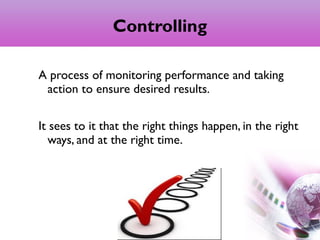
A process of monitoring performance and taking
action to ensure desired results.
It sees to it that the right things happen, in the right
ways, and at the right time.
3
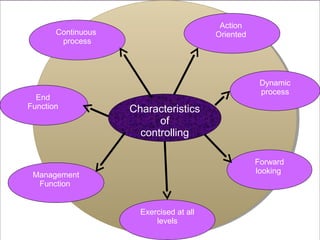
Characteristics
of
controlling
End
Function
Continuous
process
Dynamic
process
Action
Oriented
Forward
looking
Exercised at all
levels
Management
Function
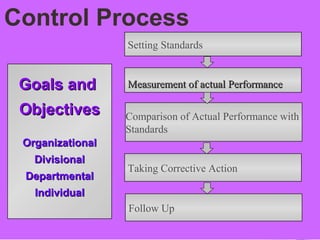
Goals andGoals and
ObjectivesObjectives
OrganizationalOrganizational
DivisionalDivisional
DepartmentalDepartmental
IndividualIndividual
Setting Standards
Measurement of actual PerformanceMeasurement of actual Performance
Taking Corrective Action
Control Process
Comparison of Actual Performance with
Standards
Follow Up
6
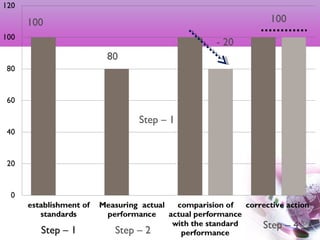
100
80
- 20
100
Step – 1
Step – 2 Step – 4
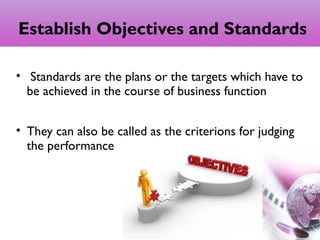
Establish Objectives and Standards
• Standards are the plans or the targets which have to
be achieved in the course of business function
• They can also be called as the criterions for judging
the performance
7
Cont.…
 Standards generally are classified into two-:
• Measurable or tangible - Those standards which can be
measured and expressed are called as measurable
standards.They can be in form of cost, output,
expenditure, time, profit, etc.
• Non-measurable or intangible- There are standards
which cannot be measured monetarily. For example-
performance of a manager, deviation of workers, their
attitudes towards a concern.These are called as in
tangible standards.
8
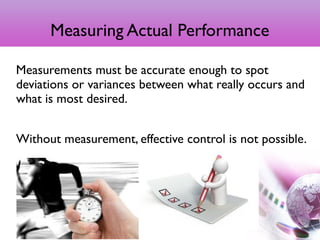
Measuring Actual Performance
Measurements must be accurate enough to spot
deviations or variances between what really occurs and
what is most desired.
Without measurement, effective control is not possible.
9
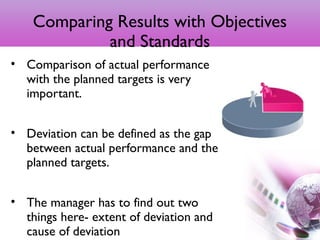
Comparing Results with Objectives
and Standards
• Comparison of actual performance
with the planned targets is very
important.
• Deviation can be defined as the gap
between actual performance and the
planned targets.
• The manager has to find out two
things here- extent of deviation and
cause of deviation 10
For example, if stationery charges increase by a minor
5 to 10%, it can be called as a minor deviation.
On the other hand, if monthly production decreases
continuously, it is called as major deviation.
11
Cont…
Once the deviation is identified, a manager has
to think about various cause which
has led to deviation.The causes can be-
• Erroneous planning,
• Co-ordination loosens,
• Implementation of plans is defective, and
• Supervision and communication is ineffective,
etc.
12
Taking Corrective Action
Once the causes and extent of deviations are known, the manager has
to detect those errors and take remedial measures for it.There are
two alternatives here-
1. Taking corrective measures for deviations which have occurred;
2. After taking the corrective measures, if the actual performance is not
in conformity with plans, the manager can revise the targets. It is here
the controlling process comes to an end.
Follow up is an important step because it is only
through taking corrective measures, a manager
can exercise controlling.
13
Relationship between planning
and controlling
Planning and controlling are two separate fuctions of
management, yet they are closely related.
Without the basis of planning, controlling activities
becomes baseless and without controlling, planning
becomes a meaningless exercise.
In absence of controlling, no purpose can be served
by.Therefore, planning and controlling reinforce each
other
14
Cont.
According to Billy Goetz, " Relationship between the two can be
summarized in the following points:
•Planning precedes controlling and controlling succeeds planning.
•Planning and controlling are inseparable functions of
management.
•Activities are put on rails by planning and they are kept at right
place through controlling.
•The process of planning and controlling works on Systems
Approach which is as follows
:Planning         Results         Corrective Action→ →
•Planning and controlling are integral parts of an organization as
both are important for smooth running of an enterprise.
•Planning and controlling reinforce each other. Each drives the
other function of management.
16

Unit 7 controlling

  • 1.
    Prof. Preeti Bhaskar SymbiosisCentre for Management Studies, Noida 1
  • 2.
    Controlling • Meaning • Importance •Steps in the process of control • Relationship between Planning and controlling 2
  • 3.
    Controlling A process ofmonitoring performance and taking action to ensure desired results. It sees to it that the right things happen, in the right ways, and at the right time. 3
  • 4.
  • 5.
    Goals andGoals and ObjectivesObjectives OrganizationalOrganizational DivisionalDivisional DepartmentalDepartmental IndividualIndividual SettingStandards Measurement of actual PerformanceMeasurement of actual Performance Taking Corrective Action Control Process Comparison of Actual Performance with Standards Follow Up
  • 6.
    6 100 80 - 20 100 Step –1 Step – 2 Step – 4
  • 7.
    Establish Objectives andStandards • Standards are the plans or the targets which have to be achieved in the course of business function • They can also be called as the criterions for judging the performance 7
  • 8.
    Cont.…  Standards generally areclassified into two-: • Measurable or tangible - Those standards which can be measured and expressed are called as measurable standards.They can be in form of cost, output, expenditure, time, profit, etc. • Non-measurable or intangible- There are standards which cannot be measured monetarily. For example- performance of a manager, deviation of workers, their attitudes towards a concern.These are called as in tangible standards. 8
  • 9.
    Measuring Actual Performance Measurementsmust be accurate enough to spot deviations or variances between what really occurs and what is most desired. Without measurement, effective control is not possible. 9
  • 10.
    Comparing Results withObjectives and Standards • Comparison of actual performance with the planned targets is very important. • Deviation can be defined as the gap between actual performance and the planned targets. • The manager has to find out two things here- extent of deviation and cause of deviation 10
  • 11.
    For example, ifstationery charges increase by a minor 5 to 10%, it can be called as a minor deviation. On the other hand, if monthly production decreases continuously, it is called as major deviation. 11
  • 12.
    Cont… Once the deviationis identified, a manager has to think about various cause which has led to deviation.The causes can be- • Erroneous planning, • Co-ordination loosens, • Implementation of plans is defective, and • Supervision and communication is ineffective, etc. 12
  • 13.
    Taking Corrective Action Oncethe causes and extent of deviations are known, the manager has to detect those errors and take remedial measures for it.There are two alternatives here- 1. Taking corrective measures for deviations which have occurred; 2. After taking the corrective measures, if the actual performance is not in conformity with plans, the manager can revise the targets. It is here the controlling process comes to an end. Follow up is an important step because it is only through taking corrective measures, a manager can exercise controlling. 13
  • 14.
    Relationship between planning andcontrolling Planning and controlling are two separate fuctions of management, yet they are closely related. Without the basis of planning, controlling activities becomes baseless and without controlling, planning becomes a meaningless exercise. In absence of controlling, no purpose can be served by.Therefore, planning and controlling reinforce each other 14
  • 15.
    Cont. According to BillyGoetz, " Relationship between the two can be summarized in the following points: •Planning precedes controlling and controlling succeeds planning. •Planning and controlling are inseparable functions of management. •Activities are put on rails by planning and they are kept at right place through controlling. •The process of planning and controlling works on Systems Approach which is as follows :Planning         Results         Corrective Action→ → •Planning and controlling are integral parts of an organization as both are important for smooth running of an enterprise. •Planning and controlling reinforce each other. Each drives the other function of management.
  • 16.

Editor's Notes

  • #6 6 6 As mentioned in Chapter 1, every organization attempts to effectively and efficiently reach its goals. Therefore, the organization will want to have goals and objectives that are at several levels in the organization so that performance can be measured, compared to the standard established, and take the appropriate corrective action.