Chapter 9:
Project Communications
      Management
       adopted from PMI’s PMBOK 2000 and
Textbook : Information Technology Project Management


                                                       1
Contents
• Importance of Good Communications
• Project Communications Management Processes
   – Communications planning (planning phase)
   – Information distribution (executing phase)
   – Performance reporting (control phase)
   – Administrative closure (control phase)
• Creating a stakeholder analysis


                      Chapter 9                   2
Importance of Good Communications
• The greatest threat to many projects is a failure to
  communicate
   – Our culture does not portray IT professionals as being good
     communicators
   – Research shows that IT professionals must be able to communicate
     effectively to succeed in their positions
   – Strong verbal skills are a key factor in career advancement for IT
     professionals
• covering processes to ensure timely development,
  collection, disseminations, storage, and disposition of
  project information.
   – major output is the communications management plan.

                                Chapter 9                            3
Project Communications
         Management Processes
• There are 4 processes in Project Communications
  Management
   – Communications planning (planning)
      • determining the information and communications needs of
        the stakeholders
   – Information distribution (execution)
      • making needed information available in a timely manner
   – Performance reporting (control)
      • collecting and disseminating performance information
   – Administrative closure (closing)
      • generating, gathering, and disseminating information to
        formalize phase or project completion
                                                                  4
Communications Planning
• 14th of 21 planning phase process
• incorporates all planning required to ensure
  timely and appreciate development, collection,
  dissemination, storage, and disposition of project
  information.
• Every project should include some type of
  communications management plan, a document
  that guides project communications
• Creating a stakeholder analysis for project
  communications also aids in communications
  planning              Chapter 9                      5
Inputs to Communications
              Planning
• Communications requirement
   – include who needs what type of information, when they need the
     information, how to distribute the information (i.e. who, what,
     when how)
• Communications technology
   – methods and tools used to transfer information among
     stakeholders
   – face-to-face conversation, knowledge repository database, on-line
     schedules, email, video-conference, voice mail, stream video,
     newsletters and web sites.
• Constraints
   – restriction that affect the performance of the project.
• Assumptions
   – factors that for planning purposes                                6
Tools and techniques
• Stakeholder analysis
  – provides the methods and techniques to
    determine a systematic and logical view of the
    information requirements of stakeholders, and
    how to meet those needs.


                                                     7
Outputs from Communications
               Planning
•   Communications management plan (CMP)
    – An evolving document and a subsidiary component of the project plan,
      the CMP describes how to handle all communication on the project
    – It can be formal or informal, detailed or high-level, depending on the
      needs of the project.
•   CMP Contents
    – A description of a collection and filing structure for gathering and
      storing various types of information
    – A distribution structure describing what information goes to whom,
      when, and how
    – A format for communicating key project information
    – A project schedule for producing the information
    – Access methods for obtaining the information
    – A method for updating the communications management plans as the
      project progresses and develops
                                                                               8
Information Distribution
• 4th of 7 executing phase process
• involves making information that stakeholders
  need on a timely basis
   – Getting the right information to the right people at the
     right time and in a useful format is just as important
     as developing the information in the first place
• By properly executing the communications
  management plan
   – using the information retrieval and distribution tools
   – responding to unexpected requests for information
   – ensure all stakeholders have the information they
     need.                 Chapter 9                            9
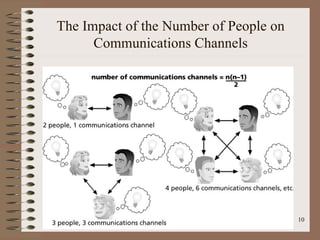
The Impact of the Number of People on
      Communications Channels


                                        10
Inputs to Information
             Distribution
• Work results
   – results of activities performed to accomplish the
     project. Information on work results – completed and
     incomplete scheduled assignments and deliverables,
     actual and committed budget cost, how QA standards
     map to the result….
• Communications management plan (CMP)
   – describe all communication on the project is handled.
• Project plan
   – formal, approved document used to guide project
     execution and control.
                                                             11
Tools and techniques
• Communications skills
   – skills involving information exchanges. They are also part of the
     general management skills.
• Information retrieval system
   – tools in information distribution process
       • simple paper files, bound notebook, or they can be stored
         electronically as files or in a database
   – Retrieval systems are either filing system or software.
       • Commercial products such as Lotus Notes and Microsoft SharePoint
         are examples of applications software.
• Info distribution methods
   – distribution system (tools) include project meetings,
     correspondence, databases stored in a data warehouse, and video
     or audio conferences.
                                                                         12
Outputs from Information
            Distribution
• Project records
   – organized for easy access
       • includes correspondence, documents, and memos
   – Team will keep their own personal records for their assigned
     areas
   – Their personal records are often more detailed than the official
     project records.
• Project reports
   – formal reports on status and issues
• Project presentations
   – describe how the reports and records are presented to
     stakeholders
   – formal or informal. A great deal of a project manager’s job
                                                                        13
Performance Reporting
• 6th of 8 controlling phase process
   – collecting and distributing information to stakeholders on how
     the project is performing
• Performance reporting keeps stakeholders informed about
  how resources are being used to achieve project
  objectives
   – This process involves progress reports, status reports, and
     forecasts.
   – Status reports describe where the project stands at a specific
     point in time
   – Progress reports describe what the project team has accomplished
     during a certain period of time
   – Project forecasting predicts future project status and progress
     based on past information and trends
   – Status review meetings often include performance reporting
                                 Chapter 9                           14
Inputs to Performance Reporting
• Project plan
   – formal, approved document used to guide project execution and
     control.
   – includes subsidiary plans such as the communications plan, risk
     management plan, and quality plan. The plan sets a baseline to
     measure progress.
• Work result
   – results of activities performed to accomplish the project.
     Information on work results – completed and incomplete
     scheduled assignments and deliverables, actual and committed
     budget cost, how QA standards map to the result….
• Other project records
   – other documents such as blueprints, technical documents, or
     specifications documents.
                                                                       15
Tools and techniques
• Performance reviews
   – project meetings are held to evaluate status and progress.
• Variance analysis
   – compares results to planned results. Generally, the analysis is
     cost- and schedule-related.
• Trend analysis
   – examines project results over the dimension of time to see if
     pattern show performance improvement or deterioration.
• Earned value analysis
   – Integrates scope, cost and schedule measures. It compares actual
     results to planned result. Calculations are based on three key
     measures: Planned value, Actual cost, Earned value.
• Info distribution tools & techniques
   – includes all the tools and technique mentioned in Information      16
     distribution process.
Outputs from Performance
           Reporting
• Performance reports
  – contain organized and summarized results of project
    reports, correspondence, documents, and memos
  – If possible, use charts and graphs to summarize
    information
  – Some key documents are status report, progress
    report, trend report and forecast report.
• Change requests
  – ask for modifications to some deliverable or objective
  – These formal documents can also involve changes to
    a contract, even include contract termination.
                                                             17
Administrative Closure
• 1st of 2 closing phase process
• A project or phase of a project requires closure
   – closing the administrative functions takes place at the
     end of the project.
   – Because projects are temporary, project closure
     briefings and lessons-learned documents provide
     important feedback
   – They keep valuable knowledge inside the organization
     and contribute to improvements in the next cycle of
     project.

                           Chapter 9                       18
Inputs to Administrative Closure
• Performance measurements documents
   – includes all the performance-related documents used to guide,
     record, and analyze project planning, execution and control
   – Other documents such as status, progress, and forecast report
• Product documentation
   – show result of activities performed to create the product or
     service that the project was chartered to achieve
   – These include plans, technical documents, design documents,
     specifications, blueprints, drawings, and electronic files.
• Other project records
   – other related documents

                                                                     19
Tools and techniques
• Performance reporting tools and techniques
   – provide a feedback loop, solving the information needs of the
     various stakeholders and showing the interaction of all the tools
     used during the Performance Reporting phase just described.
   – Tools and techniques include performance reviews, variance
     analysis, trend analysis, and earned value analysis.
• Project reports
   – formal reports on status and issues
• Project presentations
   – describe how the reports and records are presented to
     stakeholders.
   – It can be formal or informal
   – A great deal of a project manager’s job involves doing this
     stakeholder presentation.                                           20
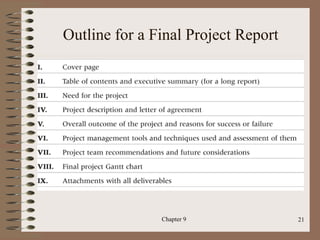
Outline for a Final Project Report


               Chapter 9             21
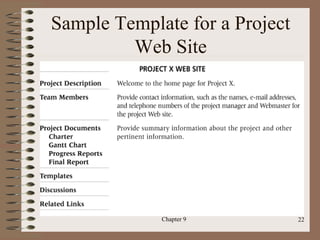
Sample Template for a Project
         Web Site


             Chapter 9          22
Outputs from Administrative
             Closure
• Project archives
   – this is the long-term storage of all project activity records
   – The information should be complete and indexed for easy
     retrieval.
• Formal acceptance
   – confirms by customer by formally accepts the completion of the
     project
       • all requirements have been fulfilled
   – These require may include staff performance reviews,
     budget/cost reports, and lessons-learned documents.
• Lessons learned
   – includes detailed information on how common and usual project
     events were resolved.
   – part of the organization’s knowledge base so the information can23
     be applied to future projects.
Suggestions for Improving Project
            Communications
•   Manage conflicts effectively
•   Develop better communication skills
•   Run effective meetings
•   Use templates for project communications


                      Chapter 9                24
Conflict Handling Modes, In Preference
                Order
• Problem-solving
   – also known as confrontation
   – directly face a conflict and resolve it at once
• Compromise
   – use a give-and-take approach
• Smoothing
   – de-emphasize areas of differences and emphasize areas of
     agreement
• Forcing
   – the win-lose approach
• Withdrawal
   – retreat or withdraw from an actual or potential disagreement
                                 Chapter 9                          25
Benefits of Problem-solving
• Problem solving often produces important
  results, such as new ideas, better
  alternatives, and motivation to work harder
  and more collaboratively
• Research by Karen Jehn suggests
  – task-related conflict often improves team
    performance
  – emotional conflict often depresses team
    performance
                       Chapter 9                26
Developing Better
        Communication Skills
• Companies and formal degree programs for IT
  professionals often neglect the importance of
  developing speaking, writing, and listening skills
• As organizations become more global, they
  realize they must invest in ways to improve
  communication with people from different
  countries and cultures
• It takes leadership to improve communication

                        Chapter 9                      27
Running Effective Meetings
• Determine if a meeting can be avoided
• Define the purpose and intended outcome of the
  meeting
• Determine who should attend the meeting
• Provide an agenda to participants before the
  meeting
• Prepare handouts, visual aids, and make logistical
  arrangements ahead of time
• Run the meeting professionally
• Build relationships
                        Chapter 9                  28
Developing a Communications
              Infrastructure
• A communications infrastructure is a set of tools,
  techniques, and principles that provide a foundation for
  the effective transfer of information
   – Tools include e-mail, project management software, groupware,
     fax machines, telephones, teleconferencing systems, document
     management systems, and word processors
   – Techniques include reporting guidelines and templates, meeting
     ground rules and procedures, decision-making processes,
     problem-solving approaches, and conflict resolution and
     negotiation techniques
   – Principles include using open dialog and an agreed upon work
     ethic

                               Chapter 9                              29
Using Software to Assist in Project
          Communications
• There are many software tools to aid in
  project communications
• The What Went Right? example describes
  several new web-based and wireless
  communications tools
• Microsoft Project 2000 includes several
  features to enhance communications

                   Chapter 9                30
Summary
• Importance of Good Communications
   – lack of good communications is one of the biggest threats to
     many project
   – strong verbal skill is a key factor
• Project Communications Management Processes
   – Communications planning:determining the information and
     communications needs of the stakeholders
   – Information distribution: making needed information available in
     a timely manner
   – Performance reporting: collecting and disseminating
     performance information
   – Administrative closure: generating, gathering, and disseminating
     information to formalize phase or project completion
                               Chapter 9                            31
Summary (2)
• Creating a stakeholder analysis
• Suggestions for Improving Project Communications
     – Manage conflicts effectively
     – Develop better communication skills
     – Run effective meetings
     – Use templates for project communications
•   Developing a Communications Infrastructure
     – Tools: e-mail, project management software,
       groupware, fax machines, telephones
     – Techniques: reporting guidelines and templates,
       meeting ground rules and procedures
     – Principles: open dialog and work ethic
                                Chapter 9                32

Project management communication

  • 1.
    Chapter 9: Project Communications Management adopted from PMI’s PMBOK 2000 and Textbook : Information Technology Project Management 1
  • 2.
    Contents • Importance ofGood Communications • Project Communications Management Processes – Communications planning (planning phase) – Information distribution (executing phase) – Performance reporting (control phase) – Administrative closure (control phase) • Creating a stakeholder analysis Chapter 9 2
  • 3.
    Importance of GoodCommunications • The greatest threat to many projects is a failure to communicate – Our culture does not portray IT professionals as being good communicators – Research shows that IT professionals must be able to communicate effectively to succeed in their positions – Strong verbal skills are a key factor in career advancement for IT professionals • covering processes to ensure timely development, collection, disseminations, storage, and disposition of project information. – major output is the communications management plan. Chapter 9 3
  • 4.
    Project Communications Management Processes • There are 4 processes in Project Communications Management – Communications planning (planning) • determining the information and communications needs of the stakeholders – Information distribution (execution) • making needed information available in a timely manner – Performance reporting (control) • collecting and disseminating performance information – Administrative closure (closing) • generating, gathering, and disseminating information to formalize phase or project completion 4
  • 5.
    Communications Planning • 14thof 21 planning phase process • incorporates all planning required to ensure timely and appreciate development, collection, dissemination, storage, and disposition of project information. • Every project should include some type of communications management plan, a document that guides project communications • Creating a stakeholder analysis for project communications also aids in communications planning Chapter 9 5
  • 6.
    Inputs to Communications Planning • Communications requirement – include who needs what type of information, when they need the information, how to distribute the information (i.e. who, what, when how) • Communications technology – methods and tools used to transfer information among stakeholders – face-to-face conversation, knowledge repository database, on-line schedules, email, video-conference, voice mail, stream video, newsletters and web sites. • Constraints – restriction that affect the performance of the project. • Assumptions – factors that for planning purposes 6
  • 7.
    Tools and techniques •Stakeholder analysis – provides the methods and techniques to determine a systematic and logical view of the information requirements of stakeholders, and how to meet those needs. 7
  • 8.
    Outputs from Communications Planning • Communications management plan (CMP) – An evolving document and a subsidiary component of the project plan, the CMP describes how to handle all communication on the project – It can be formal or informal, detailed or high-level, depending on the needs of the project. • CMP Contents – A description of a collection and filing structure for gathering and storing various types of information – A distribution structure describing what information goes to whom, when, and how – A format for communicating key project information – A project schedule for producing the information – Access methods for obtaining the information – A method for updating the communications management plans as the project progresses and develops 8
  • 9.
    Information Distribution • 4thof 7 executing phase process • involves making information that stakeholders need on a timely basis – Getting the right information to the right people at the right time and in a useful format is just as important as developing the information in the first place • By properly executing the communications management plan – using the information retrieval and distribution tools – responding to unexpected requests for information – ensure all stakeholders have the information they need. Chapter 9 9
  • 10.
    The Impact ofthe Number of People on Communications Channels 10
  • 11.
    Inputs to Information Distribution • Work results – results of activities performed to accomplish the project. Information on work results – completed and incomplete scheduled assignments and deliverables, actual and committed budget cost, how QA standards map to the result…. • Communications management plan (CMP) – describe all communication on the project is handled. • Project plan – formal, approved document used to guide project execution and control. 11
  • 12.
    Tools and techniques •Communications skills – skills involving information exchanges. They are also part of the general management skills. • Information retrieval system – tools in information distribution process • simple paper files, bound notebook, or they can be stored electronically as files or in a database – Retrieval systems are either filing system or software. • Commercial products such as Lotus Notes and Microsoft SharePoint are examples of applications software. • Info distribution methods – distribution system (tools) include project meetings, correspondence, databases stored in a data warehouse, and video or audio conferences. 12
  • 13.
    Outputs from Information Distribution • Project records – organized for easy access • includes correspondence, documents, and memos – Team will keep their own personal records for their assigned areas – Their personal records are often more detailed than the official project records. • Project reports – formal reports on status and issues • Project presentations – describe how the reports and records are presented to stakeholders – formal or informal. A great deal of a project manager’s job 13
  • 14.
    Performance Reporting • 6thof 8 controlling phase process – collecting and distributing information to stakeholders on how the project is performing • Performance reporting keeps stakeholders informed about how resources are being used to achieve project objectives – This process involves progress reports, status reports, and forecasts. – Status reports describe where the project stands at a specific point in time – Progress reports describe what the project team has accomplished during a certain period of time – Project forecasting predicts future project status and progress based on past information and trends – Status review meetings often include performance reporting Chapter 9 14
  • 15.
    Inputs to PerformanceReporting • Project plan – formal, approved document used to guide project execution and control. – includes subsidiary plans such as the communications plan, risk management plan, and quality plan. The plan sets a baseline to measure progress. • Work result – results of activities performed to accomplish the project. Information on work results – completed and incomplete scheduled assignments and deliverables, actual and committed budget cost, how QA standards map to the result…. • Other project records – other documents such as blueprints, technical documents, or specifications documents. 15
  • 16.
    Tools and techniques •Performance reviews – project meetings are held to evaluate status and progress. • Variance analysis – compares results to planned results. Generally, the analysis is cost- and schedule-related. • Trend analysis – examines project results over the dimension of time to see if pattern show performance improvement or deterioration. • Earned value analysis – Integrates scope, cost and schedule measures. It compares actual results to planned result. Calculations are based on three key measures: Planned value, Actual cost, Earned value. • Info distribution tools & techniques – includes all the tools and technique mentioned in Information 16 distribution process.
  • 17.
    Outputs from Performance Reporting • Performance reports – contain organized and summarized results of project reports, correspondence, documents, and memos – If possible, use charts and graphs to summarize information – Some key documents are status report, progress report, trend report and forecast report. • Change requests – ask for modifications to some deliverable or objective – These formal documents can also involve changes to a contract, even include contract termination. 17
  • 18.
    Administrative Closure • 1stof 2 closing phase process • A project or phase of a project requires closure – closing the administrative functions takes place at the end of the project. – Because projects are temporary, project closure briefings and lessons-learned documents provide important feedback – They keep valuable knowledge inside the organization and contribute to improvements in the next cycle of project. Chapter 9 18
  • 19.
    Inputs to AdministrativeClosure • Performance measurements documents – includes all the performance-related documents used to guide, record, and analyze project planning, execution and control – Other documents such as status, progress, and forecast report • Product documentation – show result of activities performed to create the product or service that the project was chartered to achieve – These include plans, technical documents, design documents, specifications, blueprints, drawings, and electronic files. • Other project records – other related documents 19
  • 20.
    Tools and techniques •Performance reporting tools and techniques – provide a feedback loop, solving the information needs of the various stakeholders and showing the interaction of all the tools used during the Performance Reporting phase just described. – Tools and techniques include performance reviews, variance analysis, trend analysis, and earned value analysis. • Project reports – formal reports on status and issues • Project presentations – describe how the reports and records are presented to stakeholders. – It can be formal or informal – A great deal of a project manager’s job involves doing this stakeholder presentation. 20
  • 21.
    Outline for aFinal Project Report Chapter 9 21
  • 22.
    Sample Template fora Project Web Site Chapter 9 22
  • 23.
    Outputs from Administrative Closure • Project archives – this is the long-term storage of all project activity records – The information should be complete and indexed for easy retrieval. • Formal acceptance – confirms by customer by formally accepts the completion of the project • all requirements have been fulfilled – These require may include staff performance reviews, budget/cost reports, and lessons-learned documents. • Lessons learned – includes detailed information on how common and usual project events were resolved. – part of the organization’s knowledge base so the information can23 be applied to future projects.
  • 24.
    Suggestions for ImprovingProject Communications • Manage conflicts effectively • Develop better communication skills • Run effective meetings • Use templates for project communications Chapter 9 24
  • 25.
    Conflict Handling Modes,In Preference Order • Problem-solving – also known as confrontation – directly face a conflict and resolve it at once • Compromise – use a give-and-take approach • Smoothing – de-emphasize areas of differences and emphasize areas of agreement • Forcing – the win-lose approach • Withdrawal – retreat or withdraw from an actual or potential disagreement Chapter 9 25
  • 26.
    Benefits of Problem-solving •Problem solving often produces important results, such as new ideas, better alternatives, and motivation to work harder and more collaboratively • Research by Karen Jehn suggests – task-related conflict often improves team performance – emotional conflict often depresses team performance Chapter 9 26
  • 27.
    Developing Better Communication Skills • Companies and formal degree programs for IT professionals often neglect the importance of developing speaking, writing, and listening skills • As organizations become more global, they realize they must invest in ways to improve communication with people from different countries and cultures • It takes leadership to improve communication Chapter 9 27
  • 28.
    Running Effective Meetings •Determine if a meeting can be avoided • Define the purpose and intended outcome of the meeting • Determine who should attend the meeting • Provide an agenda to participants before the meeting • Prepare handouts, visual aids, and make logistical arrangements ahead of time • Run the meeting professionally • Build relationships Chapter 9 28
  • 29.
    Developing a Communications Infrastructure • A communications infrastructure is a set of tools, techniques, and principles that provide a foundation for the effective transfer of information – Tools include e-mail, project management software, groupware, fax machines, telephones, teleconferencing systems, document management systems, and word processors – Techniques include reporting guidelines and templates, meeting ground rules and procedures, decision-making processes, problem-solving approaches, and conflict resolution and negotiation techniques – Principles include using open dialog and an agreed upon work ethic Chapter 9 29
  • 30.
    Using Software toAssist in Project Communications • There are many software tools to aid in project communications • The What Went Right? example describes several new web-based and wireless communications tools • Microsoft Project 2000 includes several features to enhance communications Chapter 9 30
  • 31.
    Summary • Importance ofGood Communications – lack of good communications is one of the biggest threats to many project – strong verbal skill is a key factor • Project Communications Management Processes – Communications planning:determining the information and communications needs of the stakeholders – Information distribution: making needed information available in a timely manner – Performance reporting: collecting and disseminating performance information – Administrative closure: generating, gathering, and disseminating information to formalize phase or project completion Chapter 9 31
  • 32.
    Summary (2) • Creatinga stakeholder analysis • Suggestions for Improving Project Communications – Manage conflicts effectively – Develop better communication skills – Run effective meetings – Use templates for project communications • Developing a Communications Infrastructure – Tools: e-mail, project management software, groupware, fax machines, telephones – Techniques: reporting guidelines and templates, meeting ground rules and procedures – Principles: open dialog and work ethic Chapter 9 32