










coordination
Submitted by
Shivdayal sharma
Submitted to
Shiv sir
Veneet sir
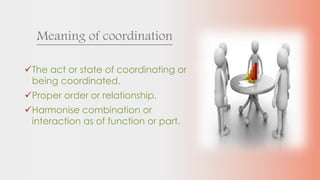
Meaning of coordination
The act or state of coordinating or
being coordinated.
Proper order or relationship.
Harmonise combination or
interaction as of function or part.
Definition of coordination
“Coordination is to harmonise all the
activities of a concern so as to facilitate
it’s working and it’s success”
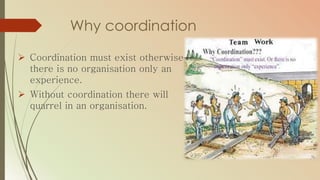
Why coordination
 Coordination must exist otherwise
there is no organisation only an
experience.
 Without coordination there will
quarrel in an organisation.
PRINCIPLES OF COORDINATION
 Direct personal contact
 Coordination is best achieved
through direct personal contact
with people, direct face to face
communication is most
effective.
 Early beginning
 Coordination can be
achieved more easily at
the stage of planning and
policy making.
 Plan should be based on
mutual participation.
 Early coordination also
improve the quality if plan.
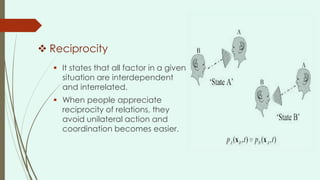
 Reciprocity
 It states that all factor in a given
situation are interdependent
and interrelated.
 When people appreciate
reciprocity of relations, they
avoid unilateral action and
coordination becomes easier.
 Continuity
 It is an ongoing or never
ending process.
 Sound coordination resolves
conflict as soon as it arises.
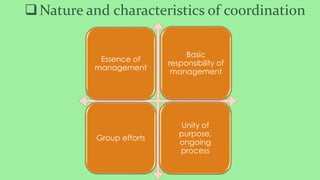
Essence of
management
Basic
responsibility of
management
Group efforts
Unity of
purpose,
ongoing
process
Nature and characteristics of coordination
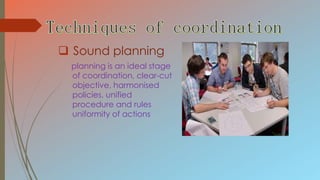
 Sound planning
planning is an ideal stage
of coordination, clear-cut
objective, harmonised
policies, unified
procedure and rules
uniformity of actions
 Simplified organisation
 A simple and sound organisation is
an important mean of coordination.
 Clear cut authority, relationship help
to reduce conflicts and to hold
people responsible. Shareholder-owner
CEO,BOD
Production
Sales &
Marketing
Finance &
purchase
R&DHuman
resource
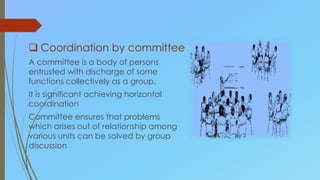
 Coordination by committee
A committee is a body of persons
entrusted with discharge of some
functions collectively as a group.
It is significant achieving horizontal
coordination
Committee ensures that problems
which arises out of relationship among
various units can be solved by group
discussion
 Coordination by
communication
Open and regular
communication is the key to
coordination.
Effective interchange of opinion
and information helps in resolving
difference and creation of mutual
understanding.
 Effective leadership
and supervision
 Effective leadership
ensures coordination both
at planning and execution
stage.
 Sound leadership can
influence subordinate to
have identify and to adopt
a common outlook.
Mere pyare bhaiyo aur
bahno.......
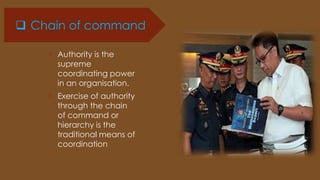
 Authority is the
supreme
coordinating power
in an organisation.
 Exercise of authority
through the chain
of command or
hierarchy is the
traditional means of
coordination
 Chain of command
Barriers to
coordinatio
n
Competition
for resources
Threats to
authority
Disagreeme
nt on
objectives
Differing
expectation
of
coordinatio
n
Lack of trust
Cost/benefi
t perceived
as
unsatisfacto
ry
Unilateral
donor
actions and
agendas
Rapid staff
turnover
Poor
transition
preparation
FAILURE OF COORDINATION
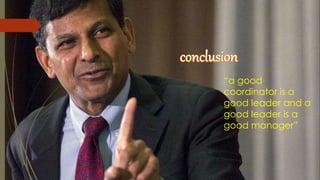
“a good
coordinator is a
good leader and a
good leader is a
good manager”
Coordination

Coordination

  • 1.
  • 2.
    Meaning of coordination Theact or state of coordinating or being coordinated. Proper order or relationship. Harmonise combination or interaction as of function or part.
  • 3.
    Definition of coordination “Coordinationis to harmonise all the activities of a concern so as to facilitate it’s working and it’s success”
  • 4.
    Why coordination  Coordinationmust exist otherwise there is no organisation only an experience.  Without coordination there will quarrel in an organisation.
  • 5.
    PRINCIPLES OF COORDINATION Direct personal contact  Coordination is best achieved through direct personal contact with people, direct face to face communication is most effective.
  • 6.
     Early beginning Coordination can be achieved more easily at the stage of planning and policy making.  Plan should be based on mutual participation.  Early coordination also improve the quality if plan.
  • 7.
     Reciprocity  Itstates that all factor in a given situation are interdependent and interrelated.  When people appreciate reciprocity of relations, they avoid unilateral action and coordination becomes easier.
  • 8.
     Continuity  Itis an ongoing or never ending process.  Sound coordination resolves conflict as soon as it arises.
  • 9.
    Essence of management Basic responsibility of management Groupefforts Unity of purpose, ongoing process Nature and characteristics of coordination
  • 10.
     Sound planning planningis an ideal stage of coordination, clear-cut objective, harmonised policies, unified procedure and rules uniformity of actions
  • 11.
     Simplified organisation A simple and sound organisation is an important mean of coordination.  Clear cut authority, relationship help to reduce conflicts and to hold people responsible. Shareholder-owner CEO,BOD Production Sales & Marketing Finance & purchase R&DHuman resource
  • 12.
     Coordination bycommittee A committee is a body of persons entrusted with discharge of some functions collectively as a group. It is significant achieving horizontal coordination Committee ensures that problems which arises out of relationship among various units can be solved by group discussion
  • 13.
     Coordination by communication Openand regular communication is the key to coordination. Effective interchange of opinion and information helps in resolving difference and creation of mutual understanding.
  • 14.
     Effective leadership andsupervision  Effective leadership ensures coordination both at planning and execution stage.  Sound leadership can influence subordinate to have identify and to adopt a common outlook. Mere pyare bhaiyo aur bahno.......
  • 15.
     Authority isthe supreme coordinating power in an organisation.  Exercise of authority through the chain of command or hierarchy is the traditional means of coordination  Chain of command
  • 17.
    Barriers to coordinatio n Competition for resources Threatsto authority Disagreeme nt on objectives Differing expectation of coordinatio n Lack of trust Cost/benefi t perceived as unsatisfacto ry Unilateral donor actions and agendas Rapid staff turnover Poor transition preparation
  • 18.
  • 19.
    “a good coordinator isa good leader and a good leader is a good manager”