CHAPTER 17
  CONTROLLING
Introduction
 Control is the last function of
 management. The controlling function
 will be unnecessary to the management
 if other functions of management are
 performed properly. Planning identifies
 the activities and controlling regulates
 the activities. Success or failure of
 planning depends upon the results of
 success or failure of controlling.
PLANNING
Definition

 “Control   is any process that guides activity
 towards     some pre-determined goal. The
 essence     of the concept is in determining
 whether    the activity is the achieving desire
 results”
Areas or scope pf control
  Control over the policies of the concern,
  organization, the personnel employed in an
  organization, capital available to the
  concern, capital expenditure, production,
  wages and salaries paid to the employed,
  the cost of production, public relation,
  research and development, tools and
  equipment and overall control.
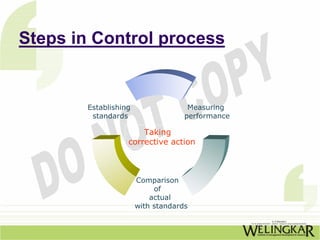
Steps in Control process


        Establishing                 Measuring
         standards                  performance

                       Taking
                   corrective action


                       Comparison
                            of
                           actual
                       with standards
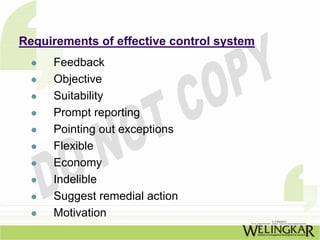
Requirements of effective control system
     Feedback
     Objective
     Suitability
     Prompt reporting
     Pointing out exceptions
     Flexible
     Economy
     Indelible
     Suggest remedial action
     Motivation
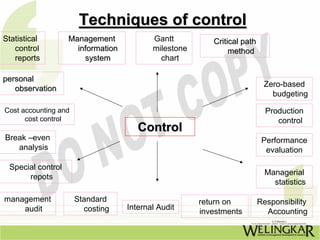
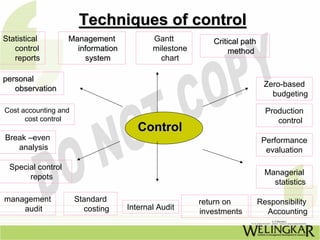
Techniques of control
Statistical        Management             Gantt          Critical path
   control           information          milestone           method
   reports             system               chart

personal
                                                                          Zero-based
   observation
                                                                            budgeting

Cost accounting and                                                        Production
      cost control                                                            control
                                      Control
Break –even                                                               Performance
   analysis                                                                evaluation

 Special control
                                                                           Managerial
      repots
                                                                             statistics

management            Standard                        return on          Responsibility
    audit               costing    Internal Audit
                                                      investments          Accounting
Pert/Cpm
Advantage of pert/cpm
  Ensure planning:
  identification of favorable factors:
  Savings of cost and time:
  Taking preventive or corrective
  actions:
  Attention on critical activities:
  Everything at right:
Advantage of pert/cpm
 Making awareness of responsibilities:
 Securing co-operation:
 Facilities decision-making:
 Improved communication:
 Simultaneous performance of works:
 Advance control action:
 Timely completion of a project:
Limitations of pert/cpm
  Error in estimation of time and cost
  application
  Time consuming and expensive
Distinction between pert and cpm
PERT                          CPM

Three times estimation done   Three times estimation done

It gives importance to time   It gives importance to cost

It is suitable where activity It is suitable where activity
   timings are not known         timings are well known


It is event oriented          It is activity oriented
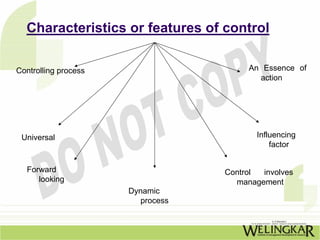
Characteristics or features of control

Controlling process                     An Essence of
                                          action


 Universal                                Influencing
                                              factor


  Forward                          Control involves
     looking                         management
                      Dynamic
                         process
Need of control
  Judging the accuracy of
  standards:
  Minimize dishonest behavior:
  Better performance:
Advantages of control
 Adjustments in operation
 verification of policy
 managerial accountability
 Psychological pressure
 Maintaining morality
 Co-ordination
 Efficiency
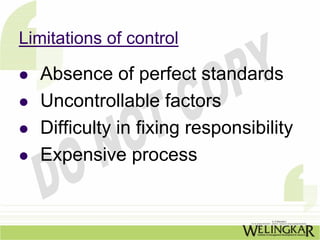
Limitations of control

  Absence of perfect standards
  Uncontrollable factors
  Difficulty in fixing responsibility
  Expensive process
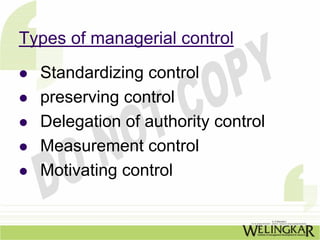
Types of managerial control
  Standardizing control
  preserving control
  Delegation of authority control
  Measurement control
  Motivating control
Budget & Definition of budget
  Budget is derived from the French word
  ‘Budgette’ which means small leather bag.
  Budget is a financial and quantitative
  statement.
   “Budget is a plan for income or outgo or
  both, of money, personal, purchased items,
  sales items, or any other entity about which
  the manager believes that determining the
  future course of action will assist in the
  managerial efforts”
Budgetary control & Definition
of budgetary control
  “The term budgetary control is applied
  to a system of management and
  according control by which all
  operations and output are forecast as
  far ahead as possible and the actual
  results when known are compared
  with the budge t estimates.”
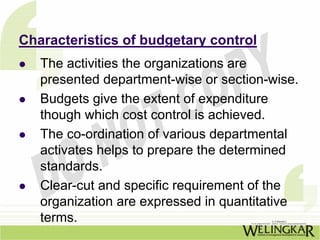
Characteristics of budgetary control
   The activities the organizations are
   presented department-wise or section-wise.
   Budgets give the extent of expenditure
   though which cost control is achieved.
   The co-ordination of various departmental
   activates helps to prepare the determined
   standards.
   Clear-cut and specific requirement of the
   organization are expressed in quantitative
   terms.
Characteristics of budgetary control

   Determines the deviations by comparisons
   and causes of such deviations.
   Recommends and implements the
   corrective actions when ever necessary.
   The future is planned on the basis of past
   experience.
   Recording the present performance for
   comparing purpose with the pre-determined
   standards.
Advantages of budgetary control
                                                                   promotion of
Tool for planning
                                                                    efficiency
   the activities
                                                                 Better utilization
Thinking in advance                                                 of resources

                                                                   Promoters
                                                                   balanced
                                                                    activities
Co-ordination
   of efforts
                                                                       Budgetary
                      Achievement        Criteria of self-
                        of goals          examination           Delegation        of
 Control      of                                                   authority
   expenditure
               Encourages     Fixation of    Ensures proper Solving      financial
               exchange of    responsibility communication     difficulties
               information
Disadvantages, Limitations or
problems of budgetary control
  Inaccuracy
  personal bias
  Non-availability of Co-
  operation
  Rigidity
  Results are not attainable
Disadvantages, Limitations or
problems of budgetary control
  Consistency
  Time Consuming process
  Ineffective budgetary control
  Discourage the initiative
  More paperwork
Essentials of Effective budgeting system

   Efficient organization
   Preparing master budget
   Quick reporting
   Flexible
Essentials of Effective budgeting system

   Support of top management
   Based on reasonable
   assumption
   Reward and punishment
   Appropriate authority
Techniques of control
Statistical        Management             Gantt          Critical path
   control           information          milestone           method
   reports             system               chart

personal
                                                                          Zero-based
   observation
                                                                            budgeting

Cost accounting and                                                        Production
      cost control                                                            control
                                      Control
Break –even                                                               Performance
   analysis                                                                evaluation

 Special control
                                                                           Managerial
      repots
                                                                             statistics

management            Standard                        return on          Responsibility
    audit               costing    Internal Audit
                                                      investments          Accounting
Types of budgets
                           Master         Physical property
        Sales budget
                             budget          budget

Cash budget                                            Research
                                                          and
                                                      development
Production                                              budget
   budget

                           Types of                   Production
 Time and                  budgets                      overhead
   material                                              budget
    budget

                                                      Production
 Selling and                                           cost budget
  distribution               Balance
  cost budget              sheet budget        Supplies budget
Budget can also be classified as
  Fixed budget
  Flexible budgets
Preparation of a budget
  Sound forecasting
  Developed accounting system
  Fixation of responsibility
  centers
  Formation of budget
  committees
Preparation of a budget
  Clear definition of business
  policies
  Statistical information
  Support of top management
  Budget period

Principles of Management – Chpt 17 : Controlling

  • 1.
    CHAPTER 17 CONTROLLING
  • 2.
    Introduction Control isthe last function of management. The controlling function will be unnecessary to the management if other functions of management are performed properly. Planning identifies the activities and controlling regulates the activities. Success or failure of planning depends upon the results of success or failure of controlling.
  • 3.
  • 4.
    Definition “Control is any process that guides activity towards some pre-determined goal. The essence of the concept is in determining whether the activity is the achieving desire results”
  • 5.
    Areas or scopepf control Control over the policies of the concern, organization, the personnel employed in an organization, capital available to the concern, capital expenditure, production, wages and salaries paid to the employed, the cost of production, public relation, research and development, tools and equipment and overall control.
  • 6.
    Steps in Controlprocess Establishing Measuring standards performance Taking corrective action Comparison of actual with standards
  • 7.
    Requirements of effectivecontrol system Feedback Objective Suitability Prompt reporting Pointing out exceptions Flexible Economy Indelible Suggest remedial action Motivation
  • 8.
    Techniques of control Statistical Management Gantt Critical path control information milestone method reports system chart personal Zero-based observation budgeting Cost accounting and Production cost control control Control Break –even Performance analysis evaluation Special control Managerial repots statistics management Standard return on Responsibility audit costing Internal Audit investments Accounting
  • 9.
    Pert/Cpm Advantage of pert/cpm Ensure planning: identification of favorable factors: Savings of cost and time: Taking preventive or corrective actions: Attention on critical activities: Everything at right:
  • 10.
    Advantage of pert/cpm Making awareness of responsibilities: Securing co-operation: Facilities decision-making: Improved communication: Simultaneous performance of works: Advance control action: Timely completion of a project:
  • 11.
    Limitations of pert/cpm Error in estimation of time and cost application Time consuming and expensive
  • 12.
    Distinction between pertand cpm PERT CPM Three times estimation done Three times estimation done It gives importance to time It gives importance to cost It is suitable where activity It is suitable where activity timings are not known timings are well known It is event oriented It is activity oriented
  • 13.
    Characteristics or featuresof control Controlling process An Essence of action Universal Influencing factor Forward Control involves looking management Dynamic process
  • 14.
    Need of control Judging the accuracy of standards: Minimize dishonest behavior: Better performance:
  • 15.
    Advantages of control Adjustments in operation verification of policy managerial accountability Psychological pressure Maintaining morality Co-ordination Efficiency
  • 16.
    Limitations of control Absence of perfect standards Uncontrollable factors Difficulty in fixing responsibility Expensive process
  • 17.
    Types of managerialcontrol Standardizing control preserving control Delegation of authority control Measurement control Motivating control
  • 18.
    Budget & Definitionof budget Budget is derived from the French word ‘Budgette’ which means small leather bag. Budget is a financial and quantitative statement. “Budget is a plan for income or outgo or both, of money, personal, purchased items, sales items, or any other entity about which the manager believes that determining the future course of action will assist in the managerial efforts”
  • 19.
    Budgetary control &Definition of budgetary control “The term budgetary control is applied to a system of management and according control by which all operations and output are forecast as far ahead as possible and the actual results when known are compared with the budge t estimates.”
  • 20.
    Characteristics of budgetarycontrol The activities the organizations are presented department-wise or section-wise. Budgets give the extent of expenditure though which cost control is achieved. The co-ordination of various departmental activates helps to prepare the determined standards. Clear-cut and specific requirement of the organization are expressed in quantitative terms.
  • 21.
    Characteristics of budgetarycontrol Determines the deviations by comparisons and causes of such deviations. Recommends and implements the corrective actions when ever necessary. The future is planned on the basis of past experience. Recording the present performance for comparing purpose with the pre-determined standards.
  • 22.
    Advantages of budgetarycontrol promotion of Tool for planning efficiency the activities Better utilization Thinking in advance of resources Promoters balanced activities Co-ordination of efforts Budgetary Achievement Criteria of self- of goals examination Delegation of Control of authority expenditure Encourages Fixation of Ensures proper Solving financial exchange of responsibility communication difficulties information
  • 23.
    Disadvantages, Limitations or problemsof budgetary control Inaccuracy personal bias Non-availability of Co- operation Rigidity Results are not attainable
  • 24.
    Disadvantages, Limitations or problemsof budgetary control Consistency Time Consuming process Ineffective budgetary control Discourage the initiative More paperwork
  • 25.
    Essentials of Effectivebudgeting system Efficient organization Preparing master budget Quick reporting Flexible
  • 26.
    Essentials of Effectivebudgeting system Support of top management Based on reasonable assumption Reward and punishment Appropriate authority
  • 27.
    Techniques of control Statistical Management Gantt Critical path control information milestone method reports system chart personal Zero-based observation budgeting Cost accounting and Production cost control control Control Break –even Performance analysis evaluation Special control Managerial repots statistics management Standard return on Responsibility audit costing Internal Audit investments Accounting
  • 28.
    Types of budgets Master Physical property Sales budget budget budget Cash budget Research and development Production budget budget Types of Production Time and budgets overhead material budget budget Production Selling and cost budget distribution Balance cost budget sheet budget Supplies budget
  • 29.
    Budget can alsobe classified as Fixed budget Flexible budgets
  • 30.
    Preparation of abudget Sound forecasting Developed accounting system Fixation of responsibility centers Formation of budget committees
  • 31.
    Preparation of abudget Clear definition of business policies Statistical information Support of top management Budget period