UNIT IV
MANAGERIAL
CONTROL
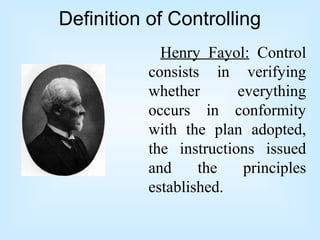
Definition of Controlling
Henry Fayol: Control
consists in verifying
whether everything
occurs in conformity
with the plan adopted,
the instructions issued
and the principles
established.
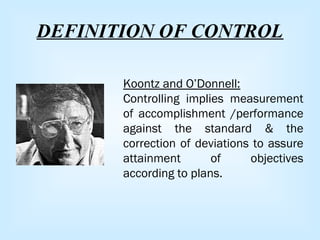
DEFINITION OF CONTROL
Koontz and O’Donnell:
Controlling implies measurement
of accomplishment /performance
against the standard & the
correction of deviations to assure
attainment of objectives
according to plans.
CONTROLLING AS A
MANAGEMENT FUNCTION
– A process of monitoring performance and taking
action to ensure desired results.
– It sees to it that the right things happen, in the
right ways, and at the right time.
– Done well, it ensures that the overall directions of
individuals and groups are consistent with short
and long range plans of the organisation
– It helps ensure that objectives and accomplishments
are consistent with one another throughout an
organization.
– It helps maintain compliance with essential
organizational rules and policies.
FEATURES/CHARACTERSTICS
OF CONTROLLING
• Continuous process.
• Flexible and dynamic
process.
• Future oriented.
• Planning and
controlling closely
related.
• Function of
management.
•Strategic and results
oriented
•Understandable
•Timely and exception
oriented
•Essence of control is
action
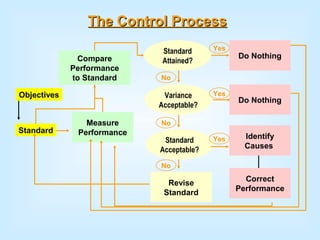
The Control ProcessThe Control Process
Identify
Causes
Correct
Performance
Variance
Acceptable?
Revise
Standard
Standard
Attained?
Standard
Acceptable?
Yes
Yes
Yes
No
No
No
Compare
Performance
to Standard
Measure
Performance
Objectives
Standard
Do Nothing
Do Nothing
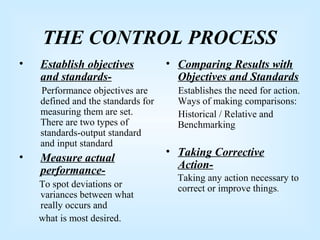
THE CONTROL PROCESS
• Establish objectives
and standards-
Performance objectives are
defined and the standards for
measuring them are set.
There are two types of
standards-output standard
and input standard
• Measure actual
performance-
To spot deviations or
variances between what
really occurs and
what is most desired.
• Comparing Results with
Objectives and Standards
Establishes the need for action.
Ways of making comparisons:
Historical / Relative and
Benchmarking
• Taking Corrective
Action-
Taking any action necessary to
correct or improve things.
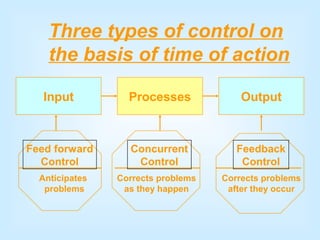
Input Processes Output
Three types of control on
the basis of time of action
Feed forward
Control
Anticipates
problems
Corrects problems
as they happen
Feedback
Control
Corrects problems
after they occur
Concurrent
Control
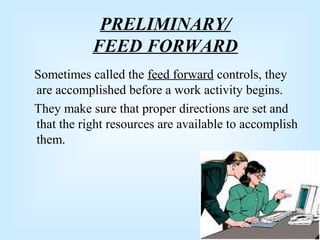
PRELIMINARY/
FEED FORWARD
Sometimes called the feed forward controls, they
are accomplished before a work activity begins.
They make sure that proper directions are set and
that the right resources are available to accomplish
them.
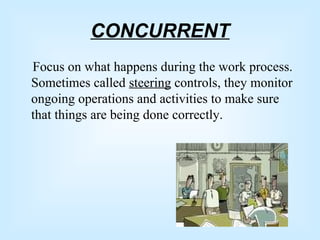
CONCURRENT
Focus on what happens during the work process.
Sometimes called steering controls, they monitor
ongoing operations and activities to make sure
that things are being done correctly.
FEEDBACK/POSTACTION
Sometimes called
feedback controls, they
take place after an action
is completed. They focus
on end results, as opposed
to inputs and activities.
Control Techniques
Control techniques may be broadly classified
into two categories:-
• Traditional control techniques.
• Advance / Modern control techniques.
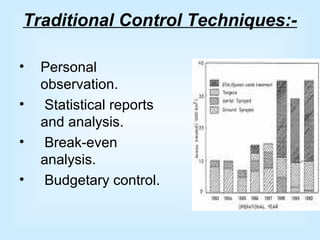
Traditional Control Techniques:-
• Personal
observation.
• Statistical reports
and analysis.
• Break-even
analysis.
• Budgetary control.
Advance control techniques:-
• Self Control
• Management Audit.
• Programme Evaluation and
Review Techniques (PERT).
• Critical Path Method (CPM).
• Management Information
Systems (MIS).
Guide to Operations
 Measures Progress
 Uncover Deviations
 Indicate Corrective Action
Policy Verification
 Verify quality of various plans
 Helps to review , revise and update plans
 Helps to carry out the plans successfully
Managerial Accountability
 Manager responsible for ultimate performance
 Managers check performance of subordinates
 Control help them to discharge their
responsibilities
 Facilitates decision making and better
management
Employee Morale
 Control brings order and discipline
 Absence of control – lower employee morale
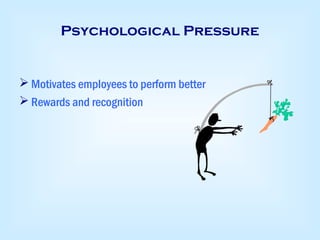
Psychological Pressure
 Motivates employees to perform better
 Rewards and recognition
Coordination in Action
Actions according to plans
Right direction
Correct inter relationship between various factors
Balance between ends and means
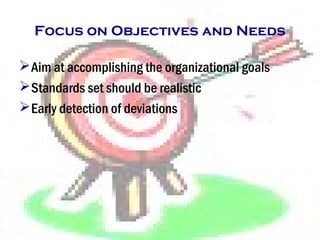
Focus on Objectives and Needs
Aim at accomplishing the organizational goals
Standards set should be realistic
Early detection of deviations
Suggestive
 Merely pointing out deviations – not enough
 Lead to corrective actions
 Check undesirable deviations
 E.g. – train employees, effective supervision, revise
standards
Suitability
 Control techniques – suit nature of activities
 E.g. – Different control system in a big and small
organization
Simple
 Simple and easy to understand
 If complicated – employees confused – poor performance
Forward Looking
 Directed towards future
 Anticipate future requirements
 Identify situations that need new plans
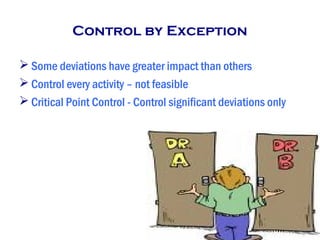
Control by Exception
 Some deviations have greater impact than others
 Control every activity – not feasible
 Critical Point Control - Control significant deviations only
Flexibility
 Keep pace with changing environment
 Adaptable to new developments
 Alternative plans
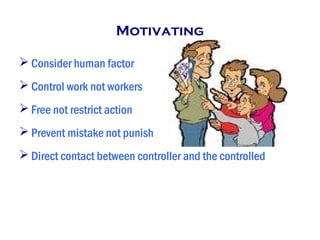
Motivating
 Consider human factor
 Control work not workers
 Free not restrict action
 Prevent mistake not punish
 Direct contact between controller and the controlled
Economical
 Control system – worth its cost
 Justifiable expenses
 Savings > Cost of control
Controlling ppt

Controlling ppt

  • 1.
  • 2.
    Definition of Controlling HenryFayol: Control consists in verifying whether everything occurs in conformity with the plan adopted, the instructions issued and the principles established.
  • 3.
    DEFINITION OF CONTROL Koontzand O’Donnell: Controlling implies measurement of accomplishment /performance against the standard & the correction of deviations to assure attainment of objectives according to plans.
  • 4.
    CONTROLLING AS A MANAGEMENTFUNCTION – A process of monitoring performance and taking action to ensure desired results. – It sees to it that the right things happen, in the right ways, and at the right time. – Done well, it ensures that the overall directions of individuals and groups are consistent with short and long range plans of the organisation – It helps ensure that objectives and accomplishments are consistent with one another throughout an organization. – It helps maintain compliance with essential organizational rules and policies.
  • 5.
    FEATURES/CHARACTERSTICS OF CONTROLLING • Continuousprocess. • Flexible and dynamic process. • Future oriented. • Planning and controlling closely related. • Function of management. •Strategic and results oriented •Understandable •Timely and exception oriented •Essence of control is action
  • 6.
    The Control ProcessTheControl Process Identify Causes Correct Performance Variance Acceptable? Revise Standard Standard Attained? Standard Acceptable? Yes Yes Yes No No No Compare Performance to Standard Measure Performance Objectives Standard Do Nothing Do Nothing
  • 7.
    THE CONTROL PROCESS •Establish objectives and standards- Performance objectives are defined and the standards for measuring them are set. There are two types of standards-output standard and input standard • Measure actual performance- To spot deviations or variances between what really occurs and what is most desired. • Comparing Results with Objectives and Standards Establishes the need for action. Ways of making comparisons: Historical / Relative and Benchmarking • Taking Corrective Action- Taking any action necessary to correct or improve things.
  • 8.
    Input Processes Output Threetypes of control on the basis of time of action Feed forward Control Anticipates problems Corrects problems as they happen Feedback Control Corrects problems after they occur Concurrent Control
  • 9.
    PRELIMINARY/ FEED FORWARD Sometimes calledthe feed forward controls, they are accomplished before a work activity begins. They make sure that proper directions are set and that the right resources are available to accomplish them.
  • 10.
    CONCURRENT Focus on whathappens during the work process. Sometimes called steering controls, they monitor ongoing operations and activities to make sure that things are being done correctly.
  • 11.
    FEEDBACK/POSTACTION Sometimes called feedback controls,they take place after an action is completed. They focus on end results, as opposed to inputs and activities.
  • 12.
    Control Techniques Control techniquesmay be broadly classified into two categories:- • Traditional control techniques. • Advance / Modern control techniques.
  • 13.
    Traditional Control Techniques:- •Personal observation. • Statistical reports and analysis. • Break-even analysis. • Budgetary control.
  • 14.
    Advance control techniques:- •Self Control • Management Audit. • Programme Evaluation and Review Techniques (PERT). • Critical Path Method (CPM). • Management Information Systems (MIS).
  • 16.
    Guide to Operations Measures Progress  Uncover Deviations  Indicate Corrective Action
  • 17.
    Policy Verification  Verifyquality of various plans  Helps to review , revise and update plans  Helps to carry out the plans successfully
  • 18.
    Managerial Accountability  Managerresponsible for ultimate performance  Managers check performance of subordinates  Control help them to discharge their responsibilities  Facilitates decision making and better management
  • 19.
    Employee Morale  Controlbrings order and discipline  Absence of control – lower employee morale
  • 20.
    Psychological Pressure  Motivatesemployees to perform better  Rewards and recognition
  • 21.
    Coordination in Action Actionsaccording to plans Right direction Correct inter relationship between various factors Balance between ends and means
  • 23.
    Focus on Objectivesand Needs Aim at accomplishing the organizational goals Standards set should be realistic Early detection of deviations
  • 24.
    Suggestive  Merely pointingout deviations – not enough  Lead to corrective actions  Check undesirable deviations  E.g. – train employees, effective supervision, revise standards
  • 25.
    Suitability  Control techniques– suit nature of activities  E.g. – Different control system in a big and small organization
  • 26.
    Simple  Simple andeasy to understand  If complicated – employees confused – poor performance
  • 27.
    Forward Looking  Directedtowards future  Anticipate future requirements  Identify situations that need new plans
  • 28.
    Control by Exception Some deviations have greater impact than others  Control every activity – not feasible  Critical Point Control - Control significant deviations only
  • 29.
    Flexibility  Keep pacewith changing environment  Adaptable to new developments  Alternative plans
  • 30.
    Motivating  Consider humanfactor  Control work not workers  Free not restrict action  Prevent mistake not punish  Direct contact between controller and the controlled
  • 31.
    Economical  Control system– worth its cost  Justifiable expenses  Savings > Cost of control