Coordination
Concept, importance and nature
concept of coordination
concept

Coordination means synchronizing the efforts
by unifying, integrating and harmonizing the
activates of different departments and
individuals for the achievement of common
objectives.
“Coordination harmonies, synchronizes and individual efforts
for better action and for the achievement of the business
objective.”

-henri fayol
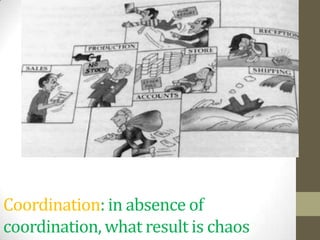
Coordination: in absence of
coordination, what result is chaos
Coordination is not a separate function of management, it is the
essence of management. Coordination is that force that binds all the
other function of management.

Coordination in planning
-the object and available resources
-the master plan of different department and divisions.
e.g. coordination between production department and sales
department targets.

Coordination in organization
- For resources of an organization and activates to be performed.
-For assigning authority, responsibility and accountability.
E.g. if the finance manger is given authority to raise funds, he/she
should also be given the responsibility to manage funds efficiently

Coordination in staffing
-between skill of worker and jobs assigned to them.
-between efficiency of worker and the compensation.
e.g. A CA should generally be given work of financially nature.
Coordination in directing
-among order, instruction and suggestion.
-among superiors and subordinate.
e.g. Manager instructs the subordinates, motivate
them and also supervises their work
Coordination in controlling
-between planned standard and actually performance.
-between correction of deviation achievement of
objective.
Need and importance of
coordination

Coordination is important as it integrated the efforts
of individual, department and specialist. The
primary reason for coordination is that individual
and departments in an organization.

The need for coordination arise because of the
following reason:
1.growth in size: as organization also increase. They
may work for cross purpose. So, coordination is
needed to integrate their efforts and activates, i.e.,
to bring unity of action.
2. Functional differential: In an organization, there
may be separate department of production, finance,
marketing, and human resources. all departments
have their own objective, policies, strategies, etc. so,
there may arise conflicts between them.
3. Specialization: In modern organization, there is high
degree of specialization, arising out of the
complexities of modern technology and the diversity
of task to be performed. So, organization employ a
number of specialists, who think that they only from
other members, which leads to conflicts between
them.
Nature/ characteristics of coordination
1.Coordination integrated group efforts: coordination
unifies unrelated and diverse activates into purposeful
work activity. It gives a common focus to group efforts to
ensure desired performance.
2.Coordination ensure unity of action: The purpose of
coordination is to secure unit of action among
interdependent activates or departments of an
organization.
3. coordination is a continuous process: It begins at the
planning stage and continues till controlling.
4.Coordination is an all-pervasive: coordination is
required at all levels of management due to the
interdependent nature of actives of various departments
.
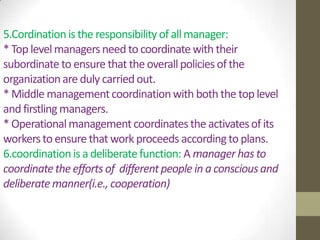
5.Cordination is the responsibility of all manager:
* Top level managers need to coordinate with their
subordinate to ensure that the overall policies of the
organization are duly carried out.
* Middle management coordination with both the top level
and firstling managers.
* Operational management coordinates the activates of its
workers to ensure that work proceeds according to plans.
6.coordination is a deliberate function: A manager has to
coordinate the efforts of different people in a conscious and
deliberate manner(i.e., cooperation)
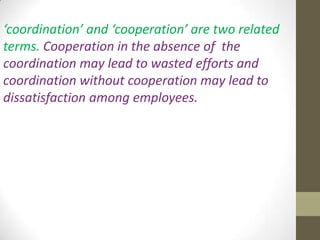
‘coordination’ and ‘cooperation’ are two related
terms. Cooperation in the absence of the
coordination may lead to wasted efforts and
coordination without cooperation may lead to
dissatisfaction among employees.
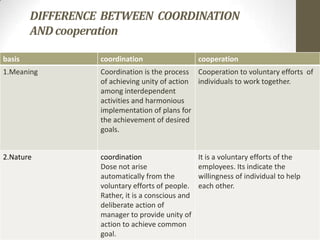
DIFFERENCE BETWEEN COORDINATION
AND cooperation
basis

coordination

cooperation

1.Meaning

Coordination is the process Cooperation to voluntary efforts of
of achieving unity of action individuals to work together.
among interdependent
activities and harmonious
implementation of plans for
the achievement of desired
goals.

2.Nature

coordination
Dose not arise
automatically from the
voluntary efforts of people.
Rather, it is a conscious and
deliberate action of
manager to provide unity of
action to achieve common
goal.

It is a voluntary efforts of the
employees. Its indicate the
willingness of individual to help
each other.
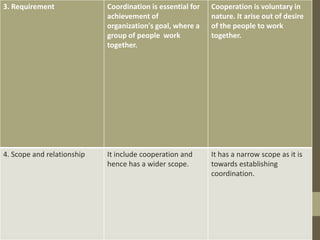
3. Requirement

Coordination is essential for
achievement of
organization's goal, where a
group of people work
together.

Cooperation is voluntary in
nature. It arise out of desire
of the people to work
together.

4. Scope and relationship

It include cooperation and
hence has a wider scope.

It has a narrow scope as it is
towards establishing
coordination.
Coordination

Coordination

  • 1.
    Coordination Concept, importance andnature concept of coordination
  • 2.
    concept Coordination means synchronizingthe efforts by unifying, integrating and harmonizing the activates of different departments and individuals for the achievement of common objectives. “Coordination harmonies, synchronizes and individual efforts for better action and for the achievement of the business objective.” -henri fayol
  • 3.
    Coordination: in absenceof coordination, what result is chaos
  • 4.
    Coordination is nota separate function of management, it is the essence of management. Coordination is that force that binds all the other function of management. Coordination in planning -the object and available resources -the master plan of different department and divisions. e.g. coordination between production department and sales department targets. Coordination in organization - For resources of an organization and activates to be performed. -For assigning authority, responsibility and accountability. E.g. if the finance manger is given authority to raise funds, he/she should also be given the responsibility to manage funds efficiently Coordination in staffing -between skill of worker and jobs assigned to them. -between efficiency of worker and the compensation. e.g. A CA should generally be given work of financially nature.
  • 5.
    Coordination in directing -amongorder, instruction and suggestion. -among superiors and subordinate. e.g. Manager instructs the subordinates, motivate them and also supervises their work Coordination in controlling -between planned standard and actually performance. -between correction of deviation achievement of objective.
  • 6.
    Need and importanceof coordination Coordination is important as it integrated the efforts of individual, department and specialist. The primary reason for coordination is that individual and departments in an organization. The need for coordination arise because of the following reason: 1.growth in size: as organization also increase. They may work for cross purpose. So, coordination is needed to integrate their efforts and activates, i.e., to bring unity of action.
  • 7.
    2. Functional differential:In an organization, there may be separate department of production, finance, marketing, and human resources. all departments have their own objective, policies, strategies, etc. so, there may arise conflicts between them. 3. Specialization: In modern organization, there is high degree of specialization, arising out of the complexities of modern technology and the diversity of task to be performed. So, organization employ a number of specialists, who think that they only from other members, which leads to conflicts between them.
  • 8.
    Nature/ characteristics ofcoordination 1.Coordination integrated group efforts: coordination unifies unrelated and diverse activates into purposeful work activity. It gives a common focus to group efforts to ensure desired performance. 2.Coordination ensure unity of action: The purpose of coordination is to secure unit of action among interdependent activates or departments of an organization. 3. coordination is a continuous process: It begins at the planning stage and continues till controlling. 4.Coordination is an all-pervasive: coordination is required at all levels of management due to the interdependent nature of actives of various departments .
  • 9.
    5.Cordination is theresponsibility of all manager: * Top level managers need to coordinate with their subordinate to ensure that the overall policies of the organization are duly carried out. * Middle management coordination with both the top level and firstling managers. * Operational management coordinates the activates of its workers to ensure that work proceeds according to plans. 6.coordination is a deliberate function: A manager has to coordinate the efforts of different people in a conscious and deliberate manner(i.e., cooperation)
  • 10.
    ‘coordination’ and ‘cooperation’are two related terms. Cooperation in the absence of the coordination may lead to wasted efforts and coordination without cooperation may lead to dissatisfaction among employees.
  • 11.
    DIFFERENCE BETWEEN COORDINATION ANDcooperation basis coordination cooperation 1.Meaning Coordination is the process Cooperation to voluntary efforts of of achieving unity of action individuals to work together. among interdependent activities and harmonious implementation of plans for the achievement of desired goals. 2.Nature coordination Dose not arise automatically from the voluntary efforts of people. Rather, it is a conscious and deliberate action of manager to provide unity of action to achieve common goal. It is a voluntary efforts of the employees. Its indicate the willingness of individual to help each other.
  • 12.
    3. Requirement Coordination isessential for achievement of organization's goal, where a group of people work together. Cooperation is voluntary in nature. It arise out of desire of the people to work together. 4. Scope and relationship It include cooperation and hence has a wider scope. It has a narrow scope as it is towards establishing coordination.