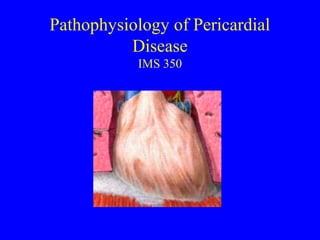
Pathophysiology of Pericardial
Disease
IMS 350
Pericardium - Anatomy
•Normal pericardium is a fibro-serous sac which surrounds
the heart and adjoining portions of the great vessels.
•The inner visceral layer, also known as the epicardium,
consists of a thin layer of mesothelial cells closely adherent to
the surface of the heart. The epicardium is reflected onto the
surface of the outer fibrous layer with which it forms the
parietal pericardium.
•The parietal pericardium consists of collagenous fibrous
tissue and elastic fibrils.
•Between the two layers lies the pericardial space, which
contains approximately 10-50ml of fluid, which is an
ultrafiltrate of plasma.
•Drainage of pericardial fluid is via right lymphatic duct and
thoracic duct.
Pericardium: Anatomy
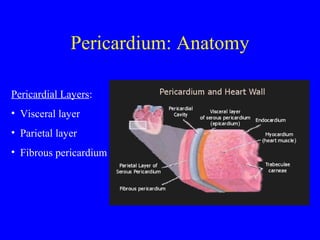
Pericardial Layers:
• Visceral layer
• Parietal layer
• Fibrous pericardium
Function of the Pericardium
1. Stabilization of the heart within the thoracic cavity by virtue of its
ligamentous attachments -- limiting the heart’s motion.
2. Protection of the heart from mechanical trauma and infection from
adjoining structures.
3. The pericardial fluid functions as a lubricant and decreases friction
of cardiac surface during systole and diastole.
4. Prevention of excessive dilation of heart especially during sudden
rise in intra-cardiac volume (e.g. acute aortic or mitral regurgitation).
Sponsored
Medical Lecture Notes – All Subjects
USMLE Exam (America) – Practice
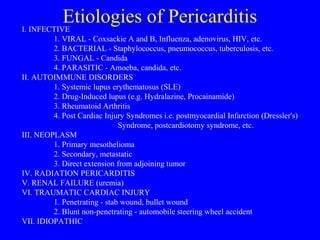
Etiologies of PericarditisI. INFECTIVE
1. VIRAL - Coxsackie A and B, Influenza, adenovirus, HIV, etc.
2. BACTERIAL - Staphylococcus, pneumococcus, tuberculosis, etc.
3. FUNGAL - Candida
4. PARASITIC - Amoeba, candida, etc.
II. AUTOIMMUNE DISORDERS
1. Systemic lupus erythematosus (SLE)
2. Drug-Induced lupus (e.g. Hydralazine, Procainamide)
3. Rheumatoid Arthritis
4. Post Cardiac Injury Syndromes i.e. postmyocardial Infarction (Dressler's)
Syndrome, postcardiotomy syndrome, etc.
III. NEOPLASM
1. Primary mesothelioma
2. Secondary, metastatic
3. Direct extension from adjoining tumor
IV. RADIATION PERICARDITIS
V. RENAL FAILURE (uremia)
VI. TRAUMATIC CARDIAC INJURY
1. Penetrating - stab wound, bullet wound
2. Blunt non-penetrating - automobile steering wheel accident
VII. IDIOPATHIC
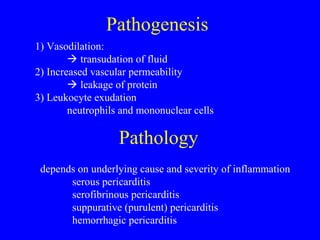
Pathogenesis
1) Vasodilation:
 transudation of fluid
2) Increased vascular permeability
 leakage of protein
3) Leukocyte exudation
neutrophils and mononuclear cells
Pathology
depends on underlying cause and severity of inflammation
serous pericarditis
serofibrinous pericarditis
suppurative (purulent) pericarditis
hemorrhagic pericarditis
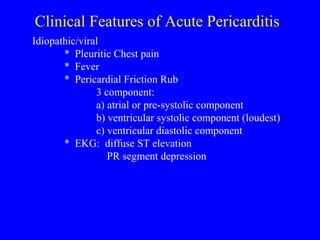
Clinical Features of Acute Pericarditis
Idiopathic/viral
* Pleuritic Chest pain
* Fever
* Pericardial Friction Rub
3 component:
a) atrial or pre-systolic component
b) ventricular systolic component (loudest)
c) ventricular diastolic component
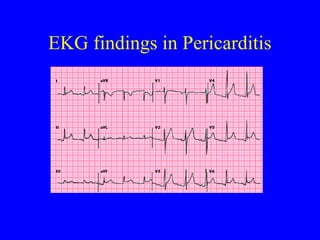
* EKG: diffuse ST elevation
PR segment depression
EKG findings in Pericarditis
Diagnostic Tests
Echocardiogram: Pericardial effusion
N.B.: absence does not rule out pericarditis
N.B.: Pericarditis is a clinical diagnosis, not an Echo diagnosis!
Blood tests: PPD, RF, ANA
Viral titers
Search for malignancy
Pericardiocentesis:
low diagnostic yield
done therapeutically
Treatment
Pain relief
analgesics and anti-inflammatory
ASA/NSAID’s
Steroids for recurring pericarditis
Antibiotics/drainage for purulent pericarditis
Dialysis for uremic pericarditis
Neoplastic: XRT, chemotherapy
Pericardial Effusion
Normal 15-50 ml of fluid
ETIOLOGY
1. Inflammation from infection, immunologic process.
2. Trauma causing bleeding in pericardial space.
3. Noninfectious conditions such as:
a. increase in pulmonary hydrostatic pressure e.g. congestive
heart failure.
b. increase in capillary permeability e.g. hypothyroidism
c. decrease in plasma oncotic pressure e.g. cirrhosis.
4. Decreased drainage of pericardial fluid due to obstruction of
thoracic duct as a result of malignancy or damage during surgery.
• Effusion may be serous, serofibrinous, suppurative, chylous, or
hemorrhagic depending on the etiology.
• Viral effusions are usually serous or serofibrinous
• Malignant effusions are usually hemorrhagic.
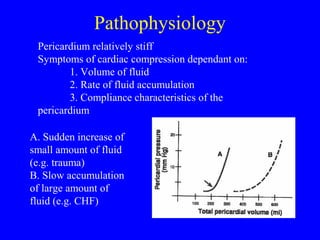
Pathophysiology
Pericardium relatively stiff
Symptoms of cardiac compression dependant on:
1. Volume of fluid
2. Rate of fluid accumulation
3. Compliance characteristics of the
pericardium
A. Sudden increase of
small amount of fluid
(e.g. trauma)
B. Slow accumulation
of large amount of
fluid (e.g. CHF)
Clinical features
Small effusions do not produce hemodynamic abnormalities.
Large effusions, in addition to causing hemodynamic
compromise, may lead to compression of adjoining structures
and produce symptoms of:
dysphagia (compression of esophagus)
hoarseness (recurrent laryngeal nerve compression)
hiccups (diaphragmatic stimulation)
dyspnea (pleural inflammation/effusion)
Physical Findings
Physical Findings:
• Muffled heart sounds
• Paradoxically reduced intensity of rub
• Ewart's sign:
Compression of lung leading to an area of
consolidation in the left infrascapular region
(atalectasis, detected as dullness to percussion
and bronchial breathing)
Diagnostic studies
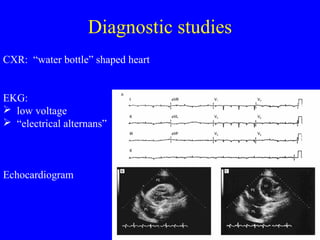
CXR: “water bottle” shaped heart
EKG:
 low voltage
 “electrical alternans”
Echocardiogram
Cardiac Tamponade
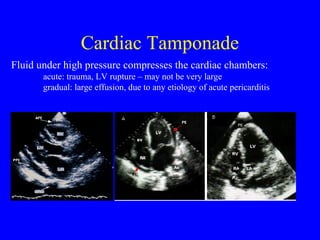
Fluid under high pressure compresses the cardiac chambers:
acute: trauma, LV rupture – may not be very large
gradual: large effusion, due to any etiology of acute pericarditis
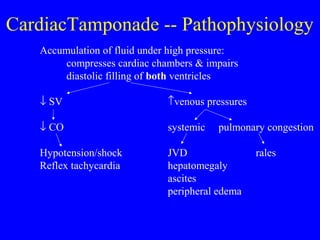
CardiacTamponade -- Pathophysiology
Accumulation of fluid under high pressure:
compresses cardiac chambers & impairs
diastolic filling of both ventricles
↓ SV ↑venous pressures
↓ CO systemic pulmonary congestion
Hypotension/shock JVD rales
Reflex tachycardia hepatomegaly
ascites
peripheral edema
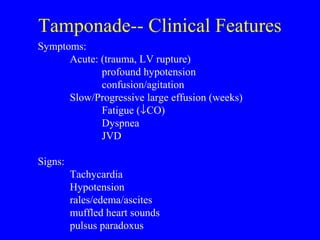
Tamponade-- Clinical Features
Symptoms:
Acute: (trauma, LV rupture)
profound hypotension
confusion/agitation
Slow/Progressive large effusion (weeks)
Fatigue (↓CO)
Dyspnea
JVD
Signs:
Tachycardia
Hypotension
rales/edema/ascites
muffled heart sounds
pulsus paradoxus
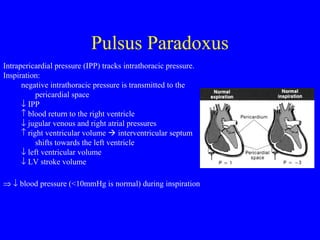
Pulsus Paradoxus
Intrapericardial pressure (IPP) tracks intrathoracic pressure.
Inspiration:
negative intrathoracic pressure is transmitted to the
pericardial space
↓ IPP
↑ blood return to the right ventricle
↓ jugular venous and right atrial pressures
↑ right ventricular volume  interventricular septum
shifts towards the left ventricle
↓ left ventricular volume
↓ LV stroke volume
⇒ ↓ blood pressure (<10mmHg is normal) during inspiration
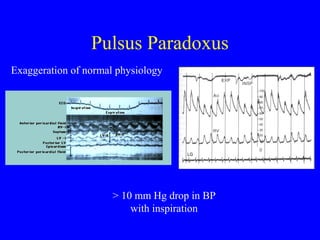
Pulsus Paradoxus
Exaggeration of normal physiology
> 10 mm Hg drop in BP
with inspiration
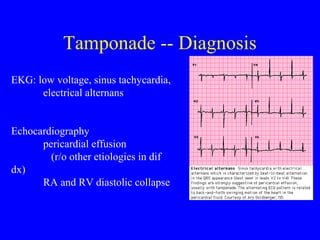
Tamponade -- Diagnosis
EKG: low voltage, sinus tachycardia,
electrical alternans
Echocardiography
pericardial effusion
(r/o other etiologies in dif
dx)
RA and RV diastolic collapse
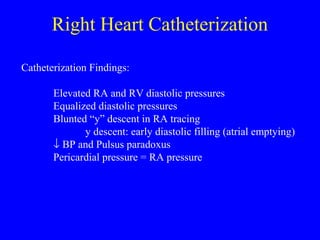
Right Heart Catheterization
Catheterization Findings:
Elevated RA and RV diastolic pressures
Equalized diastolic pressures
Blunted “y” descent in RA tracing
y descent: early diastolic filling (atrial emptying)
↓ BP and Pulsus paradoxus
Pericardial pressure = RA pressure
Jugular venous pressureJugular venous pressure
waveswaves
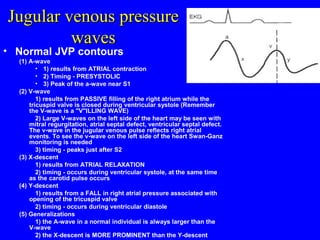
• Normal JVP contours
(1) A-wave
• 1) results from ATRIAL contraction
• 2) Timing - PRESYSTOLIC
• 3) Peak of the a-wave near S1
(2) V-wave
1) results from PASSIVE filling of the right atrium while the
tricuspid valve is closed during ventricular systole (Remember
the V-wave is a "V"ILLING WAVE)
2) Large V-waves on the left side of the heart may be seen with
mitral regurgitation, atrial septal defect, ventricular septal defect.
The v-wave in the jugular venous pulse reflects right atrial
events. To see the v-wave on the left side of the heart Swan-Ganz
monitoring is needed
3) timing - peaks just after S2
(3) X-descent
1) results from ATRIAL RELAXATION
2) timing - occurs during ventricular systole, at the same time
as the carotid pulse occurs
(4) Y-descent
1) results from a FALL in right atrial pressure associated with
opening of the tricuspid valve
2) timing - occurs during ventricular diastole
(5) Generalizations
1) the A-wave in a normal individual is always larger than the
V-wave
2) the X-descent is MORE PROMINENT than the Y-descent
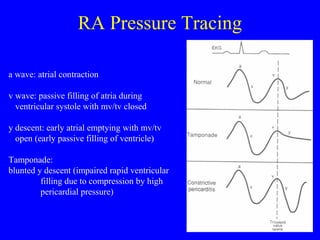
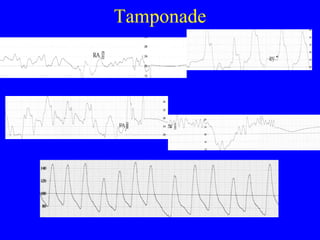
RA Pressure Tracing
a wave: atrial contraction
v wave: passive filling of atria during
ventricular systole with mv/tv closed
y descent: early atrial emptying with mv/tv
open (early passive filling of ventricle)
Tamponade:
blunted y descent (impaired rapid ventricular
filling due to compression by high
pericardial pressure)
Tamponade
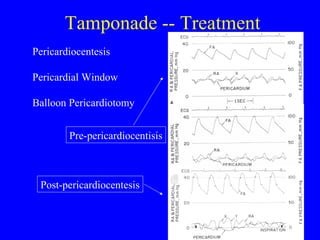
Tamponade -- Treatment
Pericardiocentesis
Pericardial Window
Balloon Pericardiotomy
Pre-pericardiocentisis
Post-pericardiocentesis
Constrictive Pericarditis
Late complication of pericardial disease
Fibrous scar formation
Fusion of pericardial layers
Calcification further stiffens pericardium
Etiologies:
any cause of pericarditis
idiopathic
post-surgery
tuberculosis
radiation
neoplasm
Pathophysiology
Rigid, scarred pericardium encircles heart:
Systolic contraction normal
Inhibits diastolic filling of both ventricles
↓ SV ↑venous pressures
↓ CO systemic pulmonary congestion
Hypotension/shock JVD rales
Reflex tachycardia hepatomegaly
ascites
peripheral edema
Physical exam
↑HR, ↓BP
ascites, edema, hepatomegaly
early diastolic “knock”
after S2
sudden cessation of ventricular diastolic filling imposed
by rigid pericardial sac
Kussmaul’s sign
Kussmaul’s Sign
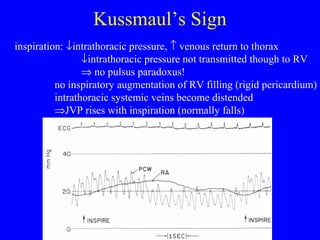
inspiration: ↓intrathoracic pressure, ↑ venous return to thorax
↓intrathoracic pressure not transmitted though to RV
⇒ no pulsus paradoxus!
no inspiratory augmentation of RV filling (rigid pericardium)
intrathoracic systemic veins become distended
⇒JVP rises with inspiration (normally falls)
Diagnosis
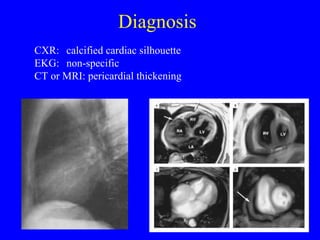
CXR: calcified cardiac silhouette
EKG: non-specific
CT or MRI: pericardial thickening
Cardiac Catheterization
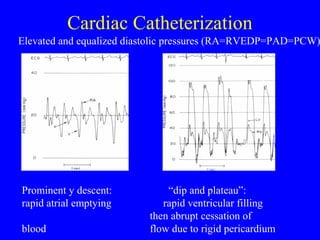
Prominent y descent: “dip and plateau”:
rapid atrial emptying rapid ventricular filling
then abrupt cessation of
blood flow due to rigid pericardium
Elevated and equalized diastolic pressures (RA=RVEDP=PAD=PCW)
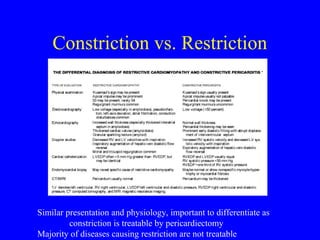
Constriction vs. Restriction
Similar presentation and physiology, important to differentiate as
constriction is treatable by pericardiectomy
Majority of diseases causing restriction are not treatable
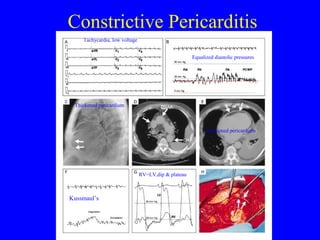
Constrictive Pericarditis
Kussmaul’s
RV=LV,dip & plateau
Equalized diastolic pressures
Tachycardia, low voltage
Thickened pericardium
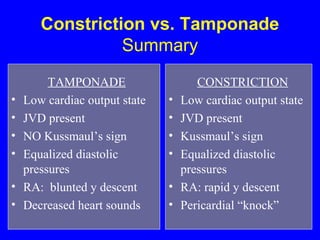
TAMPONADE
• Low cardiac output state
• JVD present
• NO Kussmaul’s sign
• Equalized diastolic
pressures
• RA: blunted y descent
• Decreased heart sounds
CONSTRICTION
• Low cardiac output state
• JVD present
• Kussmaul’s sign
• Equalized diastolic
pressures
• RA: rapid y descent
• Pericardial “knock”
Constriction vs. Tamponade
Summary
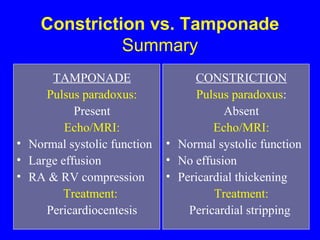
Constriction vs. Tamponade
Summary
TAMPONADE
Pulsus paradoxus:
Present
Echo/MRI:
• Normal systolic function
• Large effusion
• RA & RV compression
Treatment:
Pericardiocentesis
CONSTRICTION
Pulsus paradoxus:
Absent
Echo/MRI:
• Normal systolic function
• No effusion
• Pericardial thickening
Treatment:
Pericardial stripping

Pericarditis. Pericardial Disease

  • 1.
  • 2.
    Pericardium - Anatomy •Normalpericardium is a fibro-serous sac which surrounds the heart and adjoining portions of the great vessels. •The inner visceral layer, also known as the epicardium, consists of a thin layer of mesothelial cells closely adherent to the surface of the heart. The epicardium is reflected onto the surface of the outer fibrous layer with which it forms the parietal pericardium. •The parietal pericardium consists of collagenous fibrous tissue and elastic fibrils. •Between the two layers lies the pericardial space, which contains approximately 10-50ml of fluid, which is an ultrafiltrate of plasma. •Drainage of pericardial fluid is via right lymphatic duct and thoracic duct.
  • 3.
    Pericardium: Anatomy Pericardial Layers: •Visceral layer • Parietal layer • Fibrous pericardium
  • 4.
    Function of thePericardium 1. Stabilization of the heart within the thoracic cavity by virtue of its ligamentous attachments -- limiting the heart’s motion. 2. Protection of the heart from mechanical trauma and infection from adjoining structures. 3. The pericardial fluid functions as a lubricant and decreases friction of cardiac surface during systole and diastole. 4. Prevention of excessive dilation of heart especially during sudden rise in intra-cardiac volume (e.g. acute aortic or mitral regurgitation).
  • 5.
    Sponsored Medical Lecture Notes– All Subjects USMLE Exam (America) – Practice
  • 6.
    Etiologies of PericarditisI.INFECTIVE 1. VIRAL - Coxsackie A and B, Influenza, adenovirus, HIV, etc. 2. BACTERIAL - Staphylococcus, pneumococcus, tuberculosis, etc. 3. FUNGAL - Candida 4. PARASITIC - Amoeba, candida, etc. II. AUTOIMMUNE DISORDERS 1. Systemic lupus erythematosus (SLE) 2. Drug-Induced lupus (e.g. Hydralazine, Procainamide) 3. Rheumatoid Arthritis 4. Post Cardiac Injury Syndromes i.e. postmyocardial Infarction (Dressler's) Syndrome, postcardiotomy syndrome, etc. III. NEOPLASM 1. Primary mesothelioma 2. Secondary, metastatic 3. Direct extension from adjoining tumor IV. RADIATION PERICARDITIS V. RENAL FAILURE (uremia) VI. TRAUMATIC CARDIAC INJURY 1. Penetrating - stab wound, bullet wound 2. Blunt non-penetrating - automobile steering wheel accident VII. IDIOPATHIC
  • 7.
    Pathogenesis 1) Vasodilation:  transudationof fluid 2) Increased vascular permeability  leakage of protein 3) Leukocyte exudation neutrophils and mononuclear cells Pathology depends on underlying cause and severity of inflammation serous pericarditis serofibrinous pericarditis suppurative (purulent) pericarditis hemorrhagic pericarditis
  • 8.
    Clinical Features ofAcute Pericarditis Idiopathic/viral * Pleuritic Chest pain * Fever * Pericardial Friction Rub 3 component: a) atrial or pre-systolic component b) ventricular systolic component (loudest) c) ventricular diastolic component * EKG: diffuse ST elevation PR segment depression
  • 9.
    EKG findings inPericarditis
  • 10.
    Diagnostic Tests Echocardiogram: Pericardialeffusion N.B.: absence does not rule out pericarditis N.B.: Pericarditis is a clinical diagnosis, not an Echo diagnosis! Blood tests: PPD, RF, ANA Viral titers Search for malignancy Pericardiocentesis: low diagnostic yield done therapeutically
  • 11.
    Treatment Pain relief analgesics andanti-inflammatory ASA/NSAID’s Steroids for recurring pericarditis Antibiotics/drainage for purulent pericarditis Dialysis for uremic pericarditis Neoplastic: XRT, chemotherapy
  • 12.
    Pericardial Effusion Normal 15-50ml of fluid ETIOLOGY 1. Inflammation from infection, immunologic process. 2. Trauma causing bleeding in pericardial space. 3. Noninfectious conditions such as: a. increase in pulmonary hydrostatic pressure e.g. congestive heart failure. b. increase in capillary permeability e.g. hypothyroidism c. decrease in plasma oncotic pressure e.g. cirrhosis. 4. Decreased drainage of pericardial fluid due to obstruction of thoracic duct as a result of malignancy or damage during surgery. • Effusion may be serous, serofibrinous, suppurative, chylous, or hemorrhagic depending on the etiology. • Viral effusions are usually serous or serofibrinous • Malignant effusions are usually hemorrhagic.
  • 13.
    Pathophysiology Pericardium relatively stiff Symptomsof cardiac compression dependant on: 1. Volume of fluid 2. Rate of fluid accumulation 3. Compliance characteristics of the pericardium A. Sudden increase of small amount of fluid (e.g. trauma) B. Slow accumulation of large amount of fluid (e.g. CHF)
  • 14.
    Clinical features Small effusionsdo not produce hemodynamic abnormalities. Large effusions, in addition to causing hemodynamic compromise, may lead to compression of adjoining structures and produce symptoms of: dysphagia (compression of esophagus) hoarseness (recurrent laryngeal nerve compression) hiccups (diaphragmatic stimulation) dyspnea (pleural inflammation/effusion)
  • 15.
    Physical Findings Physical Findings: •Muffled heart sounds • Paradoxically reduced intensity of rub • Ewart's sign: Compression of lung leading to an area of consolidation in the left infrascapular region (atalectasis, detected as dullness to percussion and bronchial breathing)
  • 16.
    Diagnostic studies CXR: “waterbottle” shaped heart EKG:  low voltage  “electrical alternans” Echocardiogram
  • 17.
    Cardiac Tamponade Fluid underhigh pressure compresses the cardiac chambers: acute: trauma, LV rupture – may not be very large gradual: large effusion, due to any etiology of acute pericarditis
  • 18.
    CardiacTamponade -- Pathophysiology Accumulationof fluid under high pressure: compresses cardiac chambers & impairs diastolic filling of both ventricles ↓ SV ↑venous pressures ↓ CO systemic pulmonary congestion Hypotension/shock JVD rales Reflex tachycardia hepatomegaly ascites peripheral edema
  • 19.
    Tamponade-- Clinical Features Symptoms: Acute:(trauma, LV rupture) profound hypotension confusion/agitation Slow/Progressive large effusion (weeks) Fatigue (↓CO) Dyspnea JVD Signs: Tachycardia Hypotension rales/edema/ascites muffled heart sounds pulsus paradoxus
  • 20.
    Pulsus Paradoxus Intrapericardial pressure(IPP) tracks intrathoracic pressure. Inspiration: negative intrathoracic pressure is transmitted to the pericardial space ↓ IPP ↑ blood return to the right ventricle ↓ jugular venous and right atrial pressures ↑ right ventricular volume  interventricular septum shifts towards the left ventricle ↓ left ventricular volume ↓ LV stroke volume ⇒ ↓ blood pressure (<10mmHg is normal) during inspiration
  • 21.
    Pulsus Paradoxus Exaggeration ofnormal physiology > 10 mm Hg drop in BP with inspiration
  • 22.
    Tamponade -- Diagnosis EKG:low voltage, sinus tachycardia, electrical alternans Echocardiography pericardial effusion (r/o other etiologies in dif dx) RA and RV diastolic collapse
  • 23.
    Right Heart Catheterization CatheterizationFindings: Elevated RA and RV diastolic pressures Equalized diastolic pressures Blunted “y” descent in RA tracing y descent: early diastolic filling (atrial emptying) ↓ BP and Pulsus paradoxus Pericardial pressure = RA pressure
  • 24.
    Jugular venous pressureJugularvenous pressure waveswaves • Normal JVP contours (1) A-wave • 1) results from ATRIAL contraction • 2) Timing - PRESYSTOLIC • 3) Peak of the a-wave near S1 (2) V-wave 1) results from PASSIVE filling of the right atrium while the tricuspid valve is closed during ventricular systole (Remember the V-wave is a "V"ILLING WAVE) 2) Large V-waves on the left side of the heart may be seen with mitral regurgitation, atrial septal defect, ventricular septal defect. The v-wave in the jugular venous pulse reflects right atrial events. To see the v-wave on the left side of the heart Swan-Ganz monitoring is needed 3) timing - peaks just after S2 (3) X-descent 1) results from ATRIAL RELAXATION 2) timing - occurs during ventricular systole, at the same time as the carotid pulse occurs (4) Y-descent 1) results from a FALL in right atrial pressure associated with opening of the tricuspid valve 2) timing - occurs during ventricular diastole (5) Generalizations 1) the A-wave in a normal individual is always larger than the V-wave 2) the X-descent is MORE PROMINENT than the Y-descent
  • 25.
    RA Pressure Tracing awave: atrial contraction v wave: passive filling of atria during ventricular systole with mv/tv closed y descent: early atrial emptying with mv/tv open (early passive filling of ventricle) Tamponade: blunted y descent (impaired rapid ventricular filling due to compression by high pericardial pressure)
  • 26.
  • 27.
    Tamponade -- Treatment Pericardiocentesis PericardialWindow Balloon Pericardiotomy Pre-pericardiocentisis Post-pericardiocentesis
  • 28.
    Constrictive Pericarditis Late complicationof pericardial disease Fibrous scar formation Fusion of pericardial layers Calcification further stiffens pericardium Etiologies: any cause of pericarditis idiopathic post-surgery tuberculosis radiation neoplasm
  • 29.
    Pathophysiology Rigid, scarred pericardiumencircles heart: Systolic contraction normal Inhibits diastolic filling of both ventricles ↓ SV ↑venous pressures ↓ CO systemic pulmonary congestion Hypotension/shock JVD rales Reflex tachycardia hepatomegaly ascites peripheral edema
  • 30.
    Physical exam ↑HR, ↓BP ascites,edema, hepatomegaly early diastolic “knock” after S2 sudden cessation of ventricular diastolic filling imposed by rigid pericardial sac Kussmaul’s sign
  • 31.
    Kussmaul’s Sign inspiration: ↓intrathoracicpressure, ↑ venous return to thorax ↓intrathoracic pressure not transmitted though to RV ⇒ no pulsus paradoxus! no inspiratory augmentation of RV filling (rigid pericardium) intrathoracic systemic veins become distended ⇒JVP rises with inspiration (normally falls)
  • 32.
    Diagnosis CXR: calcified cardiacsilhouette EKG: non-specific CT or MRI: pericardial thickening
  • 33.
    Cardiac Catheterization Prominent ydescent: “dip and plateau”: rapid atrial emptying rapid ventricular filling then abrupt cessation of blood flow due to rigid pericardium Elevated and equalized diastolic pressures (RA=RVEDP=PAD=PCW)
  • 34.
    Constriction vs. Restriction Similarpresentation and physiology, important to differentiate as constriction is treatable by pericardiectomy Majority of diseases causing restriction are not treatable
  • 35.
    Constrictive Pericarditis Kussmaul’s RV=LV,dip &plateau Equalized diastolic pressures Tachycardia, low voltage Thickened pericardium Thickened pericardium
  • 36.
    TAMPONADE • Low cardiacoutput state • JVD present • NO Kussmaul’s sign • Equalized diastolic pressures • RA: blunted y descent • Decreased heart sounds CONSTRICTION • Low cardiac output state • JVD present • Kussmaul’s sign • Equalized diastolic pressures • RA: rapid y descent • Pericardial “knock” Constriction vs. Tamponade Summary
  • 37.
    Constriction vs. Tamponade Summary TAMPONADE Pulsusparadoxus: Present Echo/MRI: • Normal systolic function • Large effusion • RA & RV compression Treatment: Pericardiocentesis CONSTRICTION Pulsus paradoxus: Absent Echo/MRI: • Normal systolic function • No effusion • Pericardial thickening Treatment: Pericardial stripping