ECHO IN PERICARDIAL
DISEASES
MURTAZA KAMAL
SEPT 3, 2019
1
Scope of the talk
Introduction
Anatomy
Pathophysiology
Diseases
2
So, lets start with the pioneer…
3
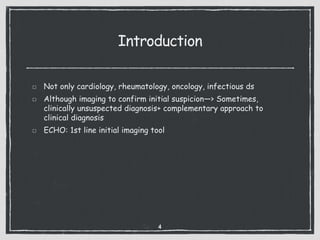
Introduction
Not only cardiology, rheumatology, oncology, infectious ds
Although imaging to confirm initial suspicion—> Sometimes,
clinically unsuspected diagnosis+ complementary approach to
clinical diagnosis
ECHO: 1st line initial imaging tool
4
Strengths+ Weaknesses…
5
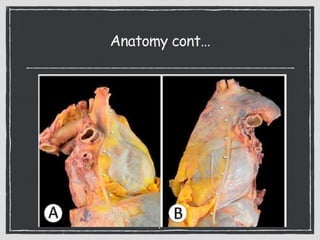
Anatomy of pericardium
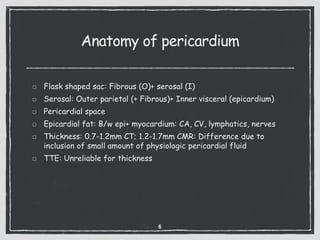
Flask shaped sac: Fibrous (O)+ serosal (I)
Serosal: Outer parietal (+ Fibrous)+ Inner visceral (epicardium)
Pericardial space
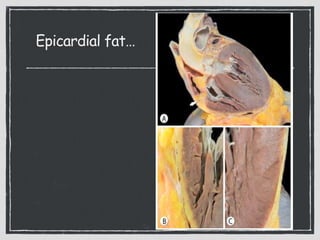
Epicardial fat: B/w epi+ myocardium: CA, CV, lymphatics, nerves
Thickness: 0.7-1.2mm CT; 1.2-1.7mm CMR: Difference due to
inclusion of small amount of physiologic pericardial fluid
TTE: Unreliable for thickness
6
Anatomy cont…
7
Epicardial fat…
8
Lymphatic drainage, vascular supply
and innervation
< 50 mm serous fluid: Plasma ultrafiltrate from epicardial+ parietal pericardial
capillaries; Prostaglandins from meso+ endothelial cells—> Modulation of
cardiac reflexes+ coronary tone—> Drainage by lymphatics on heart surface+
parietal pericardium
Arterial supply: Pericardiophrenic+ musculophrenic arteries (Br of ITA+ DTA)
Venous drainage: Pericardiophrenic veins—> Superior intercostal veins+
internal thoracic veins—> Innominate veins
Nerve innervation:
PS supply: Vagus+ Lt RLN, Br from oesophageal plexus
Sensory fibers: Phrenic nerve
Sympathetic: 1st dorsal ganglion, stellate ganglion and aortic, cardiac and
diaphragmatic plexus
9
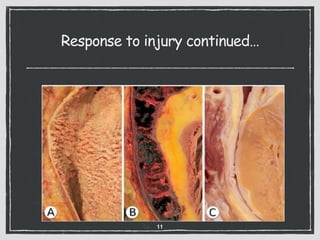
Pericardial response to injury…
Exudation of fluid, fibrin, inflammatory cells
Healing with organisation: Focal/ diffuse obliteration of
pericardial cavity by adhesions b/w vis+ parie pericardium
Ch. effusions—> Pericardial thickening
Loculated fluid accumulation: Cardiac compression
Calcific deposits: Focal/ extensive—> End stage reaction to injury
10
Response to injury continued…
11
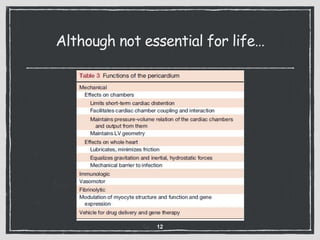
Although not essential for life…
12
Mechanical effects of pericardium
If cut—> Inelastic parietal pericardium retracts—> Exerts pressure on
underlying myocardial chambers—> Effect greatest on thinner walled RA+
RV
Effect on cardiac chamber pressures magnified by:
Rapid rise in total cardiac volume:Exercise, hypervolumia, acute
severe valvular regurgitation
Increase in pericardial fluid above normal “reserve volume”—>
Increases cardiac pressures+ reduces cardiac filling
Hypovolumia: Diminishes mechanical effects of pericardium on heart
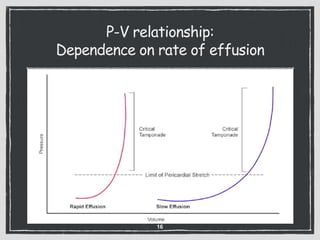
Pericardial reserve volume + P-V
relations
Pericardial reserve volume <50ml
Amount adequate to allow increased rt heart filling with normal
inspiration, without increased pericardial restrain+ increased rt
heart chamber pressures
If marked swings in intra thoracic pressures (acute dyspnea)—> Rt
ht filling during inspiration can exceed pericardial reserve
volume—> Pericardial constrain + cardiac pressure rise
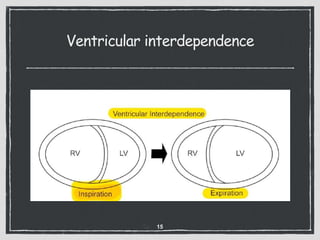
This rt ht overfilling—> decreases lt ht filling—> Ventricular
interdependence
Chiefly in diastole—> Due to in elastic parietal pericardium (CP, CT,
acute cardiac dilatation)
14
Ventricular interdependence
15
P-V relationship:
Dependence on rate of effusion
16
Pericardial diseases…
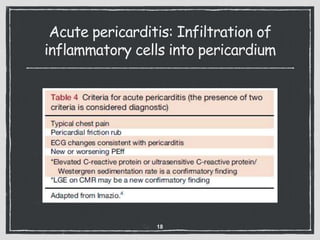
Acute pericarditis: Infiltration of
inflammatory cells into pericardium
18
Instructions for imaging…
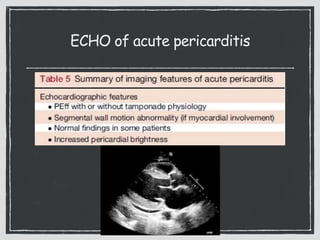
ECHO recommended as initial non invasive imaging test—>
Accurate to access PEff+ tamponade physiology: Within 24 hrs
May appear normal; +nce of PEff consistent with acute
pericarditis
Increased pericardial brightness, pericardial thickning, abnormal
septal bounce suggesting early constriction
3%: Tamponade physiology
19
ECHO of acute pericarditis
20
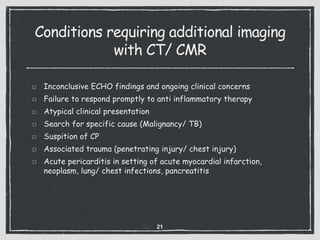
Conditions requiring additional imaging
with CT/ CMR
Inconclusive ECHO findings and ongoing clinical concerns
Failure to respond promptly to anti inflammatory therapy
Atypical clinical presentation
Search for specific cause (Malignancy/ TB)
Suspition of CP
Associated trauma (penetrating injury/ chest injury)
Acute pericarditis in setting of acute myocardial infarction,
neoplasm, lung/ chest infections, pancreatitis
21
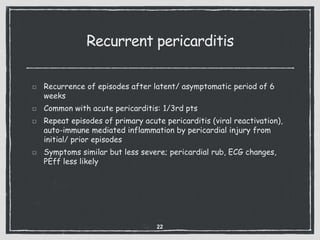
Recurrent pericarditis
Recurrence of episodes after latent/ asymptomatic period of 6
weeks
Common with acute pericarditis: 1/3rd pts
Repeat episodes of primary acute pericarditis (viral reactivation),
auto-immune mediated inflammation by pericardial injury from
initial/ prior episodes
Symptoms similar but less severe; pericardial rub, ECG changes,
PEff less likely
22
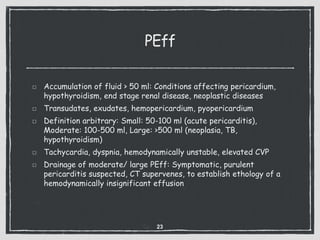
PEff
Accumulation of fluid > 50 ml: Conditions affecting pericardium,
hypothyroidism, end stage renal disease, neoplastic diseases
Transudates, exudates, hemopericardium, pyopericardium
Definition arbitrary: Small: 50-100 ml (acute pericarditis),
Moderate: 100-500 ml, Large: >500 ml (neoplasia, TB,
hypothyroidism)
Tachycardia, dyspnia, hemodynamically unstable, elevated CVP
Drainage of moderate/ large PEff: Symptomatic, purulent
pericarditis suspected, CT supervenes, to establish ethology of a
hemodynamically insignificant effusion
23
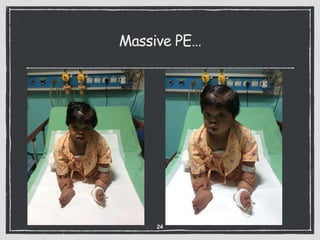
Massive PE…
24
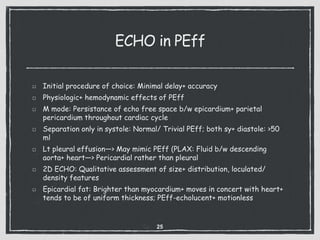
ECHO in PEff
Initial procedure of choice: Minimal delay+ accuracy
Physiologic+ hemodynamic effects of PEff
M mode: Persistance of echo free space b/w epicardium+ parietal
pericardium throughout cardiac cycle
Separation only in systole: Normal/ Trivial PEff; both sy+ diastole: >50
ml
Lt pleural effusion—> May mimic PEff (PLAX: Fluid b/w descending
aorta+ heart—> Pericardial rather than pleural
2D ECHO: Qualitative assessment of size+ distribution, loculated/
density features
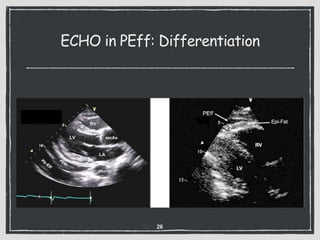
Epicardial fat: Brighter than myocardium+ moves in concert with heart+
tends to be of uniform thickness; PEff-echolucent+ motionless
25
ECHO in PEff: Differentiation
26
Echo
evaluation…
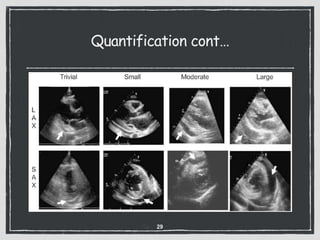
PEff quantification by 2D ECHO…
Seen in end diastole:
Trivial: Seen in systole only
Small: <10 mm
Moderate: 10-20 mm
Large: >20 mm
Very large: >25 mm
Exudate PEff: Strands, adhesions, uneven distribution reflecting
more inflammatory and complicated nature
28
Quantification cont…
29
When to consider additional imaging?
CMT/ CT:
Complex located effusions
Clot in effusion
Localisation, characterisation and quantification of fluid
30
CT
Life threatening, compresses cardiac chambers+ inhibits normal
filling
Elevation+ equalisation of cardiac diastolic + pericardial pressures,
reduced CO, exaggerated inspiratory decrease in SBP > 10 mm Hg
(PP)
Pericardial pressure rises—> Systemic+ PV pressures must increase
to maintain cardiac filling
Venocardiac gradients continue to decrease as tamponade increases—
> Progressive decrease in CO
Exhausted compensatory mechanisms—> Preload insufficient to
sustain cardiac filling+ coronary and systemic perfusion—> Abrupt
drop in HR+ BP (Terminal event)
31
CT cont…
Excessive pericardial fluid raises pressure in all chambers
throughout cardiac cycle—> Diminishes cardiac filling + CO
Atrial filling from systemic+ pulmonary veins predominates over
diastolic filling as pericardial pressure falls mainly during early
vent systole, when total cardiac volume is falling due to vent
ejection
Ventricular diastolic filling reduces due to reduced inflow
pressure gradient
Ventricular interdependence
32
CT cont…
Mild (asymptomatic) to severe (tachycardia+ marked dyspnea)
Hypotention late feature ( highlighted sympathetic tone maintains
systemic BP as CO is decreasing)
Compensatory mechanisms (tachycardia/ increased systemic
venous pressures to maintain cardiac filling/ arterial
vasoconstriction) exhaused—> Decrease in arterial pressure+
coronary perfusion —> Cardiac arrest+ death
LOW PRESSURE TAMPONADE: Hypovolumia—> Cardiac filling is
severely impaired, but equalised pericardial and end- diastolic
intracardiac pressures are normal at <10 mm Hg
33
CT associated with cardiac surgery
Early: <24 h: Surgical bleeding, cardio-pulmonary bypass induced
coagulopathy—> Should be suspected when ever haemodynamic
compromise
Late: >5-7 days: Excessive mediasinal drainage, post craniotomy
syndrome (occurs after days to weeks, with PEff+ inflammatory
component)
During PPV: The mitral inflow patterns show very minimal
respiratory variation—> Can be missed
34
ECHO in CT
Emergency
Regardless of effusion size: CT is potentially lethal
PEff, dilated IVC+ hepatic veins (elevated systemic venous
pressures), LV with decreased ED+ ES dimensions, reduced stroke
volume+ CO
Rt heart diastolic chamber collapse when pericardial pressures
exceeds intra cardiac pressures, inspiratory septal bounce into LV,
respiratory changes in doppler flow velocity recordings
35
Echo of CT cont…
RV diastolic diameter increases during inspiration, LV diastolic
diameter decreases, with opposites seen during expiration
36
Echo of CT cont…
> 90% pts: IVC plethora
Dilated IVC (>2.1cm) with <50% reductio in diameter during
inspiration—> Elevation in systemic venous pressure which occurs
as pericardial pressure increases intracardiac pressures
Dilatation of hepatic veins
37
ECHO of CT cont…
RA+ RV collapses during their relaxation phase when
intracavitatory pressure reaches its lowest value and transiently
falls below pericardial pressures
Atria: Indentation starts near peak of R wave
Ventricles: Early diastole after end of T wave
Duration of RA collapse >1/3rd of cardiac cycle: 100% Sn+Sp for
clinical cardiac tamponade
Absence of any cardiac chamber collapse:>90% negative predictive
value for clinical cardiac tamponade
38
ECHO of CT cont…
Inspiratory bounce of IVS into LV during inspiration: Not
specific- Seen in cases with PP (Pul embolism, COPD, dyspnea due
to metabolic disorders)
Inspiratory septal bulge may be absent with CT in: LVH, pre
existing markedly elevated LV filling pressures
39
ECHO in CT cont…
40
Doppler flow velocity recordings…
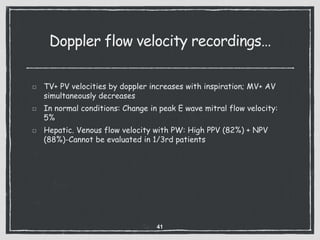
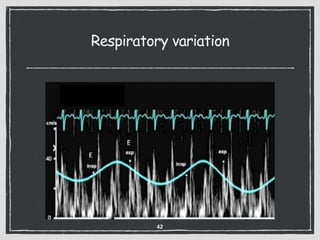
TV+ PV velocities by doppler increases with inspiration; MV+ AV
simultaneously decreases
In normal conditions: Change in peak E wave mitral flow velocity:
5%
Hepatic. Venous flow velocity with PW: High PPV (82%) + NPV
(88%)-Cannot be evaluated in 1/3rd patients
41
Respiratory variation
42
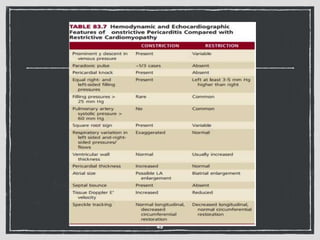
CT & CP
43
CP cont…
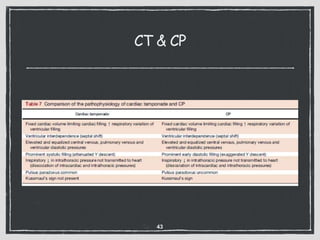
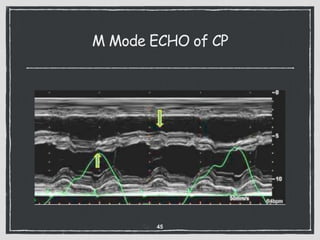
Increased pericardial thickness suggested by parallel motion of
visceral + parietal pericardium, separated by a echo free space
IVC: Absence of a dilated IVC in a patient without recent diuresis
should call into question the diagnosis of hemodynamically
significant CP
44
M Mode ECHO of CP
45
Doppler flow velocity recordings…
High early (E) velocity, shortened deceleration time, reduced
atrial wave (A)
%tage respi variation: (Expi-Inspi)/ Expi
MV: 25%
TV: 40%
Hepatic vein diastolic flow reversal increases with expiration,
reflecting ventricular interaction+ dissociation of intracardiac+
intrathoracic pressures
46
CP cont…
Usually +ve linear relationship b/w E/e’ ratio and LA pressure,
which is useful for assessing LA pressure in cardiomyopathy, is
reversed in CP: Annulus paradoxes
Medial e’ increases progressively as severity of constriction
becomes worse. Lateral mitral annular e’ is usually lower than e’
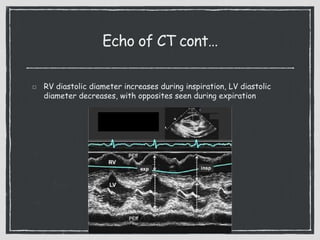
from medial annulus: Annulus reversus
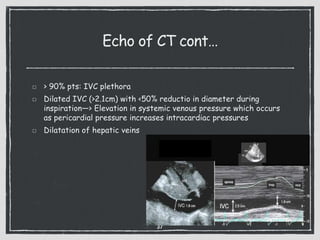
Annulus reversus: Tethering of lateral mitral annulus to thickened
pericardium
After pericardectomy, lateral + medial mitral annulus normalises
47
Strain imaging
Reduced:
Circumferential strain
Tortion
Early diastolic untwisting
Unchanged:
GLS
48
49
Effusive CP
Occurs when pericardial fluid accumulates b/w a thickened,
oedematous or fibrotic parietal+ visceral pericardium
Hallmark: Elevated RA pressure, elevated RV+ LV EDPs with
associated dip+ plateau ventricular waveforms, respiratory inter
ventricular dependence—> Occuring after pericardiocentesis
50
Congenital absence of pericardium
Case reports/ small series
Isolated (65%), associated with other congenital disorder
5 types:
Complete absence of entire pericardium
Complete absence of rt/lt sided pericardium
Partial: lt/ rt sided
MC: Complete absence of lt pericardium
Young, male patient with non specific symptoms of chest pain,
dyspnea, palpitation
Laterally displaced apical impulse, migratory apical pulsations, ESM
may be present due to excessive heart motion
51
Congenital absence of pericardium
cont…
Partial left sided defects: Greatest risk—> compression,
herniation, strangulation of cardiac chambers, great vessels or
coronaries
ECHO:
Unusual imaging windows
Appearance of an enlarged RV
Excessive cardiac motion
Abnormal IVS motion
Tear drop cardiac shape: Elongation of atrium + widening
of ventricles
52
Take home message
Echo initial test
CMR/ CT needed when poor window, complexity not handled by
echo, tissue characterisation needed-edema or inflammation
53
Thank you
54

Echo in pericardial diseases

  • 1.
  • 2.
    Scope of thetalk Introduction Anatomy Pathophysiology Diseases 2
  • 3.
    So, lets startwith the pioneer… 3
  • 4.
    Introduction Not only cardiology,rheumatology, oncology, infectious ds Although imaging to confirm initial suspicion—> Sometimes, clinically unsuspected diagnosis+ complementary approach to clinical diagnosis ECHO: 1st line initial imaging tool 4
  • 5.
  • 6.
    Anatomy of pericardium Flaskshaped sac: Fibrous (O)+ serosal (I) Serosal: Outer parietal (+ Fibrous)+ Inner visceral (epicardium) Pericardial space Epicardial fat: B/w epi+ myocardium: CA, CV, lymphatics, nerves Thickness: 0.7-1.2mm CT; 1.2-1.7mm CMR: Difference due to inclusion of small amount of physiologic pericardial fluid TTE: Unreliable for thickness 6
  • 7.
  • 8.
  • 9.
    Lymphatic drainage, vascularsupply and innervation < 50 mm serous fluid: Plasma ultrafiltrate from epicardial+ parietal pericardial capillaries; Prostaglandins from meso+ endothelial cells—> Modulation of cardiac reflexes+ coronary tone—> Drainage by lymphatics on heart surface+ parietal pericardium Arterial supply: Pericardiophrenic+ musculophrenic arteries (Br of ITA+ DTA) Venous drainage: Pericardiophrenic veins—> Superior intercostal veins+ internal thoracic veins—> Innominate veins Nerve innervation: PS supply: Vagus+ Lt RLN, Br from oesophageal plexus Sensory fibers: Phrenic nerve Sympathetic: 1st dorsal ganglion, stellate ganglion and aortic, cardiac and diaphragmatic plexus 9
  • 10.
    Pericardial response toinjury… Exudation of fluid, fibrin, inflammatory cells Healing with organisation: Focal/ diffuse obliteration of pericardial cavity by adhesions b/w vis+ parie pericardium Ch. effusions—> Pericardial thickening Loculated fluid accumulation: Cardiac compression Calcific deposits: Focal/ extensive—> End stage reaction to injury 10
  • 11.
    Response to injurycontinued… 11
  • 12.
    Although not essentialfor life… 12
  • 13.
    Mechanical effects ofpericardium If cut—> Inelastic parietal pericardium retracts—> Exerts pressure on underlying myocardial chambers—> Effect greatest on thinner walled RA+ RV Effect on cardiac chamber pressures magnified by: Rapid rise in total cardiac volume:Exercise, hypervolumia, acute severe valvular regurgitation Increase in pericardial fluid above normal “reserve volume”—> Increases cardiac pressures+ reduces cardiac filling Hypovolumia: Diminishes mechanical effects of pericardium on heart
  • 14.
    Pericardial reserve volume+ P-V relations Pericardial reserve volume <50ml Amount adequate to allow increased rt heart filling with normal inspiration, without increased pericardial restrain+ increased rt heart chamber pressures If marked swings in intra thoracic pressures (acute dyspnea)—> Rt ht filling during inspiration can exceed pericardial reserve volume—> Pericardial constrain + cardiac pressure rise This rt ht overfilling—> decreases lt ht filling—> Ventricular interdependence Chiefly in diastole—> Due to in elastic parietal pericardium (CP, CT, acute cardiac dilatation) 14
  • 15.
  • 16.
  • 17.
  • 18.
    Acute pericarditis: Infiltrationof inflammatory cells into pericardium 18
  • 19.
    Instructions for imaging… ECHOrecommended as initial non invasive imaging test—> Accurate to access PEff+ tamponade physiology: Within 24 hrs May appear normal; +nce of PEff consistent with acute pericarditis Increased pericardial brightness, pericardial thickning, abnormal septal bounce suggesting early constriction 3%: Tamponade physiology 19
  • 20.
    ECHO of acutepericarditis 20
  • 21.
    Conditions requiring additionalimaging with CT/ CMR Inconclusive ECHO findings and ongoing clinical concerns Failure to respond promptly to anti inflammatory therapy Atypical clinical presentation Search for specific cause (Malignancy/ TB) Suspition of CP Associated trauma (penetrating injury/ chest injury) Acute pericarditis in setting of acute myocardial infarction, neoplasm, lung/ chest infections, pancreatitis 21
  • 22.
    Recurrent pericarditis Recurrence ofepisodes after latent/ asymptomatic period of 6 weeks Common with acute pericarditis: 1/3rd pts Repeat episodes of primary acute pericarditis (viral reactivation), auto-immune mediated inflammation by pericardial injury from initial/ prior episodes Symptoms similar but less severe; pericardial rub, ECG changes, PEff less likely 22
  • 23.
    PEff Accumulation of fluid> 50 ml: Conditions affecting pericardium, hypothyroidism, end stage renal disease, neoplastic diseases Transudates, exudates, hemopericardium, pyopericardium Definition arbitrary: Small: 50-100 ml (acute pericarditis), Moderate: 100-500 ml, Large: >500 ml (neoplasia, TB, hypothyroidism) Tachycardia, dyspnia, hemodynamically unstable, elevated CVP Drainage of moderate/ large PEff: Symptomatic, purulent pericarditis suspected, CT supervenes, to establish ethology of a hemodynamically insignificant effusion 23
  • 24.
  • 25.
    ECHO in PEff Initialprocedure of choice: Minimal delay+ accuracy Physiologic+ hemodynamic effects of PEff M mode: Persistance of echo free space b/w epicardium+ parietal pericardium throughout cardiac cycle Separation only in systole: Normal/ Trivial PEff; both sy+ diastole: >50 ml Lt pleural effusion—> May mimic PEff (PLAX: Fluid b/w descending aorta+ heart—> Pericardial rather than pleural 2D ECHO: Qualitative assessment of size+ distribution, loculated/ density features Epicardial fat: Brighter than myocardium+ moves in concert with heart+ tends to be of uniform thickness; PEff-echolucent+ motionless 25
  • 26.
    ECHO in PEff:Differentiation 26
  • 27.
  • 28.
    PEff quantification by2D ECHO… Seen in end diastole: Trivial: Seen in systole only Small: <10 mm Moderate: 10-20 mm Large: >20 mm Very large: >25 mm Exudate PEff: Strands, adhesions, uneven distribution reflecting more inflammatory and complicated nature 28
  • 29.
  • 30.
    When to consideradditional imaging? CMT/ CT: Complex located effusions Clot in effusion Localisation, characterisation and quantification of fluid 30
  • 31.
    CT Life threatening, compressescardiac chambers+ inhibits normal filling Elevation+ equalisation of cardiac diastolic + pericardial pressures, reduced CO, exaggerated inspiratory decrease in SBP > 10 mm Hg (PP) Pericardial pressure rises—> Systemic+ PV pressures must increase to maintain cardiac filling Venocardiac gradients continue to decrease as tamponade increases— > Progressive decrease in CO Exhausted compensatory mechanisms—> Preload insufficient to sustain cardiac filling+ coronary and systemic perfusion—> Abrupt drop in HR+ BP (Terminal event) 31
  • 32.
    CT cont… Excessive pericardialfluid raises pressure in all chambers throughout cardiac cycle—> Diminishes cardiac filling + CO Atrial filling from systemic+ pulmonary veins predominates over diastolic filling as pericardial pressure falls mainly during early vent systole, when total cardiac volume is falling due to vent ejection Ventricular diastolic filling reduces due to reduced inflow pressure gradient Ventricular interdependence 32
  • 33.
    CT cont… Mild (asymptomatic)to severe (tachycardia+ marked dyspnea) Hypotention late feature ( highlighted sympathetic tone maintains systemic BP as CO is decreasing) Compensatory mechanisms (tachycardia/ increased systemic venous pressures to maintain cardiac filling/ arterial vasoconstriction) exhaused—> Decrease in arterial pressure+ coronary perfusion —> Cardiac arrest+ death LOW PRESSURE TAMPONADE: Hypovolumia—> Cardiac filling is severely impaired, but equalised pericardial and end- diastolic intracardiac pressures are normal at <10 mm Hg 33
  • 34.
    CT associated withcardiac surgery Early: <24 h: Surgical bleeding, cardio-pulmonary bypass induced coagulopathy—> Should be suspected when ever haemodynamic compromise Late: >5-7 days: Excessive mediasinal drainage, post craniotomy syndrome (occurs after days to weeks, with PEff+ inflammatory component) During PPV: The mitral inflow patterns show very minimal respiratory variation—> Can be missed 34
  • 35.
    ECHO in CT Emergency Regardlessof effusion size: CT is potentially lethal PEff, dilated IVC+ hepatic veins (elevated systemic venous pressures), LV with decreased ED+ ES dimensions, reduced stroke volume+ CO Rt heart diastolic chamber collapse when pericardial pressures exceeds intra cardiac pressures, inspiratory septal bounce into LV, respiratory changes in doppler flow velocity recordings 35
  • 36.
    Echo of CTcont… RV diastolic diameter increases during inspiration, LV diastolic diameter decreases, with opposites seen during expiration 36
  • 37.
    Echo of CTcont… > 90% pts: IVC plethora Dilated IVC (>2.1cm) with <50% reductio in diameter during inspiration—> Elevation in systemic venous pressure which occurs as pericardial pressure increases intracardiac pressures Dilatation of hepatic veins 37
  • 38.
    ECHO of CTcont… RA+ RV collapses during their relaxation phase when intracavitatory pressure reaches its lowest value and transiently falls below pericardial pressures Atria: Indentation starts near peak of R wave Ventricles: Early diastole after end of T wave Duration of RA collapse >1/3rd of cardiac cycle: 100% Sn+Sp for clinical cardiac tamponade Absence of any cardiac chamber collapse:>90% negative predictive value for clinical cardiac tamponade 38
  • 39.
    ECHO of CTcont… Inspiratory bounce of IVS into LV during inspiration: Not specific- Seen in cases with PP (Pul embolism, COPD, dyspnea due to metabolic disorders) Inspiratory septal bulge may be absent with CT in: LVH, pre existing markedly elevated LV filling pressures 39
  • 40.
    ECHO in CTcont… 40
  • 41.
    Doppler flow velocityrecordings… TV+ PV velocities by doppler increases with inspiration; MV+ AV simultaneously decreases In normal conditions: Change in peak E wave mitral flow velocity: 5% Hepatic. Venous flow velocity with PW: High PPV (82%) + NPV (88%)-Cannot be evaluated in 1/3rd patients 41
  • 42.
  • 43.
  • 44.
    CP cont… Increased pericardialthickness suggested by parallel motion of visceral + parietal pericardium, separated by a echo free space IVC: Absence of a dilated IVC in a patient without recent diuresis should call into question the diagnosis of hemodynamically significant CP 44
  • 45.
    M Mode ECHOof CP 45
  • 46.
    Doppler flow velocityrecordings… High early (E) velocity, shortened deceleration time, reduced atrial wave (A) %tage respi variation: (Expi-Inspi)/ Expi MV: 25% TV: 40% Hepatic vein diastolic flow reversal increases with expiration, reflecting ventricular interaction+ dissociation of intracardiac+ intrathoracic pressures 46
  • 47.
    CP cont… Usually +velinear relationship b/w E/e’ ratio and LA pressure, which is useful for assessing LA pressure in cardiomyopathy, is reversed in CP: Annulus paradoxes Medial e’ increases progressively as severity of constriction becomes worse. Lateral mitral annular e’ is usually lower than e’ from medial annulus: Annulus reversus Annulus reversus: Tethering of lateral mitral annulus to thickened pericardium After pericardectomy, lateral + medial mitral annulus normalises 47
  • 48.
  • 49.
  • 50.
    Effusive CP Occurs whenpericardial fluid accumulates b/w a thickened, oedematous or fibrotic parietal+ visceral pericardium Hallmark: Elevated RA pressure, elevated RV+ LV EDPs with associated dip+ plateau ventricular waveforms, respiratory inter ventricular dependence—> Occuring after pericardiocentesis 50
  • 51.
    Congenital absence ofpericardium Case reports/ small series Isolated (65%), associated with other congenital disorder 5 types: Complete absence of entire pericardium Complete absence of rt/lt sided pericardium Partial: lt/ rt sided MC: Complete absence of lt pericardium Young, male patient with non specific symptoms of chest pain, dyspnea, palpitation Laterally displaced apical impulse, migratory apical pulsations, ESM may be present due to excessive heart motion 51
  • 52.
    Congenital absence ofpericardium cont… Partial left sided defects: Greatest risk—> compression, herniation, strangulation of cardiac chambers, great vessels or coronaries ECHO: Unusual imaging windows Appearance of an enlarged RV Excessive cardiac motion Abnormal IVS motion Tear drop cardiac shape: Elongation of atrium + widening of ventricles 52
  • 53.
    Take home message Echoinitial test CMR/ CT needed when poor window, complexity not handled by echo, tissue characterisation needed-edema or inflammation 53
  • 54.