COMPLEXOMETRIC TITRATION
Introduction
Complexometric titration involves titration between
metal ion & complexing agent or chelating agent
(ligand).
In this method ion changed into a complex ion and
equivalence point is determined using metal indicator.
An EDTA used as popular complexing agent or chilon.
This chilon react with metal ion to form special type
of complex called chelate
• Complexometric titration is a form of
volumetric titration in which the formation of
a colored complex is used to indicate the end
point of a titration.
• The complexes are formed by the reaction of a
metal ion ( an acceptor, a central atom or a
cation) with an anion, a neutral molecule or
very rarely a positive ion.
• Complexometric titrations are particularly
useful for the determination of a mixture of
different metal ions in solution.
• An indicator capable of producing an distinct
color change is usually used to detect the end
point of the titration.
• Complexometry : is the type of volumetric
analysis involving the formation of complexes
which are slightly ionized in solution, like weak
electrolyte and sparingly soluble salt.
• Complex is formed by the reaction of metal
ion (Mn+) with either an anion e.g. [Ag(CN)2]-
or neutral molecule e.g. [Ag(NH3)2]+
• The metal ion is known as Central metal
atom.
• The anion or neutral molecule is known as
Ligand (L)
• M+ + L ML
• Ag+ + 2 CN- [Ag(CN)2]-
• Cu2+ + 4 CN- [Cu(CN)4]2-
• Ag+ + 2 NH3 [Ag(NH3)2]+
• Central metal atom = acts as Lewis acid
(electron acceptor)
• Ligand = acts as Lewis base (electron donor)
• Coordinate bond (dative) = The bond formed
between central metal atom (ion) (acceptor)
and the Ligand (donor)
• Dative bond is similar to covalent bond
(formed of two electrons) But in dative bond
the electrons pair are donated from one atom
to the other. The atom gives electron pair is
known as donor, while the atom accept
electron pair is known as acceptor. The bond
is represented by an arrow () from donor
to acceptor. NH3

NH3  Cu  NH3

NH3
Coordination number = The no. of coordinate
bonds formed to a metal ion by its ligands.
• The charge of a complex is the algebraic sum
of the charges of the central ion and ligand ..
e.g.
• [Ag(CN)2] -  Ag+ + 2 CN -
• 1 (+ve) + 2 (-ve) = 1 (-ve)
• e.g. [Fe(CN)6]3-  Fe3+ + 6 CN -
3 (+ve) + 6 (-ve) = 3 (-ve)
• The higher the valence of metal ion the more
stable the complex e.g.Ferricyanide is more
stable than Ferrocyanide
Types of complexing agents
Ligands can be classified as monodentate and
polydentate ligands depending upon the number of
ligand donor atoms that attach to the metal atom or ion.
• Unidentate (Monodentate) Ligand or "Simple Ligand"
• The ligand attached to metal at one site e.g. H2O , NH3
, CN - , Cl - , I - , Br - , (i.e. forming one coordinate bond,
or capable of donating one unshared pair of electrons)
H2C
H2C
NH2
NH2
H2C
H2C
NH2
NH2
CH2
CH2
H2N
H2N
Cu
+ Cu2+
2
• Bidentate Ligand
The ligand attached to metal at two sites.
Ethylene diamine
• Tridentate Ligand:
The Ligand attached to metal at 3 sites
• Tetradentate Ligand:
The Ligand attached to metal at 4 sites
Diethylene triamine
Triethylene tetramine
Ambidentate ligands:
Ligands that can attach themselves to the central
metal atom through two different atoms are called
ambidentate ligands.
For example:
(The donor atom is N)
(The donor atom is oxygen)
Complexing agents are different
types
1.Neutral molecules: neutral molecules having lone pair of
electron act as complexing agent
Example: ammonia forms cuprammonium complex with
copper [Cu(NH3)4]2+
2. Group whose proton can be easily replaced such as –
COOH, phenolic and enolic OH.
3.Sequestring agents having group like COOH, NH2 and OH.
Example of complexing agent: EDTA, Dimethylglyoxime,
salicylaldoxime
Chelation
Chelation involves the formation or presence
of two or more separate coordinate bonds
between a polydentate (multiple bonded)
ligand and a single central atom
Chelation
• Chelate : It is a complex formed between the
ligand containing two or more donor groups and
metal to form ring structure. (heterocyclic rings or
chelate rings).
• Chelating agents: organic molecules containing
two or more donor groups which combine with
metal to form complex having ring structure.
• Chelates are usually insoluble in water but
soluble in organic solvent.
• Sequestering agent : Ligands which form water
soluble chelates e.g. EDTA.
Classification of Complexometric Titrations
1) Direct Titration
2) Back titration
3) Replacement Titration
4) Alkalimetric titration of metals
Direct Titration
In this type of titrations, the sample solution of metal ion, in the
presence of a suitable buffer, is titrated against standard disodium
edetate solution.
• Metal indicator such as Mordant red 7 used.
• Precipitation of metal hydroxide prevented by used of
auxillary complexing agent.
• At the equivalence point the conc. of metal ion decreases
suddenly.
• A blank titration also carried out using blank solution
(without adding analyte).
• The volume of edetate consumed in blank titration is
subtracted from original estimation.
• Example : substance estimated by this titration are
magnesium carbonate, bismuth nitrate, zinc oxide etc.
• Direct determination of water hardness
• Water hardness is due to the presence of Ca2+ & Mg2+ salts.
• EDTA forms complex with Ca2+ & Mg2+, Ca-EDTA complex is more
stable than Mg-EDTA complex.
• At pH 12 EDTA forms complex with Ca2+ only.
• Total Ca2+ & Mg2+:
• Total Ca2+ and Mg2+ determined by titration with EDTA at pH 10
using ammonia buffer and EBT (Eriochrome Black T) as ind.
• Upon titration with EDTA, Ca2+ will be chelated first, then Mg2+.
• For Ca2+ only:
• Direct titration with EDTA at pH 12 using 8% NaOH and Murexide.
• Mg2+ is pptd. as Mg(OH)2 leaving Ca2+ which is titrated with EDTA
•
• For Mg2+ :
• Total – Ca2+ = Mg2+
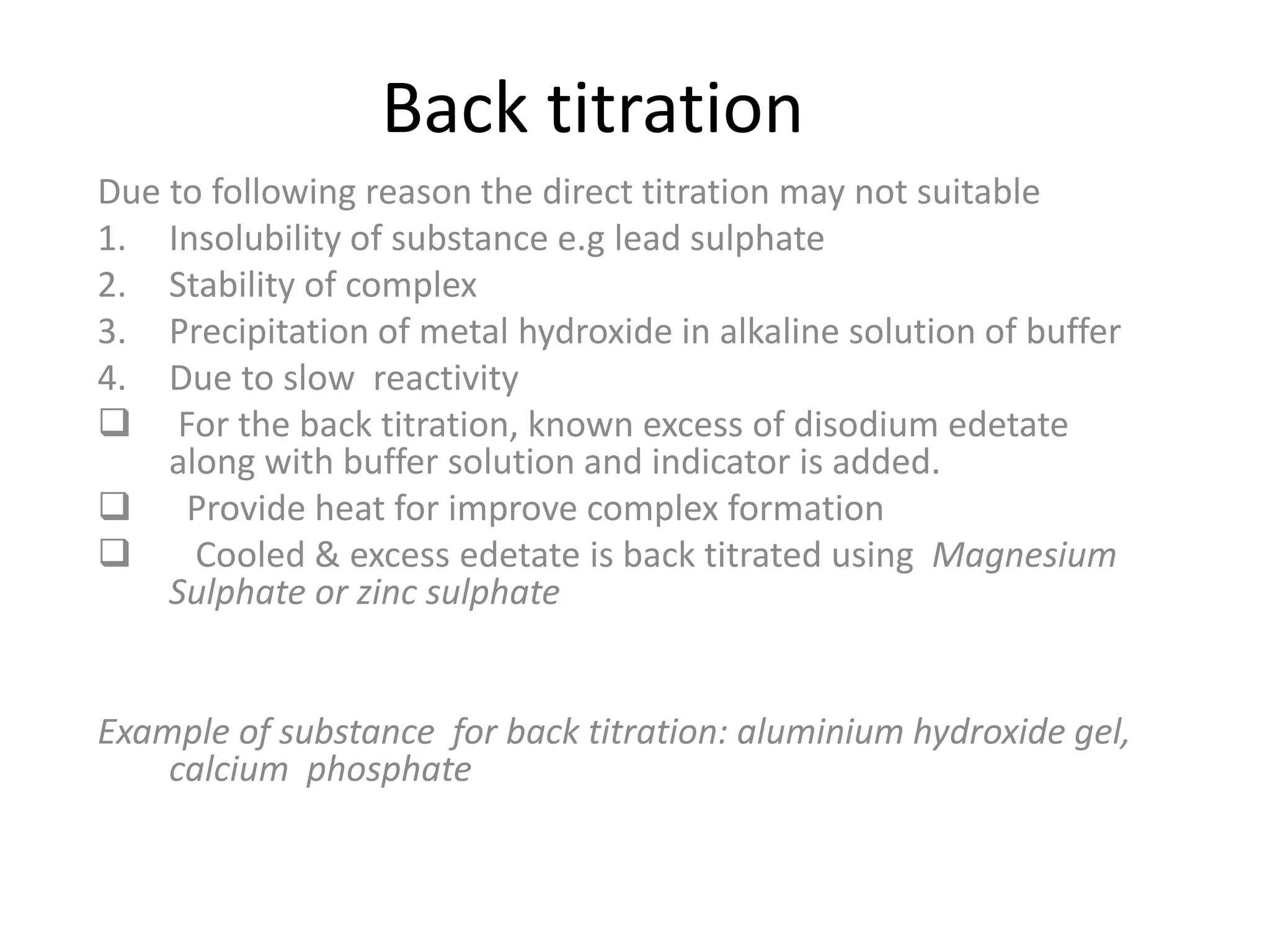
Back titration
Due to following reason the direct titration may not suitable
1. Insolubility of substance e.g lead sulphate
2. Stability of complex
3. Precipitation of metal hydroxide in alkaline solution of buffer
4. Due to slow reactivity
 For the back titration, known excess of disodium edetate
along with buffer solution and indicator is added.
 Provide heat for improve complex formation
 Cooled & excess edetate is back titrated using Magnesium
Sulphate or zinc sulphate
Example of substance for back titration: aluminium hydroxide gel,
calcium phosphate
ReplacementTitration
When both back titration and direct titration is not
possible due to the end point not being sharp
enough. Then the replacement titration is a method
of choice.
In this method of titration determination of metal ion is
done by displacing magnesium or zinc ions from
EDTA complex with an equivalent amount of metal
ion and liberated Mg or Zn ions are then titrated with
standard EDTA solution.
Mordant black used as indicator.
Calcium salt is determined in this way. In this, add
standard volume of Mg-EDTA solution to Ca salt in the
presence of buffer.
Calcium displaces Mg ion and forms a stable complex
with EDTA as Ca-EDTA complex. The displaced and
liberated Mg ions are then titrated Standard EDTA
solution using Mordant black as indicator.
Ca2+ + Mg-EDTA  Ca-EDTA + Mg2+
Mg2+ + EDTA2-  Mg-EDTA
Cadmium, Lead and Mercury can also be determined
by this titration.
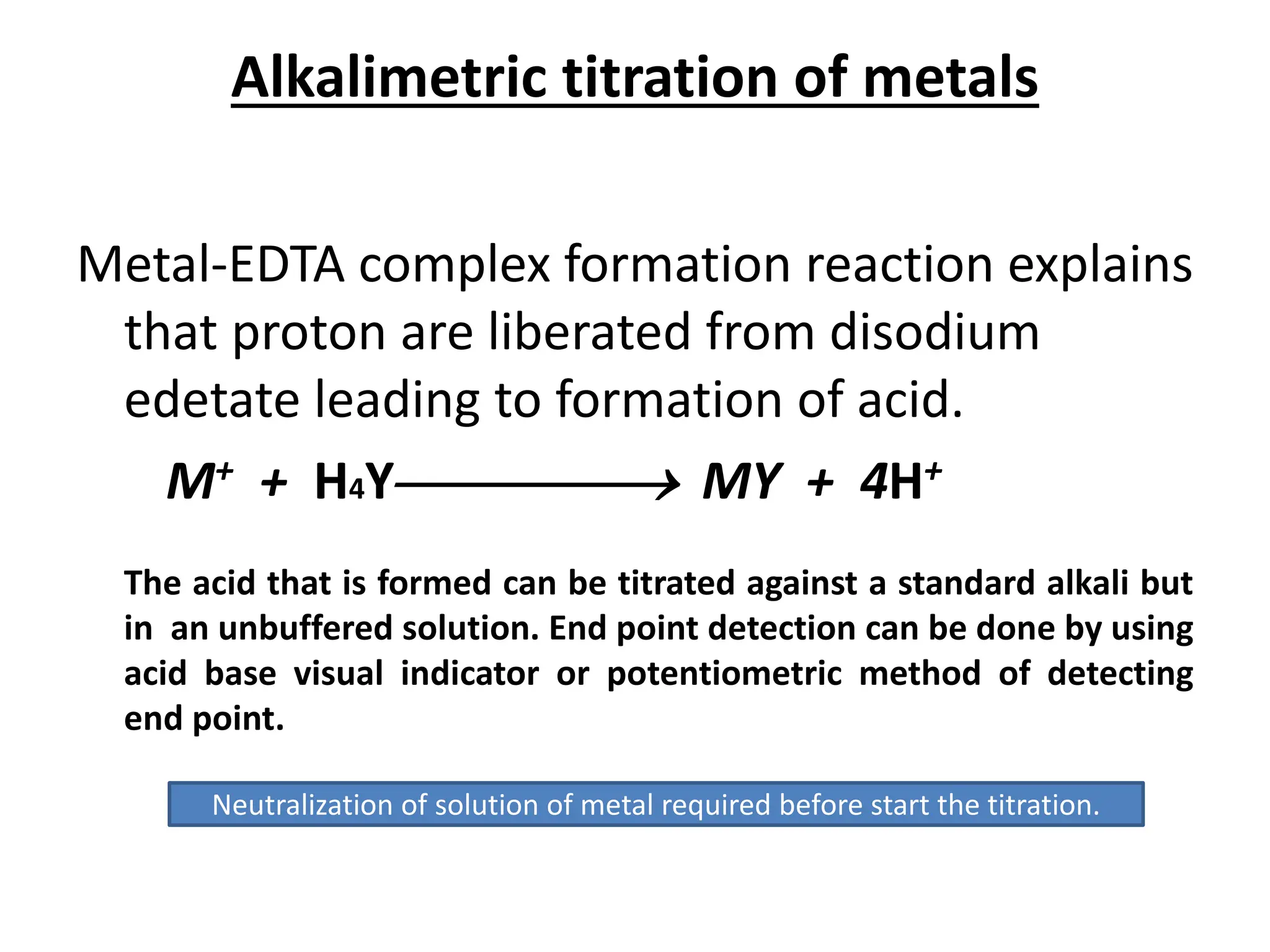
Alkalimetric titration of metals
Metal-EDTA complex formation reaction explains
that proton are liberated from disodium
edetate leading to formation of acid.
M+ + H4Y MY + 4H+
The acid that is formed can be titrated against a standard alkali but
in an unbuffered solution. End point detection can be done by using
acid base visual indicator or potentiometric method of detecting
end point.
Neutralization of solution of metal required before start the titration.
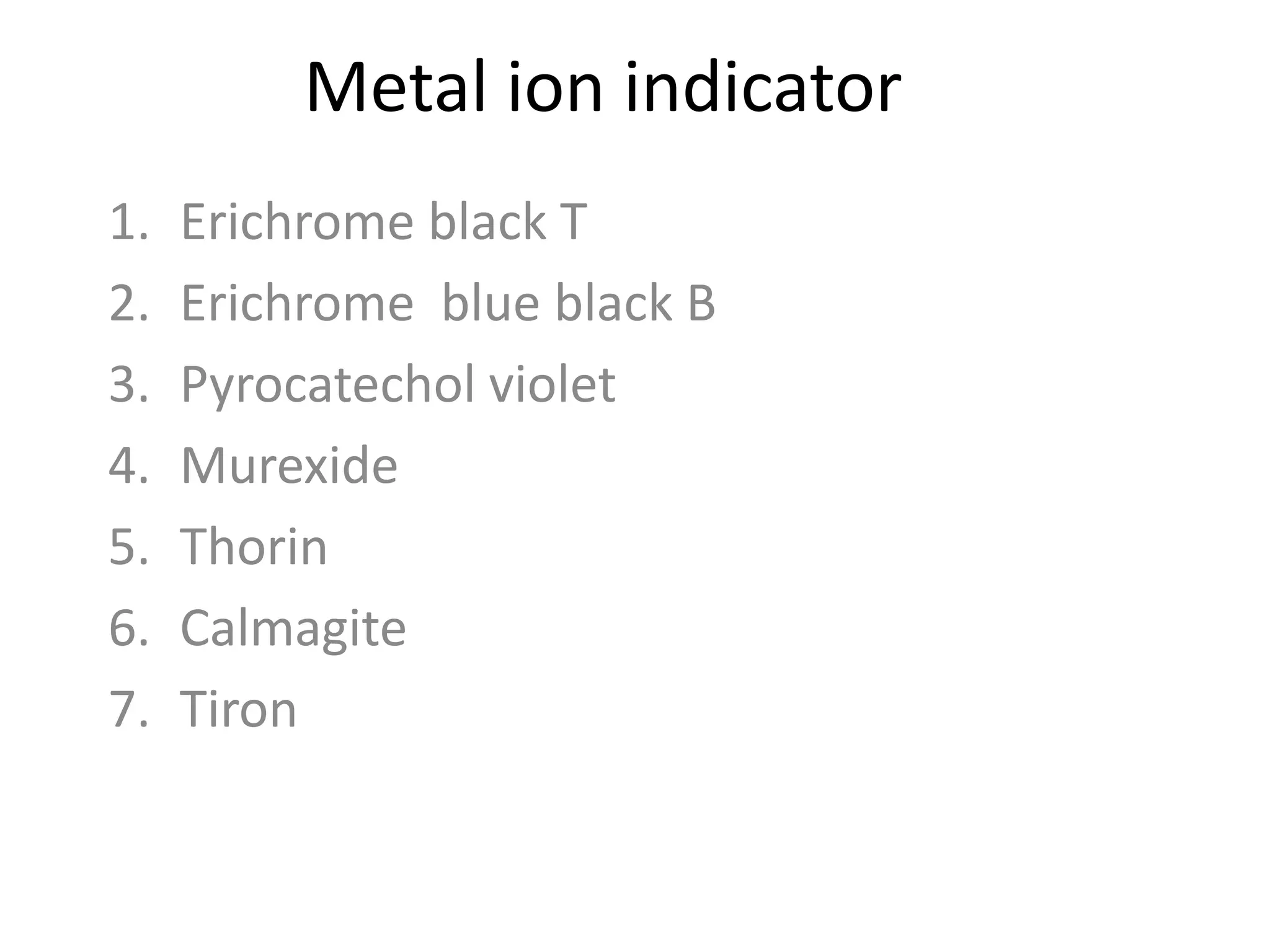
Metal ion indicator
1. Erichrome black T
2. Erichrome blue black B
3. Pyrocatechol violet
4. Murexide
5. Thorin
6. Calmagite
7. Tiron
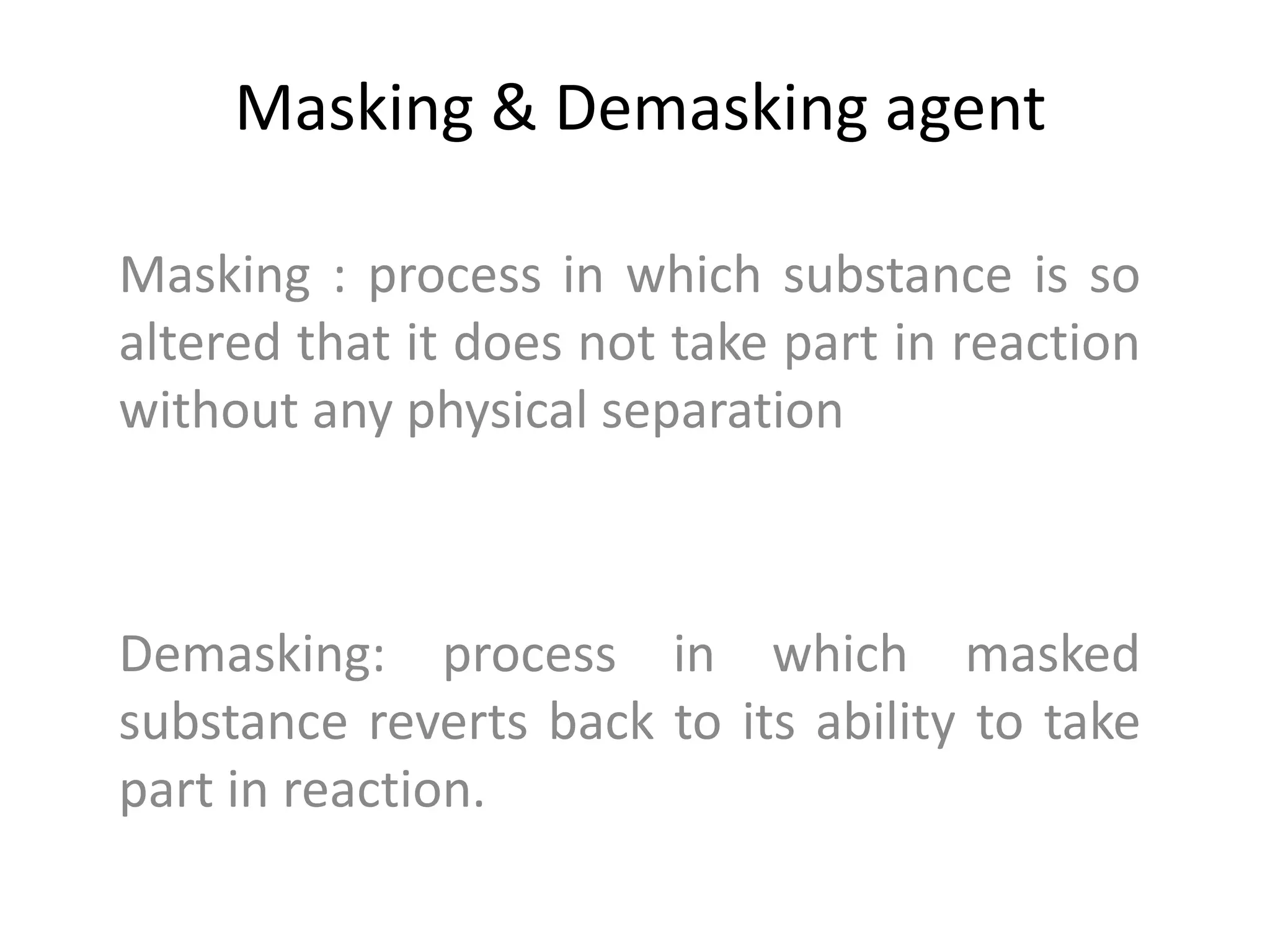
Masking & Demasking agent
Masking : process in which substance is so
altered that it does not take part in reaction
without any physical separation
Demasking: process in which masked
substance reverts back to its ability to take
part in reaction.
Need of masking & demasking agent
1. Masking agent can be used to carry out determination of
metal ion in presence of other metal ion
2. During titration of metal ion using EDTA, EDTA may form
complex with some of the impurities
Masking agent Metal can be masked
Triethanolamine Aluminium, iron
Thioglycerol Copper
Potassium and sodium cyanide Heavy metal
Ammonium fluoride Iron, Aluminium
• Demasking agent : is the process in which masking substance
reveres back to its ability to take part in the reaction.
- are reagents which regain the ability of masked ion to enter
the reaction with ind. and EDTA.
• Example:
The masking by CN– can be removed by:
- mixture of formaldehyde – acetic acid
- on addition of demasking agent to [Zn(CN)4]2- , Zn is liberated
and titrated.
• [Zn(CN)4]2- + 4 HCHO + 4 CH3COOH
(less stable) CN
•  Zn2+ + 4 CH2 + 4 CH3COO-
• OH
Cyanohydrin
(more stable)
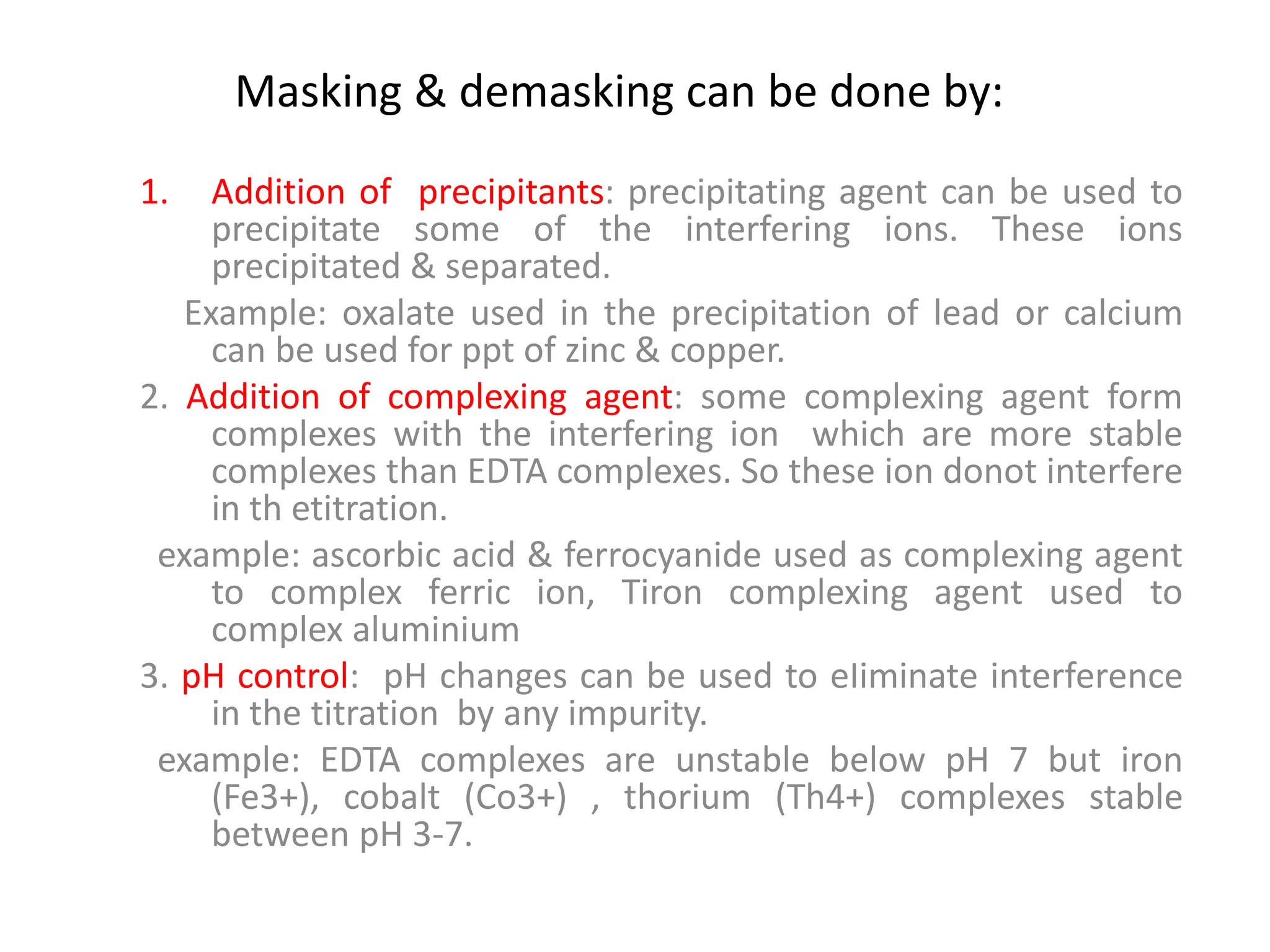
Masking & demasking can be done by:
1. Addition of precipitants: precipitating agent can be used to
precipitate some of the interfering ions. These ions
precipitated & separated.
Example: oxalate used in the precipitation of lead or calcium
can be used for ppt of zinc & copper.
2. Addition of complexing agent: some complexing agent form
complexes with the interfering ion which are more stable
complexes than EDTA complexes. So these ion donot interfere
in th etitration.
example: ascorbic acid & ferrocyanide used as complexing agent
to complex ferric ion, Tiron complexing agent used to
complex aluminium
3. pH control: pH changes can be used to eIiminate interference
in the titration by any impurity.
example: EDTA complexes are unstable below pH 7 but iron
(Fe3+), cobalt (Co3+) , thorium (Th4+) complexes stable
between pH 3-7.
Estimation of magnesium sulphate
Principle: magnesium sulphate is titrated directly
against disodium edetate in the presence of strong
ammonia-ammonium chloride solution.
End point is detected by mordant black II mixture as
indictaor.
complexometric titration for b.pharm students

complexometric titration for b.pharm students

  • 1.
  • 2.
    Introduction Complexometric titration involvestitration between metal ion & complexing agent or chelating agent (ligand). In this method ion changed into a complex ion and equivalence point is determined using metal indicator. An EDTA used as popular complexing agent or chilon. This chilon react with metal ion to form special type of complex called chelate
  • 3.
    • Complexometric titrationis a form of volumetric titration in which the formation of a colored complex is used to indicate the end point of a titration. • The complexes are formed by the reaction of a metal ion ( an acceptor, a central atom or a cation) with an anion, a neutral molecule or very rarely a positive ion.
  • 4.
    • Complexometric titrationsare particularly useful for the determination of a mixture of different metal ions in solution. • An indicator capable of producing an distinct color change is usually used to detect the end point of the titration.
  • 5.
    • Complexometry :is the type of volumetric analysis involving the formation of complexes which are slightly ionized in solution, like weak electrolyte and sparingly soluble salt. • Complex is formed by the reaction of metal ion (Mn+) with either an anion e.g. [Ag(CN)2]- or neutral molecule e.g. [Ag(NH3)2]+ • The metal ion is known as Central metal atom. • The anion or neutral molecule is known as Ligand (L)
  • 6.
    • M+ +L ML • Ag+ + 2 CN- [Ag(CN)2]- • Cu2+ + 4 CN- [Cu(CN)4]2- • Ag+ + 2 NH3 [Ag(NH3)2]+ • Central metal atom = acts as Lewis acid (electron acceptor) • Ligand = acts as Lewis base (electron donor) • Coordinate bond (dative) = The bond formed between central metal atom (ion) (acceptor) and the Ligand (donor)
  • 7.
    • Dative bondis similar to covalent bond (formed of two electrons) But in dative bond the electrons pair are donated from one atom to the other. The atom gives electron pair is known as donor, while the atom accept electron pair is known as acceptor. The bond is represented by an arrow () from donor to acceptor. NH3  NH3  Cu  NH3  NH3
  • 8.
    Coordination number =The no. of coordinate bonds formed to a metal ion by its ligands. • The charge of a complex is the algebraic sum of the charges of the central ion and ligand .. e.g. • [Ag(CN)2] -  Ag+ + 2 CN - • 1 (+ve) + 2 (-ve) = 1 (-ve) • e.g. [Fe(CN)6]3-  Fe3+ + 6 CN - 3 (+ve) + 6 (-ve) = 3 (-ve) • The higher the valence of metal ion the more stable the complex e.g.Ferricyanide is more stable than Ferrocyanide
  • 9.
    Types of complexingagents Ligands can be classified as monodentate and polydentate ligands depending upon the number of ligand donor atoms that attach to the metal atom or ion. • Unidentate (Monodentate) Ligand or "Simple Ligand" • The ligand attached to metal at one site e.g. H2O , NH3 , CN - , Cl - , I - , Br - , (i.e. forming one coordinate bond, or capable of donating one unshared pair of electrons)
  • 10.
    H2C H2C NH2 NH2 H2C H2C NH2 NH2 CH2 CH2 H2N H2N Cu + Cu2+ 2 • BidentateLigand The ligand attached to metal at two sites. Ethylene diamine
  • 11.
    • Tridentate Ligand: TheLigand attached to metal at 3 sites • Tetradentate Ligand: The Ligand attached to metal at 4 sites Diethylene triamine Triethylene tetramine
  • 12.
    Ambidentate ligands: Ligands thatcan attach themselves to the central metal atom through two different atoms are called ambidentate ligands. For example: (The donor atom is N) (The donor atom is oxygen)
  • 13.
    Complexing agents aredifferent types 1.Neutral molecules: neutral molecules having lone pair of electron act as complexing agent Example: ammonia forms cuprammonium complex with copper [Cu(NH3)4]2+ 2. Group whose proton can be easily replaced such as – COOH, phenolic and enolic OH. 3.Sequestring agents having group like COOH, NH2 and OH. Example of complexing agent: EDTA, Dimethylglyoxime, salicylaldoxime
  • 14.
    Chelation Chelation involves theformation or presence of two or more separate coordinate bonds between a polydentate (multiple bonded) ligand and a single central atom
  • 15.
    Chelation • Chelate :It is a complex formed between the ligand containing two or more donor groups and metal to form ring structure. (heterocyclic rings or chelate rings). • Chelating agents: organic molecules containing two or more donor groups which combine with metal to form complex having ring structure. • Chelates are usually insoluble in water but soluble in organic solvent. • Sequestering agent : Ligands which form water soluble chelates e.g. EDTA.
  • 16.
    Classification of ComplexometricTitrations 1) Direct Titration 2) Back titration 3) Replacement Titration 4) Alkalimetric titration of metals
  • 17.
    Direct Titration In thistype of titrations, the sample solution of metal ion, in the presence of a suitable buffer, is titrated against standard disodium edetate solution. • Metal indicator such as Mordant red 7 used. • Precipitation of metal hydroxide prevented by used of auxillary complexing agent. • At the equivalence point the conc. of metal ion decreases suddenly. • A blank titration also carried out using blank solution (without adding analyte). • The volume of edetate consumed in blank titration is subtracted from original estimation. • Example : substance estimated by this titration are magnesium carbonate, bismuth nitrate, zinc oxide etc.
  • 18.
    • Direct determinationof water hardness • Water hardness is due to the presence of Ca2+ & Mg2+ salts. • EDTA forms complex with Ca2+ & Mg2+, Ca-EDTA complex is more stable than Mg-EDTA complex. • At pH 12 EDTA forms complex with Ca2+ only. • Total Ca2+ & Mg2+: • Total Ca2+ and Mg2+ determined by titration with EDTA at pH 10 using ammonia buffer and EBT (Eriochrome Black T) as ind. • Upon titration with EDTA, Ca2+ will be chelated first, then Mg2+. • For Ca2+ only: • Direct titration with EDTA at pH 12 using 8% NaOH and Murexide. • Mg2+ is pptd. as Mg(OH)2 leaving Ca2+ which is titrated with EDTA • • For Mg2+ : • Total – Ca2+ = Mg2+
  • 19.
    Back titration Due tofollowing reason the direct titration may not suitable 1. Insolubility of substance e.g lead sulphate 2. Stability of complex 3. Precipitation of metal hydroxide in alkaline solution of buffer 4. Due to slow reactivity  For the back titration, known excess of disodium edetate along with buffer solution and indicator is added.  Provide heat for improve complex formation  Cooled & excess edetate is back titrated using Magnesium Sulphate or zinc sulphate Example of substance for back titration: aluminium hydroxide gel, calcium phosphate
  • 20.
    ReplacementTitration When both backtitration and direct titration is not possible due to the end point not being sharp enough. Then the replacement titration is a method of choice. In this method of titration determination of metal ion is done by displacing magnesium or zinc ions from EDTA complex with an equivalent amount of metal ion and liberated Mg or Zn ions are then titrated with standard EDTA solution. Mordant black used as indicator.
  • 21.
    Calcium salt isdetermined in this way. In this, add standard volume of Mg-EDTA solution to Ca salt in the presence of buffer. Calcium displaces Mg ion and forms a stable complex with EDTA as Ca-EDTA complex. The displaced and liberated Mg ions are then titrated Standard EDTA solution using Mordant black as indicator. Ca2+ + Mg-EDTA  Ca-EDTA + Mg2+ Mg2+ + EDTA2-  Mg-EDTA Cadmium, Lead and Mercury can also be determined by this titration.
  • 22.
    Alkalimetric titration ofmetals Metal-EDTA complex formation reaction explains that proton are liberated from disodium edetate leading to formation of acid. M+ + H4Y MY + 4H+ The acid that is formed can be titrated against a standard alkali but in an unbuffered solution. End point detection can be done by using acid base visual indicator or potentiometric method of detecting end point. Neutralization of solution of metal required before start the titration.
  • 23.
    Metal ion indicator 1.Erichrome black T 2. Erichrome blue black B 3. Pyrocatechol violet 4. Murexide 5. Thorin 6. Calmagite 7. Tiron
  • 24.
    Masking & Demaskingagent Masking : process in which substance is so altered that it does not take part in reaction without any physical separation Demasking: process in which masked substance reverts back to its ability to take part in reaction.
  • 25.
    Need of masking& demasking agent 1. Masking agent can be used to carry out determination of metal ion in presence of other metal ion 2. During titration of metal ion using EDTA, EDTA may form complex with some of the impurities Masking agent Metal can be masked Triethanolamine Aluminium, iron Thioglycerol Copper Potassium and sodium cyanide Heavy metal Ammonium fluoride Iron, Aluminium
  • 26.
    • Demasking agent: is the process in which masking substance reveres back to its ability to take part in the reaction. - are reagents which regain the ability of masked ion to enter the reaction with ind. and EDTA. • Example: The masking by CN– can be removed by: - mixture of formaldehyde – acetic acid - on addition of demasking agent to [Zn(CN)4]2- , Zn is liberated and titrated. • [Zn(CN)4]2- + 4 HCHO + 4 CH3COOH (less stable) CN •  Zn2+ + 4 CH2 + 4 CH3COO- • OH Cyanohydrin (more stable)
  • 27.
    Masking & demaskingcan be done by: 1. Addition of precipitants: precipitating agent can be used to precipitate some of the interfering ions. These ions precipitated & separated. Example: oxalate used in the precipitation of lead or calcium can be used for ppt of zinc & copper. 2. Addition of complexing agent: some complexing agent form complexes with the interfering ion which are more stable complexes than EDTA complexes. So these ion donot interfere in th etitration. example: ascorbic acid & ferrocyanide used as complexing agent to complex ferric ion, Tiron complexing agent used to complex aluminium 3. pH control: pH changes can be used to eIiminate interference in the titration by any impurity. example: EDTA complexes are unstable below pH 7 but iron (Fe3+), cobalt (Co3+) , thorium (Th4+) complexes stable between pH 3-7.
  • 28.
    Estimation of magnesiumsulphate Principle: magnesium sulphate is titrated directly against disodium edetate in the presence of strong ammonia-ammonium chloride solution. End point is detected by mordant black II mixture as indictaor.