 Complexometric Titration
 EDTA as a Chelating Agent
 Role of Metallochromic Indicator
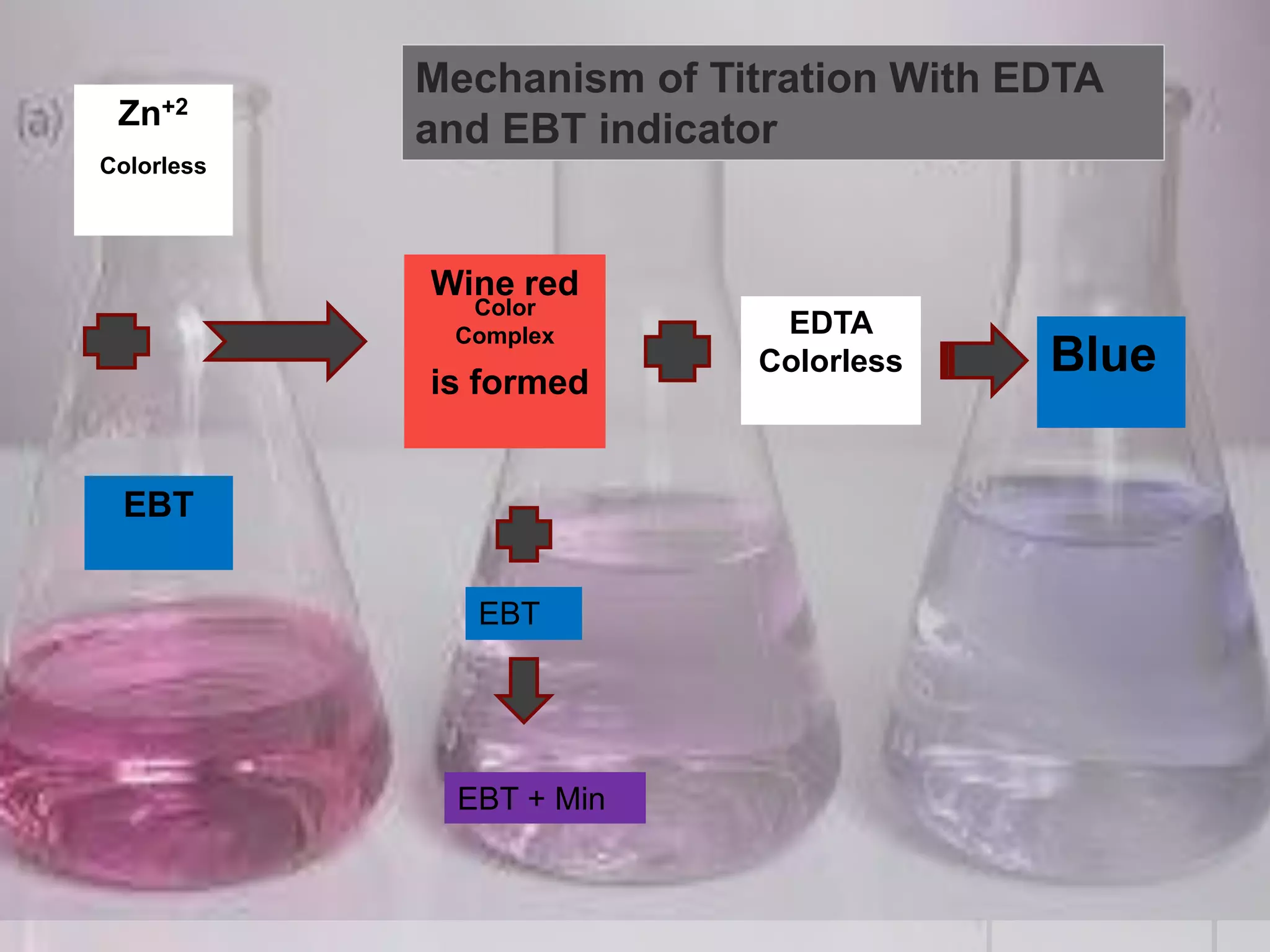
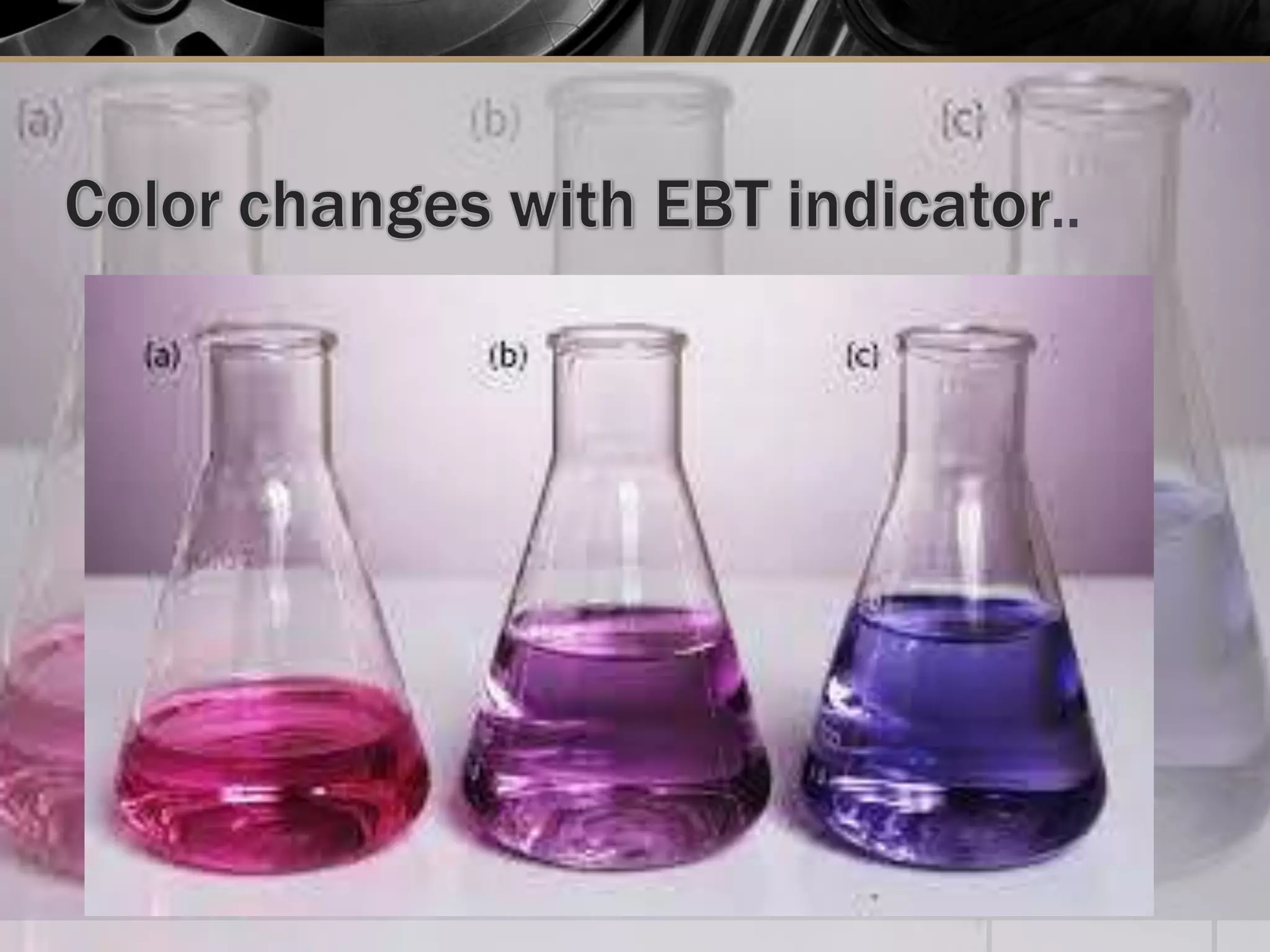
 Mechanism of Titration with EBT Indicator
 Requirements for visual Detection
 Types of EDTA Titration
 Methods of Increasing Selectivity for
Complexation
 Analysis of a Metals Mixture
 References
..
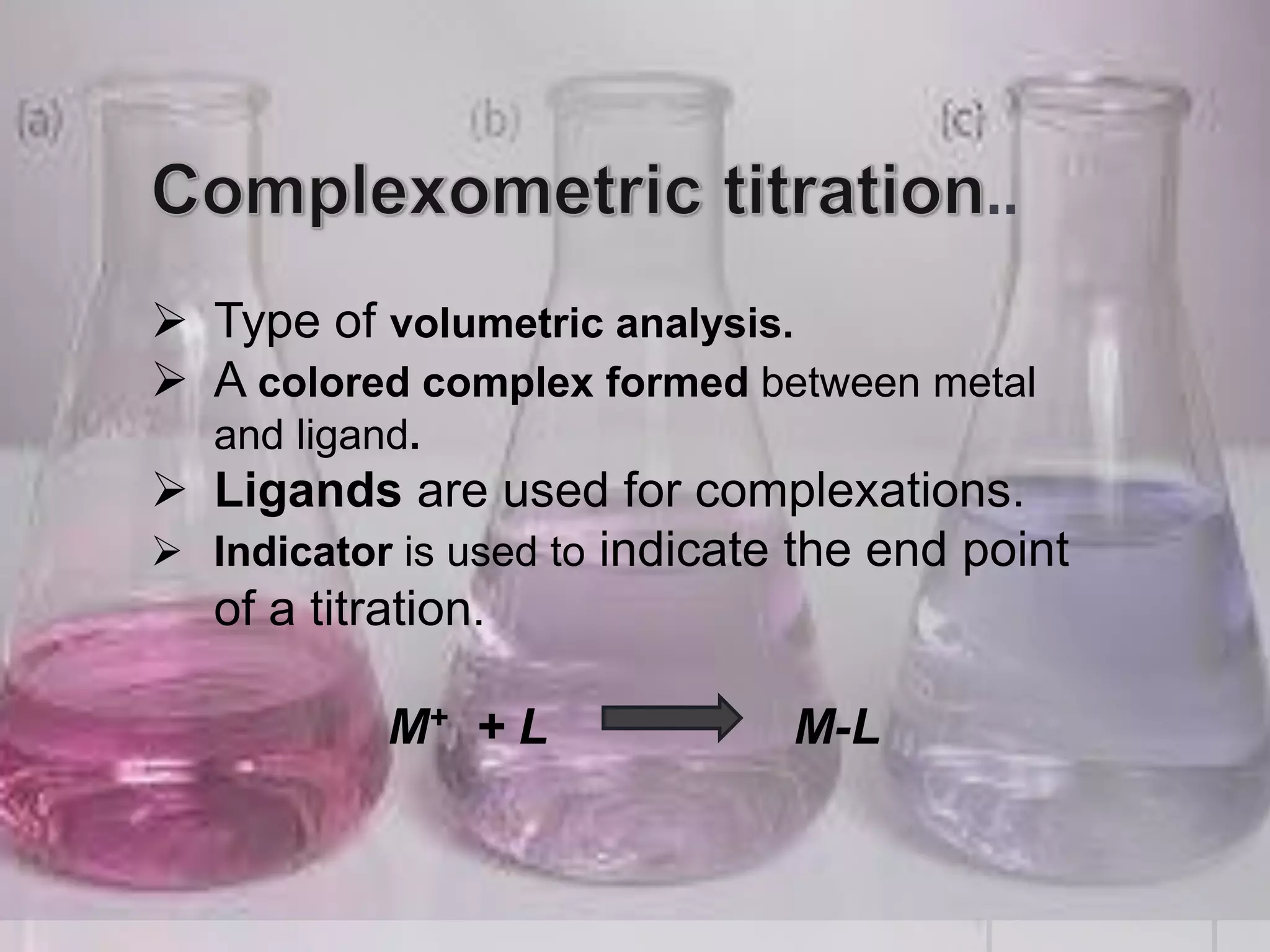
 Type of volumetric analysis.
 A colored complex formed between metal
and ligand.
 Ligands are used for complexations.
 Indicator is used to indicate the end point
of a titration.
M+ + L M-L
..
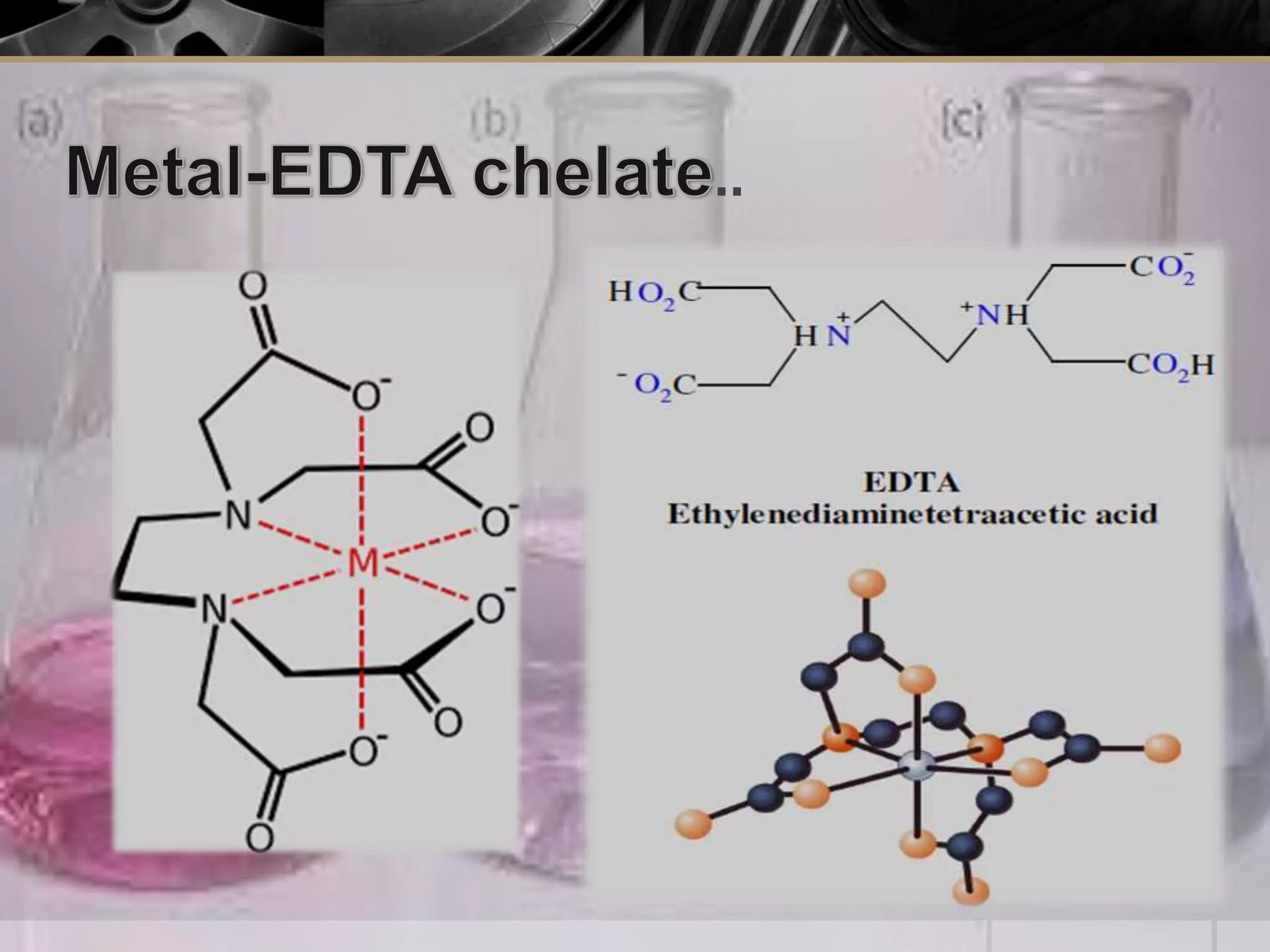
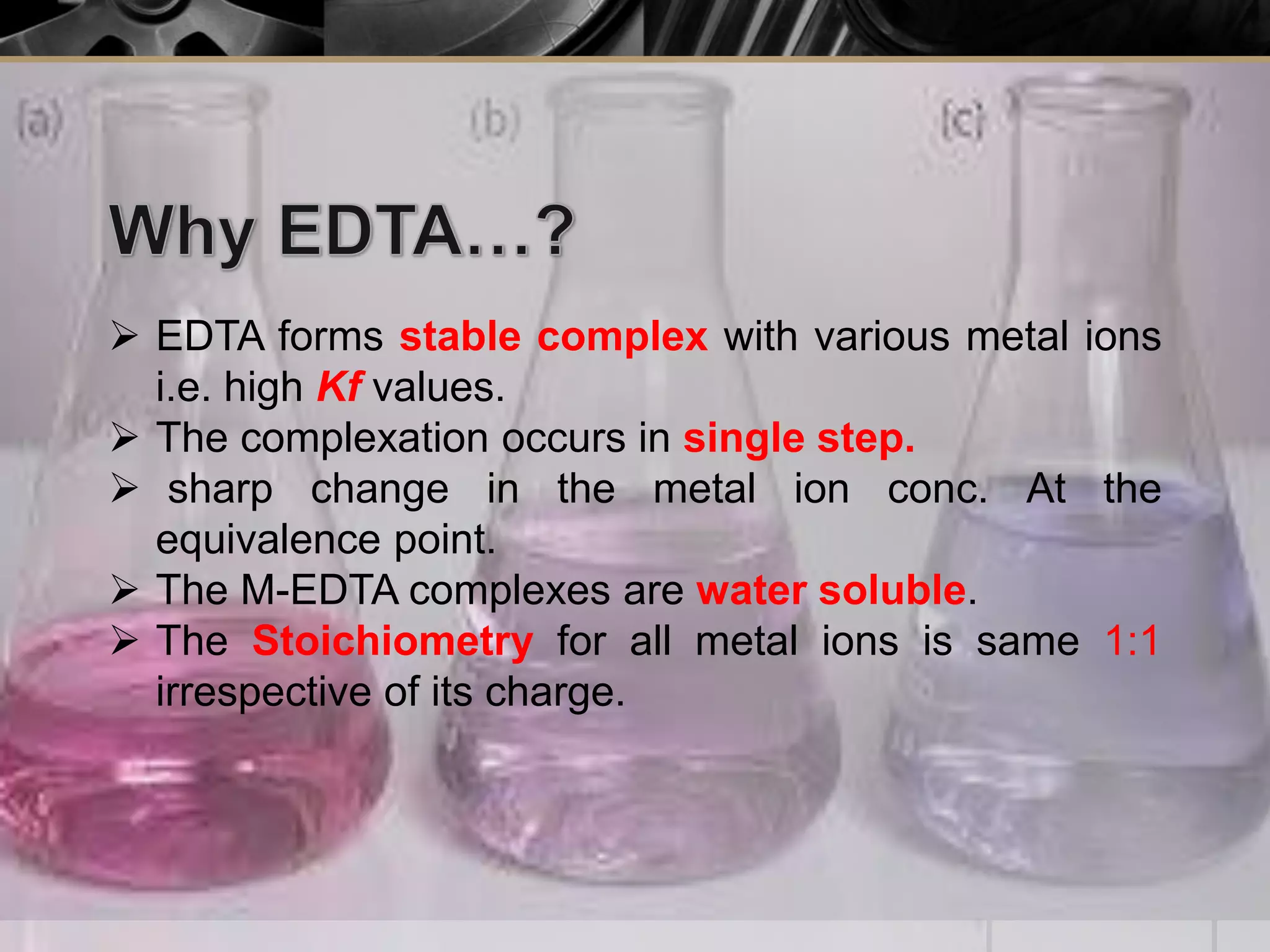
 EDTA forms stable complex with various metal ions
i.e. high Kf values.
 The complexation occurs in single step.
 sharp change in the metal ion conc. At the
equivalence point.
 The M-EDTA complexes are water soluble.
 The Stoichiometry for all metal ions is same 1:1
irrespective of its charge.
..
 Hydrolysis of certain metal ions occurs at high
pH.
 At low pH EDTA loses its ability to donate its lone
pairs.
 EDTA lacks selectivity i.e. Forms stable
complexes with various metals.
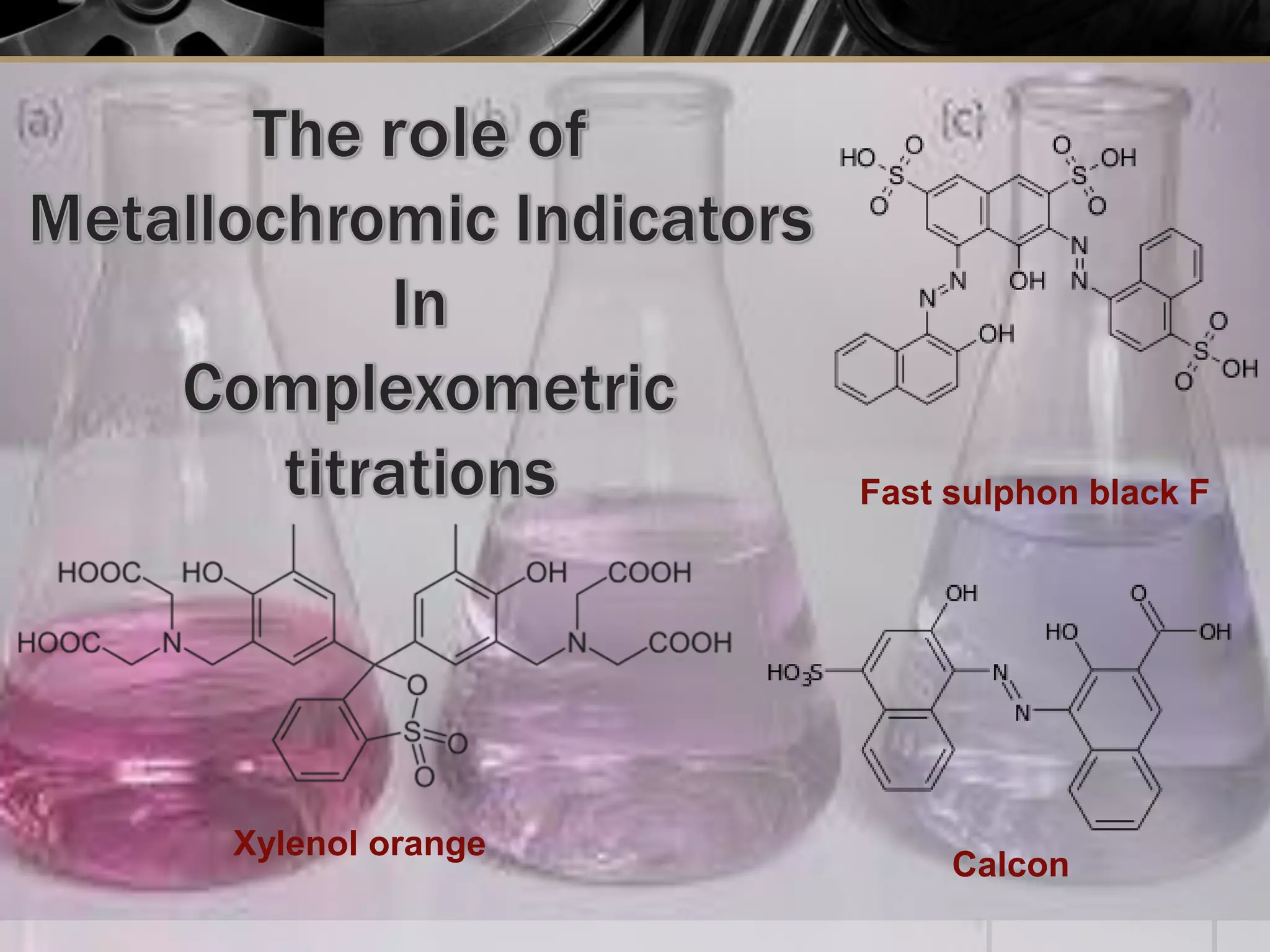
Fast sulphon black F
Calcon
Xylenol orange
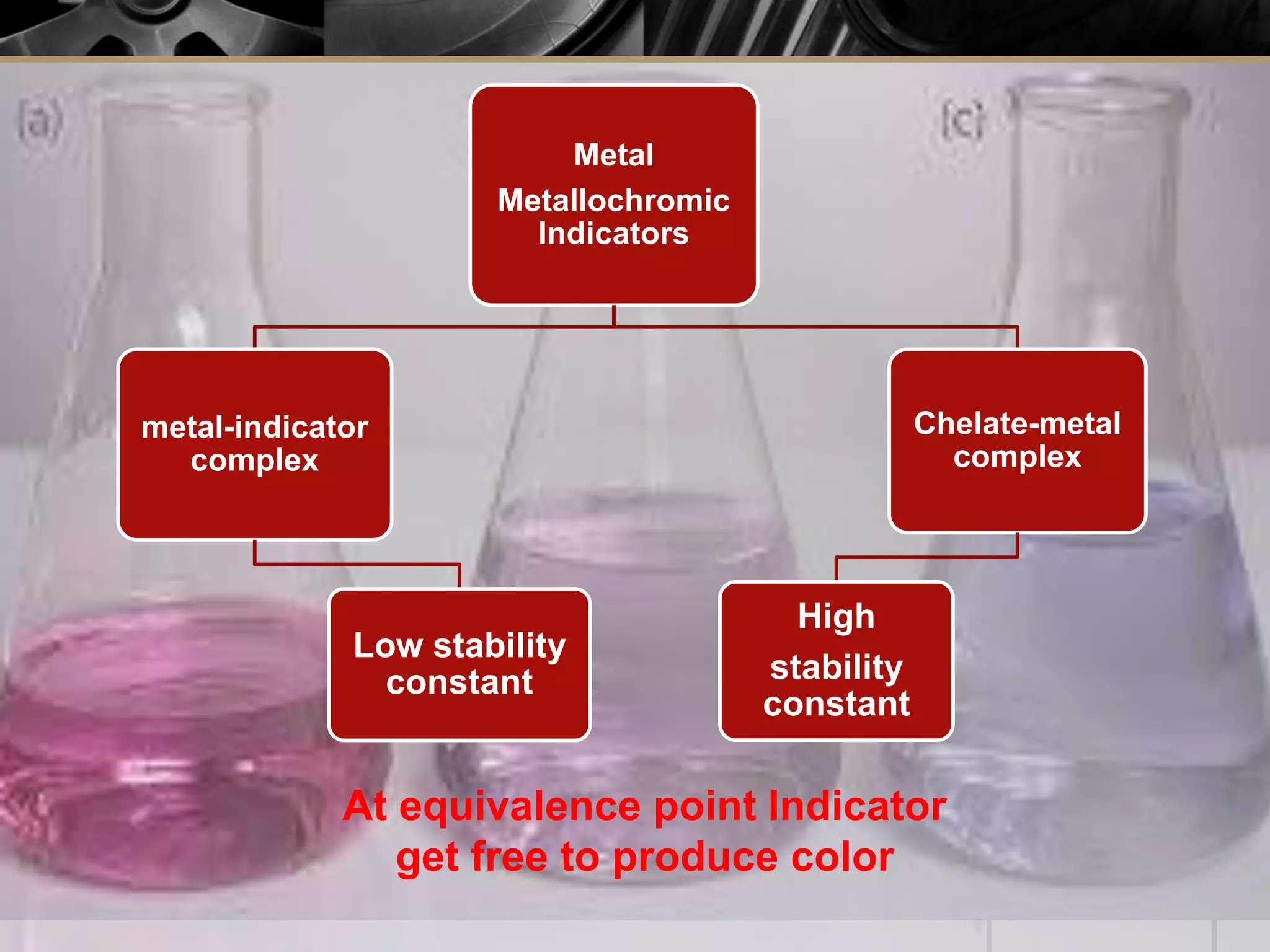
Metal
Metallochromic
Indicators
metal-indicator
complex
Low stability
constant
Chelate-metal
complex
High
stability
constant
At equivalence point Indicator
get free to produce color
EDTA
Colorless
Zn+2
Colorless
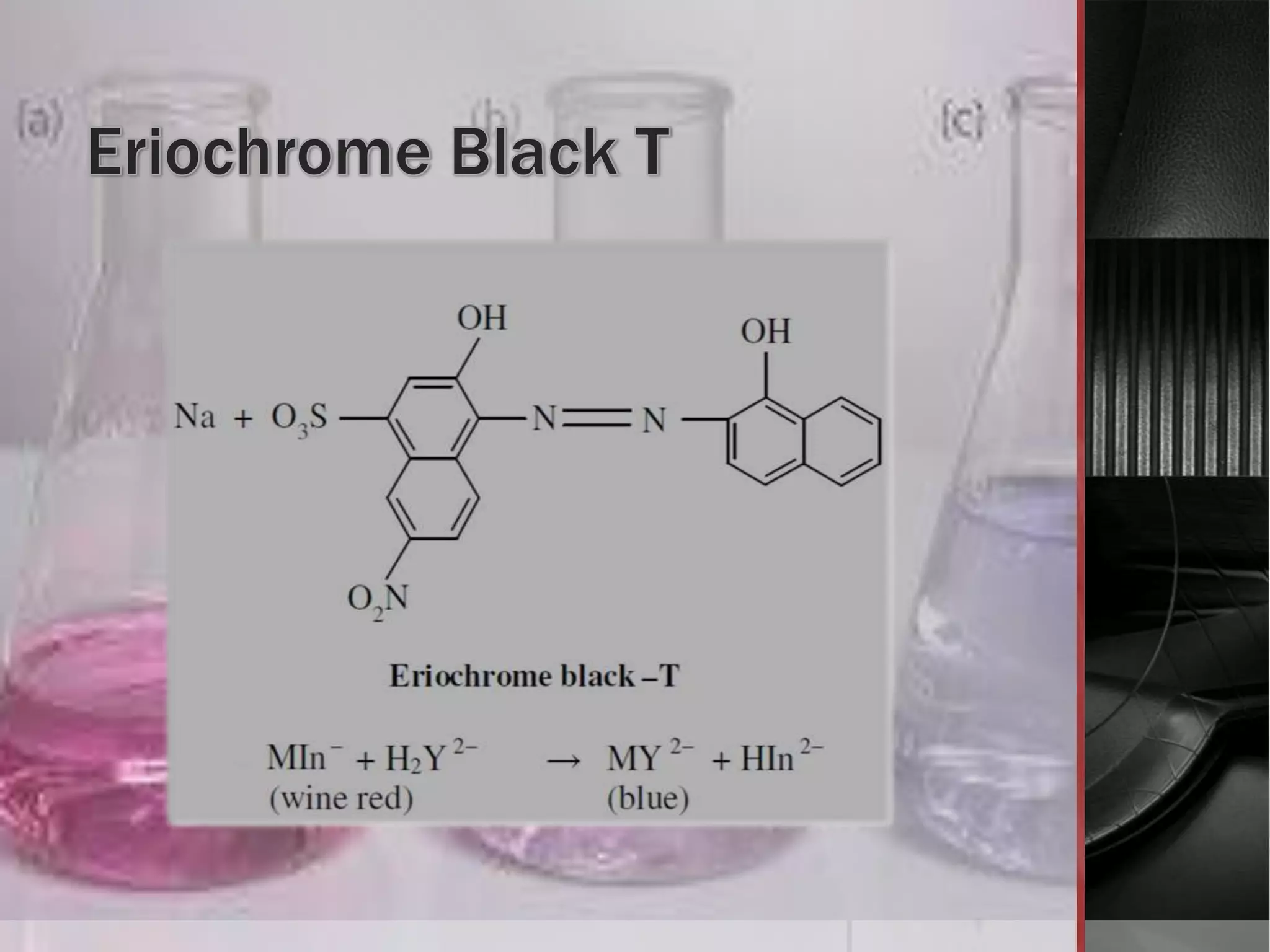
EBT
Wine red
Color
Complex
is formed
Blue
EBT
EBT + Min
Mechanism of Titration With EDTA
and EBT indicator
..
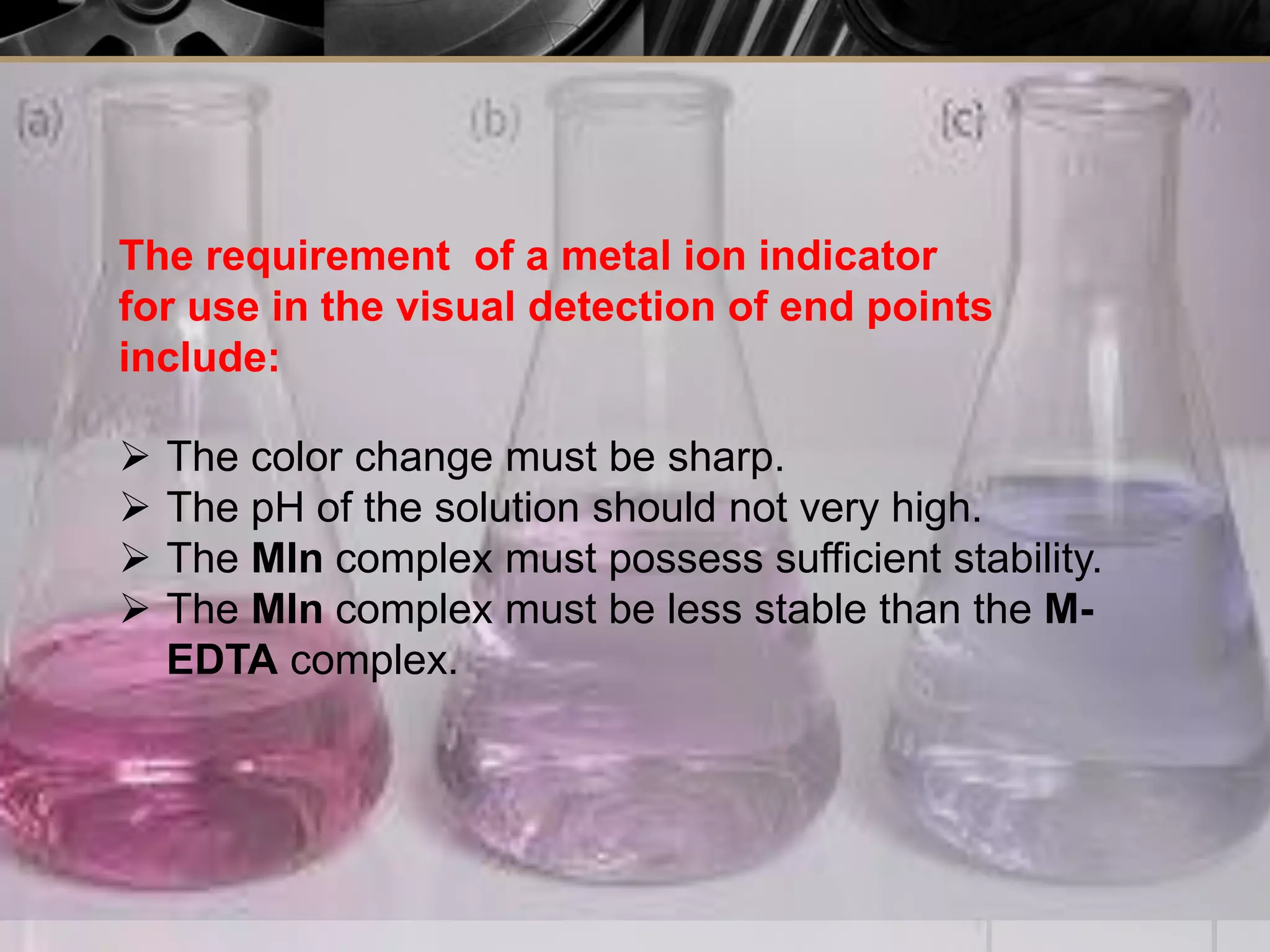
The requirement of a metal ion indicator
for use in the visual detection of end points
include:
 The color change must be sharp.
 The pH of the solution should not very high.
 The MIn complex must possess sufficient stability.
 The MIn complex must be less stable than the M-
EDTA complex.
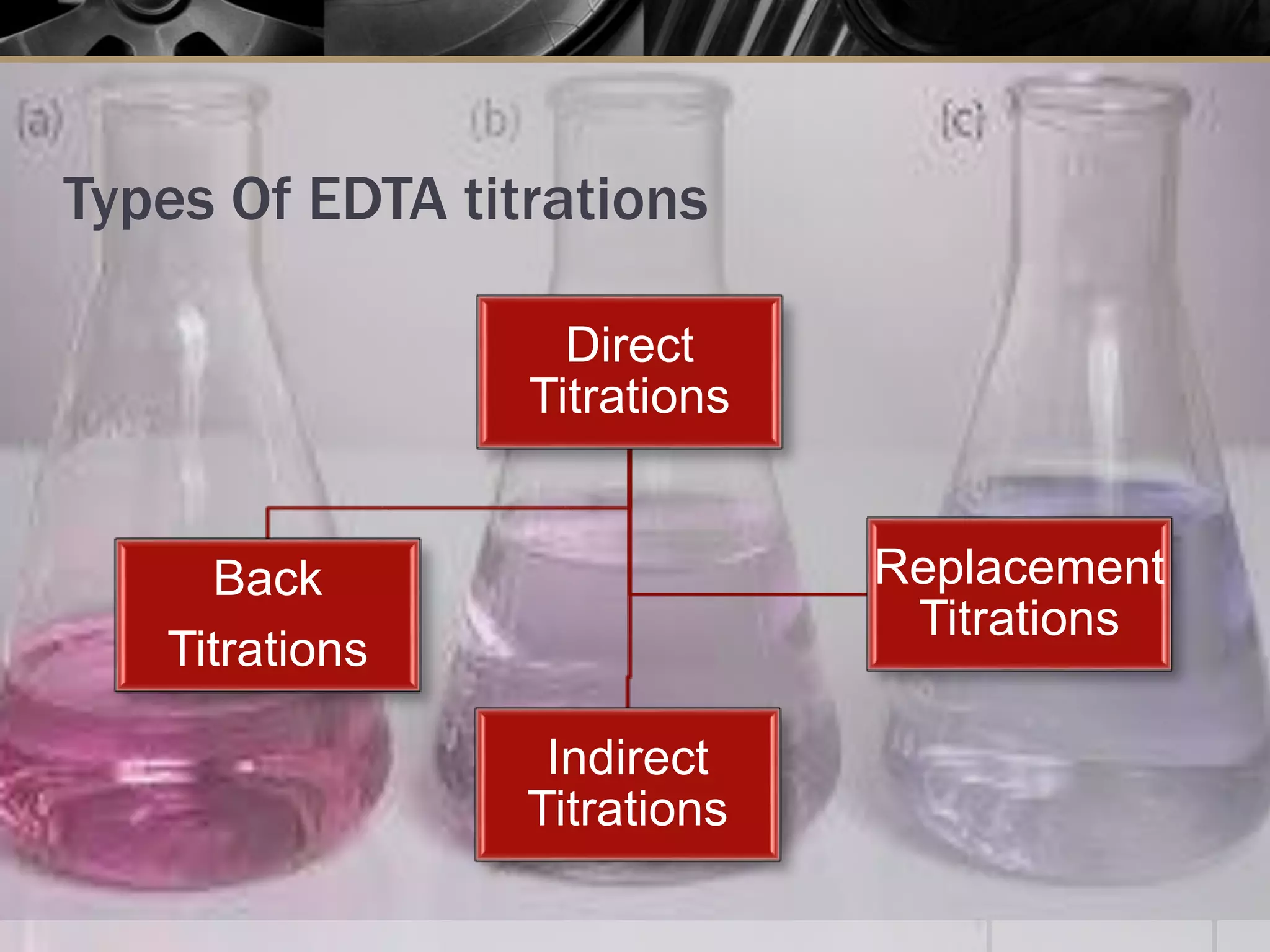
Types Of EDTA titrations
Direct
Titrations
Back
Titrations
Indirect
Titrations
Replacement
Titrations
• It is the simplest method in which the standard
solution of EDTA is slowly added to the metal ion
solution till the end point.
Mmols of std.EDTA
added
Mmols of metal in
the sample
Back titration
• This method is suitable when;
• The reaction of metal ion with EDTA is slow ,
• The metal ion precipitates.
• No suitable indicator is available
Std.EDTA added in excess
Exc.EDTA+ std.Metal =mmols of exc
EDTA
Total EDTA –Exc.EDTA=mmols of
Metal in sample
• When direct or back titrations do not give sharp end points.
• when there is no suitable indicator for the analyte.
Mg-EDTA
Ca+2 sample
EDTA
Ca+2 ions
Mg-EDTA
Mg+2 ions
EDTA
Mmols of EDTA= mmols of Ca+2
• Certain anions that form precipitate with metal
cations and do not react with EDTA can be
analyzed indirectly. SO4
-2, PO4
-3, can be
determined by this method.
• e.g. SO4
-2 can be determined by adding excess
of Ba+2 to precipitate as BaSO4
. The precipitate
is filtered and washed .
• The excess Ba+2 in the filtrate is then titrated
with EDTA.
pH control
Use of masking and
demasking agents
Classical separation
Kinetic masking
• The formation of a metal chelate complex
dependent on the pH of the medium.
• In weakly acid solution, the chelates of many
metals such as alkaline earth metals are
completely dissociated, whereas
• chelates of Bi+3, Fe2+ or Cr+2 are readily
formed at this pH.
..
Masking agents:
• They prevent interfering ion from reaction
without physical separation.
• These reagents form complexes with interfering
ions.
• They form more stable complexes then ind. &
EDTA
Example; fluorides, cyanides etc.
Demasking agent : are reagents which
regain the ability of masked ion to enter the
reaction with ind. and EDTA.
Example:
• The masking by CN– can be removed
by:
• Mixture of formaldehyde – acetic acid
These are attempted only be applied if they are
not tedious; further only those precipitates may
be used for separations in which, after being re-
dissolved, the cations can be determined
complexometrically. Some of the examples are
CaC2O4, nickel dimethylglyoximate, and CuSCN
Kinetic masking
The metal ion does not form a complex due
to its kinetic inertness. Or it reacts slow.
For example, the reaction of chromium (III)
with EDTA is quite slow.
It is, therefore, possible to titrate other metal
ions which react rapidly without interference
from Cr (III).
..
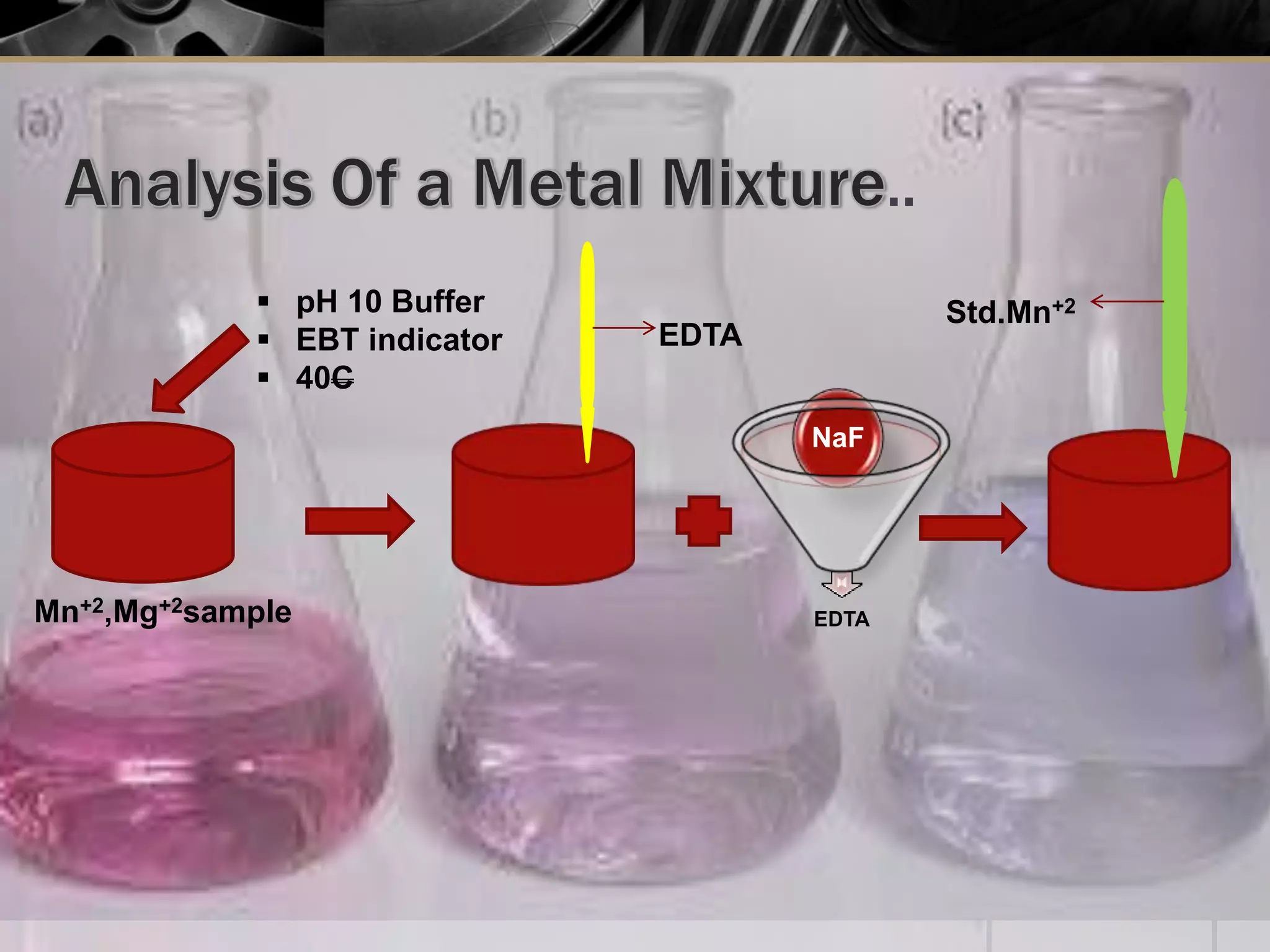
Mn+2,Mg+2sample
 pH 10 Buffer
 EBT indicator
 40C
EDTA
EDTA
NaF
Std.Mn+2
..
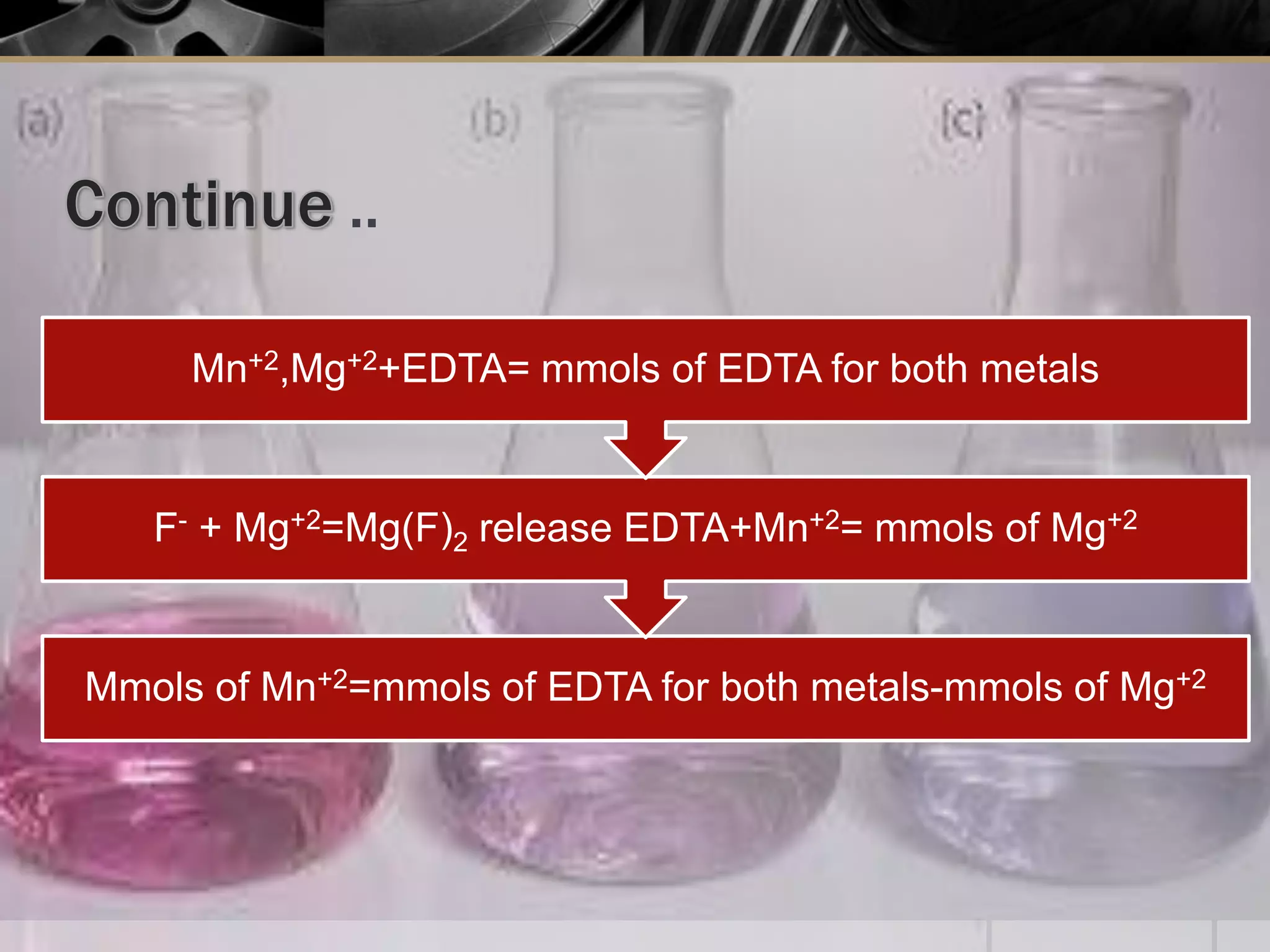
Mmols of Mn+2=mmols of EDTA for both metals-mmols of Mg+2
F- + Mg+2=Mg(F)2 release EDTA+Mn+2= mmols of Mg+2
Mn+2,Mg+2+EDTA= mmols of EDTA for both metals
1. https://www.slideshare.net/obydullah/complexometric-
titrationsACS publications
2. https://pubs.acs.org/doi/pdf/10.1021/ed074p1463
3. http://www.srmuniv.ac.in/sites/default/files/downloads/Comple
xometric_Titration.pdf
4. Instrumental skoog
Complexometric titrations with EDTA

Complexometric titrations with EDTA

  • 2.
     Complexometric Titration EDTA as a Chelating Agent  Role of Metallochromic Indicator  Mechanism of Titration with EBT Indicator  Requirements for visual Detection  Types of EDTA Titration  Methods of Increasing Selectivity for Complexation  Analysis of a Metals Mixture  References
  • 3.
    ..  Type ofvolumetric analysis.  A colored complex formed between metal and ligand.  Ligands are used for complexations.  Indicator is used to indicate the end point of a titration. M+ + L M-L
  • 4.
  • 5.
     EDTA formsstable complex with various metal ions i.e. high Kf values.  The complexation occurs in single step.  sharp change in the metal ion conc. At the equivalence point.  The M-EDTA complexes are water soluble.  The Stoichiometry for all metal ions is same 1:1 irrespective of its charge.
  • 6.
    ..  Hydrolysis ofcertain metal ions occurs at high pH.  At low pH EDTA loses its ability to donate its lone pairs.  EDTA lacks selectivity i.e. Forms stable complexes with various metals.
  • 7.
    Fast sulphon blackF Calcon Xylenol orange
  • 9.
  • 10.
    EDTA Colorless Zn+2 Colorless EBT Wine red Color Complex is formed Blue EBT EBT+ Min Mechanism of Titration With EDTA and EBT indicator
  • 11.
  • 12.
    The requirement ofa metal ion indicator for use in the visual detection of end points include:  The color change must be sharp.  The pH of the solution should not very high.  The MIn complex must possess sufficient stability.  The MIn complex must be less stable than the M- EDTA complex.
  • 13.
    Types Of EDTAtitrations Direct Titrations Back Titrations Indirect Titrations Replacement Titrations
  • 14.
    • It isthe simplest method in which the standard solution of EDTA is slowly added to the metal ion solution till the end point. Mmols of std.EDTA added Mmols of metal in the sample
  • 15.
    Back titration • Thismethod is suitable when; • The reaction of metal ion with EDTA is slow , • The metal ion precipitates. • No suitable indicator is available Std.EDTA added in excess Exc.EDTA+ std.Metal =mmols of exc EDTA Total EDTA –Exc.EDTA=mmols of Metal in sample
  • 16.
    • When director back titrations do not give sharp end points. • when there is no suitable indicator for the analyte. Mg-EDTA Ca+2 sample EDTA Ca+2 ions Mg-EDTA Mg+2 ions EDTA Mmols of EDTA= mmols of Ca+2
  • 17.
    • Certain anionsthat form precipitate with metal cations and do not react with EDTA can be analyzed indirectly. SO4 -2, PO4 -3, can be determined by this method. • e.g. SO4 -2 can be determined by adding excess of Ba+2 to precipitate as BaSO4 . The precipitate is filtered and washed . • The excess Ba+2 in the filtrate is then titrated with EDTA.
  • 18.
    pH control Use ofmasking and demasking agents Classical separation Kinetic masking
  • 19.
    • The formationof a metal chelate complex dependent on the pH of the medium. • In weakly acid solution, the chelates of many metals such as alkaline earth metals are completely dissociated, whereas • chelates of Bi+3, Fe2+ or Cr+2 are readily formed at this pH.
  • 21.
    .. Masking agents: • Theyprevent interfering ion from reaction without physical separation. • These reagents form complexes with interfering ions. • They form more stable complexes then ind. & EDTA Example; fluorides, cyanides etc.
  • 22.
    Demasking agent :are reagents which regain the ability of masked ion to enter the reaction with ind. and EDTA. Example: • The masking by CN– can be removed by: • Mixture of formaldehyde – acetic acid
  • 23.
    These are attemptedonly be applied if they are not tedious; further only those precipitates may be used for separations in which, after being re- dissolved, the cations can be determined complexometrically. Some of the examples are CaC2O4, nickel dimethylglyoximate, and CuSCN
  • 24.
    Kinetic masking The metalion does not form a complex due to its kinetic inertness. Or it reacts slow. For example, the reaction of chromium (III) with EDTA is quite slow. It is, therefore, possible to titrate other metal ions which react rapidly without interference from Cr (III).
  • 25.
    .. Mn+2,Mg+2sample  pH 10Buffer  EBT indicator  40C EDTA EDTA NaF Std.Mn+2
  • 26.
    .. Mmols of Mn+2=mmolsof EDTA for both metals-mmols of Mg+2 F- + Mg+2=Mg(F)2 release EDTA+Mn+2= mmols of Mg+2 Mn+2,Mg+2+EDTA= mmols of EDTA for both metals
  • 27.
    1. https://www.slideshare.net/obydullah/complexometric- titrationsACS publications 2.https://pubs.acs.org/doi/pdf/10.1021/ed074p1463 3. http://www.srmuniv.ac.in/sites/default/files/downloads/Comple xometric_Titration.pdf 4. Instrumental skoog