ANTIHYPERTENSIVE AGENTS
BY
SWATHI KENCHA
ASSISTANT PROFESSOR
BANGALORE
HYPERTENSION
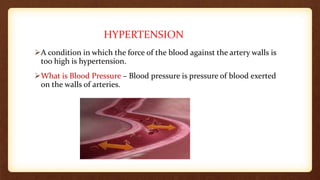
A condition in which the force of the blood against the artery walls is
too high is hypertension.
What is Blood Pressure – Blood pressure is pressure of blood exerted
on the walls of arteries.
• Hypertension is defined as blood pressure above 140/90,and is
considered severe if the pressure is above 180/120.
• Hypertension has no serious symptoms but if it is untreated,it can
cause health conditions such as heart disease and stroke.
• Primary Hypertension – The blood pressure is above normal for which
no logical cause is known.
• Renal Hypertension – This hypertension may also be induced due to
the pathological conditions of the kidney.
SYMPTOMS OF HYPERTENSION
• Dizziness
• Feeling faint
• Fast or irregular heartbeat
• Feeling sick
• Feeling more thirsty than normal
• Blurred vision
• Confusion &Tiredness
• Breathing very fastly
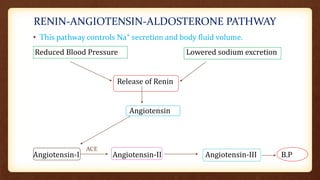
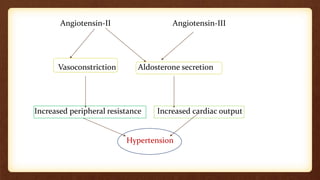
RENIN-ANGIOTENSIN-ALDOSTERONE PATHWAY
• This pathway controls Na⁺ secretion and body fluid volume.
Reduced Blood Pressure Lowered sodium excretion
Release of Renin
Angiotensin
Angiotensin-I Angiotensin-II Angiotensin-III B.P
ACE
Angiotensin-II Angiotensin-III
Vasoconstriction Aldosterone secretion
Increased peripheral resistance Increased cardiac output
Hypertension
ANTIHYPERTENSIVE AGENTS
• Drugs that are used to control or manage the hypertension are called as
antihypertensive agents.
• Different types of antihypertensive agents to treat hypertension.
• They work in different ways to control blood pressure.
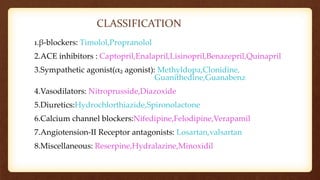
CLASSIFICATION
1.β-blockers: Timolol,Propranolol
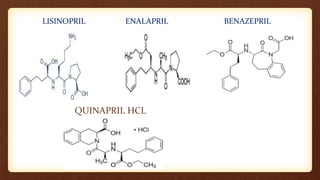
2.ACE inhibitors : Captopril,Enalapril,Lisinopril,Benazepril,Quinapril
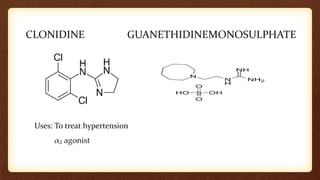
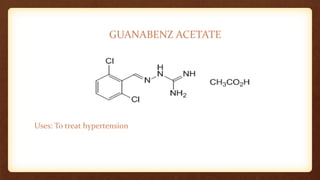
3.Sympathetic agonist(α₂ agonist): Methyldopa,Clonidine,
Guanithedine,Guanabenz
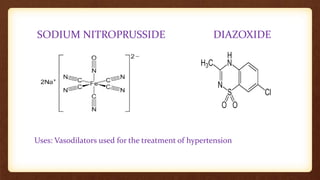
4.Vasodilators: Nitroprusside,Diazoxide
5.Diuretics:Hydrochlorthiazide,Spironolactone
6.Calcium channel blockers:Nifedipine,Felodipine,Verapamil
7.Angiotension-II Receptor antagonists: Losartan,valsartan
8.Miscellaneous: Reserpine,Hydralazine,Minoxidil
TIMOLOL
Uses: Decreases systemic vascular resistance
Used as antihypertensive
PROPRANOLOL
Uses:β-blocker used in the treatment of hypertension.
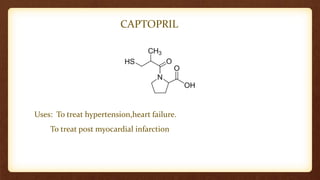
CAPTOPRIL
Uses: To treat hypertension,heart failure.
To treat post myocardial infarction
LISINOPRIL ENALAPRIL BENAZEPRIL
QUINAPRIL HCL
METHYLDOPA
Uses:Methyldopa is used to treat high blood pressure
It relaxes the blood vessels so that blood flows easily through the
body.
CLONIDINE GUANETHIDINEMONOSULPHATE
Uses: To treat hypertension
α₂ agonist
GUANABENZ ACETATE
Uses: To treat hypertension
SODIUM NITROPRUSSIDE DIAZOXIDE
Uses: Vasodilators used for the treatment of hypertension
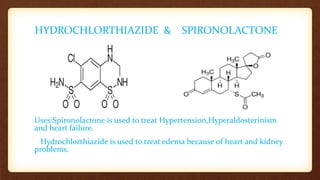
HYDROCHLORTHIAZIDE & SPIRONOLACTONE
Uses:Spironolactone is used to treat Hypertension,Hyperaldosterinism
and heart failure.
Hydrochlorthiazide is used to treat edema because of heart and kidney
problems.
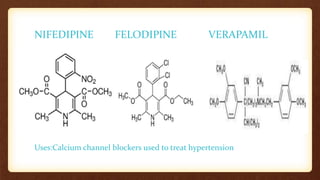
NIFEDIPINE FELODIPINE VERAPAMIL
Uses:Calcium channel blockers used to treat hypertension
LOSARTAN VALSARTAN
Uses: Angiotensin II Receptor antagonists
To treat hypertension
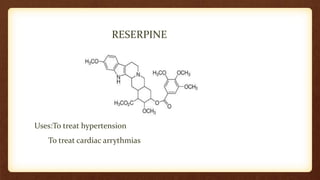
RESERPINE
Uses:To treat hypertension
To treat cardiac arrythmias
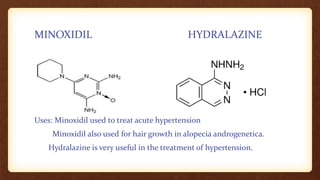
MINOXIDIL HYDRALAZINE
Uses: Minoxidil used to treat acute hypertension
Minoxidil also used for hair growth in alopecia androgenetica.
Hydralazine is very useful in the treatment of hypertension.
MOA OF β-BLOCKERS
• β-adrenergic blocking agents are drugs that reduce your B.P.
• β-blockers work by blocking the effects of the hormone
/neurotransmitter –epinephrine.
• β-blockers causes heart to beat more slowly and with less force
,which lowers blood pressure.
Eg:Timolol,Propranolol
MOA OF ACE INHIBITORS
• ACE Inhibitors relaxes veins and arteries to lower blood pressure.
• ACE Inhibitors prevents an enzyme(Angiotensin converting enzyme)
in the body and blocks the production of angiotensin-II,a substance
(peptide) that narrows blood vessels(vasoconstriction).
• This narrowing can cause increase in B.P and forces heart to work
harder.
VASODILATORS MECHANISM
• Vasodilator drugs relaxes the smooth muscle in blood vessels,which
causes blood vessels to dilate.
• Dilation of arterial blood vessels leads to a reduced systemic vascular
resistance .
• This leads to fall in arterial blood pressure.
Eg: sodiumnitroprusside and diazoxide
MOA OF α₂-AGONISTS
• These drugs stimulate α-adrenergic receptors in the brain.
• This action results in reduced sympathetic outflow from the CNS
and decreases peripheral resistance,renal vascular resistance ,Heart
rate and blood pressure.
Eg:Methyldopa,clonidine,Guanethidine,Guanabenz
MOA OF DIURETICS
• Thiazide diuretics enhance urinary excretion of both Na & H₂O by
specifically inhibiting Na reabsorption located in the thick portion of
the ascending limb of loop of henle and also in the distal tubule.
• They also cause an increase in the excretion of Cl⁻,K⁺ and HCO₃⁻ ions.
• Thiazide diuretics also minimizes the glomerular filtration rate.
Eg: Chlorthiazide
• Spironolactone competes with aldosterone at the specific receptor site
located in the distal tubule and causes diuresis.
MOA OF CALCIUM CHANNEL BLOCKERS
• Calcium channel blockers inhibits the inward movement(influx) of
calcium ions and decreases contractility.
Eg: Nifedipine,Felodipine &Verapamil
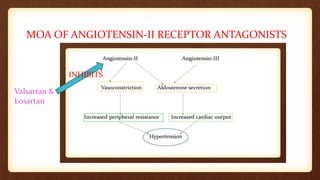
MOA OF ANGIOTENSIN-II RECEPTOR ANTAGONISTS
Valsartan &
Losartan
INHIBITS
MECHANISM OF RESERPINE
• It is an adrenergic blocking agent used to treat mild to moderate
hypertension by disrupting norepinephrine vesticular storage.
• The antihypertensive action of reserpine is a result by depleting
catecholamines from peripheral sympathetic nerve endings.
MECHANISM OF MINOXIDIL
• The antihypertensive activity of minoxidil is by opening ATP sensitive
potassium channels in vascular smooth muscle and causes
vasodilation.
SYNTHESIS OF METHYLDOPA
THANK YOU