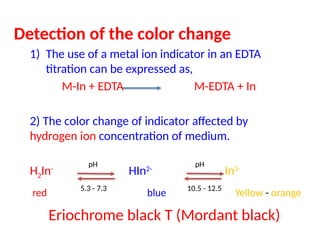
Detection of thecolor change
1) The use of a metal ion indicator in an EDTA
titration can be expressed as,
M-In + EDTA M-EDTA + In
2) The color change of indicator affected by
hydrogen ion concentration of medium.
H2In-
HIn2-
In3-
pH
pH
5.3 - 7.3 10.5 - 12.5
Yellow - orange
red blue
Eriochrome black T (Mordant black)
5.
Preparation and standardizationof EDTA
• Normally the standard solution used is
Na2[H2Y2-
].2H2O, with concentration =
0.05M.
• The primary standard is either Zn2+
salt or
Ca2+
salt.
• The suitable buffer is added to adjust the
pH, and a suitable indicator, then the
solution is titrated with EDTA.
6.
Methods of EDTAtitrations
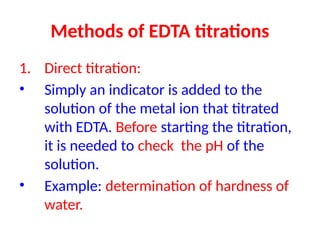
1. Direct titration:
• Simply an indicator is added to the
solution of the metal ion that titrated
with EDTA. Before starting the titration,
it is needed to check the pH of the
solution.
• Example: determination of hardness of
water.
7.
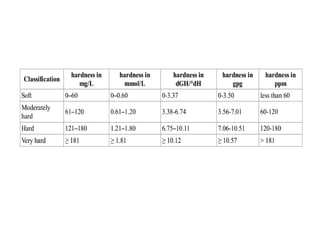
Water hardness
• Waterhardness is total amount of Ca2+
and Mg2+
in water sample, expressed in
ppm [parts per million].
• Water is said to be “hard” when it
contains Ca2+
and Mg2+
ions.
• These ions react with soap to form an
insoluble substance called “soap scum”.
9.
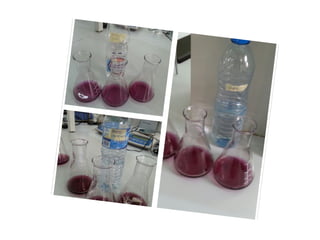
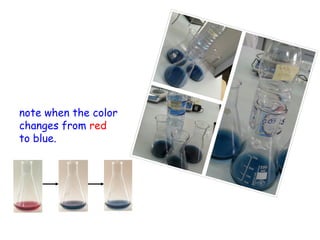
• Water hardnessis determined by taking
certain volume of water, the medium is
made alkaline with suitable buffer then
titrated with standard solution of EDTA
and Eriochrome black T [EBT] as indicator.
• If H2S is added all other heavy metals
present will be precipitated as sulfides.
• Ca2+
+ H2Y2-
[CaY]2-
+ 2H+
• Mg2+
+ H2Y2-
[MgY]2-
+ 2H+
2. Back titration:
•An excess of EDTA is added to the metal
ion solution, and the excess EDTA is
titrated with a known concentration of a
second metal ion. The second metal ion
must form a weaker complex with EDTA
than the analyte ion. Why?
13.
• Back titrationis carried out for the
following:
1. Insoluble materials [ PbSO4, CaCO3]
2. Materials which precipitate at the pH of
titration.
3. Materials which react quantitatively
only in excess of EDTA.
4. In case there is No suitable indicator
available for direct titration.
14.
• Example: determinationof Alum
• potassium aluminium sulfate, or
potassium alum [KAl(SO₄)₂]
• Direct determination of aluminum with EDTA is
impossible - complexation reaction is too slow,
making titration impractical.
• Complex stability constant for Al3+
is so high, that
EDTA titration is tempting.
• Of several possible solutions back titration proves
to be the best approach. EDTA and aluminum are
allowed to react in hot solution for several
minutes, then excess EDTA can be fast and easily
titrated with Zn2+
.
15.
Al3+
+ H2Y2-
[AlY]1-
+ 2H+
(Slowreaction)
[excess]
• Few ml of dilute HCl is added just to make the
medium acidic [pH = 2-3], then the mixture is
boiled for 2-3 minutes.
• The remaining EDTA is back titrated using
STD Zn2+
salt (as sulfate or chloride)
solution after pH adjustment.
Zn2+
+ H2Y2-
[ZnY]2-
+ 2H+
(Fast)

![Preparation and standardization of EDTA
• Normally the standard solution used is
Na2[H2Y2-
].2H2O, with concentration =
0.05M.
• The primary standard is either Zn2+
salt or
Ca2+
salt.
• The suitable buffer is added to adjust the
pH, and a suitable indicator, then the
solution is titrated with EDTA.](https://image.slidesharecdn.com/lecture2-250820033359-fc9f54f0/85/Lecture-2-Complexometric-titration-pptx-5-320.jpg)
![Water hardness
• Water hardness is total amount of Ca2+
and Mg2+
in water sample, expressed in
ppm [parts per million].
• Water is said to be “hard” when it
contains Ca2+
and Mg2+
ions.
• These ions react with soap to form an
insoluble substance called “soap scum”.](https://image.slidesharecdn.com/lecture2-250820033359-fc9f54f0/85/Lecture-2-Complexometric-titration-pptx-7-320.jpg)
![• Water hardness is determined by taking
certain volume of water, the medium is
made alkaline with suitable buffer then
titrated with standard solution of EDTA
and Eriochrome black T [EBT] as indicator.
• If H2S is added all other heavy metals
present will be precipitated as sulfides.
• Ca2+
+ H2Y2-
[CaY]2-
+ 2H+
• Mg2+
+ H2Y2-
[MgY]2-
+ 2H+](https://image.slidesharecdn.com/lecture2-250820033359-fc9f54f0/85/Lecture-2-Complexometric-titration-pptx-9-320.jpg)
![• Back titration is carried out for the
following:
1. Insoluble materials [ PbSO4, CaCO3]
2. Materials which precipitate at the pH of
titration.
3. Materials which react quantitatively
only in excess of EDTA.
4. In case there is No suitable indicator
available for direct titration.](https://image.slidesharecdn.com/lecture2-250820033359-fc9f54f0/85/Lecture-2-Complexometric-titration-pptx-13-320.jpg)
![• Example: determination of Alum
• potassium aluminium sulfate, or
potassium alum [KAl(SO₄)₂]
• Direct determination of aluminum with EDTA is
impossible - complexation reaction is too slow,
making titration impractical.
• Complex stability constant for Al3+
is so high, that
EDTA titration is tempting.
• Of several possible solutions back titration proves
to be the best approach. EDTA and aluminum are
allowed to react in hot solution for several
minutes, then excess EDTA can be fast and easily
titrated with Zn2+
.](https://image.slidesharecdn.com/lecture2-250820033359-fc9f54f0/85/Lecture-2-Complexometric-titration-pptx-14-320.jpg)
![Al3+
+ H2Y2-
[AlY]1-
+ 2H+
(Slow reaction)
[excess]
• Few ml of dilute HCl is added just to make the
medium acidic [pH = 2-3], then the mixture is
boiled for 2-3 minutes.
• The remaining EDTA is back titrated using
STD Zn2+
salt (as sulfate or chloride)
solution after pH adjustment.
Zn2+
+ H2Y2-
[ZnY]2-
+ 2H+
(Fast)](https://image.slidesharecdn.com/lecture2-250820033359-fc9f54f0/85/Lecture-2-Complexometric-titration-pptx-15-320.jpg)