Raju Kaiti, M. optometry
Consultant Optometrist
Nepal eye Hospital (NEH)
CORNEAL TOPOGRAPHY
Introduction
 A non-invasive medical imaging technique for mapping the surface
curvature of the cornea
 Study of shape 0f corneal surface
 Configuration or description of surface
 Assist in the diagnosis and t/t of number of conditions:
 In planning Catarct sx and IOL implantation
 In planning refractive surgery such as LASIK, and evaluating its results
 Before fitting contact lenses and in assessing the fit of contact lenses
 In assessing corneal pathologies
 In checking the progression/regression of corneal pathologies and /or degeneration
Cornea
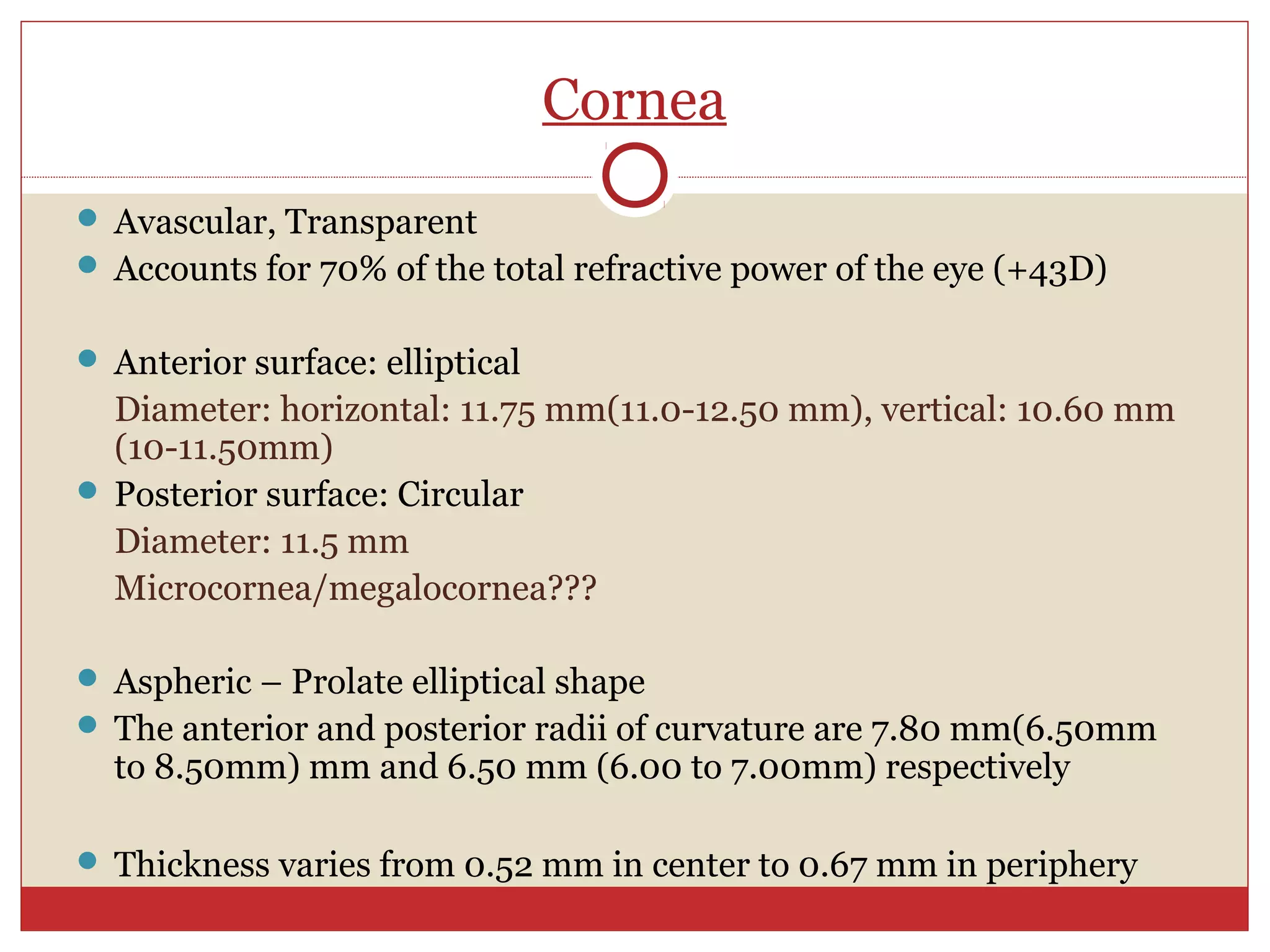
 Avascular, Transparent
 Accounts for 70% of the total refractive power of the eye (+43D)
 Anterior surface: elliptical
Diameter: horizontal: 11.75 mm(11.0-12.50 mm), vertical: 10.60 mm
(10-11.50mm)
 Posterior surface: Circular
Diameter: 11.5 mm
Microcornea/megalocornea???
 Aspheric – Prolate elliptical shape
 The anterior and posterior radii of curvature are 7.80 mm(6.50mm
to 8.50mm) mm and 6.50 mm (6.00 to 7.00mm) respectively
 Thickness varies from 0.52 mm in center to 0.67 mm in periphery
Cornea
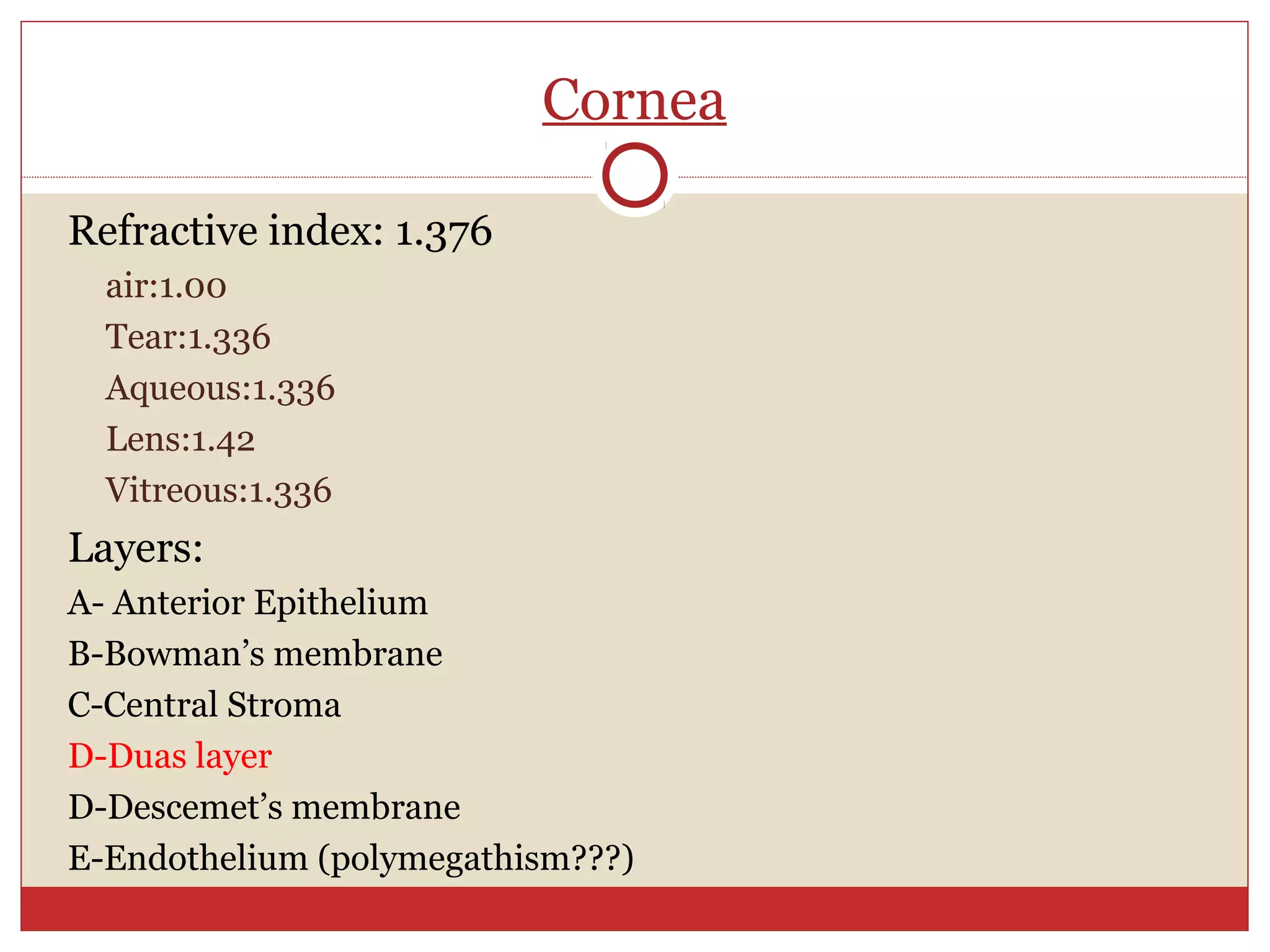
Refractive index: 1.376
air:1.00
Tear:1.336
Aqueous:1.336
Lens:1.42
Vitreous:1.336
Layers:
A- Anterior Epithelium
B-Bowman’s membrane
C-Central Stroma
D-Duas layer
D-Descemet’s membrane
E-Endothelium (polymegathism???)
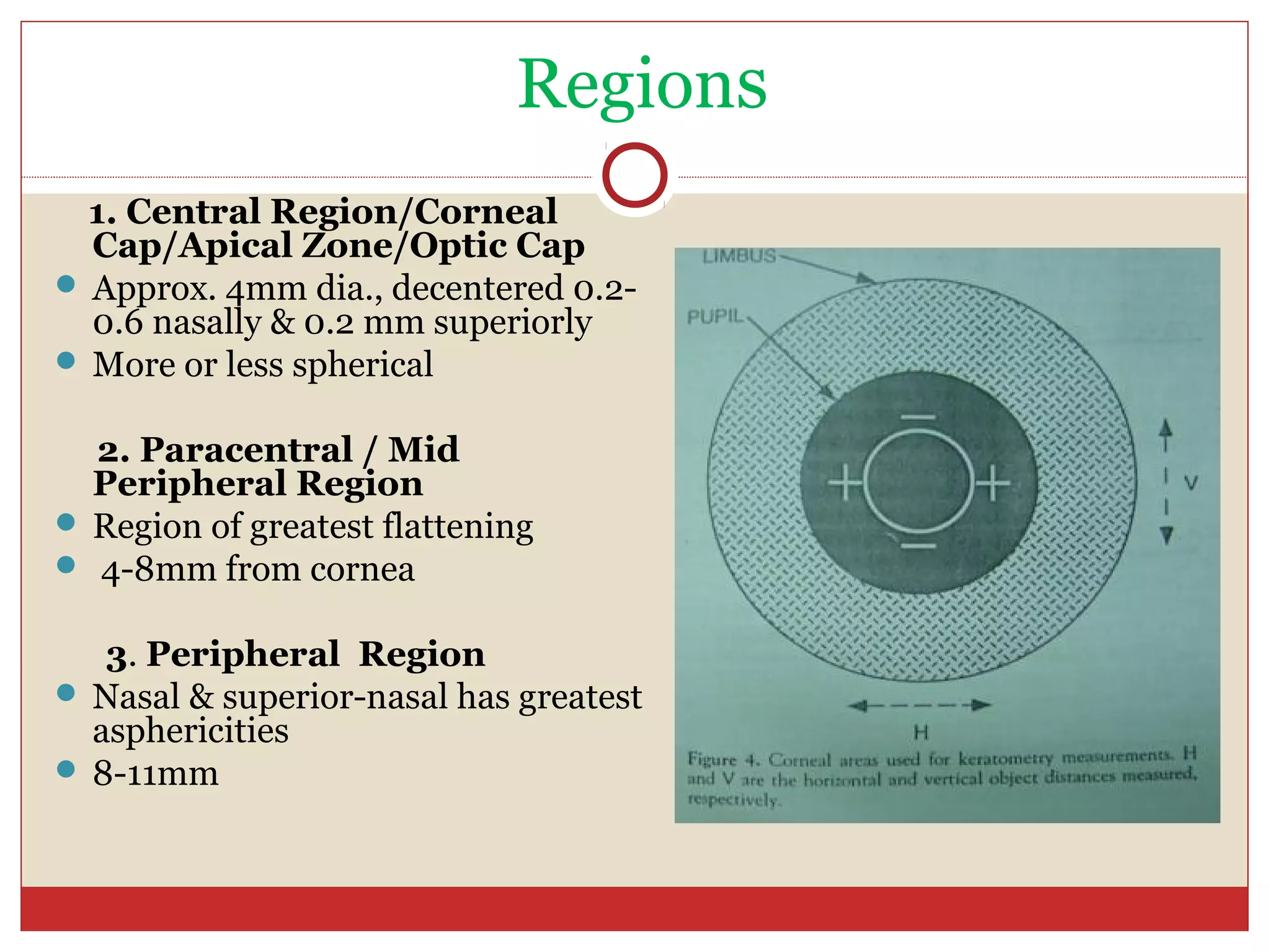
Regions
1. Central Region/Corneal
Cap/Apical Zone/Optic Cap
 Approx. 4mm dia., decentered 0.2-
0.6 nasally & 0.2 mm superiorly
 More or less spherical
2. Paracentral / Mid
Peripheral Region
 Region of greatest flattening
 4-8mm from cornea
3. Peripheral Region
 Nasal & superior-nasal has greatest
asphericities
 8-11mm
Corneal curvature & its measurement
Keratometry – (Ophthalmometry ) measure central 3 - 4
mm
Keratoscopy
 Placido disc
 Photokeratoscopy
 Videokeratoscopy
Computer assisted topographic analysis
Keratometry
Clinical technique us to measure the curvature of the
anterior corneal surface.
Another name: Ophthalmometry
Keratometer
An instrument that Measures the front surface
corneal radii
Measures the Central cap – 3 mm
Saggital radius
Corneal anterior surface acts as a convex
mirror – utilizes 1st
Purkinje image
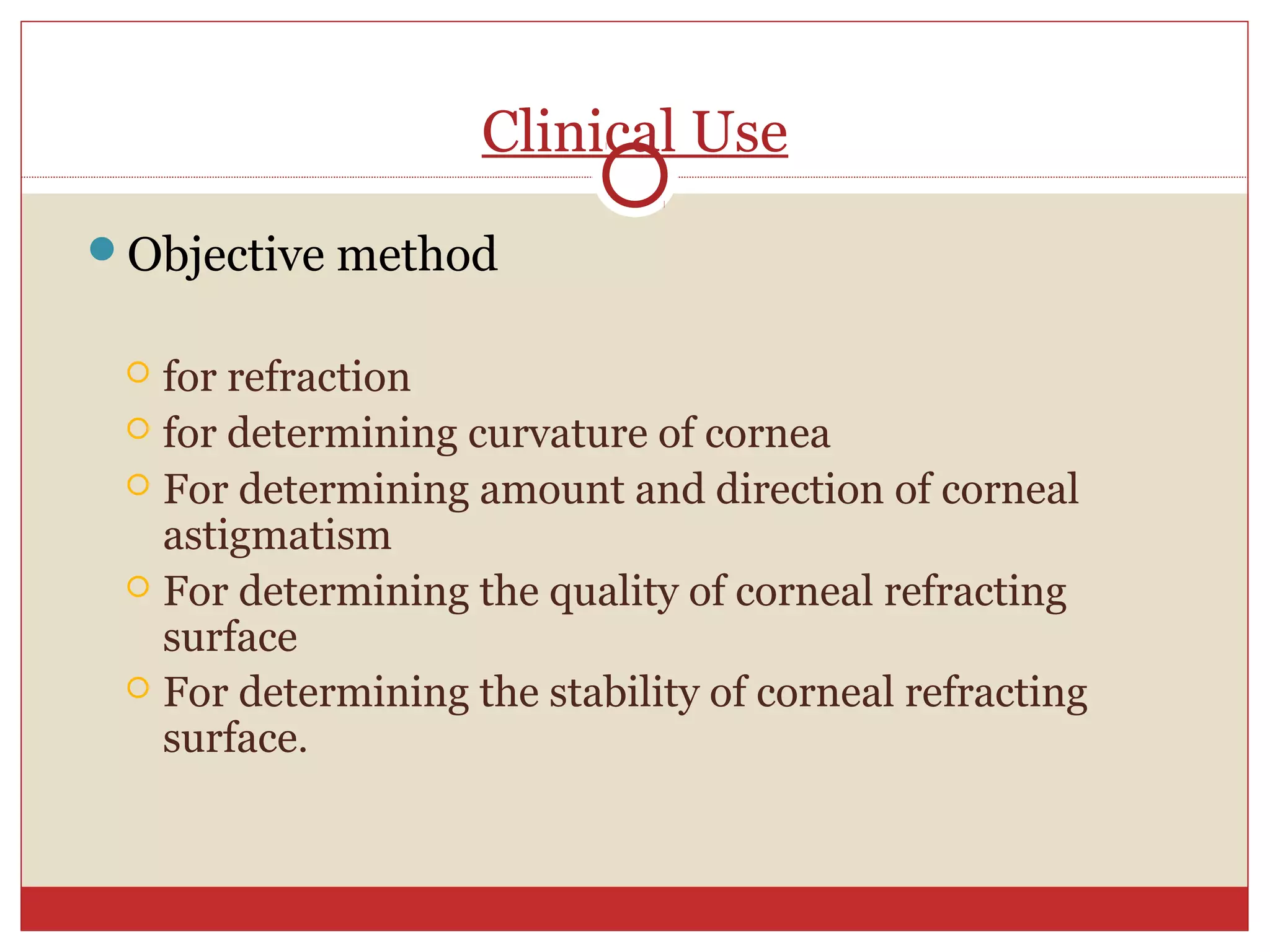
Clinical Use
Objective method
 for refraction
 for determining curvature of cornea
 For determining amount and direction of corneal
astigmatism
 For determining the quality of corneal refracting
surface
 For determining the stability of corneal refracting
surface.
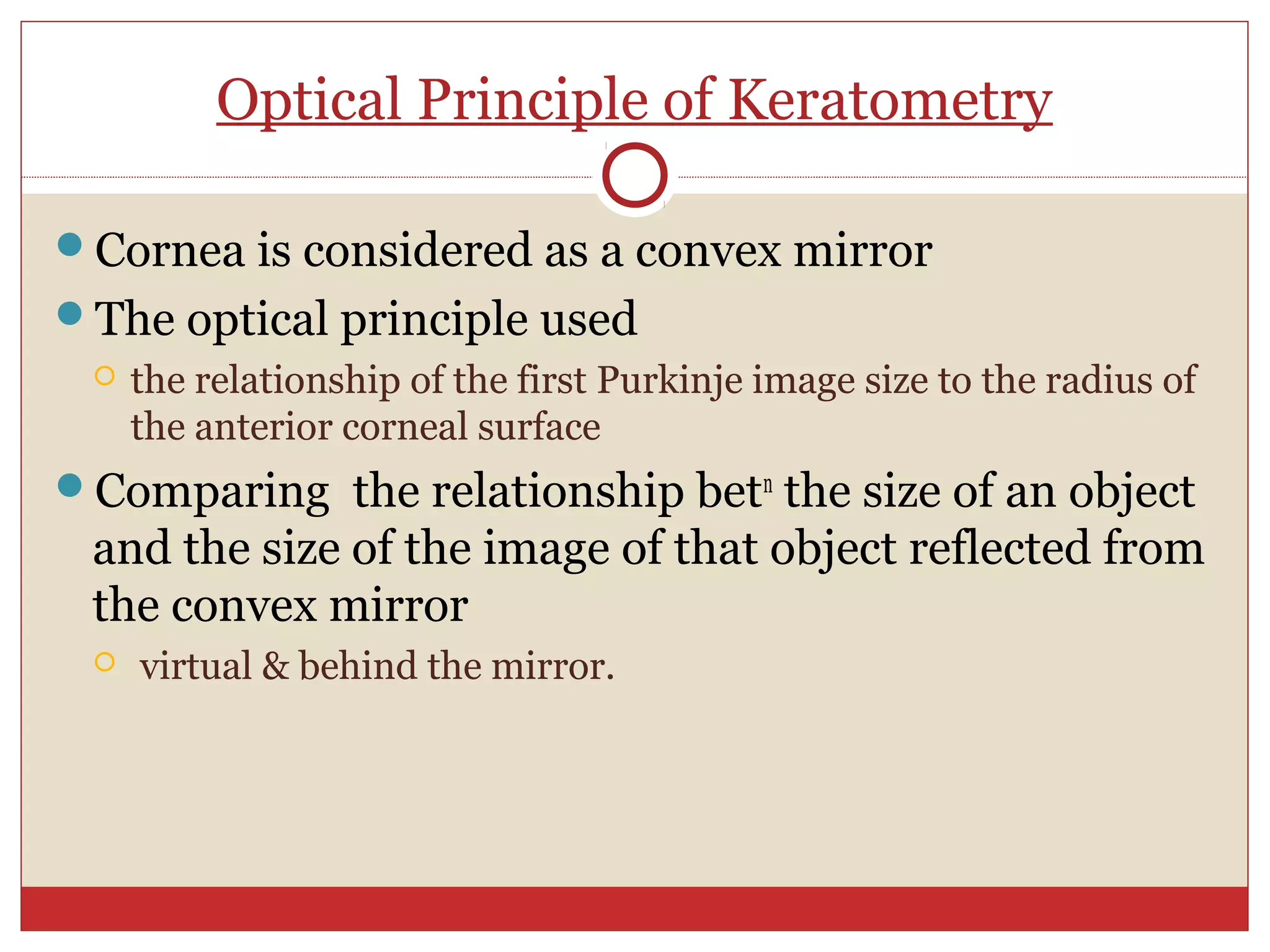
Optical Principle of Keratometry
Cornea is considered as a convex mirror
The optical principle used
 the relationship of the first Purkinje image size to the radius of
the anterior corneal surface
Comparing the relationship betn
the size of an object
and the size of the image of that object reflected from
the convex mirror
 virtual & behind the mirror.
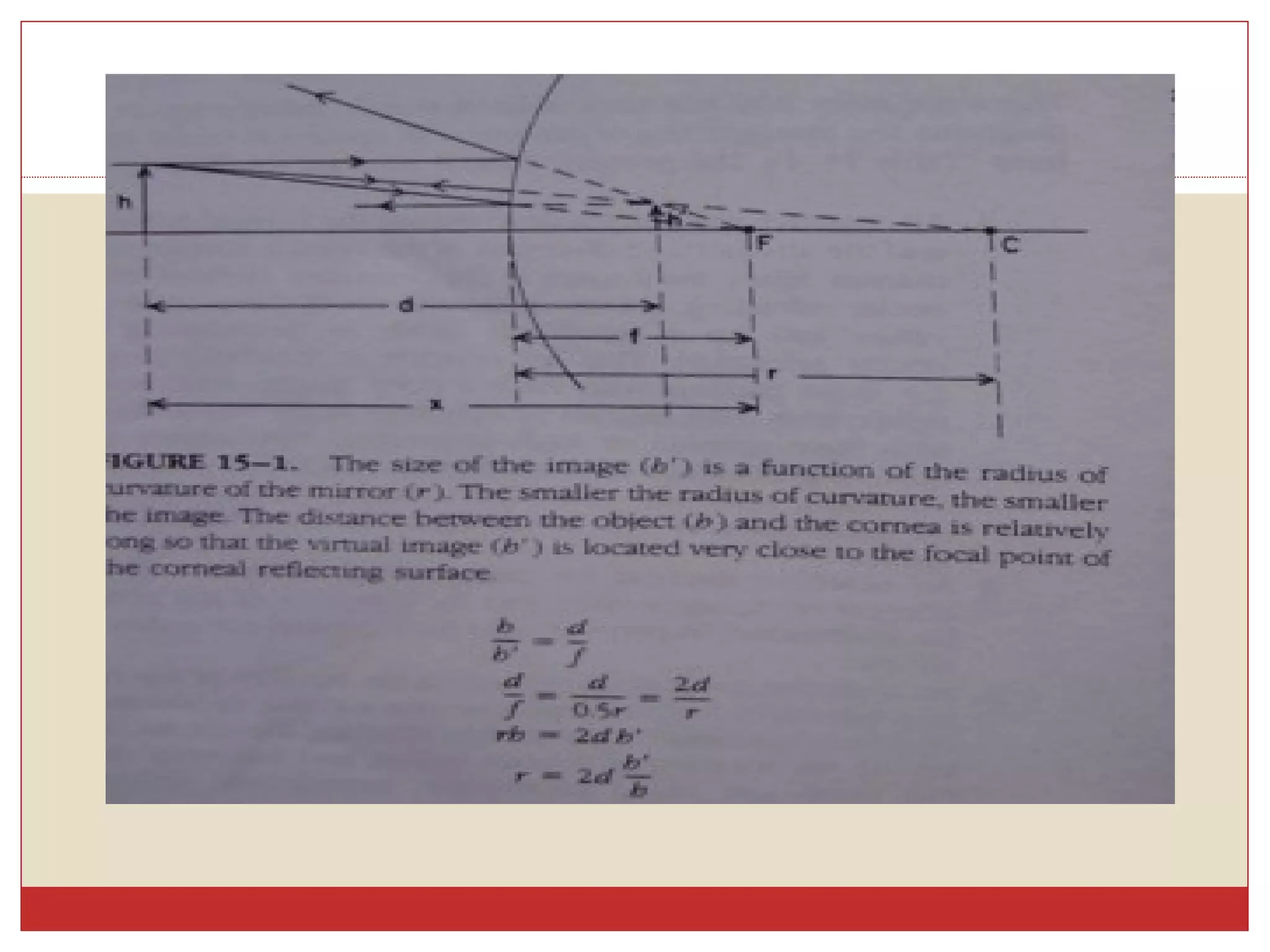
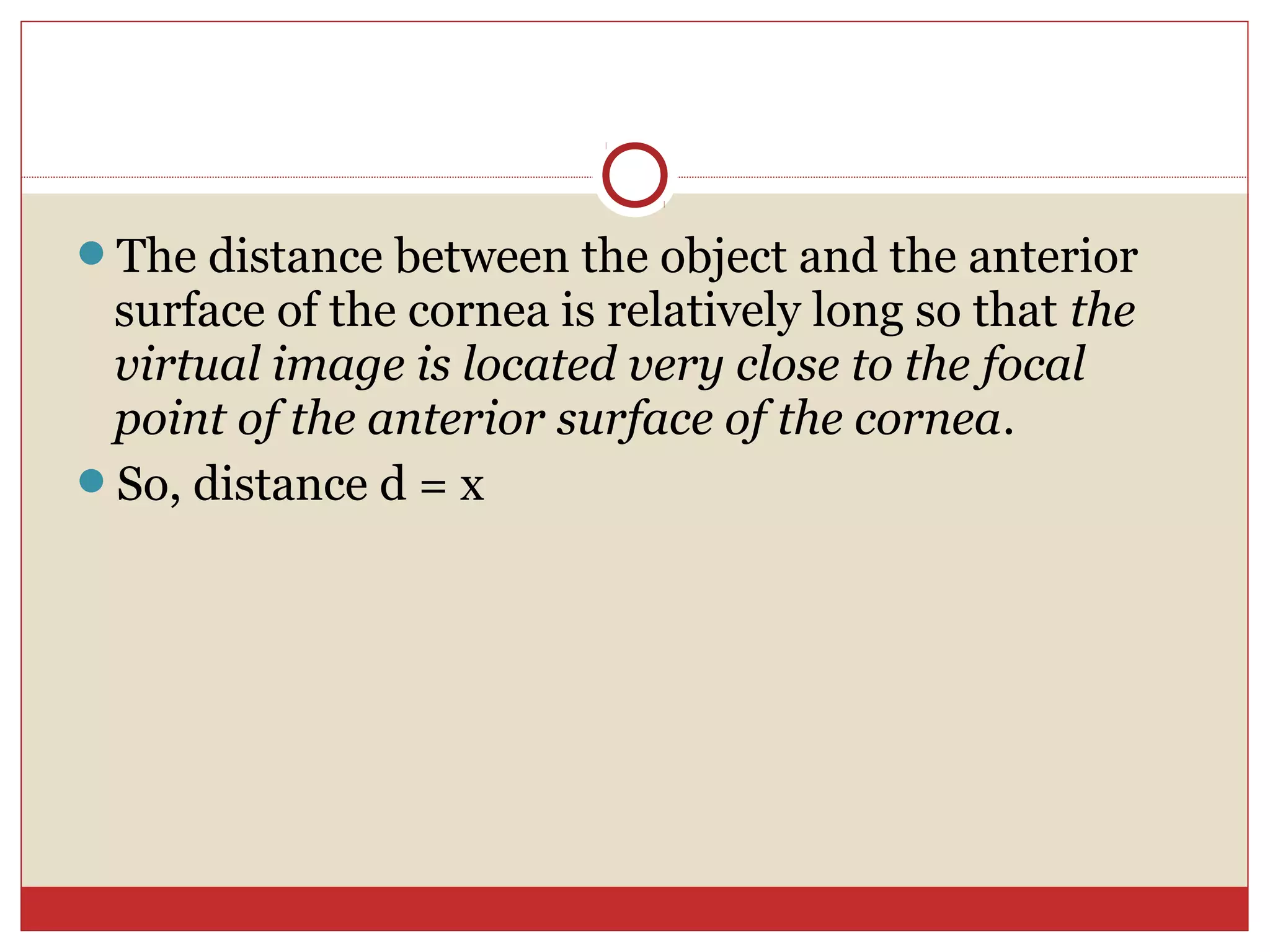
The distance between the object and the anterior
surface of the cornea is relatively long so that the
virtual image is located very close to the focal
point of the anterior surface of the cornea.
So, distance d = x
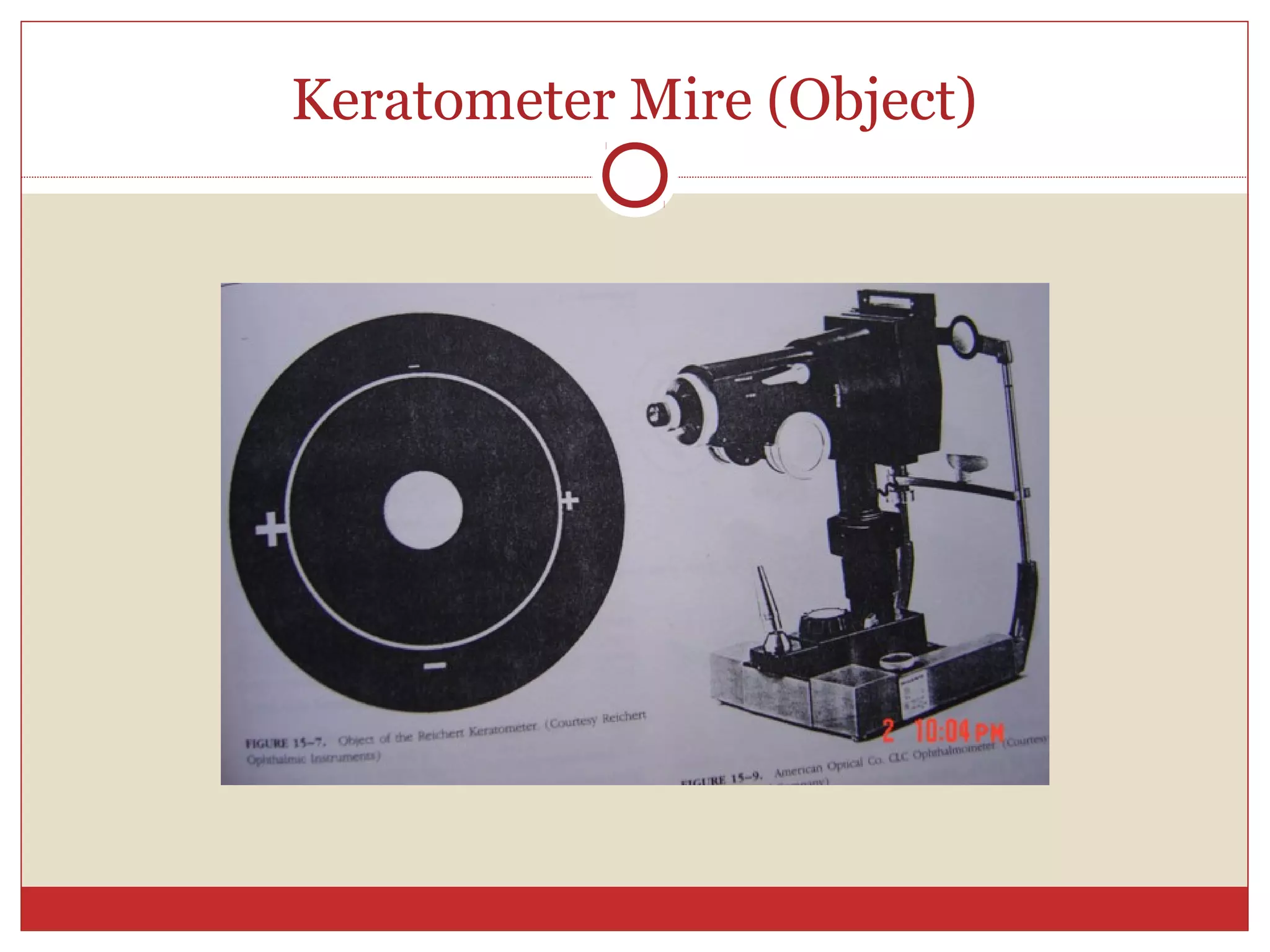
Keratometer Mire (Object)
Optical Principle of Keratometry
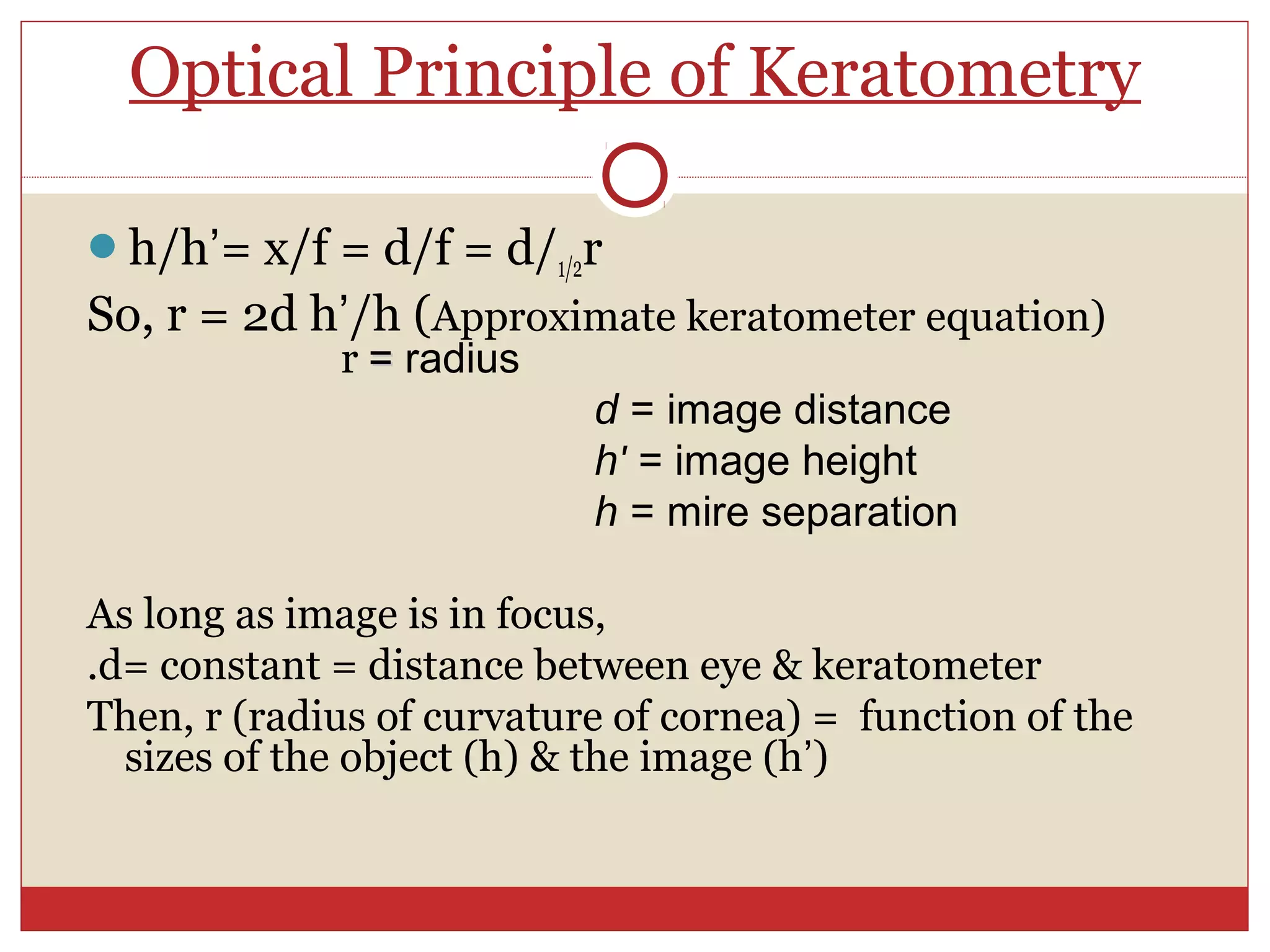
h/h’= x/f = d/f = d/1/2r
So, r = 2d h’/h (Approximate keratometer equation)
r == radius
d = image distance
h' = image height
h = mire separation
As long as image is in focus,
.d= constant = distance between eye & keratometer
Then, r (radius of curvature of cornea) = function of the
sizes of the object (h) & the image (h’)
Optical Principle of Keratometry
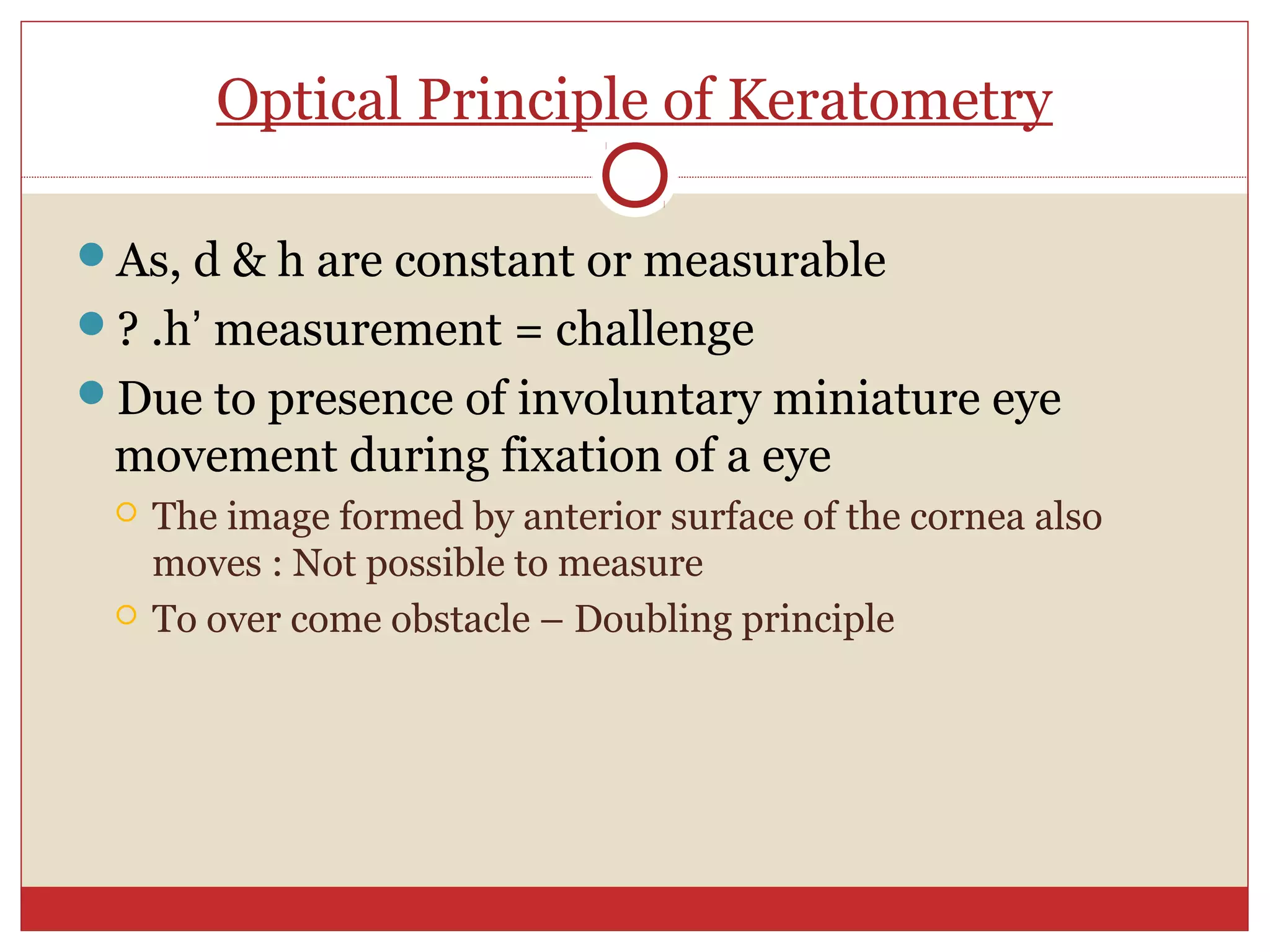
As, d & h are constant or measurable
? .h’ measurement = challenge
Due to presence of involuntary miniature eye
movement during fixation of a eye
 The image formed by anterior surface of the cornea also
moves : Not possible to measure
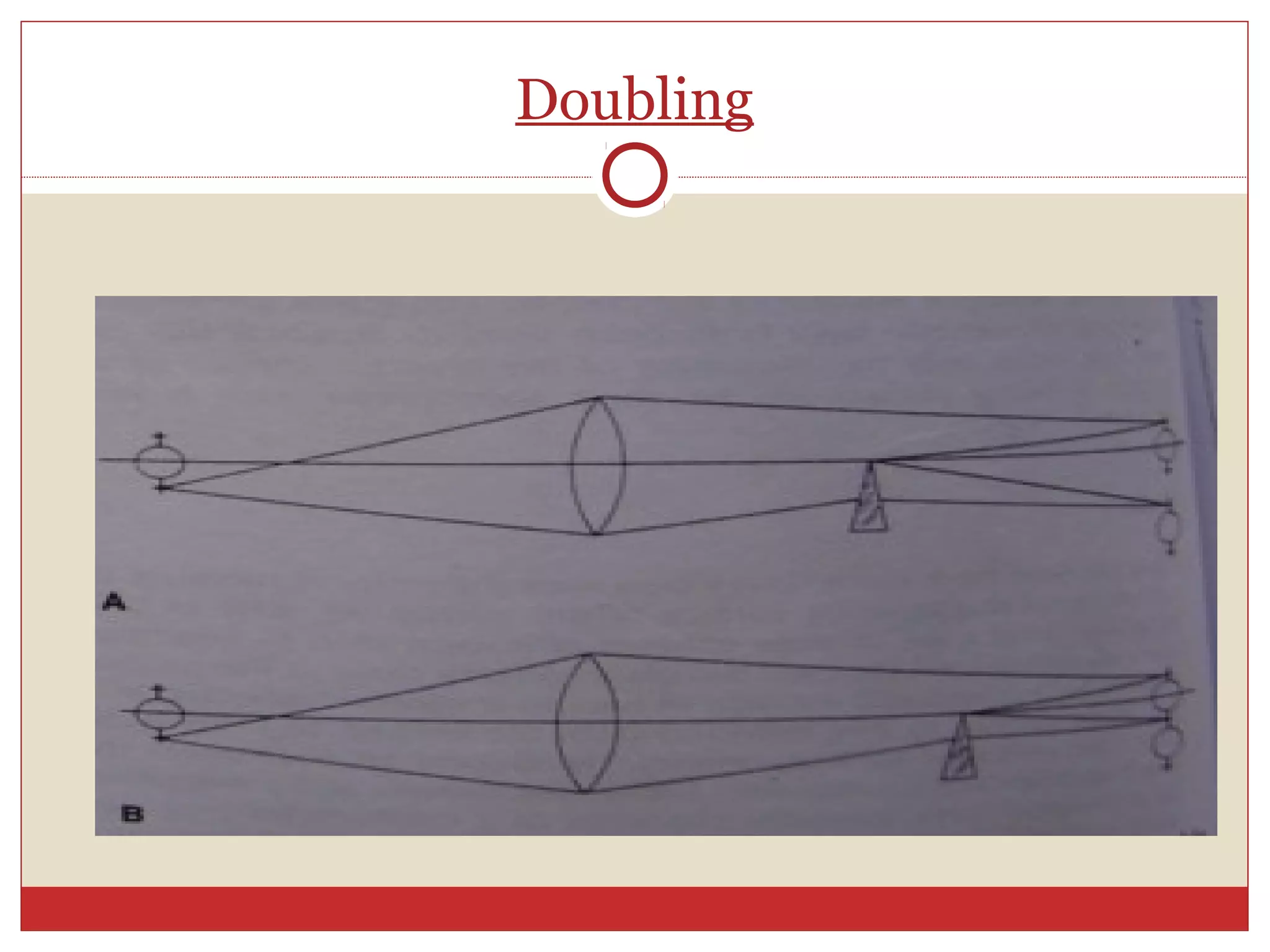
 To over come obstacle – Doubling principle
Optical Principle of Keratometry
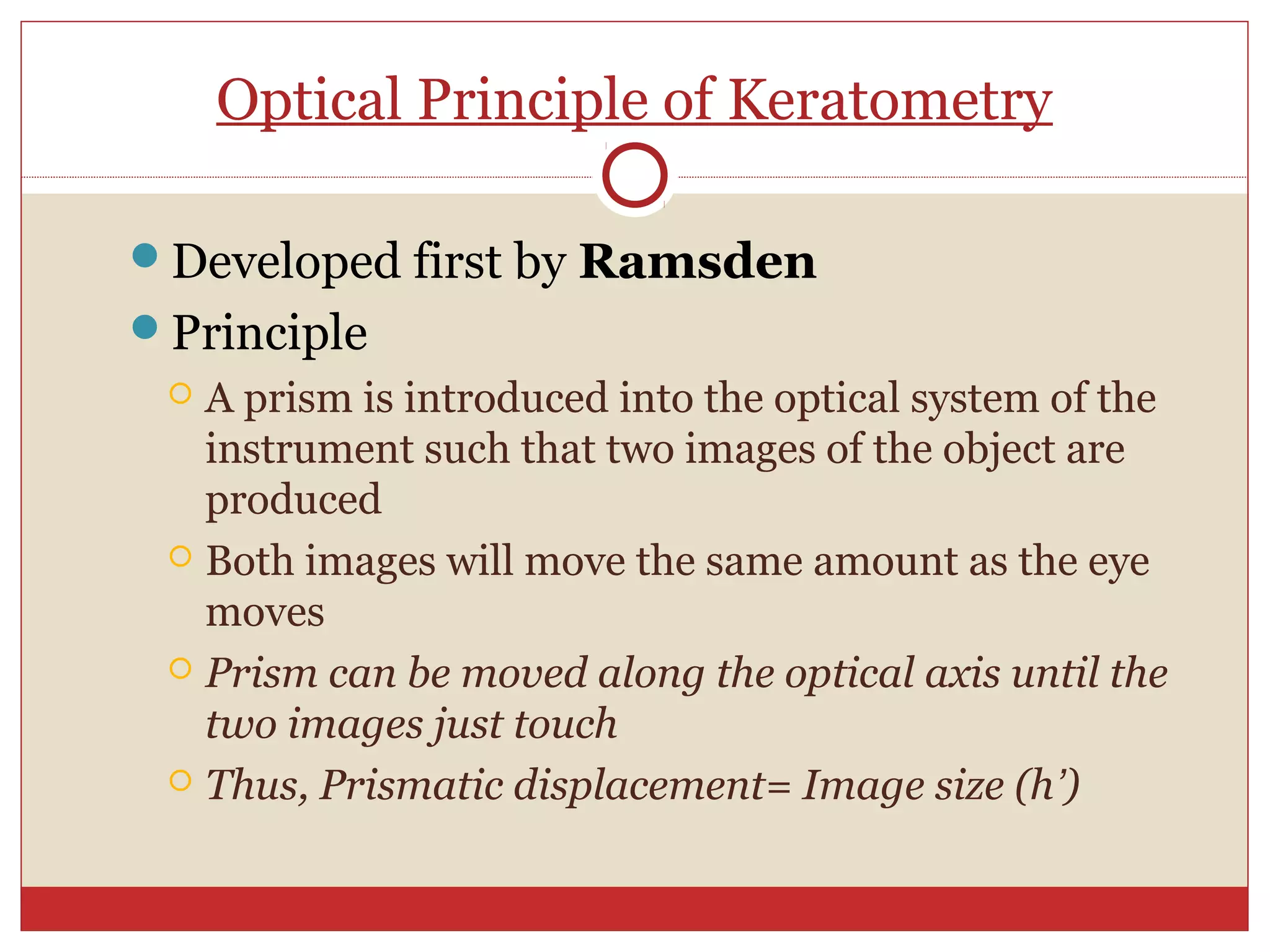
Developed first by Ramsden
Principle
 A prism is introduced into the optical system of the
instrument such that two images of the object are
produced
 Both images will move the same amount as the eye
moves
 Prism can be moved along the optical axis until the
two images just touch
 Thus, Prismatic displacement= Image size (h’)
Doubling
Optical Principle of Keratometry
The doubling principle
 The prism produces double image of the object
 Prism is moved along the optical axis until the two images are
just touching
 The larger the image size is, greater the amount of doubling –
greater would be the prism displacement
Optical Principle of Keratometry
In instrument, the rotating power wheel– moves
the prism
Amount of prism displacement = image size
 Corresponds to the radius of curvature = Calibrated in the
rotating power wheel
Types of doubling
Fixed doubling :
Variable doubling
Divided doubling
Full doubling
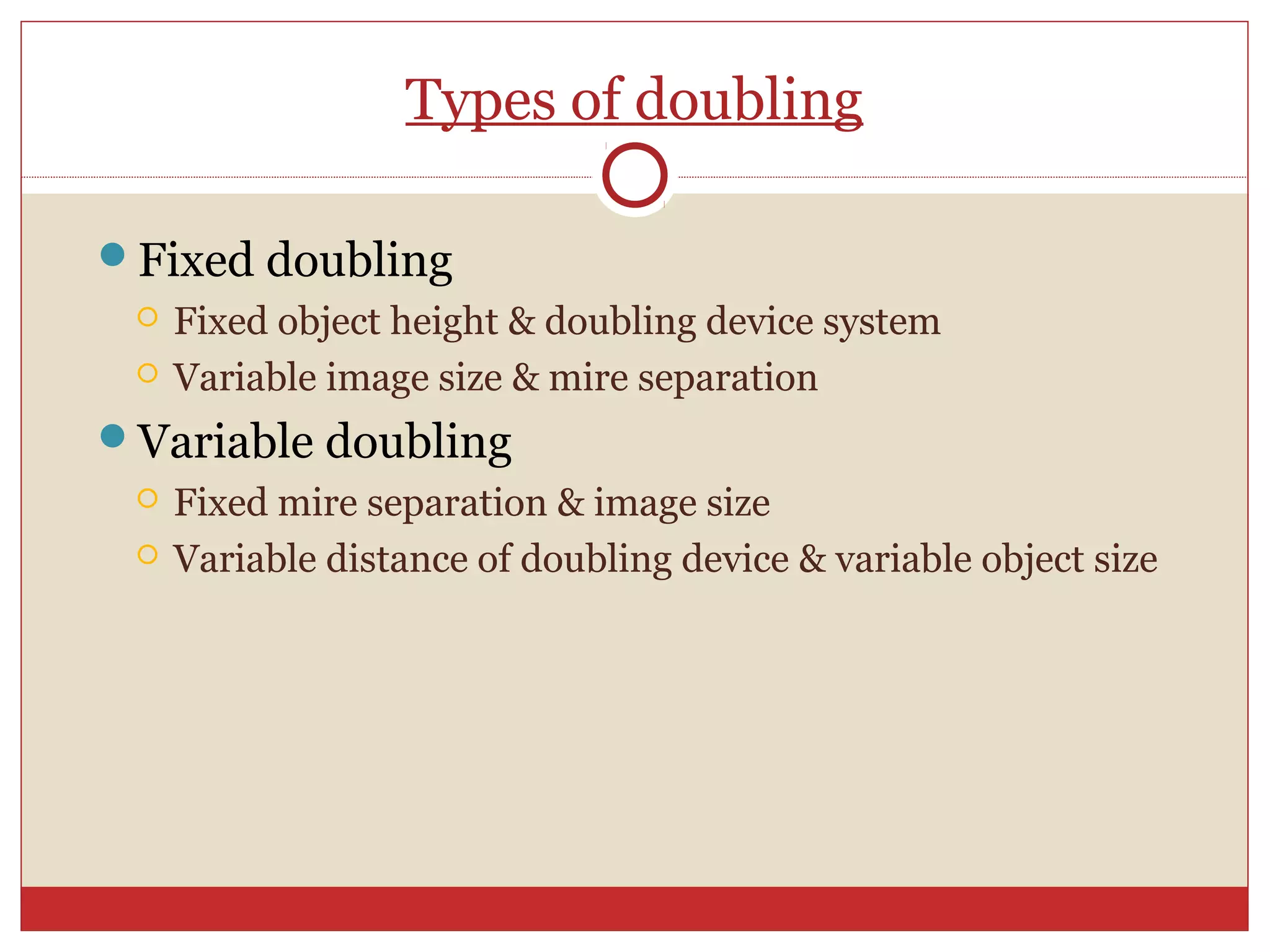
Types of doubling
Fixed doubling
 Fixed object height & doubling device system
 Variable image size & mire separation
Variable doubling
 Fixed mire separation & image size
 Variable distance of doubling device & variable object size
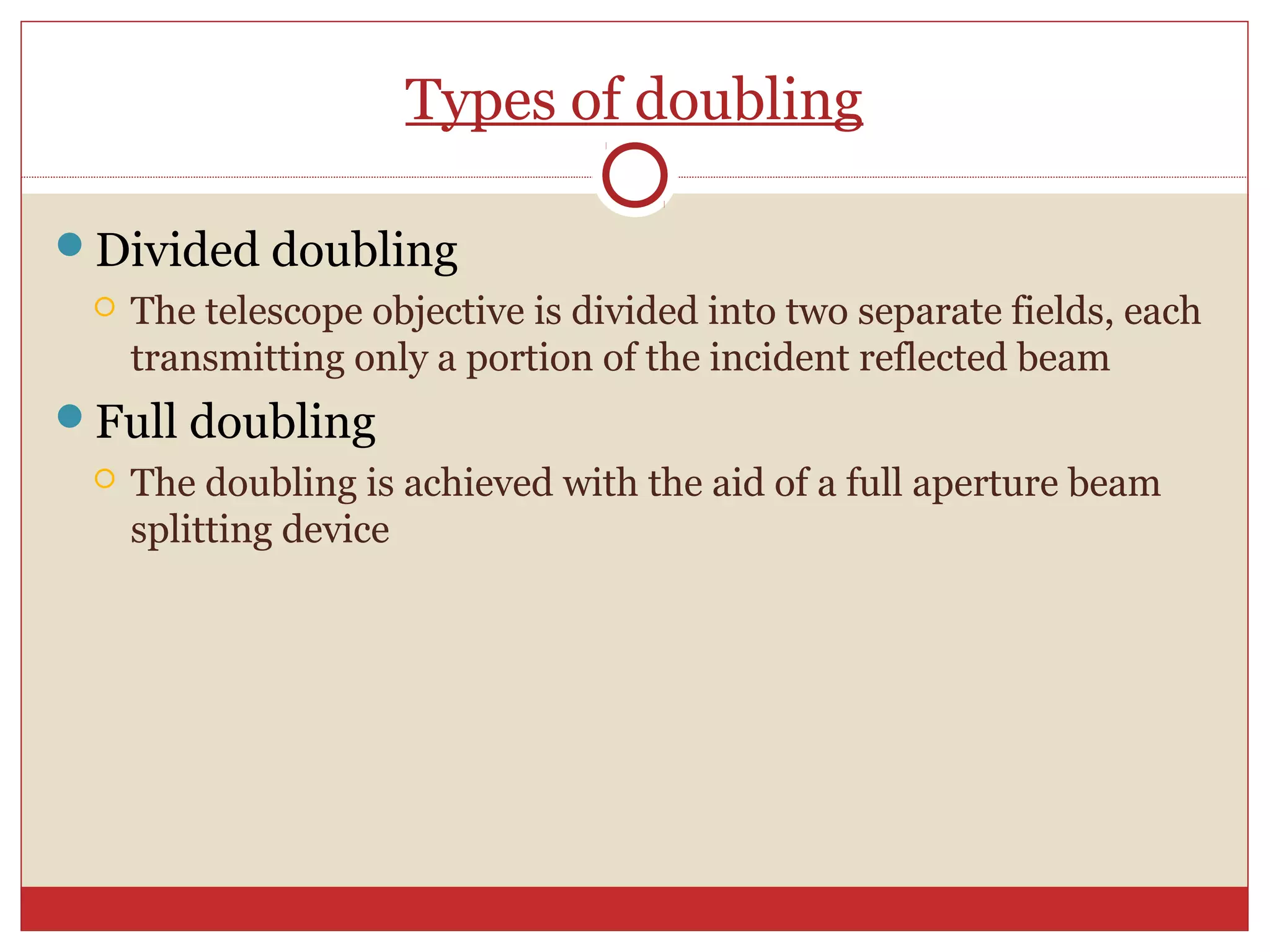
Types of doubling
Divided doubling
 The telescope objective is divided into two separate fields, each
transmitting only a portion of the incident reflected beam
Full doubling
 The doubling is achieved with the aid of a full aperture beam
splitting device
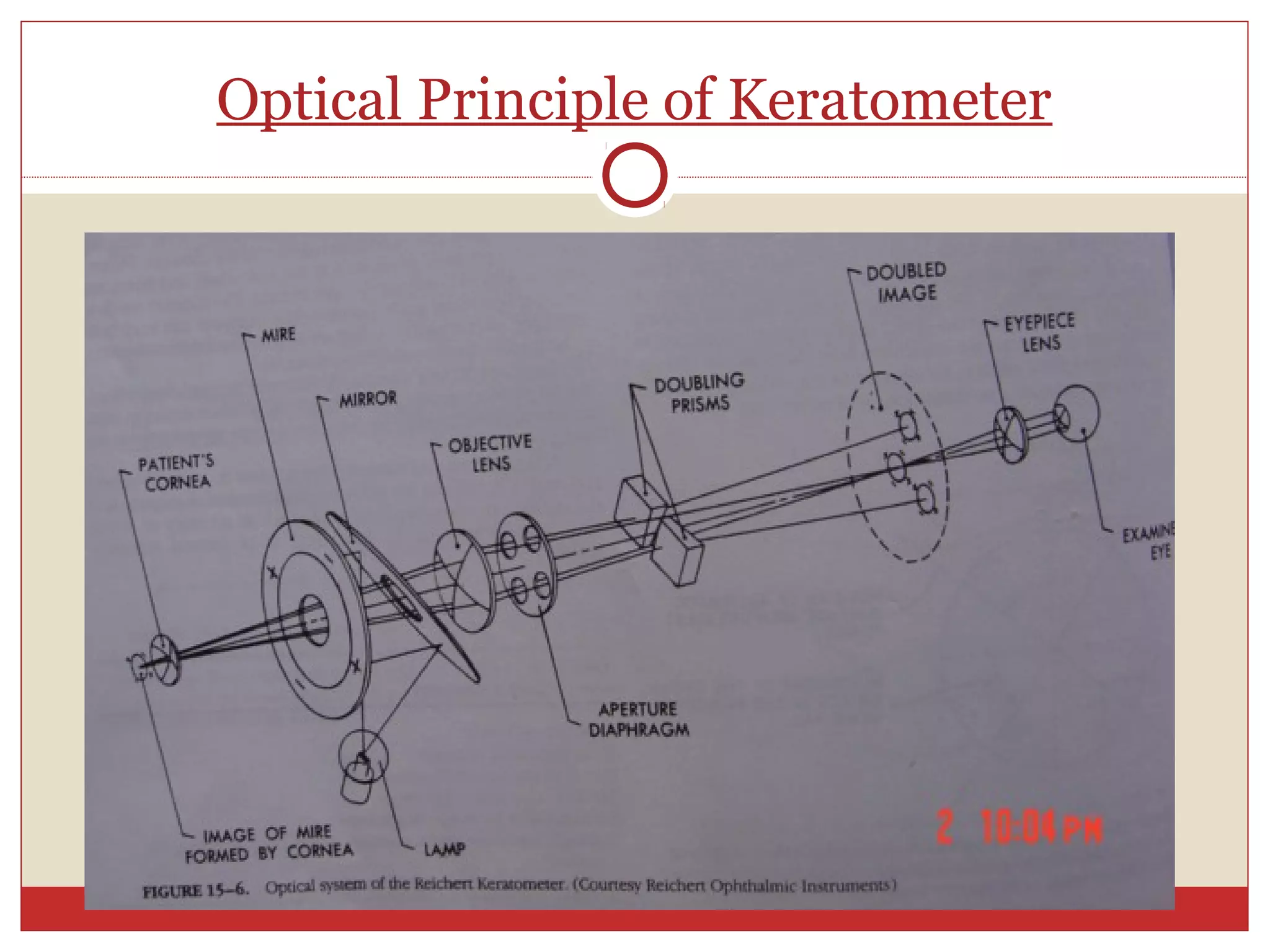
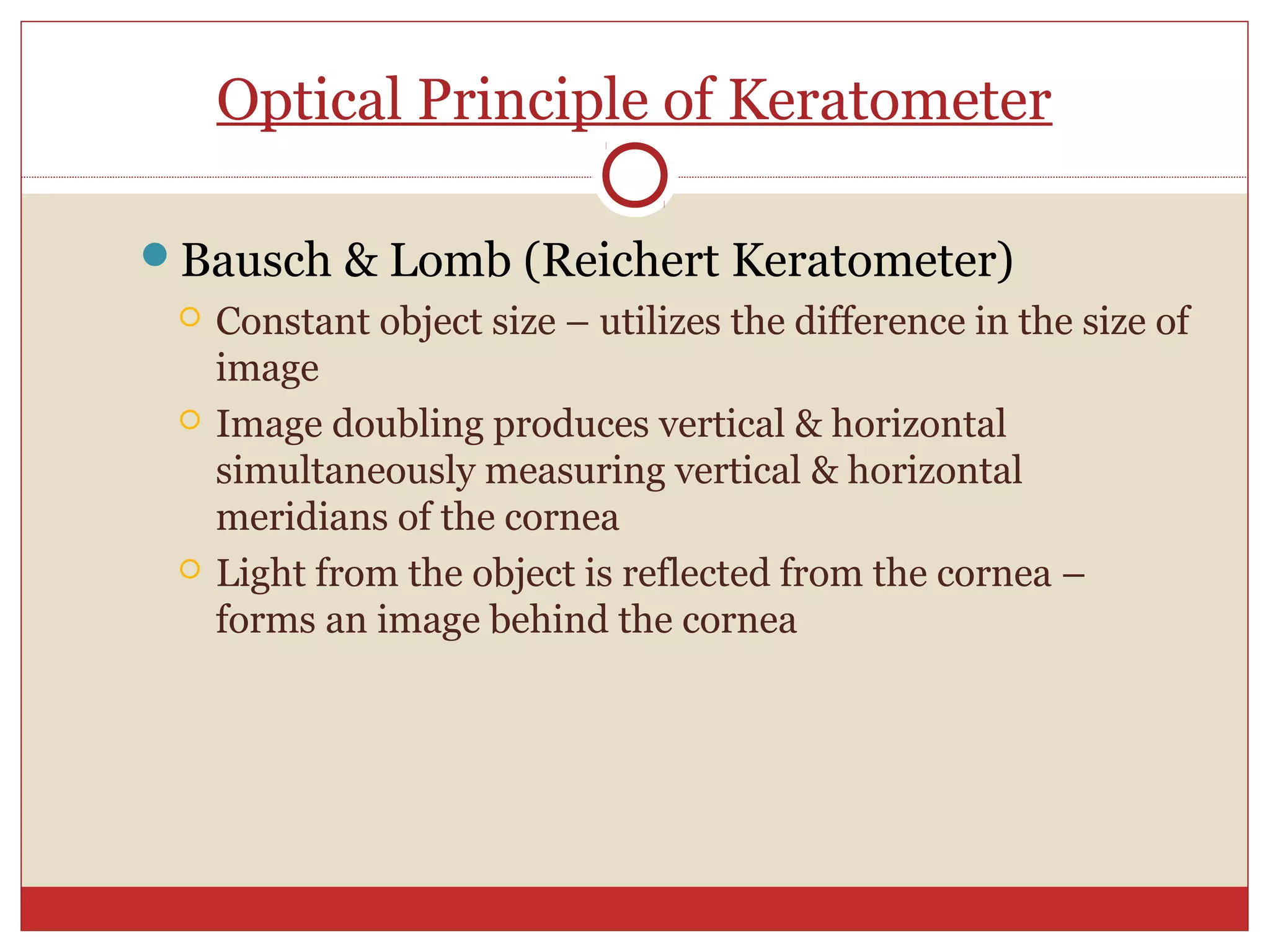
Optical Principle of Keratometer
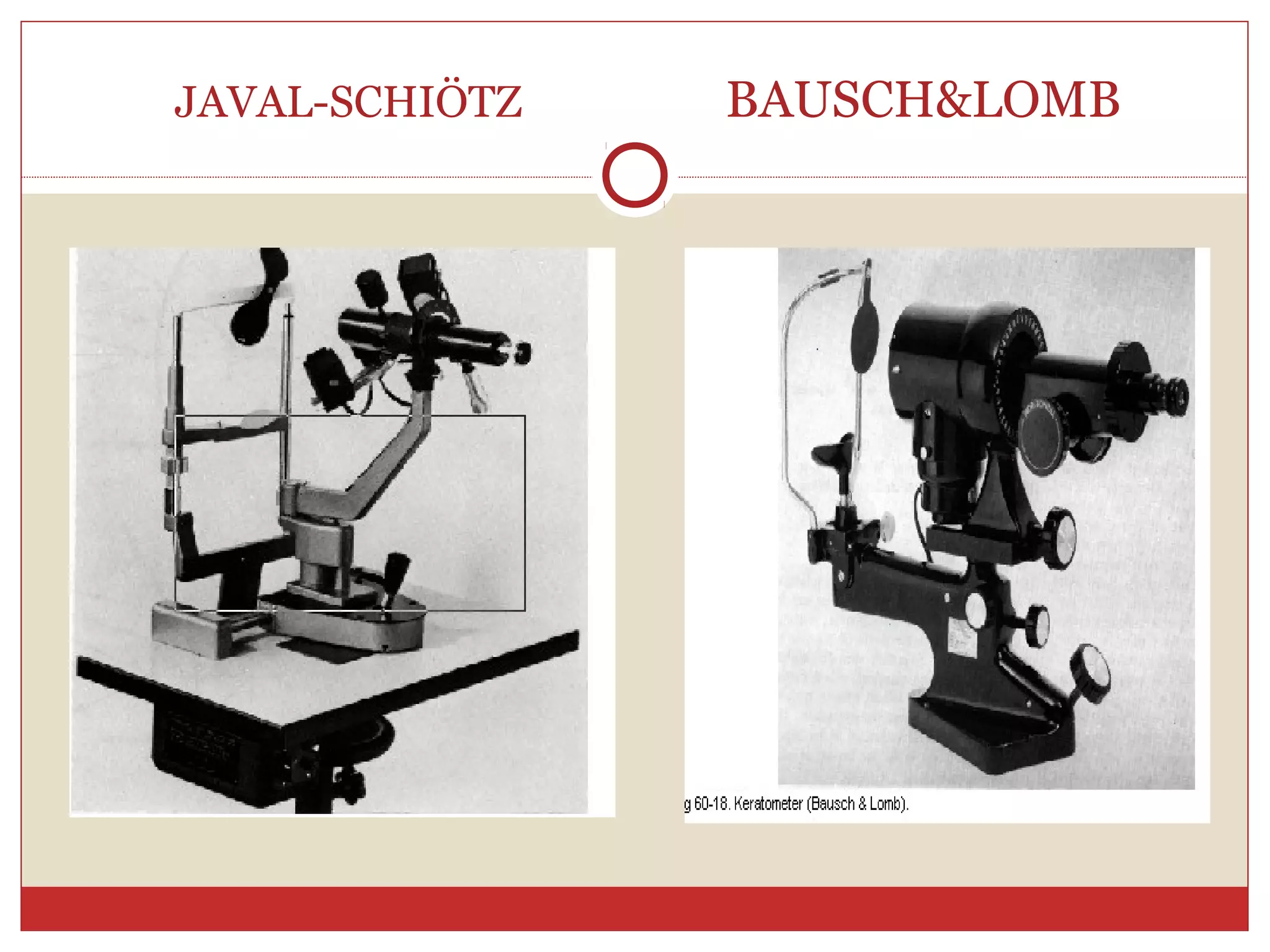
Bausch & Lomb (Reichert Keratometer)
 Constant object size – utilizes the difference in the size of
image
 Image doubling produces vertical & horizontal
simultaneously measuring vertical & horizontal
meridians of the cornea
 Light from the object is reflected from the cornea –
forms an image behind the cornea
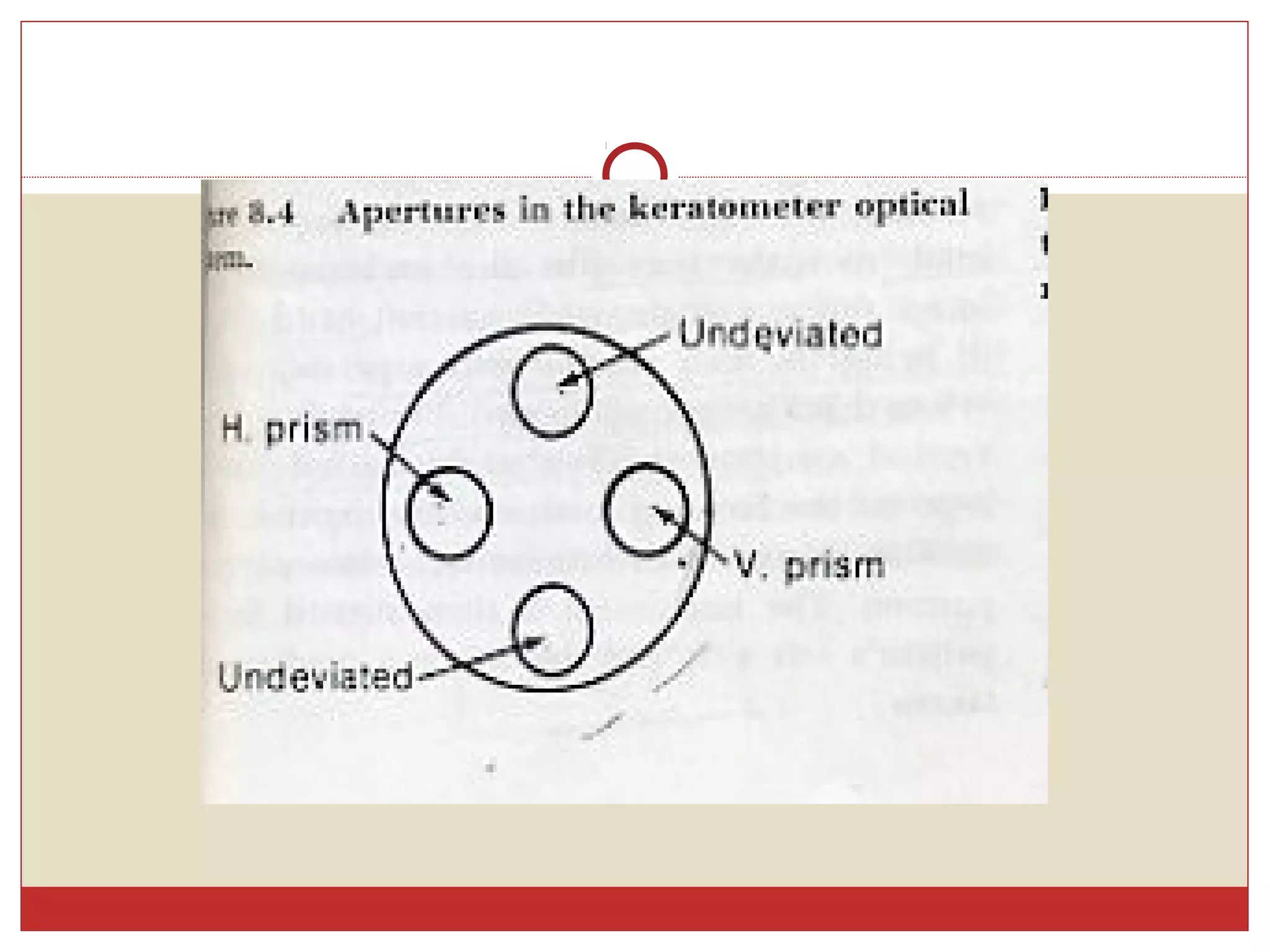
Image produced by the cornea acts an object :
 The light from the cornea is then refracted thru objective
lens of the instrument, a diaphragm with four apertures and
two doubling prisms
Two prism
 Base up –light passing thru one horizontal aperture –
vertically displaced image
 Base out –light passing thru other horizontal aperture –
horizontally displaced image
 Two vertical apertures : acts as scheiner’s disk- produces a
doubling central image if the instrument is not properly
focused on the corneal image
 So, at perfect focus : Keratometer - Produces three images of
the object
The triple image is viewed thru the optical eye
piece
By rotating the power wheels – the position of the
doubling prisms changed until the images just
touch each other
Amount of doubling correspond to the image size
reflected from the cornea
Corresponding value in the Power Wheel =
corneal curvature
Types of Keratometers
1-position
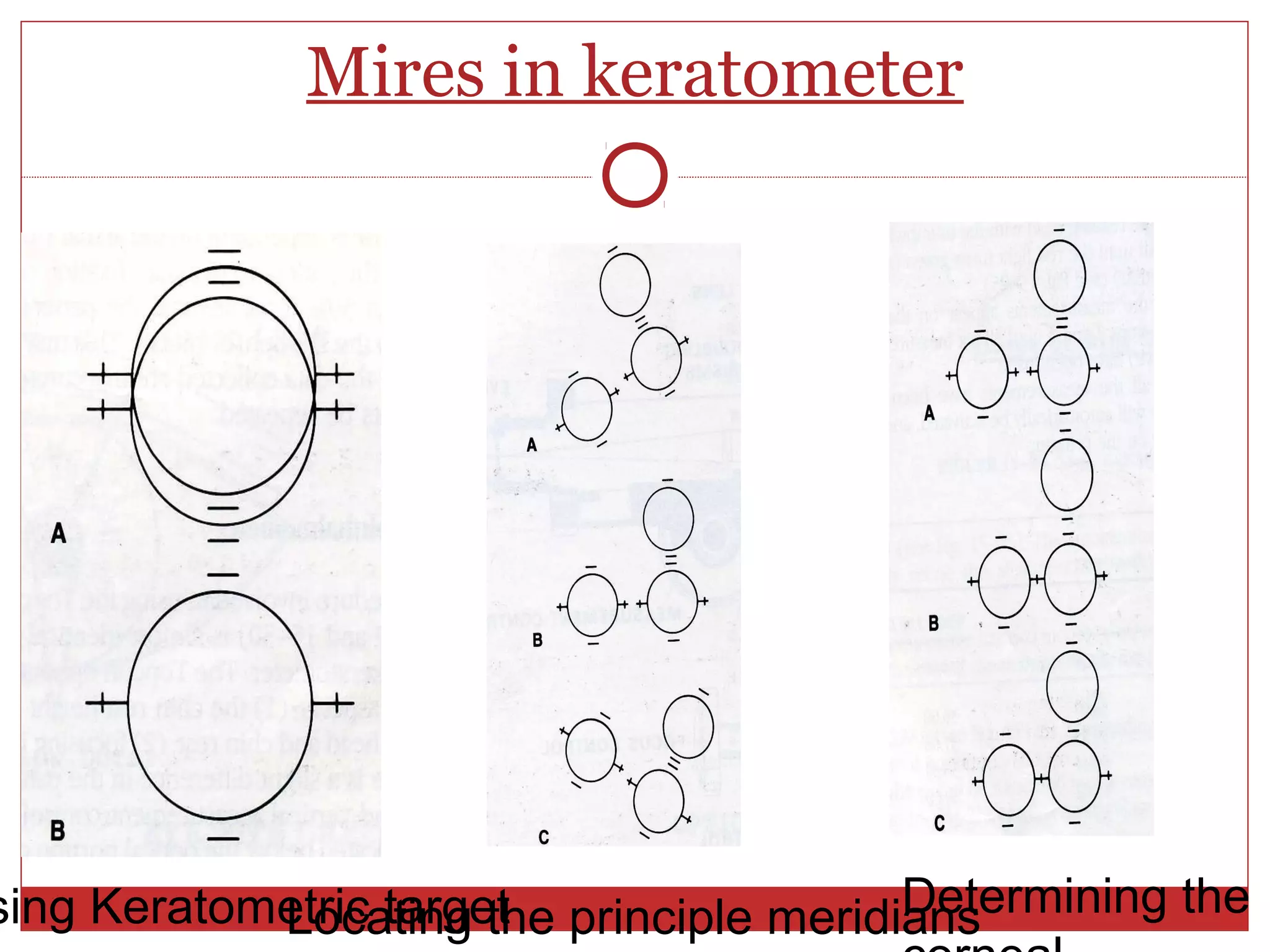
 Simultaneous doubling of perpendicular pairs of mires is
produced by doubling devices in each of the corresponding
principle meridians
 Simultaneous measurement of both meridian
2-position
 Require rotation about the axis to measure each principle
meridians
Mires in keratometer
sing Keratometric targetLocating the principle meridiansDetermining the
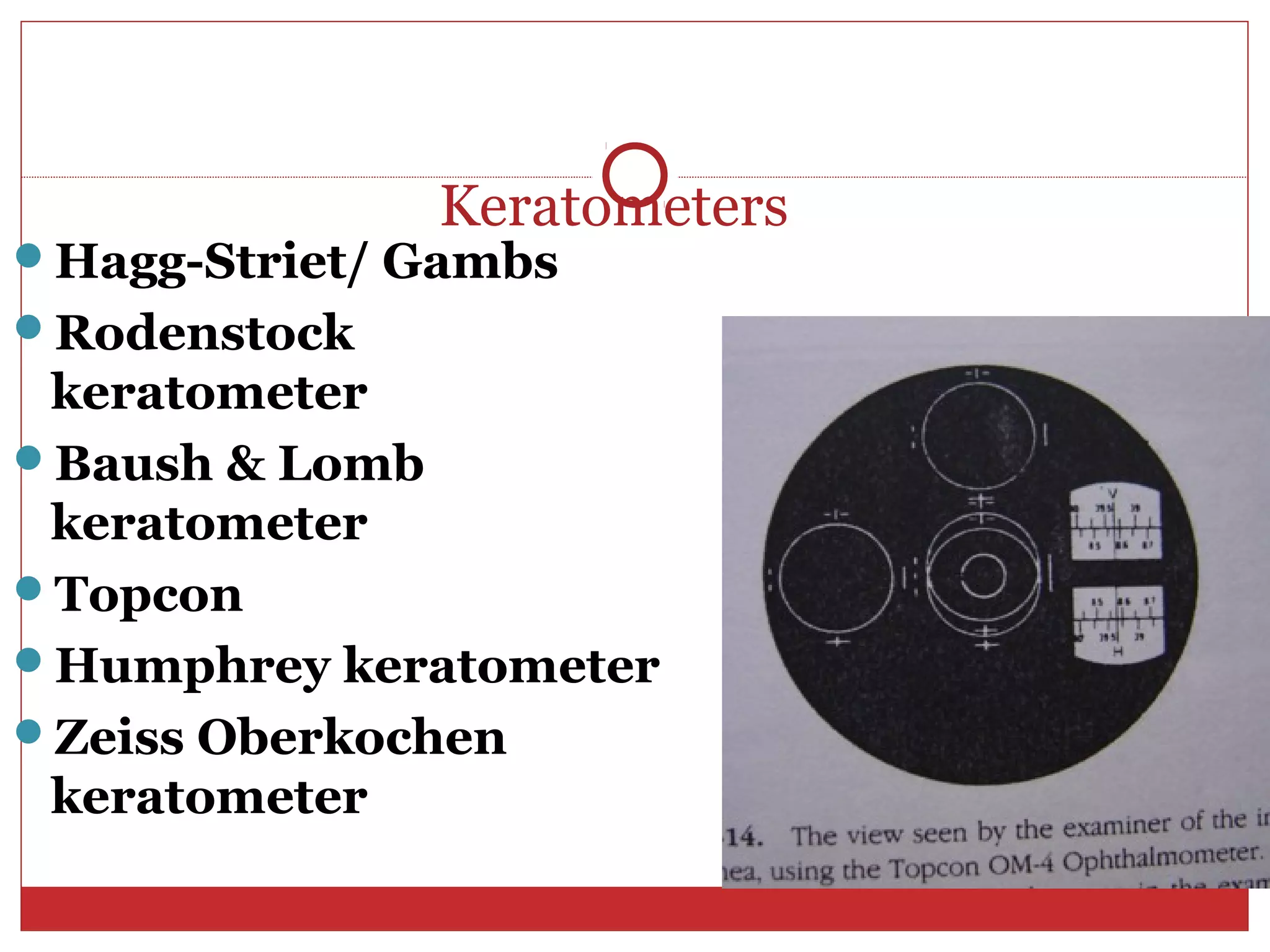
Keratometers
Hagg-Striet/ Gambs
Rodenstock
keratometer
Baush & Lomb
keratometer
Topcon
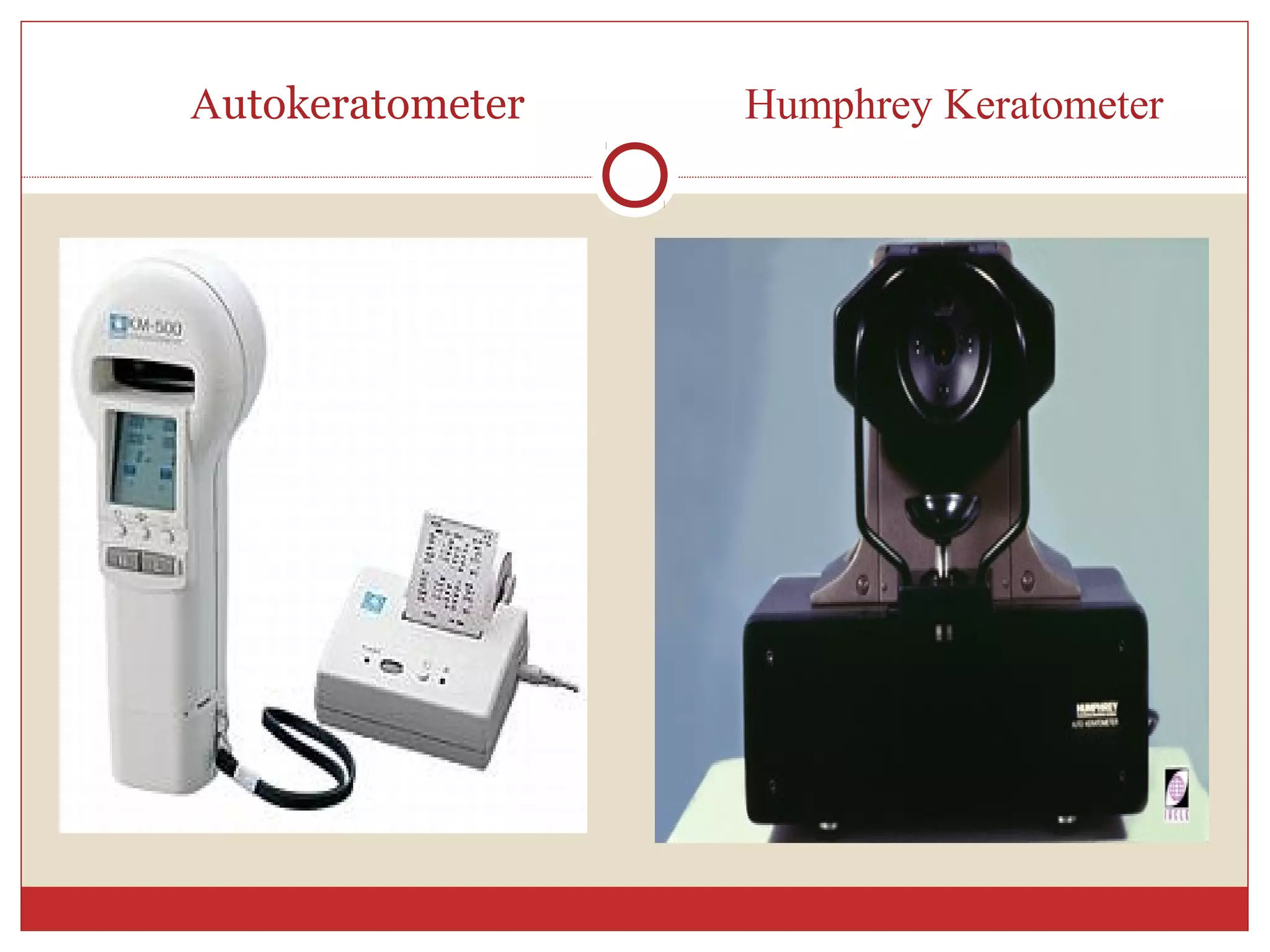
Humphrey keratometer
Zeiss Oberkochen
keratometer
JAVAL-SCHIÖTZ BAUSCH&LOMB
Autokeratometer Humphrey Keratometer
Keratometry
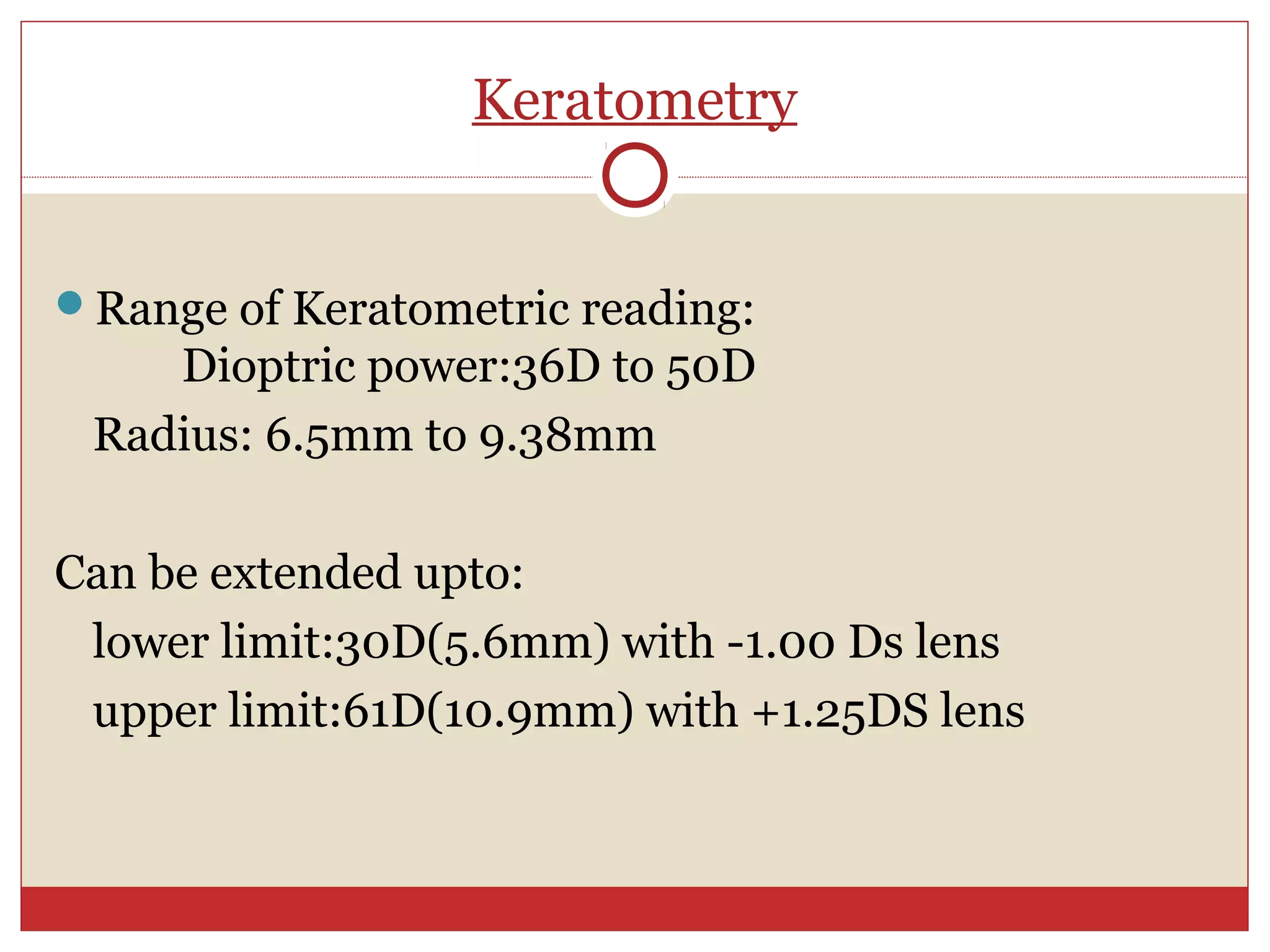
Range of Keratometric reading:
Dioptric power:36D to 50D
Radius: 6.5mm to 9.38mm
Can be extended upto:
lower limit:30D(5.6mm) with -1.00 Ds lens
upper limit:61D(10.9mm) with +1.25DS lens
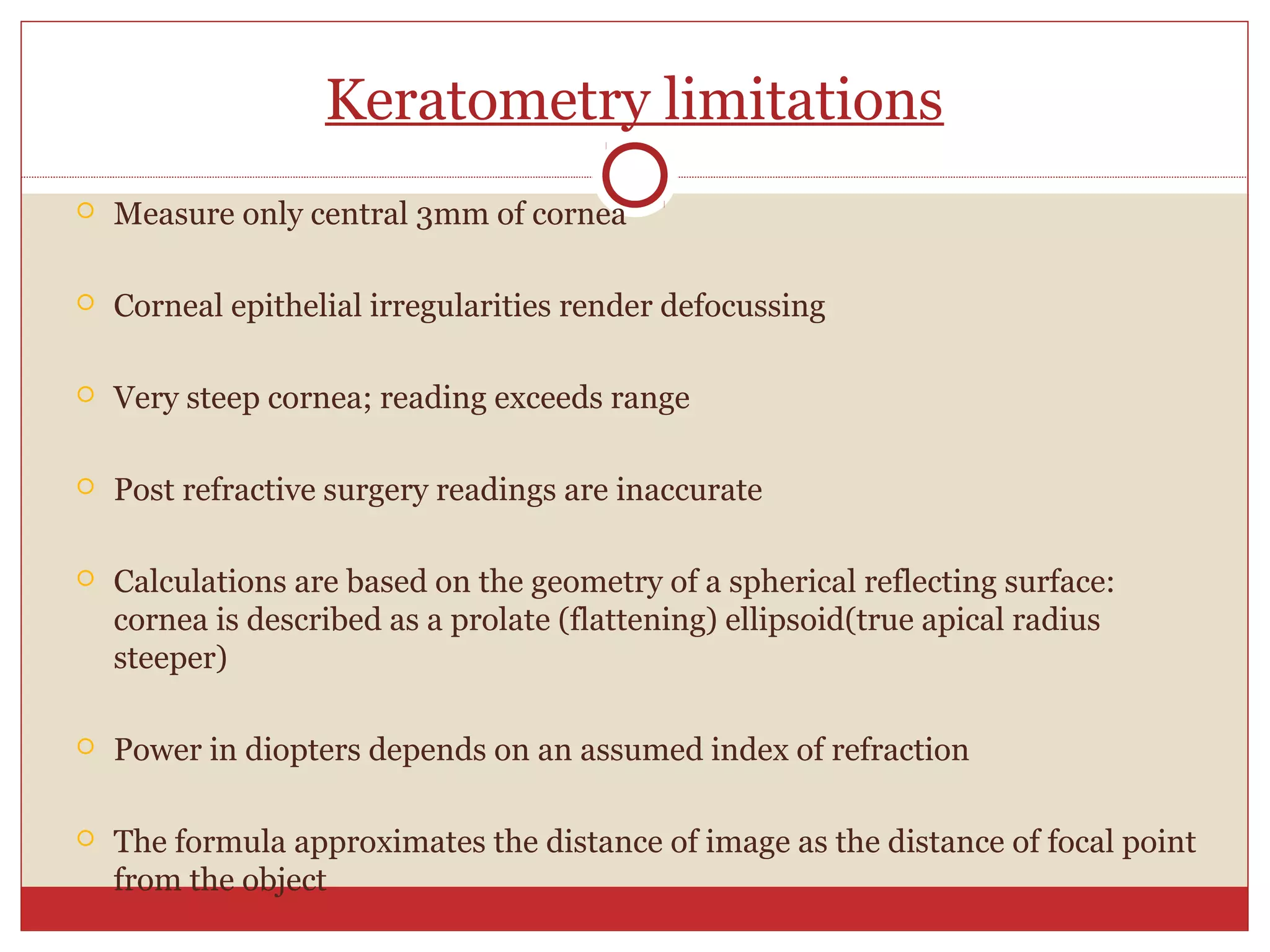
Keratometry limitations
 Measure only central 3mm of cornea
 Corneal epithelial irregularities render defocussing
 Very steep cornea; reading exceeds range
 Post refractive surgery readings are inaccurate
 Calculations are based on the geometry of a spherical reflecting surface:
cornea is described as a prolate (flattening) ellipsoid(true apical radius
steeper)
 Power in diopters depends on an assumed index of refraction
 The formula approximates the distance of image as the distance of focal point
from the object
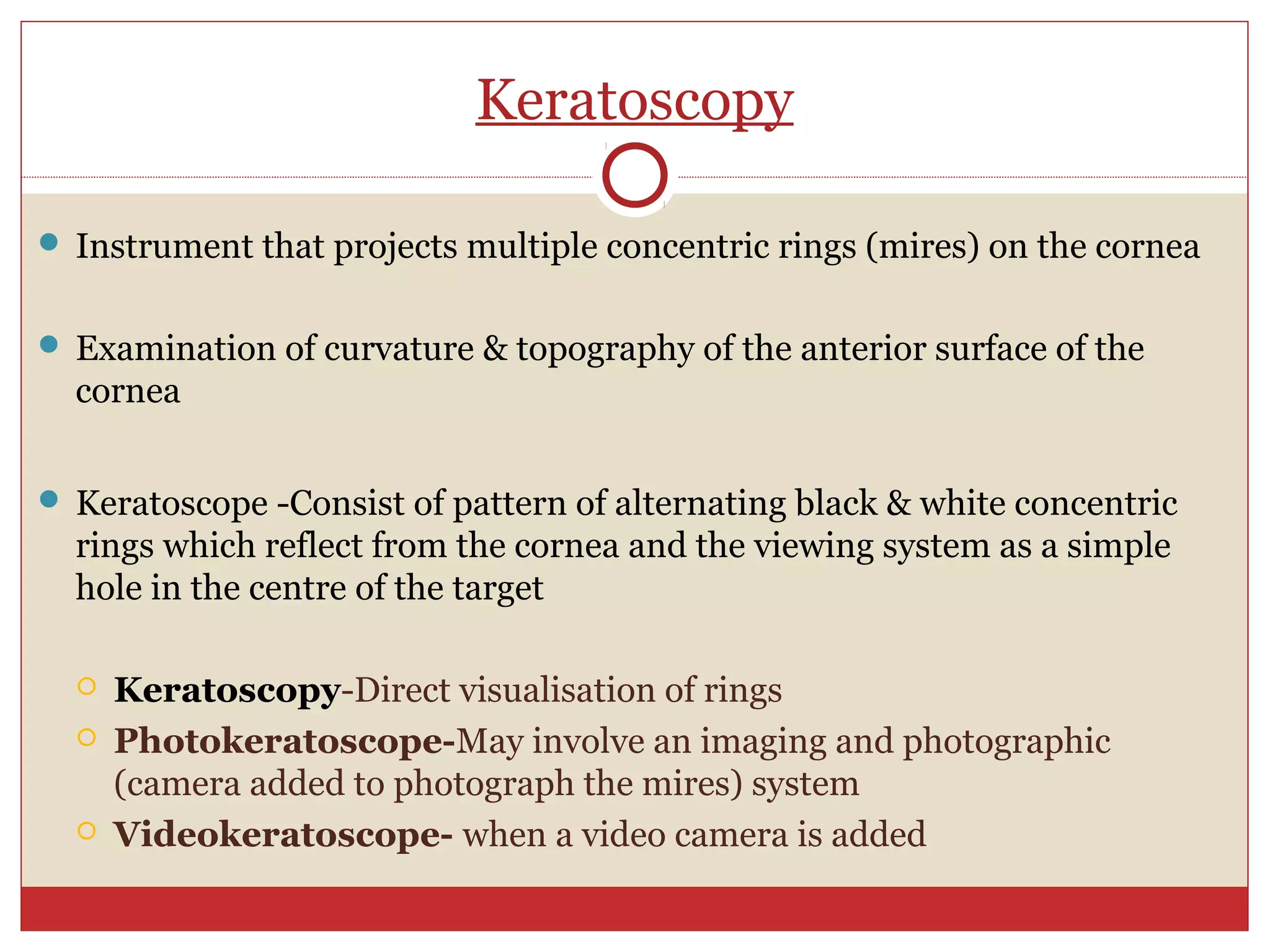
Keratoscopy
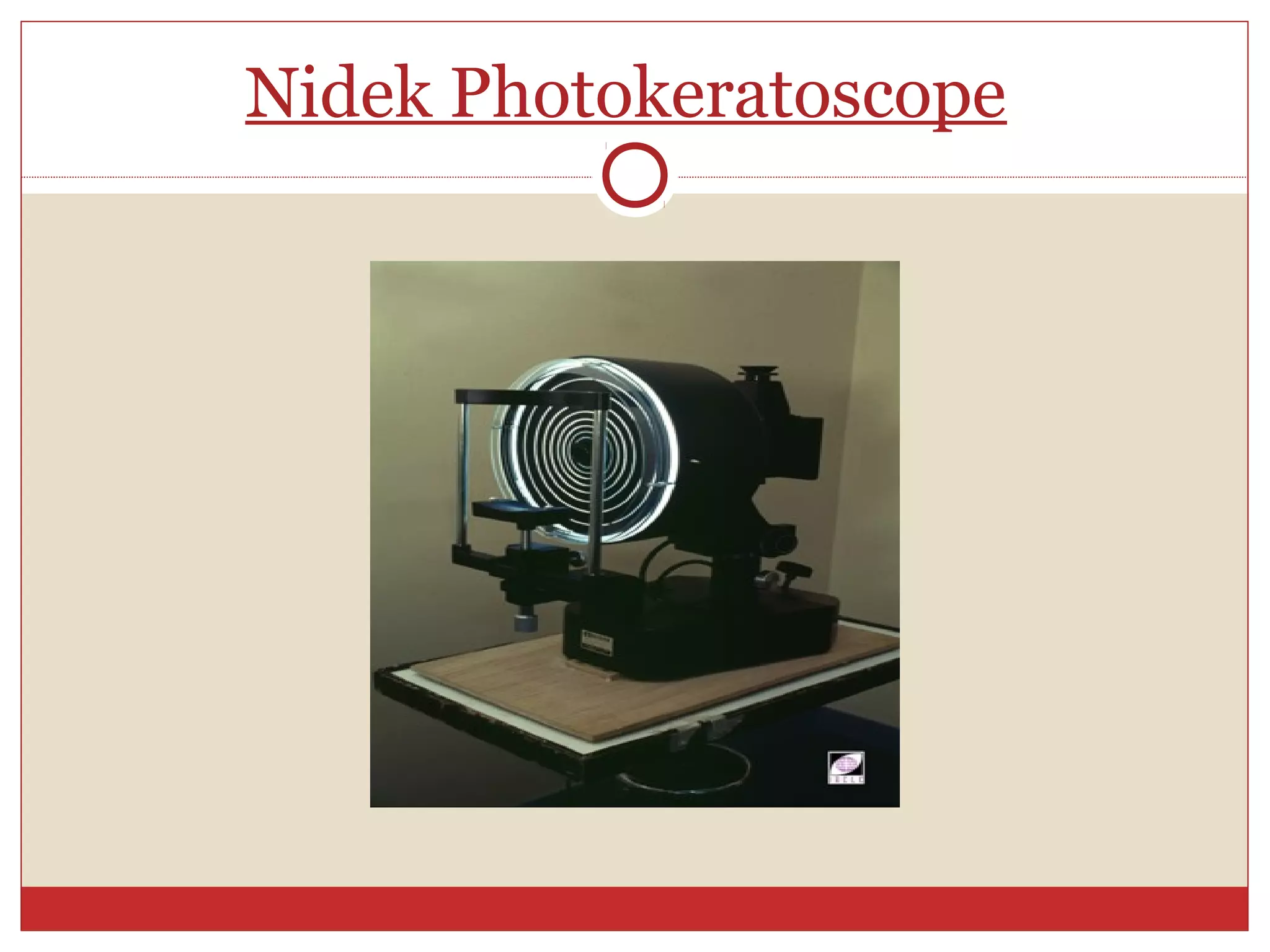
 Instrument that projects multiple concentric rings (mires) on the cornea
 Examination of curvature & topography of the anterior surface of the
cornea
 Keratoscope -Consist of pattern of alternating black & white concentric
rings which reflect from the cornea and the viewing system as a simple
hole in the centre of the target
 Keratoscopy-Direct visualisation of rings
 Photokeratoscope-May involve an imaging and photographic
(camera added to photograph the mires) system
 Videokeratoscope- when a video camera is added
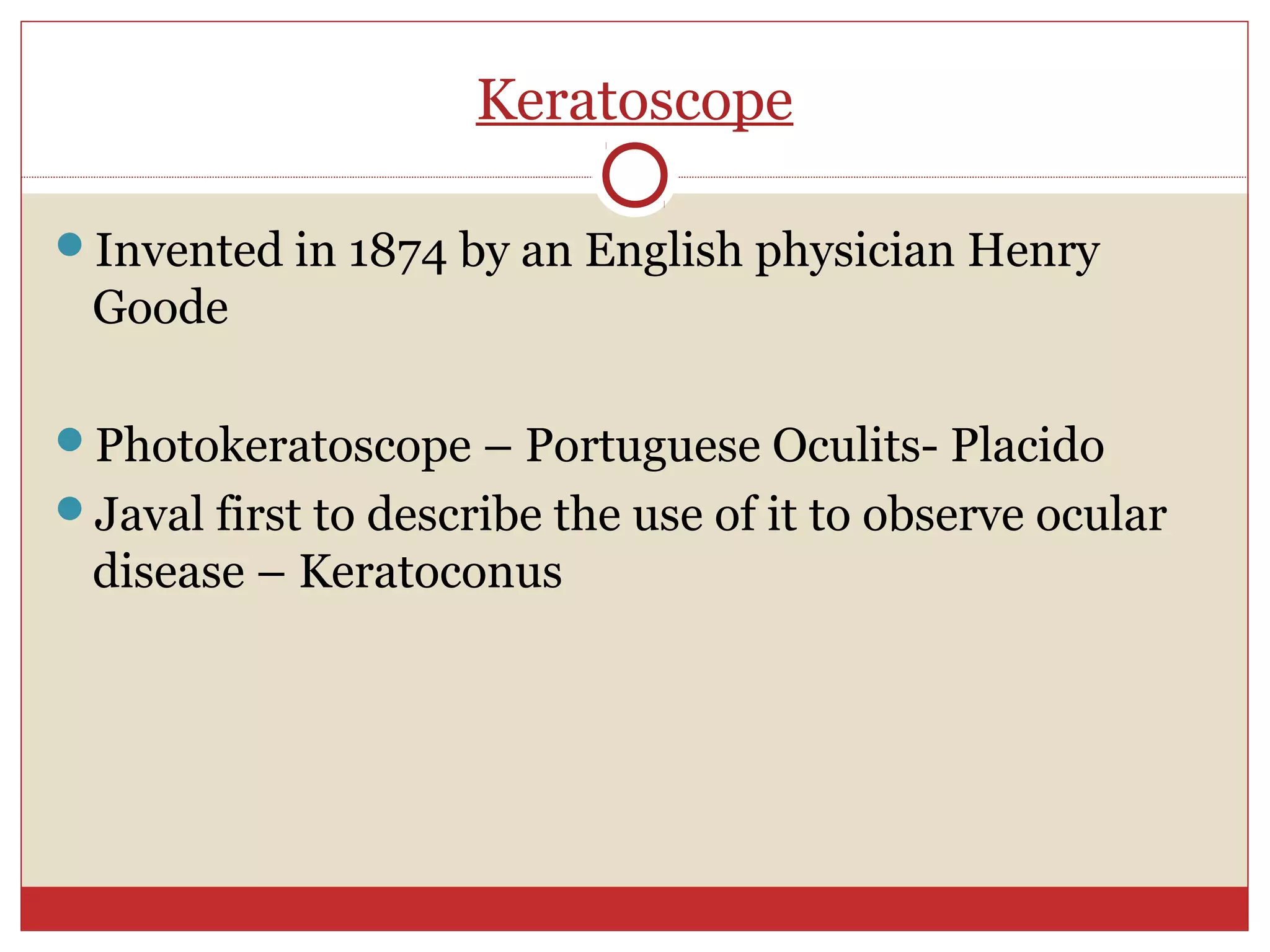
Keratoscope
Invented in 1874 by an English physician Henry
Goode
Photokeratoscope – Portuguese Oculits- Placido
Javal first to describe the use of it to observe ocular
disease – Keratoconus
Keratoscope Uses
Diagnosis & management of corneal topographic
disorders – keratoconus
Contact lens fitting
Ocular trauma & ophthalmic surgeries
Keratorefractive surgery
Orthokeratology
Keratoscope instrumentation
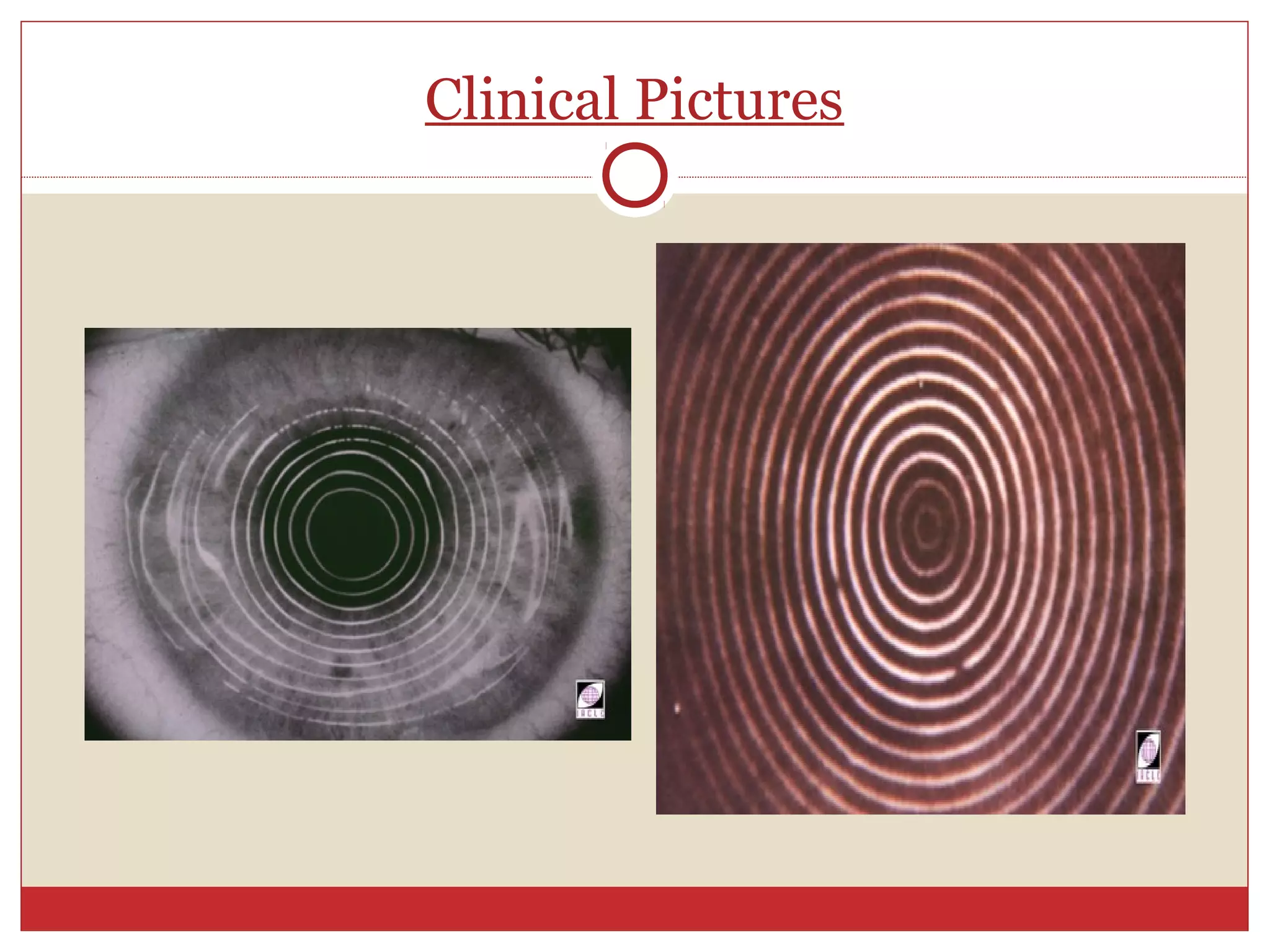
Uses the images (concentric rings) reflected from
the cornea
Evaluate the contour of the image rings to
 Circular : spherical
 Change of the rings from circular form : astigmatic Or
irregular cornea
Principle:
 The size of the reflected image is directly proportional to
the radius of curvature of the reflecting surface
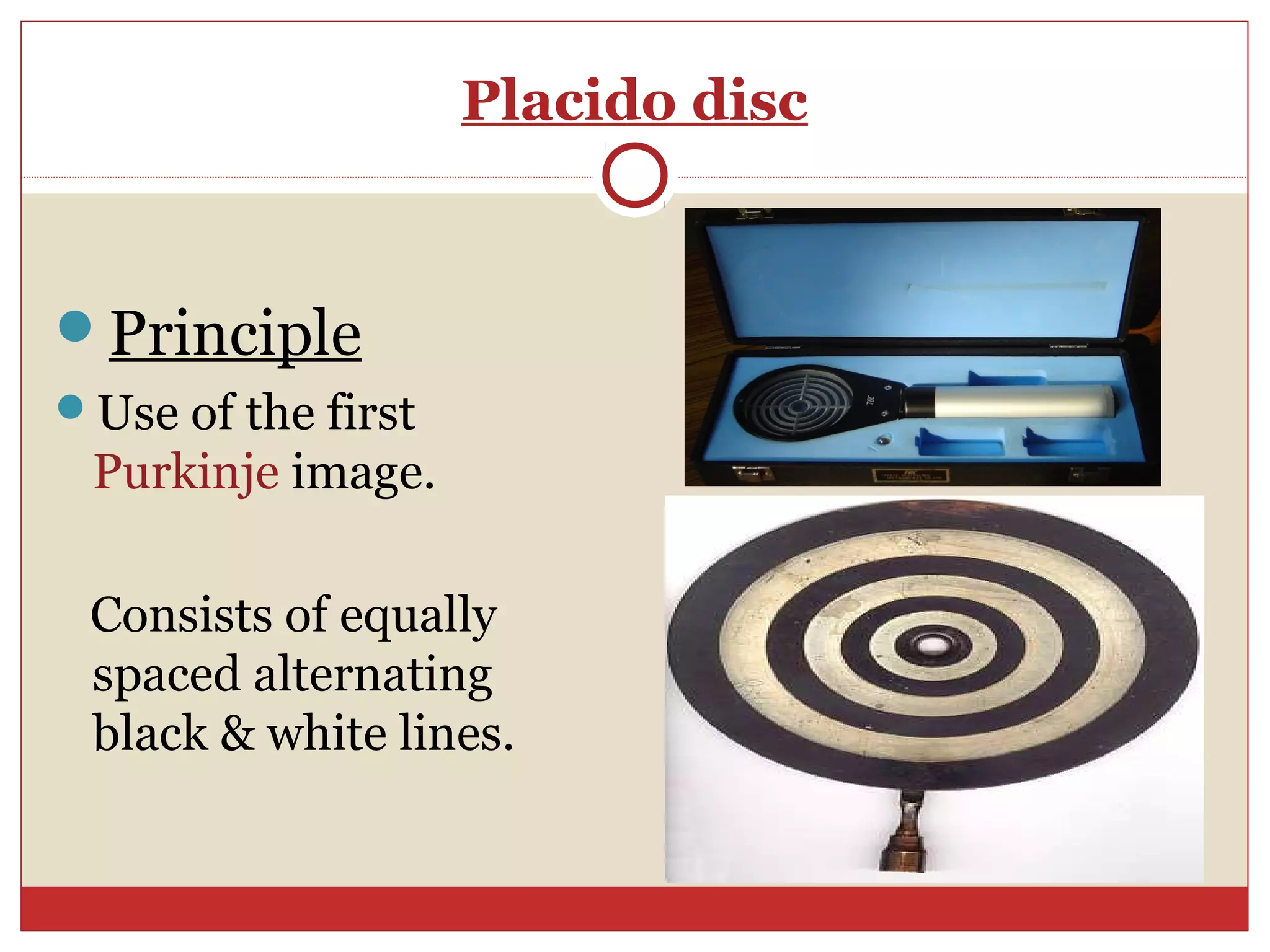
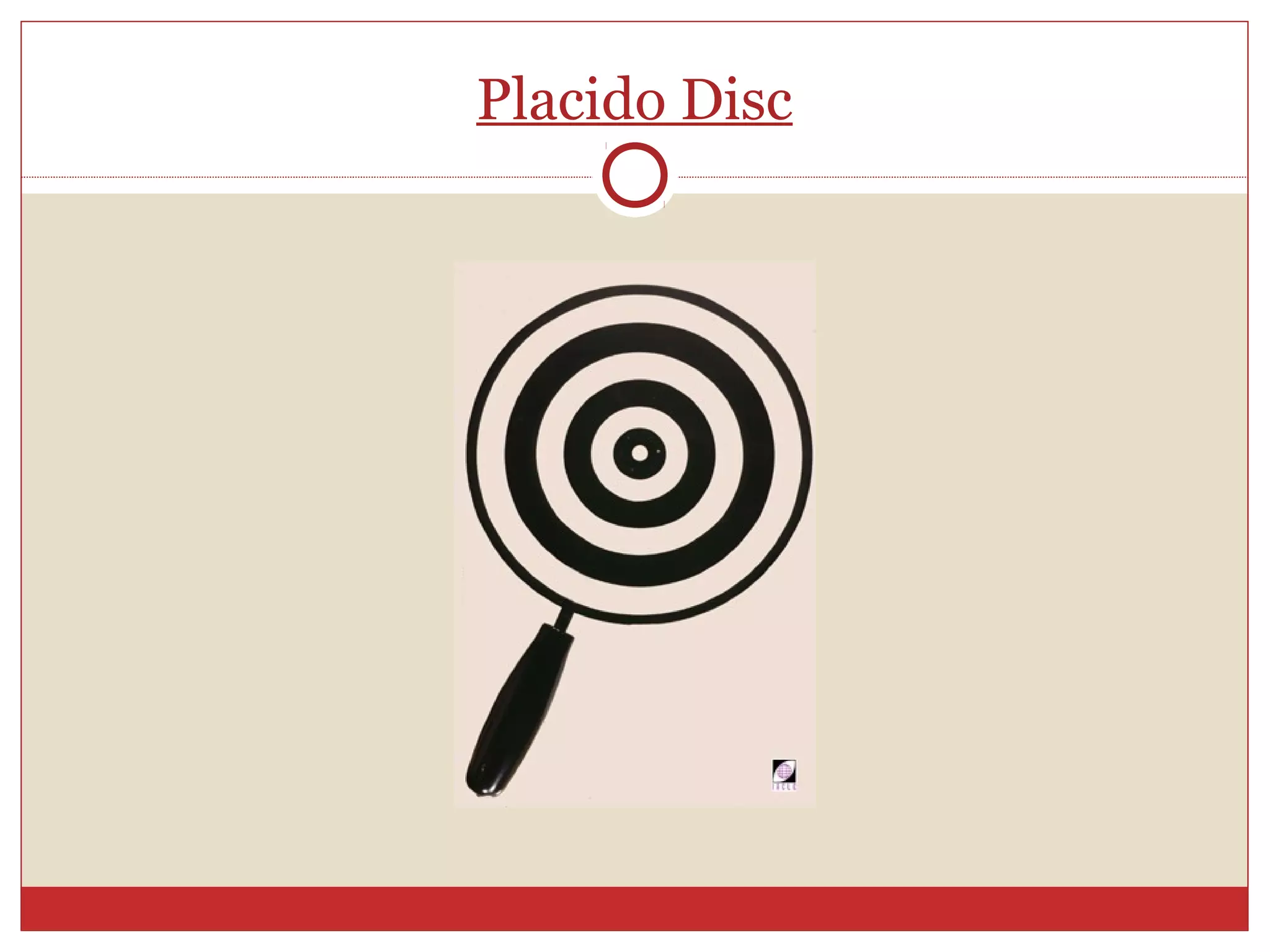
Placido Disc
Nidek Photokeratoscope
Clinical Pictures
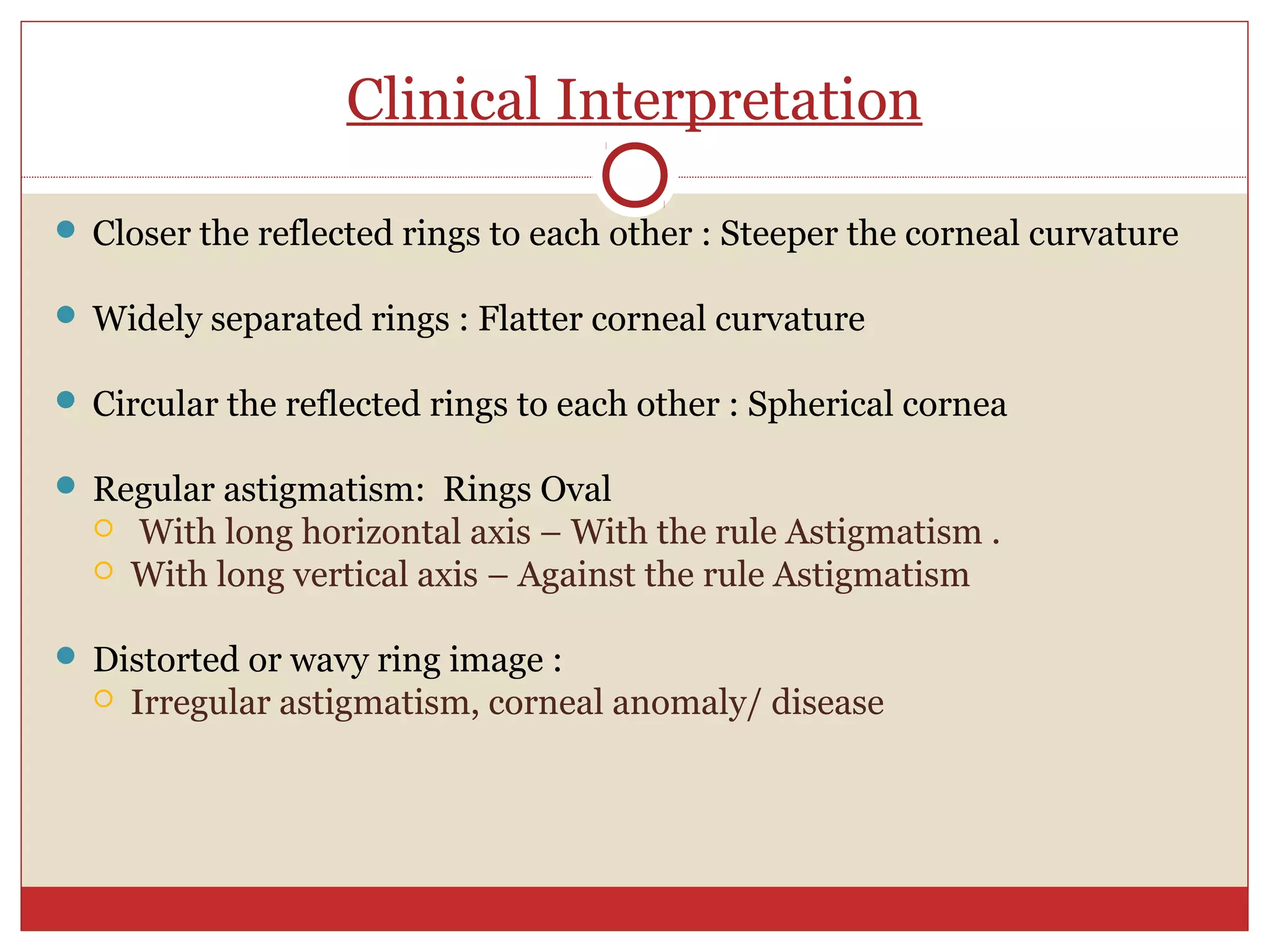
Clinical Interpretation
 Closer the reflected rings to each other : Steeper the corneal curvature
 Widely separated rings : Flatter corneal curvature
 Circular the reflected rings to each other : Spherical cornea
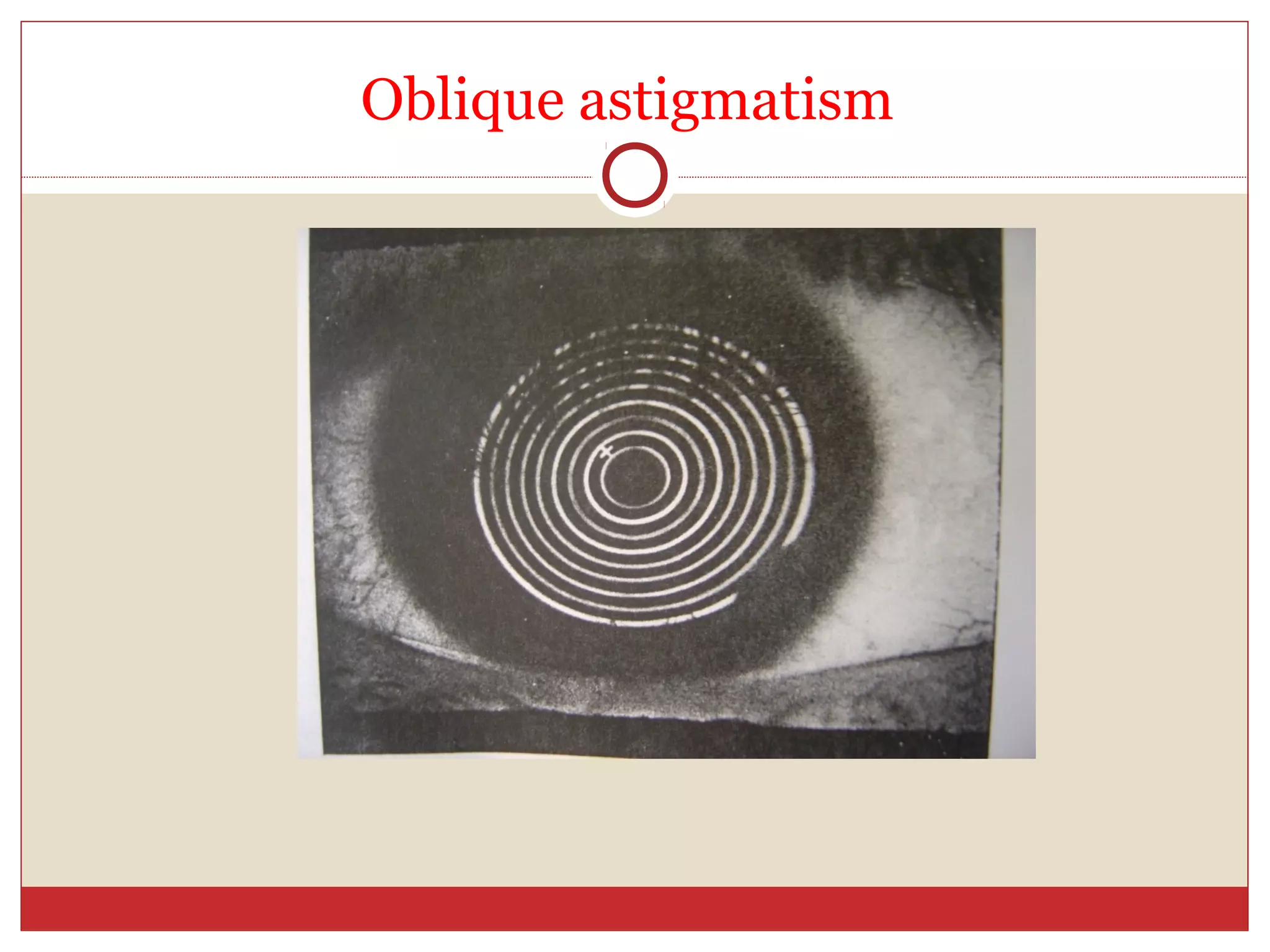
 Regular astigmatism: Rings Oval
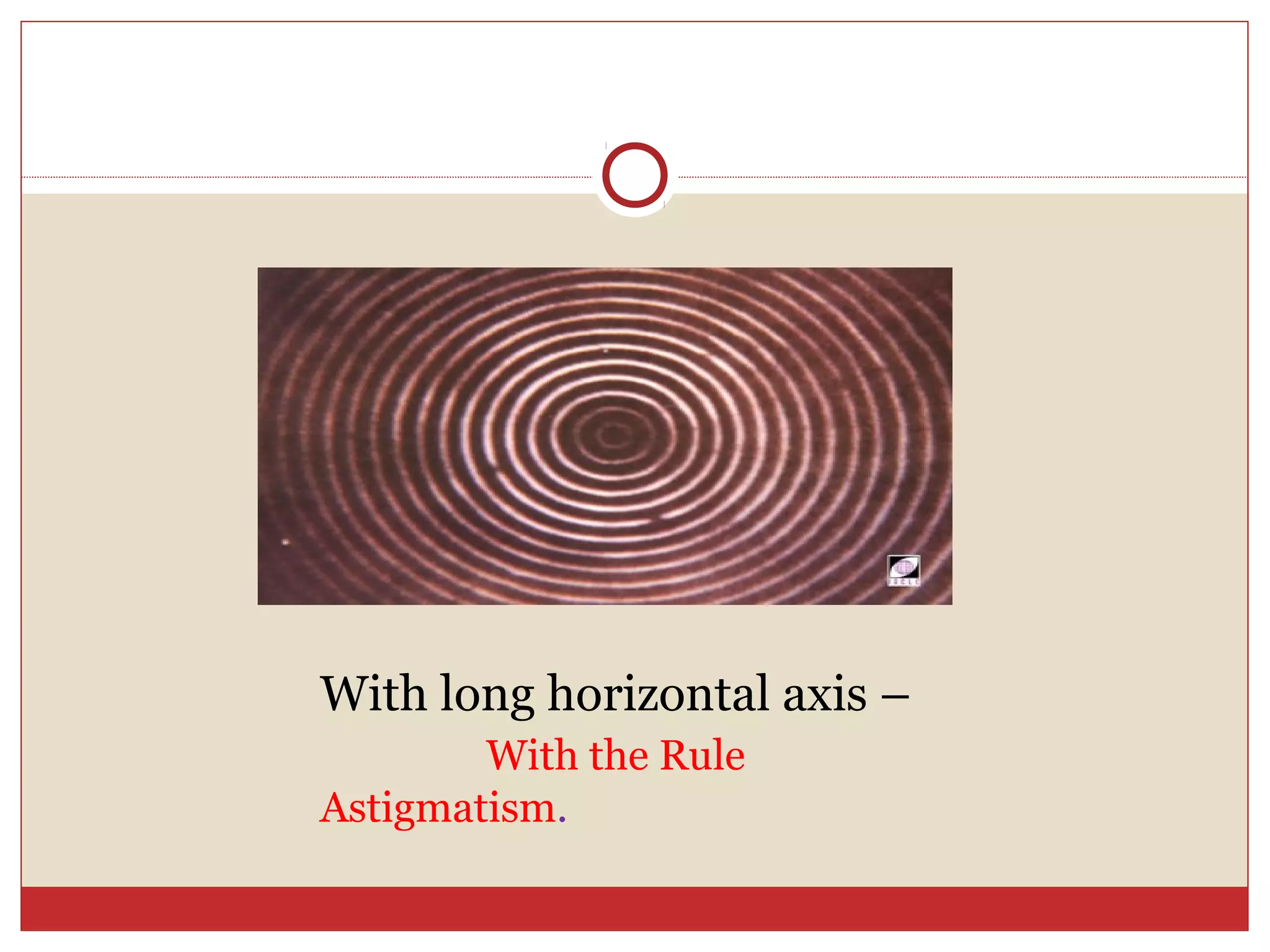
 With long horizontal axis – With the rule Astigmatism .
 With long vertical axis – Against the rule Astigmatism
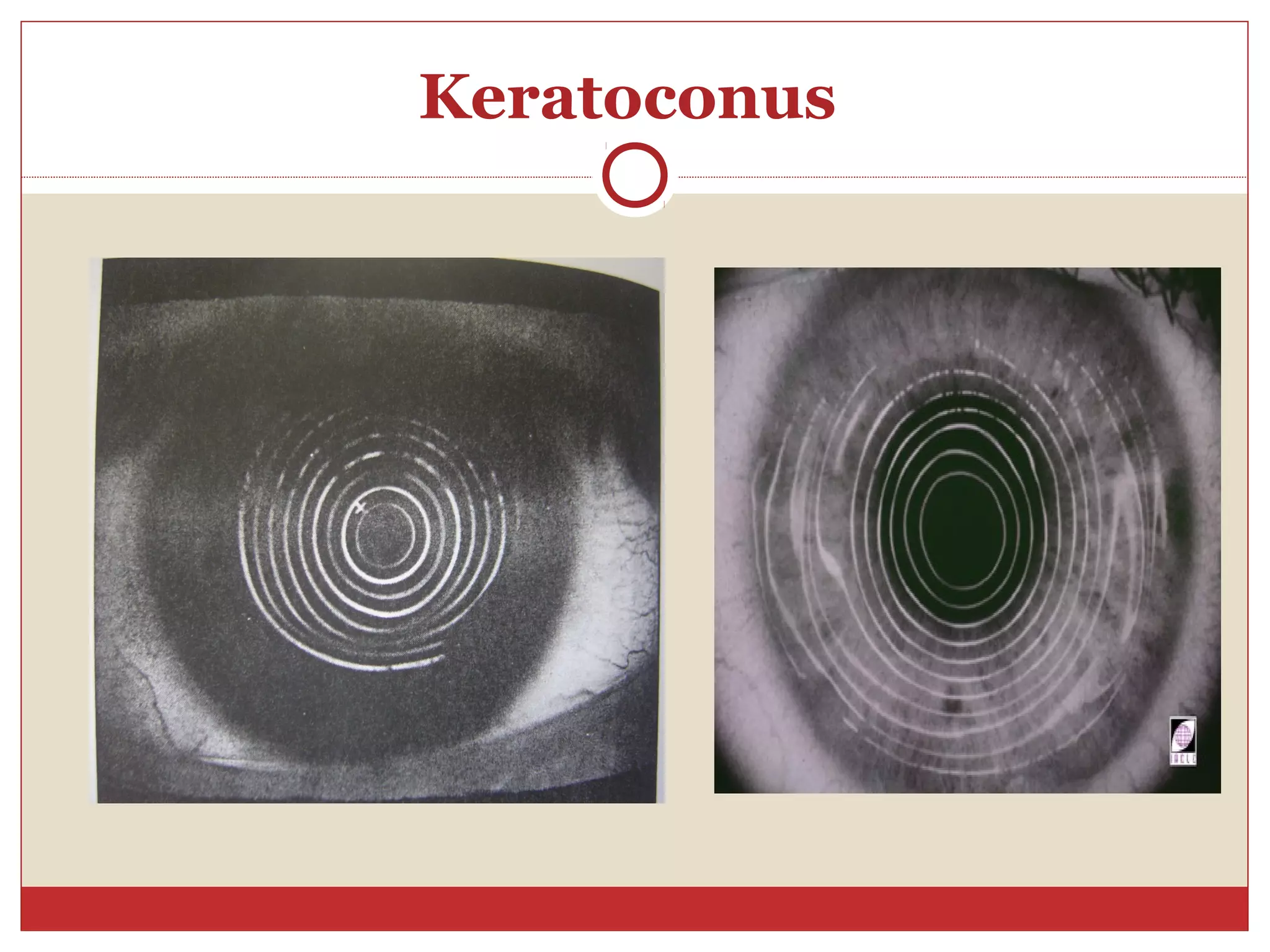
 Distorted or wavy ring image :
 Irregular astigmatism, corneal anomaly/ disease
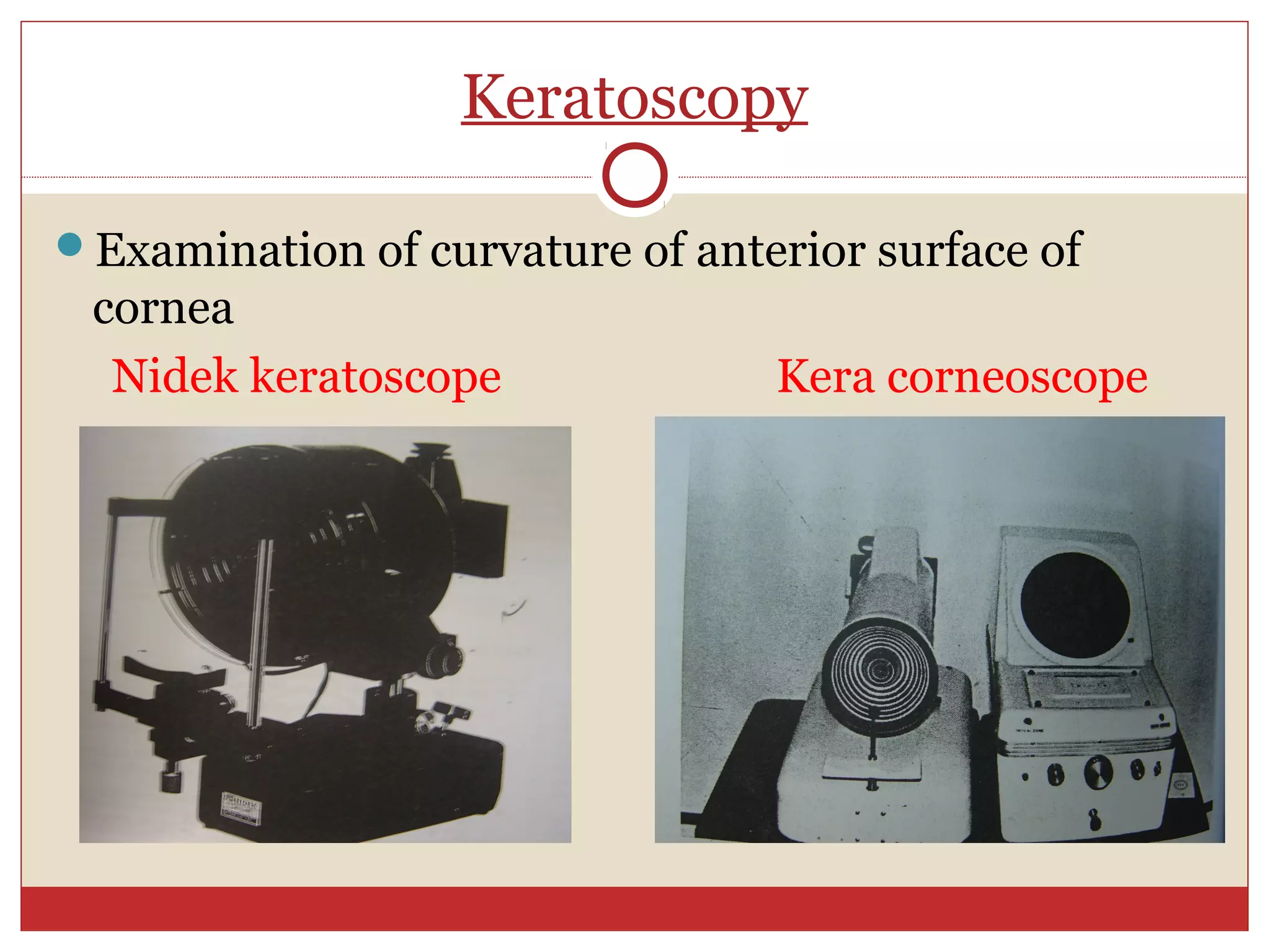
Keratoscopy
Examination of curvature of anterior surface of
cornea
Nidek keratoscope Kera corneoscope
Placido disc
Principle
Use of the first
Purkinje image.
Consists of equally
spaced alternating
black & white lines.
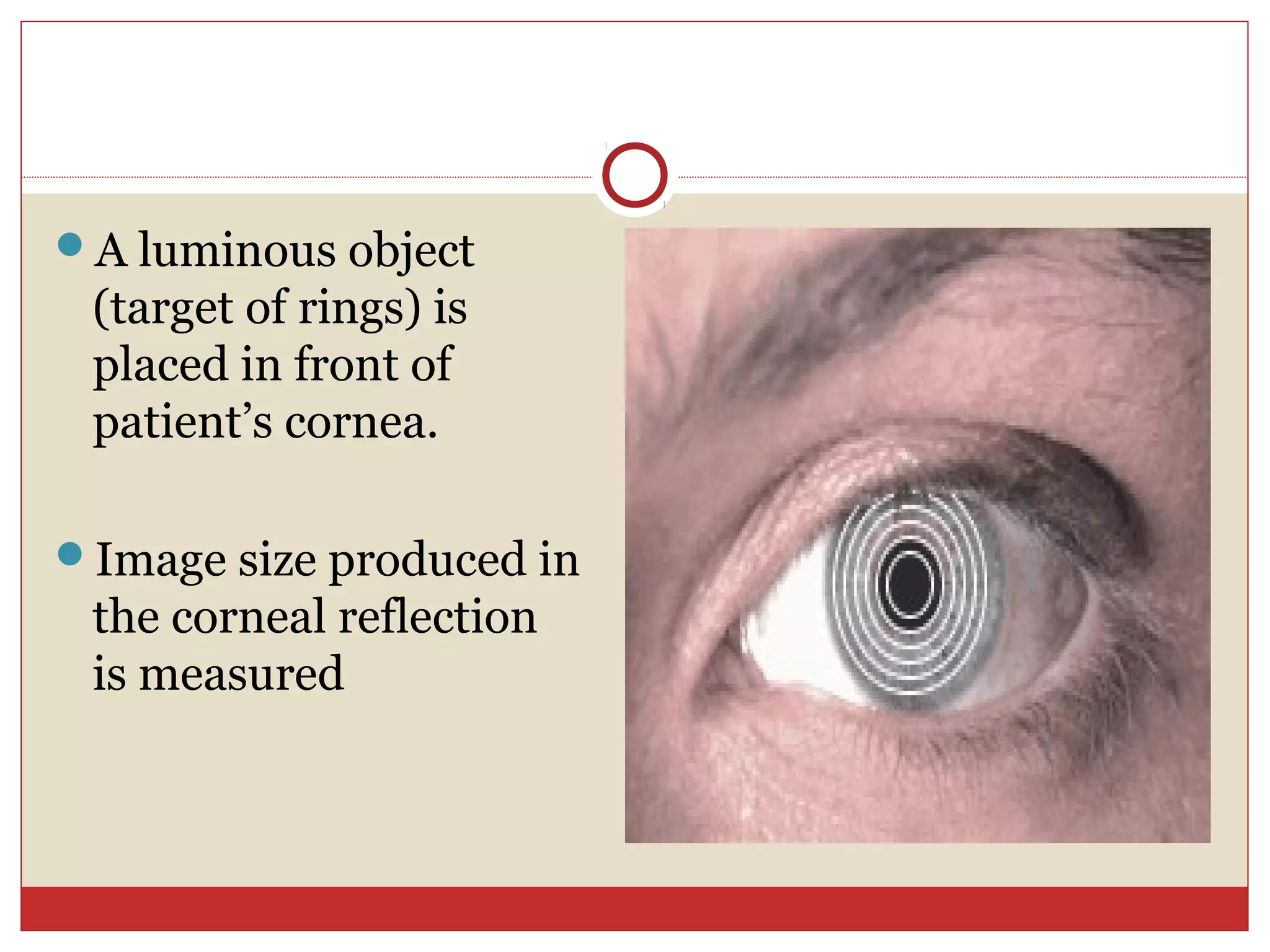
A luminous object
(target of rings) is
placed in front of
patient’s cornea.
Image size produced in
the corneal reflection
is measured
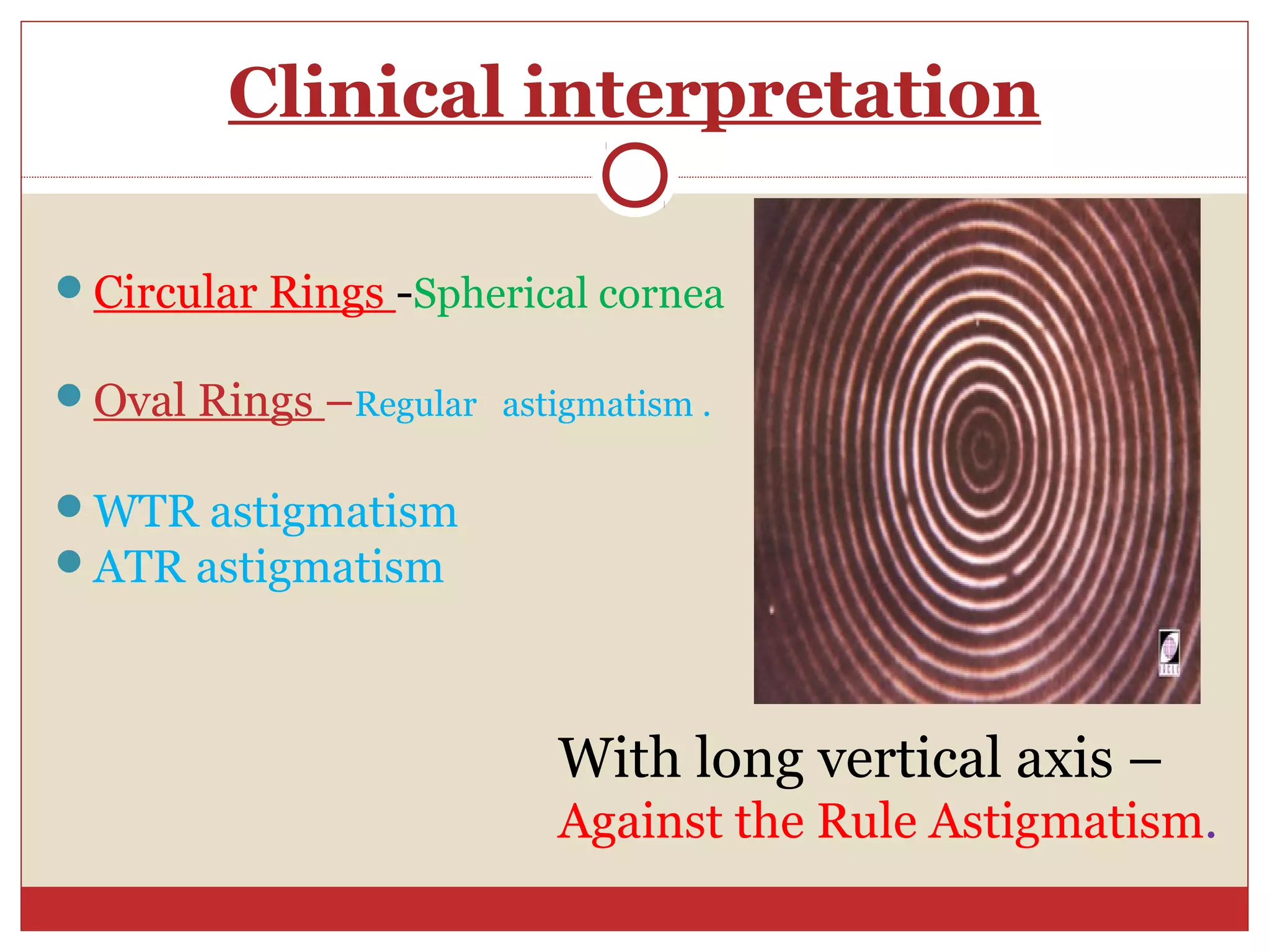
Clinical interpretation
Circular Rings -Spherical cornea
Oval Rings –Regular astigmatism .
WTR astigmatism
ATR astigmatism
With long vertical axis –
Against the Rule Astigmatism.
With long horizontal axis –
With the Rule
Astigmatism.
Oblique astigmatism
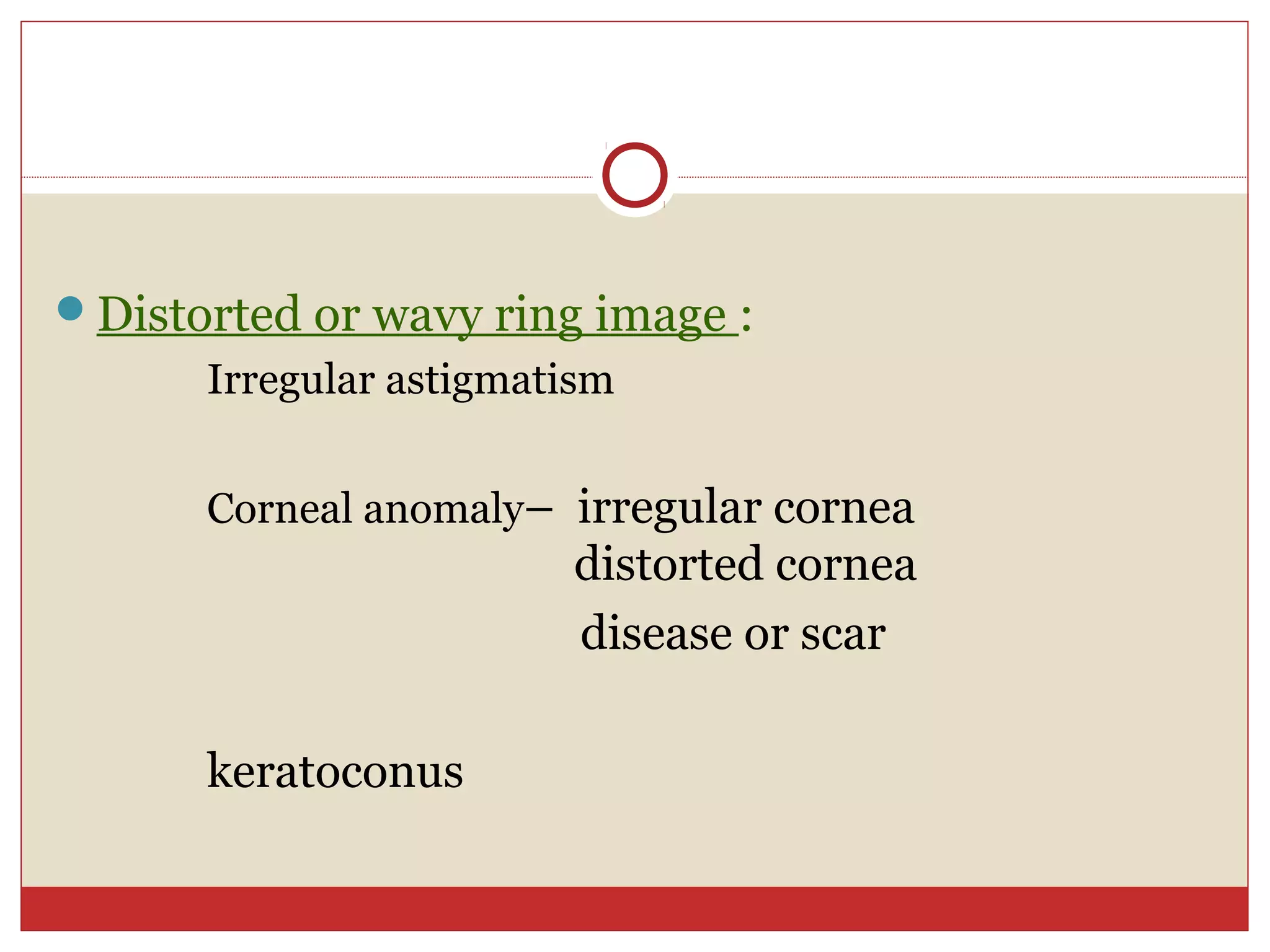
Distorted or wavy ring image :
Irregular astigmatism
Corneal anomaly– irregular cornea
distorted cornea
disease or scar
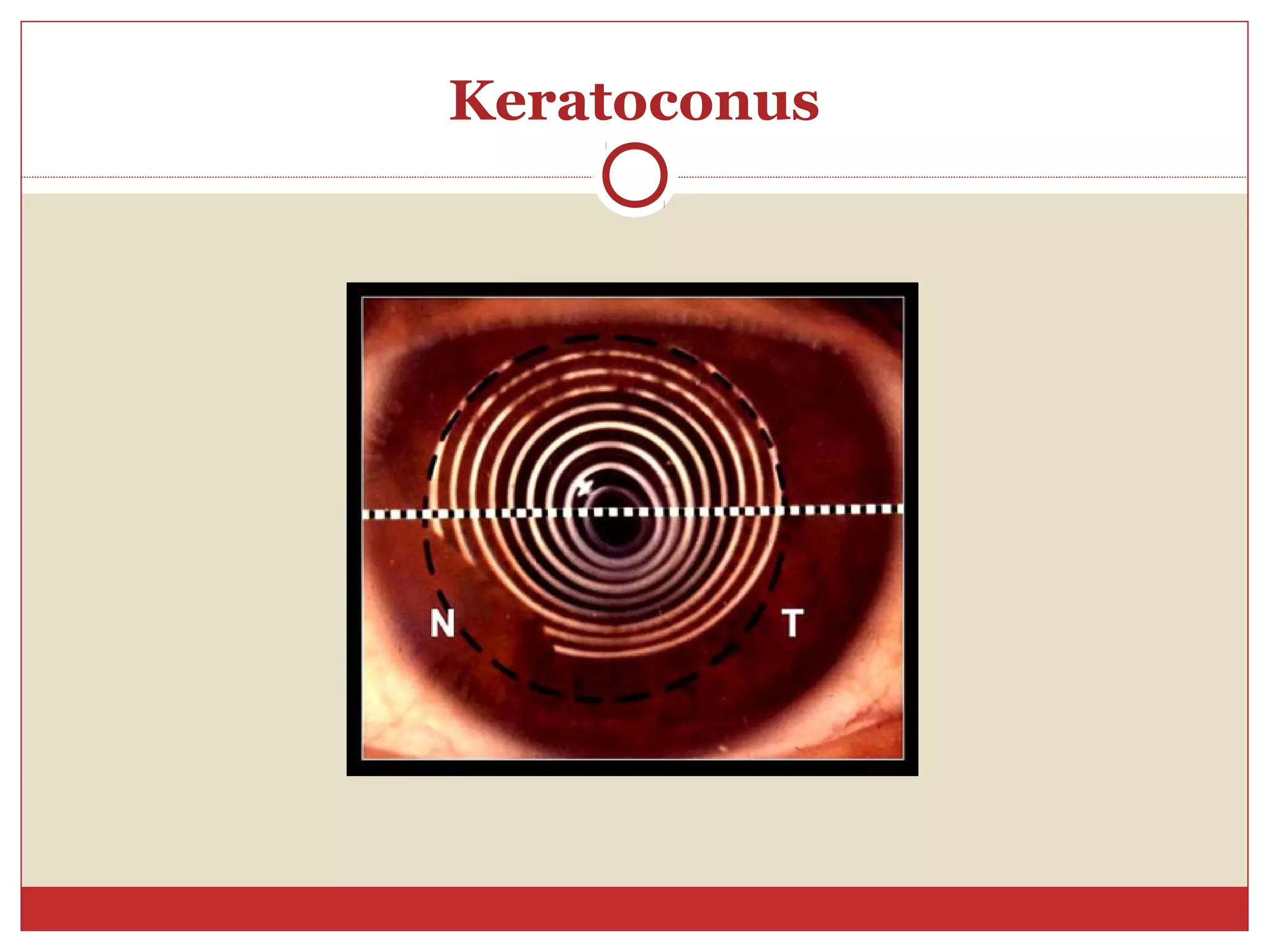
keratoconus
Keratoconus
Keratoconus
Disadvantages
Small degrees of abnormalities of corneal shape are not
easily identifiable.
Not used in corneas with epithelial defects and stromal
ulcers
Clinically significant amounts of corneal cylinder (up to
3.00 D) may not be diagnosed.
Subtle irregularities cannot be detected.
Limited depth of focus.
Corneal Topography ????
Measurement is restricted to a small central
corneal area (3-3.5mm) in keratometry.
Measures corneal curvature at two positions in
each principal meridians. (4 paracentral points).
Modern viedeokeratoscopes evaluate several
thousands of points from nearly the entire corneal
surface.
They measure the entire corneal contour.
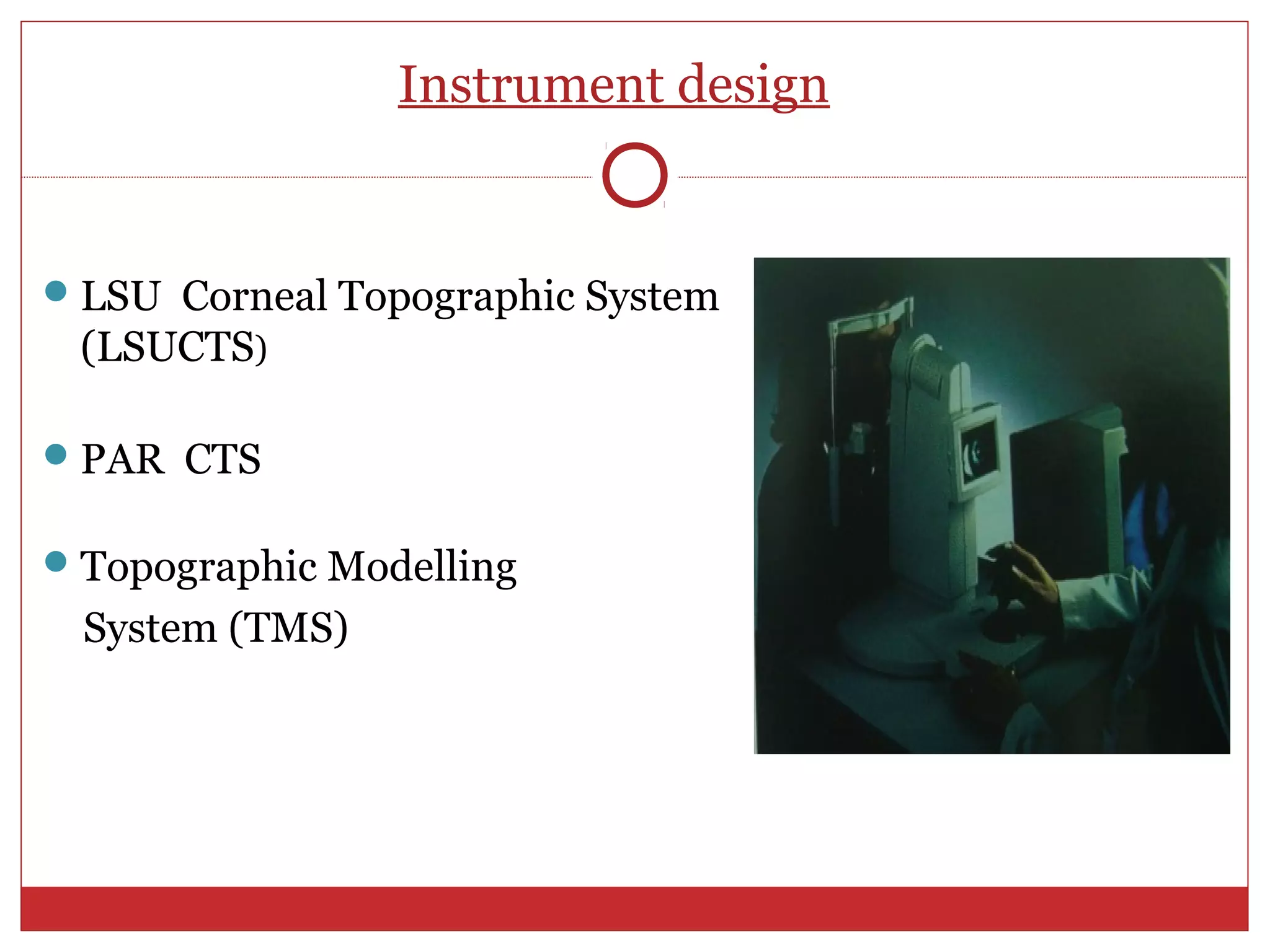
Instrument design
LSU Corneal Topographic System
(LSUCTS)
PAR CTS
Topographic Modelling
System (TMS)
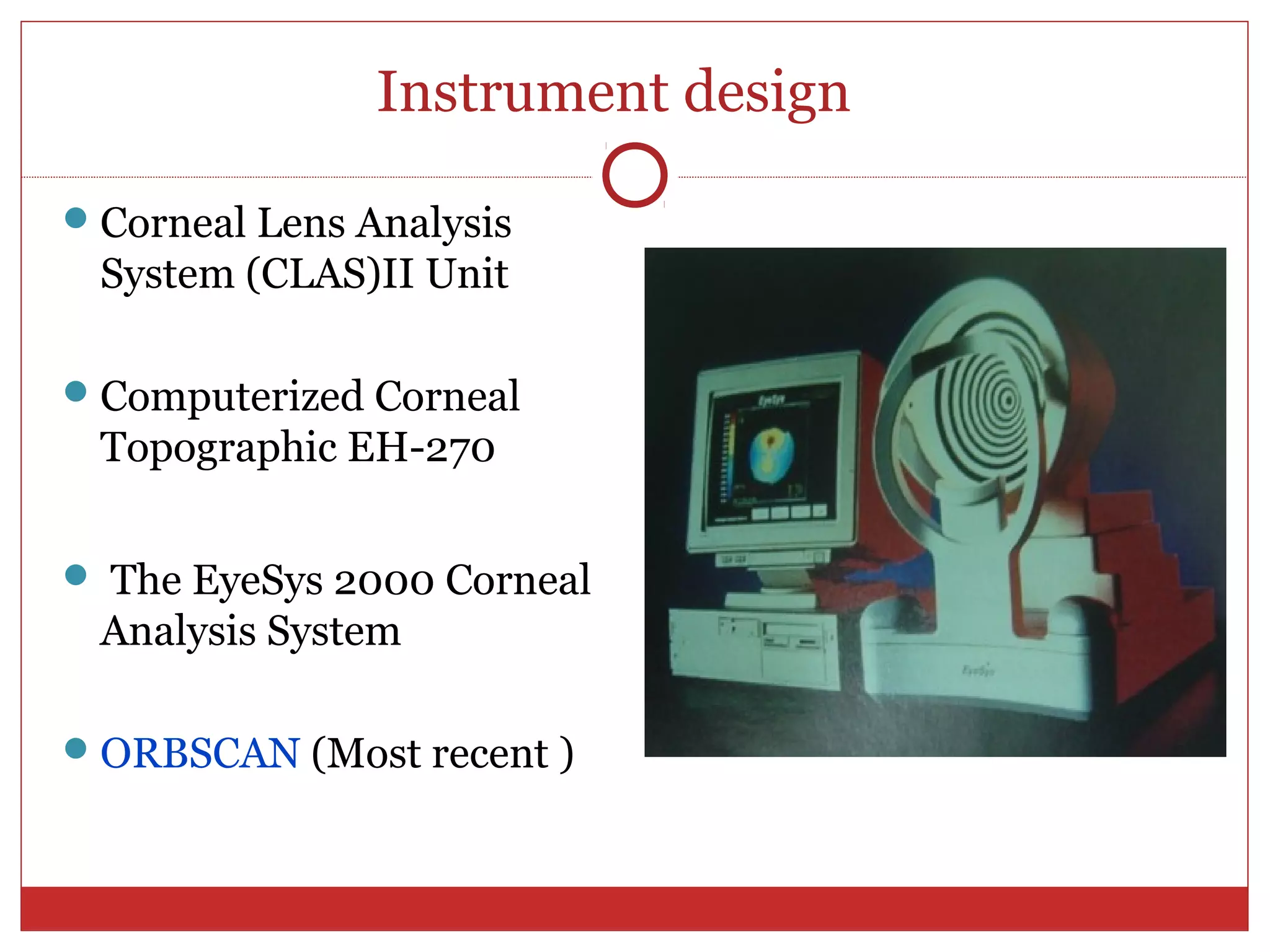
Instrument design
Corneal Lens Analysis
System (CLAS)II Unit
Computerized Corneal
Topographic EH-270
 The EyeSys 2000 Corneal
Analysis System
ORBSCAN (Most recent )
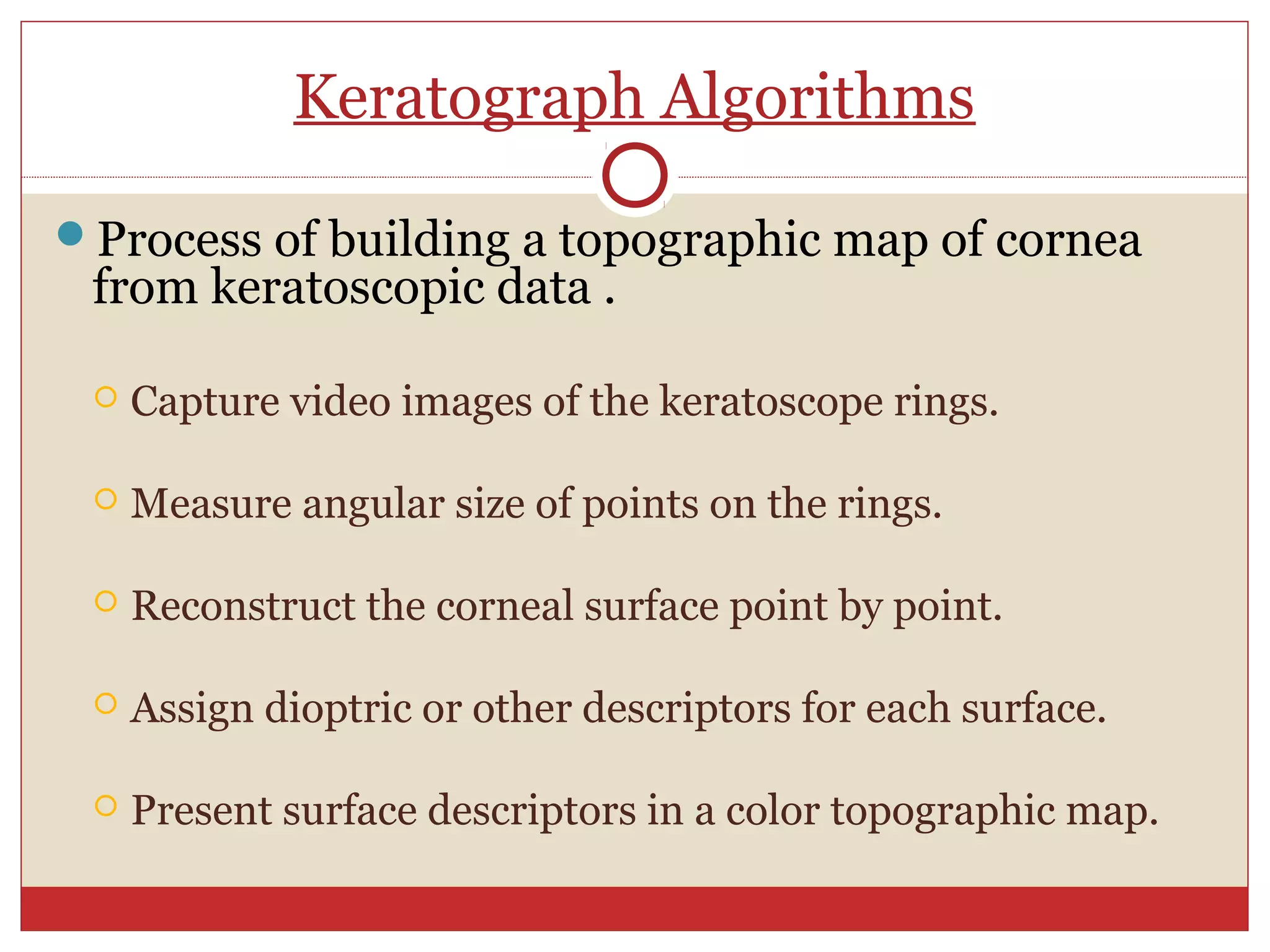
Keratograph Algorithms
Process of building a topographic map of cornea
from keratoscopic data .
 Capture video images of the keratoscope rings.
 Measure angular size of points on the rings.
 Reconstruct the corneal surface point by point.
 Assign dioptric or other descriptors for each surface.
 Present surface descriptors in a color topographic map.
Analysis System (Display Options )
Numerical power plots
Simulated keratometry view
Profile view
Photokeratoscopic view
Surface Elevation Maps
Col0r Coded Maps
Interpretation of corneal Color maps
 1 .Color coding
 2. Scale
 3. Quantitative indices
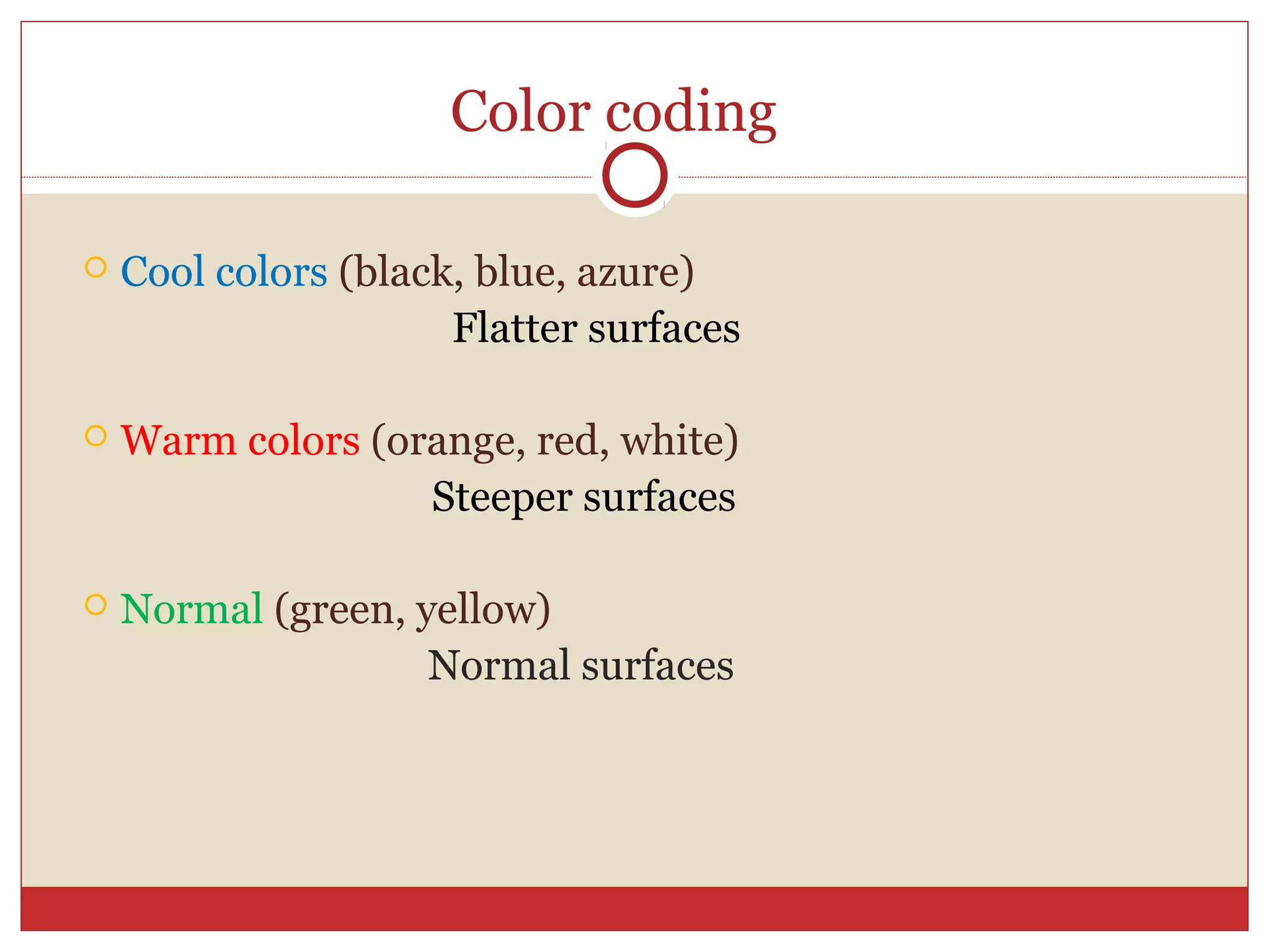
Color coding
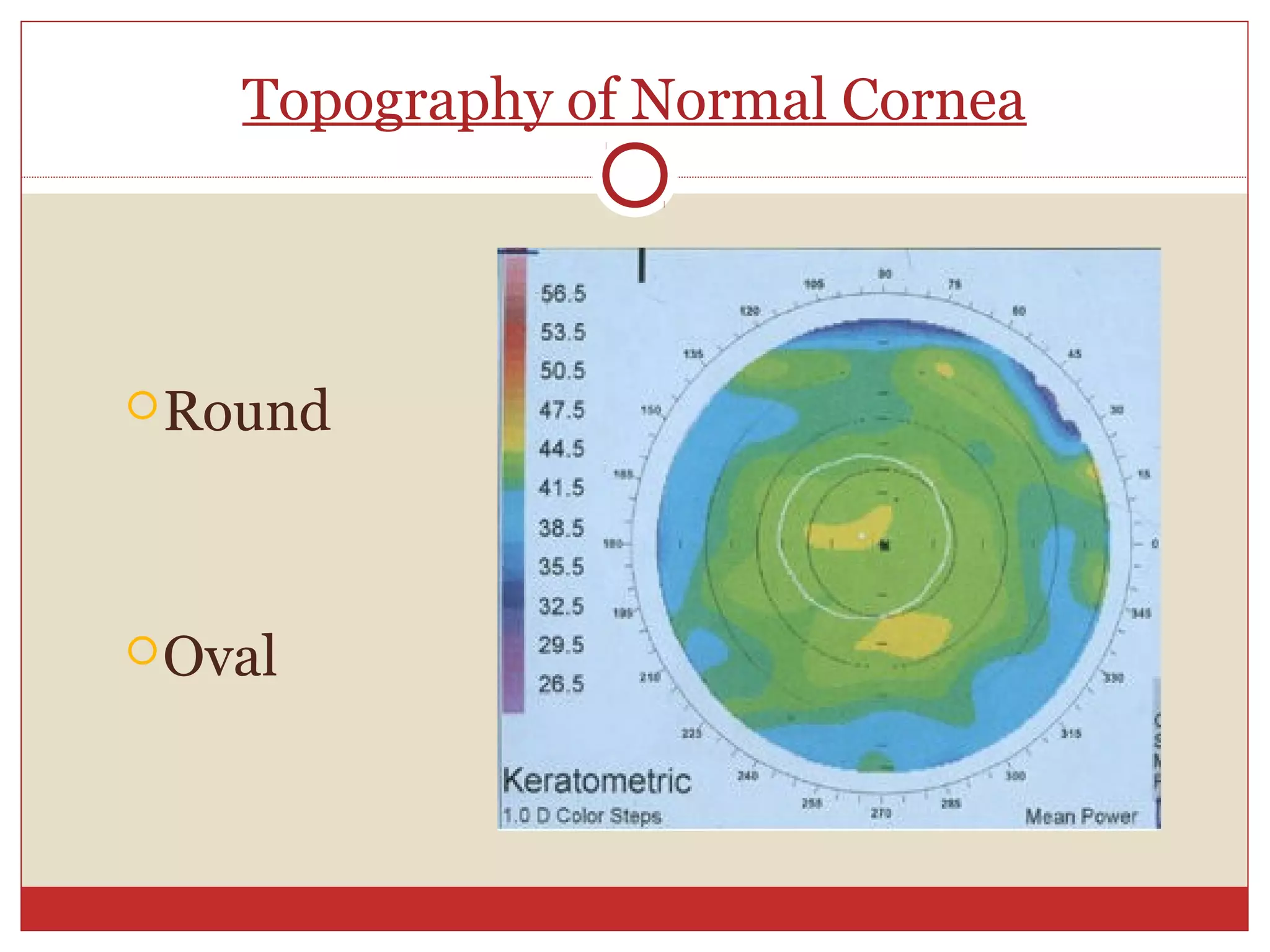
 Cool colors (black, blue, azure)
Flatter surfaces
 Warm colors (orange, red, white)
Steeper surfaces
 Normal (green, yellow)
Normal surfaces
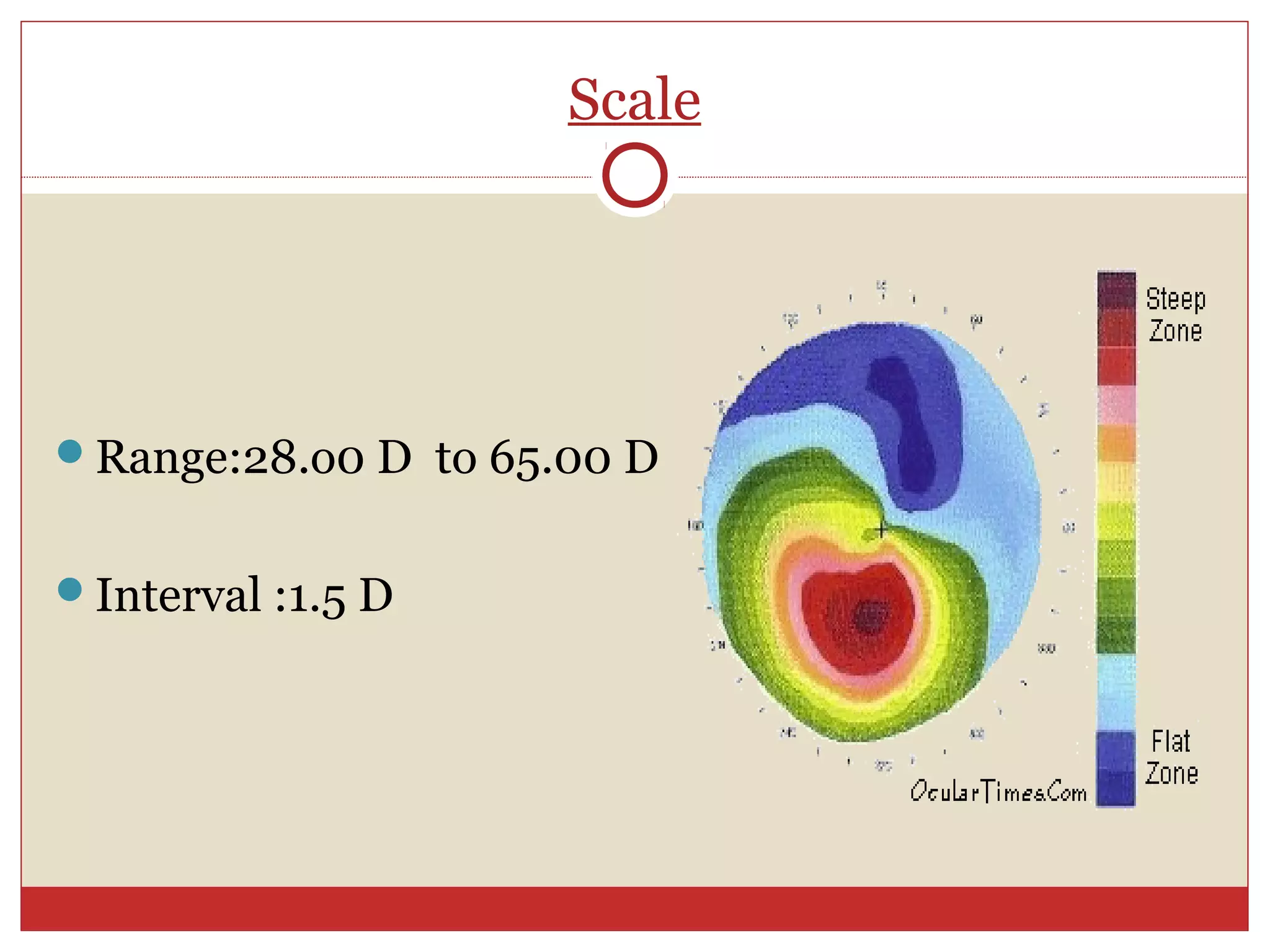
Scale
Range:28.o0 D to 65.00 D
Interval :1.5 D
Quantitative indices
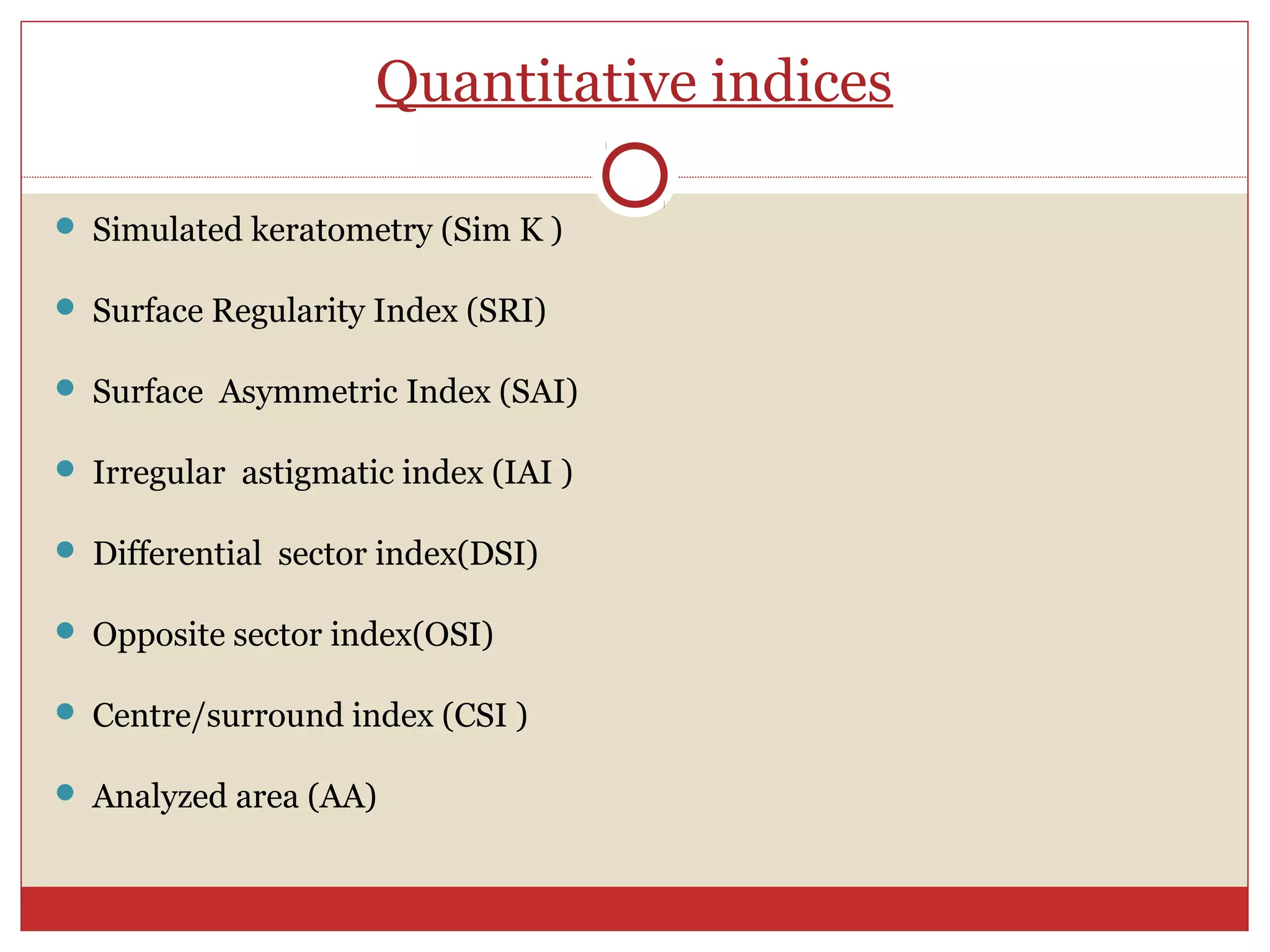
 Simulated keratometry (Sim K )
 Surface Regularity Index (SRI)
 Surface Asymmetric Index (SAI)
 Irregular astigmatic index (IAI )
 Differential sector index(DSI)
 Opposite sector index(OSI)
 Centre/surround index (CSI )
 Analyzed area (AA)
Quantitative indices
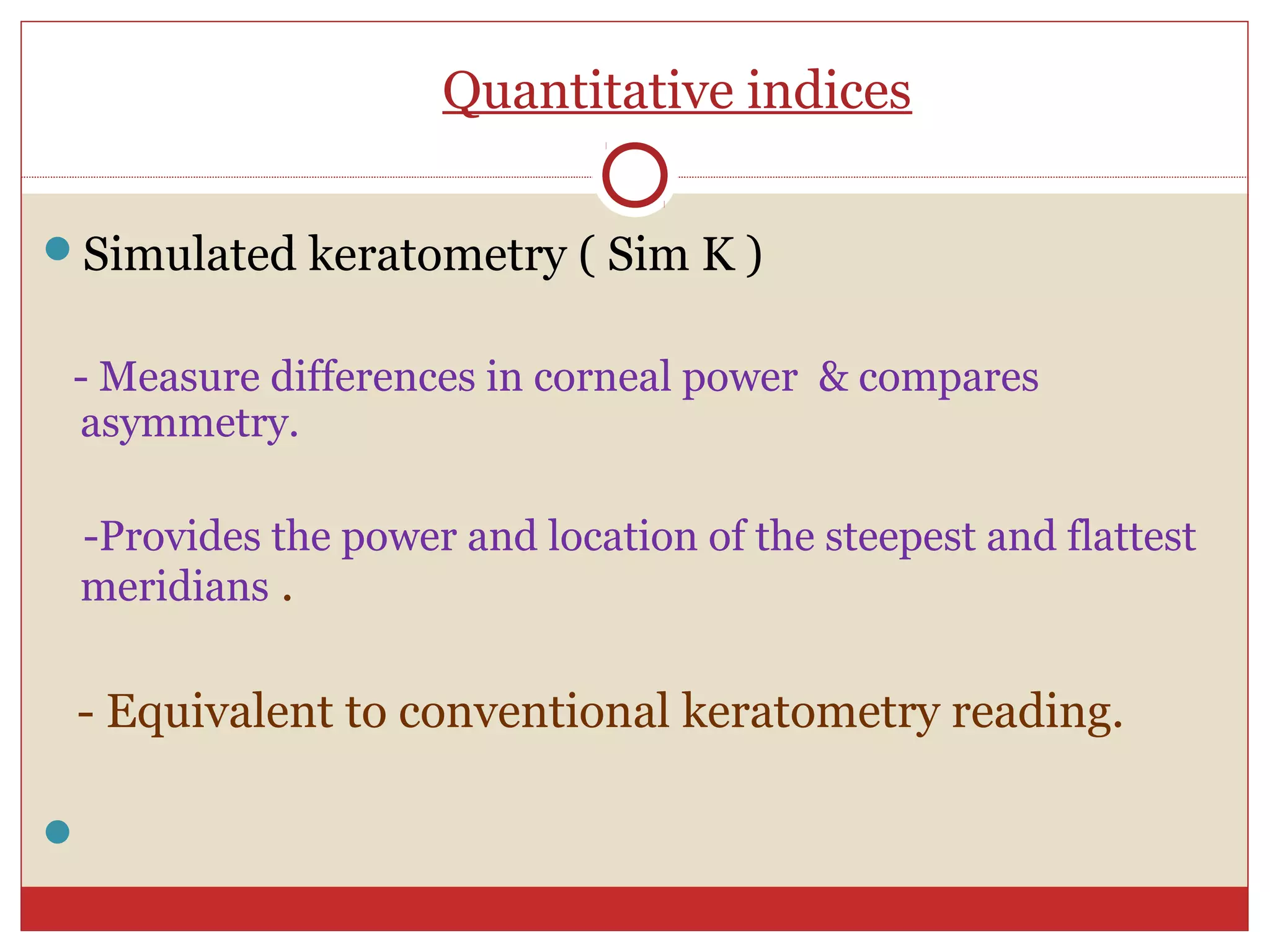
Simulated keratometry ( Sim K )
- Measure differences in corneal power & compares
asymmetry.
-Provides the power and location of the steepest and flattest
meridians .
- Equivalent to conventional keratometry reading.

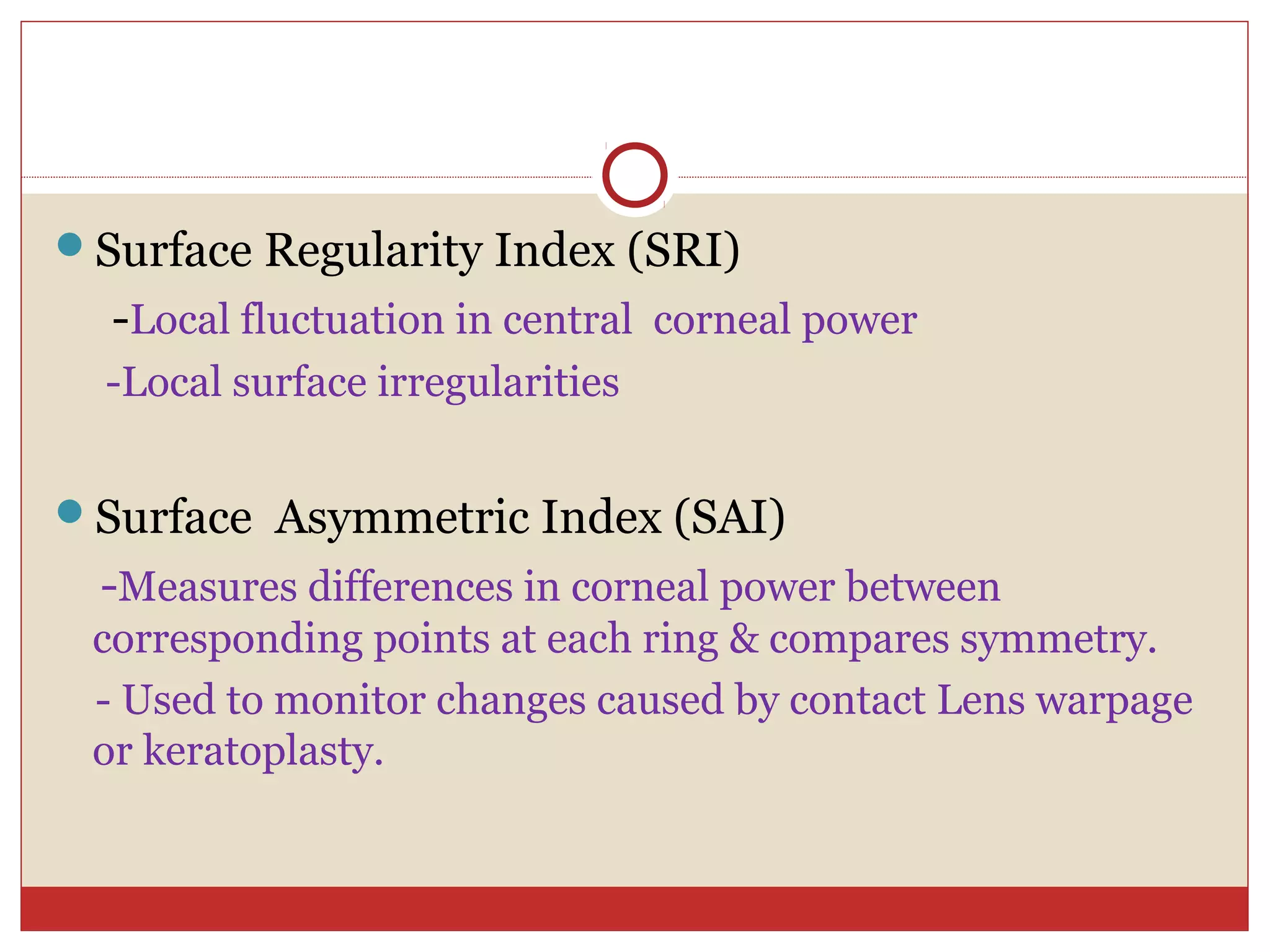
Surface Regularity Index (SRI)
-Local fluctuation in central corneal power
-Local surface irregularities
Surface Asymmetric Index (SAI)
-Measures differences in corneal power between
corresponding points at each ring & compares symmetry.
- Used to monitor changes caused by contact Lens warpage
or keratoplasty.
Implications
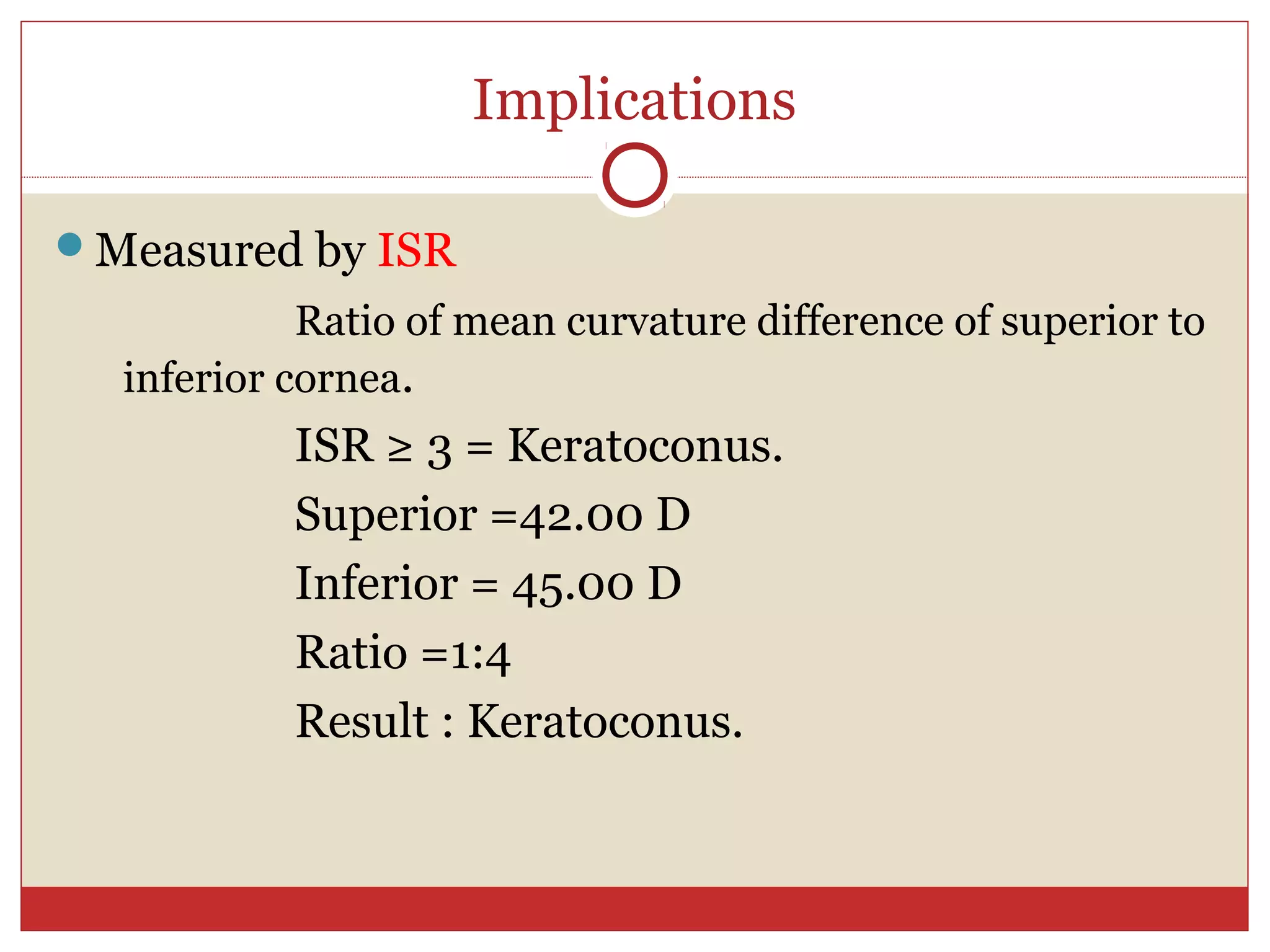
Measured by ISR
Ratio of mean curvature difference of superior to
inferior cornea.
ISR ≥ 3 = Keratoconus.
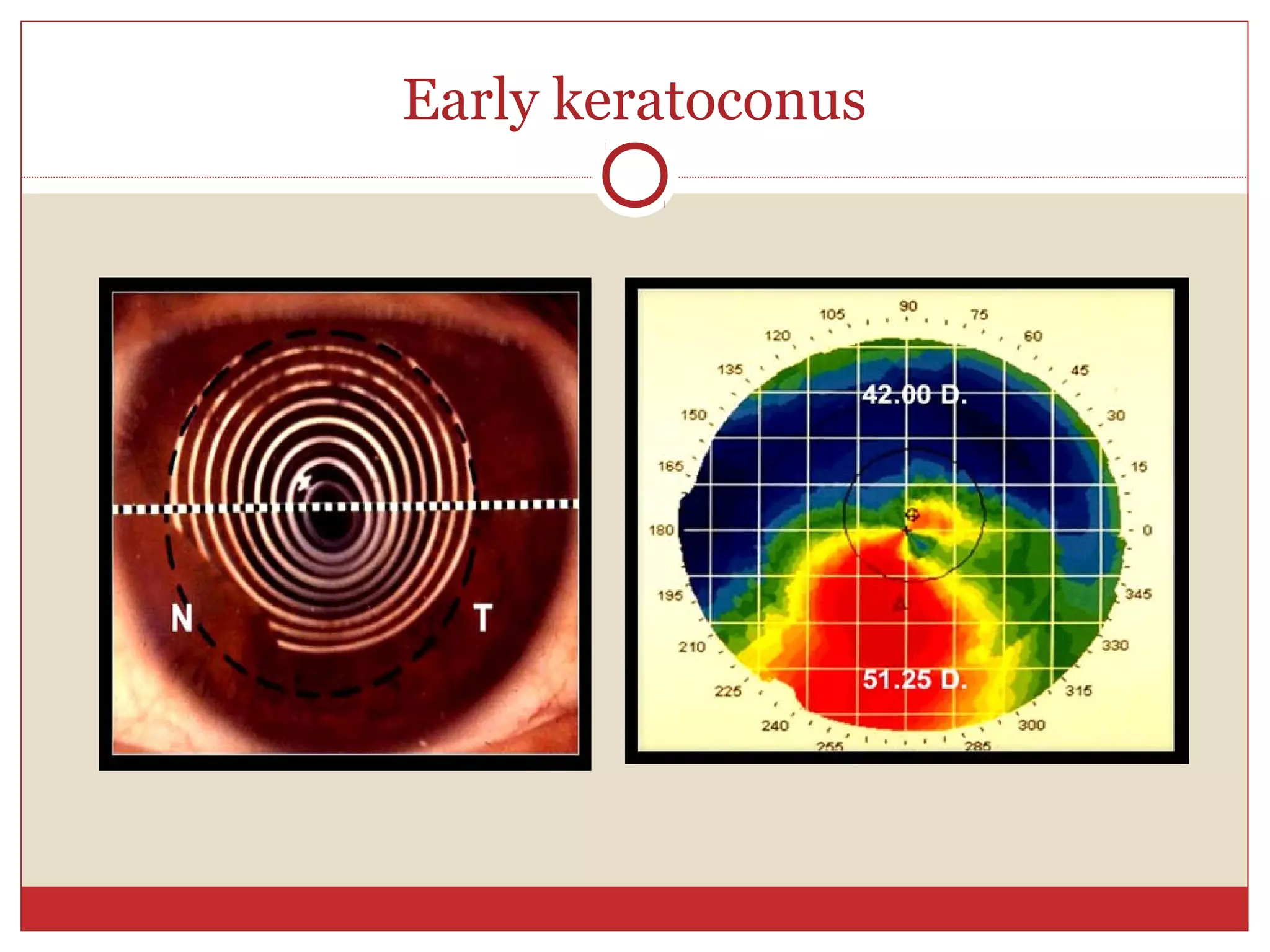
Superior =42.00 D
Inferior = 45.00 D
Ratio =1:4
Result : Keratoconus.
Contd…
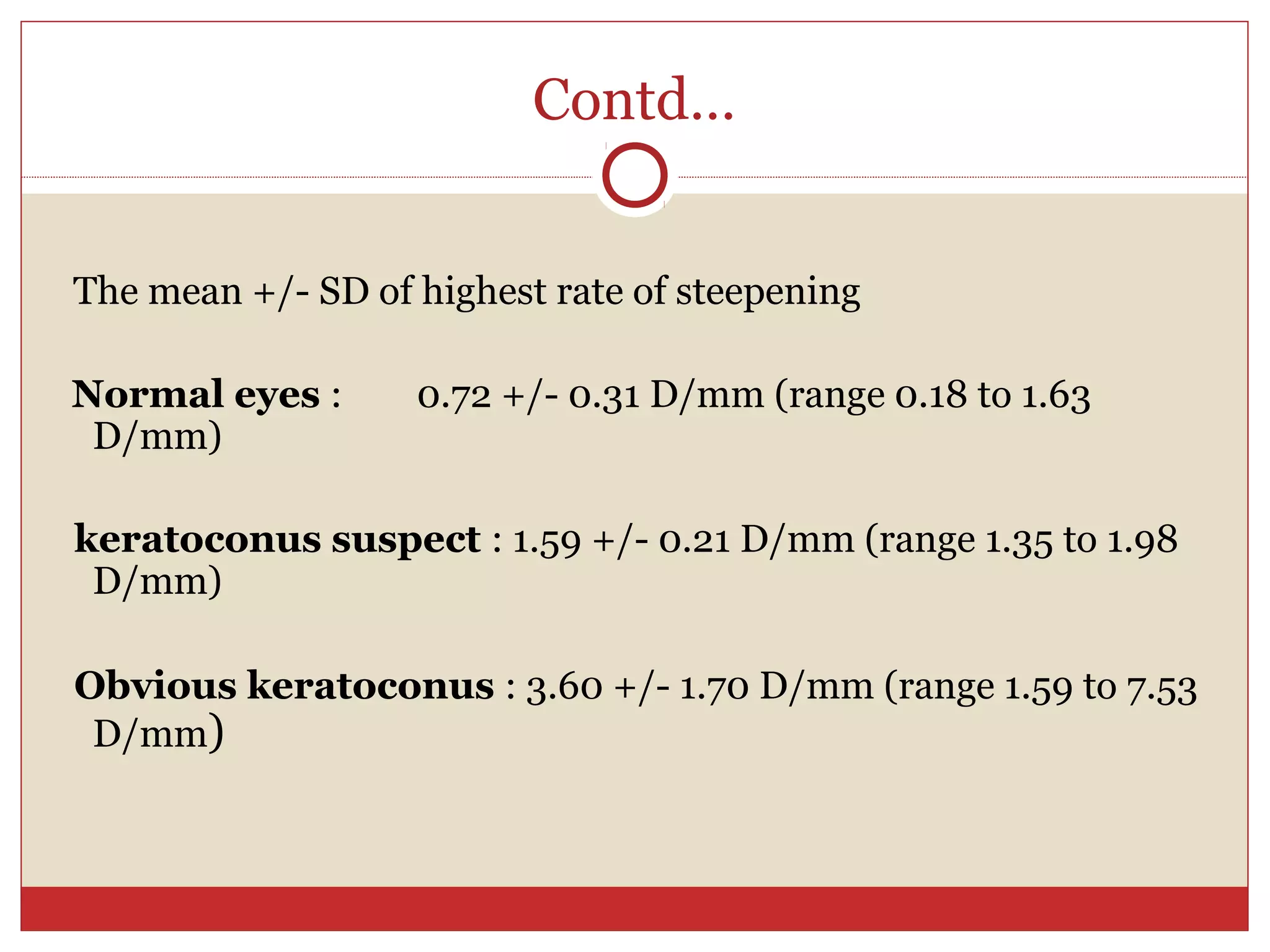
The mean +/- SD of highest rate of steepening
Normal eyes : 0.72 +/- 0.31 D/mm (range 0.18 to 1.63
D/mm)
keratoconus suspect : 1.59 +/- 0.21 D/mm (range 1.35 to 1.98
D/mm)
Obvious keratoconus : 3.60 +/- 1.70 D/mm (range 1.59 to 7.53
D/mm)
Contd…
Corneal color coding map may resemble in certain
disease.
Can Quantitative indices help????
Several efforts are under way.
Topography of Normal Cornea
Round
Oval
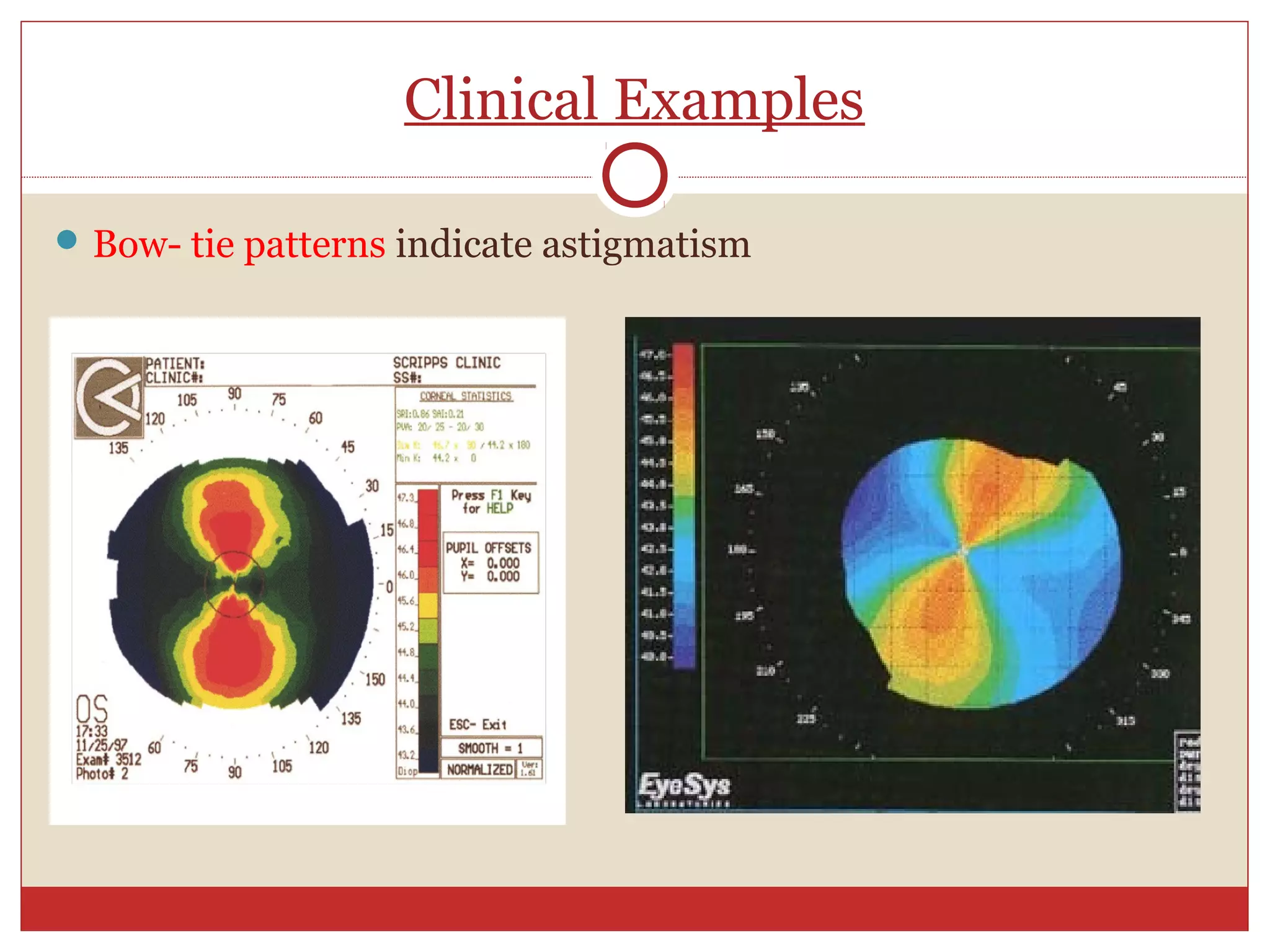
Clinical Examples
Bow- tie patterns indicate astigmatism
Early keratoconus
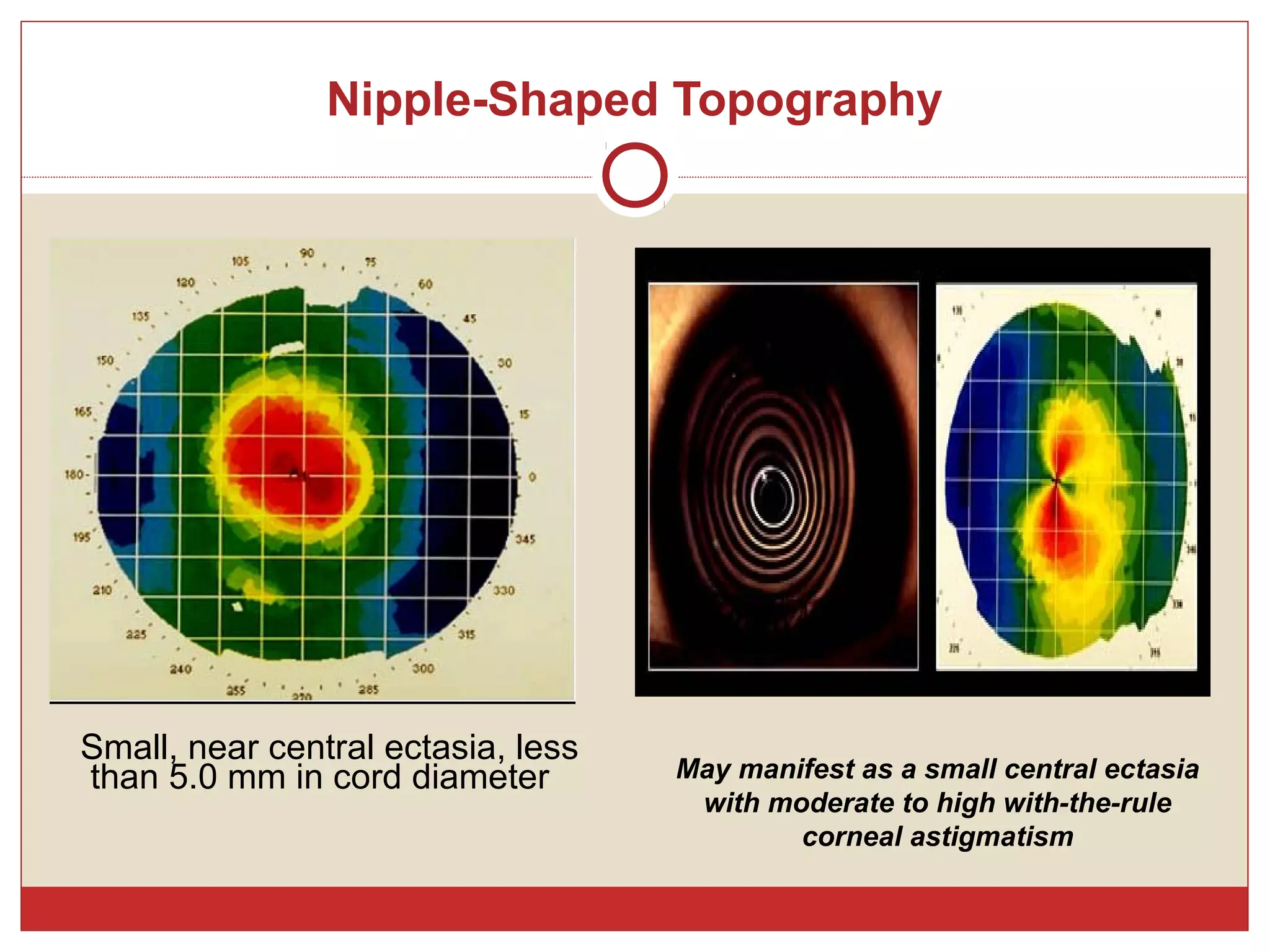
Nipple-Shaped Topography
Small, near central ectasia, less
than 5.0 mm in cord diameter May manifest as a small central ectasia
with moderate to high with-the-rule
corneal astigmatism
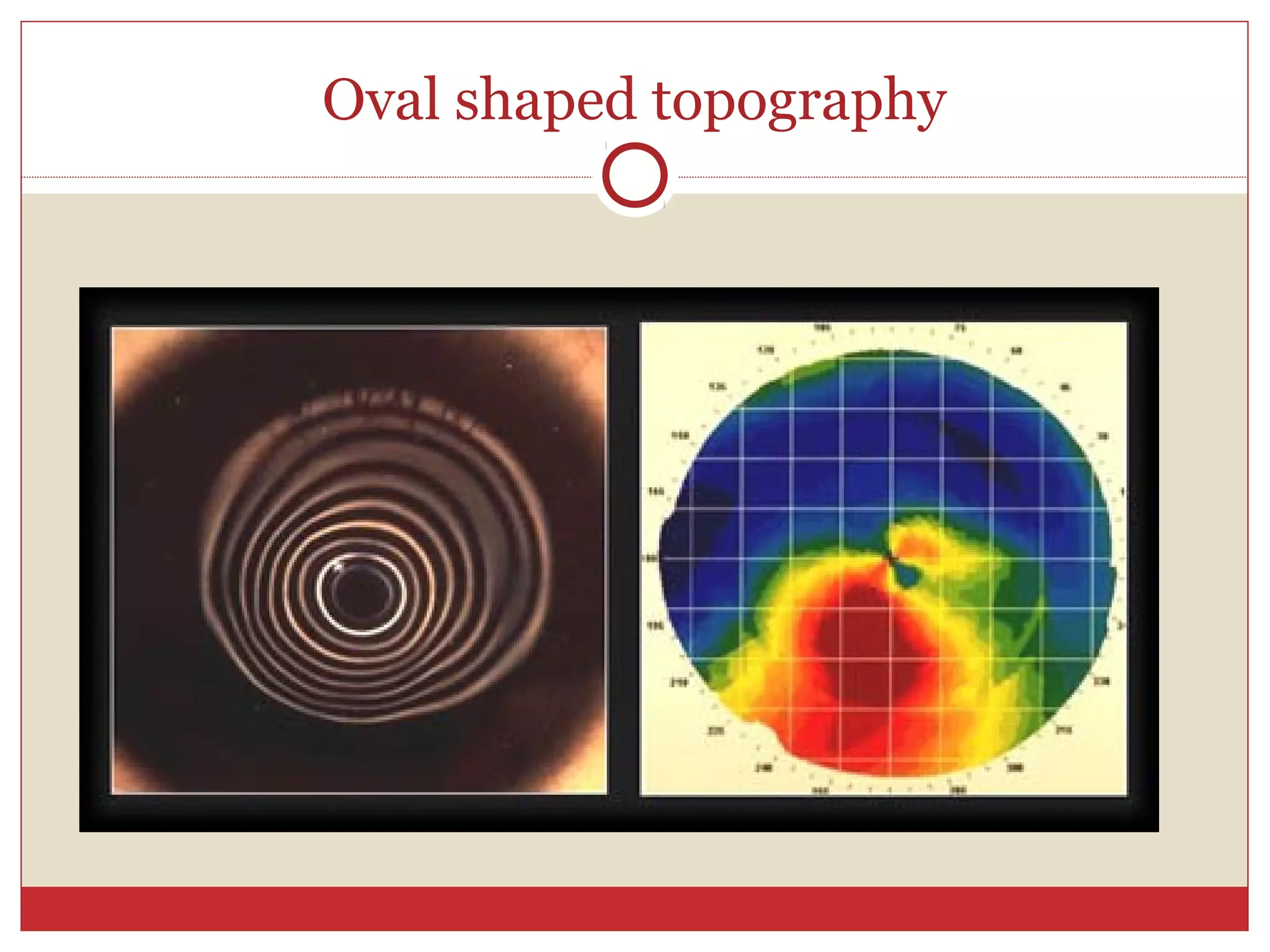
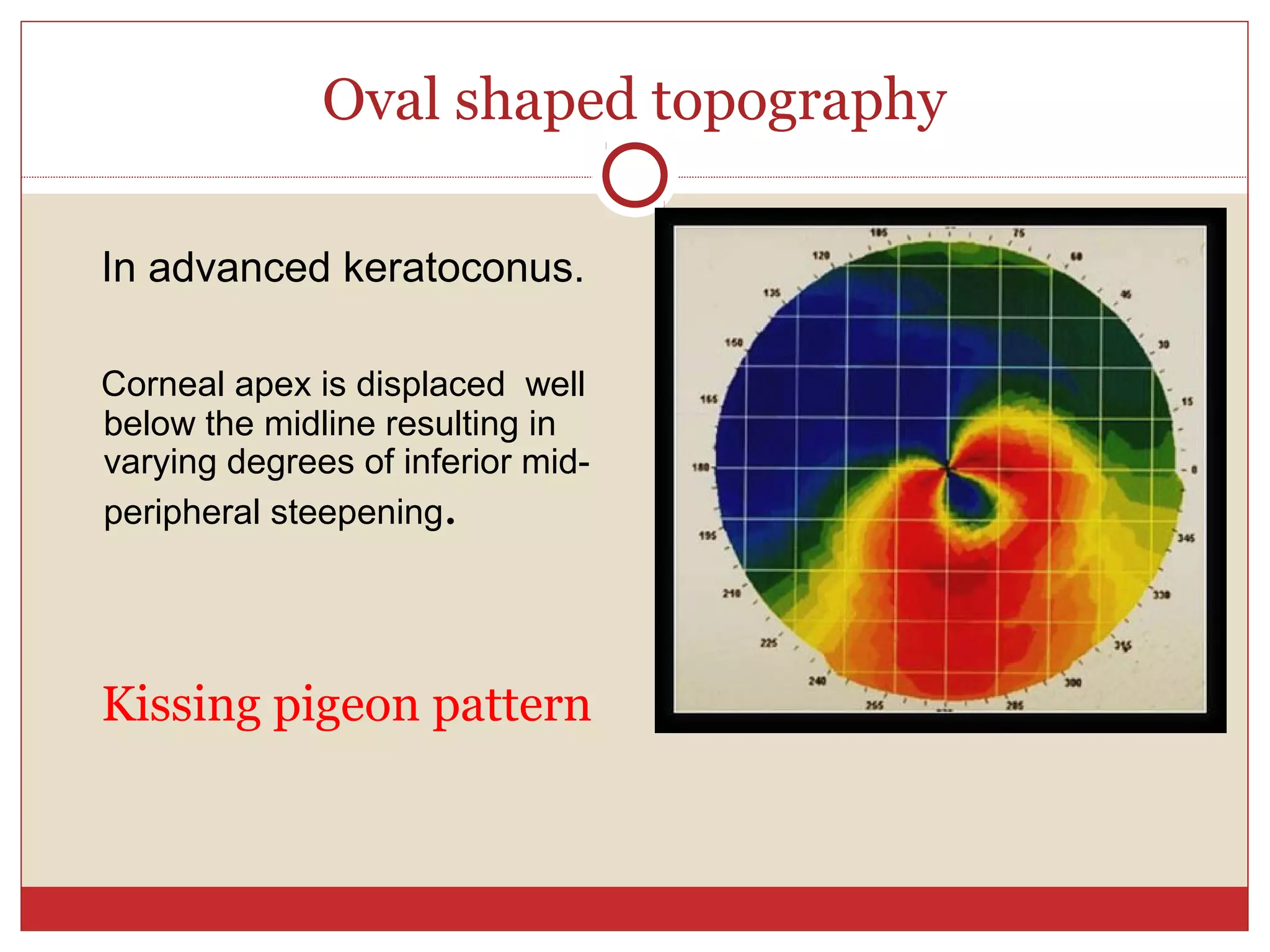
Oval shaped topography
In advanced keratoconus.
Corneal apex is displaced well
below the midline resulting in
varying degrees of inferior mid-
peripheral steepening.
Kissing pigeon pattern
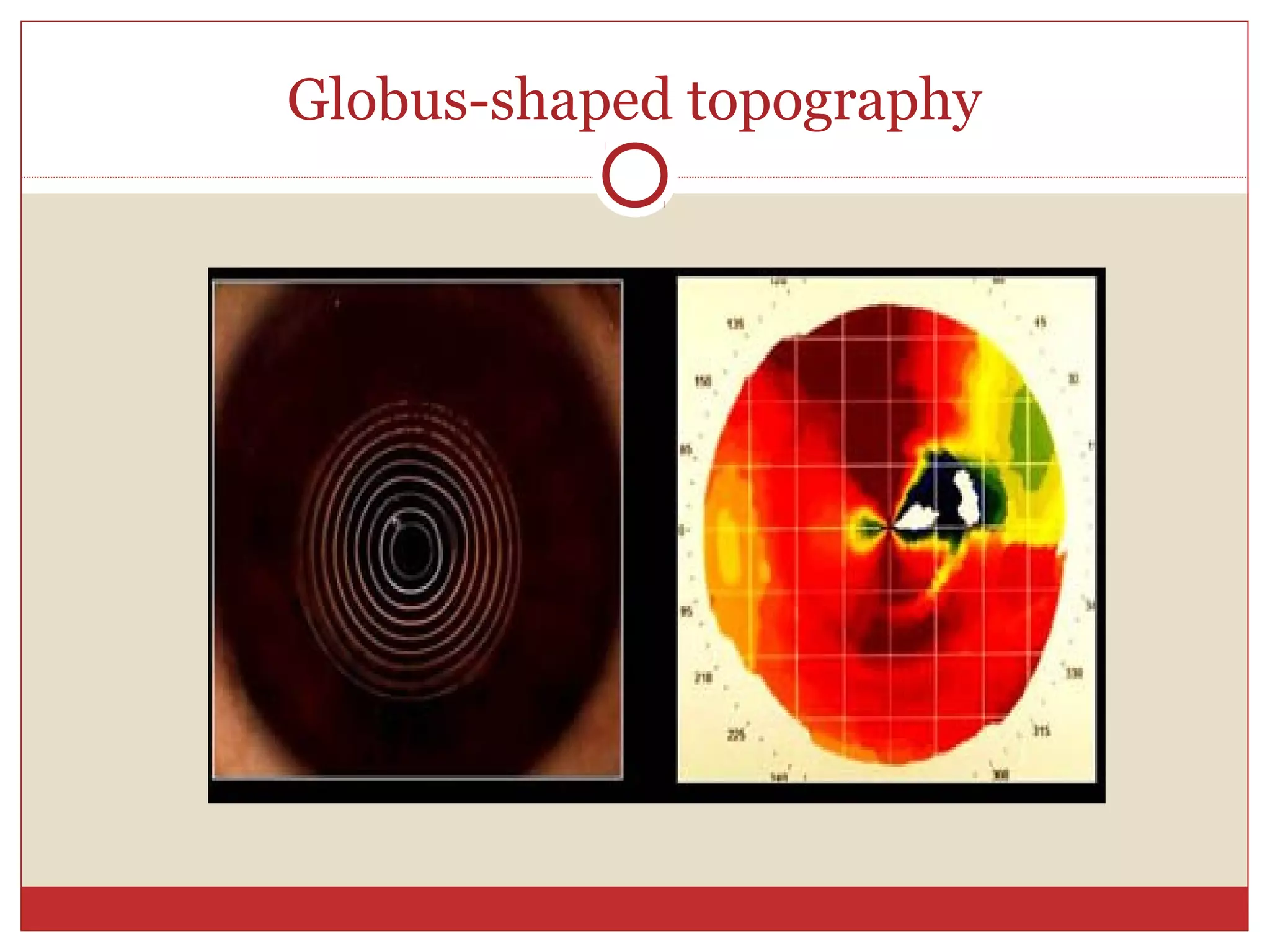
Globus-shaped topography
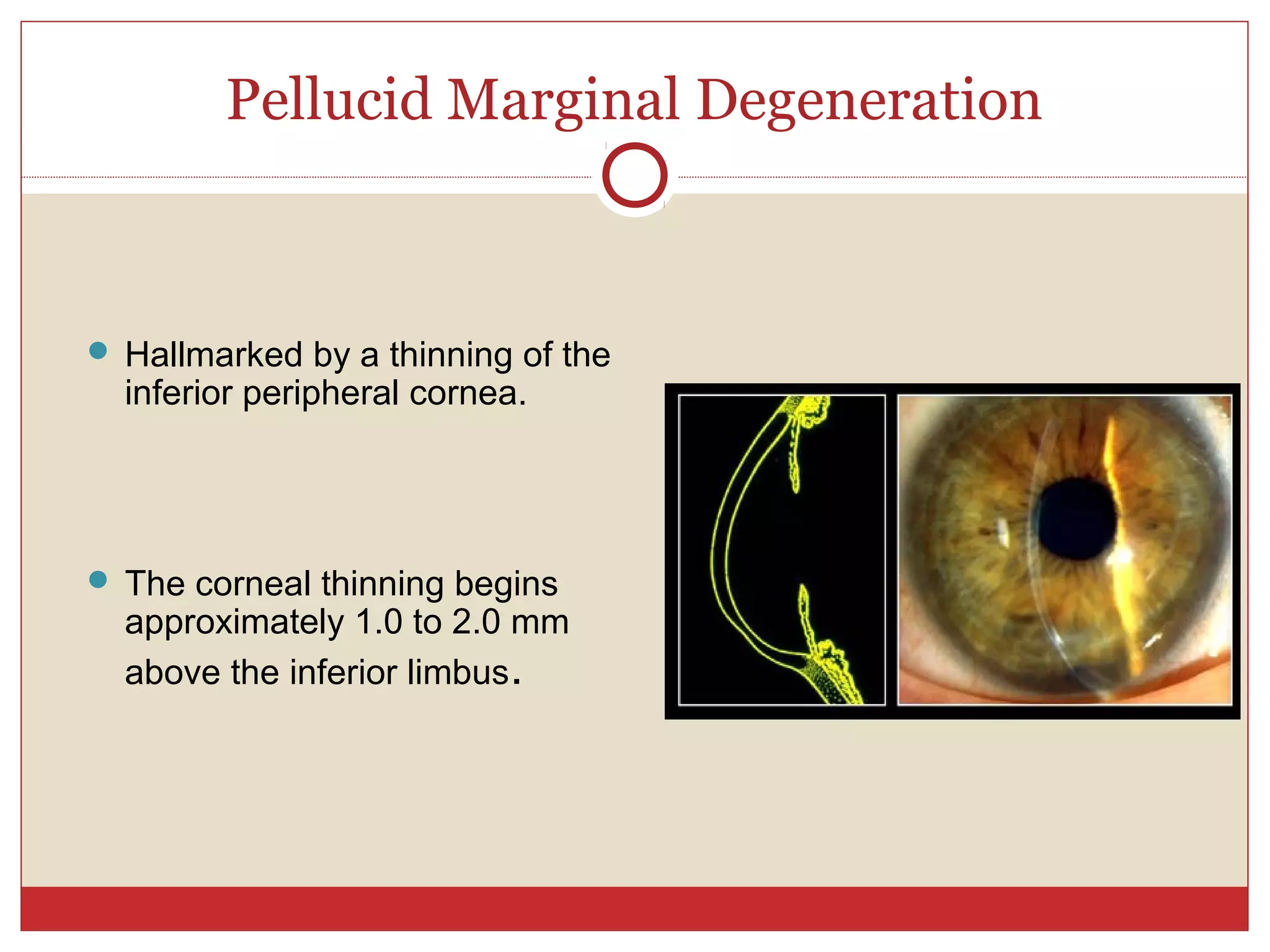
Pellucid Marginal Degeneration
 Hallmarked by a thinning of the
inferior peripheral cornea.
 The corneal thinning begins
approximately 1.0 to 2.0 mm
above the inferior limbus.
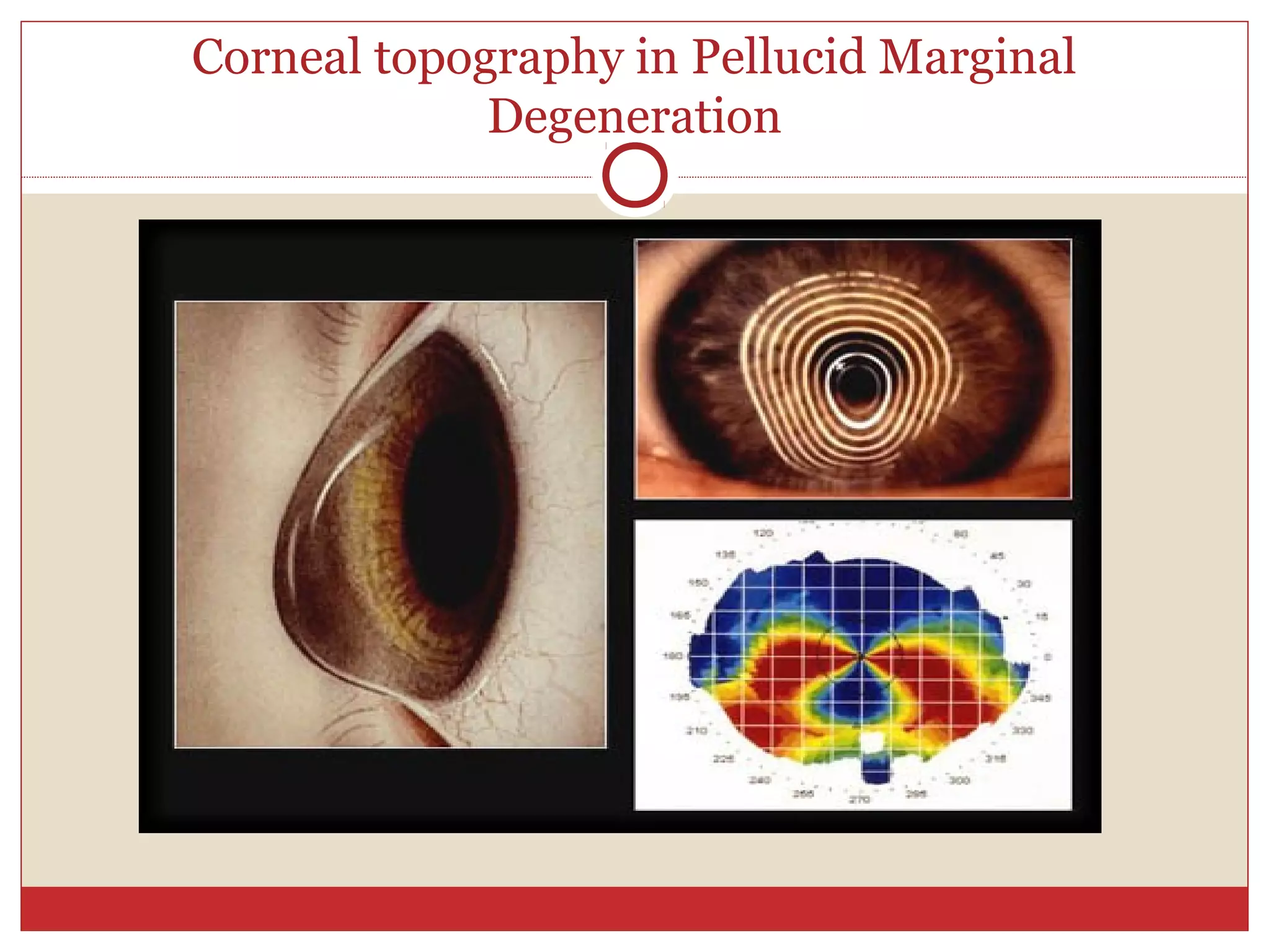
Corneal topography in Pellucid Marginal
Degeneration
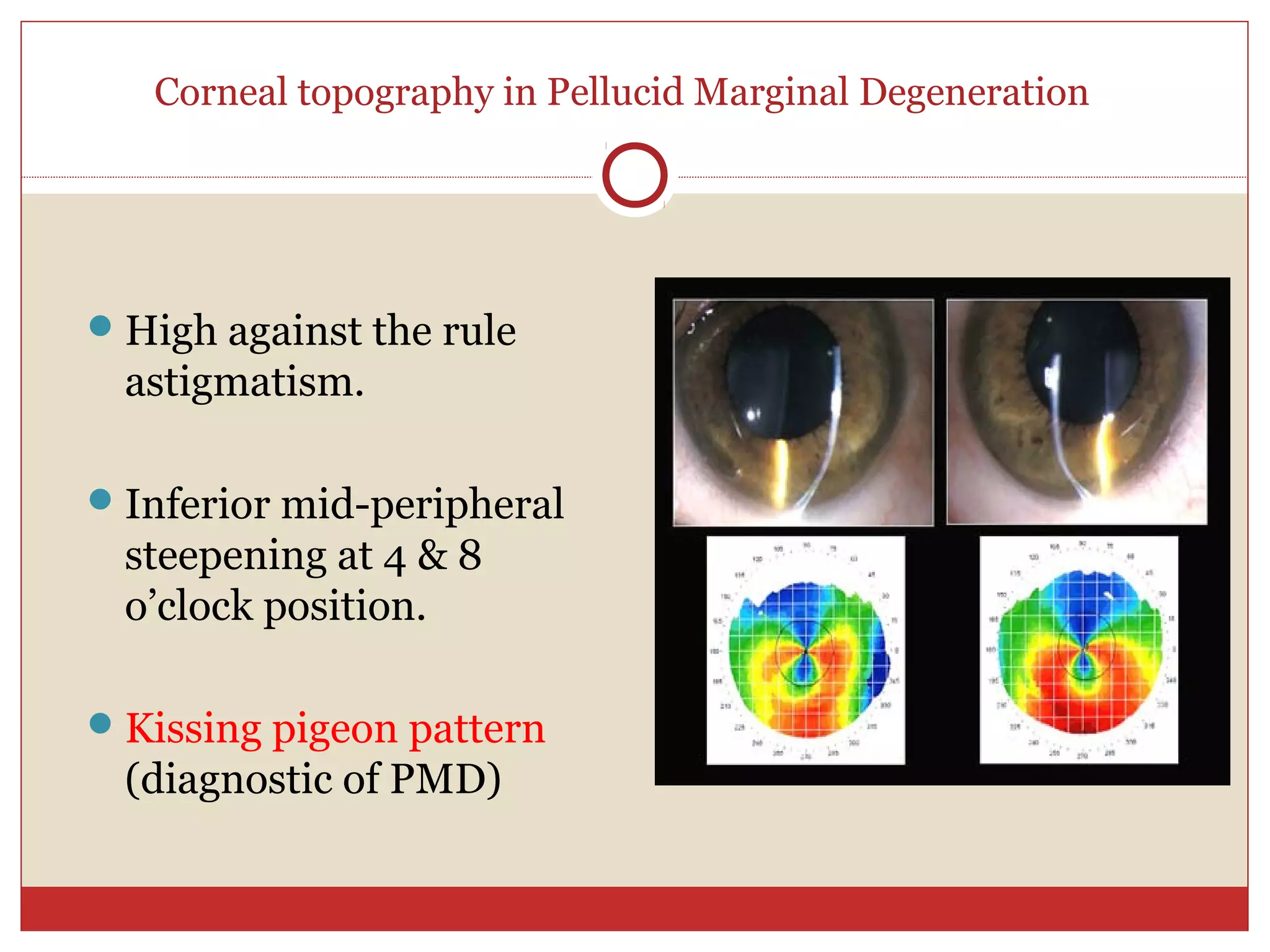
Corneal topography in Pellucid Marginal Degeneration
High against the rule
astigmatism.
Inferior mid-peripheral
steepening at 4 & 8
o’clock position.
Kissing pigeon pattern
(diagnostic of PMD)
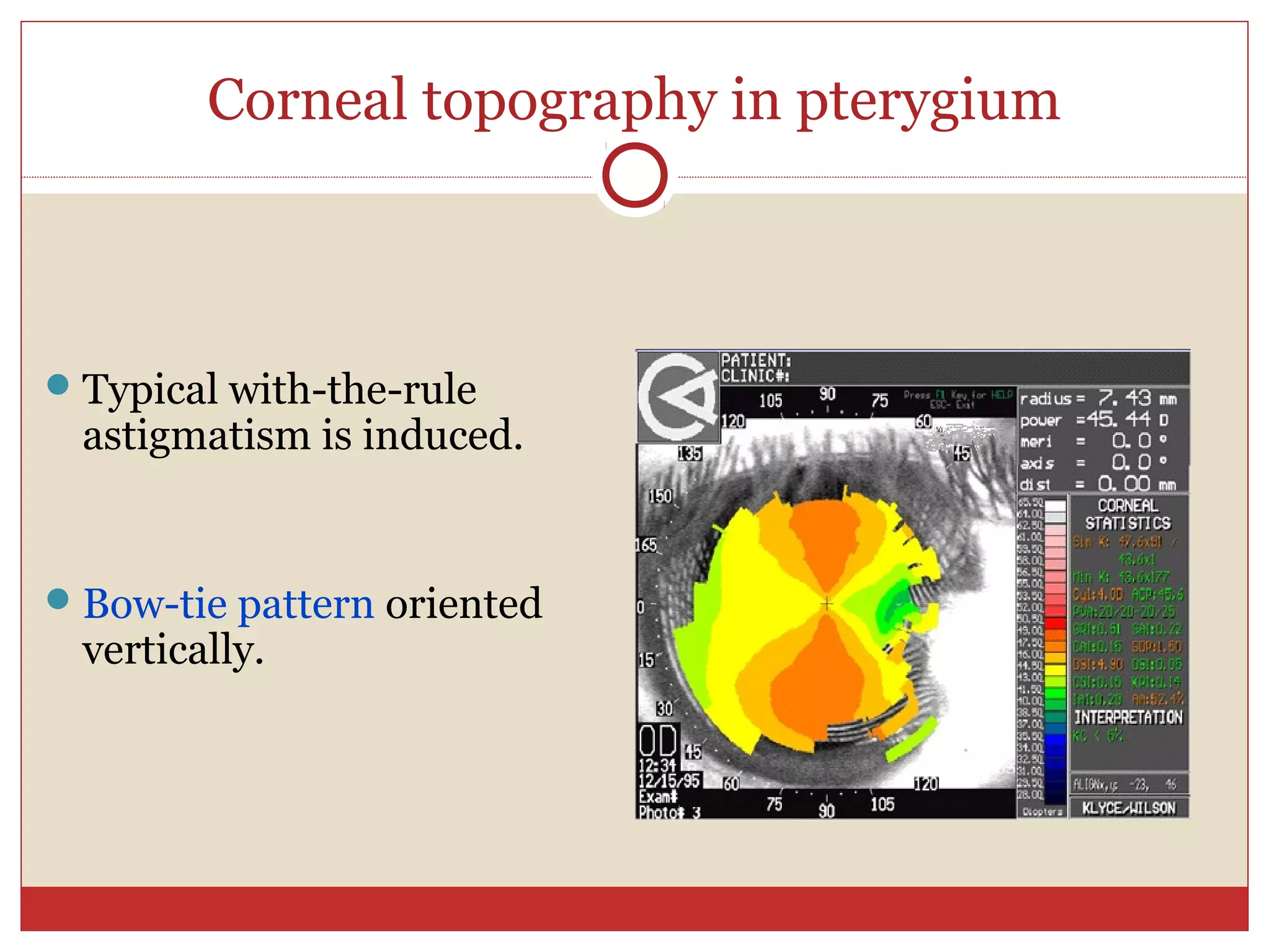
Corneal topography in pterygium
Typical with-the-rule
astigmatism is induced.
Bow-tie pattern oriented
vertically.
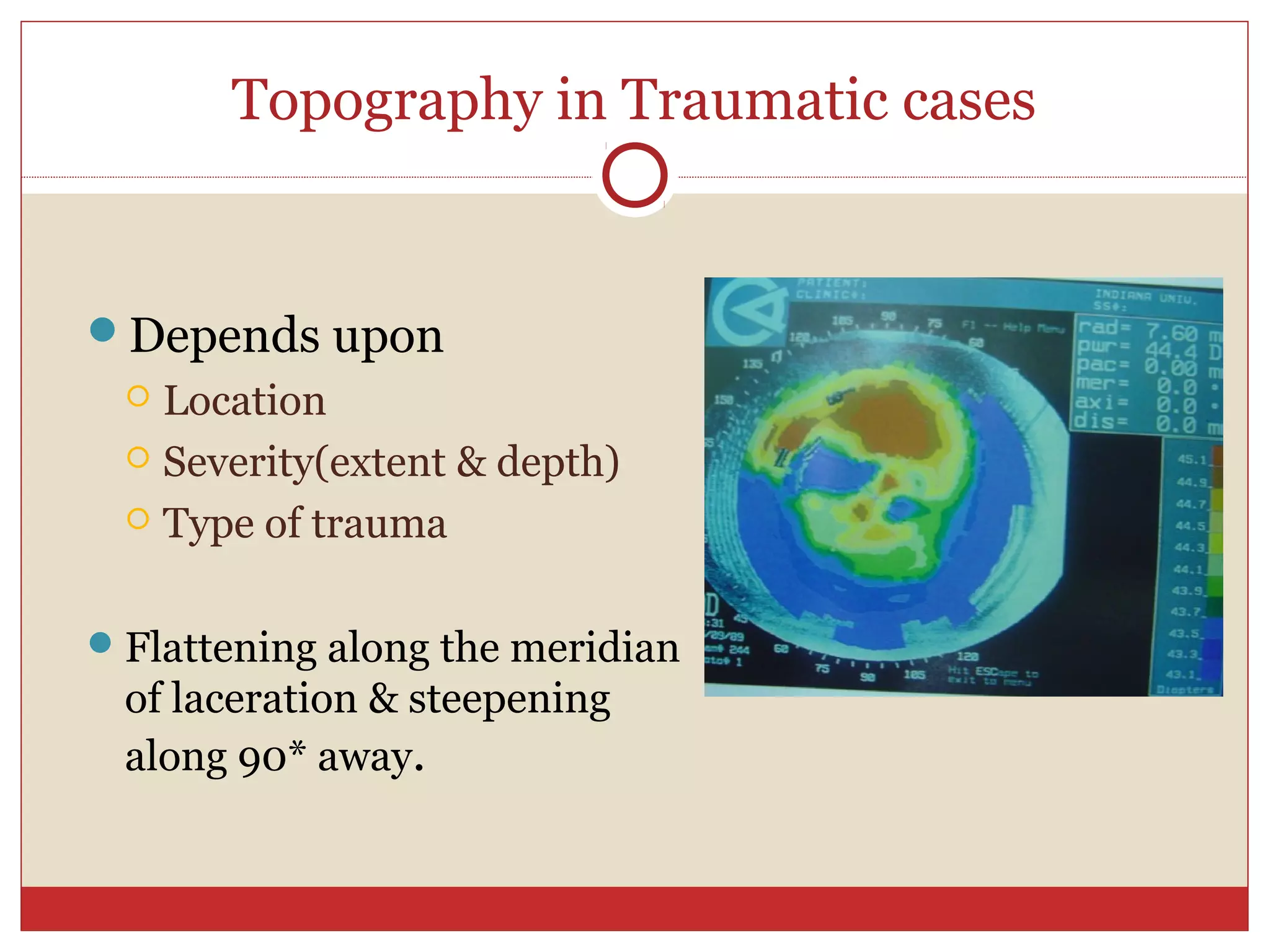
Topography in Traumatic cases
Depends upon
 Location
 Severity(extent & depth)
 Type of trauma
Flattening along the meridian
of laceration & steepening
along 90* away.
Clinical Uses
Photorefractive Surgery
Preoperative screening
Surgical planning
Assessment of surgical outcomes
Detection & management of complications
Refinement & development of surgical outcome
Contd…
Evaluation Of intraocular Surgery
 Cataract
 Penetrating keratoplasty
 Radial Keratotomy
 Epikeratophakia
Contd…
Diagnosis of Corneal degenerations & dystrophies.
Keratoconus
Keratoglobus
Pellucid Marginal Degeneration
Terrien’s Marginal degenerations
Contact lens
CL fitting
Choice of trial lens.
Verification of parameters
Orthokeratology
Contd…
Determination Of
 Refraction esp. for poor quality retinoscopic reflex.
 Curvature of cornea
 Amount and direction of corneal astigmatism
 Quality of corneal refracting surface
 Stability of corneal refracting surface.
Contd…
 In cases of trauma
 Progressive Myopia
 Aphakia or high ametropia
 To calculate the power of intraocular Lens
 Who can’t adequately participate in subjective refraction procedure
eg.children, mentally retarded patients
Limitations
Measures the contour of peripheral cornea less accurately
than that of the central.
Inability to directly measure the optical performance of
complex surface patterns generated by penetrating
keratoplasty or refractive surgical procedures.
Formulae for power calculation are centered on corneal
apex & not on relevant line of sight.
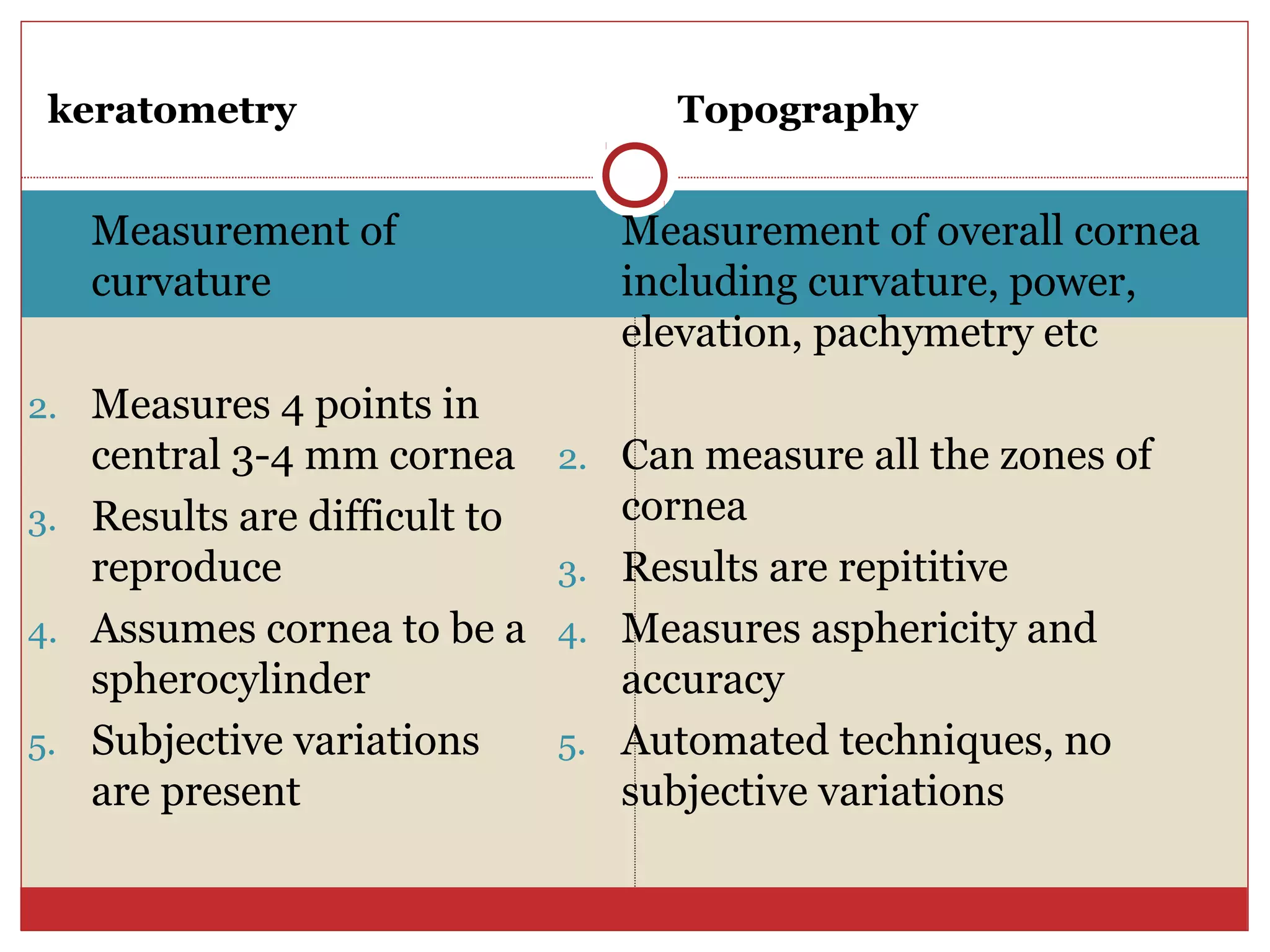
keratometry Topography
1. Measurement of
curvature
2. Measures 4 points in
central 3-4 mm cornea
3. Results are difficult to
reproduce
4. Assumes cornea to be a
spherocylinder
5. Subjective variations
are present
1. Measurement of overall cornea
including curvature, power,
elevation, pachymetry etc
2. Can measure all the zones of
cornea
3. Results are repititive
4. Measures asphericity and
accuracy
5. Automated techniques, no
subjective variations
Any relevant quarries?????????
Coneal topography instrumentation, techniques, procedures, limitations, advantages and disadvantages

Coneal topography instrumentation, techniques, procedures, limitations, advantages and disadvantages

  • 1.
    Raju Kaiti, M.optometry Consultant Optometrist Nepal eye Hospital (NEH) CORNEAL TOPOGRAPHY
  • 2.
    Introduction  A non-invasivemedical imaging technique for mapping the surface curvature of the cornea  Study of shape 0f corneal surface  Configuration or description of surface  Assist in the diagnosis and t/t of number of conditions:  In planning Catarct sx and IOL implantation  In planning refractive surgery such as LASIK, and evaluating its results  Before fitting contact lenses and in assessing the fit of contact lenses  In assessing corneal pathologies  In checking the progression/regression of corneal pathologies and /or degeneration
  • 3.
    Cornea  Avascular, Transparent Accounts for 70% of the total refractive power of the eye (+43D)  Anterior surface: elliptical Diameter: horizontal: 11.75 mm(11.0-12.50 mm), vertical: 10.60 mm (10-11.50mm)  Posterior surface: Circular Diameter: 11.5 mm Microcornea/megalocornea???  Aspheric – Prolate elliptical shape  The anterior and posterior radii of curvature are 7.80 mm(6.50mm to 8.50mm) mm and 6.50 mm (6.00 to 7.00mm) respectively  Thickness varies from 0.52 mm in center to 0.67 mm in periphery
  • 4.
    Cornea Refractive index: 1.376 air:1.00 Tear:1.336 Aqueous:1.336 Lens:1.42 Vitreous:1.336 Layers: A-Anterior Epithelium B-Bowman’s membrane C-Central Stroma D-Duas layer D-Descemet’s membrane E-Endothelium (polymegathism???)
  • 5.
    Regions 1. Central Region/Corneal Cap/ApicalZone/Optic Cap  Approx. 4mm dia., decentered 0.2- 0.6 nasally & 0.2 mm superiorly  More or less spherical 2. Paracentral / Mid Peripheral Region  Region of greatest flattening  4-8mm from cornea 3. Peripheral Region  Nasal & superior-nasal has greatest asphericities  8-11mm
  • 6.
    Corneal curvature &its measurement Keratometry – (Ophthalmometry ) measure central 3 - 4 mm Keratoscopy  Placido disc  Photokeratoscopy  Videokeratoscopy Computer assisted topographic analysis
  • 7.
    Keratometry Clinical technique usto measure the curvature of the anterior corneal surface. Another name: Ophthalmometry
  • 8.
    Keratometer An instrument thatMeasures the front surface corneal radii Measures the Central cap – 3 mm Saggital radius Corneal anterior surface acts as a convex mirror – utilizes 1st Purkinje image
  • 9.
    Clinical Use Objective method for refraction  for determining curvature of cornea  For determining amount and direction of corneal astigmatism  For determining the quality of corneal refracting surface  For determining the stability of corneal refracting surface.
  • 10.
    Optical Principle ofKeratometry Cornea is considered as a convex mirror The optical principle used  the relationship of the first Purkinje image size to the radius of the anterior corneal surface Comparing the relationship betn the size of an object and the size of the image of that object reflected from the convex mirror  virtual & behind the mirror.
  • 12.
    The distance betweenthe object and the anterior surface of the cornea is relatively long so that the virtual image is located very close to the focal point of the anterior surface of the cornea. So, distance d = x
  • 13.
  • 14.
    Optical Principle ofKeratometry h/h’= x/f = d/f = d/1/2r So, r = 2d h’/h (Approximate keratometer equation) r == radius d = image distance h' = image height h = mire separation As long as image is in focus, .d= constant = distance between eye & keratometer Then, r (radius of curvature of cornea) = function of the sizes of the object (h) & the image (h’)
  • 15.
    Optical Principle ofKeratometry As, d & h are constant or measurable ? .h’ measurement = challenge Due to presence of involuntary miniature eye movement during fixation of a eye  The image formed by anterior surface of the cornea also moves : Not possible to measure  To over come obstacle – Doubling principle
  • 16.
    Optical Principle ofKeratometry Developed first by Ramsden Principle  A prism is introduced into the optical system of the instrument such that two images of the object are produced  Both images will move the same amount as the eye moves  Prism can be moved along the optical axis until the two images just touch  Thus, Prismatic displacement= Image size (h’)
  • 17.
  • 18.
    Optical Principle ofKeratometry The doubling principle  The prism produces double image of the object  Prism is moved along the optical axis until the two images are just touching  The larger the image size is, greater the amount of doubling – greater would be the prism displacement
  • 19.
    Optical Principle ofKeratometry In instrument, the rotating power wheel– moves the prism Amount of prism displacement = image size  Corresponds to the radius of curvature = Calibrated in the rotating power wheel
  • 20.
    Types of doubling Fixeddoubling : Variable doubling Divided doubling Full doubling
  • 21.
    Types of doubling Fixeddoubling  Fixed object height & doubling device system  Variable image size & mire separation Variable doubling  Fixed mire separation & image size  Variable distance of doubling device & variable object size
  • 22.
    Types of doubling Divideddoubling  The telescope objective is divided into two separate fields, each transmitting only a portion of the incident reflected beam Full doubling  The doubling is achieved with the aid of a full aperture beam splitting device
  • 23.
  • 24.
    Optical Principle ofKeratometer Bausch & Lomb (Reichert Keratometer)  Constant object size – utilizes the difference in the size of image  Image doubling produces vertical & horizontal simultaneously measuring vertical & horizontal meridians of the cornea  Light from the object is reflected from the cornea – forms an image behind the cornea
  • 25.
    Image produced bythe cornea acts an object :  The light from the cornea is then refracted thru objective lens of the instrument, a diaphragm with four apertures and two doubling prisms Two prism  Base up –light passing thru one horizontal aperture – vertically displaced image  Base out –light passing thru other horizontal aperture – horizontally displaced image  Two vertical apertures : acts as scheiner’s disk- produces a doubling central image if the instrument is not properly focused on the corneal image  So, at perfect focus : Keratometer - Produces three images of the object
  • 26.
    The triple imageis viewed thru the optical eye piece By rotating the power wheels – the position of the doubling prisms changed until the images just touch each other Amount of doubling correspond to the image size reflected from the cornea Corresponding value in the Power Wheel = corneal curvature
  • 27.
    Types of Keratometers 1-position Simultaneous doubling of perpendicular pairs of mires is produced by doubling devices in each of the corresponding principle meridians  Simultaneous measurement of both meridian 2-position  Require rotation about the axis to measure each principle meridians
  • 29.
    Mires in keratometer singKeratometric targetLocating the principle meridiansDetermining the
  • 30.
    Keratometers Hagg-Striet/ Gambs Rodenstock keratometer Baush &Lomb keratometer Topcon Humphrey keratometer Zeiss Oberkochen keratometer
  • 31.
  • 32.
  • 33.
    Keratometry Range of Keratometricreading: Dioptric power:36D to 50D Radius: 6.5mm to 9.38mm Can be extended upto: lower limit:30D(5.6mm) with -1.00 Ds lens upper limit:61D(10.9mm) with +1.25DS lens
  • 34.
    Keratometry limitations  Measureonly central 3mm of cornea  Corneal epithelial irregularities render defocussing  Very steep cornea; reading exceeds range  Post refractive surgery readings are inaccurate  Calculations are based on the geometry of a spherical reflecting surface: cornea is described as a prolate (flattening) ellipsoid(true apical radius steeper)  Power in diopters depends on an assumed index of refraction  The formula approximates the distance of image as the distance of focal point from the object
  • 35.
    Keratoscopy  Instrument thatprojects multiple concentric rings (mires) on the cornea  Examination of curvature & topography of the anterior surface of the cornea  Keratoscope -Consist of pattern of alternating black & white concentric rings which reflect from the cornea and the viewing system as a simple hole in the centre of the target  Keratoscopy-Direct visualisation of rings  Photokeratoscope-May involve an imaging and photographic (camera added to photograph the mires) system  Videokeratoscope- when a video camera is added
  • 36.
    Keratoscope Invented in 1874by an English physician Henry Goode Photokeratoscope – Portuguese Oculits- Placido Javal first to describe the use of it to observe ocular disease – Keratoconus
  • 37.
    Keratoscope Uses Diagnosis &management of corneal topographic disorders – keratoconus Contact lens fitting Ocular trauma & ophthalmic surgeries Keratorefractive surgery Orthokeratology
  • 38.
    Keratoscope instrumentation Uses theimages (concentric rings) reflected from the cornea Evaluate the contour of the image rings to  Circular : spherical  Change of the rings from circular form : astigmatic Or irregular cornea Principle:  The size of the reflected image is directly proportional to the radius of curvature of the reflecting surface
  • 39.
  • 40.
  • 41.
  • 42.
    Clinical Interpretation  Closerthe reflected rings to each other : Steeper the corneal curvature  Widely separated rings : Flatter corneal curvature  Circular the reflected rings to each other : Spherical cornea  Regular astigmatism: Rings Oval  With long horizontal axis – With the rule Astigmatism .  With long vertical axis – Against the rule Astigmatism  Distorted or wavy ring image :  Irregular astigmatism, corneal anomaly/ disease
  • 43.
    Keratoscopy Examination of curvatureof anterior surface of cornea Nidek keratoscope Kera corneoscope
  • 44.
    Placido disc Principle Use ofthe first Purkinje image. Consists of equally spaced alternating black & white lines.
  • 45.
    A luminous object (targetof rings) is placed in front of patient’s cornea. Image size produced in the corneal reflection is measured
  • 46.
    Clinical interpretation Circular Rings-Spherical cornea Oval Rings –Regular astigmatism . WTR astigmatism ATR astigmatism With long vertical axis – Against the Rule Astigmatism.
  • 47.
    With long horizontalaxis – With the Rule Astigmatism.
  • 48.
  • 49.
    Distorted or wavyring image : Irregular astigmatism Corneal anomaly– irregular cornea distorted cornea disease or scar keratoconus
  • 50.
  • 51.
  • 52.
    Disadvantages Small degrees ofabnormalities of corneal shape are not easily identifiable. Not used in corneas with epithelial defects and stromal ulcers Clinically significant amounts of corneal cylinder (up to 3.00 D) may not be diagnosed. Subtle irregularities cannot be detected. Limited depth of focus.
  • 53.
    Corneal Topography ???? Measurementis restricted to a small central corneal area (3-3.5mm) in keratometry. Measures corneal curvature at two positions in each principal meridians. (4 paracentral points). Modern viedeokeratoscopes evaluate several thousands of points from nearly the entire corneal surface. They measure the entire corneal contour.
  • 54.
    Instrument design LSU CornealTopographic System (LSUCTS) PAR CTS Topographic Modelling System (TMS)
  • 55.
    Instrument design Corneal LensAnalysis System (CLAS)II Unit Computerized Corneal Topographic EH-270  The EyeSys 2000 Corneal Analysis System ORBSCAN (Most recent )
  • 56.
    Keratograph Algorithms Process ofbuilding a topographic map of cornea from keratoscopic data .  Capture video images of the keratoscope rings.  Measure angular size of points on the rings.  Reconstruct the corneal surface point by point.  Assign dioptric or other descriptors for each surface.  Present surface descriptors in a color topographic map.
  • 57.
    Analysis System (DisplayOptions ) Numerical power plots Simulated keratometry view Profile view Photokeratoscopic view Surface Elevation Maps Col0r Coded Maps
  • 58.
    Interpretation of cornealColor maps  1 .Color coding  2. Scale  3. Quantitative indices
  • 59.
    Color coding  Coolcolors (black, blue, azure) Flatter surfaces  Warm colors (orange, red, white) Steeper surfaces  Normal (green, yellow) Normal surfaces
  • 60.
    Scale Range:28.o0 D to65.00 D Interval :1.5 D
  • 61.
    Quantitative indices  Simulatedkeratometry (Sim K )  Surface Regularity Index (SRI)  Surface Asymmetric Index (SAI)  Irregular astigmatic index (IAI )  Differential sector index(DSI)  Opposite sector index(OSI)  Centre/surround index (CSI )  Analyzed area (AA)
  • 62.
    Quantitative indices Simulated keratometry( Sim K ) - Measure differences in corneal power & compares asymmetry. -Provides the power and location of the steepest and flattest meridians . - Equivalent to conventional keratometry reading. 
  • 63.
    Surface Regularity Index(SRI) -Local fluctuation in central corneal power -Local surface irregularities Surface Asymmetric Index (SAI) -Measures differences in corneal power between corresponding points at each ring & compares symmetry. - Used to monitor changes caused by contact Lens warpage or keratoplasty.
  • 64.
    Implications Measured by ISR Ratioof mean curvature difference of superior to inferior cornea. ISR ≥ 3 = Keratoconus. Superior =42.00 D Inferior = 45.00 D Ratio =1:4 Result : Keratoconus.
  • 65.
    Contd… The mean +/-SD of highest rate of steepening Normal eyes : 0.72 +/- 0.31 D/mm (range 0.18 to 1.63 D/mm) keratoconus suspect : 1.59 +/- 0.21 D/mm (range 1.35 to 1.98 D/mm) Obvious keratoconus : 3.60 +/- 1.70 D/mm (range 1.59 to 7.53 D/mm)
  • 66.
    Contd… Corneal color codingmap may resemble in certain disease. Can Quantitative indices help???? Several efforts are under way.
  • 67.
    Topography of NormalCornea Round Oval
  • 68.
    Clinical Examples Bow- tiepatterns indicate astigmatism
  • 69.
  • 70.
    Nipple-Shaped Topography Small, nearcentral ectasia, less than 5.0 mm in cord diameter May manifest as a small central ectasia with moderate to high with-the-rule corneal astigmatism
  • 71.
  • 72.
    Oval shaped topography Inadvanced keratoconus. Corneal apex is displaced well below the midline resulting in varying degrees of inferior mid- peripheral steepening. Kissing pigeon pattern
  • 73.
  • 74.
    Pellucid Marginal Degeneration Hallmarked by a thinning of the inferior peripheral cornea.  The corneal thinning begins approximately 1.0 to 2.0 mm above the inferior limbus.
  • 75.
    Corneal topography inPellucid Marginal Degeneration
  • 76.
    Corneal topography inPellucid Marginal Degeneration High against the rule astigmatism. Inferior mid-peripheral steepening at 4 & 8 o’clock position. Kissing pigeon pattern (diagnostic of PMD)
  • 77.
    Corneal topography inpterygium Typical with-the-rule astigmatism is induced. Bow-tie pattern oriented vertically.
  • 78.
    Topography in Traumaticcases Depends upon  Location  Severity(extent & depth)  Type of trauma Flattening along the meridian of laceration & steepening along 90* away.
  • 79.
    Clinical Uses Photorefractive Surgery Preoperativescreening Surgical planning Assessment of surgical outcomes Detection & management of complications Refinement & development of surgical outcome
  • 80.
    Contd… Evaluation Of intraocularSurgery  Cataract  Penetrating keratoplasty  Radial Keratotomy  Epikeratophakia
  • 81.
    Contd… Diagnosis of Cornealdegenerations & dystrophies. Keratoconus Keratoglobus Pellucid Marginal Degeneration Terrien’s Marginal degenerations Contact lens CL fitting Choice of trial lens. Verification of parameters Orthokeratology
  • 82.
    Contd… Determination Of  Refractionesp. for poor quality retinoscopic reflex.  Curvature of cornea  Amount and direction of corneal astigmatism  Quality of corneal refracting surface  Stability of corneal refracting surface.
  • 83.
    Contd…  In casesof trauma  Progressive Myopia  Aphakia or high ametropia  To calculate the power of intraocular Lens  Who can’t adequately participate in subjective refraction procedure eg.children, mentally retarded patients
  • 84.
    Limitations Measures the contourof peripheral cornea less accurately than that of the central. Inability to directly measure the optical performance of complex surface patterns generated by penetrating keratoplasty or refractive surgical procedures. Formulae for power calculation are centered on corneal apex & not on relevant line of sight.
  • 85.
    keratometry Topography 1. Measurementof curvature 2. Measures 4 points in central 3-4 mm cornea 3. Results are difficult to reproduce 4. Assumes cornea to be a spherocylinder 5. Subjective variations are present 1. Measurement of overall cornea including curvature, power, elevation, pachymetry etc 2. Can measure all the zones of cornea 3. Results are repititive 4. Measures asphericity and accuracy 5. Automated techniques, no subjective variations
  • 86.