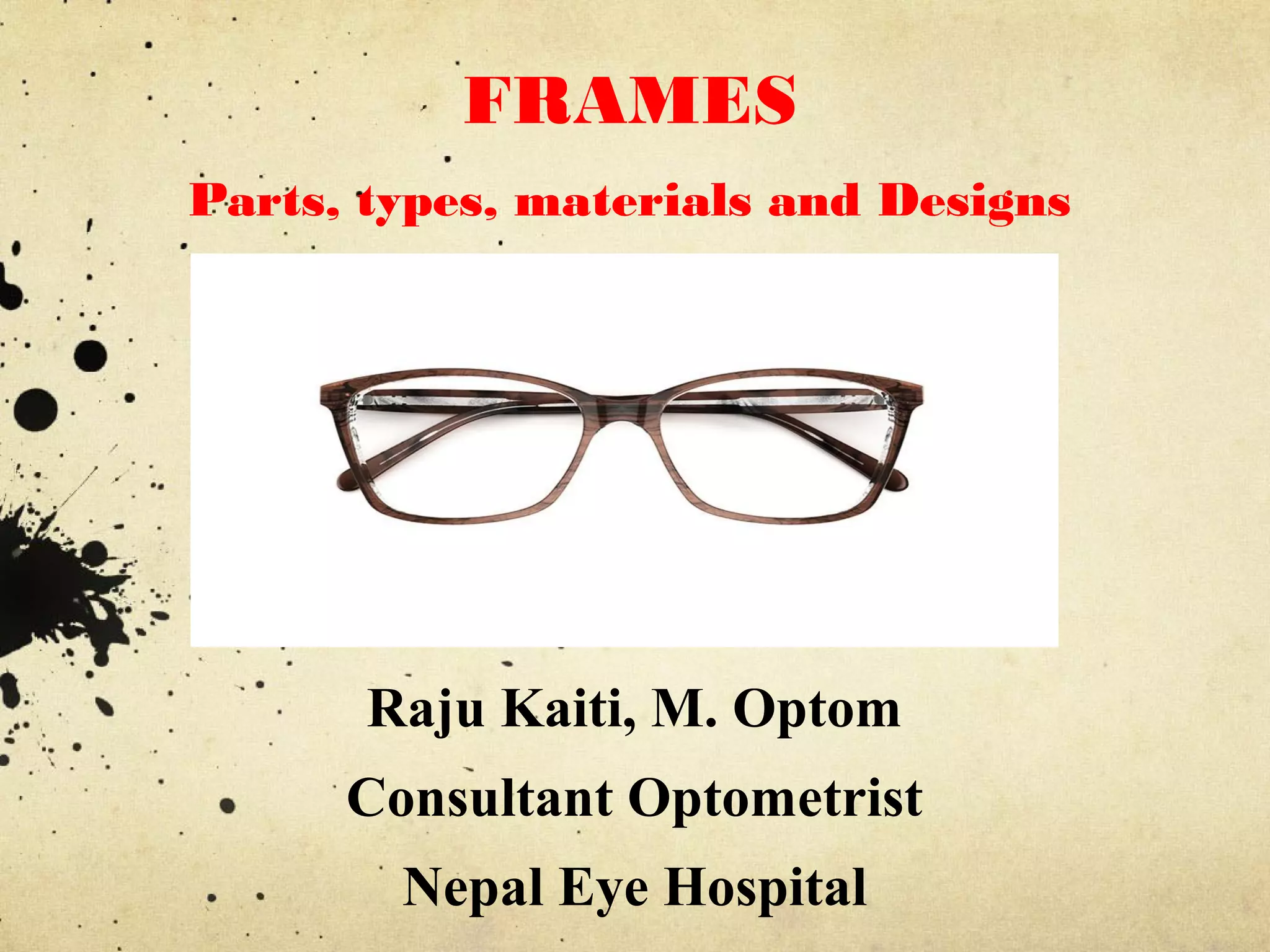
FRAMES
Parts, types, materials and Designs
Raju Kaiti, M. Optom
Consultant Optometrist
Nepal Eye Hospital
Purpose
Value for expertly prescribed ophthalmic lenses
Vision, comfort and convenience
Cosmetic pleasing
Adjustment of Frame on face & proper support to
lenses
Professional accord
Type of frame Fitting
According to Purpose
Prescription lens wear
Protective eye wear
Sports eye wear
Cosmetic eye wear
According to Demand
•Age group: Small children, young
adult, old adult
•Profession: House wife to
executive, shopkeeper to medical
practitioner, drivers to social
workers
•Refractive error: minus vs plus, low
vs high.
•Special purpose frame
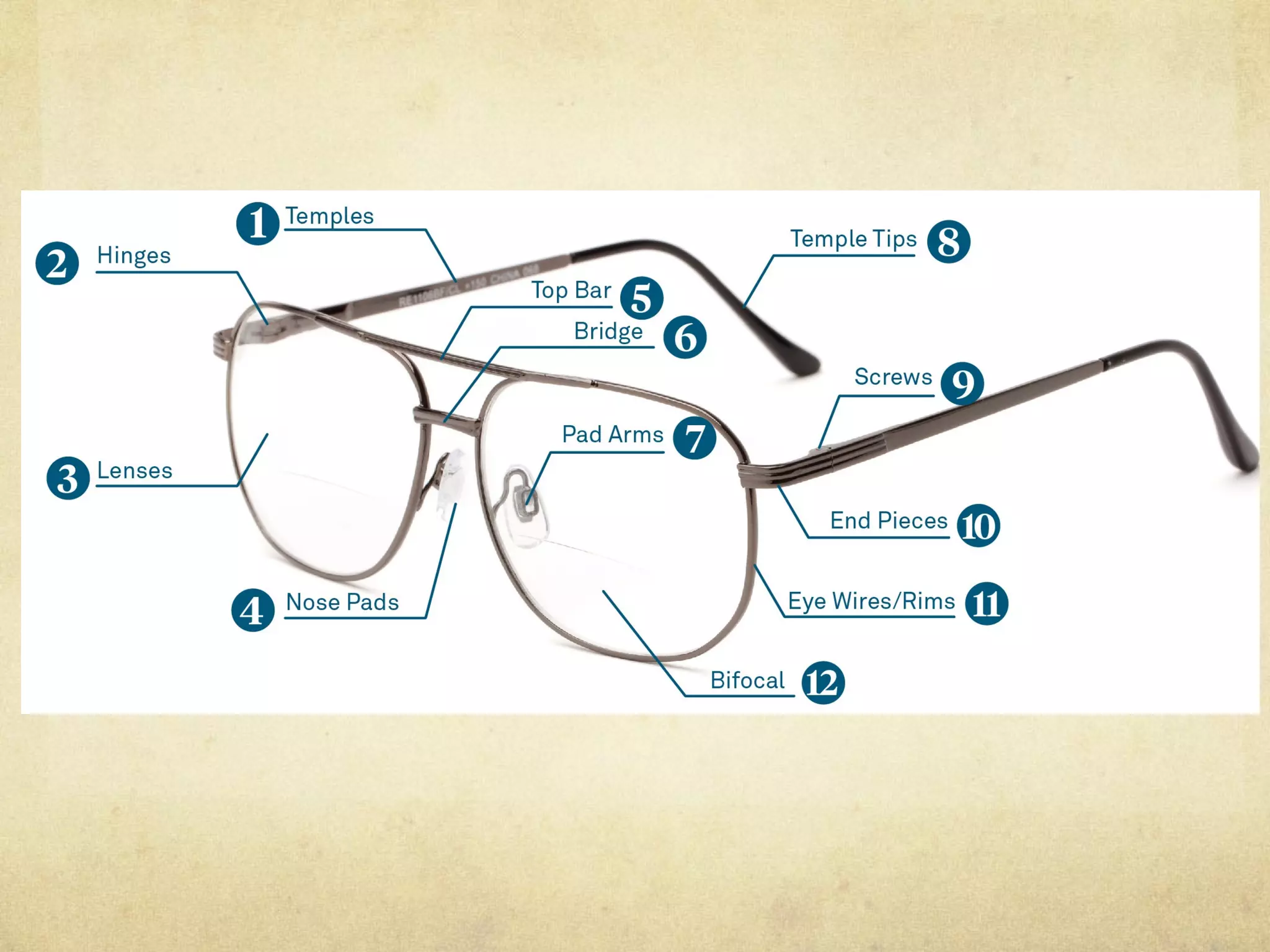
Basic Parts
Frame is a portion of the spectacles that holds the
lens in their proper position before the eyes
A frame generally consists of the front, which in
one form or another contains the lenses, and the
temples, which attach to the front and hook over
the ears to help hold the spectacles in place.
Rests on the nose, balance on the ears and anchor
around the ears
fitting triangle
Frame Front: contains lens
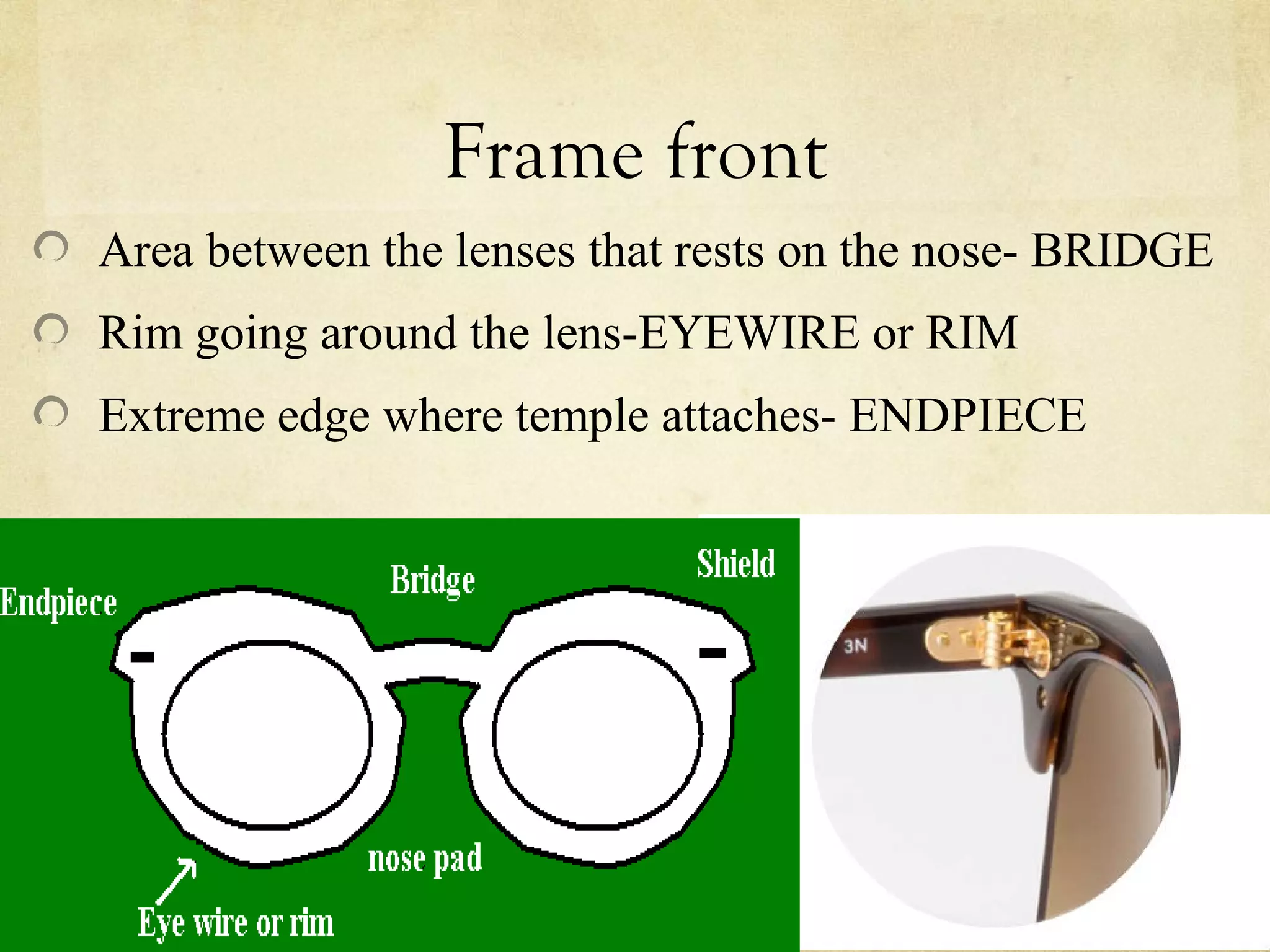
Frame front
Area between the lenses that rests on the nose- BRIDGE
Rim going around the lens-EYEWIRE or RIM
Extreme edge where temple attaches- ENDPIECE
A few plastic frames may still have a metal shield on
the front of the endpiece to which rivets are attached to
hold the hinge in place- SHIELD
Hinge: holds the temples to the front, and consist of an
odd number of interfitting BARRELS
The hinge is the only moving part on an eyewear
frame.
The hinge helps keep the frame tight, takes the brunt
of many impacts and allows the temples to fold in or
out. Therefore, a high quality hinge will prolong the
life of the frame.
A barrel hinge is one of the most popular hinges to
feature on eyewear. A barrel hinge is the one with
'loops' and a screw through these loops. The 'loops'
are the barrel.
The amount of barrels usually depend on the
thickness of the temples. The thicker the temple
results in more barrels. This is to strengthen the
hinge. Barrels typically come in intervals of either
3, 5 or 7. Some of the barrels are fixed to the
temple and the others to the rear of the end pieces.
The advantages of a hinge barrel are, added
durability and a strong mechanism. The
disadvantages are over time the hinge made
become loose, rust and on some occasions the
screw pop out of the mechanism.
Temples
Attach to the front and hook over the ears to help
hold the spectacles in place.
End-piece
Plastic: Three types
Butt type
Most common type
front is straight and temple butt is flat, both meet at 90
degree angle
Mitre type
Face front and temple butt meets at 45 degrees
Turn Back type
Frame front bends around and meets the temple end to
end
• Metal End piece???
???????
P9260 54 17 142☐ ☐
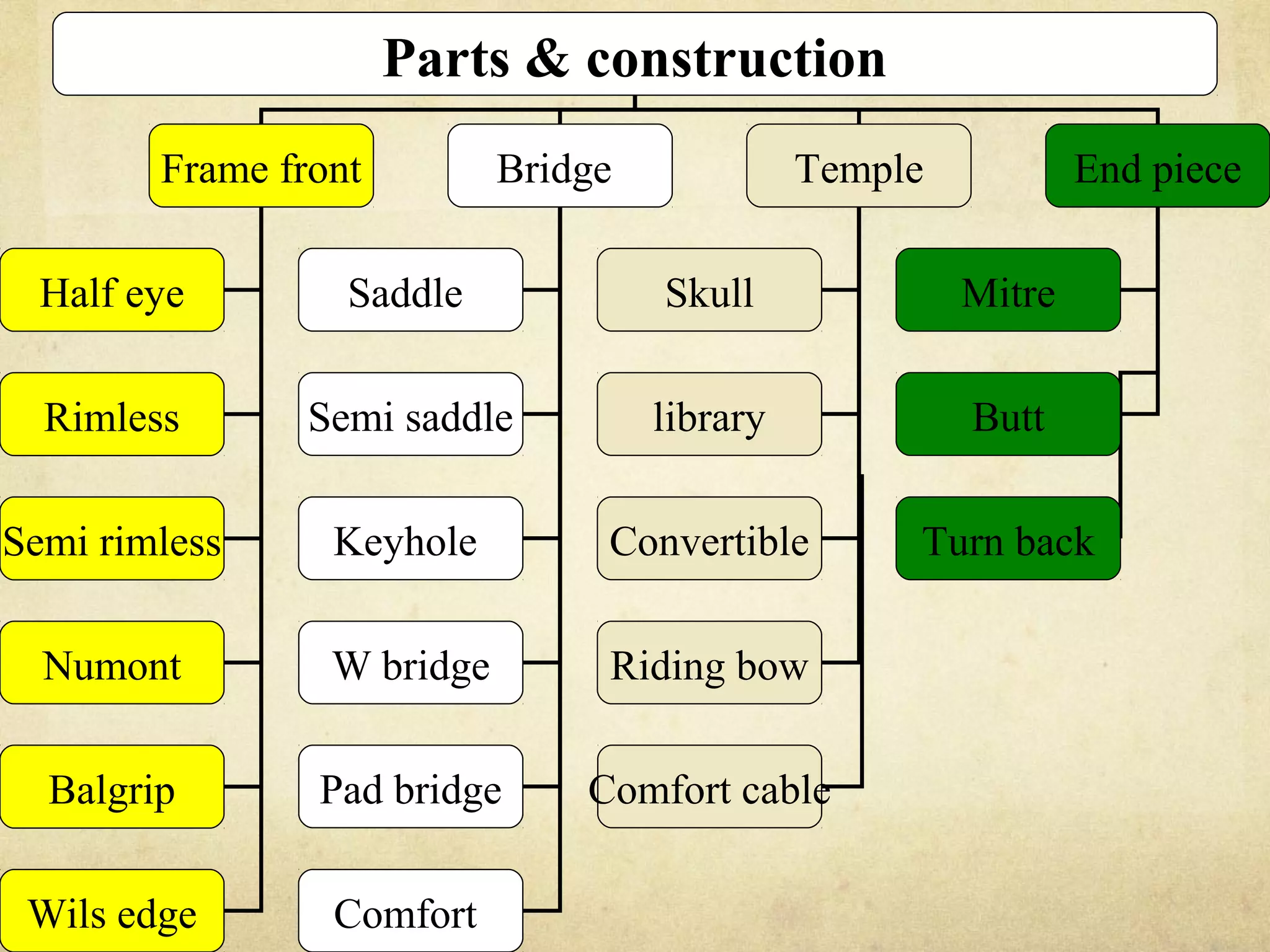
Parts & construction
Frame front Bridge Temple End piece
Half eye
Rimless
Semi rimless
Numont
Balgrip
Wils edge
Saddle
Semi saddle
Keyhole
W bridge
Pad bridge
Comfort
Skull
library
Convertible
Riding bow
Comfort cable
Mitre
Butt
Turn back
Half eye
Reading correction but no correction for
distance vision
Constructed to sit lower on the nose than
normal glasses
Just to look under the lens for reading
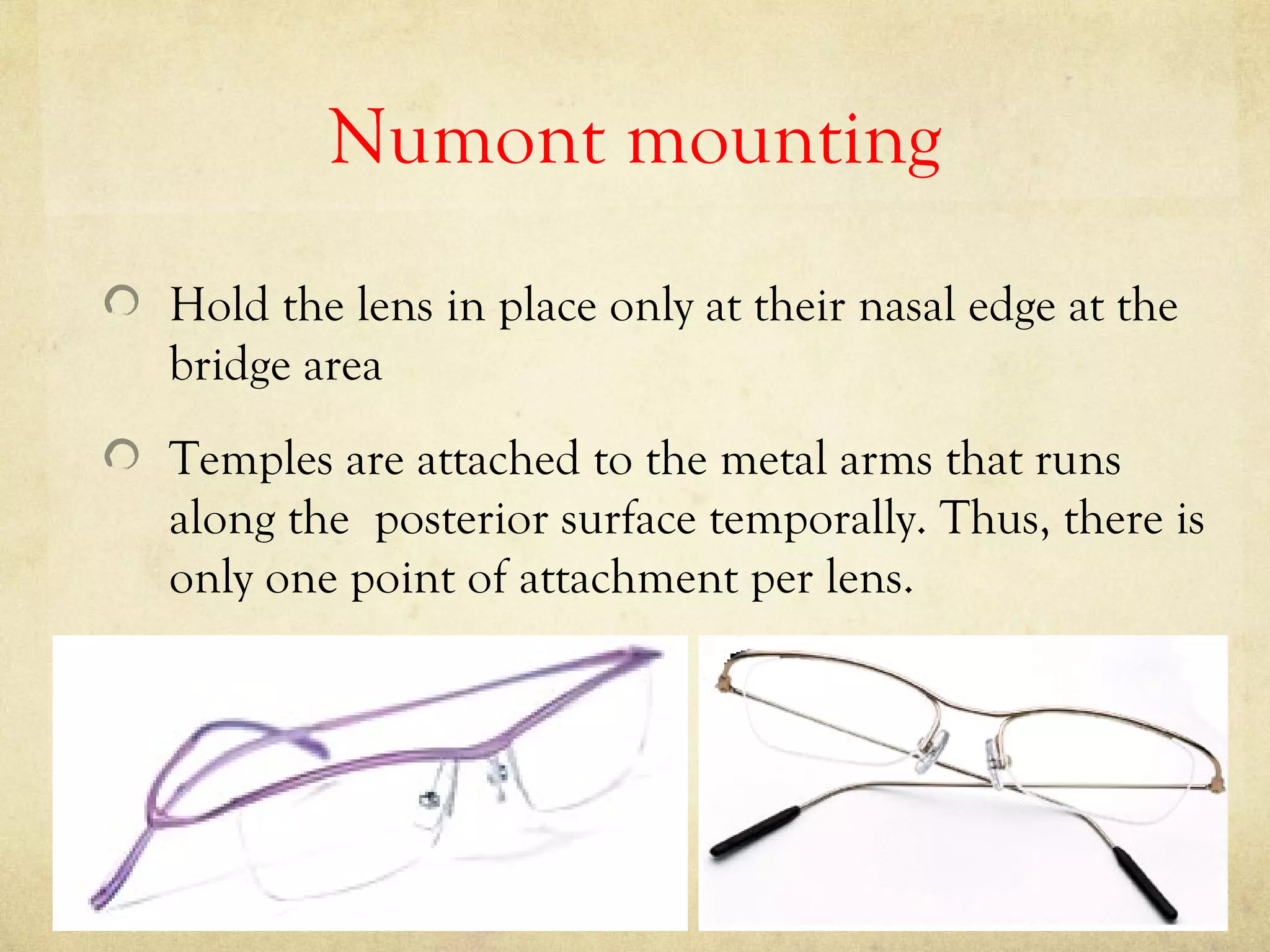
Numont mounting
Hold the lens in place only at their nasal edge at the
bridge area
Temples are attached to the metal arms that runs
along the posterior surface temporally. Thus, there is
only one point of attachment per lens.
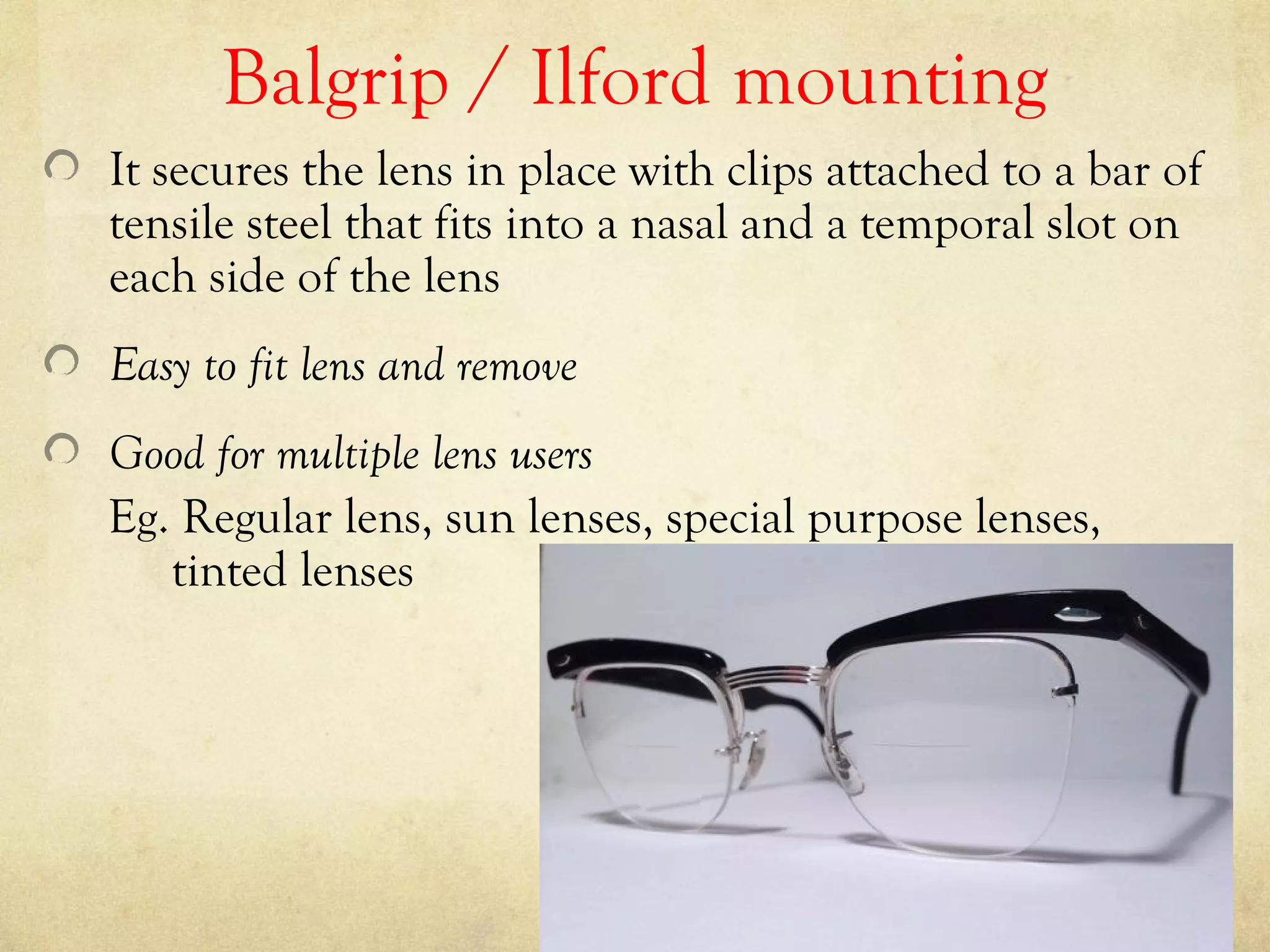
Balgrip / Ilford mounting
It secures the lens in place with clips attached to a bar of
tensile steel that fits into a nasal and a temporal slot on
each side of the lens
Easy to fit lens and remove
Good for multiple lens users
Eg. Regular lens, sun lenses, special purpose lenses,
tinted lenses
Lorgnettes
Lorgnettes have a handle attached to a frame front
and no temples. They are designed to be held up in
front of the eyes for reading. They are seldom used
now.
Lorgnettes
Ptosis Frame
Ptosis frames have a wire or plastic
crutch attached to the top eye-wire
to support the drooping eyelid.
Crutch glasses for ptosis
Make up Spectacles
Make-up frames allow each eye-wire
to be swivelled up or down
independently to allow access to one
eye to apply cosmetics or insert a
contact lens while using the other
eye
Make up Spectacle
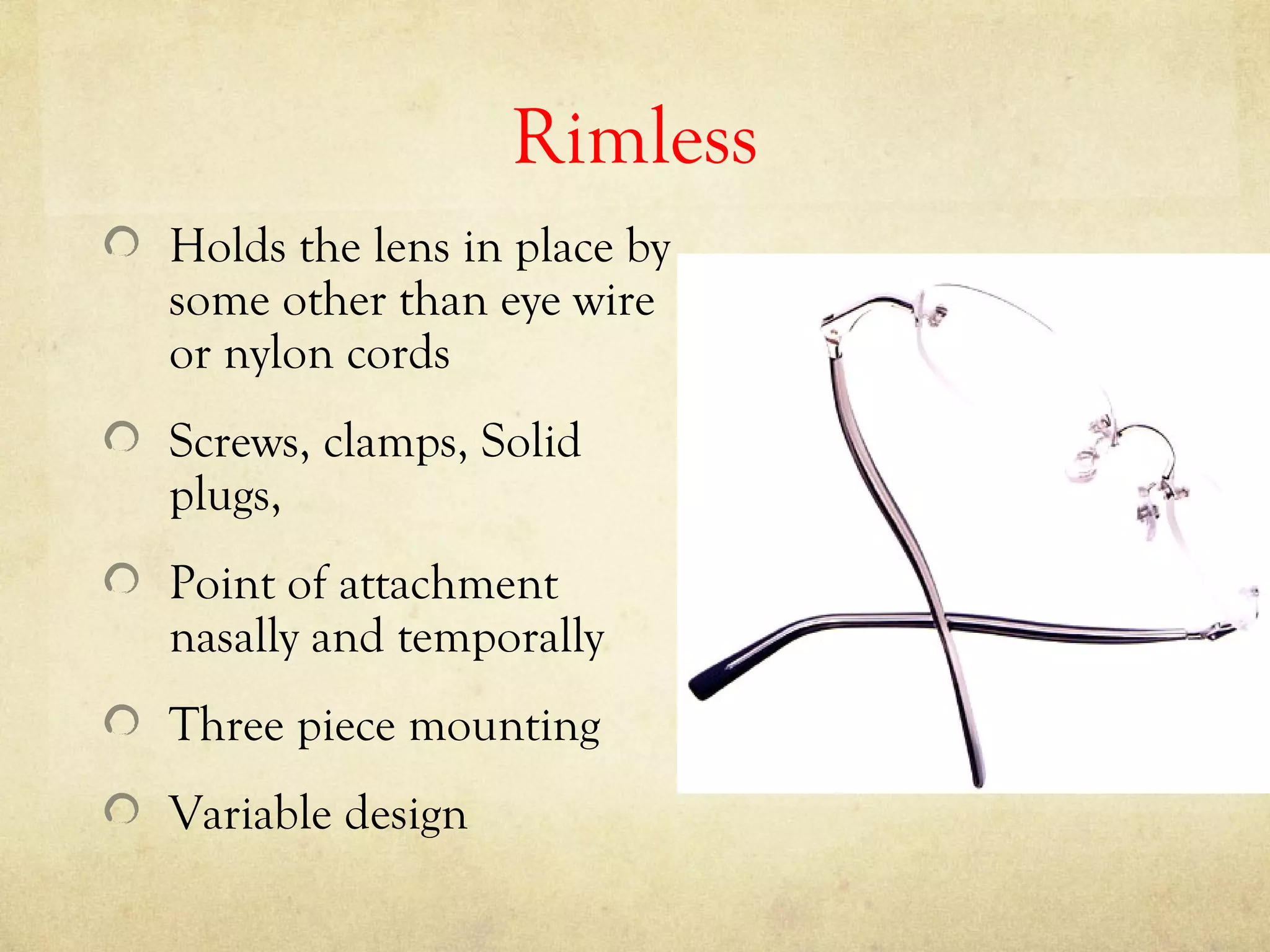
Rimless
Holds the lens in place by
some other than eye wire
or nylon cords
Screws, clamps, Solid
plugs,
Point of attachment
nasally and temporally
Three piece mounting
Variable design
Semi-rimless mountings
Metal reinforcing arm
Superior, upper posterior
designs
Centre portion of
mounting consists of
bridge, pad arms, and pads
Wils Edge mounting
It secures the lens in place by means of a
grooved arm that grips the top of the lens
Lens is also grooved
match the groove to the form of the arm
Bridge style
Can be constructed of either plastic or metal
Because of variety of nose shapes, there is also quite an
assortment of bridge constructions in both materials
• Metal, rimless or semi-rimless (Adjustable pads makes a
contact) (W bridge, pad bridge and strap bridge)
• Plastic frames design makes a contact with nose (saddle,
modified saddle and keyhole)
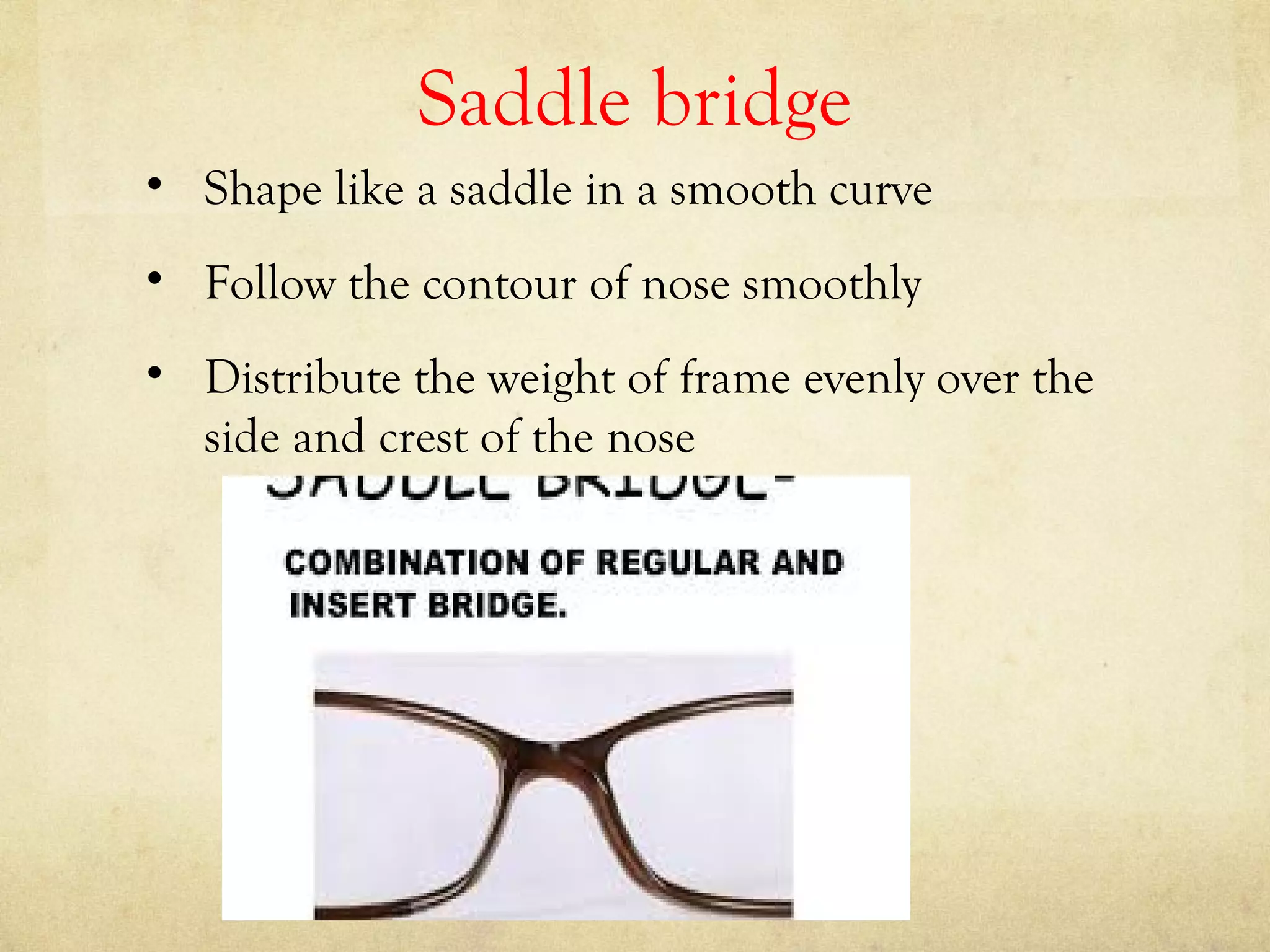
Saddle bridge
• Shape like a saddle in a smooth curve
• Follow the contour of nose smoothly
• Distribute the weight of frame evenly over the
side and crest of the nose
Modified saddle / semi-saddle
• The bridge area looks much the same as the saddle
bridge does when viewed from front
• Nose pad are attached to the back of the bridge
• These pads carry some of the weight of lens and frames
Keyhole saddle
• Shaped like old fashioned hey hole at the top
• Flares out slightly and rest on the side of the
noses but not on the crest
• Mostly used with a non adjustable and fixed
nose pads
• Accentuate the length of nose (Cosmesis)
W Bridge
• Metal saddle bridge
• Older style
• antique
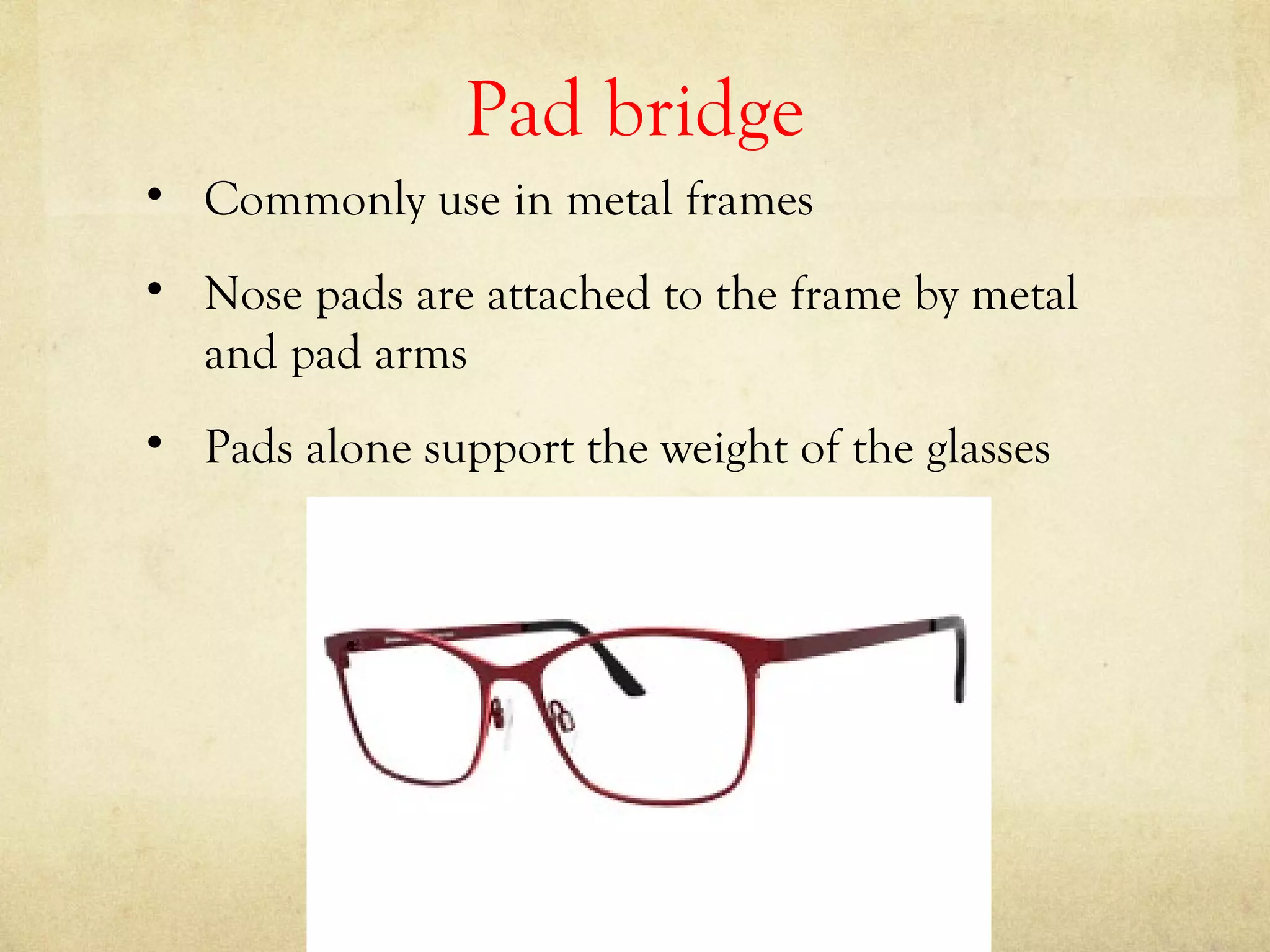
Pad bridge
• Commonly use in metal frames
• Nose pads are attached to the frame by metal
and pad arms
• Pads alone support the weight of the glasses
Comfort bridge
• Metal frame with clear plastic saddle type
bridge
• Strap bridge
• Alternative to adjustable or replace nose pads
Basic five types
But greater variation can be seen
Skull temples
• Bend down behind the ear and follow the contour of skull
• Rests evenly over it
• Bend of frame rests on ear; bent down portion is narrower at the
top of the ear and widens towards the end
• Regular use
• Most frequently used
Library temple
• “Straight back temple”
• Begins with an average width at butt and increase in width posteriorly
• Hold the lens by the pressure at the side of head
• Use for temporary lens users, variable vertex distance needed (effective
power)
Convertible temple
• Similar to library but can be modified into skull temple
• Versatile and can be made to fit people with variety of
temple length requirements
• Can be bent down and back as per need
• Custom design of temple
Riding bow Temple
• Curve around the ear
• Follows the crotch of ear and extends to the level of the earlobe
• Children, safety, high prescription
Comfort cable
• Similar to riding bow temples
• Metal construction
• Curled portion; flexible coiled cable
• Reduce rocking back and forth of the frames and balance
• Anisometropic prescription
Temple style Indicated for Contraindicated for
Comfort cable
or riding bow
• Active people
• Jobs requiring unusual
head positions
• Young children
• Especially heavy frames
and/or lenses
• Off and on wear
Straight back • Off and on wear • Heavy lenses
• Persons with parallel
sided noses
• Frames with weak
fronts
Skull • Normal, everyday wear • Jobs requiring unusual
head positions
Material
Metal Plastics Others
Gold
Aluminum
Nickel silver
Monel
Titanium
Stainless steel
Cellulose nitrate
Cellulose acetate
Cellulose aceto
propionate
Optyl
Nylon
Polyamide
Carbon
Rubber
Polycarbonate
Bronze
Properties of frame materials
 DIMENTIONAL STABILITY
 DERMAL COMPATIBILITY
 MECHANICAL DURABILITY
 LOW SPECIFIC GRAVITY
 GOOD STRENTH TO WT. RATIO
 GOOD THERMAL ELETRIC INSULATION
 HIGH RESISTANCE TO CHEMICAL
 EASE OF PRODUCTION
 RESISTANCE TO CORROSION
 LOW COST
Classification: material types
• Metal frames; except nose pad and posterior temple
sections
• Plastic frames:
• Combined frames:
• Other frames:
Metal frames
• All metal parts
• except nose pads and posterior temple sections
• Lens holder is fixed with screw
• Fixed design/ can’t customize shape of lens
Metal frame Materials
1. GOLD –
Gold having all these property except low cost
Types
 FINE GOLD: 100% pure gold
 SOLID GOLD: gold + base metal evenly mixed
 GOLD FILLED: base metal inside solid gold coating
 PLATED GOLD: A base metal thinly plated with gold
• Fine gold
 24 karat gold
use
 chemically
pure,
unalloyed
metal
 Too soft
 Other metal
added to
improve gold
hardness &
durability
Solid gold
10 karat gold
use
Fine gold or
gold alloyed use
Gold + base
metals evenly
mix
Frame is solid
rather than
hollow
Gold filled
Base metal
inside around
that solid gold
coating by the
use of heat &
pressure
Wt. Of gold
must be at least
120 of the total
wt.
Fineness must
be 10 karat
Gold plated
This frame
made by gold
filled process
But the gold
is less than
150 to the
total volume
of the weight
Gold may
also applied to
base metals by
an
electroplating
process
Gold-Filled
• Gold filled frames have the gold (normally 10 karat)
wrought over the base metal (usually nickel based
alloy)before the metal is fashioned into a frame. This
frame type has the greatest amount of gold and is the
most durable.
• To be classed as gold-filled the gold layer must be at
least 1/50th
of the total metal content, by weight.
• Light weight; easy to adjust and align; durable; can be
easily repaired
• More expensive than gold plate frames
Gold-plated
• Produced first in the base metal usually a nickel based
alloy
• They are then plated in gold using electroplating
• Advantages:
• Easy to adjust and align; durable; can be easily repaired;
cheaper to produce than gold filled frames
• Disadvantages:
• More susceptible to corrosion than gold filled frames
2.ALUMINIUM
Advantage –
 Stain & tarnish resistance
 Strong & light wt.
 Resistance to corrosion
 Can painted many attractive color
Disadvantage –
 Doesn’t solder or weld well
 Requires screw or rivets
 It conduct heat readily & become cold in winter
 No flexibility
3. Nickel Silver/German Silver
 50% - Copper (pliability)
 25% - Nickel (whitish appearance)
 Zink & other metals (strength)
 Material is rigid & lustrous
 It mostly use base metal in gold filled
4. Monel
 Whitish in color, pliable for good adjustment
 68 % - Nickel, 30 % - Copper, 2 % - Iron
 Traces of silicon, carbon & sulfur
 Can be coated with many color and resist
corrosion
 Access high polished
 Mostly use for temples & bridges
Bronze Frames
• it is anti-corrosive, light and comfortable
• Alloy of copper & Iron
• Pliable, tough
• Mechanically strong
5. TitaniumAdvantage -
 Lightweight , Flexible
 Corrosion resistant
 abrasion resistant
 Thinnest of all metals
 Hypoallergenic
Disadvantage –
 Expensive
 Limited color
 Hard to solder or weld
6. Stainless Steel
 74% - iron
 18% - chromium
 8% - nickel
 Durable, flexible, strong, nonmagnetic
 Resistant to oxidation & corrosion
 Endless color ranges
 Well suited for temple: flexibility;easy to adjust and align
Disadvantages:
More expensive than gold plated frames
Can’t be repaired
Relatively high
Plastic frame materials
Thermosetting
 Material begins as liquid & becomes solid during manufacturing
process
 Once product has been manufactured, it never again soften to any
significant extent
Thermoplastic –
 has property of softening when heated & hardening when cooled
 basic structure of material remain same
 eg. polymethyl nitrate
cellulose nitrate
cellulose acetate
1. Cellulose Nitrate/ Zylonite
 More tougher
 Can be made thinner frame
 Harder surface
 Easier to work
 Better dimensional stability
 FDA banned: flammability
2. Cellulose acetate
 Thermoplastic polymer
 Produced in pre-colored sheets and the frames are then cut from these sheets
ussing various cutting jigs.
 Metal cores are inserted in the temples to provide greater strenght.
 Advantage
 Low flammability
 Faster production; More color available
 Easily polished; easily repaired
Disadvantages
 Allergic reaction by uncoated materials
 Brittle with age
 Will blister if overheated
To make any adjustment, cellulose acetate should be heated to about 70 degree
Celsius and then manipulated only when soft.
3. Cellulose aceto-proprionate
• Also a thermoplastic material
• Produced by a forced injection moulding process; fewer steps for
production and less wastages
• Material of choice because it is much cheaper to produce
• Metal cores in the temples
• ¾ of wt. of cellulose acetate; low flammability; easily produced;
can be made thinner than acetate frames
• Disadvantages
• Less color stability unless it is covered with high quality frame
coating material
• Frames become brittle with age
• Needs more heat than cellulose acetate
4.Polyamide
 Means more than one amide; an organic compound of
nylon family; produced like proprionate
 Has considerable mechanical stability and can be made
even thinner than proprionate
 Advantages:
 Lighter; hypoallergenic, low flammabilty; very hard so
durable; can be made thinner than other plastic frames
 Disadvantages:
 Will shrink overheated
 Cannot be repaired
 Polyamide is easily affected by heat and is best fitted cold
5. Optyl
 ThermoelasticThermoelastic material and has a very powerful memory and will
always return to its original shape with heat
 Has considerably greater durability than other frame materials
Advantages –
 very hard, durable surface; hypoallergenic
 Non flammability; Dimensional stability
 30% lighter than cellulose acetate in weight
 Will not age (due to lack of plasticizers)
Disadvantages-
 Will return to its original shape if overheated, losing any adjustment
 Can’t be repaired
 Optyl requires considerable heat, greater than 90o
C and should
not be manipulated cold
6. Nylon
• Tough material so used in protective spectacles and sunglasses
where they receive rough treatment
• Highly flexible and maintain flexibility of soaked overnight
periodically
• Previously used as sports eye wear
• Low flammability; Not affected by heat and cold
• Disadvantages:
• Difficult to adjust and are not as attractive as other materials
It is difficult to fit lenses to a nylon frame.nylon should be cold
when fitted with lenses. For adjustments, it is possible to heat
nylon in hot water (no other material should be heated this way)
Other frames
Rubber
• Flexible and return to its original shape if it is bent, but
not adjustable
Carbon Fiber
• Very tough, yet brittle frame material
• Mainly used for the frame front
• Mad from nylon mixed with a fibre of potassium titanate.
Advantages:
Light weight; strong; low flammability
Disadvantage:
–Not adjustable
–Color opaque and limited
–Encounter in breakage on cold weather
Polycarbonate
• Sport and safety eye wear
• Non prescription; lens and frames are molded as one
unit
• Impact resistance
• Shield type glasses
Disadvantage
• Resistance to adjustment
Frames:types, materials and designs

Frames:types, materials and designs

  • 1.
    FRAMES Parts, types, materialsand Designs Raju Kaiti, M. Optom Consultant Optometrist Nepal Eye Hospital
  • 2.
    Purpose Value for expertlyprescribed ophthalmic lenses Vision, comfort and convenience Cosmetic pleasing Adjustment of Frame on face & proper support to lenses Professional accord
  • 3.
    Type of frameFitting According to Purpose Prescription lens wear Protective eye wear Sports eye wear Cosmetic eye wear According to Demand •Age group: Small children, young adult, old adult •Profession: House wife to executive, shopkeeper to medical practitioner, drivers to social workers •Refractive error: minus vs plus, low vs high. •Special purpose frame
  • 4.
    Basic Parts Frame isa portion of the spectacles that holds the lens in their proper position before the eyes A frame generally consists of the front, which in one form or another contains the lenses, and the temples, which attach to the front and hook over the ears to help hold the spectacles in place. Rests on the nose, balance on the ears and anchor around the ears fitting triangle Frame Front: contains lens
  • 7.
    Frame front Area betweenthe lenses that rests on the nose- BRIDGE Rim going around the lens-EYEWIRE or RIM Extreme edge where temple attaches- ENDPIECE
  • 8.
    A few plasticframes may still have a metal shield on the front of the endpiece to which rivets are attached to hold the hinge in place- SHIELD Hinge: holds the temples to the front, and consist of an odd number of interfitting BARRELS
  • 9.
    The hinge isthe only moving part on an eyewear frame. The hinge helps keep the frame tight, takes the brunt of many impacts and allows the temples to fold in or out. Therefore, a high quality hinge will prolong the life of the frame. A barrel hinge is one of the most popular hinges to feature on eyewear. A barrel hinge is the one with 'loops' and a screw through these loops. The 'loops' are the barrel.
  • 10.
    The amount ofbarrels usually depend on the thickness of the temples. The thicker the temple results in more barrels. This is to strengthen the hinge. Barrels typically come in intervals of either 3, 5 or 7. Some of the barrels are fixed to the temple and the others to the rear of the end pieces. The advantages of a hinge barrel are, added durability and a strong mechanism. The disadvantages are over time the hinge made become loose, rust and on some occasions the screw pop out of the mechanism.
  • 11.
    Temples Attach to thefront and hook over the ears to help hold the spectacles in place.
  • 12.
    End-piece Plastic: Three types Butttype Most common type front is straight and temple butt is flat, both meet at 90 degree angle Mitre type Face front and temple butt meets at 45 degrees Turn Back type Frame front bends around and meets the temple end to end • Metal End piece???
  • 13.
  • 14.
    Parts & construction Framefront Bridge Temple End piece Half eye Rimless Semi rimless Numont Balgrip Wils edge Saddle Semi saddle Keyhole W bridge Pad bridge Comfort Skull library Convertible Riding bow Comfort cable Mitre Butt Turn back
  • 15.
    Half eye Reading correctionbut no correction for distance vision Constructed to sit lower on the nose than normal glasses Just to look under the lens for reading
  • 17.
    Numont mounting Hold thelens in place only at their nasal edge at the bridge area Temples are attached to the metal arms that runs along the posterior surface temporally. Thus, there is only one point of attachment per lens.
  • 19.
    Balgrip / Ilfordmounting It secures the lens in place with clips attached to a bar of tensile steel that fits into a nasal and a temporal slot on each side of the lens Easy to fit lens and remove Good for multiple lens users Eg. Regular lens, sun lenses, special purpose lenses, tinted lenses
  • 21.
    Lorgnettes Lorgnettes have ahandle attached to a frame front and no temples. They are designed to be held up in front of the eyes for reading. They are seldom used now.
  • 22.
  • 23.
    Ptosis Frame Ptosis frameshave a wire or plastic crutch attached to the top eye-wire to support the drooping eyelid.
  • 24.
  • 25.
    Make up Spectacles Make-upframes allow each eye-wire to be swivelled up or down independently to allow access to one eye to apply cosmetics or insert a contact lens while using the other eye
  • 26.
  • 28.
    Rimless Holds the lensin place by some other than eye wire or nylon cords Screws, clamps, Solid plugs, Point of attachment nasally and temporally Three piece mounting Variable design
  • 29.
    Semi-rimless mountings Metal reinforcingarm Superior, upper posterior designs Centre portion of mounting consists of bridge, pad arms, and pads
  • 30.
    Wils Edge mounting Itsecures the lens in place by means of a grooved arm that grips the top of the lens Lens is also grooved match the groove to the form of the arm
  • 31.
    Bridge style Can beconstructed of either plastic or metal Because of variety of nose shapes, there is also quite an assortment of bridge constructions in both materials • Metal, rimless or semi-rimless (Adjustable pads makes a contact) (W bridge, pad bridge and strap bridge) • Plastic frames design makes a contact with nose (saddle, modified saddle and keyhole)
  • 32.
    Saddle bridge • Shapelike a saddle in a smooth curve • Follow the contour of nose smoothly • Distribute the weight of frame evenly over the side and crest of the nose
  • 33.
    Modified saddle /semi-saddle • The bridge area looks much the same as the saddle bridge does when viewed from front • Nose pad are attached to the back of the bridge • These pads carry some of the weight of lens and frames
  • 34.
    Keyhole saddle • Shapedlike old fashioned hey hole at the top • Flares out slightly and rest on the side of the noses but not on the crest • Mostly used with a non adjustable and fixed nose pads • Accentuate the length of nose (Cosmesis)
  • 36.
    W Bridge • Metalsaddle bridge • Older style • antique
  • 37.
    Pad bridge • Commonlyuse in metal frames • Nose pads are attached to the frame by metal and pad arms • Pads alone support the weight of the glasses
  • 38.
    Comfort bridge • Metalframe with clear plastic saddle type bridge • Strap bridge • Alternative to adjustable or replace nose pads
  • 39.
    Basic five types Butgreater variation can be seen
  • 40.
    Skull temples • Benddown behind the ear and follow the contour of skull • Rests evenly over it • Bend of frame rests on ear; bent down portion is narrower at the top of the ear and widens towards the end • Regular use • Most frequently used
  • 41.
    Library temple • “Straightback temple” • Begins with an average width at butt and increase in width posteriorly • Hold the lens by the pressure at the side of head • Use for temporary lens users, variable vertex distance needed (effective power)
  • 42.
    Convertible temple • Similarto library but can be modified into skull temple • Versatile and can be made to fit people with variety of temple length requirements • Can be bent down and back as per need • Custom design of temple
  • 43.
    Riding bow Temple •Curve around the ear • Follows the crotch of ear and extends to the level of the earlobe • Children, safety, high prescription
  • 44.
    Comfort cable • Similarto riding bow temples • Metal construction • Curled portion; flexible coiled cable • Reduce rocking back and forth of the frames and balance • Anisometropic prescription
  • 45.
    Temple style Indicatedfor Contraindicated for Comfort cable or riding bow • Active people • Jobs requiring unusual head positions • Young children • Especially heavy frames and/or lenses • Off and on wear Straight back • Off and on wear • Heavy lenses • Persons with parallel sided noses • Frames with weak fronts Skull • Normal, everyday wear • Jobs requiring unusual head positions
  • 46.
    Material Metal Plastics Others Gold Aluminum Nickelsilver Monel Titanium Stainless steel Cellulose nitrate Cellulose acetate Cellulose aceto propionate Optyl Nylon Polyamide Carbon Rubber Polycarbonate Bronze
  • 47.
    Properties of framematerials  DIMENTIONAL STABILITY  DERMAL COMPATIBILITY  MECHANICAL DURABILITY  LOW SPECIFIC GRAVITY  GOOD STRENTH TO WT. RATIO  GOOD THERMAL ELETRIC INSULATION  HIGH RESISTANCE TO CHEMICAL  EASE OF PRODUCTION  RESISTANCE TO CORROSION  LOW COST
  • 48.
    Classification: material types •Metal frames; except nose pad and posterior temple sections • Plastic frames: • Combined frames: • Other frames:
  • 49.
    Metal frames • Allmetal parts • except nose pads and posterior temple sections • Lens holder is fixed with screw • Fixed design/ can’t customize shape of lens
  • 50.
    Metal frame Materials 1.GOLD – Gold having all these property except low cost Types  FINE GOLD: 100% pure gold  SOLID GOLD: gold + base metal evenly mixed  GOLD FILLED: base metal inside solid gold coating  PLATED GOLD: A base metal thinly plated with gold
  • 51.
    • Fine gold 24 karat gold use  chemically pure, unalloyed metal  Too soft  Other metal added to improve gold hardness & durability Solid gold 10 karat gold use Fine gold or gold alloyed use Gold + base metals evenly mix Frame is solid rather than hollow Gold filled Base metal inside around that solid gold coating by the use of heat & pressure Wt. Of gold must be at least 120 of the total wt. Fineness must be 10 karat Gold plated This frame made by gold filled process But the gold is less than 150 to the total volume of the weight Gold may also applied to base metals by an electroplating process
  • 52.
    Gold-Filled • Gold filledframes have the gold (normally 10 karat) wrought over the base metal (usually nickel based alloy)before the metal is fashioned into a frame. This frame type has the greatest amount of gold and is the most durable. • To be classed as gold-filled the gold layer must be at least 1/50th of the total metal content, by weight. • Light weight; easy to adjust and align; durable; can be easily repaired • More expensive than gold plate frames
  • 53.
    Gold-plated • Produced firstin the base metal usually a nickel based alloy • They are then plated in gold using electroplating • Advantages: • Easy to adjust and align; durable; can be easily repaired; cheaper to produce than gold filled frames • Disadvantages: • More susceptible to corrosion than gold filled frames
  • 54.
    2.ALUMINIUM Advantage –  Stain& tarnish resistance  Strong & light wt.  Resistance to corrosion  Can painted many attractive color Disadvantage –  Doesn’t solder or weld well  Requires screw or rivets  It conduct heat readily & become cold in winter  No flexibility
  • 55.
    3. Nickel Silver/GermanSilver  50% - Copper (pliability)  25% - Nickel (whitish appearance)  Zink & other metals (strength)  Material is rigid & lustrous  It mostly use base metal in gold filled
  • 56.
    4. Monel  Whitishin color, pliable for good adjustment  68 % - Nickel, 30 % - Copper, 2 % - Iron  Traces of silicon, carbon & sulfur  Can be coated with many color and resist corrosion  Access high polished  Mostly use for temples & bridges
  • 57.
    Bronze Frames • itis anti-corrosive, light and comfortable • Alloy of copper & Iron • Pliable, tough • Mechanically strong
  • 58.
    5. TitaniumAdvantage - Lightweight , Flexible  Corrosion resistant  abrasion resistant  Thinnest of all metals  Hypoallergenic Disadvantage –  Expensive  Limited color  Hard to solder or weld
  • 59.
    6. Stainless Steel 74% - iron  18% - chromium  8% - nickel  Durable, flexible, strong, nonmagnetic  Resistant to oxidation & corrosion  Endless color ranges  Well suited for temple: flexibility;easy to adjust and align Disadvantages: More expensive than gold plated frames Can’t be repaired Relatively high
  • 60.
    Plastic frame materials Thermosetting Material begins as liquid & becomes solid during manufacturing process  Once product has been manufactured, it never again soften to any significant extent Thermoplastic –  has property of softening when heated & hardening when cooled  basic structure of material remain same  eg. polymethyl nitrate cellulose nitrate cellulose acetate
  • 61.
    1. Cellulose Nitrate/Zylonite  More tougher  Can be made thinner frame  Harder surface  Easier to work  Better dimensional stability  FDA banned: flammability
  • 62.
    2. Cellulose acetate Thermoplastic polymer  Produced in pre-colored sheets and the frames are then cut from these sheets ussing various cutting jigs.  Metal cores are inserted in the temples to provide greater strenght.  Advantage  Low flammability  Faster production; More color available  Easily polished; easily repaired Disadvantages  Allergic reaction by uncoated materials  Brittle with age  Will blister if overheated To make any adjustment, cellulose acetate should be heated to about 70 degree Celsius and then manipulated only when soft.
  • 63.
    3. Cellulose aceto-proprionate •Also a thermoplastic material • Produced by a forced injection moulding process; fewer steps for production and less wastages • Material of choice because it is much cheaper to produce • Metal cores in the temples • ¾ of wt. of cellulose acetate; low flammability; easily produced; can be made thinner than acetate frames • Disadvantages • Less color stability unless it is covered with high quality frame coating material • Frames become brittle with age • Needs more heat than cellulose acetate
  • 64.
    4.Polyamide  Means morethan one amide; an organic compound of nylon family; produced like proprionate  Has considerable mechanical stability and can be made even thinner than proprionate  Advantages:  Lighter; hypoallergenic, low flammabilty; very hard so durable; can be made thinner than other plastic frames  Disadvantages:  Will shrink overheated  Cannot be repaired  Polyamide is easily affected by heat and is best fitted cold
  • 65.
    5. Optyl  ThermoelasticThermoelasticmaterial and has a very powerful memory and will always return to its original shape with heat  Has considerably greater durability than other frame materials Advantages –  very hard, durable surface; hypoallergenic  Non flammability; Dimensional stability  30% lighter than cellulose acetate in weight  Will not age (due to lack of plasticizers) Disadvantages-  Will return to its original shape if overheated, losing any adjustment  Can’t be repaired  Optyl requires considerable heat, greater than 90o C and should not be manipulated cold
  • 66.
    6. Nylon • Toughmaterial so used in protective spectacles and sunglasses where they receive rough treatment • Highly flexible and maintain flexibility of soaked overnight periodically • Previously used as sports eye wear • Low flammability; Not affected by heat and cold • Disadvantages: • Difficult to adjust and are not as attractive as other materials It is difficult to fit lenses to a nylon frame.nylon should be cold when fitted with lenses. For adjustments, it is possible to heat nylon in hot water (no other material should be heated this way)
  • 67.
    Other frames Rubber • Flexibleand return to its original shape if it is bent, but not adjustable
  • 68.
    Carbon Fiber • Verytough, yet brittle frame material • Mainly used for the frame front • Mad from nylon mixed with a fibre of potassium titanate. Advantages: Light weight; strong; low flammability Disadvantage: –Not adjustable –Color opaque and limited –Encounter in breakage on cold weather
  • 69.
    Polycarbonate • Sport andsafety eye wear • Non prescription; lens and frames are molded as one unit • Impact resistance • Shield type glasses Disadvantage • Resistance to adjustment

Editor's Notes

  • #4 Special purpose frame: folding frames, reversible spectacle, sport spectacles, ptosis, entropion spectacle, hemianopic spectacle,