JCC
Optom . Ameen Rashid
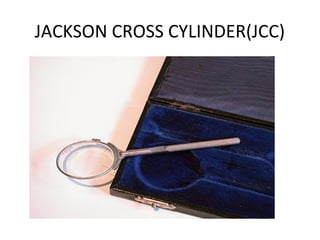
JACKSON CROSS CYLINDER(JCC)
JCC
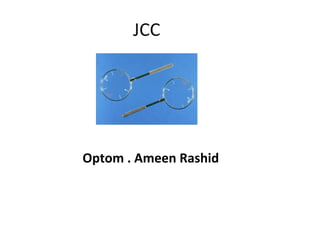
• Cross cylinder is a type of toric lens
used during refraction
• Also known as ‘flip cylinder’.
• Its use was popularized by Edward
Jackson and it is often referred to
as Jackson’s cross cylinder.
• The cross cylinder is a Combination of two
cylinder of equal strength but with opposite
sign placed with their axis at
right angle to each other and mounted in a
handle.
• The cross cylinder is a sphero cylindical lens in
which the power of the cylinder is twice the
power of the sphere and of the opposite sign
• the lens is mounted on a handle which is
placed at 45 to the axes of the cylinders.
• The commonly used cross
cylinders are of +/- 0.25D and
+/-0.50D.
Color code
• There is a colour key for jcc.
• Uk manufactured
minus axis – white dot
plus axis – red dot
JCC TEST
• Gives BVA done by fogging.
• The goal if astigmatism is
present ,is to place the circle of
least confusion of the sturms
conoid on the retina thus creating
mixed astigmatism.
1.Discovering the astigmatism
• If no cylinder correction is present initially,
the cross cylinder placed arbitrarily at 90
and180 degree to check for astigmatism.
• If a preferred flip position is found , a cylinder
is added with axis parallel to the respective
plus or minus axis of the cross cylinder until
the two flip choices are equal.
Cont….
• If no preference is found with cross cylinder
axes at 90 and 180,the 45 and 135 should
always be checked assuming that no
astigmatism is present.
2.Refinement of the axis
• Always done first.
• Because the correct axis can be
found in the presence of an incorrect
power but the full cylinder power
will not be found in the presence of
an incorrect axis.
To refine axis
• To check the axis, the cross cylinder is held
before the eye with its handle is parallel with
the axis of the trial cylinder
• Pt is asked to tell about any change in the VA,
pt notices no difference b/w the two position -
axis of the correcting cylinder in the trial frame
is correct.
• If VA is improved, cylinder correction is
present
• The cross cylinders is held in the preferred
position and the axis of the trial cylinder
rotated slightly towards the axis of the same
sign on the crossed cylinder
• The process is repeated until the trial cylinder
is in the correct axis for the eye.
13
Which is clearerWhich is clearer
position 1 or position 2?position 1 or position 2?
(a) (b)
Which is clearerWhich is clearer
position 1 or position 2?position 1 or position 2?
If position 1 in (a) and position 2 in (b) were clearest, cyl axis is between 90° and 135°
If position 1 in (a) and position 1 in (b) were clearest, cyl axis is between 90° and 45°
1 2 1 2
JCC Test
3.Refinement of cylinder power
• Cross cylinder is placed with its axis parallel to the
axis of the cylinder in the trial frame. first with same
sign and then opposite sign.
• VA is not change in either of the position the power
of the cylinder in the trial frame is correct.
Cont……….
• If VA is improve in any position
corresponding correction should be
made and reverified till final correction
is attained.
Power of the correcting Estimated
initial cylinder (DC)
required (0.25 JCC)
0.25 30°
0.50 20°
0.75 15°
1.00–2.00 10°
2.25 5°
Weaknesses
• Dependent on good initial BVS
• Patient confusion with
questions.
17
JCC Test
Jackson cross cylinder

Jackson cross cylinder

  • 1.
  • 2.
  • 3.
    JCC • Cross cylinderis a type of toric lens used during refraction • Also known as ‘flip cylinder’. • Its use was popularized by Edward Jackson and it is often referred to as Jackson’s cross cylinder.
  • 4.
    • The crosscylinder is a Combination of two cylinder of equal strength but with opposite sign placed with their axis at right angle to each other and mounted in a handle. • The cross cylinder is a sphero cylindical lens in which the power of the cylinder is twice the power of the sphere and of the opposite sign • the lens is mounted on a handle which is placed at 45 to the axes of the cylinders.
  • 5.
    • The commonlyused cross cylinders are of +/- 0.25D and +/-0.50D.
  • 6.
    Color code • Thereis a colour key for jcc. • Uk manufactured minus axis – white dot plus axis – red dot
  • 7.
    JCC TEST • GivesBVA done by fogging. • The goal if astigmatism is present ,is to place the circle of least confusion of the sturms conoid on the retina thus creating mixed astigmatism.
  • 8.
    1.Discovering the astigmatism •If no cylinder correction is present initially, the cross cylinder placed arbitrarily at 90 and180 degree to check for astigmatism. • If a preferred flip position is found , a cylinder is added with axis parallel to the respective plus or minus axis of the cross cylinder until the two flip choices are equal.
  • 9.
    Cont…. • If nopreference is found with cross cylinder axes at 90 and 180,the 45 and 135 should always be checked assuming that no astigmatism is present.
  • 10.
    2.Refinement of theaxis • Always done first. • Because the correct axis can be found in the presence of an incorrect power but the full cylinder power will not be found in the presence of an incorrect axis.
  • 11.
    To refine axis •To check the axis, the cross cylinder is held before the eye with its handle is parallel with the axis of the trial cylinder • Pt is asked to tell about any change in the VA, pt notices no difference b/w the two position - axis of the correcting cylinder in the trial frame is correct. • If VA is improved, cylinder correction is present
  • 12.
    • The crosscylinders is held in the preferred position and the axis of the trial cylinder rotated slightly towards the axis of the same sign on the crossed cylinder • The process is repeated until the trial cylinder is in the correct axis for the eye.
  • 13.
    13 Which is clearerWhichis clearer position 1 or position 2?position 1 or position 2? (a) (b) Which is clearerWhich is clearer position 1 or position 2?position 1 or position 2? If position 1 in (a) and position 2 in (b) were clearest, cyl axis is between 90° and 135° If position 1 in (a) and position 1 in (b) were clearest, cyl axis is between 90° and 45° 1 2 1 2 JCC Test
  • 14.
    3.Refinement of cylinderpower • Cross cylinder is placed with its axis parallel to the axis of the cylinder in the trial frame. first with same sign and then opposite sign. • VA is not change in either of the position the power of the cylinder in the trial frame is correct.
  • 15.
    Cont………. • If VAis improve in any position corresponding correction should be made and reverified till final correction is attained.
  • 16.
    Power of thecorrecting Estimated initial cylinder (DC) required (0.25 JCC) 0.25 30° 0.50 20° 0.75 15° 1.00–2.00 10° 2.25 5°
  • 17.
    Weaknesses • Dependent ongood initial BVS • Patient confusion with questions. 17 JCC Test