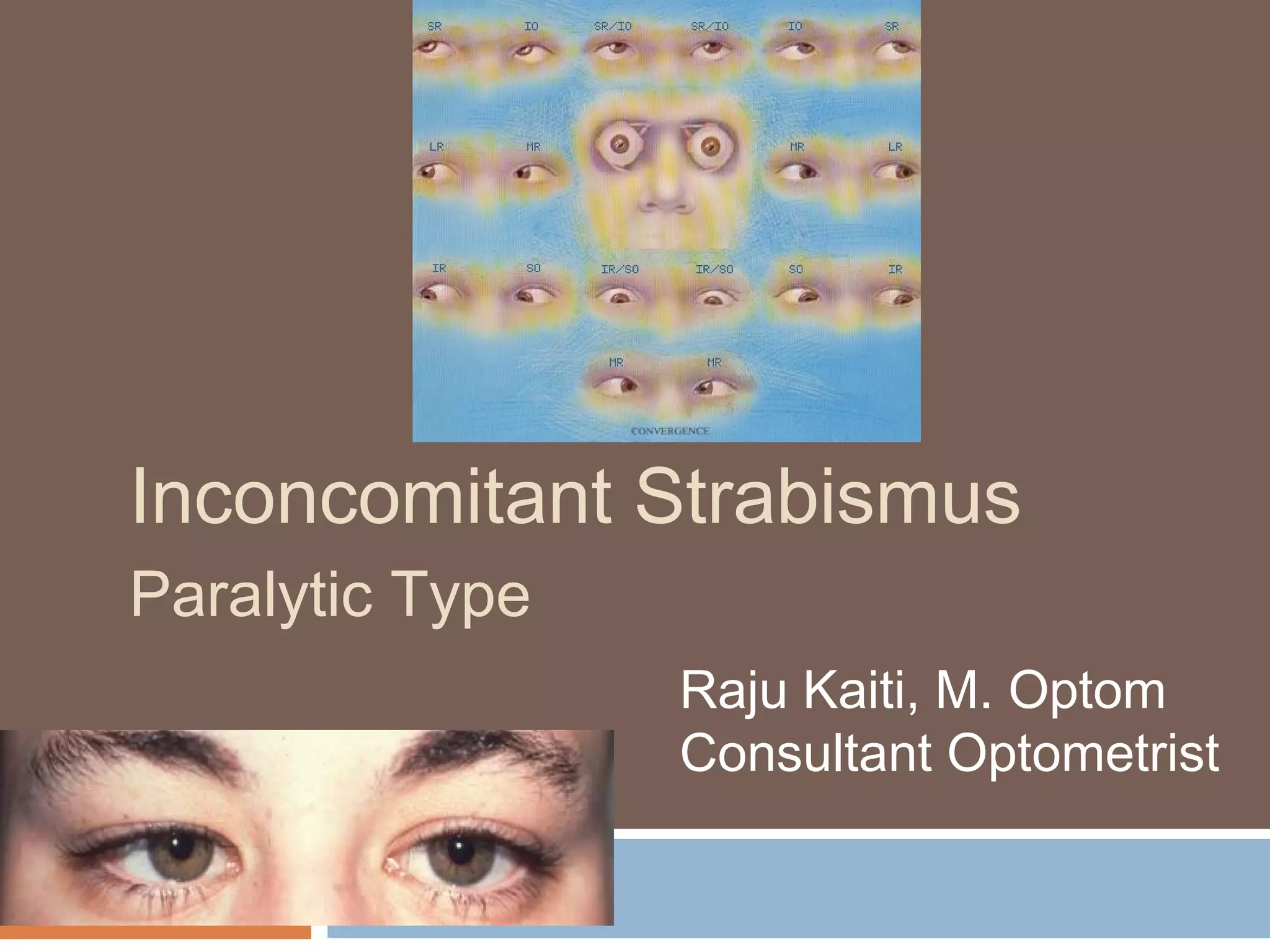
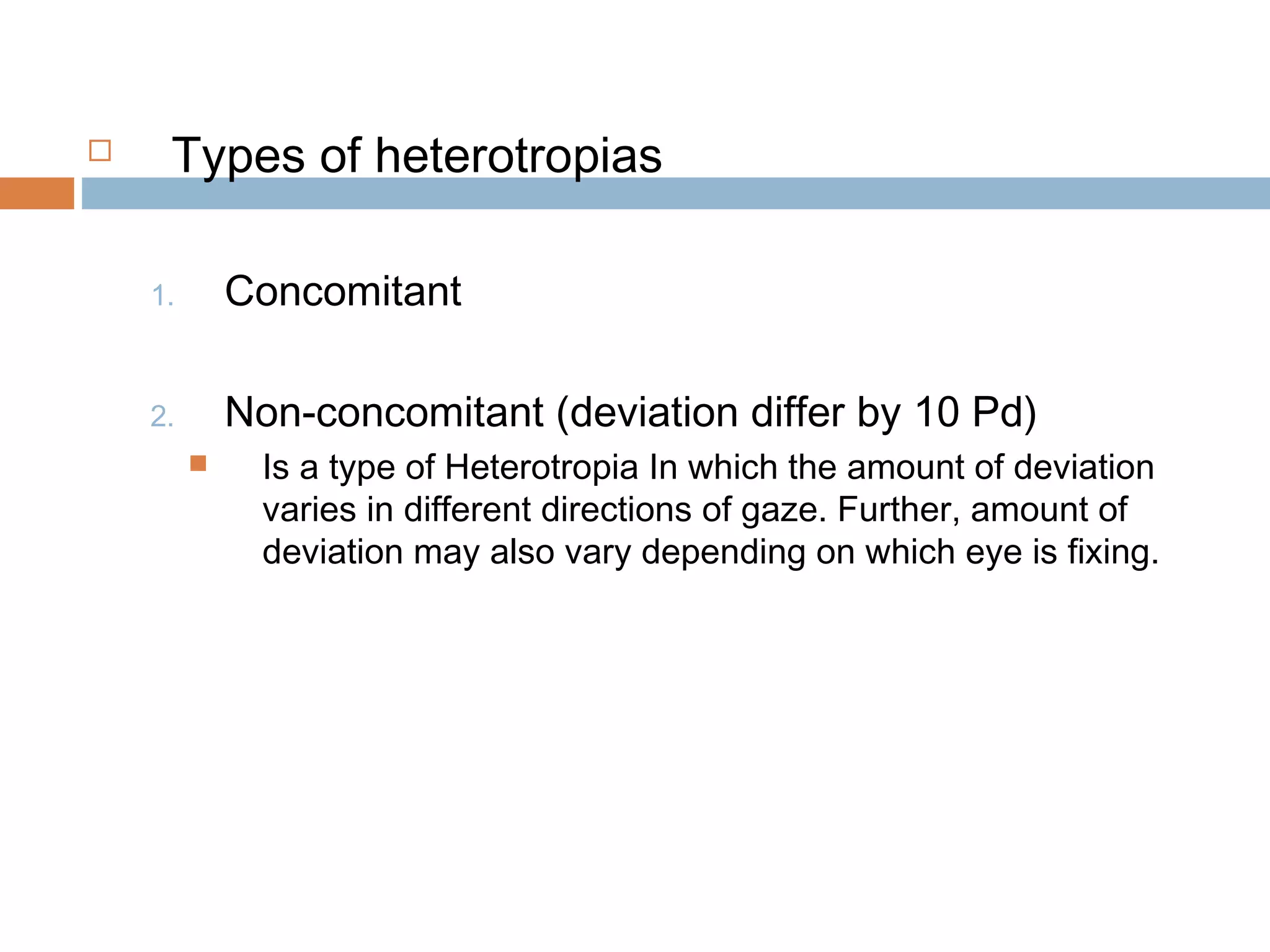
Inconcomitant Strabismus
Paralytic Type
Raju Kaiti, M. Optom
Consultant Optometrist
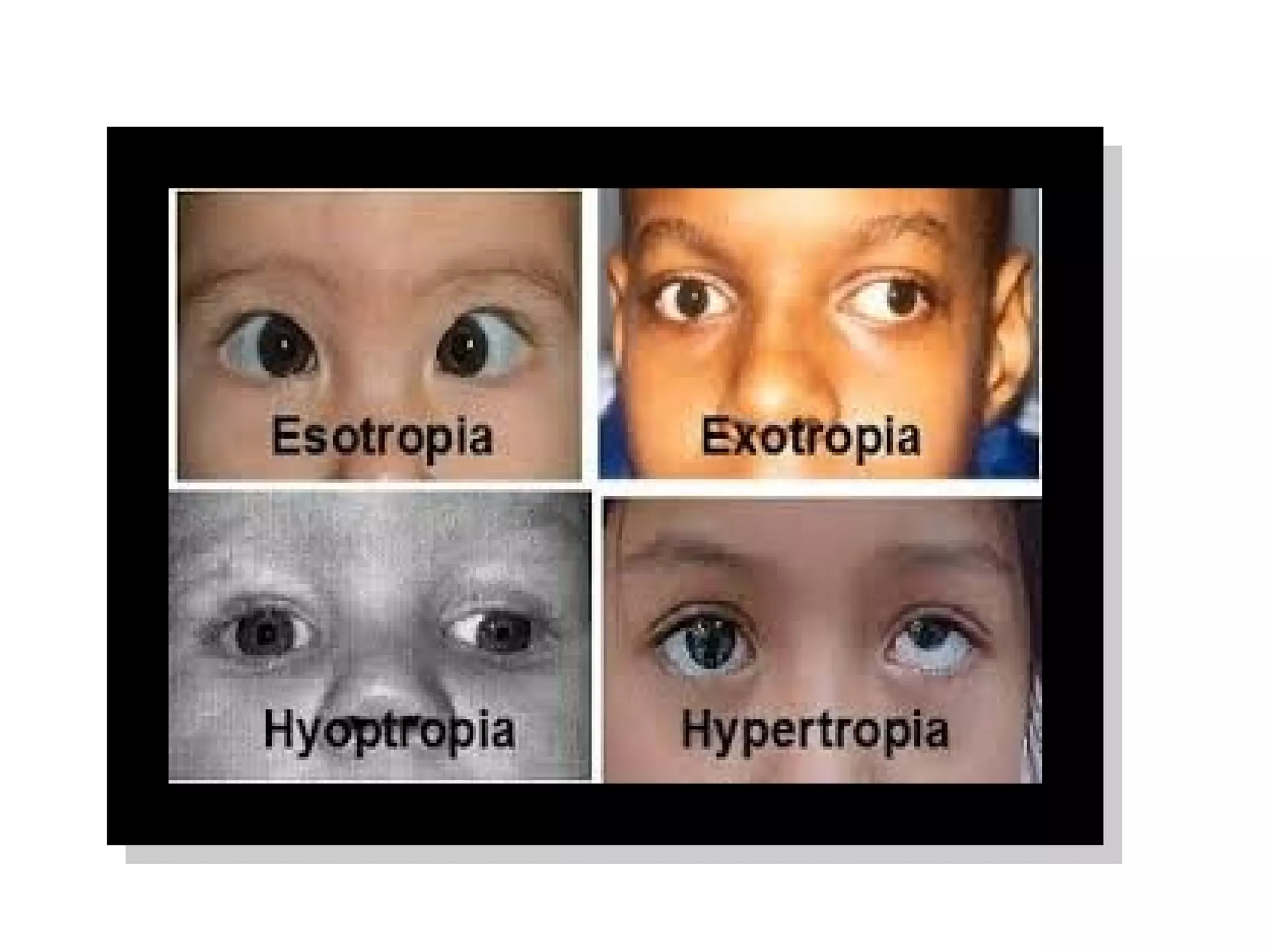
 Types of heterotropias
1. Concomitant
2. Non-concomitant (deviation differ by 10 Pd)
 Is a type of Heterotropia In which the amount of deviation
varies in different directions of gaze. Further, amount of
deviation may also vary depending on which eye is fixing.
Types of Incomitant deviations
1. Non-paralytic (Special types of Strabismus)
i. vertically incomitant horizontal heterotropias e.g.:
A-, V-, X-, Y- and λ- pattern heterotropias
ii. Special restrictive ocular motility defects: e.g.:
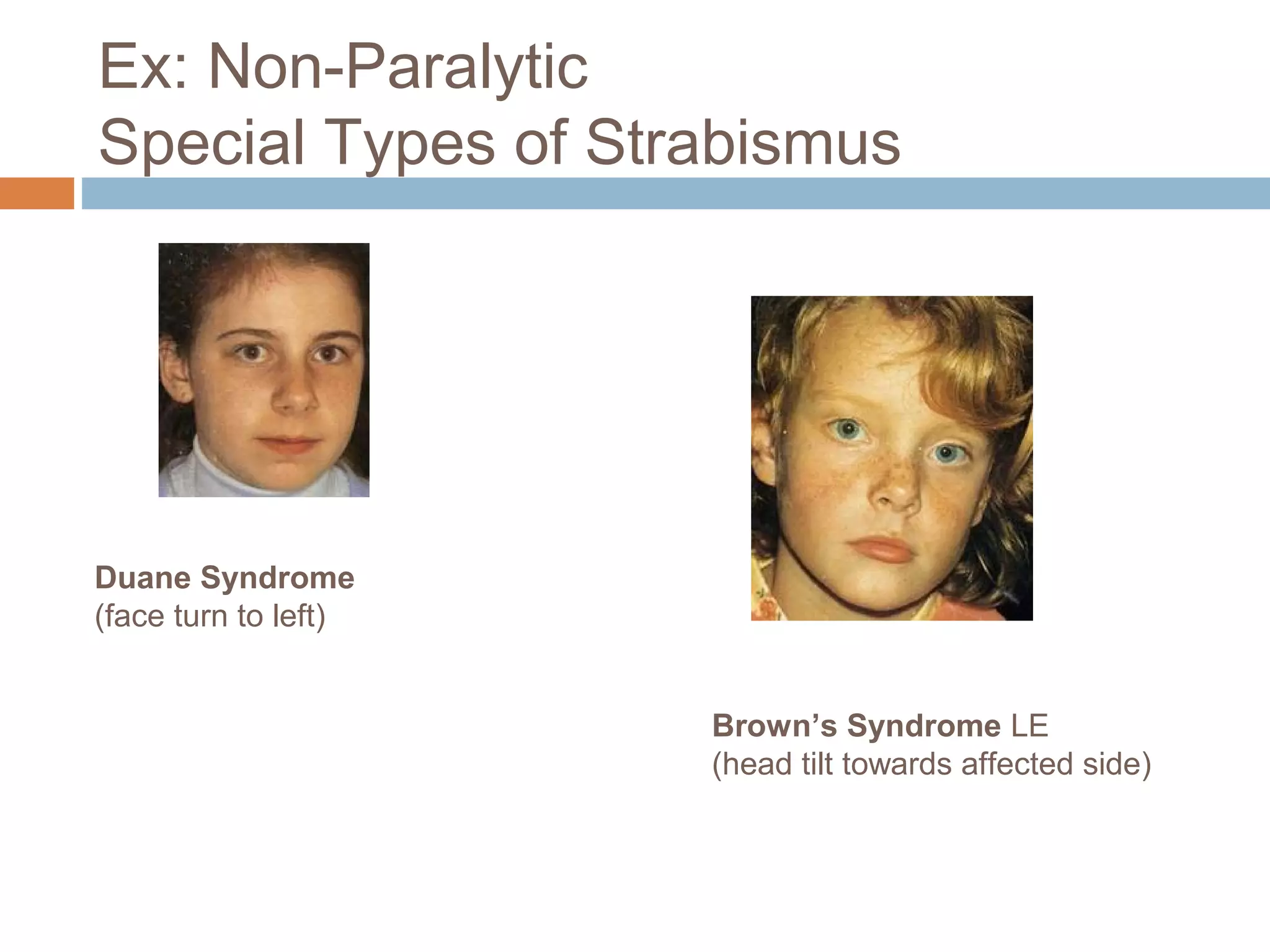
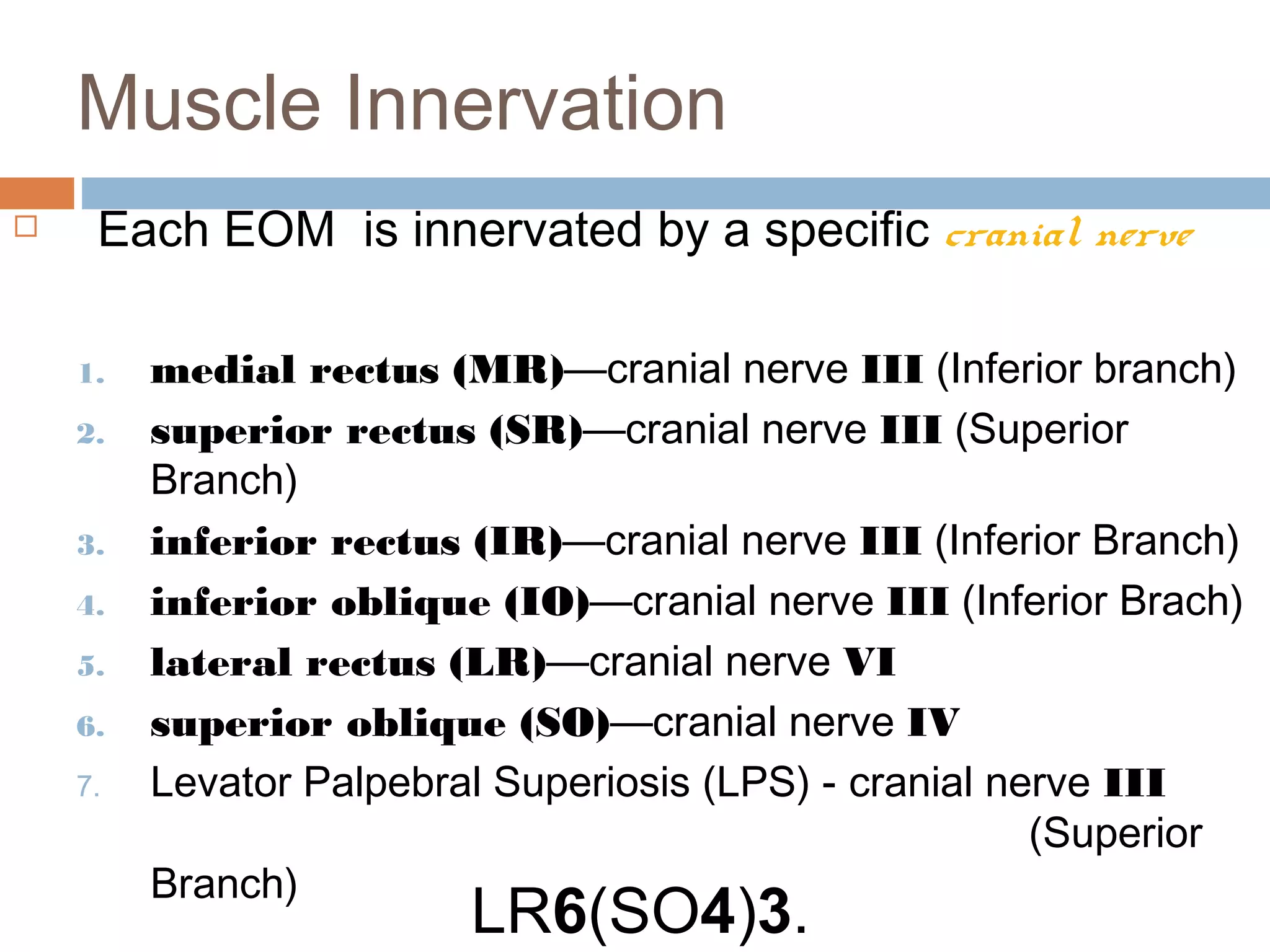
Duane’s Retraction syndrome, Brown’s syndrome,
Grave’s ophthalmopathy, etc.
2. Paralytic (Paralysis of Cranial Nerve/s)
Vertically incomitant horizontal
heterotropias
 Refers to those horizontal deviations that change in
magnitude with upgaze and downgaze
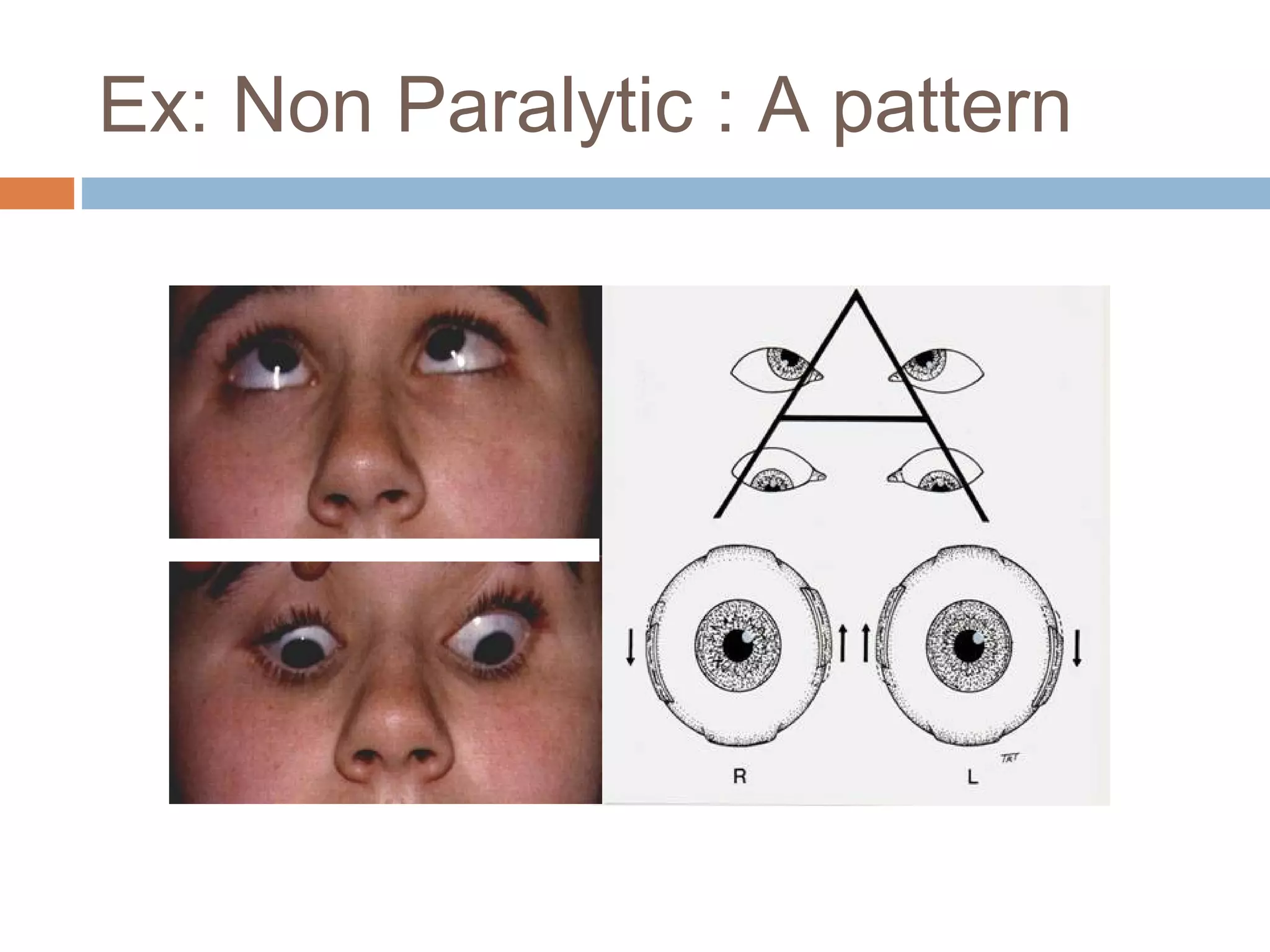
 A pattern Horizontal heterotropia:
 Increasing convergence (decreasing divergence) in
upgaze and increasing divergence in downgaze.
 Considered significant if deviation differ by 10 Pd
 A esotropia- esotropia will increase in upgaze and decrease
in downgaze
 A exotropia: exotropia will decrease in upgaze and increase
in downgaze
Ex: Non Paralytic : A pattern
Vertically incomitant horizontal
heterotropias
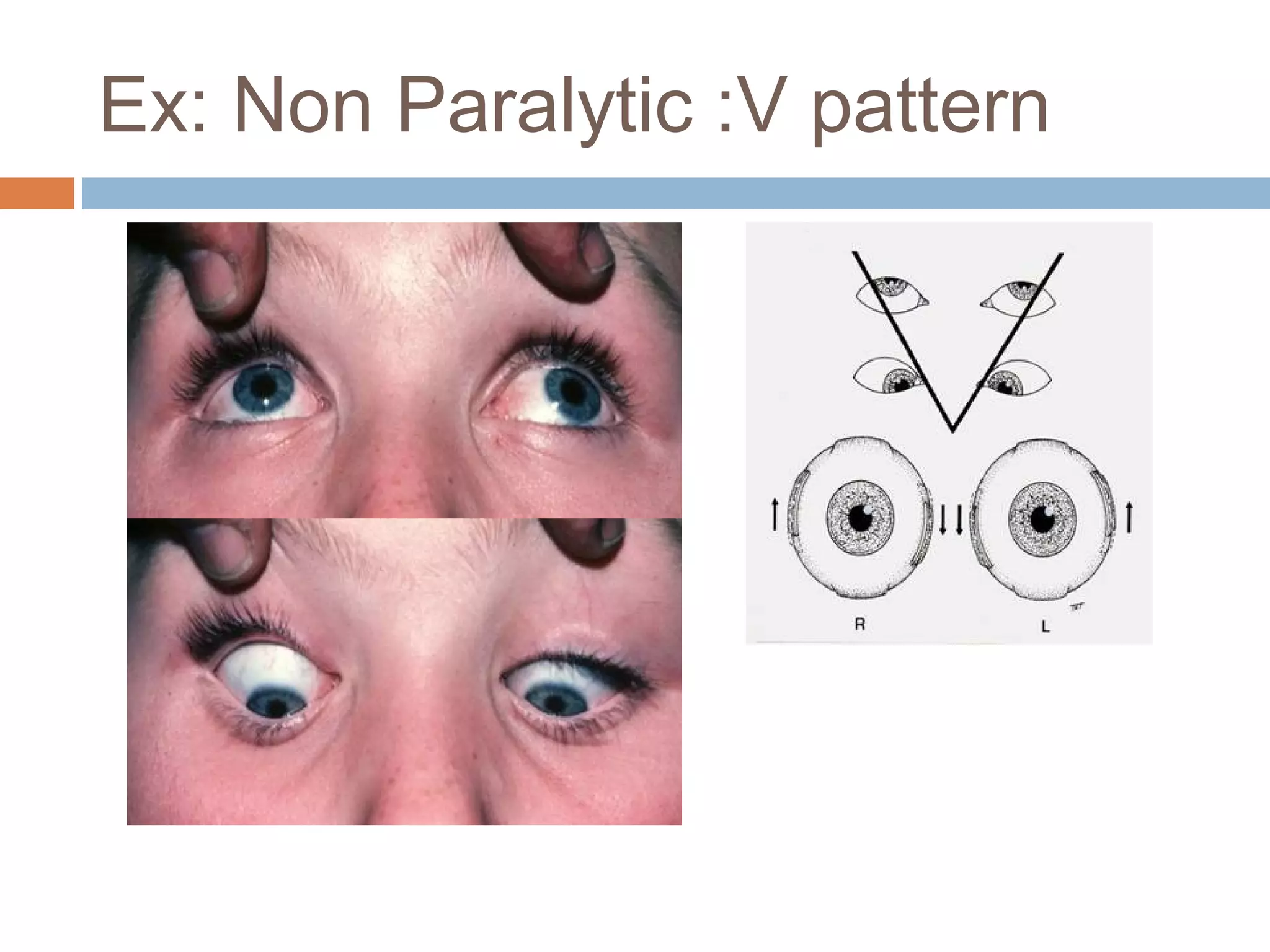
 V pattern Horizontal heterotropia:
 Increasing convergence (decreasing divergence) in
downgaze and increasing divergence in upgaze.
 Considered significant if deviation differ by 15 Pd
 V esotropia- esotropia will increase in downgaze and
decrease in upgaze
 V exotropia: exotropia will increase in upgaze and decrease
in downgaze
Ex: Non Paralytic :V pattern
Vertically incomitant horizontal
heterotropias
 Y pattern Horizontal heterotropia:
 Have exotropia only in upgaze
 λ- pattern Horizontal heterotropia:
 Exotropia in down gaze only
 X- pattern Horizontal heterotropia:
 No deviation or a small one in primary position, but a
significant exotropia in upgaze as well as in downgaze
Ex: Non-Paralytic
Special Types of Strabismus
Duane Syndrome
(face turn to left)
Brown’s Syndrome LE
(head tilt towards affected side)
Muscle Innervation
 Each EOM is innervated by a specific cranial nerve
1. medial rectus (MR)—cranial nerve III (Inferior branch)
2. superior rectus (SR)—cranial nerve III (Superior
Branch)
3. inferior rectus (IR)—cranial nerve III (Inferior Branch)
4. inferior oblique (IO)—cranial nerve III (Inferior Brach)
5. lateral rectus (LR)—cranial nerve VI
6. superior oblique (SO)—cranial nerve IV
7. Levator Palpebral Superiosis (LPS) - cranial nerve III
(Superior
Branch)
LR6(SO4)3.
Paralytic Deviation
 Ocular deviation resulting from complete or
incomplete paralysis of one or more
extraocular muscles.
 Complete called as palsy
 Incomplete called as paresis
Etiology:
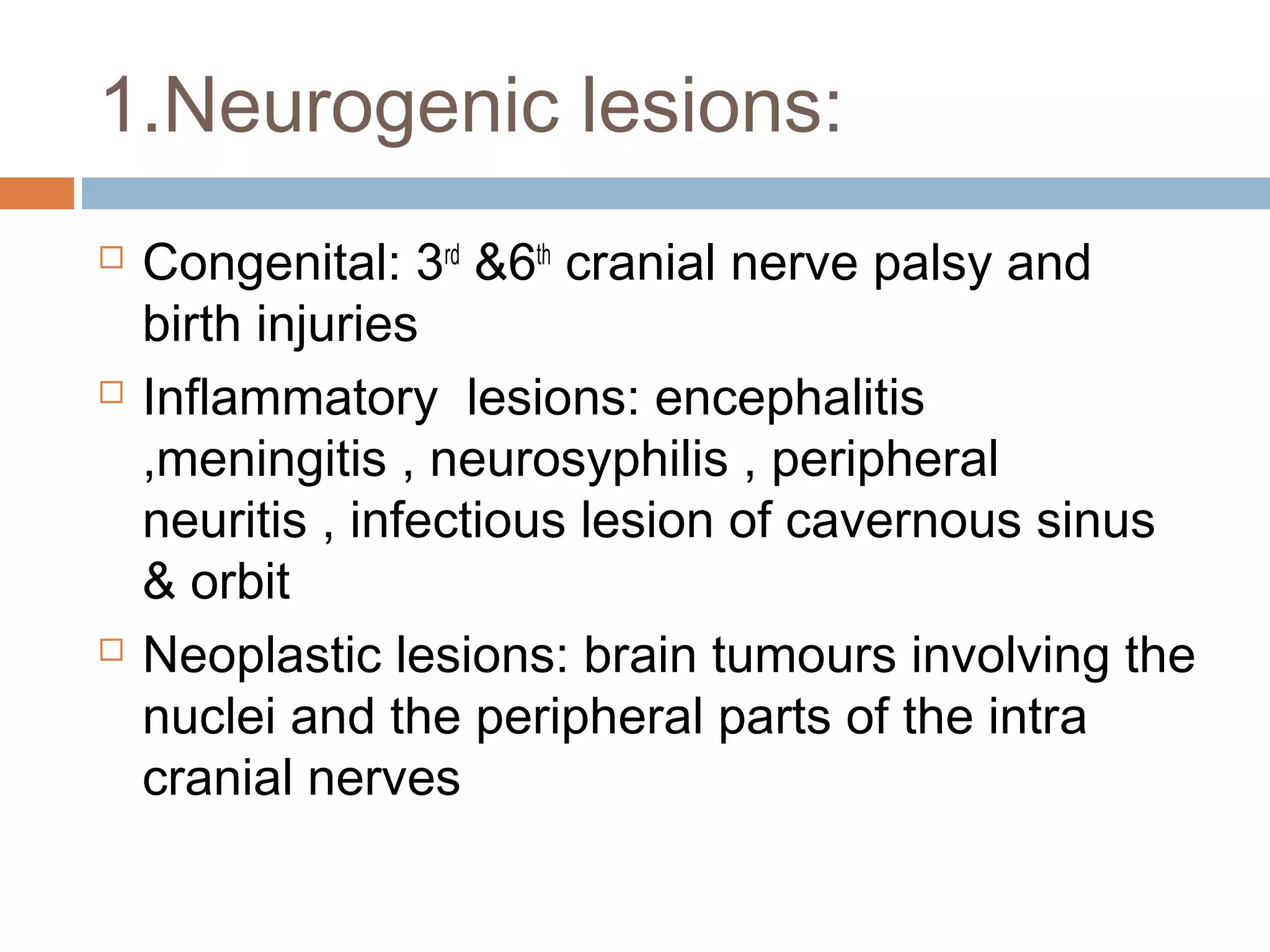
1.Neurogenic lesions:
 Congenital: 3rd
&6th
cranial nerve palsy and
birth injuries
 Inflammatory lesions: encephalitis
,meningitis , neurosyphilis , peripheral
neuritis , infectious lesion of cavernous sinus
& orbit
 Neoplastic lesions: brain tumours involving the
nuclei and the peripheral parts of the intra
cranial nerves
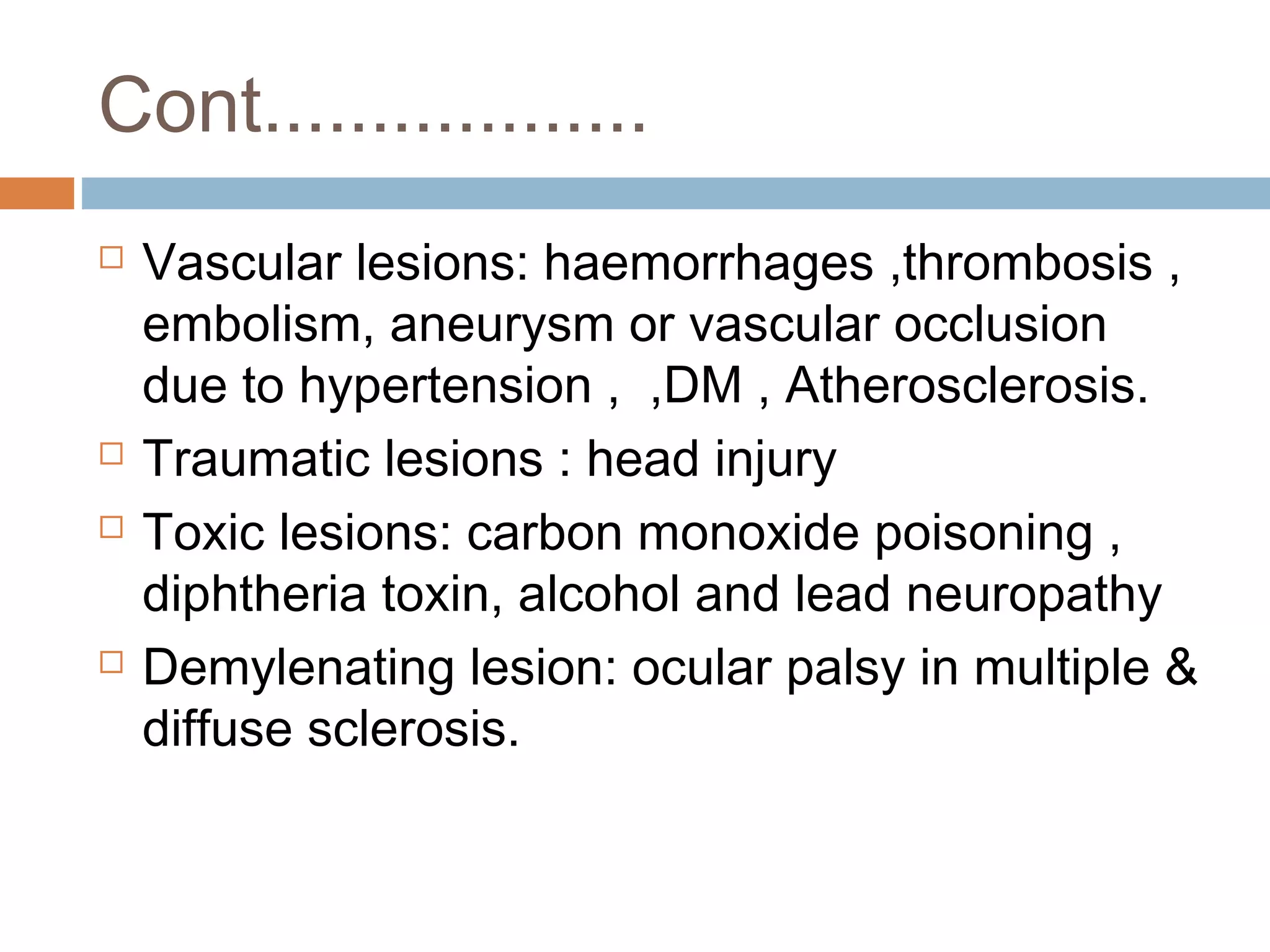
Cont..................
 Vascular lesions: haemorrhages ,thrombosis ,
embolism, aneurysm or vascular occlusion
due to hypertension , ,DM , Atherosclerosis.
 Traumatic lesions : head injury
 Toxic lesions: carbon monoxide poisoning ,
diphtheria toxin, alcohol and lead neuropathy
 Demylenating lesion: ocular palsy in multiple &
diffuse sclerosis.
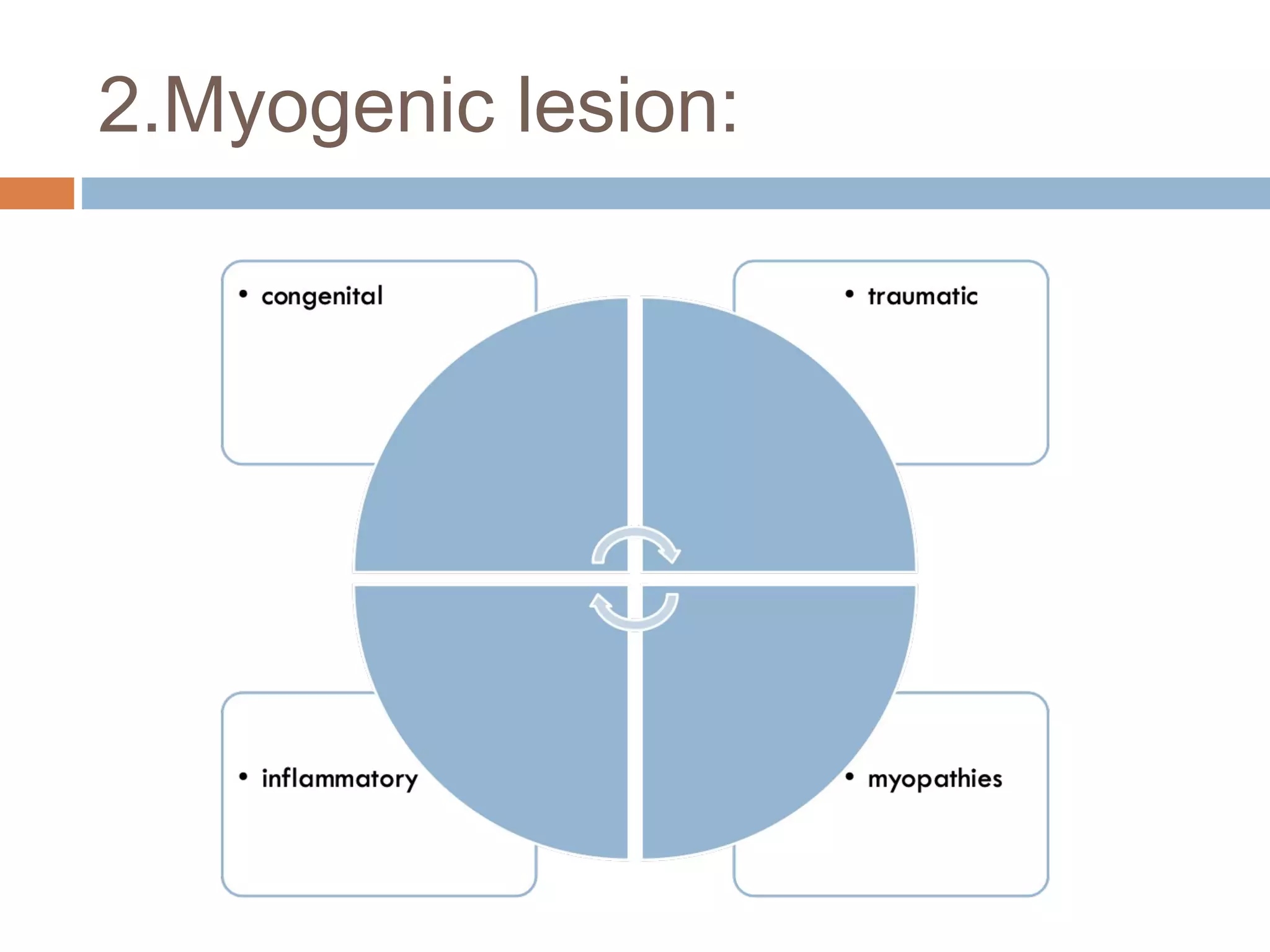
2.Myogenic lesion:
3.Neuromuscular junction
lesion:
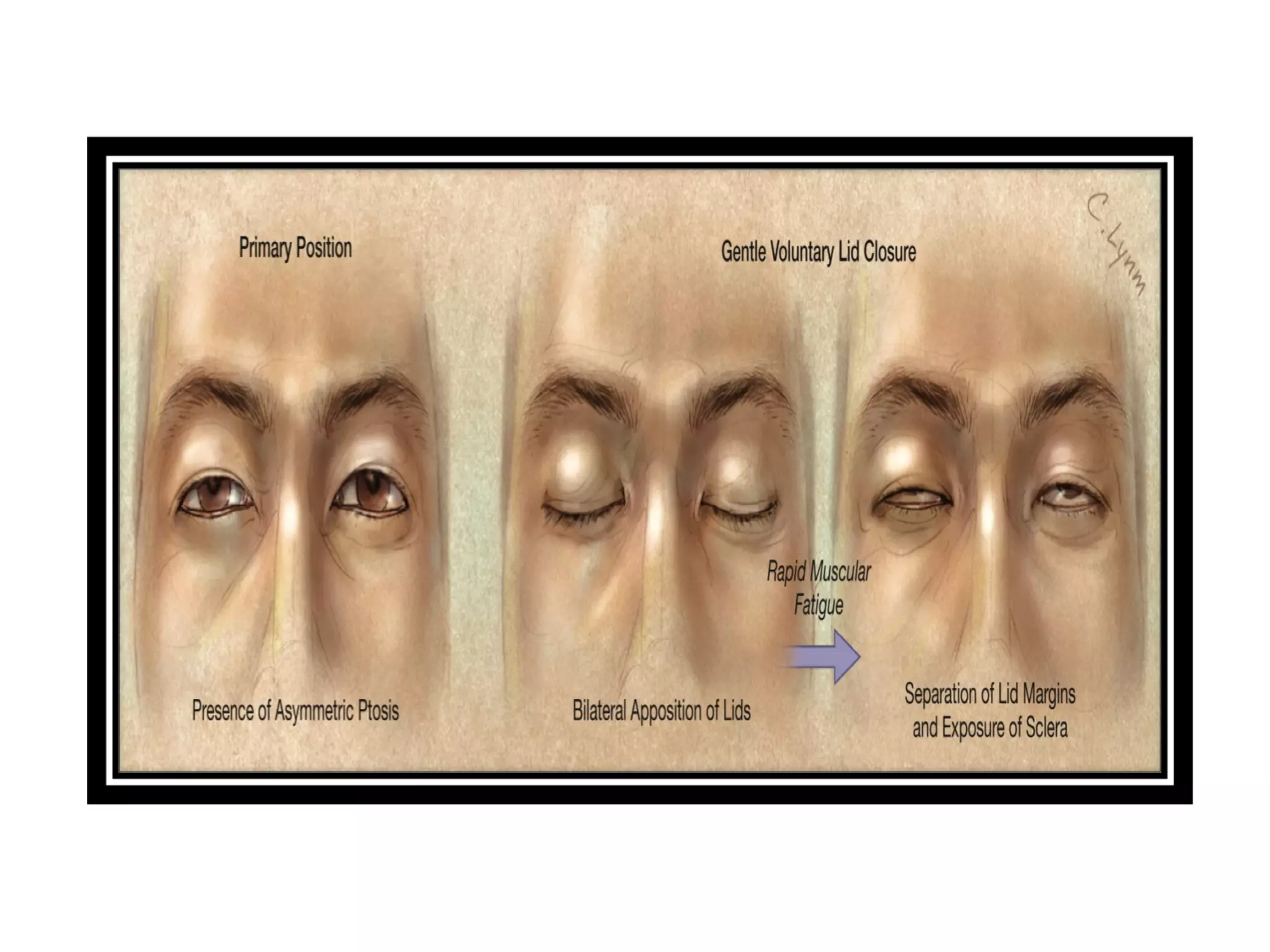
Myasthenia gravis : characterized by primarily fatigue of group of
muscles.
General features:
 Diplopia
 Confusion
 Ocular deviation : i . primary
ii . Secondary
 Ocular movements
 Past pointing
 Nausea, vertigo & dizziness
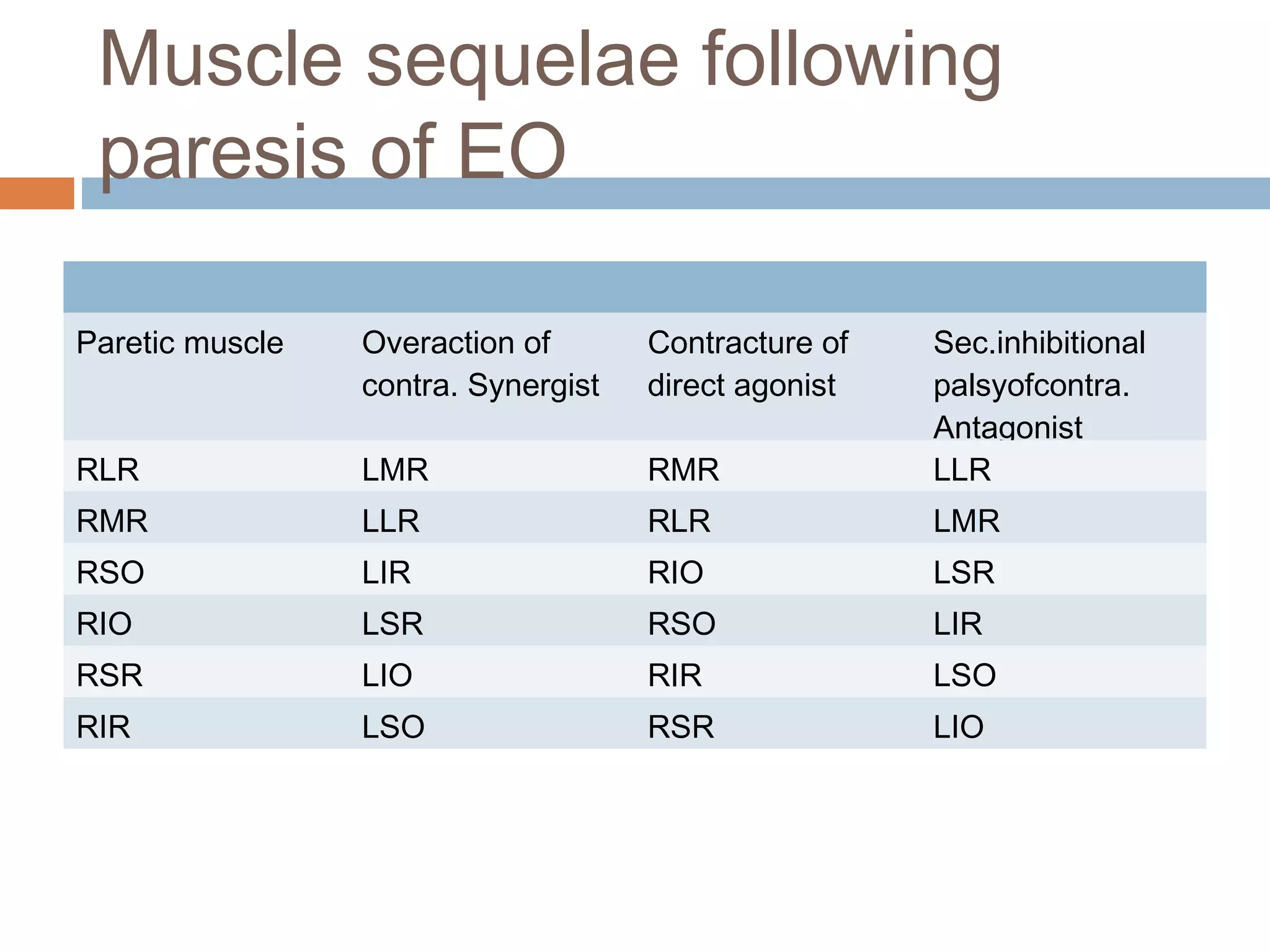
 Muscle sequelae :
Muscle sequelae :
 Changes that take place in EO muscle after
sometime of paralysis or paresis of one or
more EO muscle.
i . Overaction of contralateral synergistic
muscle.
ii . Contracture of direct antagonist
iii . Secondary inhibitional palsy of the
contralateral antagonist muscle.
Muscle sequelae following
paresis of EO
Paretic muscle Overaction of
contra. Synergist
Contracture of
direct agonist
Sec.inhibitional
palsyofcontra.
Antagonist
RLR LMR RMR LLR
RMR LLR RLR LMR
RSO LIR RIO LSR
RIO LSR RSO LIR
RSR LIO RIR LSO
RIR LSO RSR LIO
Cont.........................
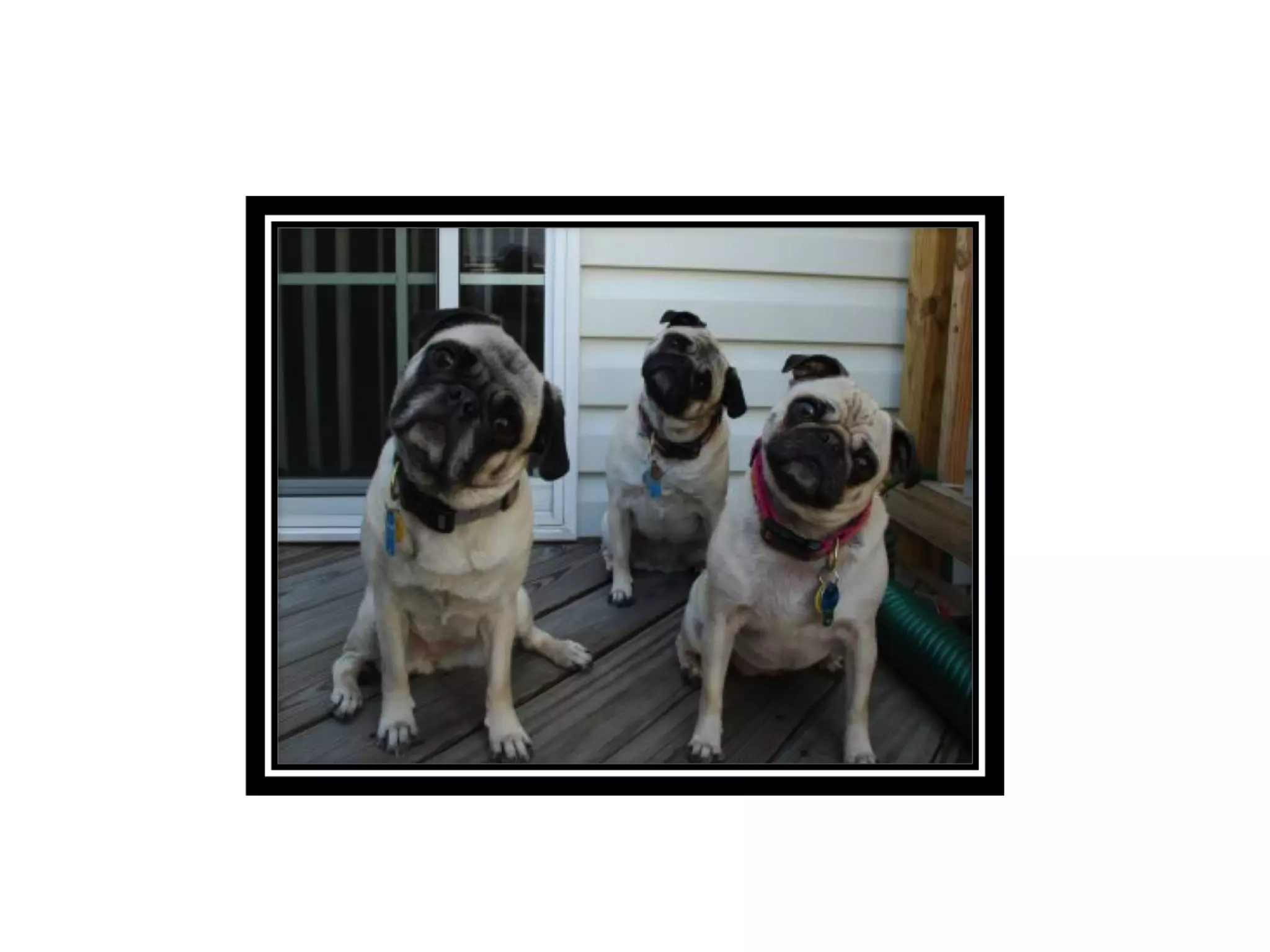
 Abnormal head posture :
i. Chin elevation or depression
ii. Face turn
iii. Head tilt
 Sensory adaptation
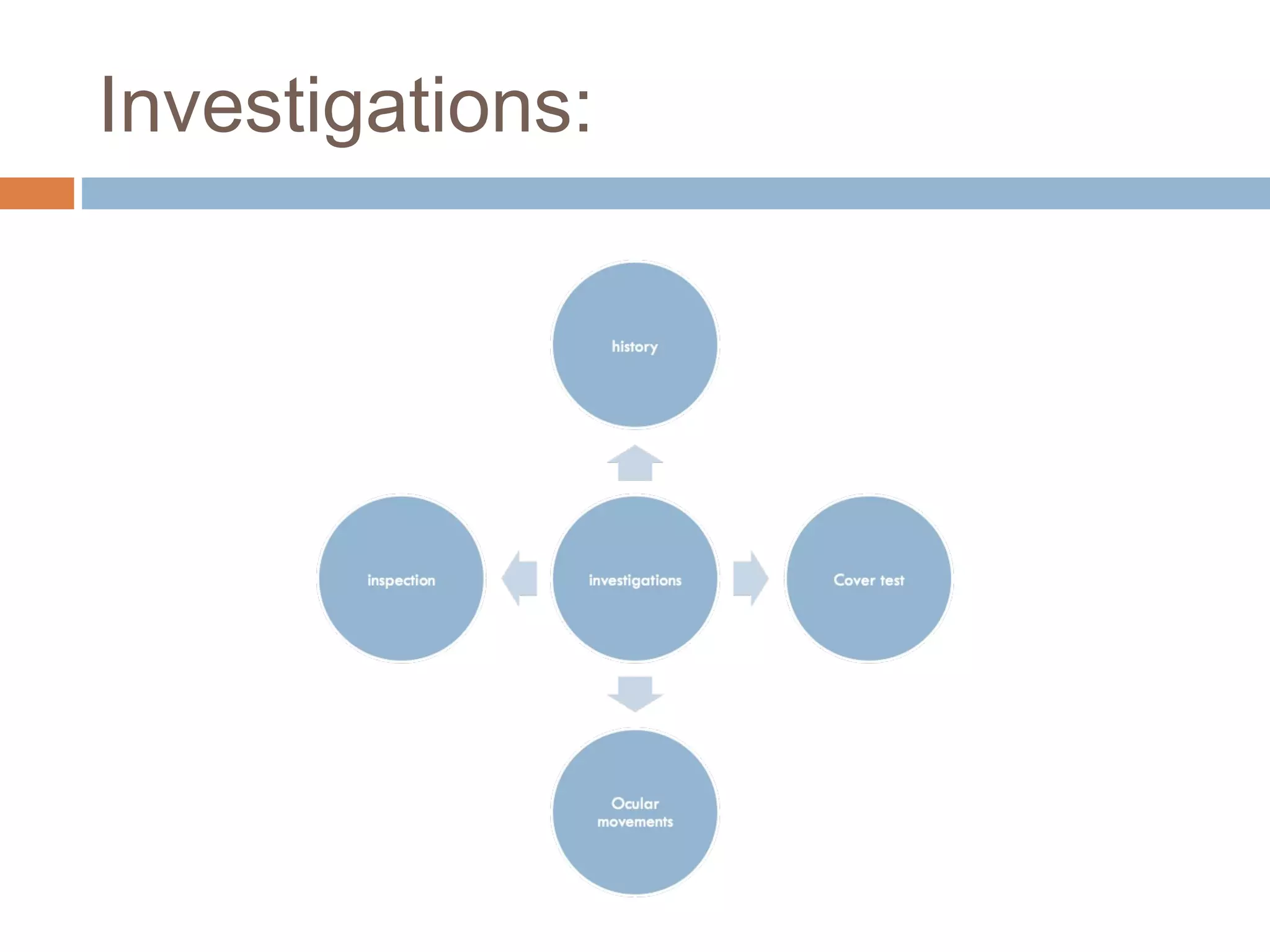
Investigations:
History :
SUBJECTIVE SYMPTOMS:
 Diplopia
 Confusion
 Headache , eye strain , difficulty in focusing ,
aesthenopic symptoms , discomfort from
abnormal head posture
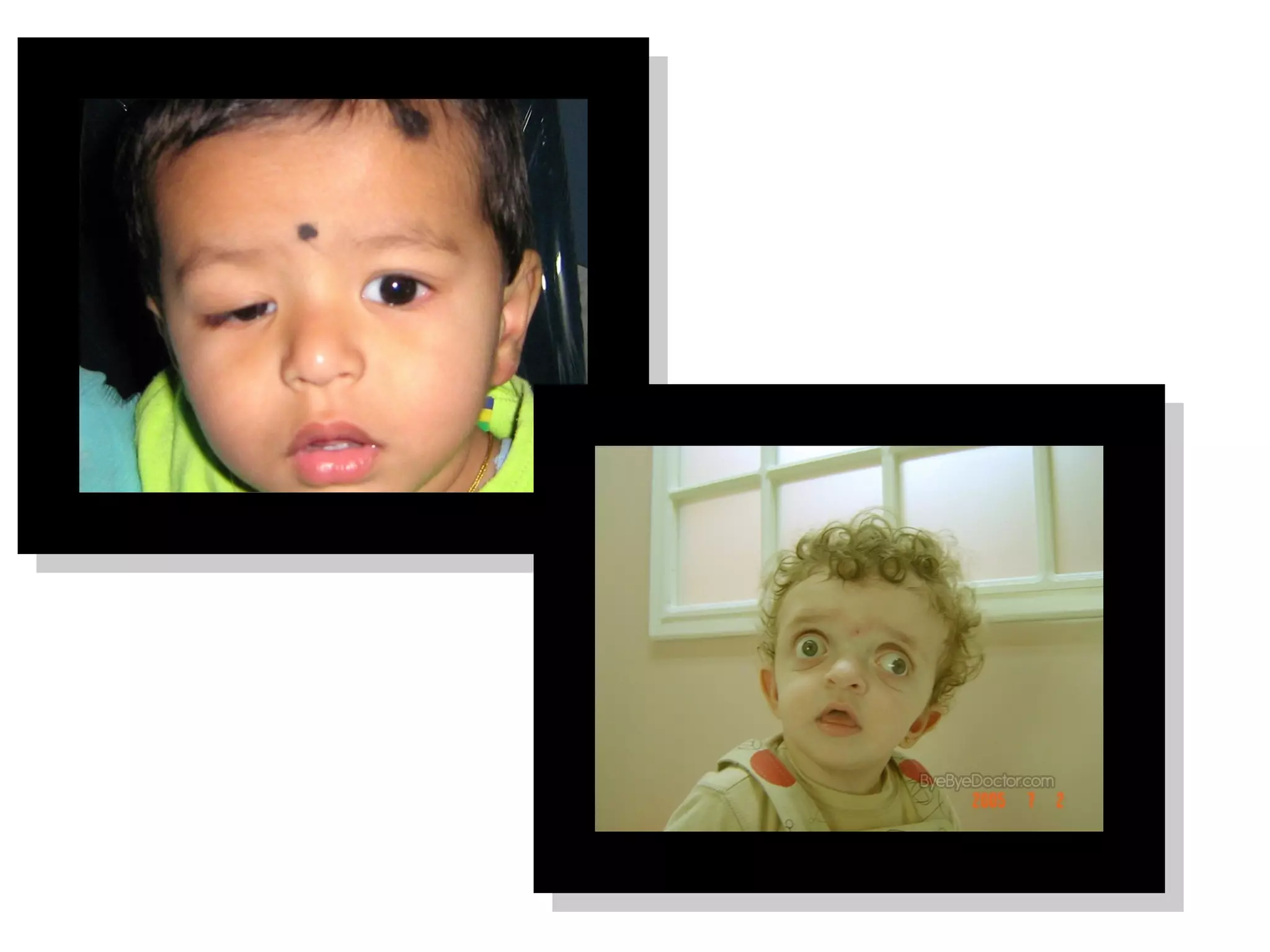
Objective symptoms:
 Constant / intermittent deviation
 Abnormal head posture
 Ptosis , exophthalmos.
Inspection:
 Ocular posture
 Abnormal head posture ; note its exact
components
 Facial asymmetry
 Ptosis , exophthalmos
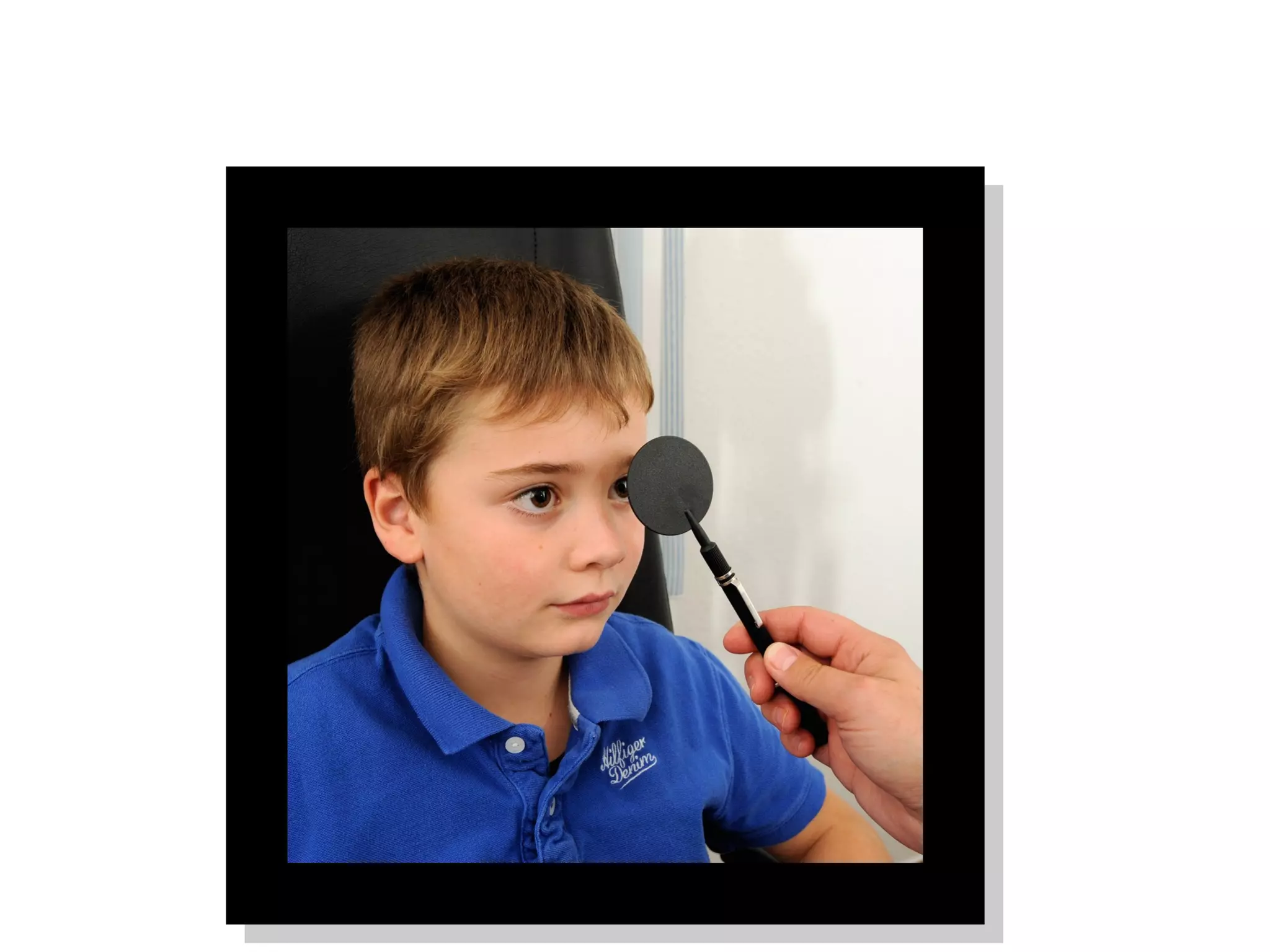
Cover test:
 Both for distance & near , with & without
abnormal head posture
 Presence of any manifest or latent deviation
 Type of deviation
 Primary versus secondary deviation
 Normally fixing eye : for the dominant eye.
Ocular movements:
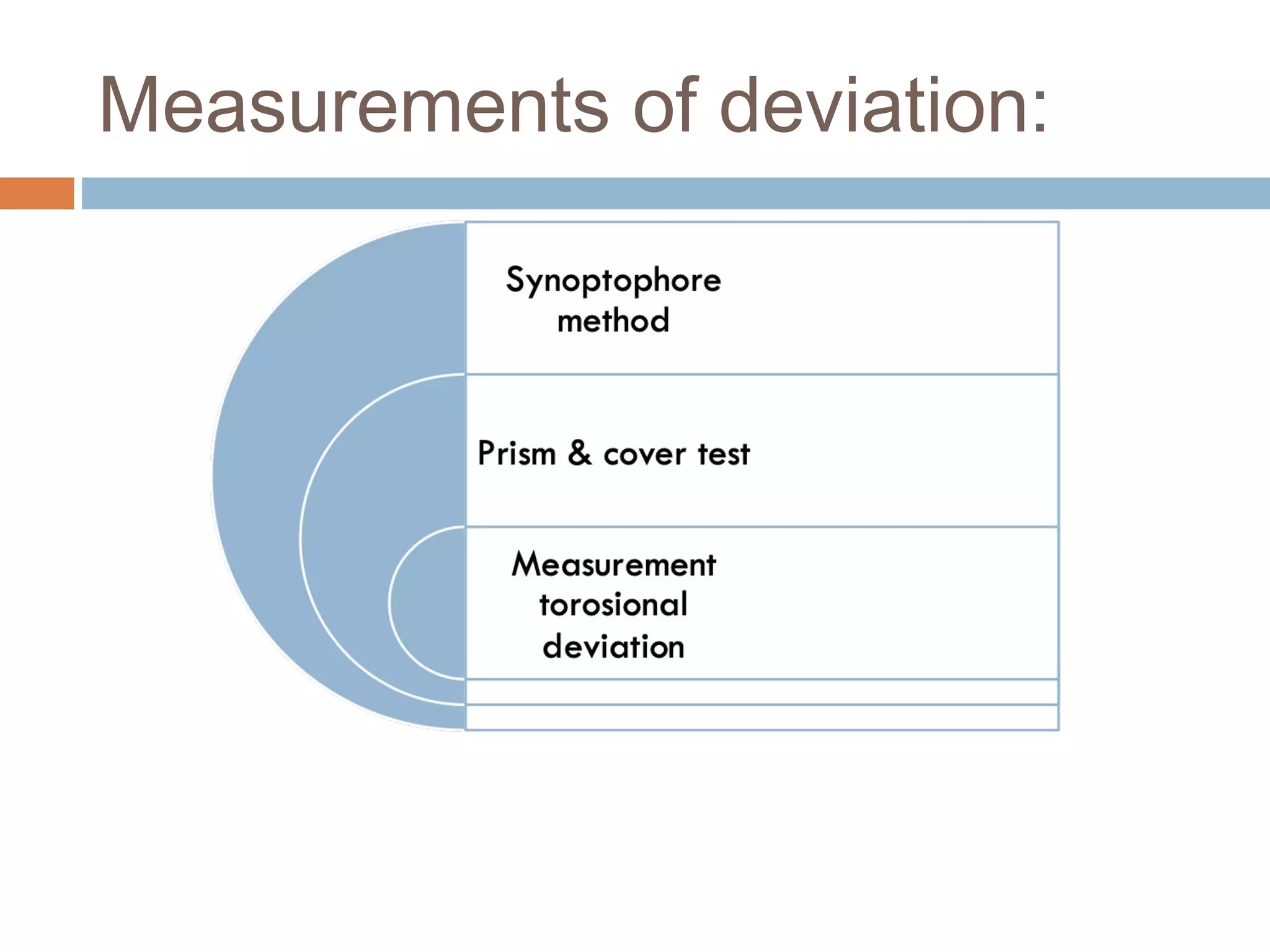
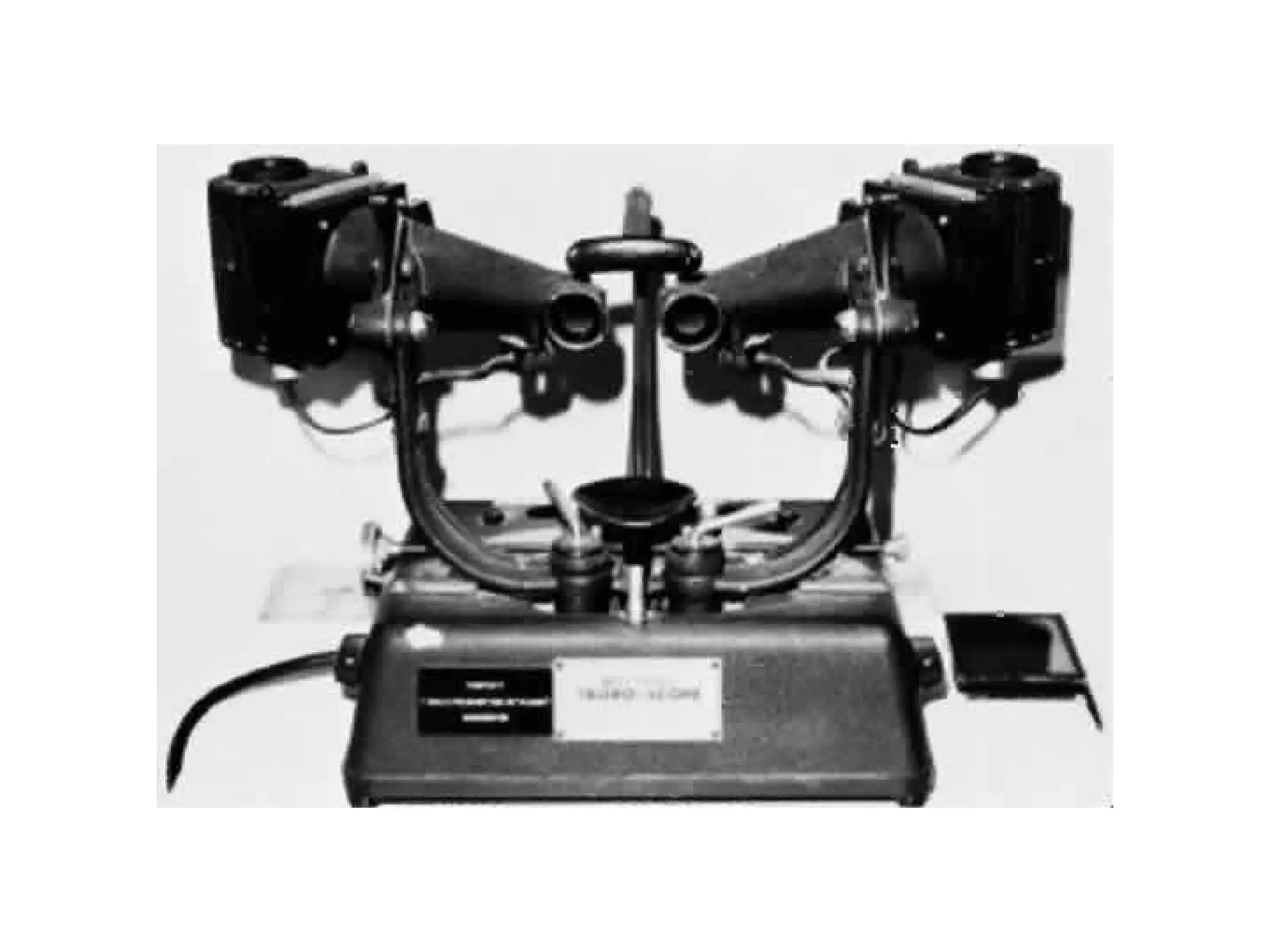
Measurements of deviation:
Different types of test :
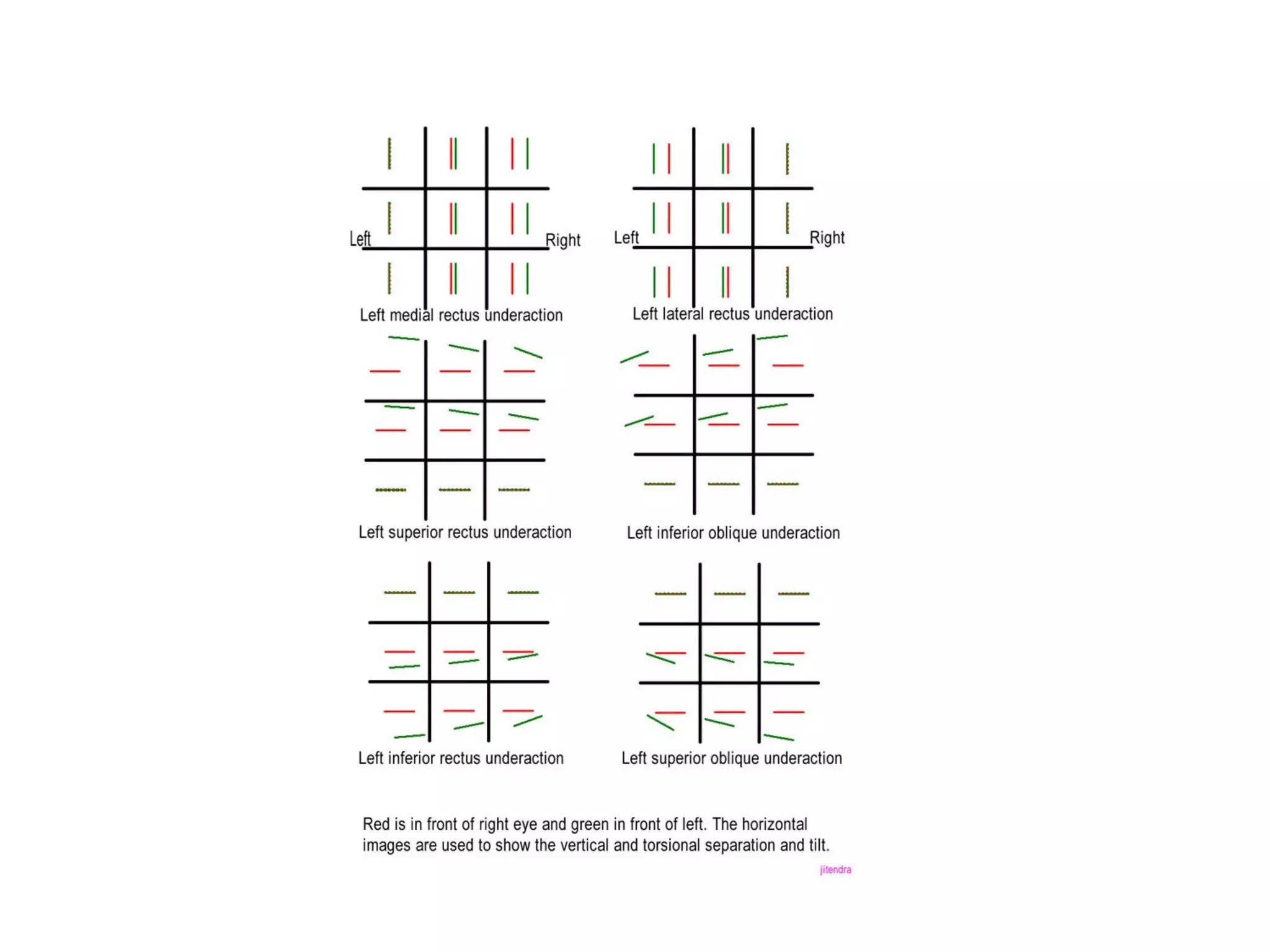
 Diplopia test
 Bielschowsky three step test
 Haploscopic test
 Field of binocular fixation
 Other test : FDT , EMG , EOG , Orbital USG ,
Computerised tomographic scanning.
Differential diagnosis in
paralytic squint :
 Comitant versus incomitant squint
 Congenital versus acquired palsies
 Paralytic versus restrictive palsies.
Clinical varieties of ocular
palsies :
 Isolated ocular muscle paralysis : SO (4TH
nerve palsy) and LR (6TH
nerve palsy).
 Paralysis of 3rd
cranial nerve
 External ophthalmoplegia
 Total opthalmoplegia
 Internuclear ophthalmoplegia
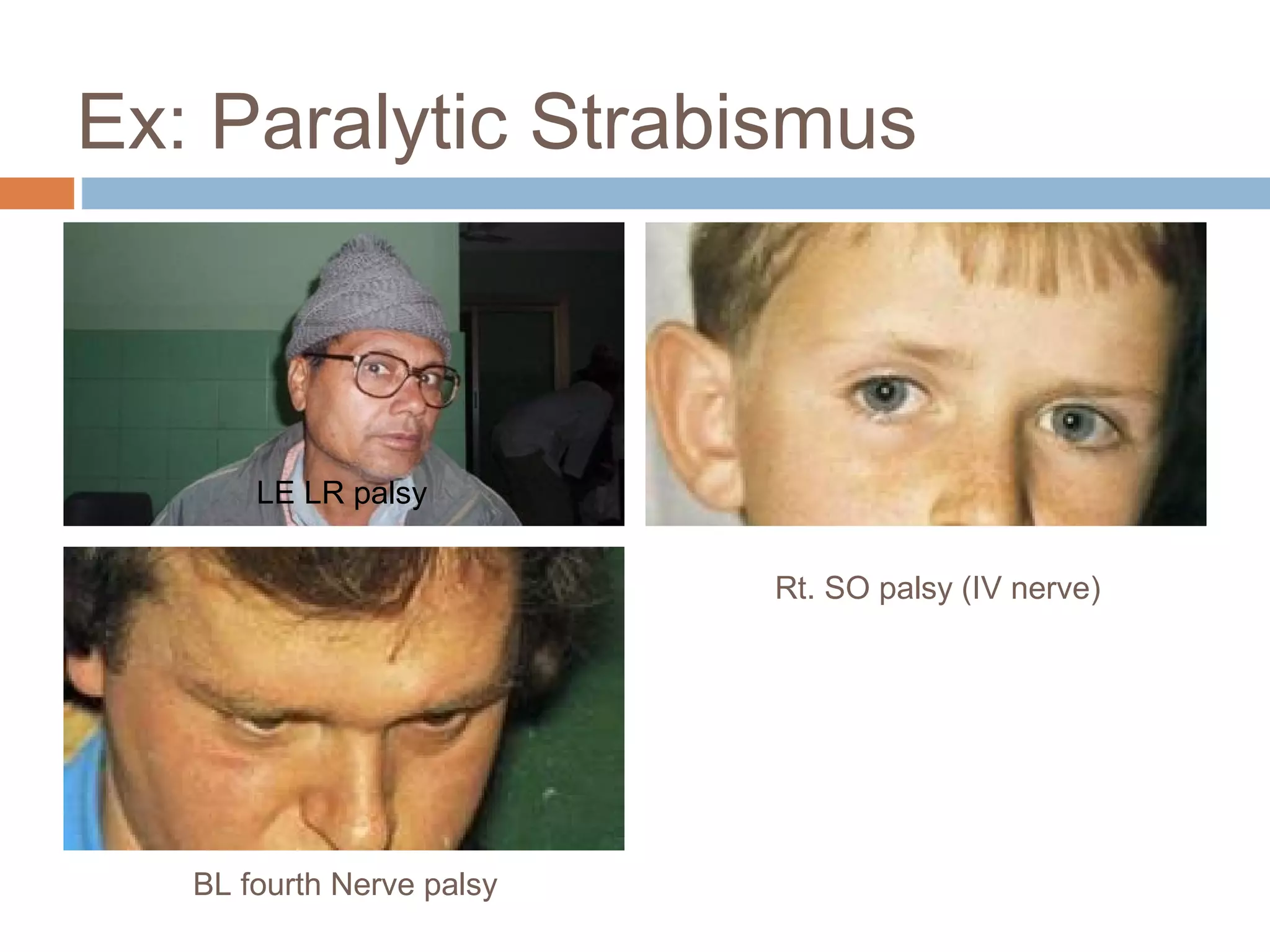
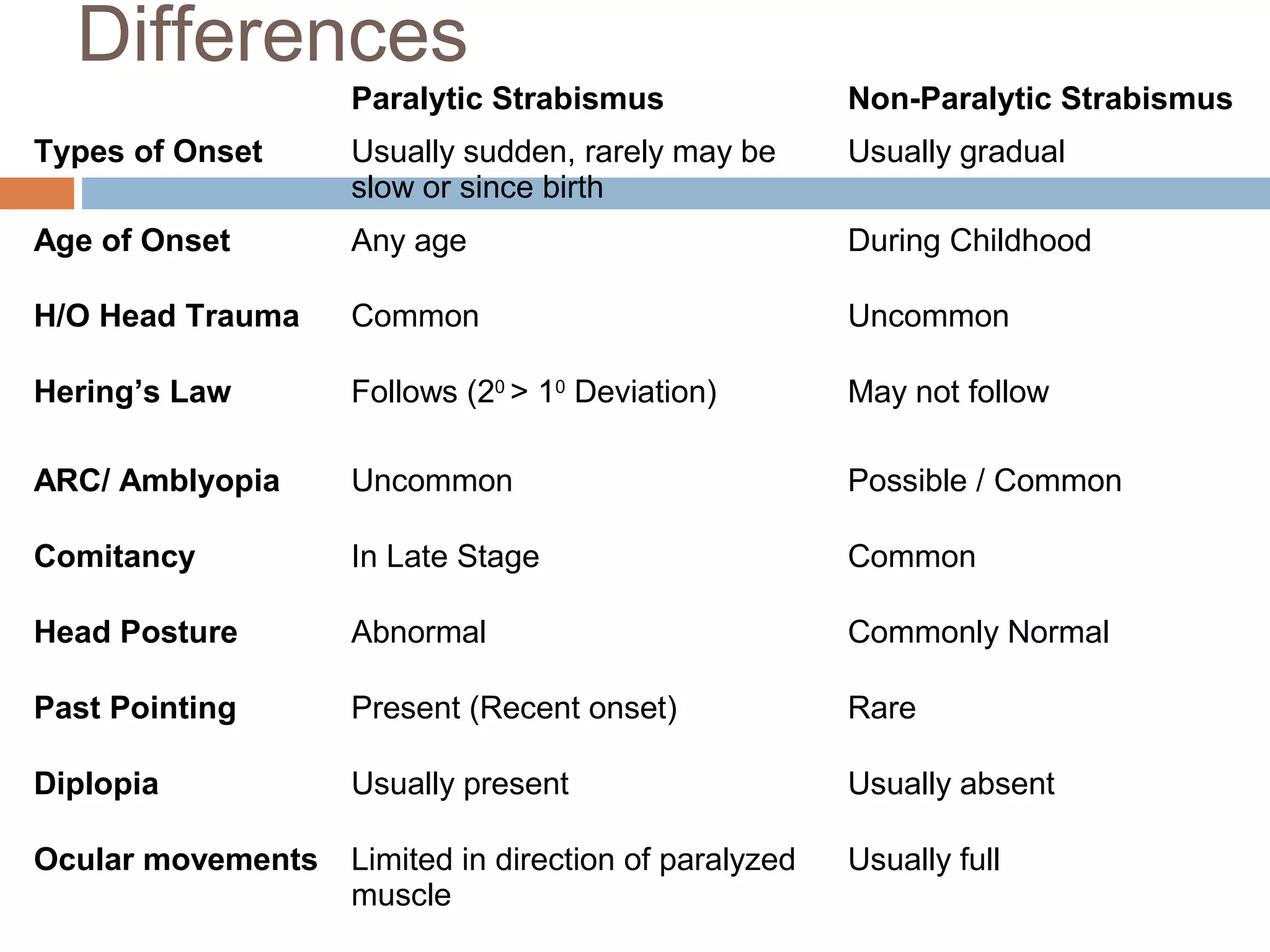
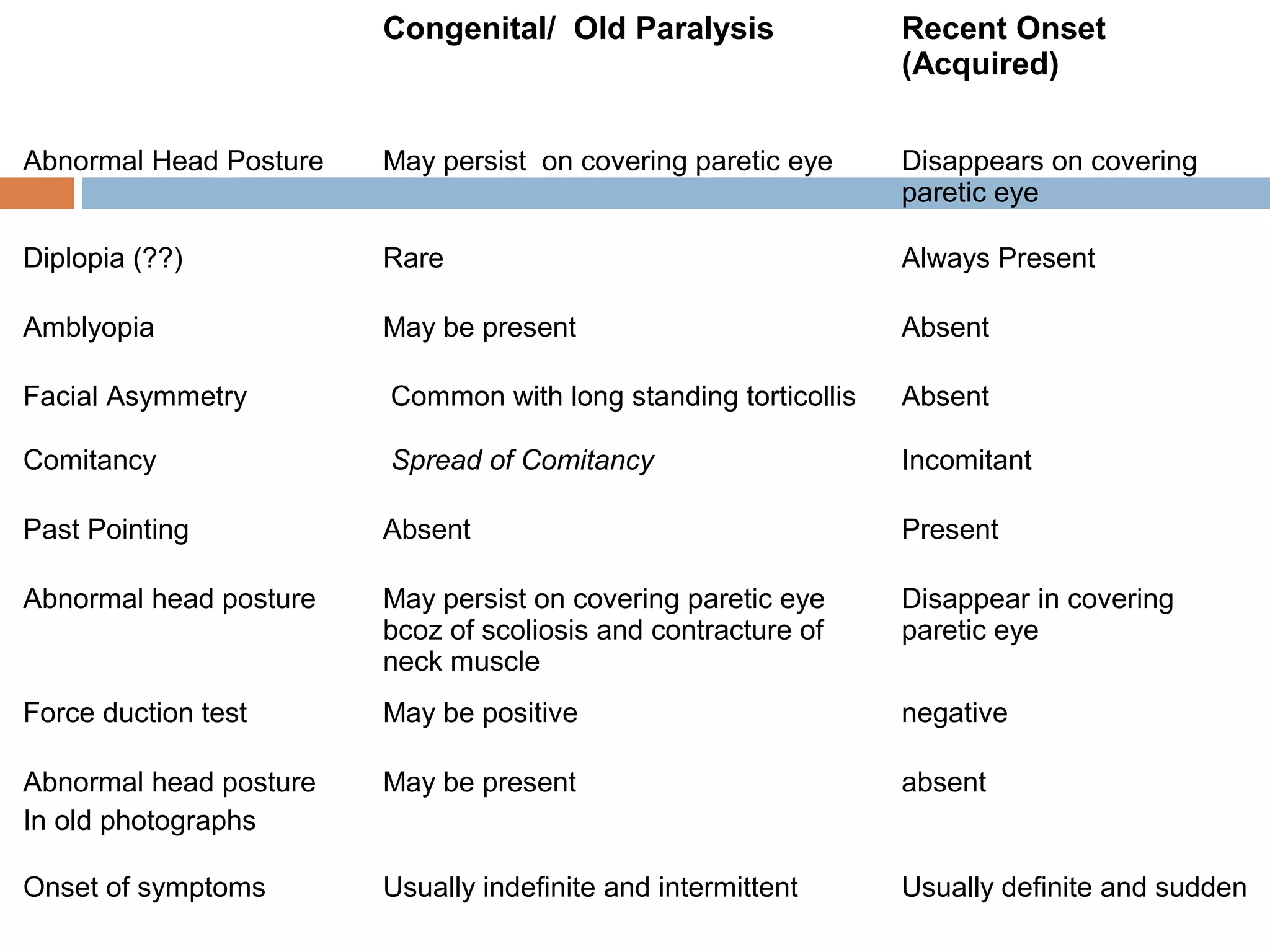
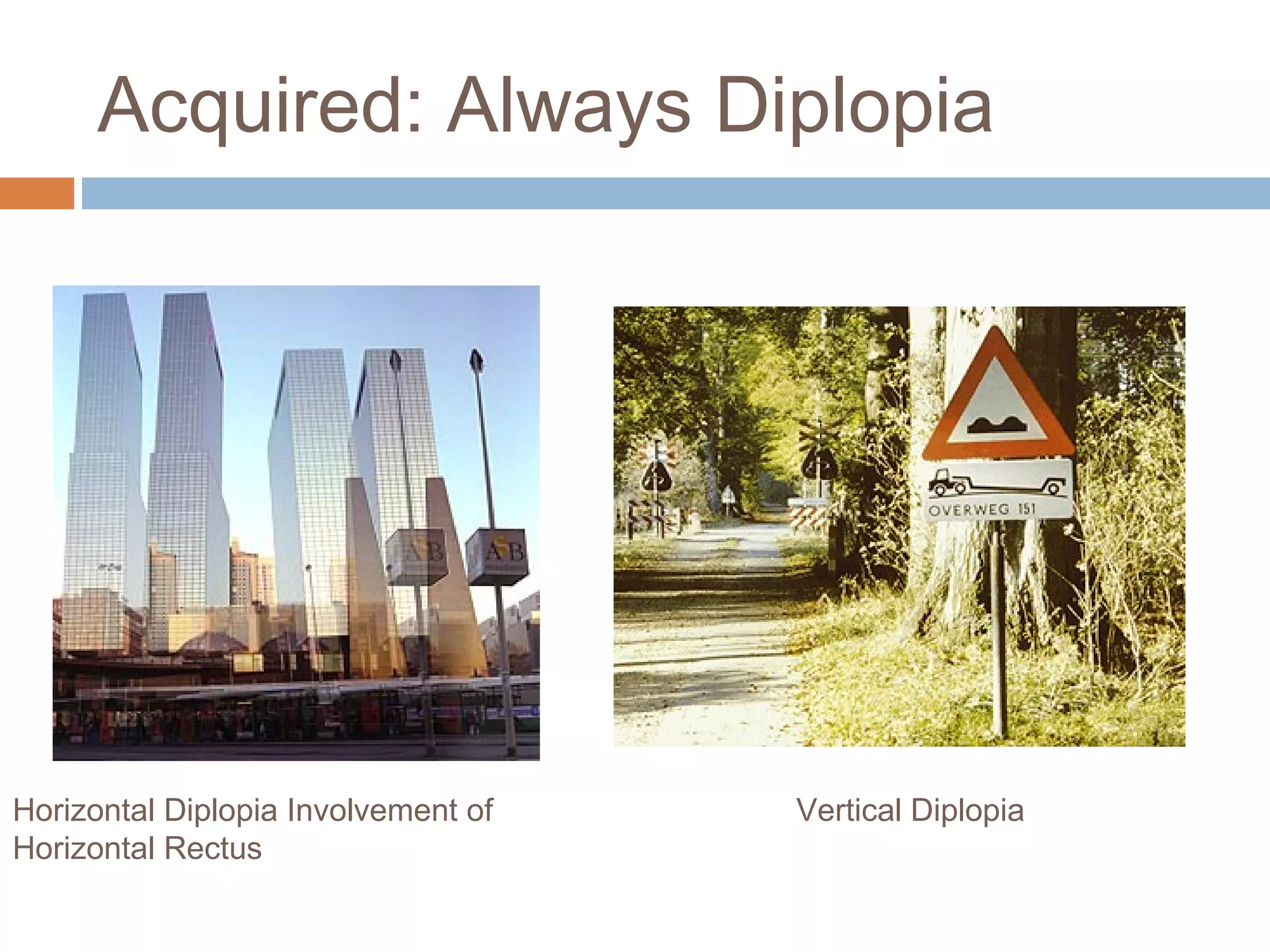
Ex: Paralytic Strabismus
LE LR palsy
Rt. SO palsy (IV nerve)
BL fourth Nerve palsy
Differences
Paralytic Strabismus Non-Paralytic Strabismus
Types of Onset Usually sudden, rarely may be
slow or since birth
Usually gradual
Age of Onset Any age During Childhood
H/O Head Trauma Common Uncommon
Hering’s Law Follows (20
> 10
Deviation) May not follow
ARC/ Amblyopia Uncommon Possible / Common
Comitancy In Late Stage Common
Head Posture Abnormal Commonly Normal
Past Pointing Present (Recent onset) Rare
Diplopia Usually present Usually absent
Ocular movements Limited in direction of paralyzed
muscle
Usually full
Congenital/ Old Paralysis Recent Onset
(Acquired)
Abnormal Head Posture May persist on covering paretic eye Disappears on covering
paretic eye
Diplopia (??) Rare Always Present
Amblyopia May be present Absent
Facial Asymmetry Common with long standing torticollis Absent
Comitancy Spread of Comitancy Incomitant
Past Pointing Absent Present
Abnormal head posture May persist on covering paretic eye
bcoz of scoliosis and contracture of
neck muscle
Disappear in covering
paretic eye
Force duction test May be positive negative
Abnormal head posture
In old photographs
May be present absent
Onset of symptoms Usually indefinite and intermittent Usually definite and sudden
Acquired: Always Diplopia
Horizontal Diplopia Involvement of
Horizontal Rectus
Vertical Diplopia
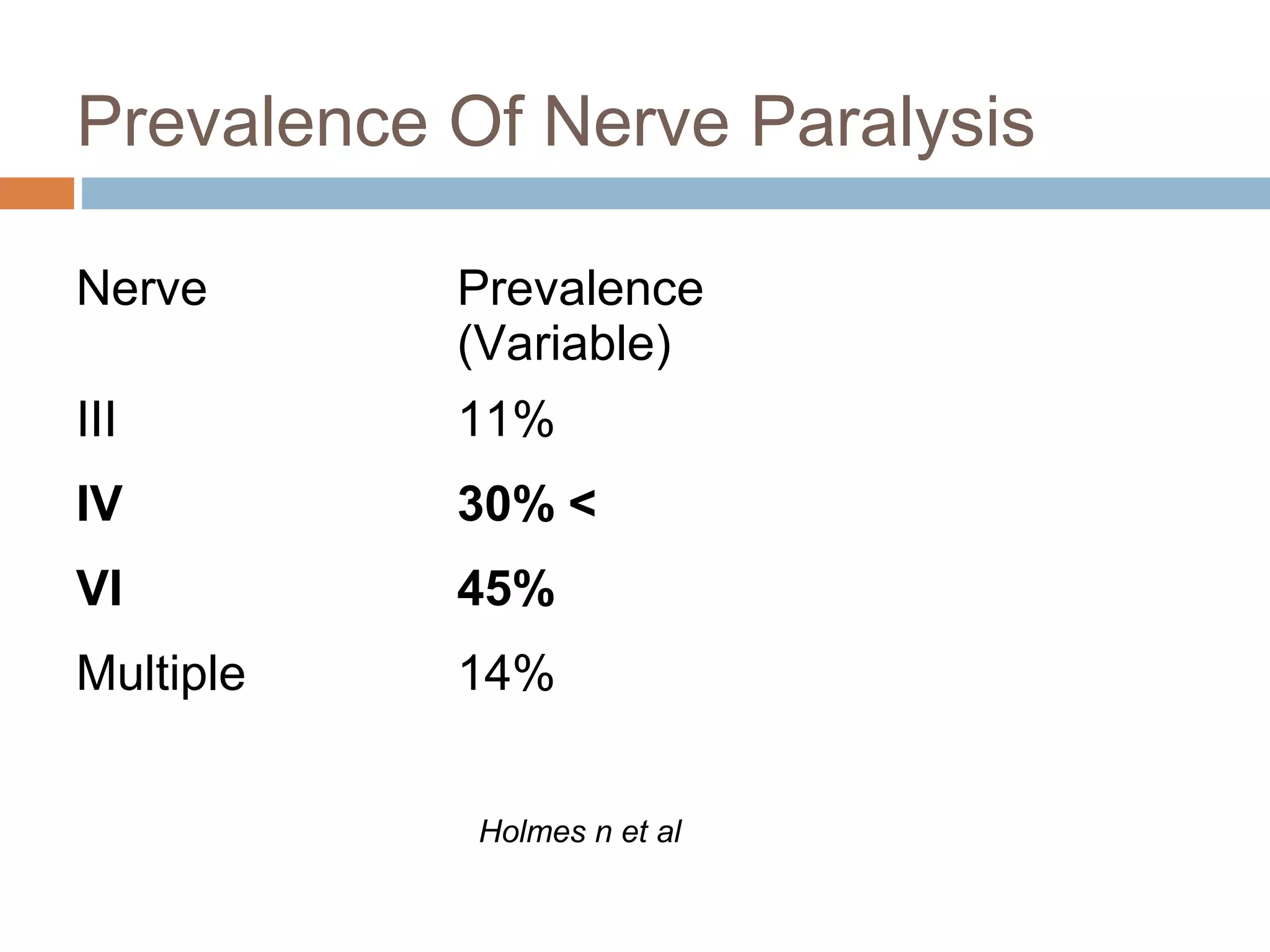
Prevalence Of Nerve Paralysis
Nerve Prevalence
(Variable)
III 11%
IV 30% <
VI 45%
Multiple 14%
Holmes n et al
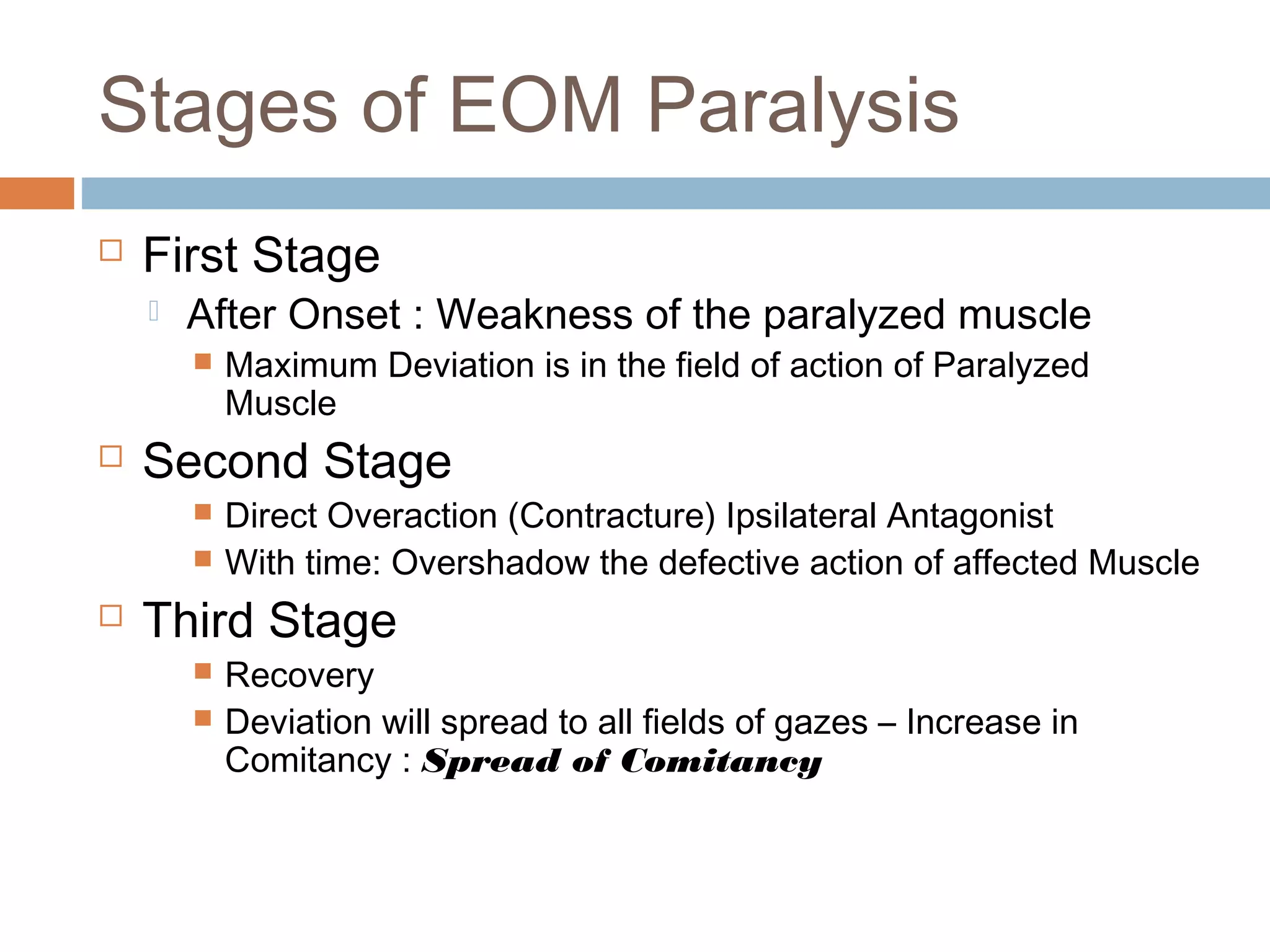
Stages of EOM Paralysis
 First Stage
 After Onset : Weakness of the paralyzed muscle
 Maximum Deviation is in the field of action of Paralyzed
Muscle
 Second Stage
 Direct Overaction (Contracture) Ipsilateral Antagonist
 With time: Overshadow the defective action of affected Muscle
 Third Stage
 Recovery
 Deviation will spread to all fields of gazes – Increase in
Comitancy : Spread of Comitancy
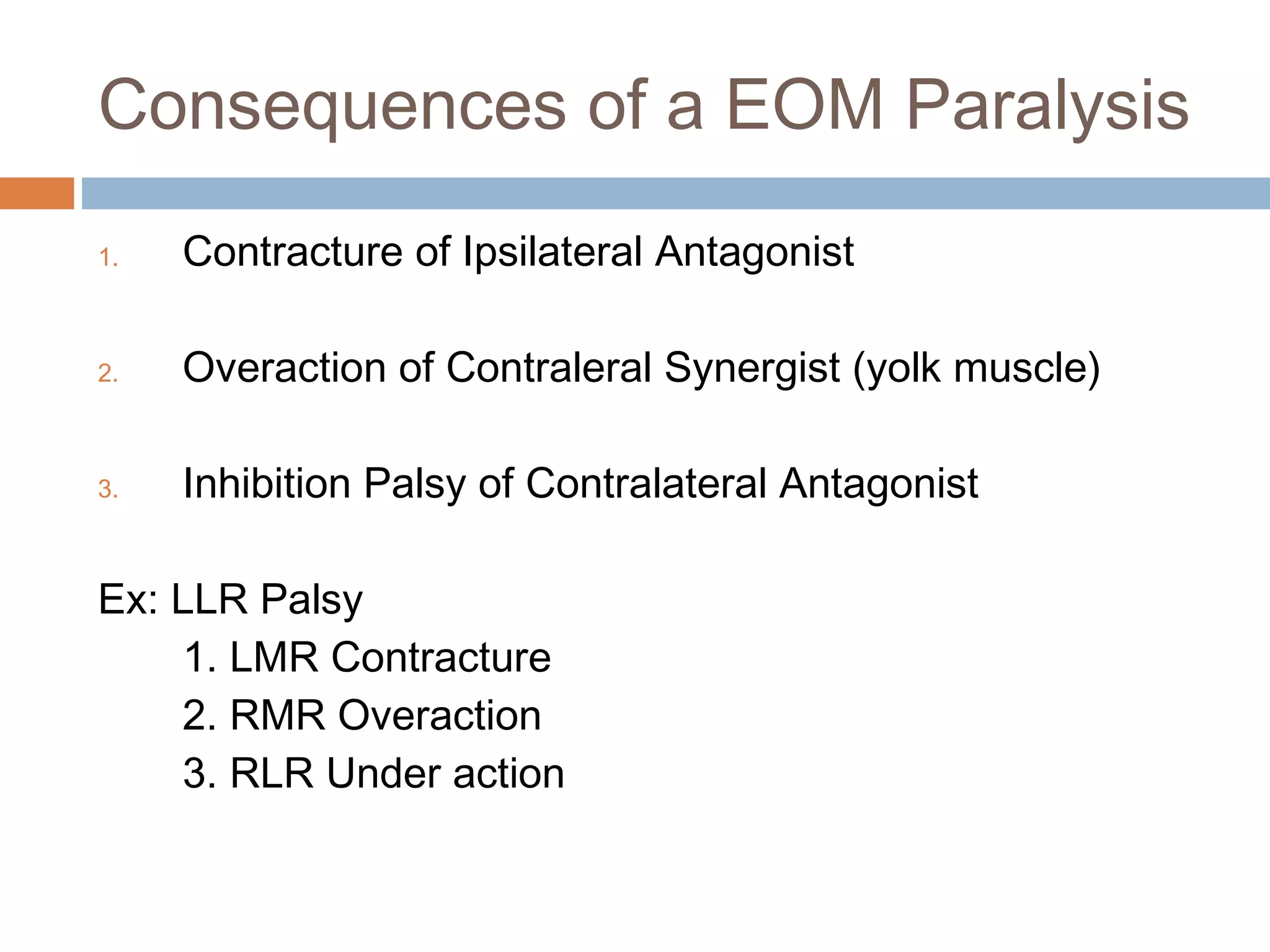
Consequences of a EOM Paralysis
1. Contracture of Ipsilateral Antagonist
2. Overaction of Contraleral Synergist (yolk muscle)
3. Inhibition Palsy of Contralateral Antagonist
Ex: LLR Palsy
1. LMR Contracture
2. RMR Overaction
3. RLR Under action
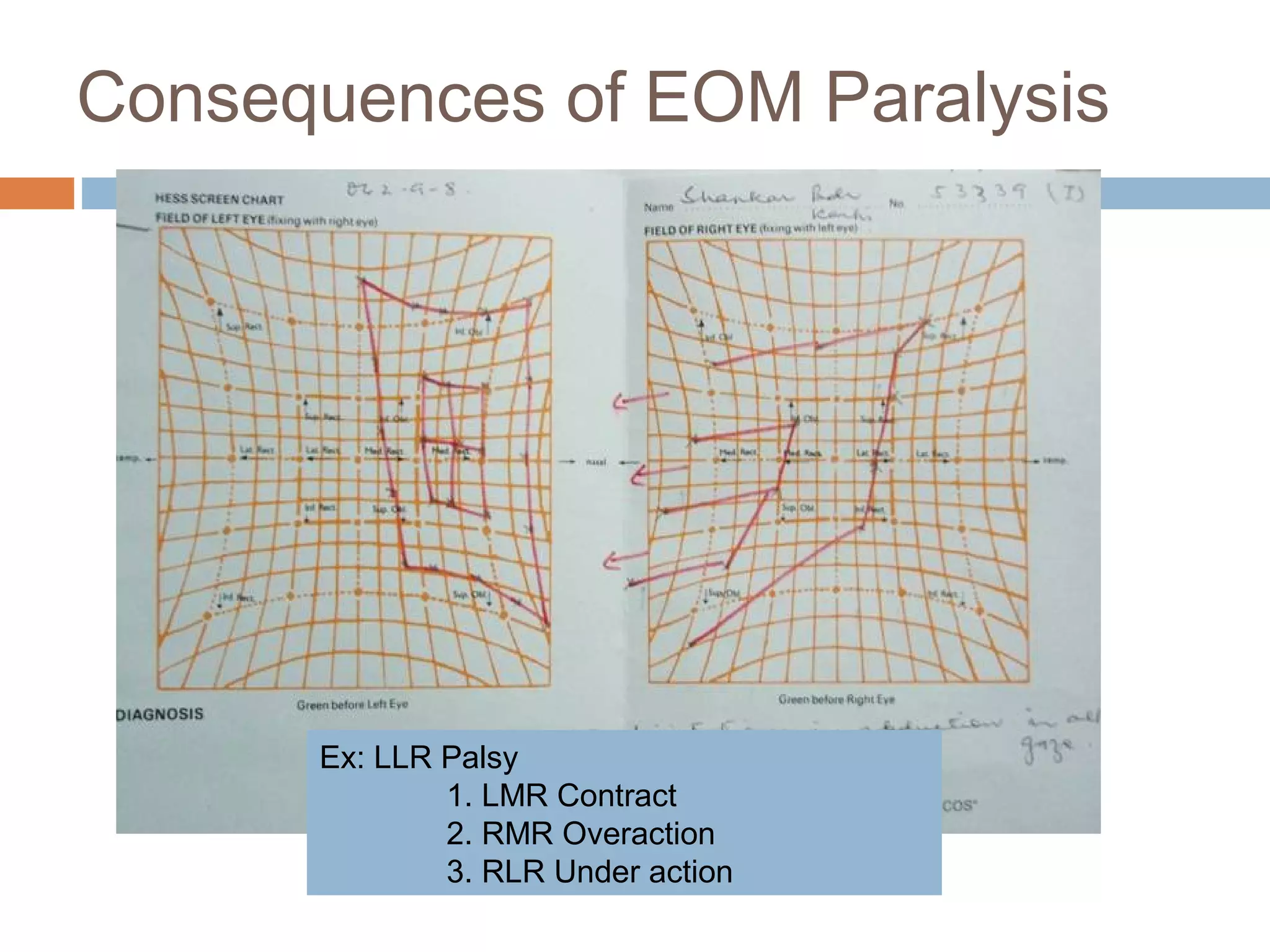
Consequences of EOM Paralysis
Ex: LLR Palsy
1. LMR Contract
2. RMR Overaction
3. RLR Under action
Individual Cranial Nerve Palsy
Oculomotor Nerve Paralysis
(III Cranial Nerve)
 III Nerve – Superior Branch – LPS/ SR
- Inferior Brach – MR/IO/ IR
- Intrinsic Muscles (Iris/ Ciliary Body)
 Rarely Isolated Muscle Paralysis
IIIrd
Cranial Nerve Paralysis
 PATHOPHYSIOLOGY
 Results from damage to the oculomotor nerve anywhere in its
 the nucleus in the dorsal mesencephalon
 fascicles in the brainstem parenchyma,
 the nerve root in subarachnoid space, or
 in the cavernous sinus or
 posterior orbit.
 Interesting Facts (Involvement of IIIrd Nerve Nucleus)
 Damage to the third nerve nucleus results in
 an ipsilateral third nerve palsy with contralateral superior rectus under action
and bilateral ptosis.
 Damage to the third nerve fascicles results in an ipsilateral third nerve
palsy with contralateral hemiparesis (Weber's syndrome),
IIIrd
Cranial Nerve Paralysis
 Damage to Course of IIIrd Nerve
 Damage at the level subarachnoid space produces
 an isolated third nerve palsy.
 causes
 Cavernous sinus involvement
 Rarely isolated IIIrd
Nerve palsy
 May include pareses of cranial nerves IV, VI and V-1, and an
ipsilateral Horner's syndrome.
 Common Causes
 metastatic disease, inflammation, herpes zoster, carotid artery
aneurysm, pituitary adenoma and apoplexy, and sphenoid wing
meningioma.
IIIrd
Cranial Nerve Paralysis
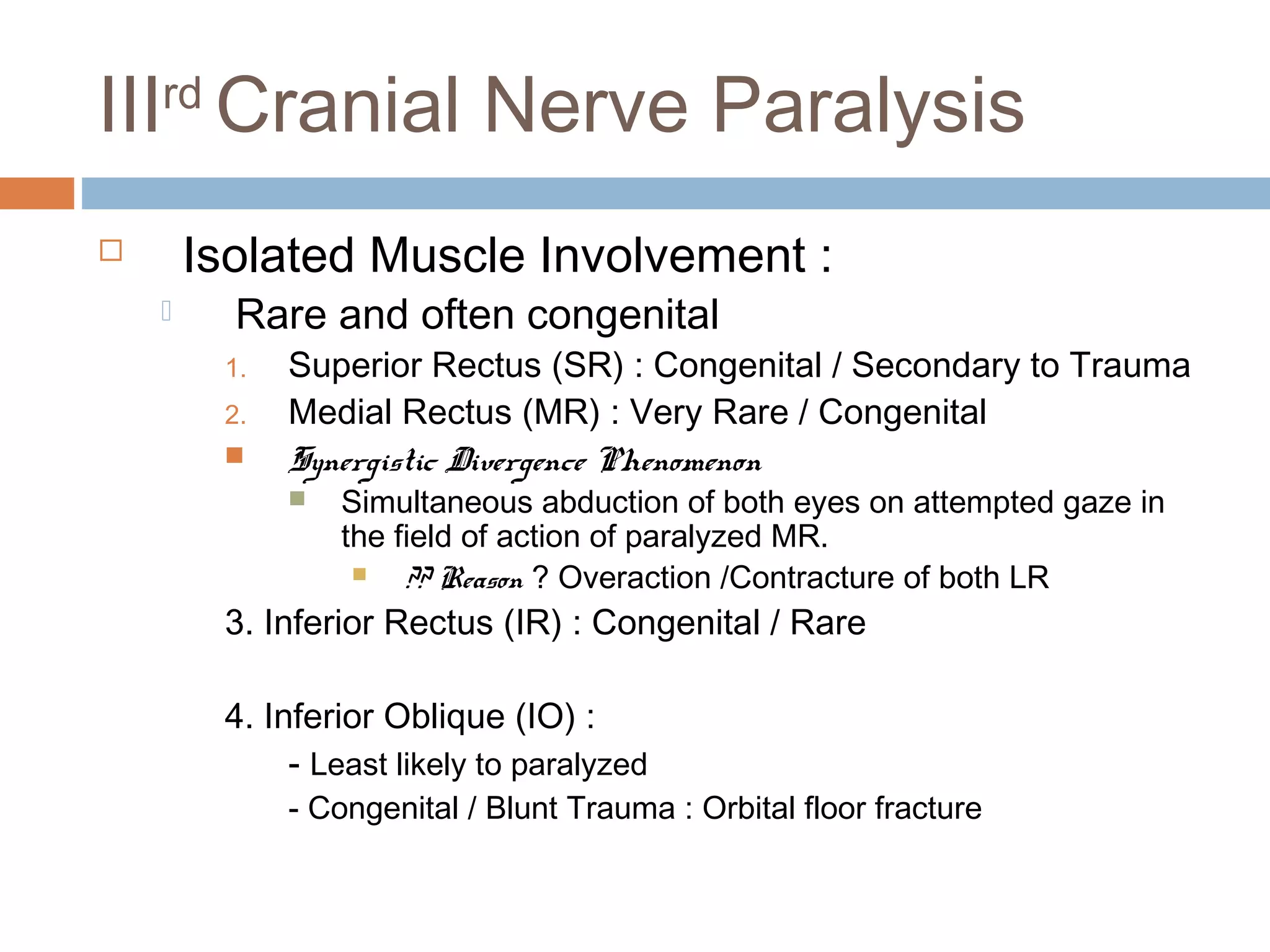
 Isolated Muscle Involvement :
 Rare and often congenital
1. Superior Rectus (SR) : Congenital / Secondary to Trauma
2. Medial Rectus (MR) : Very Rare / Congenital
 Synergistic Divergence Phenomenon
 Simultaneous abduction of both eyes on attempted gaze in
the field of action of paralyzed MR.
 ?? Reason ? Overaction /Contracture of both LR
3. Inferior Rectus (IR) : Congenital / Rare
4. Inferior Oblique (IO) :
- Least likely to paralyzed
- Congenital / Blunt Trauma : Orbital floor fracture
IIIrd
Cranial Nerve Paralysis
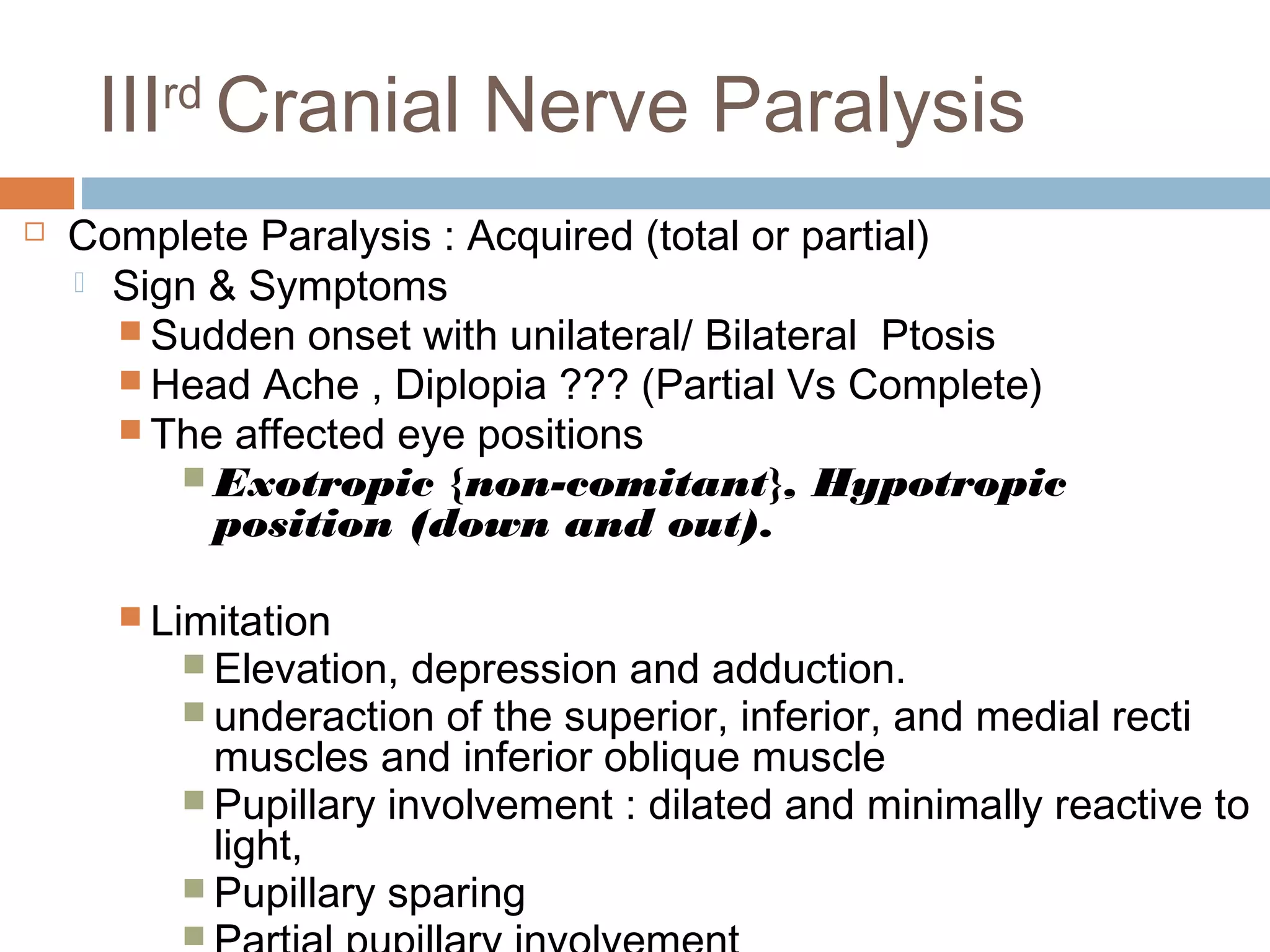
 Complete Paralysis : Acquired (total or partial)
 Sign & Symptoms
 Sudden onset with unilateral/ Bilateral Ptosis
 Head Ache , Diplopia ??? (Partial Vs Complete)
 The affected eye positions
 Exotropic {non-comitant}, Hypotropic
position (down and out).
 Limitation
 Elevation, depression and adduction.
 underaction of the superior, inferior, and medial recti
muscles and inferior oblique muscle
 Pupillary involvement : dilated and minimally reactive to
light,
 Pupillary sparing

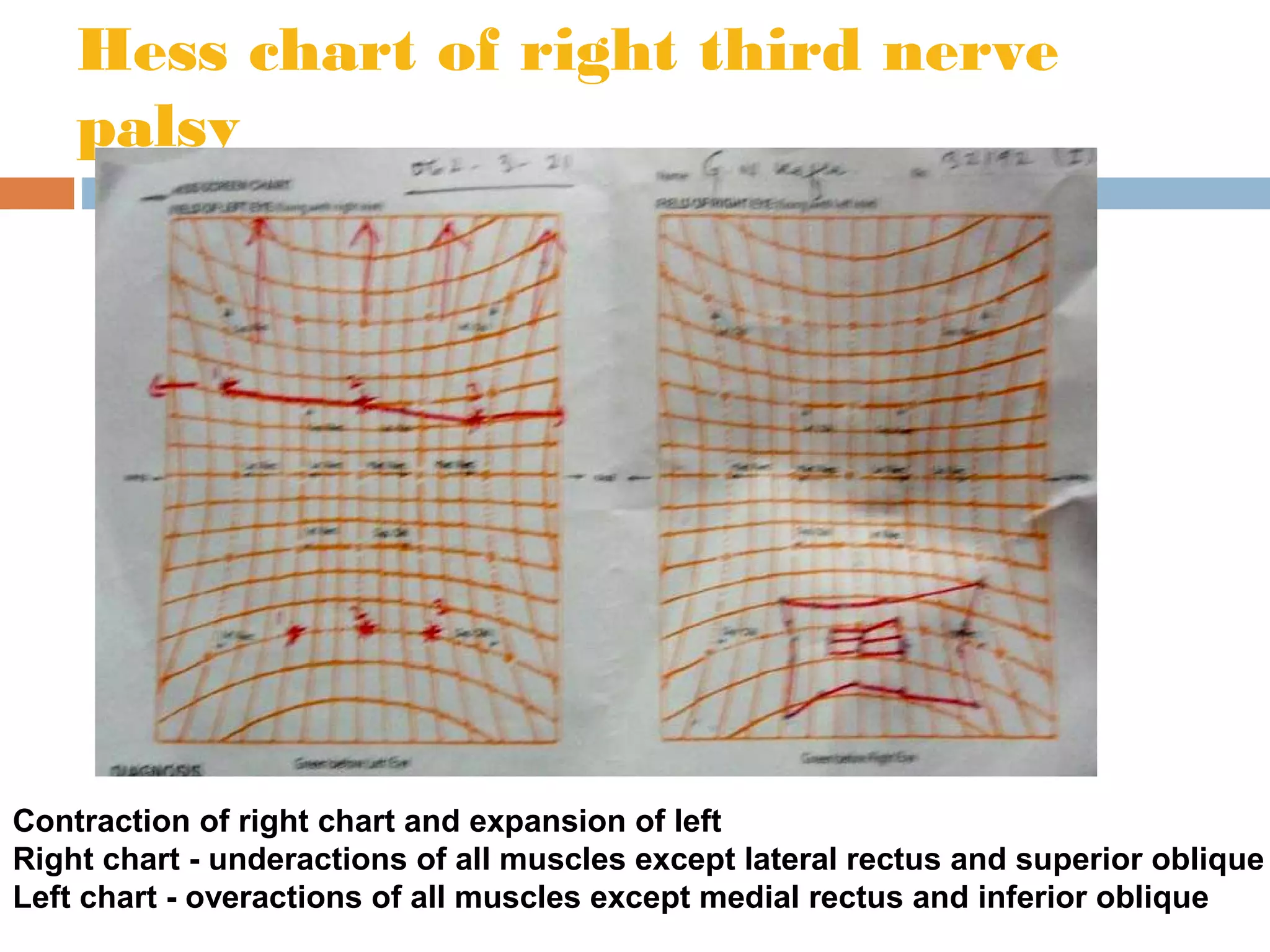
Hess chart of right third nerve
palsy
Contraction of right chart and expansion of left
Right chart - underactions of all muscles except lateral rectus and superior oblique
Left chart - overactions of all muscles except medial rectus and inferior oblique
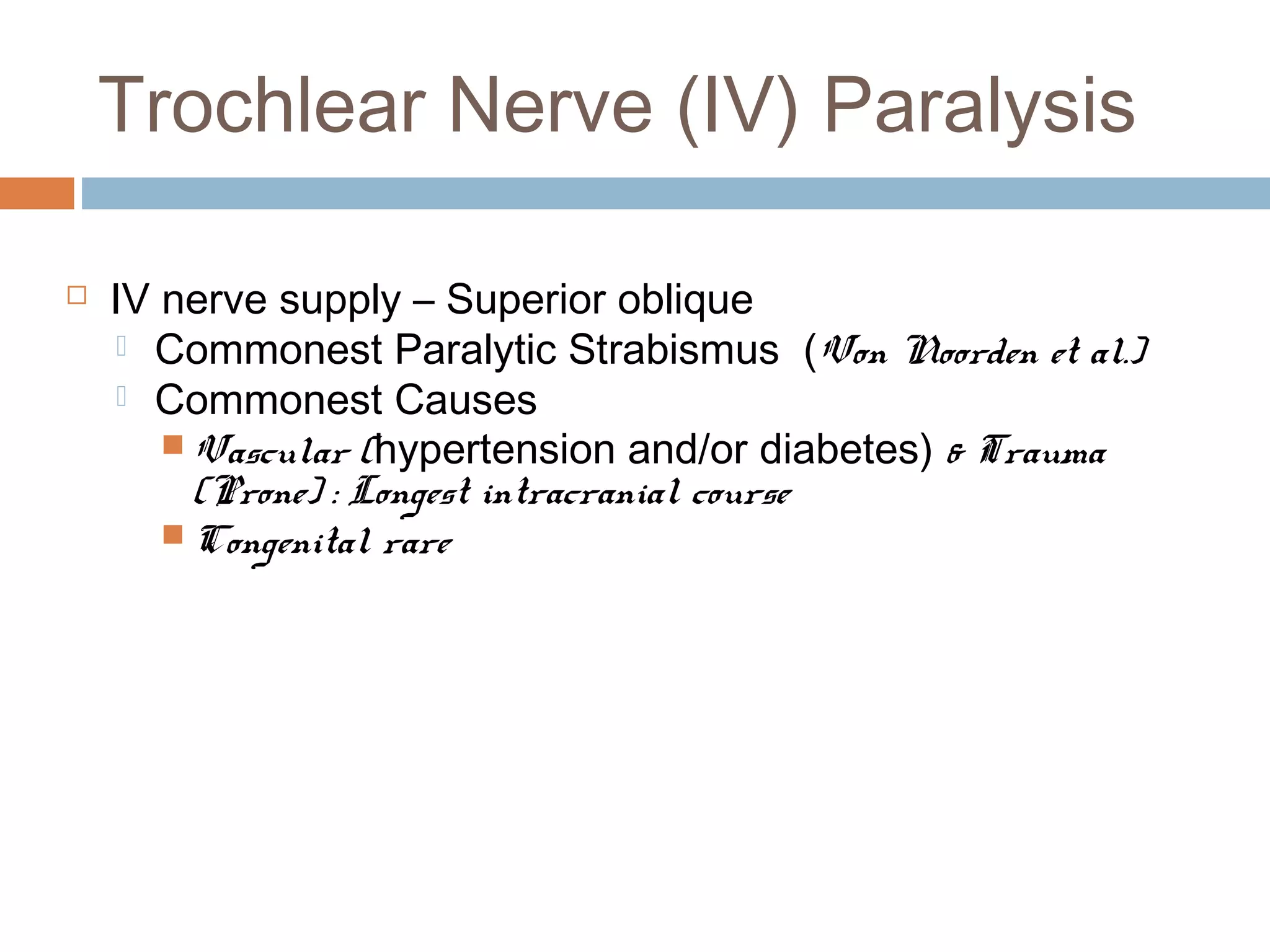
Trochlear Nerve (IV) Paralysis
 IV nerve supply – Superior oblique
 Commonest Paralytic Strabismus (Von Noorden et al.)
 Commonest Causes
 Vascular (hypertension and/or diabetes) & Trauma
(Prone) : Longest intracranial course
 Congenital rare
Trochlear Nerve (IV) Paralysis
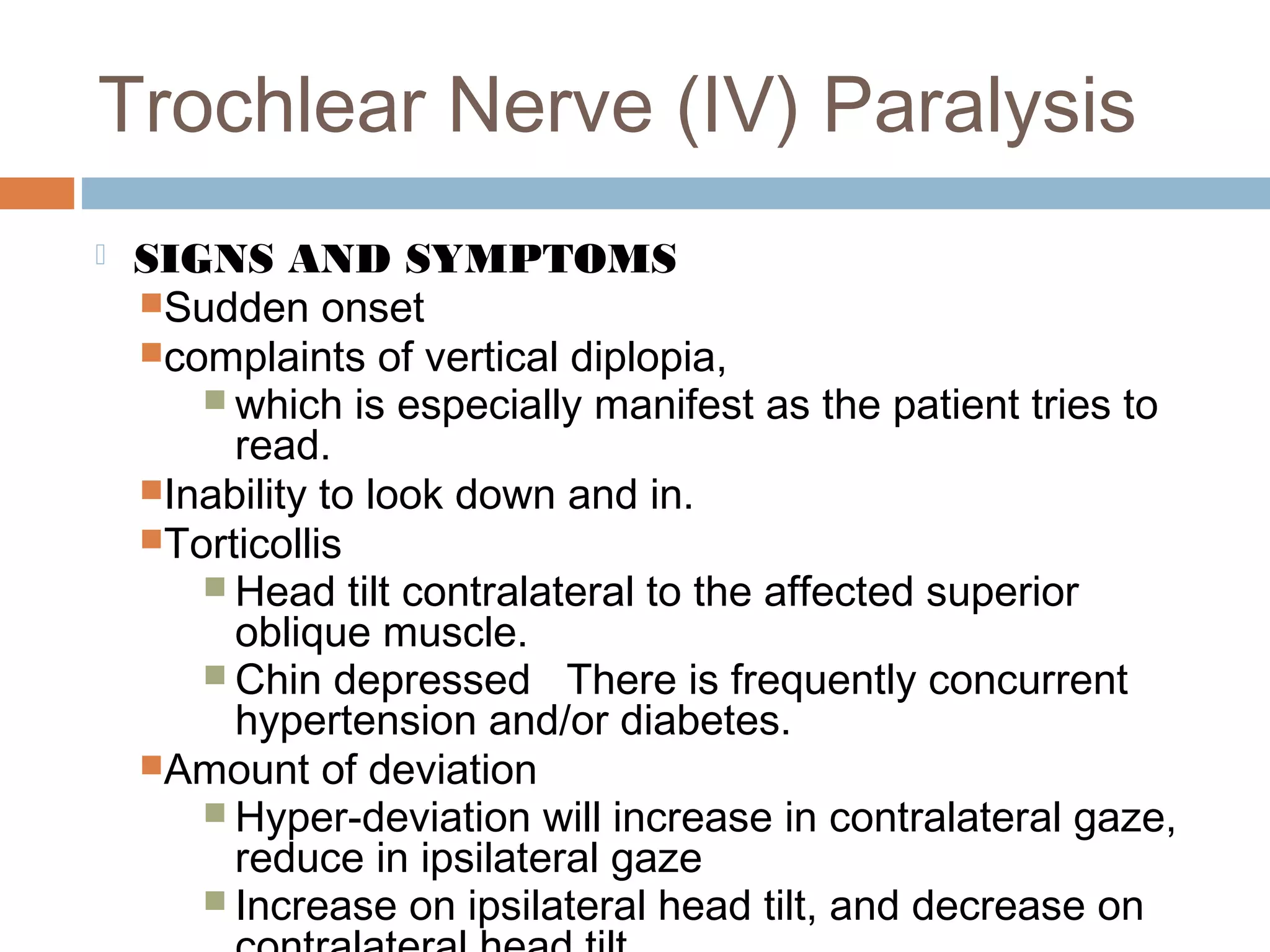
 SIGNS AND SYMPTOMS
Sudden onset
complaints of vertical diplopia,
 which is especially manifest as the patient tries to
read.
Inability to look down and in.
Torticollis
 Head tilt contralateral to the affected superior
oblique muscle.
 Chin depressed There is frequently concurrent
hypertension and/or diabetes.
Amount of deviation
 Hyper-deviation will increase in contralateral gaze,
reduce in ipsilateral gaze
 Increase on ipsilateral head tilt, and decrease on
Trochlear Nerve (IV) Paralysis
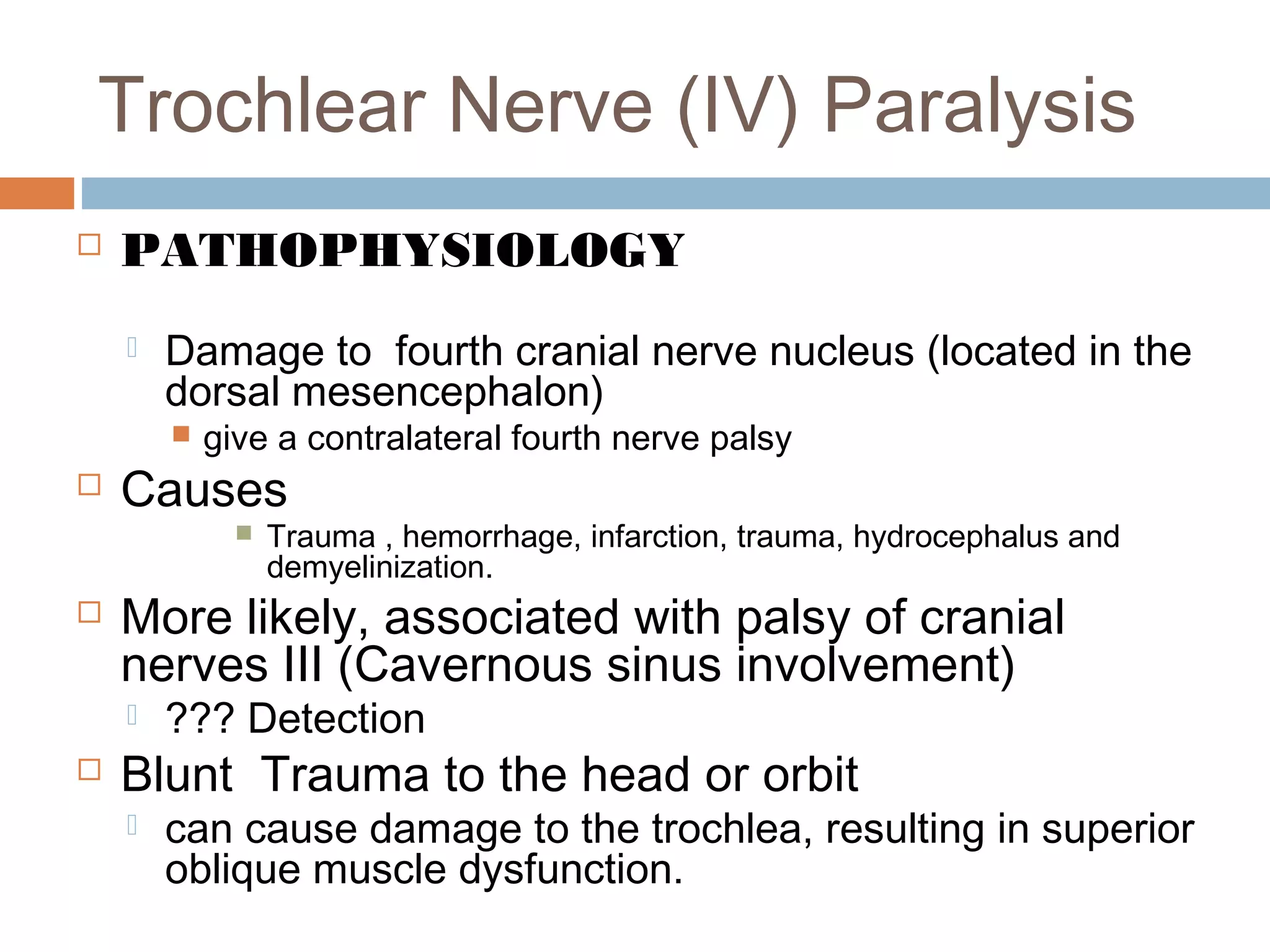
 PATHOPHYSIOLOGY
 Damage to fourth cranial nerve nucleus (located in the
dorsal mesencephalon)
 give a contralateral fourth nerve palsy
 Causes
 Trauma , hemorrhage, infarction, trauma, hydrocephalus and
demyelinization.
 More likely, associated with palsy of cranial
nerves III (Cavernous sinus involvement)
 ??? Detection
 Blunt Trauma to the head or orbit
 can cause damage to the trochlea, resulting in superior
oblique muscle dysfunction.
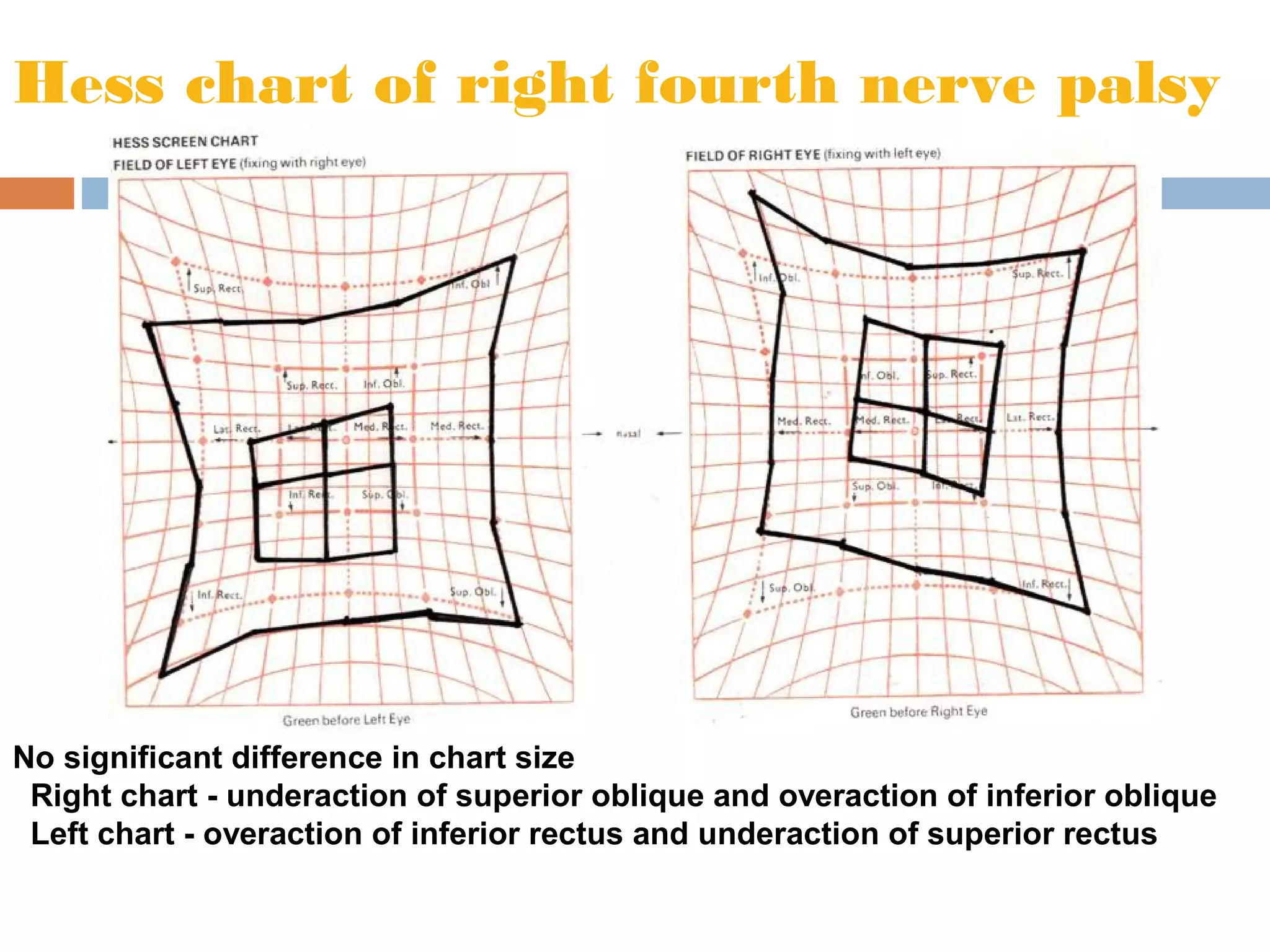
Hess chart of right fourth nerve palsy
No significant difference in chart size
Right chart - underaction of superior oblique and overaction of inferior oblique
Left chart - overaction of inferior rectus and underaction of superior rectus
CRANIAL NERVE VI PALSY
(Abducen)
 VI Supply – Lateral Rectus muscle
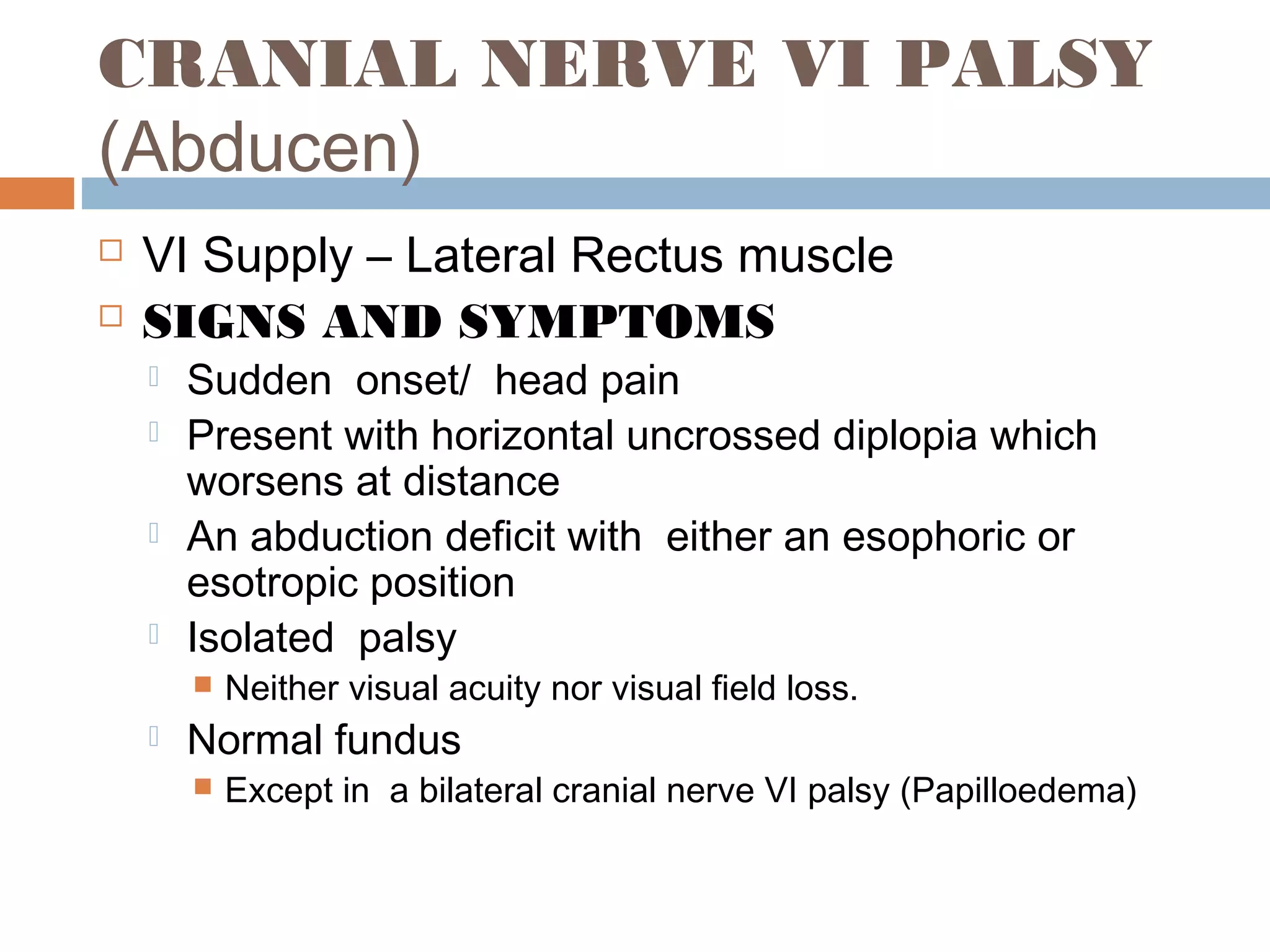
 SIGNS AND SYMPTOMS
 Sudden onset/ head pain
 Present with horizontal uncrossed diplopia which
worsens at distance
 An abduction deficit with either an esophoric or
esotropic position
 Isolated palsy
 Neither visual acuity nor visual field loss.
 Normal fundus
 Except in a bilateral cranial nerve VI palsy (Papilloedema)
CRANIAL NERVE VI PALSY
Abducen
 PATHOPHYSIOLOGY
 Originate from Pons
 Close association with the facial nerve & PPRF
 Damage to the sixth nerve at the brain stem
 VII (facial) nerve palsy or an internuclear ophthalmoplegia.
 Within the cavernous sinus
 the sixth nerve is joined by
 the oculosympathetic nerves and cranial nerves III, IV and V-1.
 Damage
 VI palsy and Horner's syndrome
 Concurrent CN III and IV palsy.
 Causes :
 Aneurysm, meningioma, pituitary adenoma, inflammation, or fistula.
ischemic infarction
 Diabetes and hypertension;
 prime cause of isolated sixth nerve palsy.
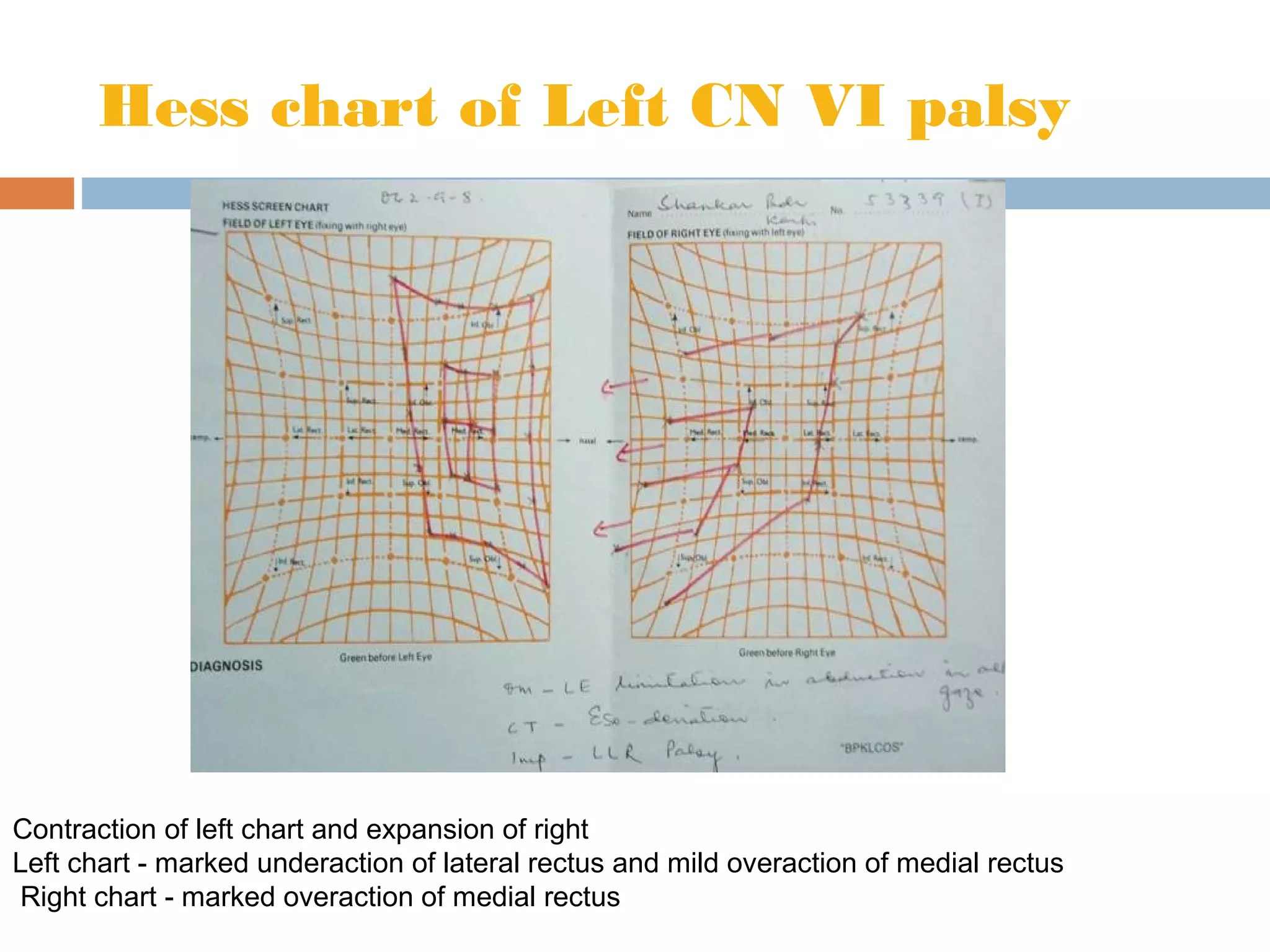
Hess chart of Left CN VI palsy
Contraction of left chart and expansion of right
Left chart - marked underaction of lateral rectus and mild overaction of medial rectus
Right chart - marked overaction of medial rectus
Clinical Evaluation of Paralytic
Strabismus
1. Observation
2. EOM Evaluation
3. Cover Test
4. Measurement of deviation
5. Past Pointing
6. Head tilt Test
7. Diplopia/ Hess Charting
8. Force duction/ Force Generation test
9. Imaging Test (CT/ MRI)
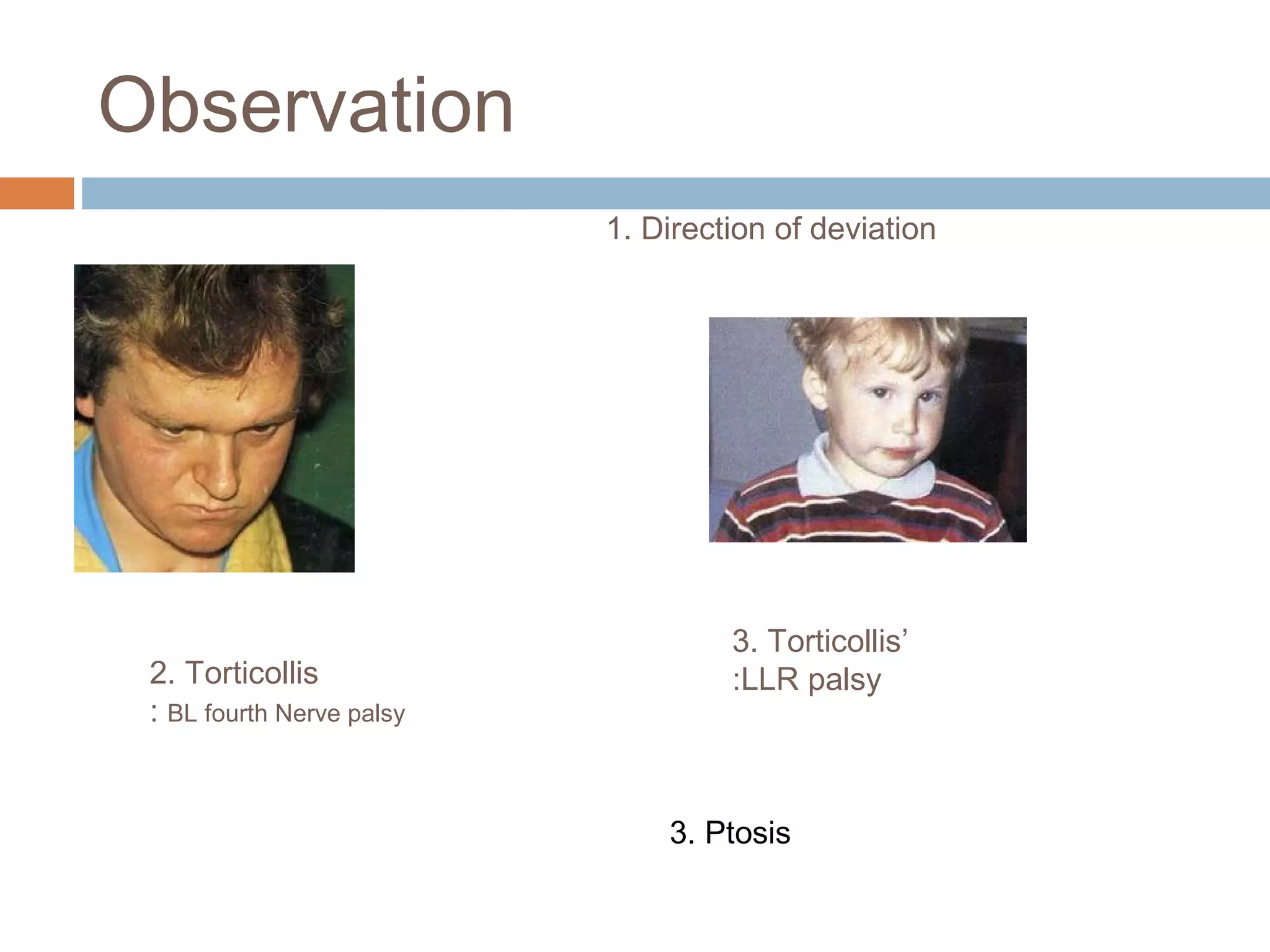
Observation
2. Torticollis
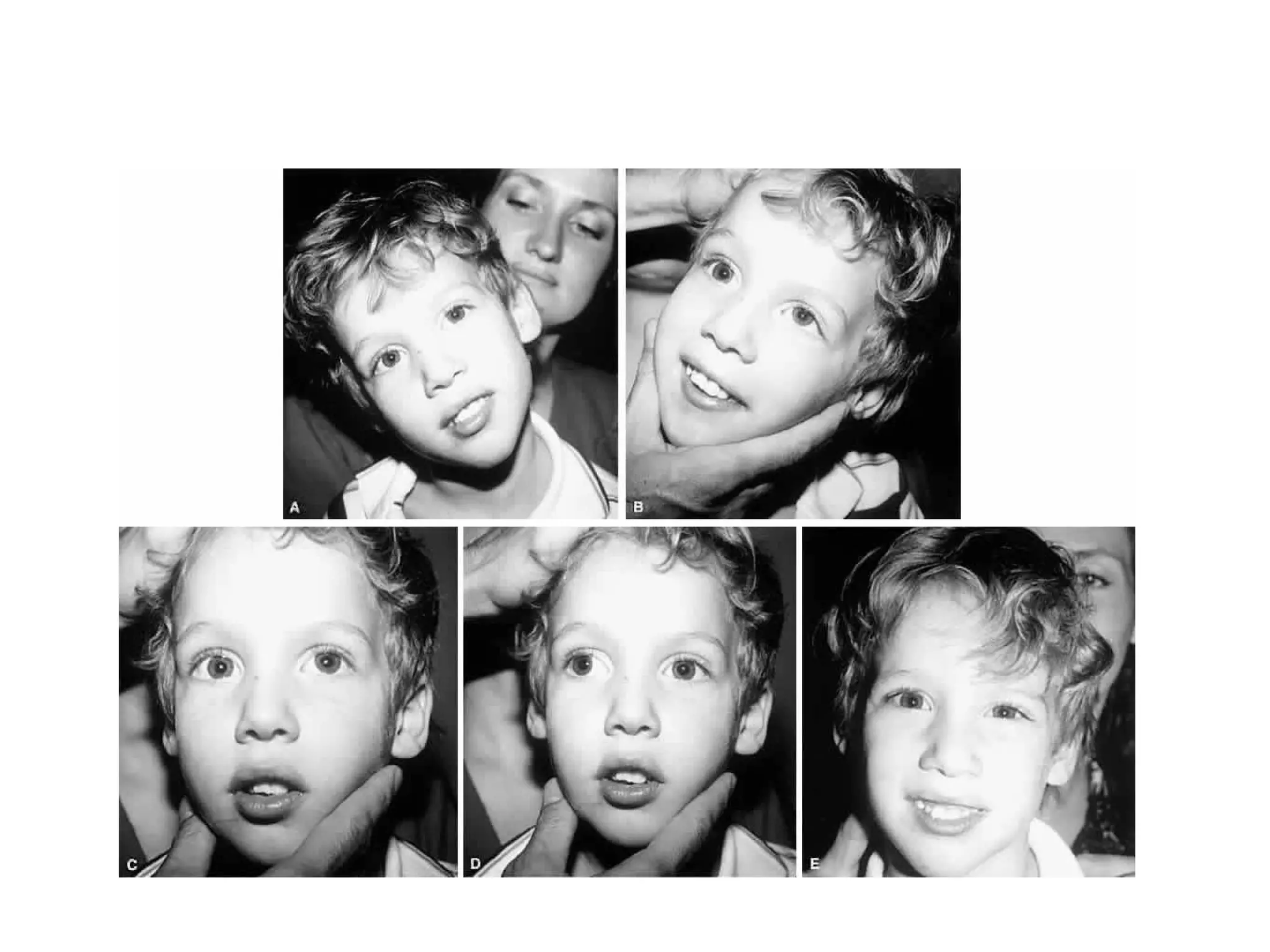
: BL fourth Nerve palsy
3. Torticollis’
:LLR palsy
1. Direction of deviation
3. Ptosis
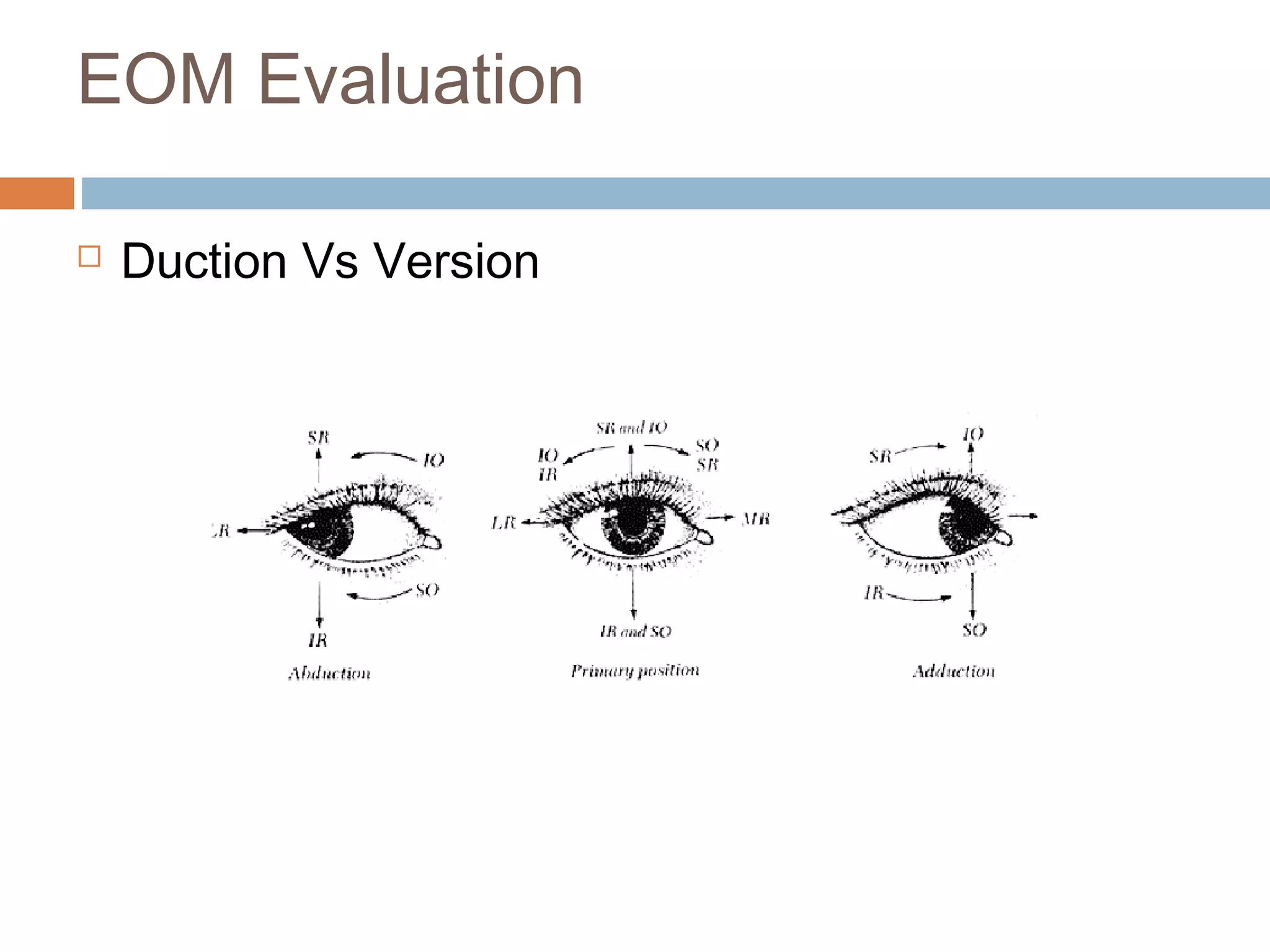
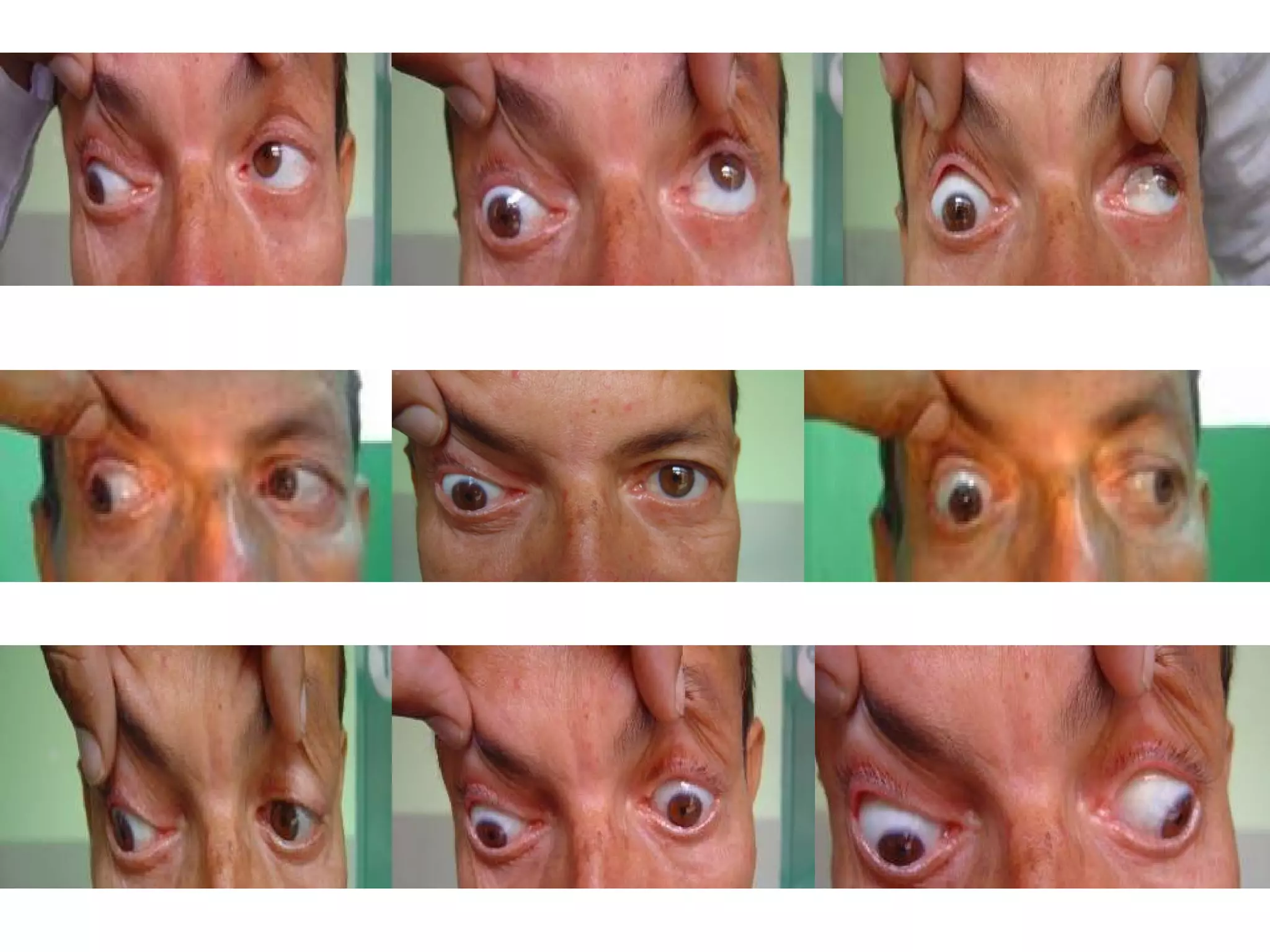
EOM Evaluation
 Duction Vs Version
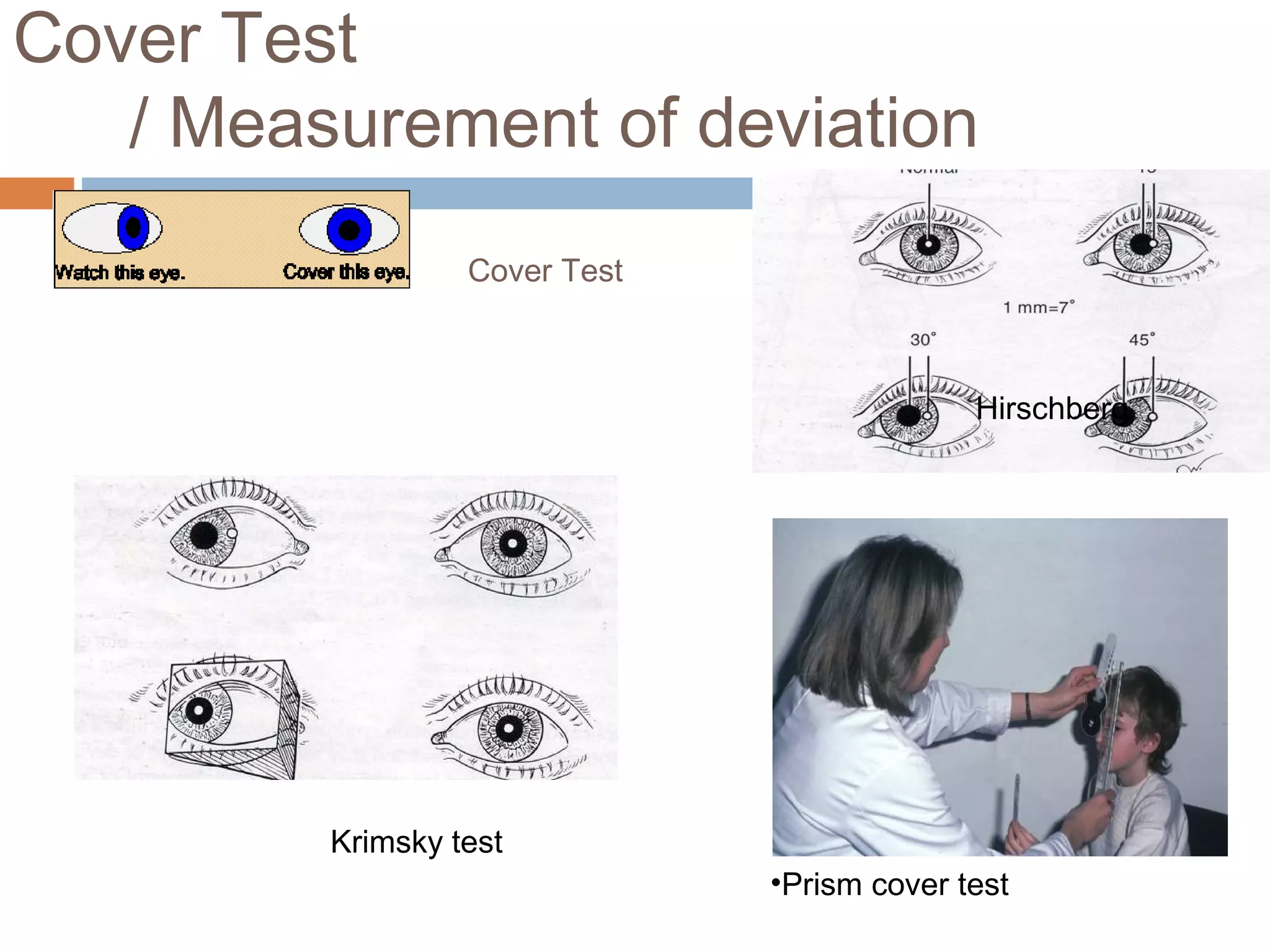
Cover Test
/ Measurement of deviation
Hirschberg
Krimsky test
•Prism cover test
Cover Test
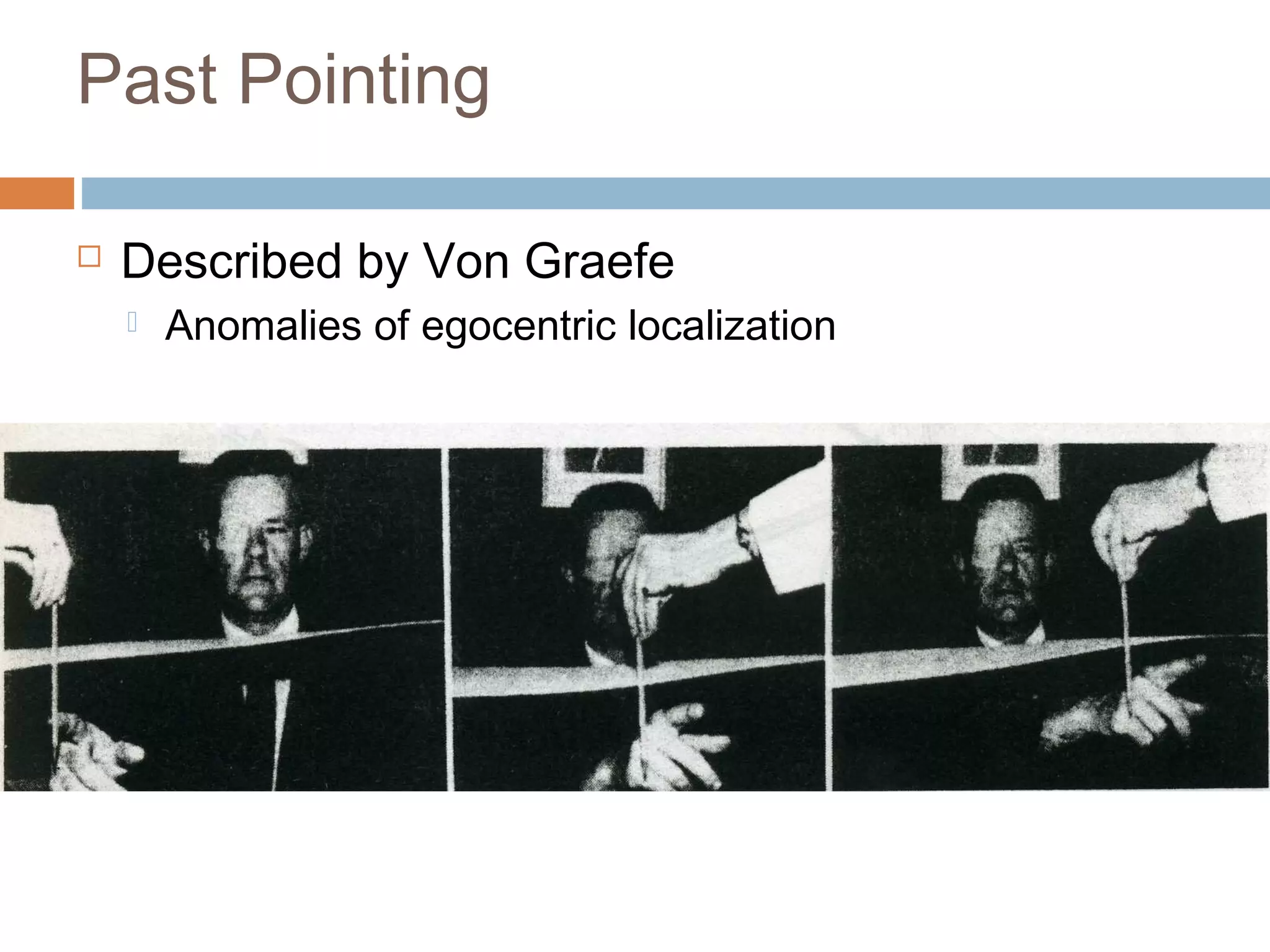
Past Pointing
 Described by Von Graefe
 Anomalies of egocentric localization
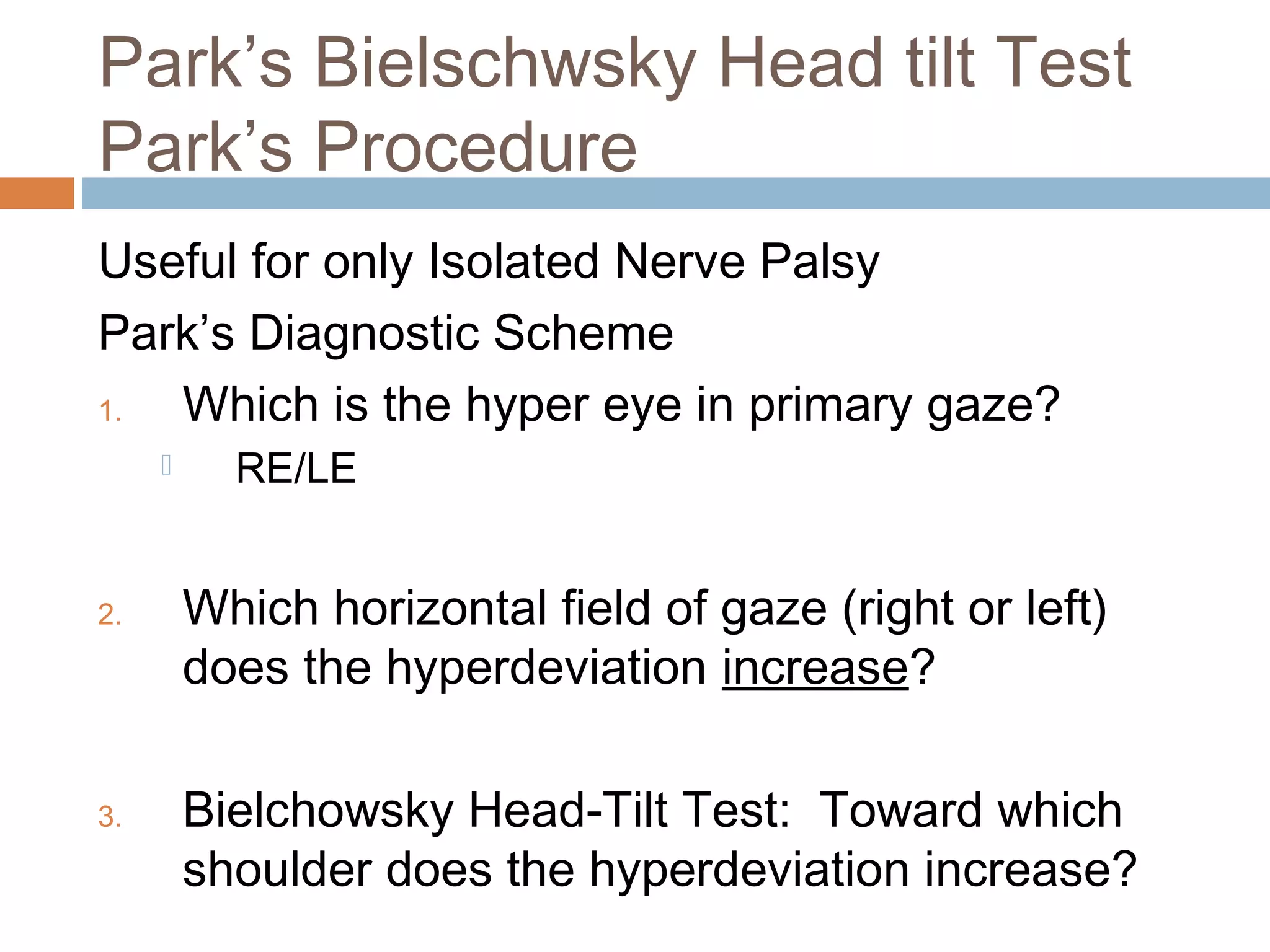
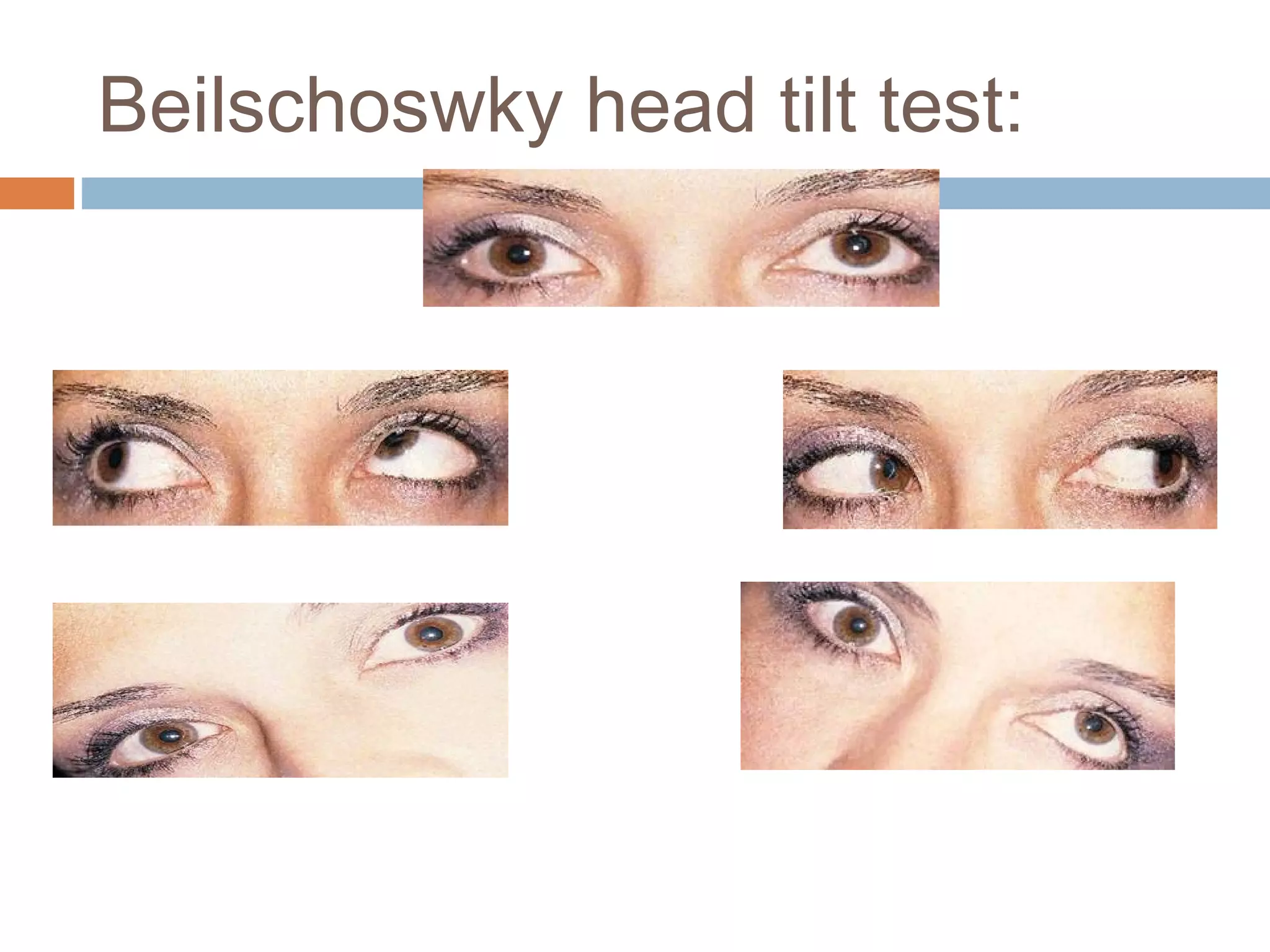
Park’s Bielschwsky Head tilt Test
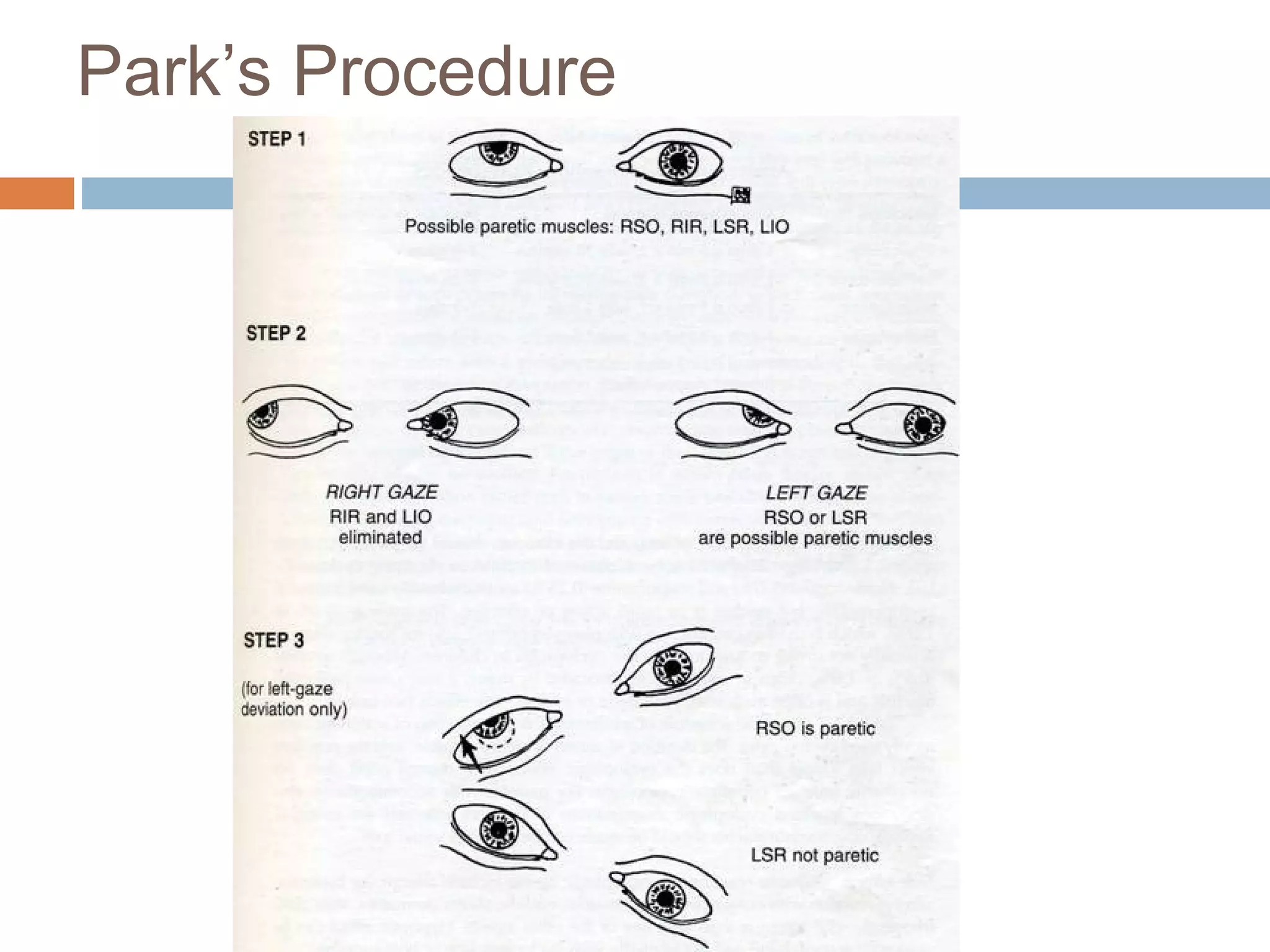
Park’s Procedure
Useful for only Isolated Nerve Palsy
Park’s Diagnostic Scheme
1. Which is the hyper eye in primary gaze?
 RE/LE
2. Which horizontal field of gaze (right or left)
does the hyperdeviation increase?
3. Bielchowsky Head-Tilt Test: Toward which
shoulder does the hyperdeviation increase?
Beilschoswky head tilt test:
Park’s Procedure
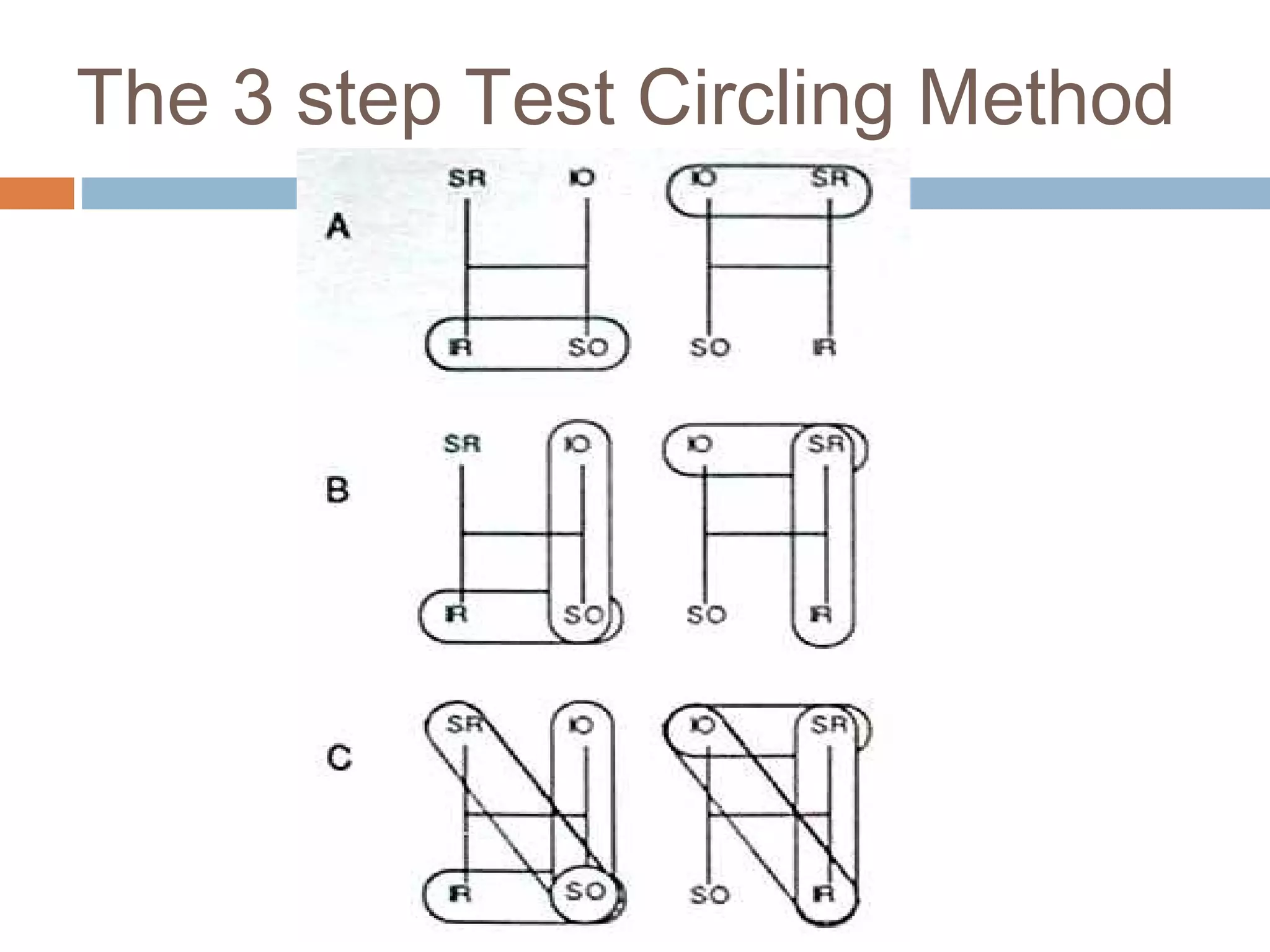
The 3 step Test Circling Method
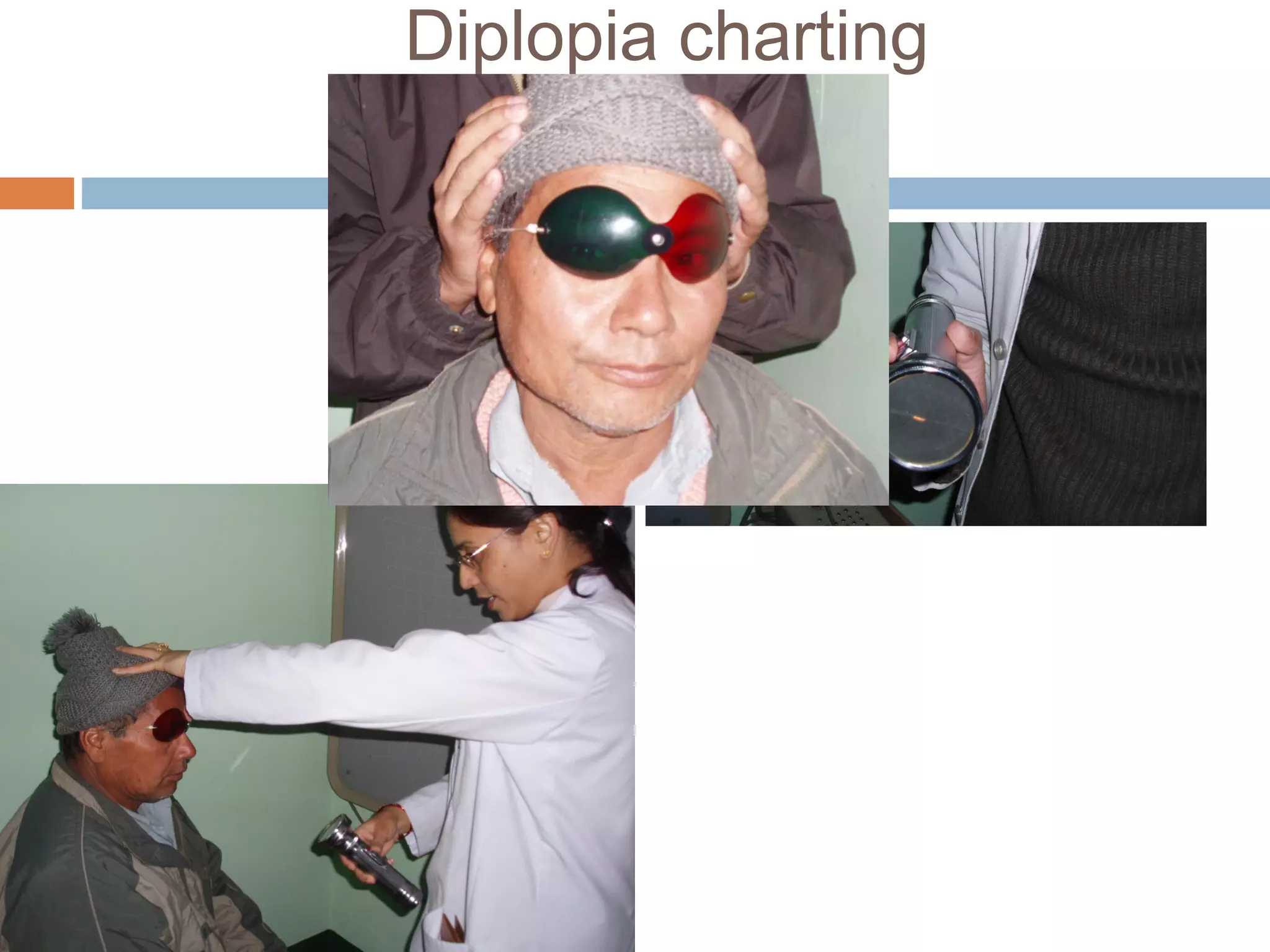
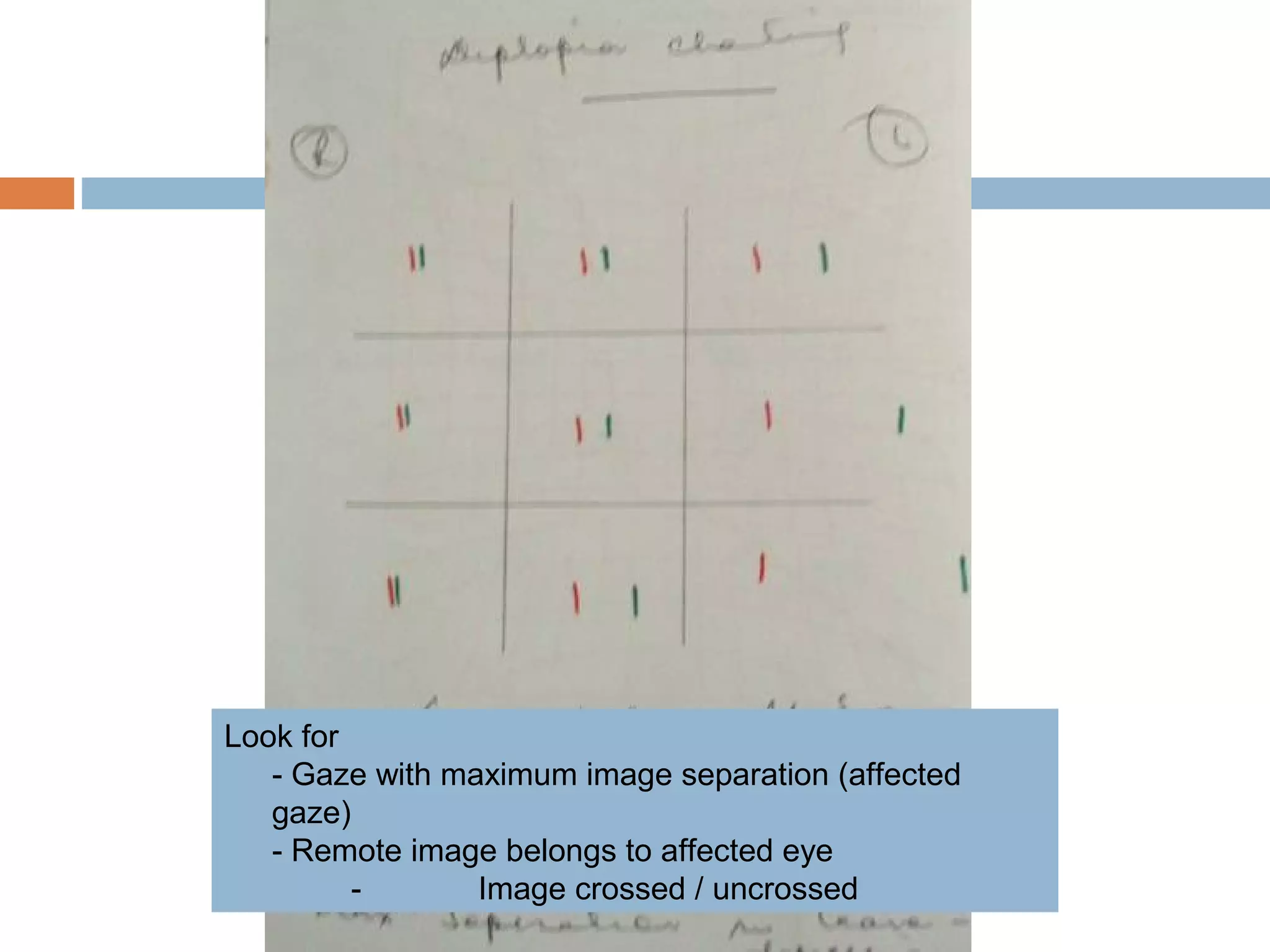
Diplopia charting
Look for
- Gaze with maximum image separation (affected
gaze)
- Remote image belongs to affected eye
- Image crossed / uncrossed
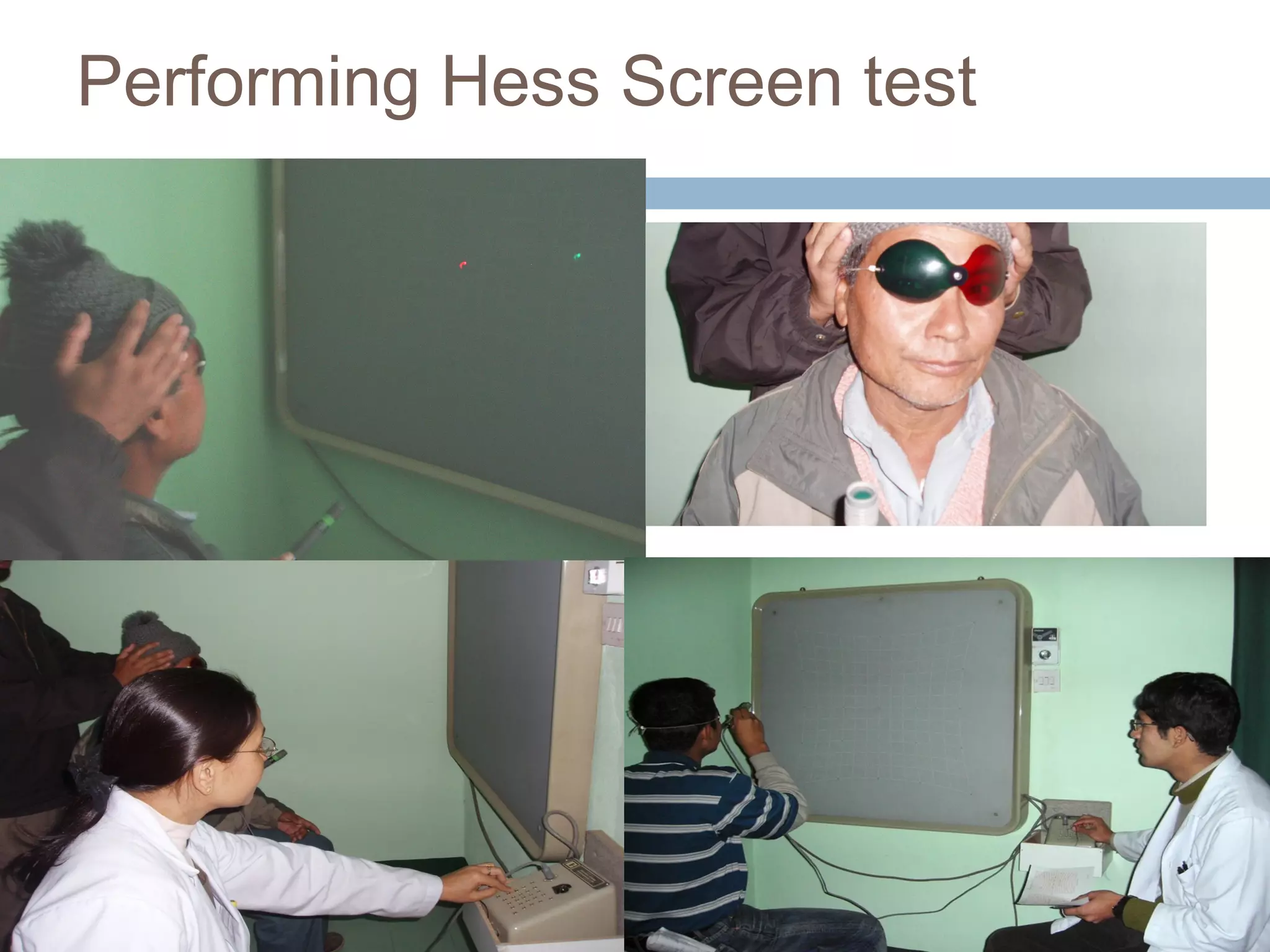
Performing Hess Screen test
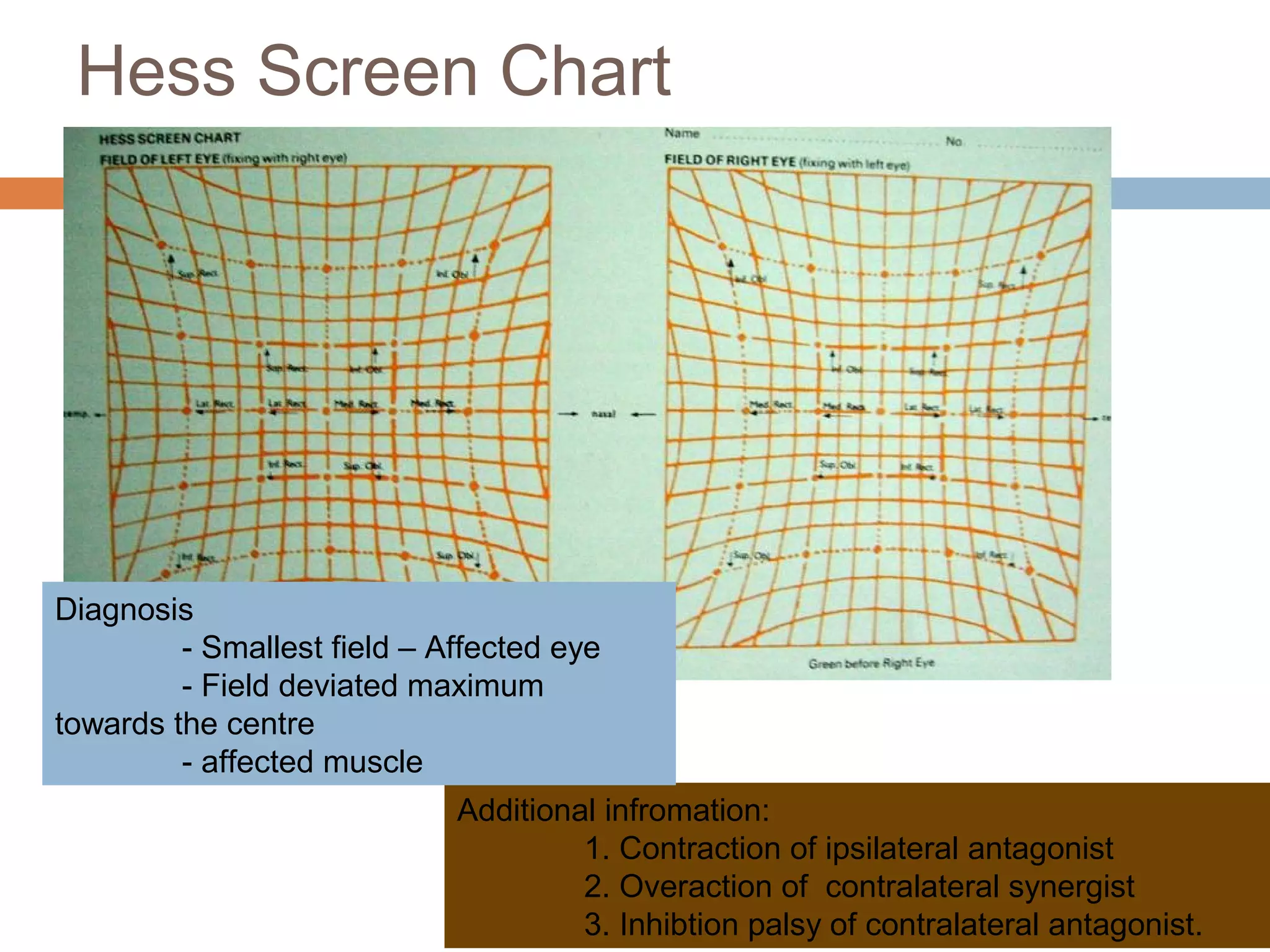
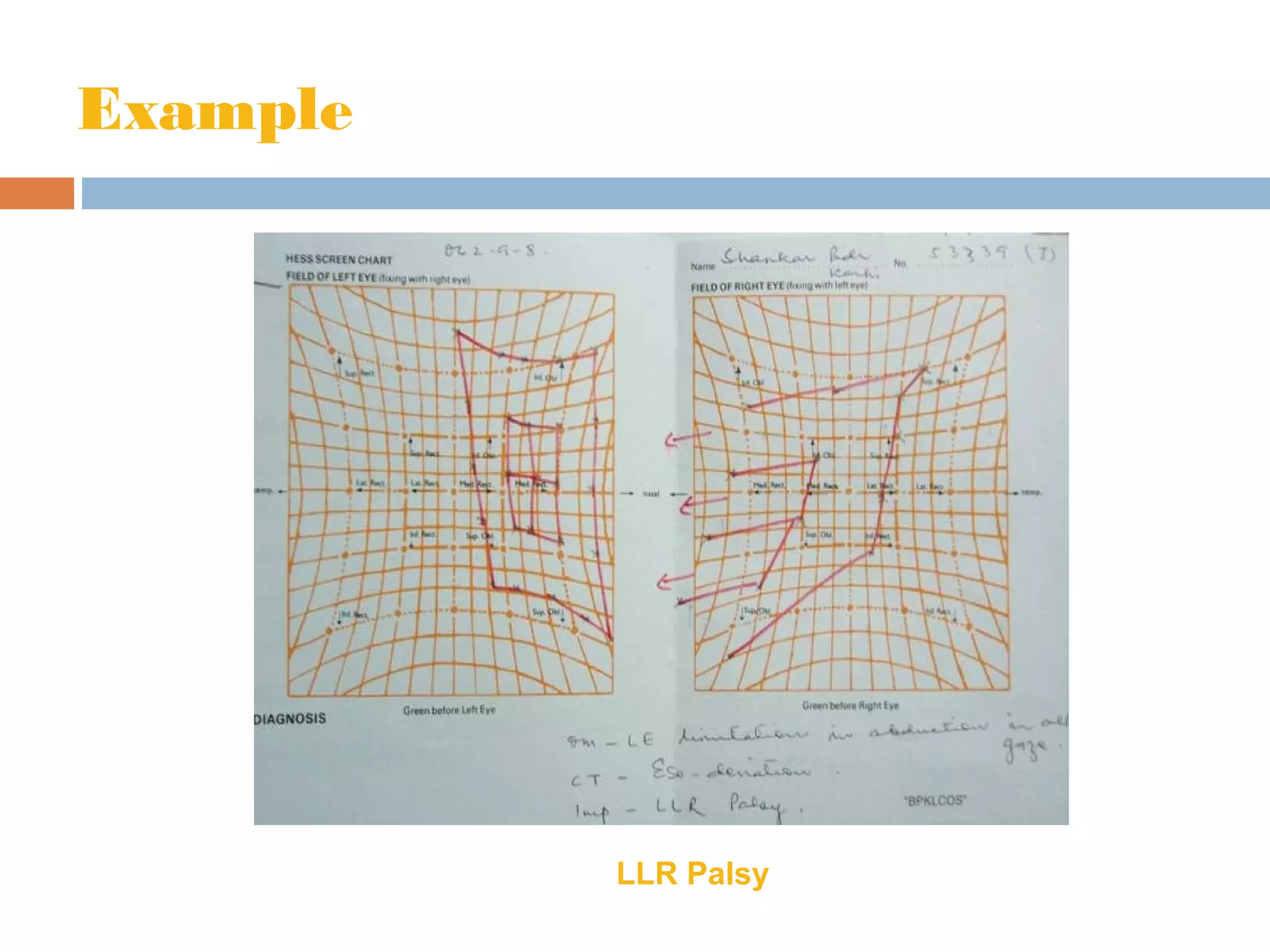
Hess Screen Chart
Additional infromation:
1. Contraction of ipsilateral antagonist
2. Overaction of contralateral synergist
3. Inhibtion palsy of contralateral antagonist.
Diagnosis
- Smallest field – Affected eye
- Field deviated maximum
towards the centre
- affected muscle
Example
LLR Palsy
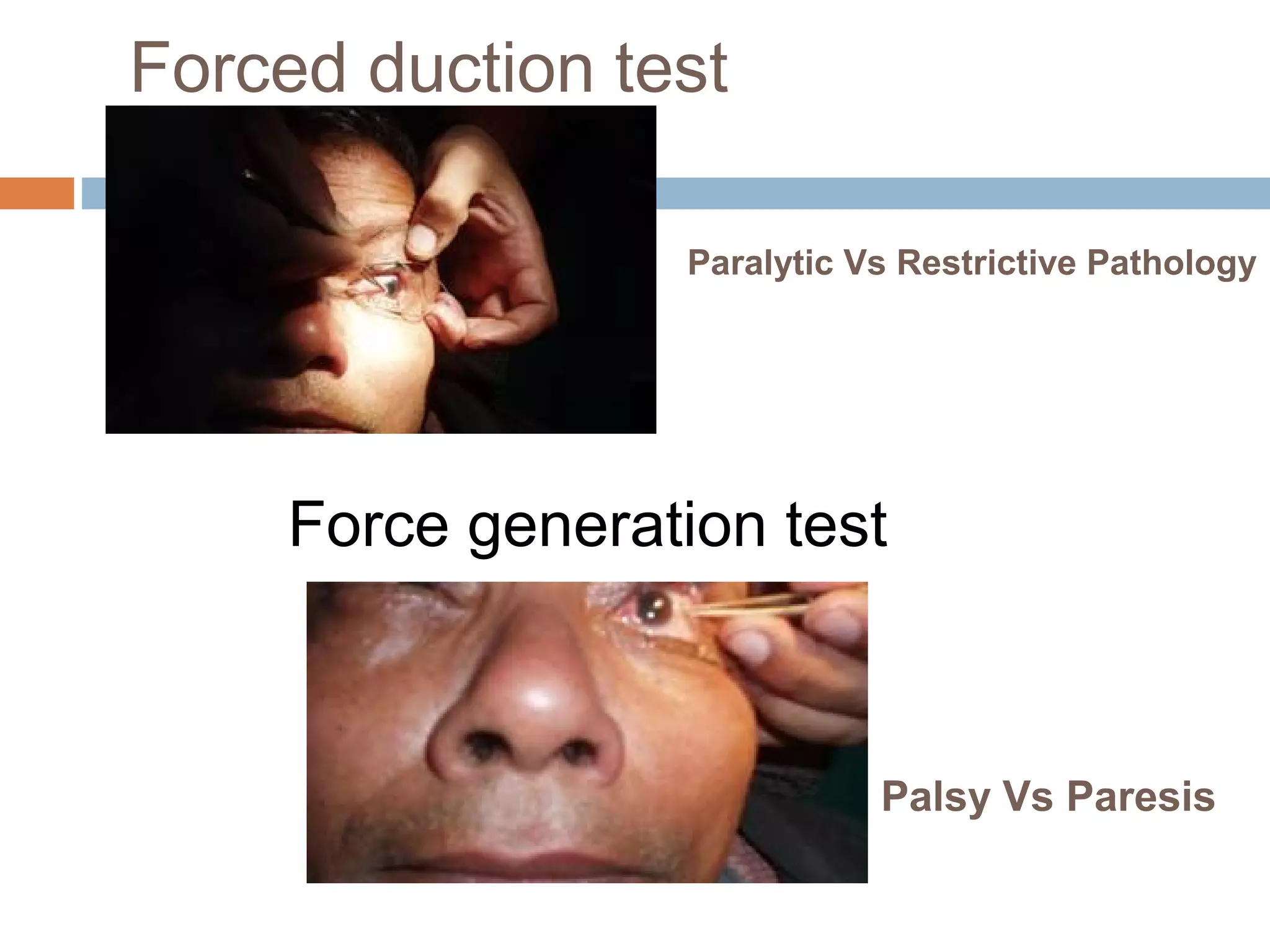
Forced duction test
Force generation test
Palsy Vs Paresis
Paralytic Vs Restrictive Pathology
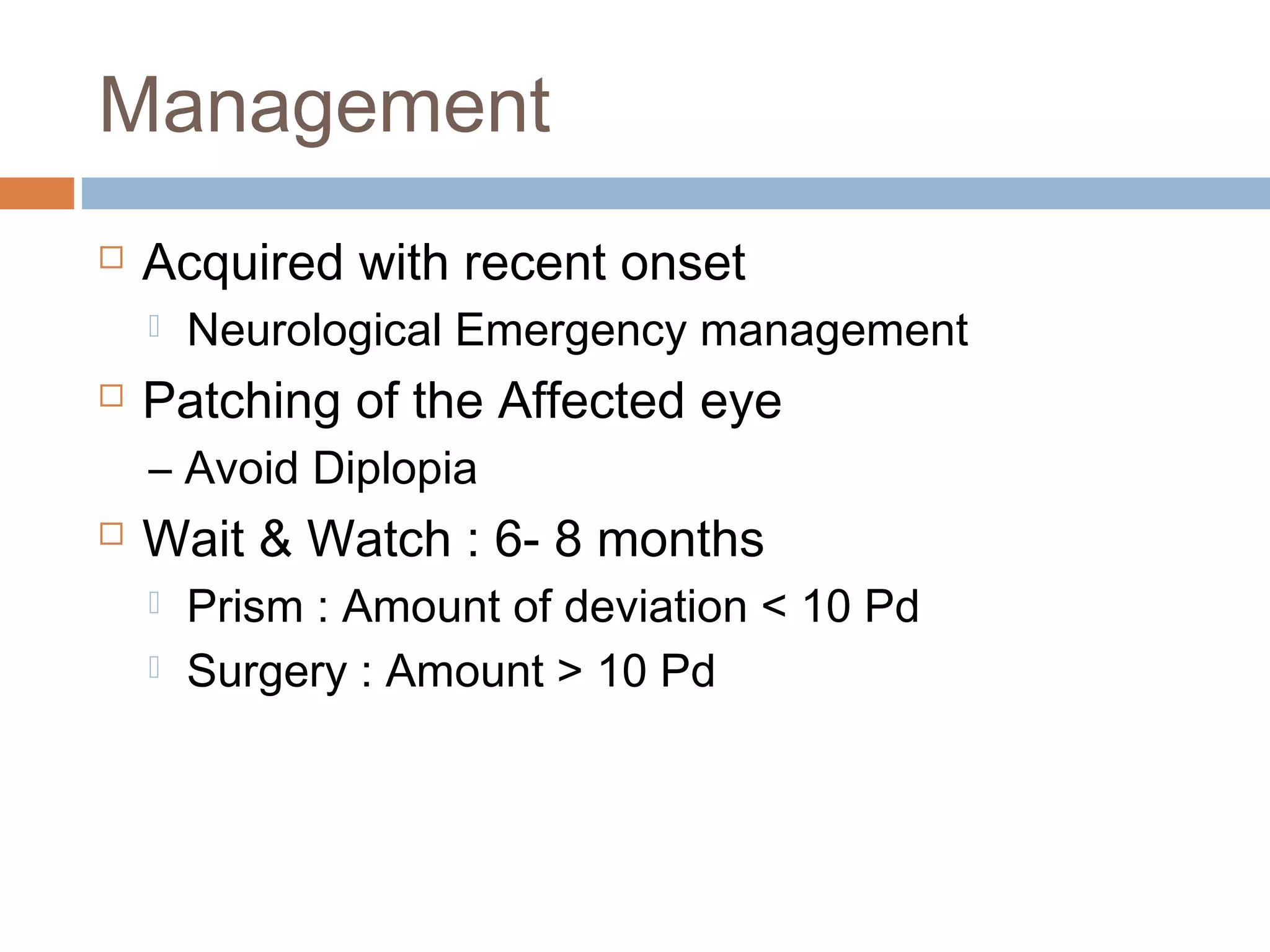
Management
 Acquired with recent onset
 Neurological Emergency management
 Patching of the Affected eye
– Avoid Diplopia
 Wait & Watch : 6- 8 months
 Prism : Amount of deviation < 10 Pd
 Surgery : Amount > 10 Pd
Inconcomitant strabismus types and different tests

Inconcomitant strabismus types and different tests

  • 1.
    Inconcomitant Strabismus Paralytic Type RajuKaiti, M. Optom Consultant Optometrist
  • 2.
     Types ofheterotropias 1. Concomitant 2. Non-concomitant (deviation differ by 10 Pd)  Is a type of Heterotropia In which the amount of deviation varies in different directions of gaze. Further, amount of deviation may also vary depending on which eye is fixing.
  • 3.
    Types of Incomitantdeviations 1. Non-paralytic (Special types of Strabismus) i. vertically incomitant horizontal heterotropias e.g.: A-, V-, X-, Y- and λ- pattern heterotropias ii. Special restrictive ocular motility defects: e.g.: Duane’s Retraction syndrome, Brown’s syndrome, Grave’s ophthalmopathy, etc. 2. Paralytic (Paralysis of Cranial Nerve/s)
  • 4.
    Vertically incomitant horizontal heterotropias Refers to those horizontal deviations that change in magnitude with upgaze and downgaze  A pattern Horizontal heterotropia:  Increasing convergence (decreasing divergence) in upgaze and increasing divergence in downgaze.  Considered significant if deviation differ by 10 Pd  A esotropia- esotropia will increase in upgaze and decrease in downgaze  A exotropia: exotropia will decrease in upgaze and increase in downgaze
  • 5.
    Ex: Non Paralytic: A pattern
  • 6.
    Vertically incomitant horizontal heterotropias V pattern Horizontal heterotropia:  Increasing convergence (decreasing divergence) in downgaze and increasing divergence in upgaze.  Considered significant if deviation differ by 15 Pd  V esotropia- esotropia will increase in downgaze and decrease in upgaze  V exotropia: exotropia will increase in upgaze and decrease in downgaze
  • 7.
  • 8.
    Vertically incomitant horizontal heterotropias Y pattern Horizontal heterotropia:  Have exotropia only in upgaze  λ- pattern Horizontal heterotropia:  Exotropia in down gaze only  X- pattern Horizontal heterotropia:  No deviation or a small one in primary position, but a significant exotropia in upgaze as well as in downgaze
  • 9.
    Ex: Non-Paralytic Special Typesof Strabismus Duane Syndrome (face turn to left) Brown’s Syndrome LE (head tilt towards affected side)
  • 10.
    Muscle Innervation  EachEOM is innervated by a specific cranial nerve 1. medial rectus (MR)—cranial nerve III (Inferior branch) 2. superior rectus (SR)—cranial nerve III (Superior Branch) 3. inferior rectus (IR)—cranial nerve III (Inferior Branch) 4. inferior oblique (IO)—cranial nerve III (Inferior Brach) 5. lateral rectus (LR)—cranial nerve VI 6. superior oblique (SO)—cranial nerve IV 7. Levator Palpebral Superiosis (LPS) - cranial nerve III (Superior Branch) LR6(SO4)3.
  • 11.
    Paralytic Deviation  Oculardeviation resulting from complete or incomplete paralysis of one or more extraocular muscles.  Complete called as palsy  Incomplete called as paresis
  • 13.
  • 14.
    1.Neurogenic lesions:  Congenital:3rd &6th cranial nerve palsy and birth injuries  Inflammatory lesions: encephalitis ,meningitis , neurosyphilis , peripheral neuritis , infectious lesion of cavernous sinus & orbit  Neoplastic lesions: brain tumours involving the nuclei and the peripheral parts of the intra cranial nerves
  • 15.
    Cont..................  Vascular lesions:haemorrhages ,thrombosis , embolism, aneurysm or vascular occlusion due to hypertension , ,DM , Atherosclerosis.  Traumatic lesions : head injury  Toxic lesions: carbon monoxide poisoning , diphtheria toxin, alcohol and lead neuropathy  Demylenating lesion: ocular palsy in multiple & diffuse sclerosis.
  • 16.
  • 17.
    3.Neuromuscular junction lesion: Myasthenia gravis: characterized by primarily fatigue of group of muscles.
  • 19.
    General features:  Diplopia Confusion  Ocular deviation : i . primary ii . Secondary  Ocular movements  Past pointing  Nausea, vertigo & dizziness  Muscle sequelae :
  • 20.
    Muscle sequelae : Changes that take place in EO muscle after sometime of paralysis or paresis of one or more EO muscle. i . Overaction of contralateral synergistic muscle. ii . Contracture of direct antagonist iii . Secondary inhibitional palsy of the contralateral antagonist muscle.
  • 21.
    Muscle sequelae following paresisof EO Paretic muscle Overaction of contra. Synergist Contracture of direct agonist Sec.inhibitional palsyofcontra. Antagonist RLR LMR RMR LLR RMR LLR RLR LMR RSO LIR RIO LSR RIO LSR RSO LIR RSR LIO RIR LSO RIR LSO RSR LIO
  • 22.
    Cont.........................  Abnormal headposture : i. Chin elevation or depression ii. Face turn iii. Head tilt  Sensory adaptation
  • 24.
  • 25.
  • 26.
    SUBJECTIVE SYMPTOMS:  Diplopia Confusion  Headache , eye strain , difficulty in focusing , aesthenopic symptoms , discomfort from abnormal head posture
  • 27.
    Objective symptoms:  Constant/ intermittent deviation  Abnormal head posture  Ptosis , exophthalmos.
  • 29.
    Inspection:  Ocular posture Abnormal head posture ; note its exact components  Facial asymmetry  Ptosis , exophthalmos
  • 30.
    Cover test:  Bothfor distance & near , with & without abnormal head posture  Presence of any manifest or latent deviation  Type of deviation  Primary versus secondary deviation  Normally fixing eye : for the dominant eye.
  • 32.
  • 33.
  • 35.
    Different types oftest :  Diplopia test  Bielschowsky three step test  Haploscopic test  Field of binocular fixation  Other test : FDT , EMG , EOG , Orbital USG , Computerised tomographic scanning.
  • 38.
    Differential diagnosis in paralyticsquint :  Comitant versus incomitant squint  Congenital versus acquired palsies  Paralytic versus restrictive palsies.
  • 39.
    Clinical varieties ofocular palsies :  Isolated ocular muscle paralysis : SO (4TH nerve palsy) and LR (6TH nerve palsy).  Paralysis of 3rd cranial nerve  External ophthalmoplegia  Total opthalmoplegia  Internuclear ophthalmoplegia
  • 40.
    Ex: Paralytic Strabismus LELR palsy Rt. SO palsy (IV nerve) BL fourth Nerve palsy
  • 41.
    Differences Paralytic Strabismus Non-ParalyticStrabismus Types of Onset Usually sudden, rarely may be slow or since birth Usually gradual Age of Onset Any age During Childhood H/O Head Trauma Common Uncommon Hering’s Law Follows (20 > 10 Deviation) May not follow ARC/ Amblyopia Uncommon Possible / Common Comitancy In Late Stage Common Head Posture Abnormal Commonly Normal Past Pointing Present (Recent onset) Rare Diplopia Usually present Usually absent Ocular movements Limited in direction of paralyzed muscle Usually full
  • 42.
    Congenital/ Old ParalysisRecent Onset (Acquired) Abnormal Head Posture May persist on covering paretic eye Disappears on covering paretic eye Diplopia (??) Rare Always Present Amblyopia May be present Absent Facial Asymmetry Common with long standing torticollis Absent Comitancy Spread of Comitancy Incomitant Past Pointing Absent Present Abnormal head posture May persist on covering paretic eye bcoz of scoliosis and contracture of neck muscle Disappear in covering paretic eye Force duction test May be positive negative Abnormal head posture In old photographs May be present absent Onset of symptoms Usually indefinite and intermittent Usually definite and sudden
  • 43.
    Acquired: Always Diplopia HorizontalDiplopia Involvement of Horizontal Rectus Vertical Diplopia
  • 44.
    Prevalence Of NerveParalysis Nerve Prevalence (Variable) III 11% IV 30% < VI 45% Multiple 14% Holmes n et al
  • 45.
    Stages of EOMParalysis  First Stage  After Onset : Weakness of the paralyzed muscle  Maximum Deviation is in the field of action of Paralyzed Muscle  Second Stage  Direct Overaction (Contracture) Ipsilateral Antagonist  With time: Overshadow the defective action of affected Muscle  Third Stage  Recovery  Deviation will spread to all fields of gazes – Increase in Comitancy : Spread of Comitancy
  • 46.
    Consequences of aEOM Paralysis 1. Contracture of Ipsilateral Antagonist 2. Overaction of Contraleral Synergist (yolk muscle) 3. Inhibition Palsy of Contralateral Antagonist Ex: LLR Palsy 1. LMR Contracture 2. RMR Overaction 3. RLR Under action
  • 47.
    Consequences of EOMParalysis Ex: LLR Palsy 1. LMR Contract 2. RMR Overaction 3. RLR Under action
  • 48.
  • 49.
    Oculomotor Nerve Paralysis (IIICranial Nerve)  III Nerve – Superior Branch – LPS/ SR - Inferior Brach – MR/IO/ IR - Intrinsic Muscles (Iris/ Ciliary Body)  Rarely Isolated Muscle Paralysis
  • 50.
    IIIrd Cranial Nerve Paralysis PATHOPHYSIOLOGY  Results from damage to the oculomotor nerve anywhere in its  the nucleus in the dorsal mesencephalon  fascicles in the brainstem parenchyma,  the nerve root in subarachnoid space, or  in the cavernous sinus or  posterior orbit.  Interesting Facts (Involvement of IIIrd Nerve Nucleus)  Damage to the third nerve nucleus results in  an ipsilateral third nerve palsy with contralateral superior rectus under action and bilateral ptosis.  Damage to the third nerve fascicles results in an ipsilateral third nerve palsy with contralateral hemiparesis (Weber's syndrome),
  • 51.
    IIIrd Cranial Nerve Paralysis Damage to Course of IIIrd Nerve  Damage at the level subarachnoid space produces  an isolated third nerve palsy.  causes  Cavernous sinus involvement  Rarely isolated IIIrd Nerve palsy  May include pareses of cranial nerves IV, VI and V-1, and an ipsilateral Horner's syndrome.  Common Causes  metastatic disease, inflammation, herpes zoster, carotid artery aneurysm, pituitary adenoma and apoplexy, and sphenoid wing meningioma.
  • 52.
    IIIrd Cranial Nerve Paralysis Isolated Muscle Involvement :  Rare and often congenital 1. Superior Rectus (SR) : Congenital / Secondary to Trauma 2. Medial Rectus (MR) : Very Rare / Congenital  Synergistic Divergence Phenomenon  Simultaneous abduction of both eyes on attempted gaze in the field of action of paralyzed MR.  ?? Reason ? Overaction /Contracture of both LR 3. Inferior Rectus (IR) : Congenital / Rare 4. Inferior Oblique (IO) : - Least likely to paralyzed - Congenital / Blunt Trauma : Orbital floor fracture
  • 53.
    IIIrd Cranial Nerve Paralysis Complete Paralysis : Acquired (total or partial)  Sign & Symptoms  Sudden onset with unilateral/ Bilateral Ptosis  Head Ache , Diplopia ??? (Partial Vs Complete)  The affected eye positions  Exotropic {non-comitant}, Hypotropic position (down and out).  Limitation  Elevation, depression and adduction.  underaction of the superior, inferior, and medial recti muscles and inferior oblique muscle  Pupillary involvement : dilated and minimally reactive to light,  Pupillary sparing 
  • 54.
    Hess chart ofright third nerve palsy Contraction of right chart and expansion of left Right chart - underactions of all muscles except lateral rectus and superior oblique Left chart - overactions of all muscles except medial rectus and inferior oblique
  • 55.
    Trochlear Nerve (IV)Paralysis  IV nerve supply – Superior oblique  Commonest Paralytic Strabismus (Von Noorden et al.)  Commonest Causes  Vascular (hypertension and/or diabetes) & Trauma (Prone) : Longest intracranial course  Congenital rare
  • 56.
    Trochlear Nerve (IV)Paralysis  SIGNS AND SYMPTOMS Sudden onset complaints of vertical diplopia,  which is especially manifest as the patient tries to read. Inability to look down and in. Torticollis  Head tilt contralateral to the affected superior oblique muscle.  Chin depressed There is frequently concurrent hypertension and/or diabetes. Amount of deviation  Hyper-deviation will increase in contralateral gaze, reduce in ipsilateral gaze  Increase on ipsilateral head tilt, and decrease on
  • 57.
    Trochlear Nerve (IV)Paralysis  PATHOPHYSIOLOGY  Damage to fourth cranial nerve nucleus (located in the dorsal mesencephalon)  give a contralateral fourth nerve palsy  Causes  Trauma , hemorrhage, infarction, trauma, hydrocephalus and demyelinization.  More likely, associated with palsy of cranial nerves III (Cavernous sinus involvement)  ??? Detection  Blunt Trauma to the head or orbit  can cause damage to the trochlea, resulting in superior oblique muscle dysfunction.
  • 58.
    Hess chart ofright fourth nerve palsy No significant difference in chart size Right chart - underaction of superior oblique and overaction of inferior oblique Left chart - overaction of inferior rectus and underaction of superior rectus
  • 59.
    CRANIAL NERVE VIPALSY (Abducen)  VI Supply – Lateral Rectus muscle  SIGNS AND SYMPTOMS  Sudden onset/ head pain  Present with horizontal uncrossed diplopia which worsens at distance  An abduction deficit with either an esophoric or esotropic position  Isolated palsy  Neither visual acuity nor visual field loss.  Normal fundus  Except in a bilateral cranial nerve VI palsy (Papilloedema)
  • 60.
    CRANIAL NERVE VIPALSY Abducen  PATHOPHYSIOLOGY  Originate from Pons  Close association with the facial nerve & PPRF  Damage to the sixth nerve at the brain stem  VII (facial) nerve palsy or an internuclear ophthalmoplegia.  Within the cavernous sinus  the sixth nerve is joined by  the oculosympathetic nerves and cranial nerves III, IV and V-1.  Damage  VI palsy and Horner's syndrome  Concurrent CN III and IV palsy.  Causes :  Aneurysm, meningioma, pituitary adenoma, inflammation, or fistula. ischemic infarction  Diabetes and hypertension;  prime cause of isolated sixth nerve palsy.
  • 61.
    Hess chart ofLeft CN VI palsy Contraction of left chart and expansion of right Left chart - marked underaction of lateral rectus and mild overaction of medial rectus Right chart - marked overaction of medial rectus
  • 62.
    Clinical Evaluation ofParalytic Strabismus 1. Observation 2. EOM Evaluation 3. Cover Test 4. Measurement of deviation 5. Past Pointing 6. Head tilt Test 7. Diplopia/ Hess Charting 8. Force duction/ Force Generation test 9. Imaging Test (CT/ MRI)
  • 63.
    Observation 2. Torticollis : BLfourth Nerve palsy 3. Torticollis’ :LLR palsy 1. Direction of deviation 3. Ptosis
  • 64.
  • 66.
    Cover Test / Measurementof deviation Hirschberg Krimsky test •Prism cover test Cover Test
  • 67.
    Past Pointing  Describedby Von Graefe  Anomalies of egocentric localization
  • 68.
    Park’s Bielschwsky Headtilt Test Park’s Procedure Useful for only Isolated Nerve Palsy Park’s Diagnostic Scheme 1. Which is the hyper eye in primary gaze?  RE/LE 2. Which horizontal field of gaze (right or left) does the hyperdeviation increase? 3. Bielchowsky Head-Tilt Test: Toward which shoulder does the hyperdeviation increase?
  • 69.
  • 70.
  • 71.
    The 3 stepTest Circling Method
  • 72.
  • 73.
    Look for - Gazewith maximum image separation (affected gaze) - Remote image belongs to affected eye - Image crossed / uncrossed
  • 74.
  • 75.
    Hess Screen Chart Additionalinfromation: 1. Contraction of ipsilateral antagonist 2. Overaction of contralateral synergist 3. Inhibtion palsy of contralateral antagonist. Diagnosis - Smallest field – Affected eye - Field deviated maximum towards the centre - affected muscle
  • 76.
  • 77.
    Forced duction test Forcegeneration test Palsy Vs Paresis Paralytic Vs Restrictive Pathology
  • 78.
    Management  Acquired withrecent onset  Neurological Emergency management  Patching of the Affected eye – Avoid Diplopia  Wait & Watch : 6- 8 months  Prism : Amount of deviation < 10 Pd  Surgery : Amount > 10 Pd