COLOR VISION TESTS
Dr Saurabh Kushwaha
Resident Ophthalmology
SCOPE
 Color vision
 Color attributes
 Classes of cones
 Color vision defect
 Color vision tests
 Photochromatic plate tests
 Hue discrimination tests
 Spectral anomaloscopes
 Lantern tests
COLOR VISION
 Color vision is the subjective sensory
phenomena ability of the eye to discriminate
between colors excited by lights of different
wavelengths
 Function of cones
 Not an inherent property of the object
 Internal construct of an individual:
wavelength of the light entering and structure
of the eye
SPECTRUM OF LIGHT
TYPES OF COLORS
 Primary colors
 Additive colors/ Negative of primary
 Complementary colors
 Metamers
COLOR ATTRIBUTES
 HUE
Determined by the wavelength of light absorbed & reflected by
the object
 SATURATION
Purity of color
It can be estimated by measuring how much of a particular
wavelength must be added before it is distinguishable from
white
The more the wavelength required to be added to make the
discrimination the lesser the saturation
 BRIGHTNESS
Depends upon luminosity of the component wavelength
The wavelength shift of maximum luminosity from photopic to
scotopic viewing is called Purkinje shift
COLOR ATTRIBUTES
TYPES OF VISION
 Achromatic
• Sensation of white vision with no color vision
 Chromatic
• Spectral color vision
• Extra spectral color vision
CLASSES OF CONES
1st Class 2nd Class 3rd Class
SWS receptors MWS receptors LWS receptors
4% in retina 32% in retina 64% in retina
Blue cones Green cones Red cones
Most sensitive to
blue violet
Most sensitive
to green
Most sensitive to
greenish- yellow
CLASSES OF CONES
CHARACTERISTICS OF CONES
THEORIES OF COLOR VISION
 Young-Helmholtz theory of color vision
(Trichromatic color theory)
 Hering’s opponent color theory
 Donders’s zones theory
COLOR VISION DEFECT
 Faculty to appreciate one or more primary
colors is either defective (anomalous) or
absent (anopia)
 Color blindness is also called
as Daltonism (John Dalton was
deuteronope)
TYPES OF COLOR VISION DEFECT
CONGENITAL DEFECTS
ANOMALOUS TRICHROMACY
 Partial deficiencies in one of the three cone pigments
 Phenotypically mild
1. Protanomaly (protanomalous trichromacy)
The red spectrum is displaced towards shorter
wavelength
2. Deuteranomly (Deuteranomalous trichromacy)
• The chlorolabe spectrum is displaced towards
longer wavelength
3. Tritanomaly
• Very rare
• Blue-green and yellow-green insensitivity
• Cone pigment for blue defective
DICHROMACY
 Lack one type of cone function completely
 Match colors with a mixture of two primaries
 Defect is more severe
 Types: Depending on which cone pigment is missing
1. Protanopia
• Most common
• 1% male, 0.02% female
• Lack the long-wave ‘red’ sensitive receptors
• Red - brown confusion
2. Deuteranopia
• 1% male, 0.01% female
• Lack the middle-wave ‘green’ sensitive receptors
• Green - brown confusion
3.Tritanopia
• Very rare
• 0.01% of male, 0.03% of female
• Lack the short-wave ‘blue’ sensitive cones
• Blue - green and yellow - violet confusion
DICHROMACY
ACHROMATOPSIA
CONE
MONOCHROMACY
 Prsence of only one
primary color cone
 Gray scale vision with
no combination of colors
 2 types –
• L/M cone present: AR
• S cone present: X
linked
 Acuity 6/18 to 6/60
ROD
MONOCHROMACY
 Complete absence of
cones, AR
 1 in 30,000
 Features
• Total color blindness
• Pendular nystagmus
• Low vision, 6/60
• Photophobia
• Normal Fundus
ROD MONOCHROMACY
ACQUIRED COLOR VISION DEFECTS
 Defects due to ocular disease, side-effect of
medication, consequence of toxic poisoning or head
trauma
 Occurs due to disruption of the neural pathway
between the eye and the vision center of the brain
rather than by the loss of cone function in the eye
 Ex: Brain damage : Achromatopsia
Diabetic Retinopathy : Tritanopia
Ethambutol toxicity : Deuteranopia
Stargardt’s disease : Protanopia
KOLLNER’S RULE
Red-Green deficiencies in
optic nerve lesions
resembling protan-
Deutan
 Optic neuritis
 Leber’s optic atrophy
 Toxic amblyopia
 Cone dystrophy
 Stargardt’s disease
 Best disease
Blue-yellow deficiencies in
retinal lesions resembling
Tritan
 Diabetic retinopathy
 ARMD
 RP
 Myopic retinal
degeneration
 Early Glaucoma
 Autosomal dominant optic
atrophy
 Papilledema
COLOR VISION TEST
 There are a number of clinical color vision
tests which aim:
• Identity
• Classify
• Grade the severity of color vision defect
• Determine the occupational suitability
TYPES OF COLOR VISION TESTS
INDICATIONS
 All children at their first eye test
 History suggest impaired color discrimination
 For occupational purposes
 Suspected acquired color vision defect as a
result of an ocular or systemic disease, or a
side effect of medication or injury
PSEUDOISOCHROMATIC PLATES
 To identity a colored symbol made up of colored
dots of varying sizes embedded in a background of
differently colored dots
 The figure and the background colors are chosen
so that they are confused (isochromatic) by color
deficient but discerned by the normal person
 The difference between the colors should exceed
the minimum required for them to be discriminated by
person with normal color vision
 Examples –Ishihara plates (red-green defect),
Hardy Rand Rittler (HRR) ( both red-green defect and
blue defect)
ISHIHARA PLATES
 Jacob Stilling, German scientist (1873)
 Detection of presence of protan/deutan
 Symbol recognition by discrimination of either
hue or saturation
 Currently available editions are - 38, 24 and 14
plate version
CRITERION FOR TESTING
 Proper illumination (natural day light )
 Visual acuity, > 6/60
 Patient should use his/her near correction
 Field of vision
 Testing Distance: 75 cm for plate
 Observation time is 3 to 5 secs per plate (10 secs
for winding paths)
 Monocular testing
 Plane of paper is right angle to line of vision
 Store plates inndark when not in use
ISHIHARA TEST
ISHIHARA TEST
ISHIHARA TEST
TEST INTERPRETATION
HUE DISCRIMINATION TESTS
 Qualitative test for hue discrimination-color
samples in small caps to be arranged according
to hue
 Useful in acquired colour vision abnormalities
 Diagnosis of the type and degree of color vision
defect
 Cannot distinguish between dichromats and
anomalous trichromats
 Manual dexterity is required so unsuitable in
children
FRANSWORTH MUNSELL 100 HUE
TEST
 Consists of 4 boxes, 85 caps with 2 piolt caps at
the end of each box
 Patient arranges caps in natural order according
to color/ hue
 Takes 15 – 30 mins in total
 Main purpose
• to classify type of CVD
• to measure the severity
• to assess the progression of an acquired CVD
FM 100 HUE TEST
TEST INTERPRETATION
TESTING AND ERROR SCORE
TEST INTERPRETATION
FRANSWORTH DICHOTOMOUS
D-15 TEST
 Shorter veraion of Fransworth Munsell 100 Hue
Test with 15 caps
 Single fixed reference cap
 15 movable color caps sampling a complete
color circle
FD PANEL D-15 TEST
 Because of large differences in color of adjacent
caps it evaluates major color confusion of
severe R-G or B -Y defects
 Done after the color vision defect has been
indicated by fail on the Ishihara plates
 Detects individuals with moderate – severe
dyschromatopsia
TEST INTERPRETATION
 Score is plotted on paper as arrangement of caps
 Correct: semi circle; Error: crossed lines
 Axis of lines determine the type of color deficiency
SPECTRAL ANOMALOSCOPES
 Specifically developed and most sensitive to
diagnose congenital color deficiency
 Most provide a Rayleigh match  red added to
green to produce yellow test color
 Some have Moreland match  blue added to
green to make blue-green test color
 Extensive training required by the administrator
• Nagel
• Besancon
• Pickford-Nicolson
NAGEL’S ANOMALOSCOPE
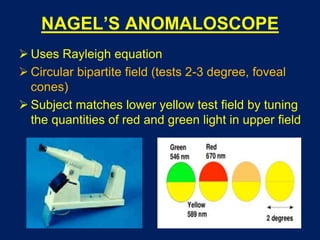
 Uses Rayleigh equation
 Circular bipartite field (tests 2-3 degree, foveal
cones)
 Subject matches lower yellow test field by tuning
the quantities of red and green light in upper field
TEST INTERPRETATION
 Subject is asked to comment on whether upper and
lower fields are same color
Deuteranomalous trichomats  upper field is too red
Protanomalous trichomats  upper field is too green
 Adjust red/green to match yellow ( green > greenish-
yellow > yellow > orange > red)
 Luminosity of yellow can be altered
 Check range of match by altering ration in one –unit
steps
TEST INTERPRETATION
 Examiner determines range of red-green ratios
that produce an acceptable match and required
brightness of lower field
 Anomalous quotient - A546/A670 for subject
divided by A546/A670 for admin
 Normal: 0.74 - 1.33
TEST INTERPRETATION
 Normal subject
matches in a narrow range
a scale of 0 (pure green) to 73 (pure
red) & the normal match will be
around 42 units
 Protans
turn down the intensity of yellow
light when matching the field to the
Red one
 Deutans
turn up the intensity of yellow light
when matching the field to the Red
one
TEST INTERPRETATION
 Values recorded from both red-green and luminance dial
 Normal subjects narrow range of accepted values
 Anomalous subjects wider range
 Dichromats  widest possible range
 Luminance setting differentiate protan from deutan subjects
Protanoscopes match by lowering luminance of yellow field
Deuteranopes have a luminance function much closer to
normal
LANTERN TESTS
 Measure if subject can perform colour signal
recognition with adequate proficiency to maintain
safety standards
 Subject is asked to identity the color of a signal light in
lantern
 Used in maritime, air and railway industries
 Speed and sequence of colour presentation
determines efficacy of test
 Farnsworth lantern
 Beyene latern
 Glies-Archer lantern
 Edridge-Green lantern
FARNSWORTH LANTERN TEST
 Usually done at 6 metre distance
 Simulate colour vision demands under working
conditions
 Nine possible combinations of 3 colors - red, green
and white in the two positions
 A patient must tell average 8 out of 9 correct
responses to pass the test
SUMMARY
THANK YOU

Color vision

  • 1.
    COLOR VISION TESTS DrSaurabh Kushwaha Resident Ophthalmology
  • 2.
    SCOPE  Color vision Color attributes  Classes of cones  Color vision defect  Color vision tests  Photochromatic plate tests  Hue discrimination tests  Spectral anomaloscopes  Lantern tests
  • 3.
    COLOR VISION  Colorvision is the subjective sensory phenomena ability of the eye to discriminate between colors excited by lights of different wavelengths  Function of cones  Not an inherent property of the object  Internal construct of an individual: wavelength of the light entering and structure of the eye
  • 4.
  • 5.
    TYPES OF COLORS Primary colors  Additive colors/ Negative of primary  Complementary colors  Metamers
  • 6.
    COLOR ATTRIBUTES  HUE Determinedby the wavelength of light absorbed & reflected by the object  SATURATION Purity of color It can be estimated by measuring how much of a particular wavelength must be added before it is distinguishable from white The more the wavelength required to be added to make the discrimination the lesser the saturation  BRIGHTNESS Depends upon luminosity of the component wavelength The wavelength shift of maximum luminosity from photopic to scotopic viewing is called Purkinje shift
  • 7.
  • 8.
    TYPES OF VISION Achromatic • Sensation of white vision with no color vision  Chromatic • Spectral color vision • Extra spectral color vision
  • 9.
    CLASSES OF CONES 1stClass 2nd Class 3rd Class SWS receptors MWS receptors LWS receptors 4% in retina 32% in retina 64% in retina Blue cones Green cones Red cones Most sensitive to blue violet Most sensitive to green Most sensitive to greenish- yellow
  • 10.
  • 11.
  • 12.
    THEORIES OF COLORVISION  Young-Helmholtz theory of color vision (Trichromatic color theory)  Hering’s opponent color theory  Donders’s zones theory
  • 13.
    COLOR VISION DEFECT Faculty to appreciate one or more primary colors is either defective (anomalous) or absent (anopia)  Color blindness is also called as Daltonism (John Dalton was deuteronope)
  • 14.
    TYPES OF COLORVISION DEFECT
  • 15.
  • 16.
    ANOMALOUS TRICHROMACY  Partialdeficiencies in one of the three cone pigments  Phenotypically mild 1. Protanomaly (protanomalous trichromacy) The red spectrum is displaced towards shorter wavelength
  • 17.
    2. Deuteranomly (Deuteranomaloustrichromacy) • The chlorolabe spectrum is displaced towards longer wavelength 3. Tritanomaly • Very rare • Blue-green and yellow-green insensitivity • Cone pigment for blue defective
  • 18.
    DICHROMACY  Lack onetype of cone function completely  Match colors with a mixture of two primaries  Defect is more severe  Types: Depending on which cone pigment is missing 1. Protanopia • Most common • 1% male, 0.02% female • Lack the long-wave ‘red’ sensitive receptors • Red - brown confusion
  • 19.
    2. Deuteranopia • 1%male, 0.01% female • Lack the middle-wave ‘green’ sensitive receptors • Green - brown confusion 3.Tritanopia • Very rare • 0.01% of male, 0.03% of female • Lack the short-wave ‘blue’ sensitive cones • Blue - green and yellow - violet confusion
  • 20.
  • 21.
    ACHROMATOPSIA CONE MONOCHROMACY  Prsence ofonly one primary color cone  Gray scale vision with no combination of colors  2 types – • L/M cone present: AR • S cone present: X linked  Acuity 6/18 to 6/60 ROD MONOCHROMACY  Complete absence of cones, AR  1 in 30,000  Features • Total color blindness • Pendular nystagmus • Low vision, 6/60 • Photophobia • Normal Fundus
  • 22.
  • 23.
    ACQUIRED COLOR VISIONDEFECTS  Defects due to ocular disease, side-effect of medication, consequence of toxic poisoning or head trauma  Occurs due to disruption of the neural pathway between the eye and the vision center of the brain rather than by the loss of cone function in the eye  Ex: Brain damage : Achromatopsia Diabetic Retinopathy : Tritanopia Ethambutol toxicity : Deuteranopia Stargardt’s disease : Protanopia
  • 24.
    KOLLNER’S RULE Red-Green deficienciesin optic nerve lesions resembling protan- Deutan  Optic neuritis  Leber’s optic atrophy  Toxic amblyopia  Cone dystrophy  Stargardt’s disease  Best disease Blue-yellow deficiencies in retinal lesions resembling Tritan  Diabetic retinopathy  ARMD  RP  Myopic retinal degeneration  Early Glaucoma  Autosomal dominant optic atrophy  Papilledema
  • 25.
    COLOR VISION TEST There are a number of clinical color vision tests which aim: • Identity • Classify • Grade the severity of color vision defect • Determine the occupational suitability
  • 26.
    TYPES OF COLORVISION TESTS
  • 27.
    INDICATIONS  All childrenat their first eye test  History suggest impaired color discrimination  For occupational purposes  Suspected acquired color vision defect as a result of an ocular or systemic disease, or a side effect of medication or injury
  • 28.
    PSEUDOISOCHROMATIC PLATES  Toidentity a colored symbol made up of colored dots of varying sizes embedded in a background of differently colored dots  The figure and the background colors are chosen so that they are confused (isochromatic) by color deficient but discerned by the normal person  The difference between the colors should exceed the minimum required for them to be discriminated by person with normal color vision  Examples –Ishihara plates (red-green defect), Hardy Rand Rittler (HRR) ( both red-green defect and blue defect)
  • 29.
    ISHIHARA PLATES  JacobStilling, German scientist (1873)  Detection of presence of protan/deutan  Symbol recognition by discrimination of either hue or saturation  Currently available editions are - 38, 24 and 14 plate version
  • 30.
    CRITERION FOR TESTING Proper illumination (natural day light )  Visual acuity, > 6/60  Patient should use his/her near correction  Field of vision  Testing Distance: 75 cm for plate  Observation time is 3 to 5 secs per plate (10 secs for winding paths)  Monocular testing  Plane of paper is right angle to line of vision  Store plates inndark when not in use
  • 31.
  • 32.
  • 33.
  • 34.
  • 35.
    HUE DISCRIMINATION TESTS Qualitative test for hue discrimination-color samples in small caps to be arranged according to hue  Useful in acquired colour vision abnormalities  Diagnosis of the type and degree of color vision defect  Cannot distinguish between dichromats and anomalous trichromats  Manual dexterity is required so unsuitable in children
  • 36.
    FRANSWORTH MUNSELL 100HUE TEST  Consists of 4 boxes, 85 caps with 2 piolt caps at the end of each box  Patient arranges caps in natural order according to color/ hue  Takes 15 – 30 mins in total  Main purpose • to classify type of CVD • to measure the severity • to assess the progression of an acquired CVD
  • 37.
  • 38.
  • 39.
  • 40.
  • 41.
    FRANSWORTH DICHOTOMOUS D-15 TEST Shorter veraion of Fransworth Munsell 100 Hue Test with 15 caps  Single fixed reference cap  15 movable color caps sampling a complete color circle
  • 42.
    FD PANEL D-15TEST  Because of large differences in color of adjacent caps it evaluates major color confusion of severe R-G or B -Y defects  Done after the color vision defect has been indicated by fail on the Ishihara plates  Detects individuals with moderate – severe dyschromatopsia
  • 43.
    TEST INTERPRETATION  Scoreis plotted on paper as arrangement of caps  Correct: semi circle; Error: crossed lines  Axis of lines determine the type of color deficiency
  • 44.
    SPECTRAL ANOMALOSCOPES  Specificallydeveloped and most sensitive to diagnose congenital color deficiency  Most provide a Rayleigh match  red added to green to produce yellow test color  Some have Moreland match  blue added to green to make blue-green test color  Extensive training required by the administrator • Nagel • Besancon • Pickford-Nicolson
  • 45.
    NAGEL’S ANOMALOSCOPE  UsesRayleigh equation  Circular bipartite field (tests 2-3 degree, foveal cones)  Subject matches lower yellow test field by tuning the quantities of red and green light in upper field
  • 46.
    TEST INTERPRETATION  Subjectis asked to comment on whether upper and lower fields are same color Deuteranomalous trichomats  upper field is too red Protanomalous trichomats  upper field is too green  Adjust red/green to match yellow ( green > greenish- yellow > yellow > orange > red)  Luminosity of yellow can be altered  Check range of match by altering ration in one –unit steps
  • 47.
    TEST INTERPRETATION  Examinerdetermines range of red-green ratios that produce an acceptable match and required brightness of lower field  Anomalous quotient - A546/A670 for subject divided by A546/A670 for admin  Normal: 0.74 - 1.33
  • 48.
    TEST INTERPRETATION  Normalsubject matches in a narrow range a scale of 0 (pure green) to 73 (pure red) & the normal match will be around 42 units  Protans turn down the intensity of yellow light when matching the field to the Red one  Deutans turn up the intensity of yellow light when matching the field to the Red one
  • 49.
    TEST INTERPRETATION  Valuesrecorded from both red-green and luminance dial  Normal subjects narrow range of accepted values  Anomalous subjects wider range  Dichromats  widest possible range  Luminance setting differentiate protan from deutan subjects Protanoscopes match by lowering luminance of yellow field Deuteranopes have a luminance function much closer to normal
  • 50.
    LANTERN TESTS  Measureif subject can perform colour signal recognition with adequate proficiency to maintain safety standards  Subject is asked to identity the color of a signal light in lantern  Used in maritime, air and railway industries  Speed and sequence of colour presentation determines efficacy of test  Farnsworth lantern  Beyene latern  Glies-Archer lantern  Edridge-Green lantern
  • 51.
    FARNSWORTH LANTERN TEST Usually done at 6 metre distance  Simulate colour vision demands under working conditions  Nine possible combinations of 3 colors - red, green and white in the two positions  A patient must tell average 8 out of 9 correct responses to pass the test
  • 52.
  • 53.