 Measurement of the convergence induced by
accommodation, per diopter of
accommodation.
 To determine the change in accommodative
convergence that occurs when the patient
accommodates or relaxes accommodates a
given amount.
 Unit = ∆∕D
 Normal range = ( 4 – 6) ∆/D
 Abnormalities of the AC/A ratio are very
important causes of strabismus.
 A high AC/A ratio may cause excessive
convergence & produce a convergent
squint during accommodation on a near
object.
 A low AC/A ratio may cause a divergent
squint when the patient looks at a near
object.
1. Stimulus AC/A Ratio
Ratio of accommodative convergence
to stimulus to accommodation.
2. Response AC/A Ratio
Ratio of accommodative convergence
to response to accommodation.
 Usually stimulus AC/A > Response AC/A
 Heterophoria method
 Gradient method
 Fixation disparity method
 Graphical method
 Simple method, consists of comparing the
measurement of the latent deviation of eyes
 Using prisms & alternate cover test at a point of
distance fixation ( 6m ) with refractive
correction.
 At a point of near fixation ( 33cm ) with
refractive correction.
 IPD should be measured.
 +ve sign for esodeviation, -ve sign for
exodeviation.
 AC/A ratio is calculated from this following
formula:-
AC/A = IPD + (∆n - ∆d/D)
 The change in the stimulus to
accommodation is produced by means of
ophthalmic lenses not by a change in
viewing distance.
 Concave lenses placed before the eyes
increase the requirement for accommodation
& convex lenses relax accommodation.
 -1D lenses produce an equivalent of 1D of
accommodation, where as +1D lenses relax
accommodation by 1D.
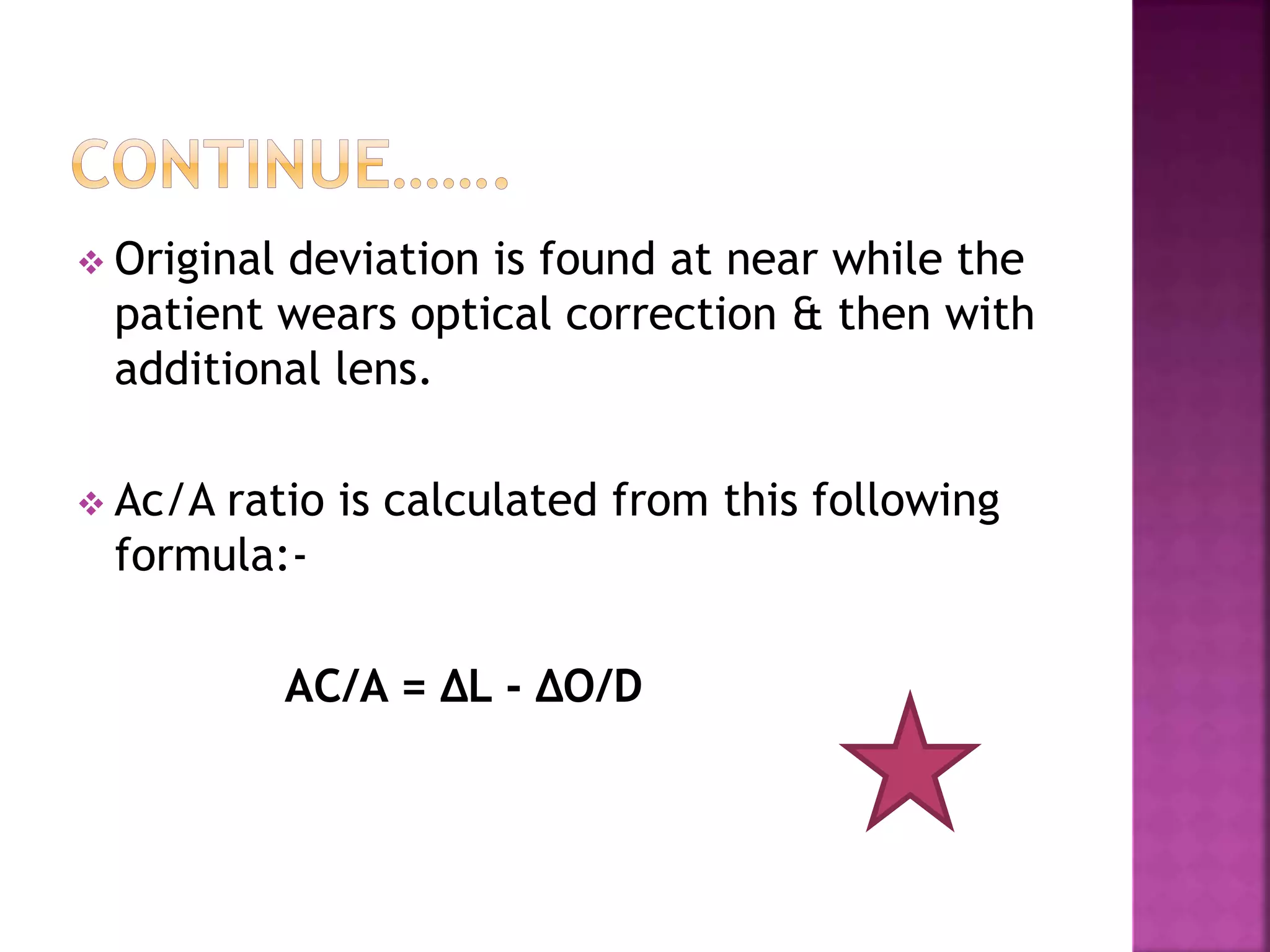
 Original deviation is found at near while the
patient wears optical correction & then with
additional lens.
 Ac/A ratio is calculated from this following
formula:-
AC/A = ∆L - ∆O/D
 Used by Ogle & co-workers.
 Indirect method, more reliable due to test
under binocular condition.
 Consists of 2 sets of data
 First changes in fixation disparity induced by force
convergence using prism
 Second change in fixation disparity induced by altering
the accommodative stimulus with lens
 From these 2 sets of data they determined
stimuli for convergence & accommodation
that gave same fixation disparity.
 Because of its complexity, this test is not
performed in routine clinical practice.
 Convergence (in prism diopter) is plotted
along the x- axis.
 Stimulus to accommodation is indicated
along the y-axis.
 Slope of graph represents AC/A ratio.
 Diagnosis of convergence excess type of
esodeviation.
 Divergence excess exodeviation
 Divergence insufficiency
 Convergence insufficiency
 Apply in those patient who have chance of
obtaining some fusion when eyes are straight
or within 10PD in distance with optical
correction.
 Try to keep eyes straight for distance upto
age of 8 years.
 If eso deviation is less then 10PD in distance-
has chance of developing fusion with full
optical correction.
 If eso deviation is greater than 10PD in
distance has no chance of developing fusion
unless the deviation is reduced to under
10PD.
 Prescribing Prism
 Prescribing Visual Training
 Alteration of Sph. Portion of Correction
 if AC/A sufficiently large additional plus for
convergence excess
 CONVERGENCE EXCESS:
 n>d
 high AC/A ratio
 Treatment
 Near add (overcorrection of plus power
or under correction of minus power
most effective) e.g.
 Base-out prism (alternative method)
 Base-in training(not so effective)
 CONVERGENCE INSUFFICIENCY
 n> d
 Low AC/A ratio
 Treatment
 Base-out training (most effective)
 “Pencil push-up” training
 DIVERGENCE EXCESS
 n< d
 high AC/A ratio
 Treatment
overcorrection of minus power or
undercorrection of plus power
in mild case base-in prism for full time
wear
 DIVERGENCE INSUFFICIENCY
 n>d
 low AC/a ratio
 Treatment
 Base-out prism
THANK YOU…….

AC/A

  • 2.
     Measurement ofthe convergence induced by accommodation, per diopter of accommodation.  To determine the change in accommodative convergence that occurs when the patient accommodates or relaxes accommodates a given amount.  Unit = ∆∕D  Normal range = ( 4 – 6) ∆/D
  • 3.
     Abnormalities ofthe AC/A ratio are very important causes of strabismus.  A high AC/A ratio may cause excessive convergence & produce a convergent squint during accommodation on a near object.  A low AC/A ratio may cause a divergent squint when the patient looks at a near object.
  • 4.
    1. Stimulus AC/ARatio Ratio of accommodative convergence to stimulus to accommodation. 2. Response AC/A Ratio Ratio of accommodative convergence to response to accommodation.  Usually stimulus AC/A > Response AC/A
  • 5.
     Heterophoria method Gradient method  Fixation disparity method  Graphical method
  • 6.
     Simple method,consists of comparing the measurement of the latent deviation of eyes  Using prisms & alternate cover test at a point of distance fixation ( 6m ) with refractive correction.  At a point of near fixation ( 33cm ) with refractive correction.  IPD should be measured.  +ve sign for esodeviation, -ve sign for exodeviation.
  • 7.
     AC/A ratiois calculated from this following formula:- AC/A = IPD + (∆n - ∆d/D)
  • 8.
     The changein the stimulus to accommodation is produced by means of ophthalmic lenses not by a change in viewing distance.  Concave lenses placed before the eyes increase the requirement for accommodation & convex lenses relax accommodation.  -1D lenses produce an equivalent of 1D of accommodation, where as +1D lenses relax accommodation by 1D.
  • 9.
     Original deviationis found at near while the patient wears optical correction & then with additional lens.  Ac/A ratio is calculated from this following formula:- AC/A = ∆L - ∆O/D
  • 10.
     Used byOgle & co-workers.  Indirect method, more reliable due to test under binocular condition.  Consists of 2 sets of data  First changes in fixation disparity induced by force convergence using prism  Second change in fixation disparity induced by altering the accommodative stimulus with lens
  • 11.
     From these2 sets of data they determined stimuli for convergence & accommodation that gave same fixation disparity.  Because of its complexity, this test is not performed in routine clinical practice.
  • 12.
     Convergence (inprism diopter) is plotted along the x- axis.  Stimulus to accommodation is indicated along the y-axis.  Slope of graph represents AC/A ratio.
  • 14.
     Diagnosis ofconvergence excess type of esodeviation.  Divergence excess exodeviation  Divergence insufficiency  Convergence insufficiency
  • 15.
     Apply inthose patient who have chance of obtaining some fusion when eyes are straight or within 10PD in distance with optical correction.  Try to keep eyes straight for distance upto age of 8 years.
  • 16.
     If esodeviation is less then 10PD in distance- has chance of developing fusion with full optical correction.  If eso deviation is greater than 10PD in distance has no chance of developing fusion unless the deviation is reduced to under 10PD.
  • 17.
     Prescribing Prism Prescribing Visual Training  Alteration of Sph. Portion of Correction  if AC/A sufficiently large additional plus for convergence excess
  • 18.
     CONVERGENCE EXCESS: n>d  high AC/A ratio  Treatment  Near add (overcorrection of plus power or under correction of minus power most effective) e.g.  Base-out prism (alternative method)  Base-in training(not so effective)
  • 19.
     CONVERGENCE INSUFFICIENCY n> d  Low AC/A ratio  Treatment  Base-out training (most effective)  “Pencil push-up” training
  • 20.
     DIVERGENCE EXCESS n< d  high AC/A ratio  Treatment overcorrection of minus power or undercorrection of plus power in mild case base-in prism for full time wear
  • 21.
     DIVERGENCE INSUFFICIENCY n>d  low AC/a ratio  Treatment  Base-out prism
  • 22.