This document provides an overview of cognitive linguistics and its approach to language and language learning. It discusses key aspects of cognitive linguistics including word grammar theory, which views language as a network of words and meanings rather than as a set of rules. The document also outlines how cognitive linguistics informs communicative language teaching practices through principles such as using meaningful tasks and focusing on language function and communication. Examples are provided to illustrate how vocabulary and grammar can be understood as interconnected networks.
Introduction to Cognitive Linguistics, covers Word Grammar, Language Network, and course context.
Discusses the paper's design, language theories (Widdowson, Chomsky), and communicative learning principles.
Highlights language as a meaning system, emphasizing the communicative aspect and cognitive learning theory.
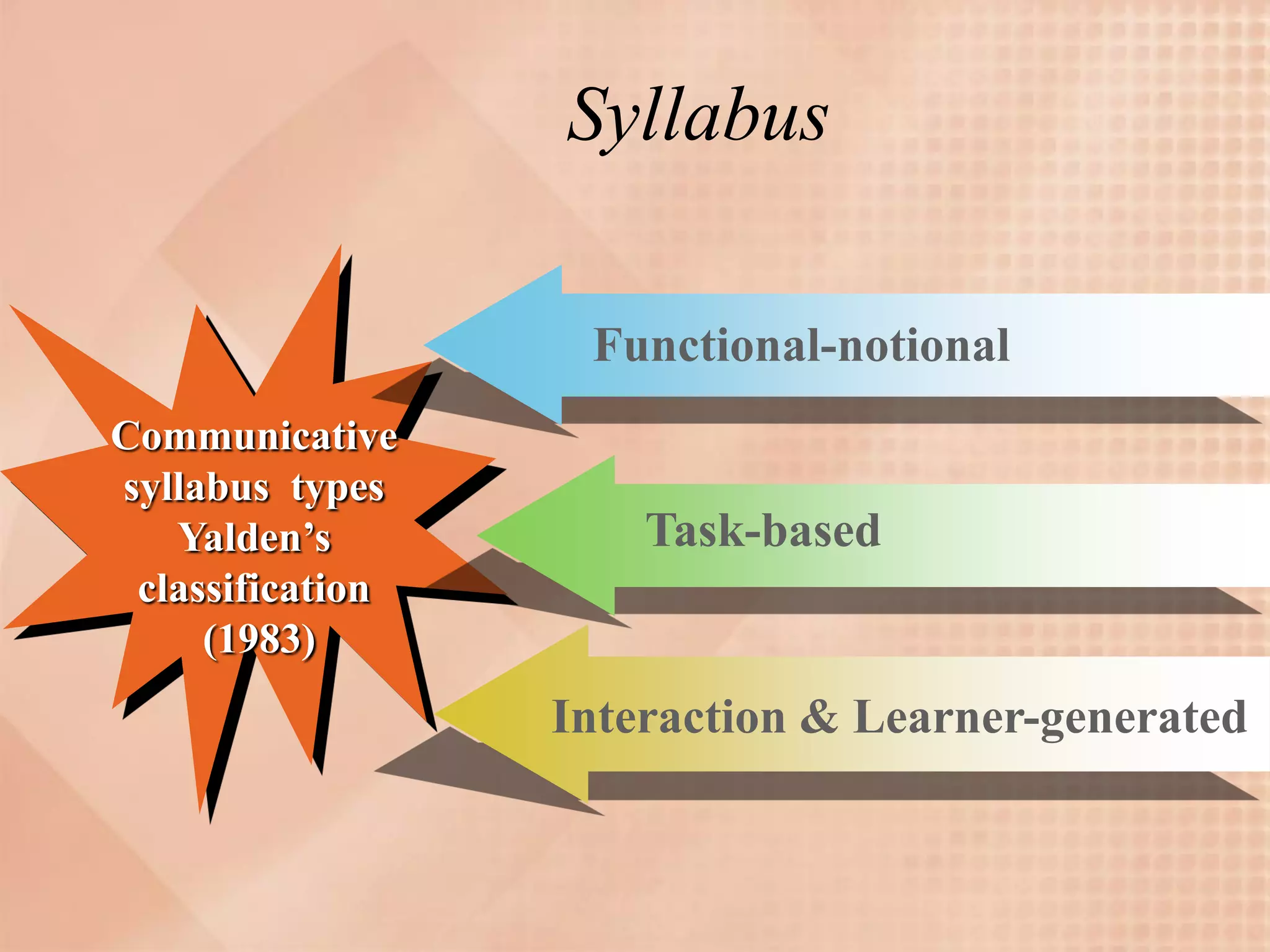
Outlines objectives of language learning focusing on expression, semiotic systems, error analysis, and functional syllabuses.
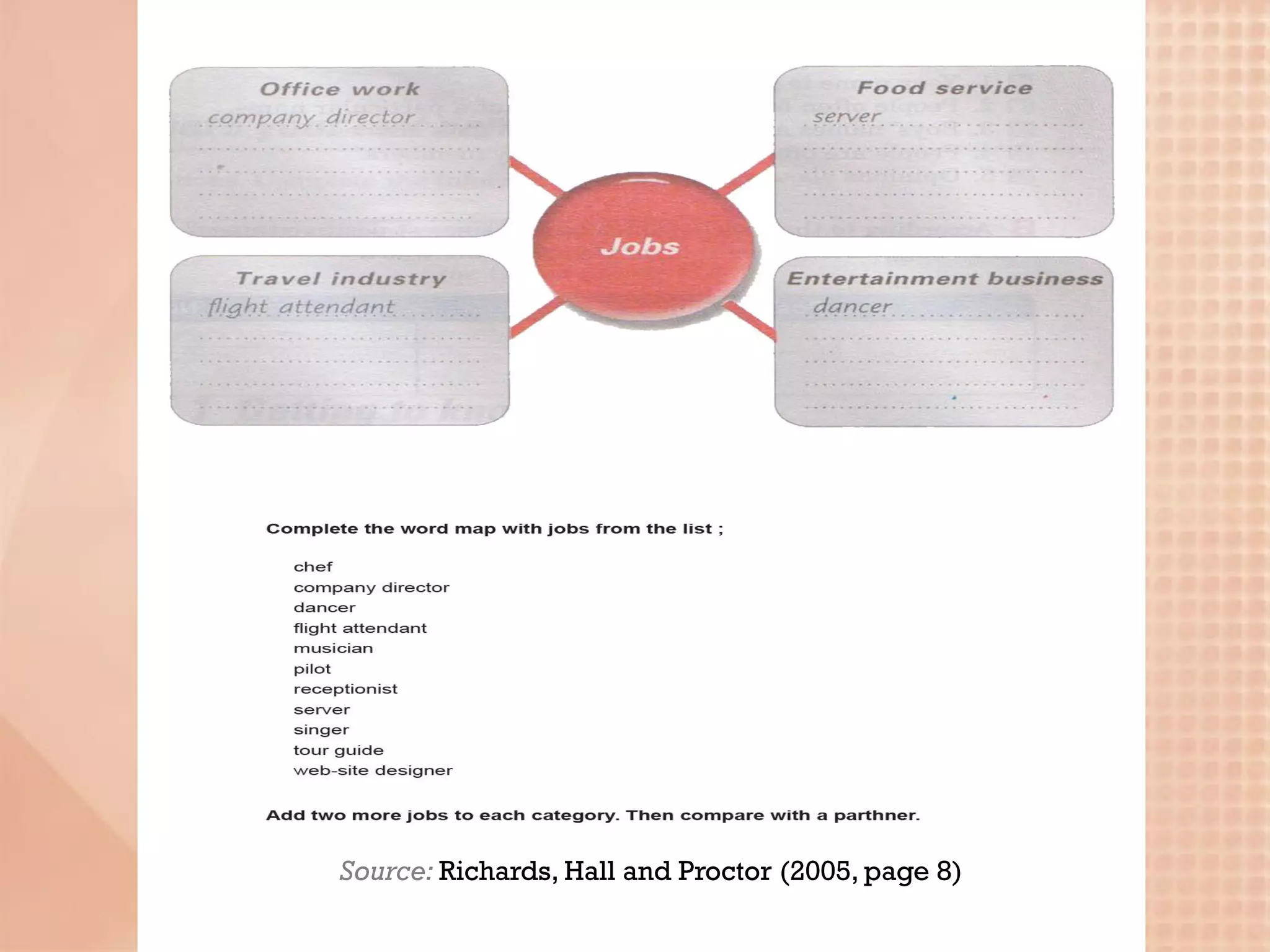
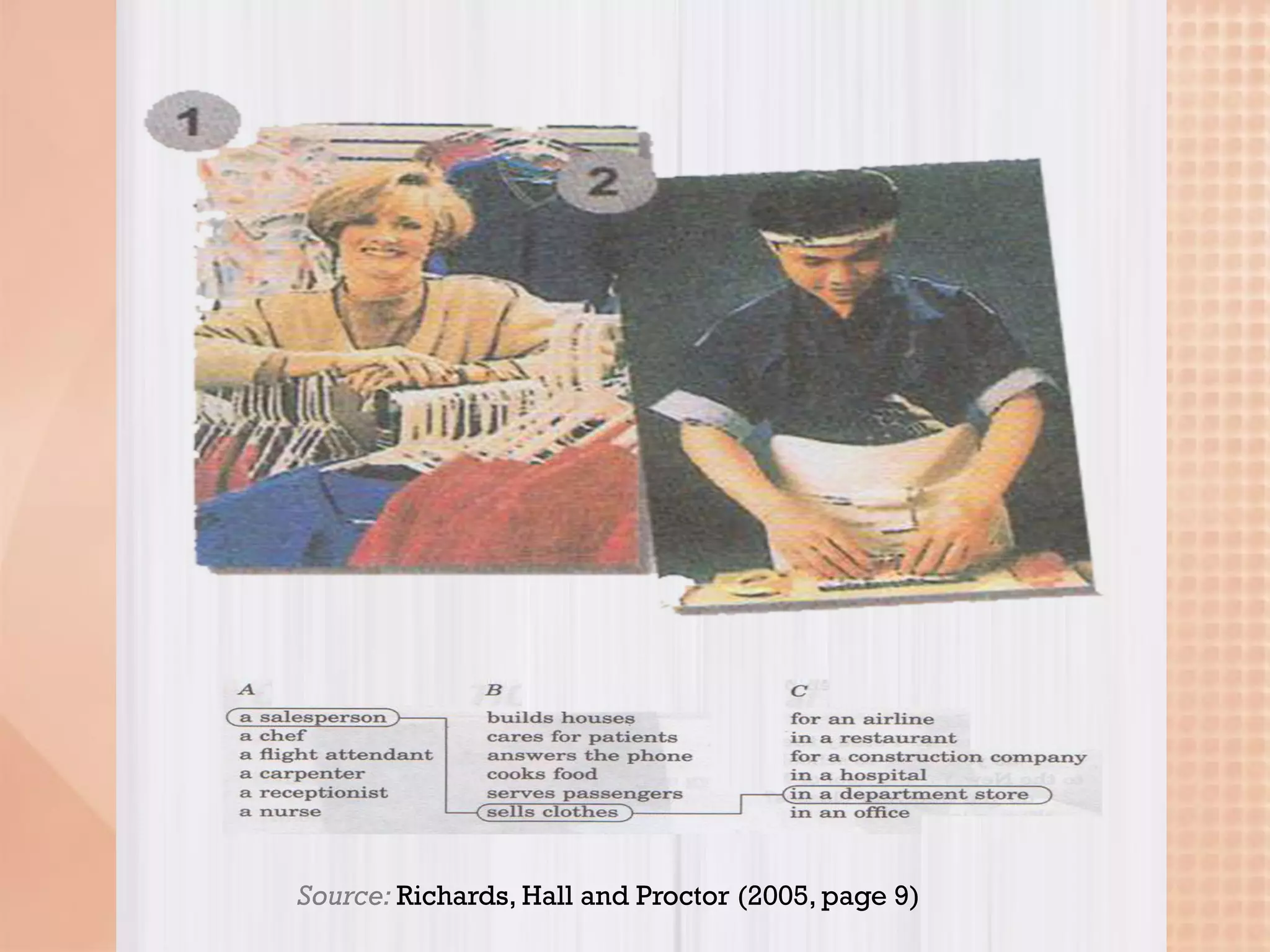
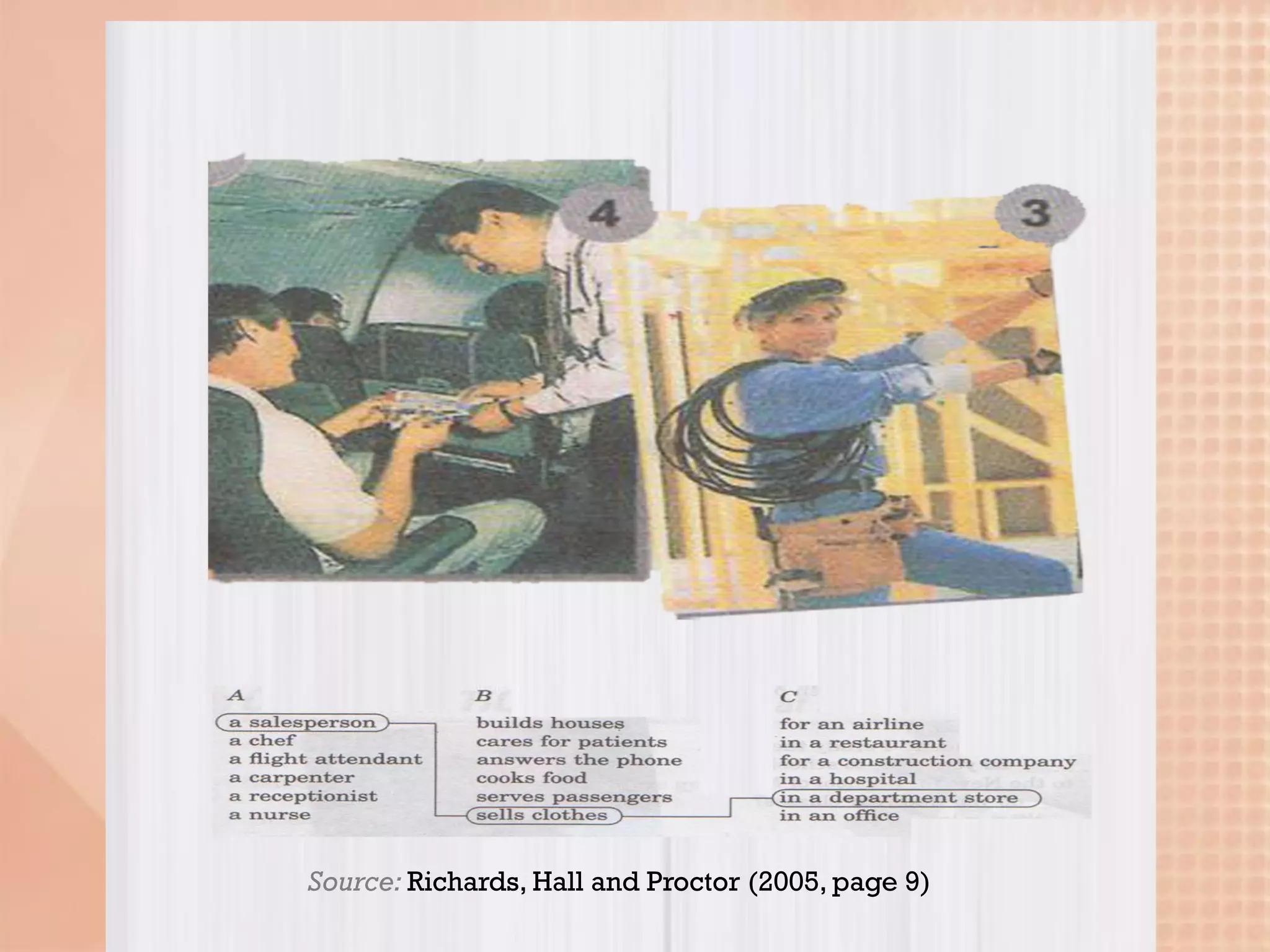
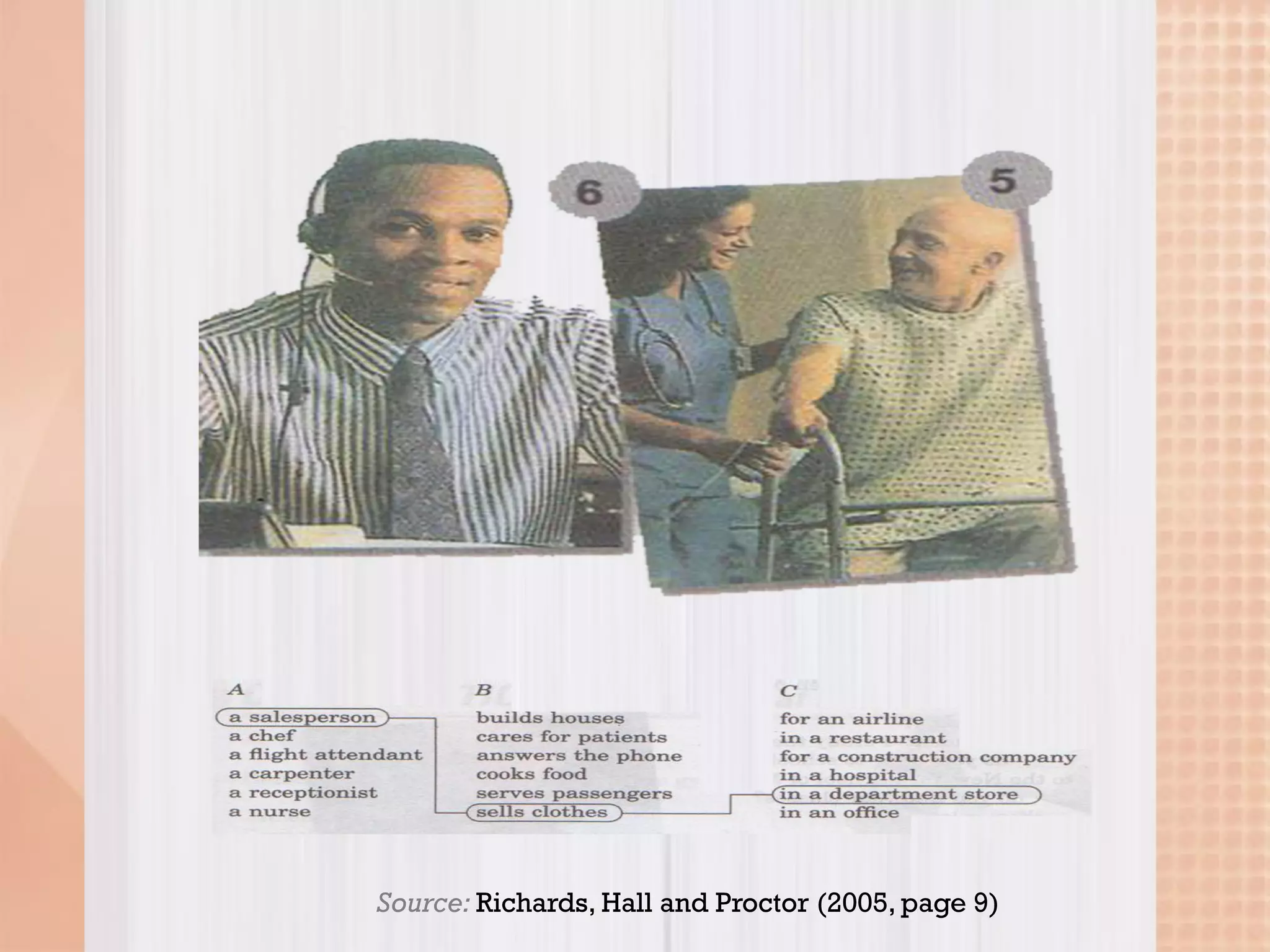
Details learning techniques in CLT, including communicative activities, role plays, and vocabulary games. Describes lesson themes on jobs using communicative methods, discussion, role play, and grammar in context.
Explains the cognitive linguistics interface in language learning, focusing on usage and structure.
Overview of Word Grammar, discussing language as a cognitive network drawing from other language theories.
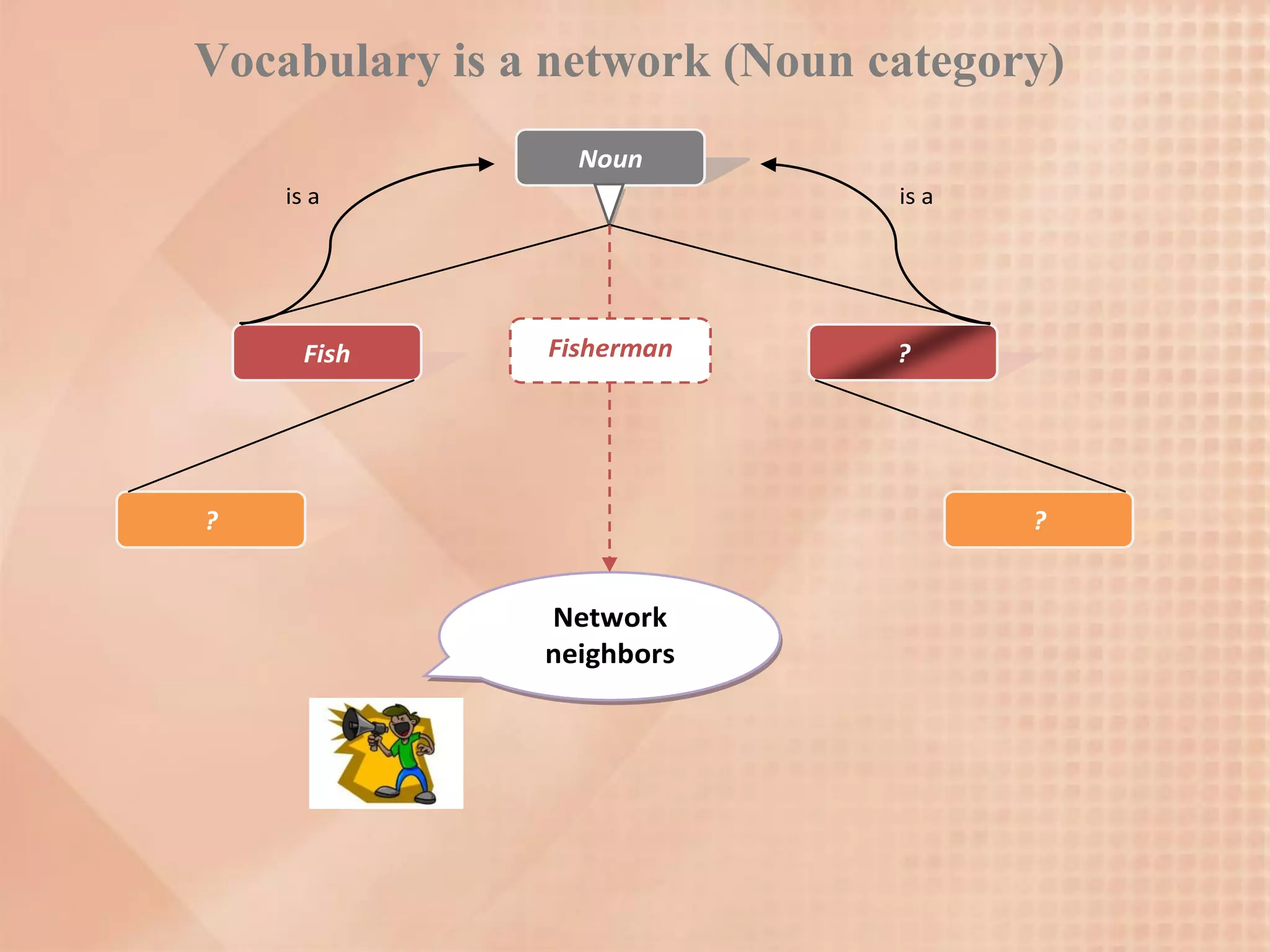
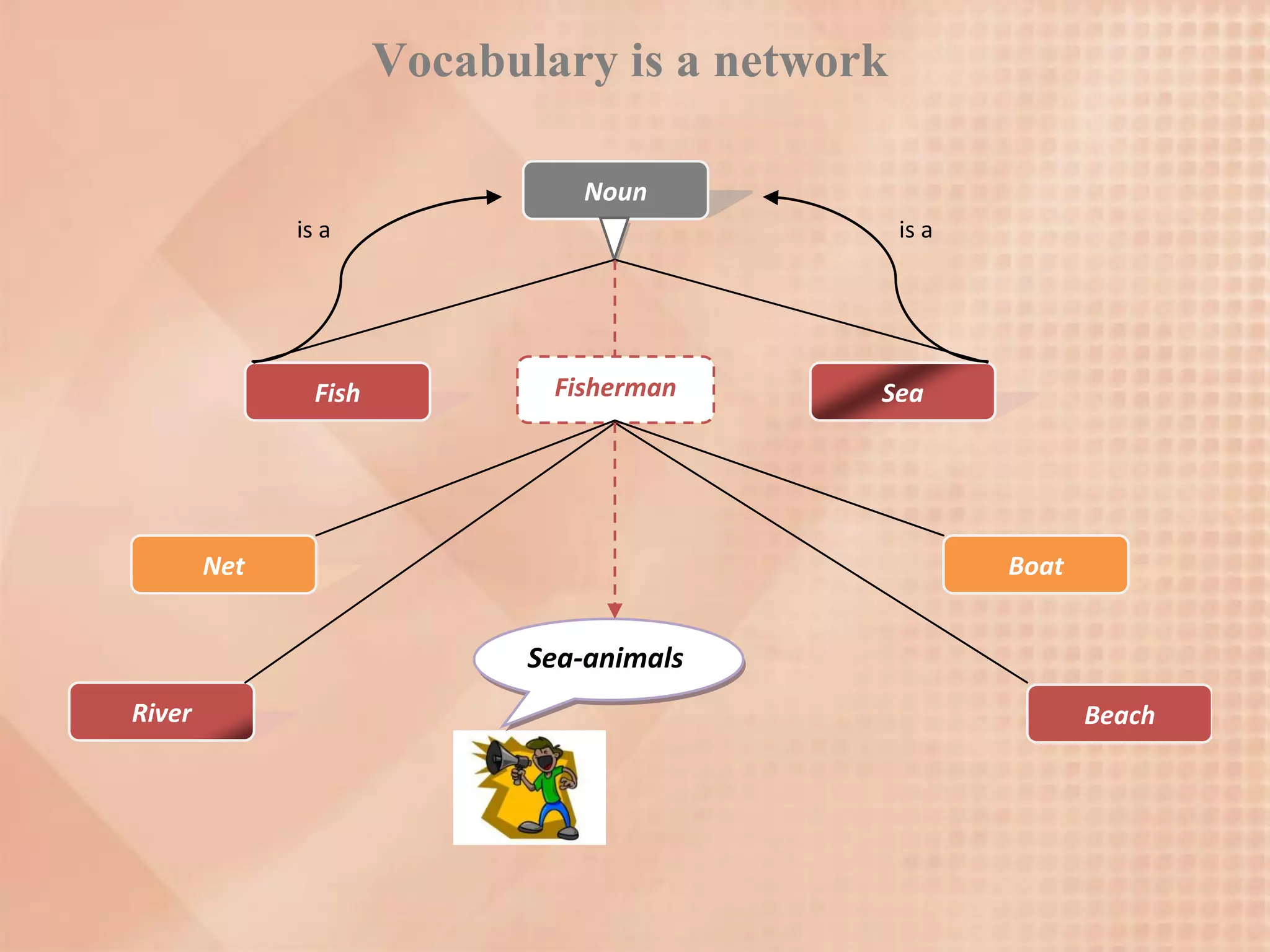
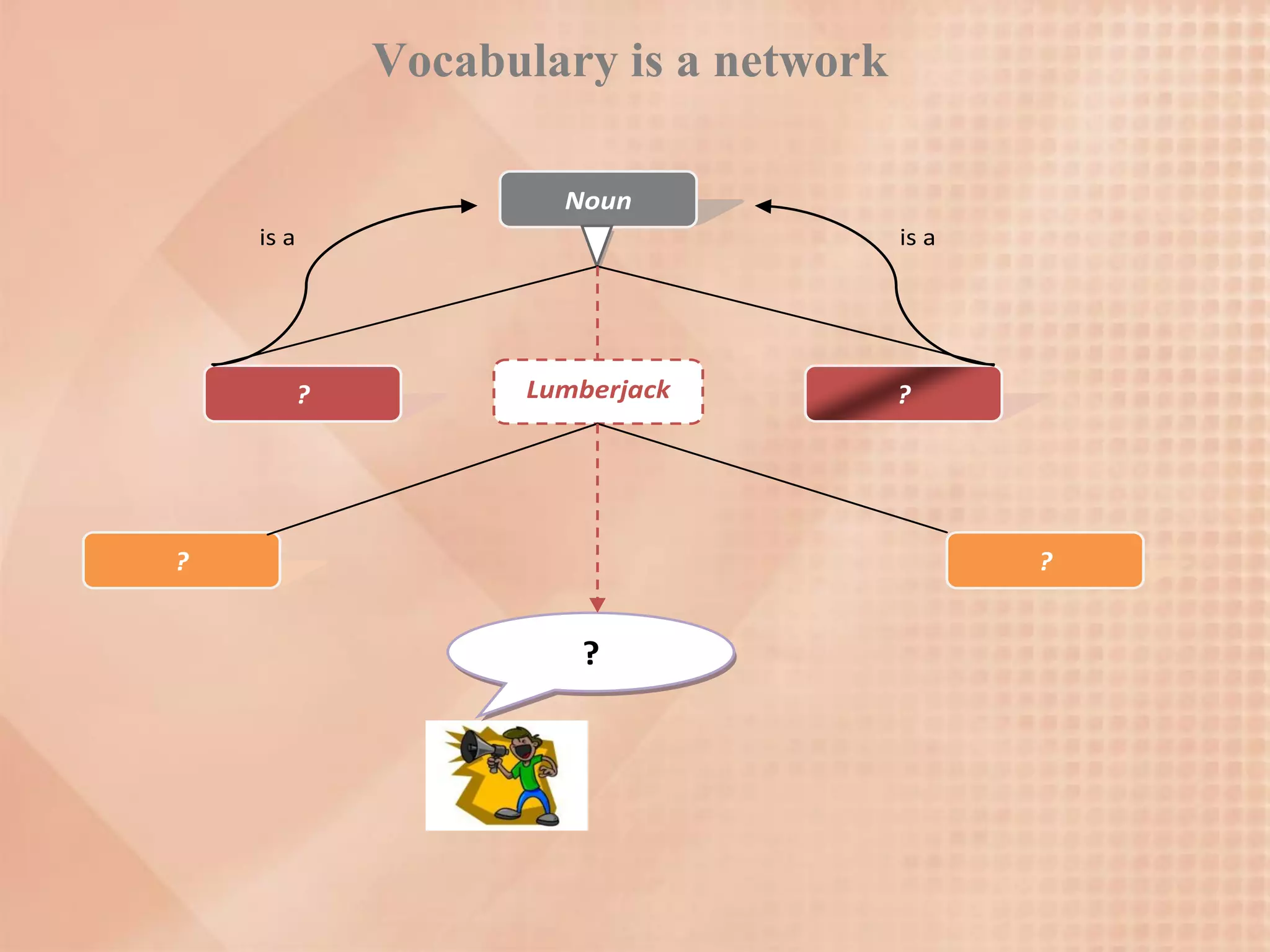
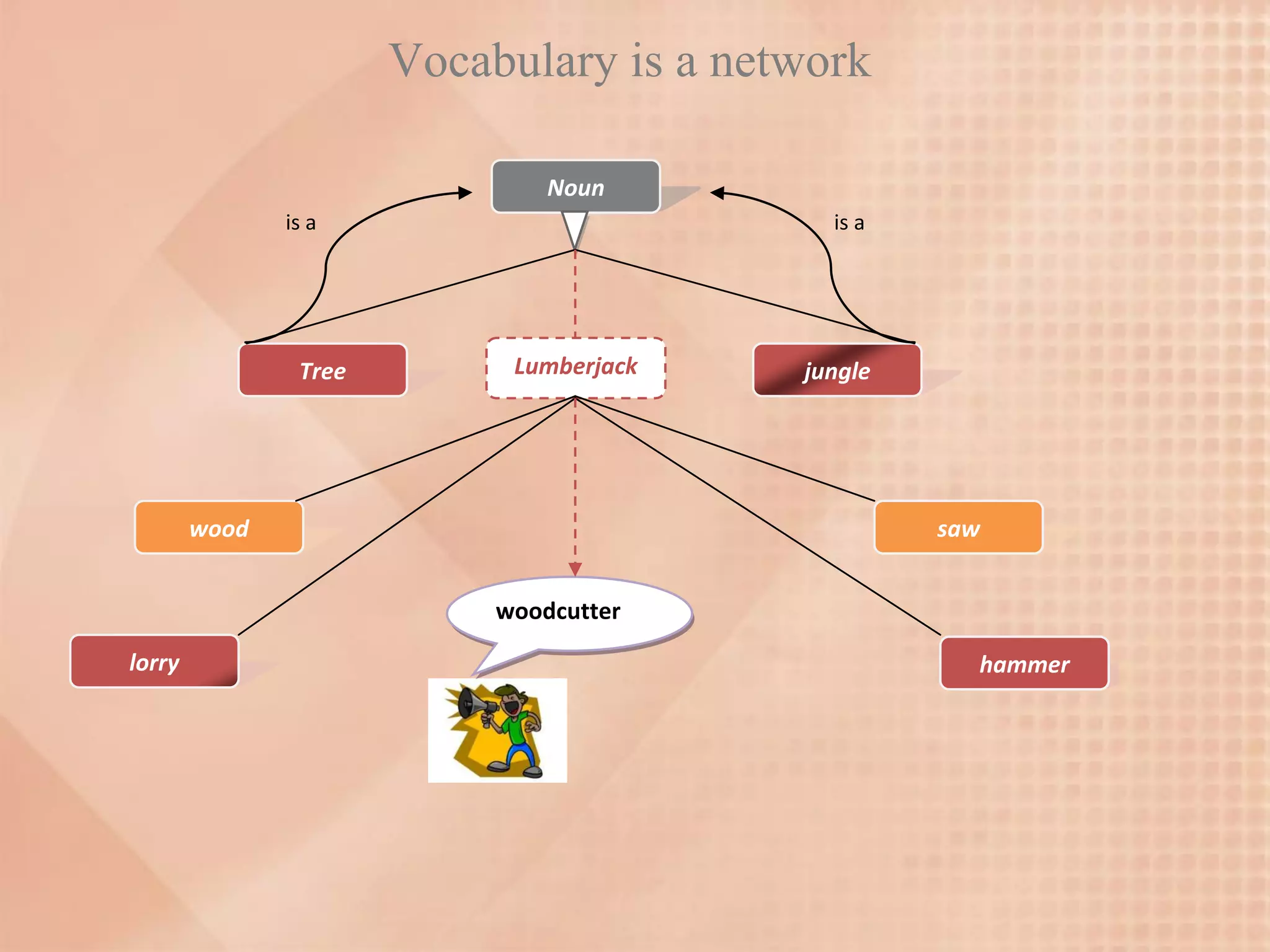
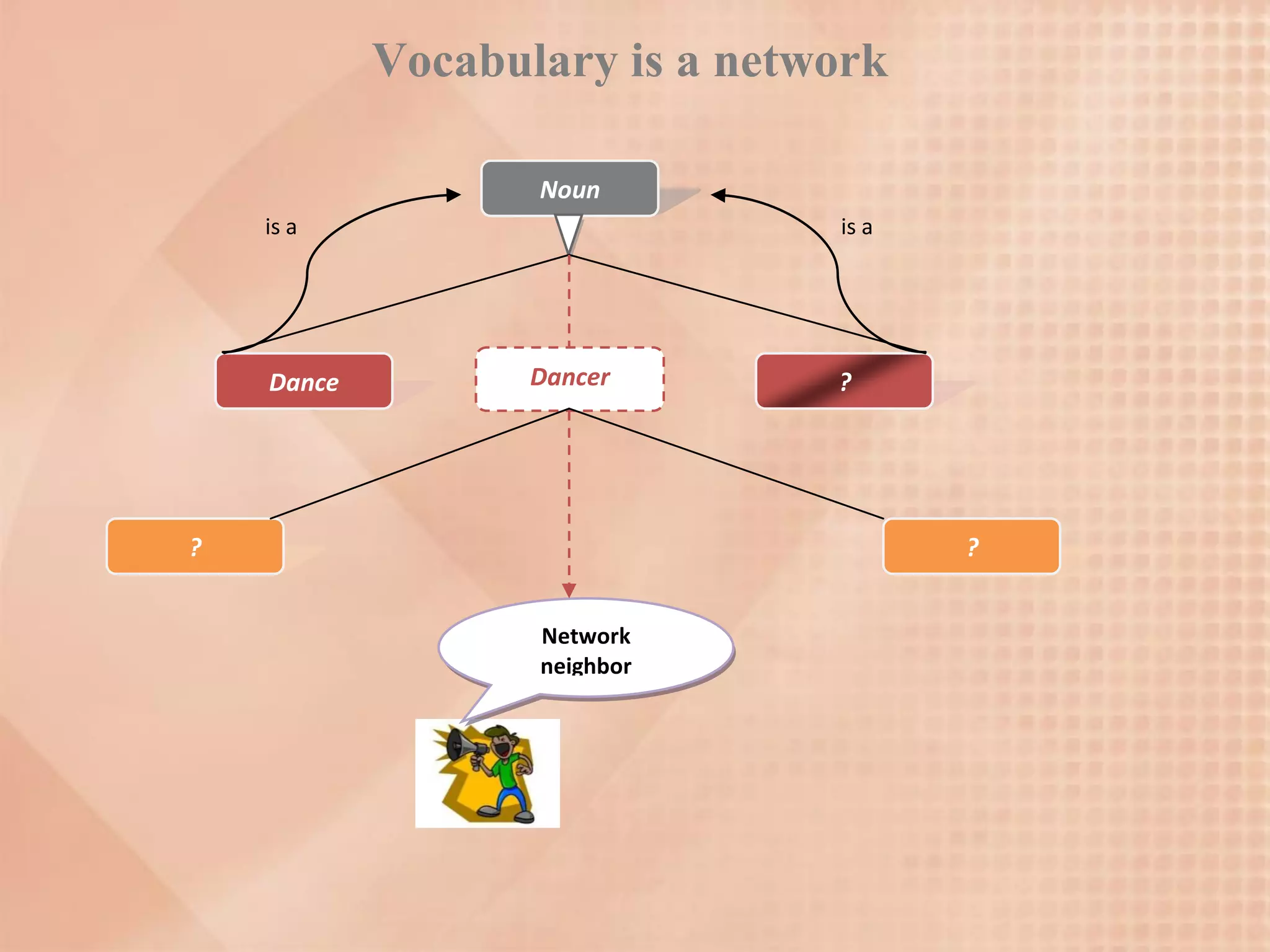
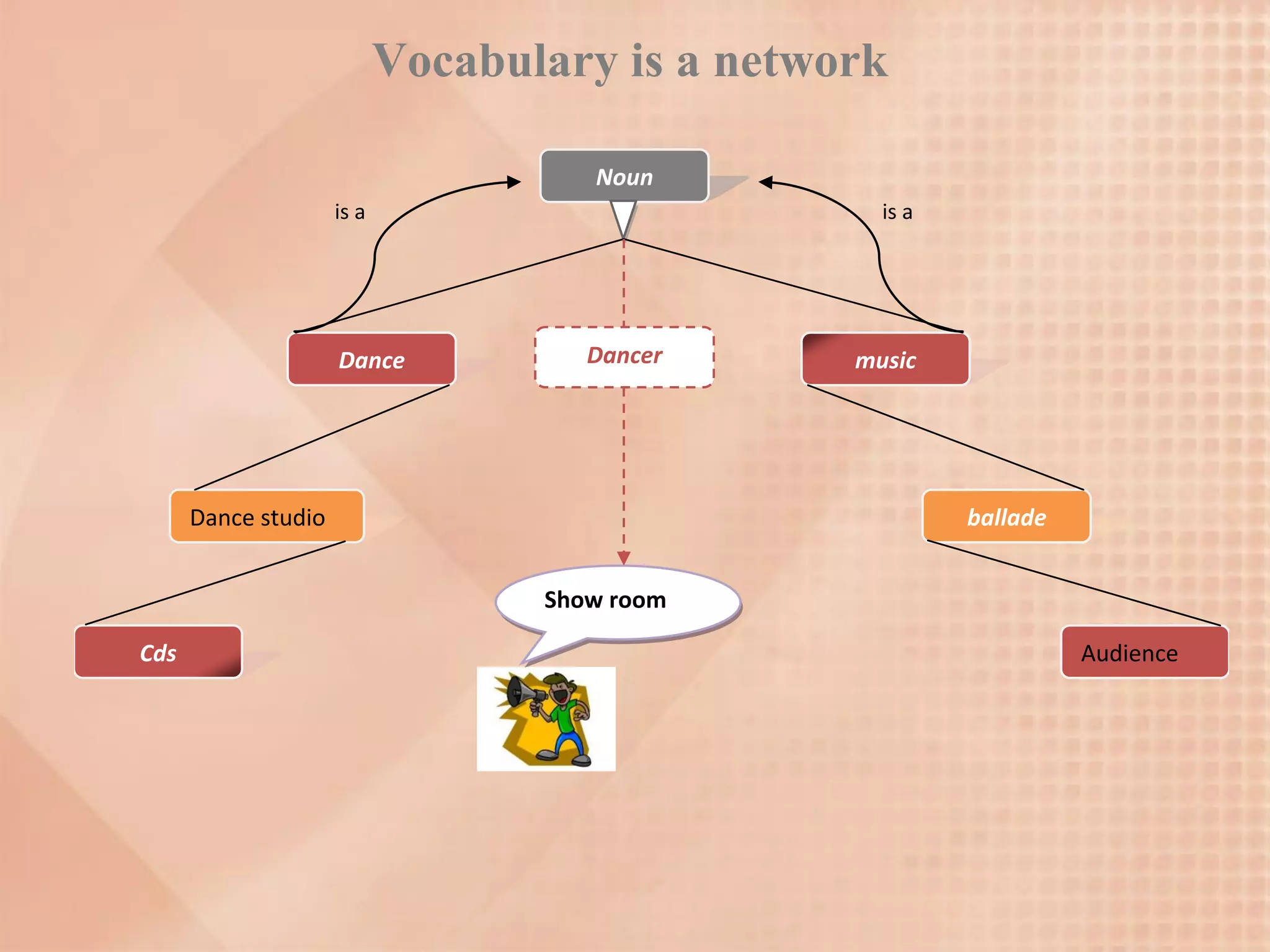
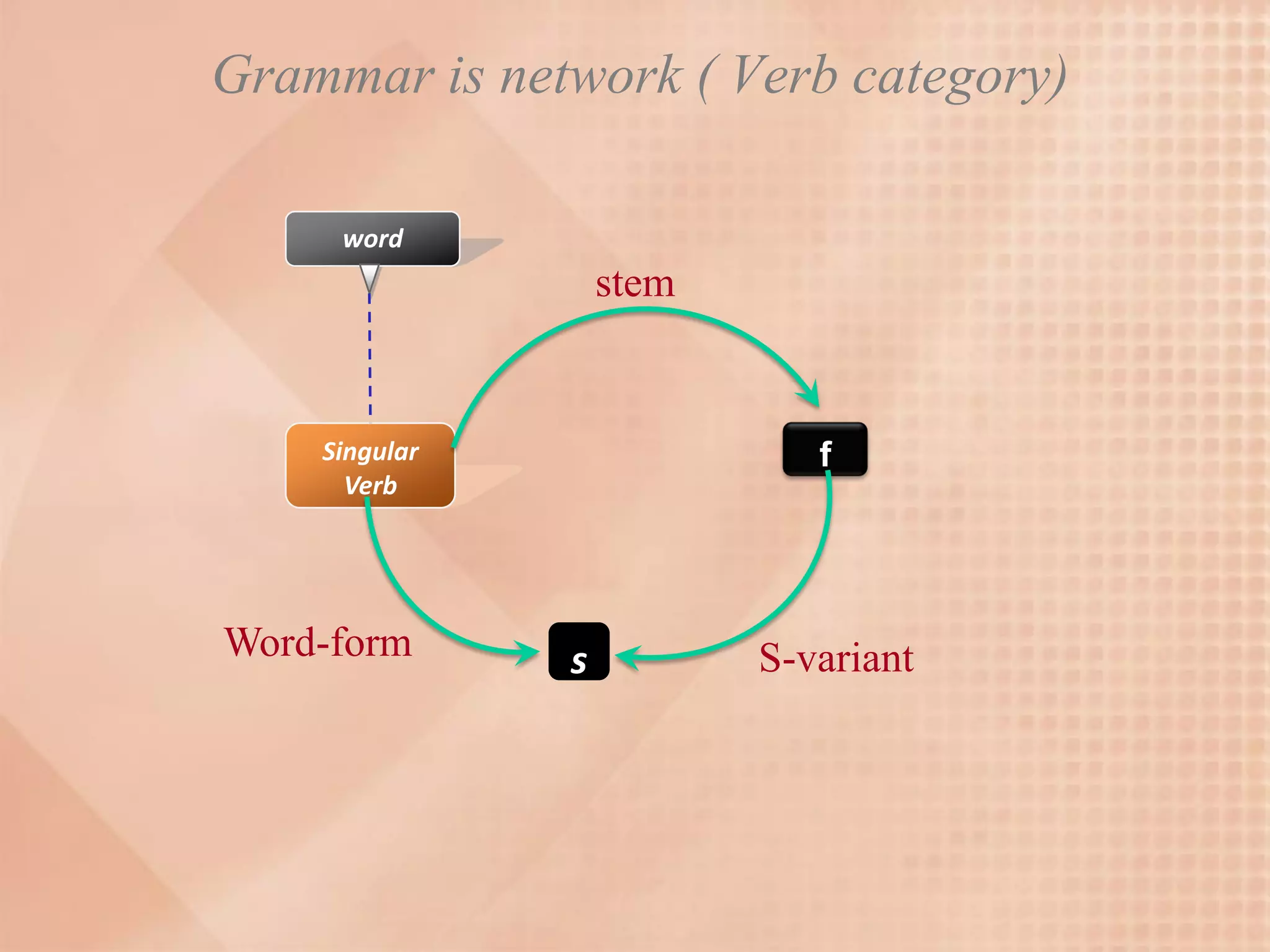
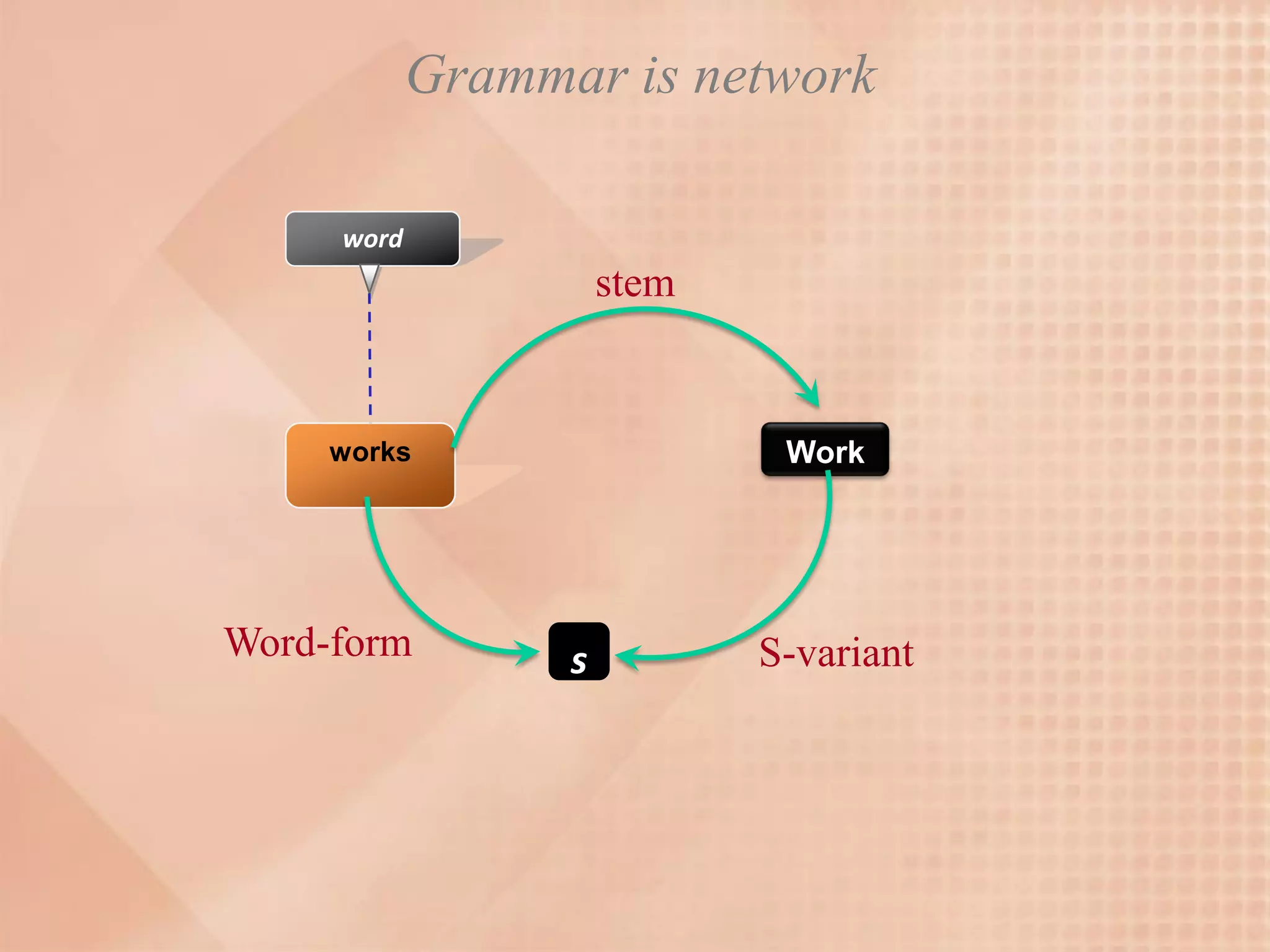
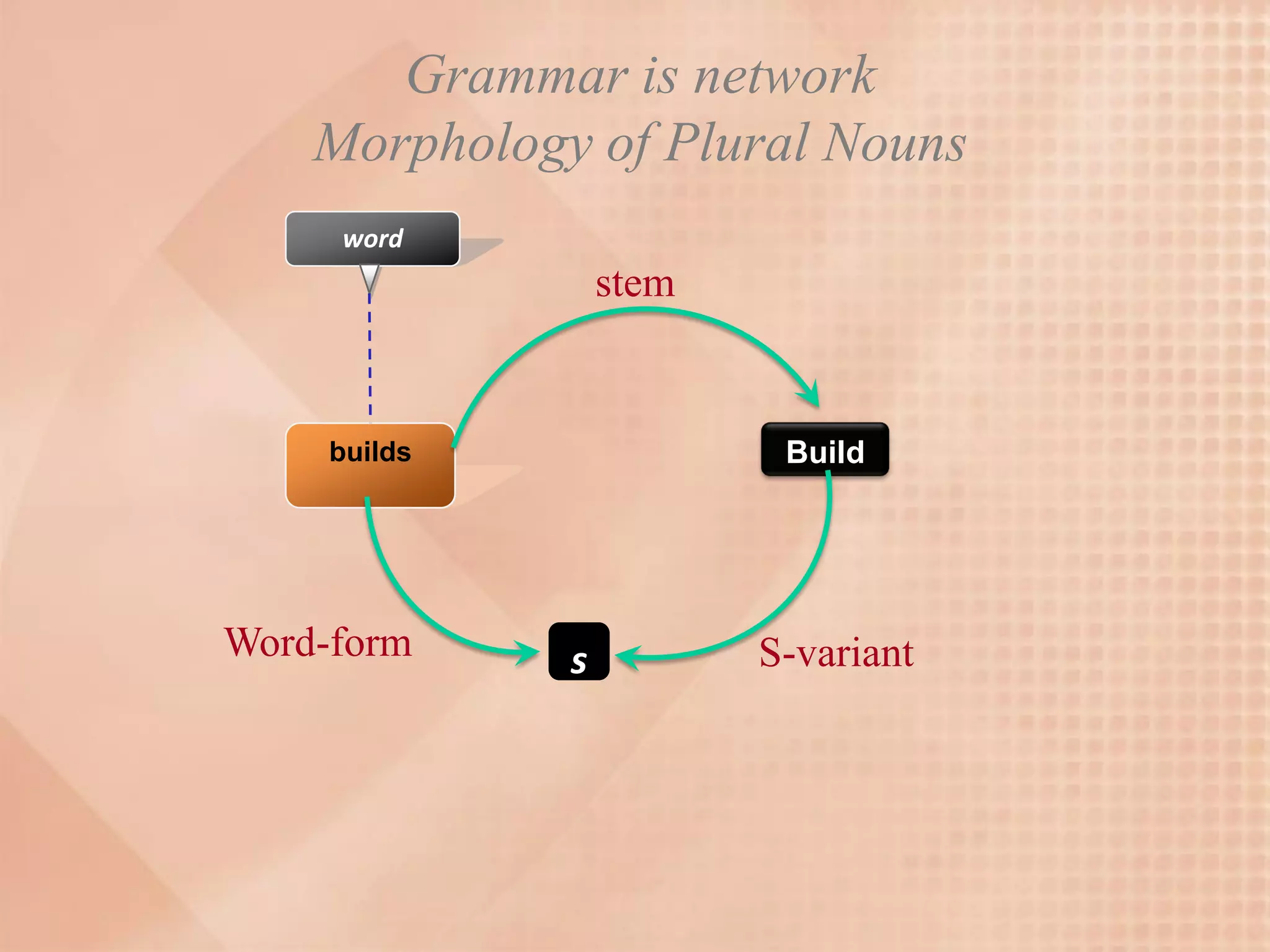
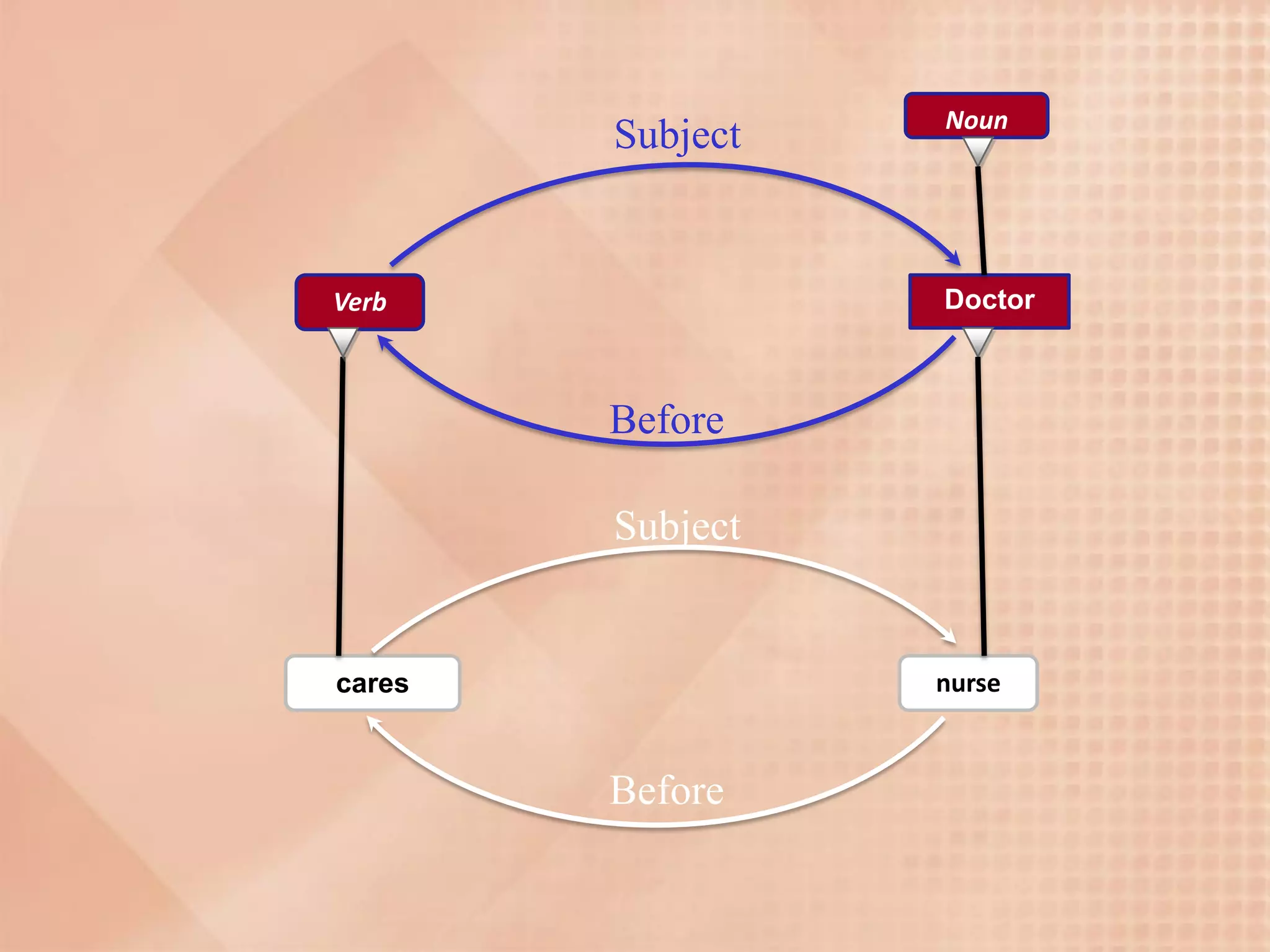
Details vocabulary and grammar as networks, including relationships and examples from nouns and verbs.
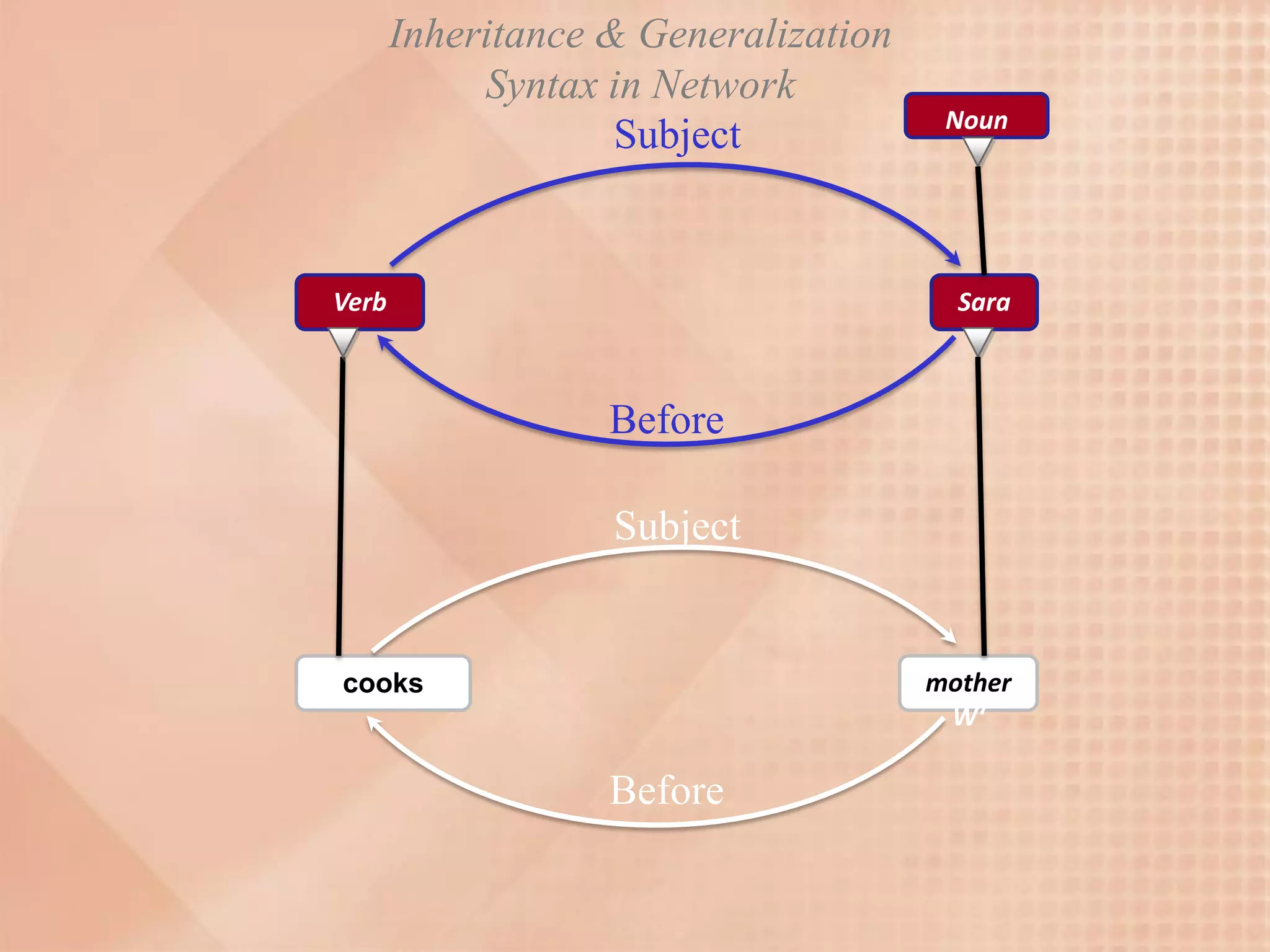
Explains syntax in networks, discussing the principles of inheritance and generalization in language.
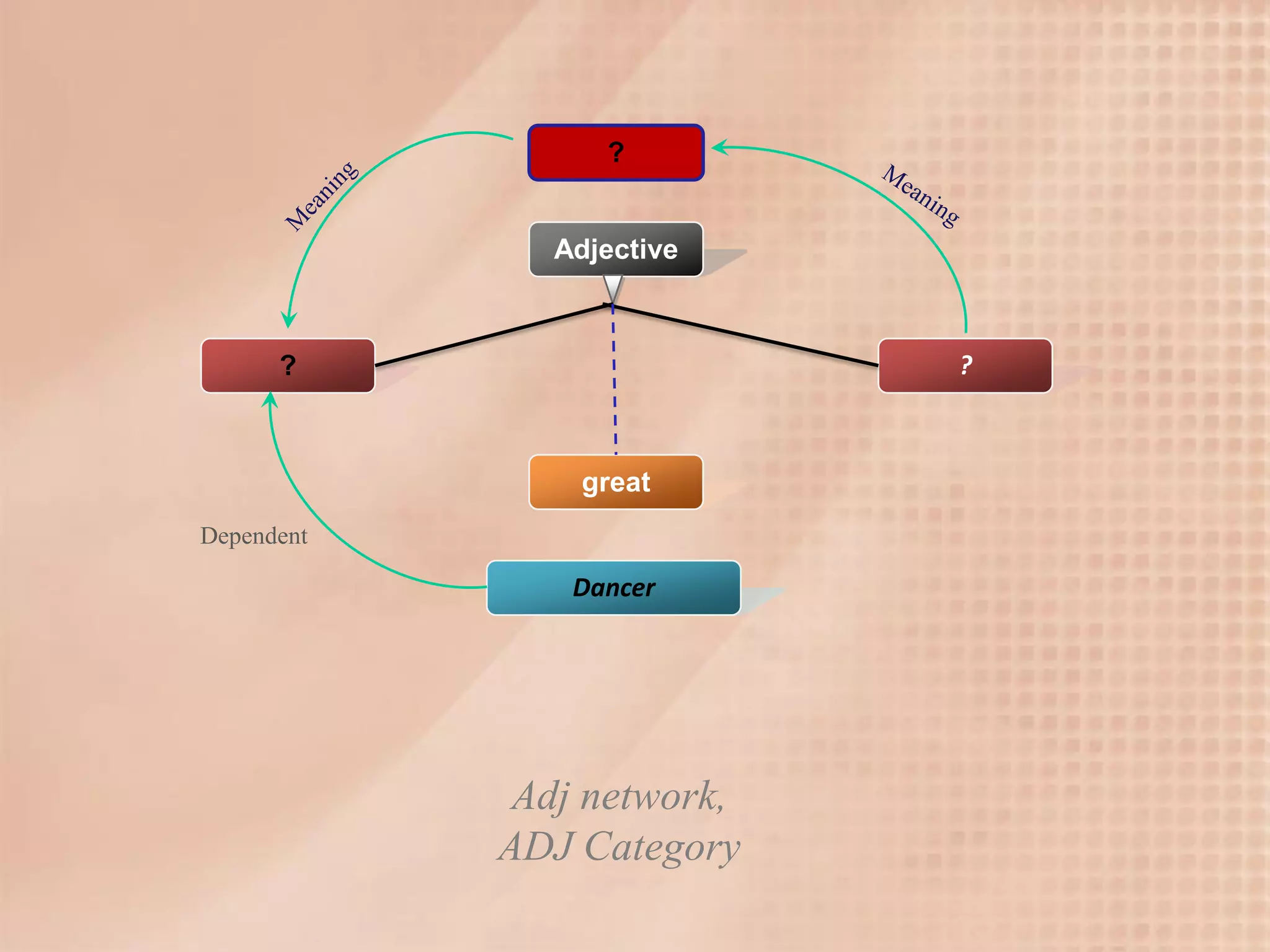
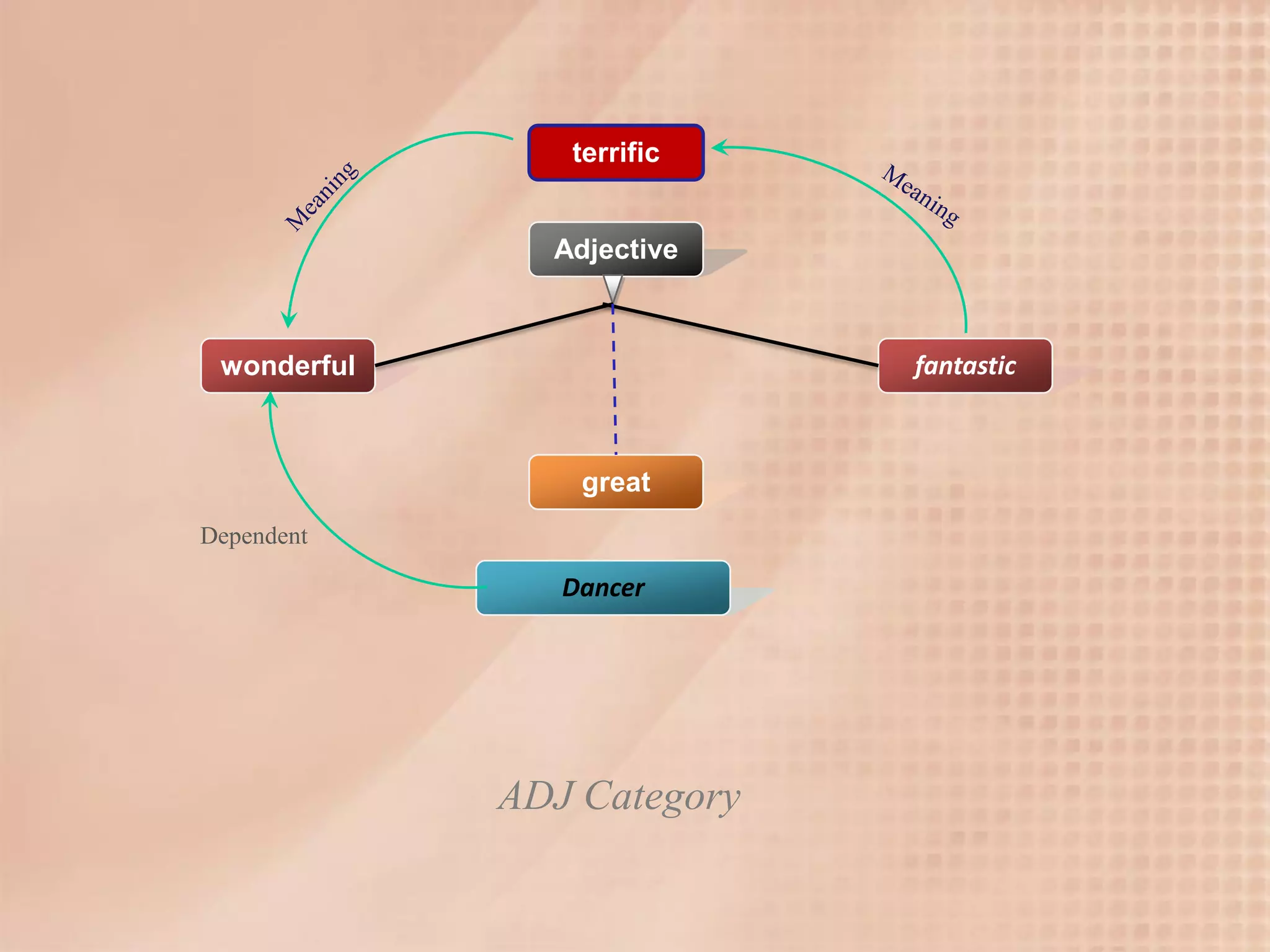
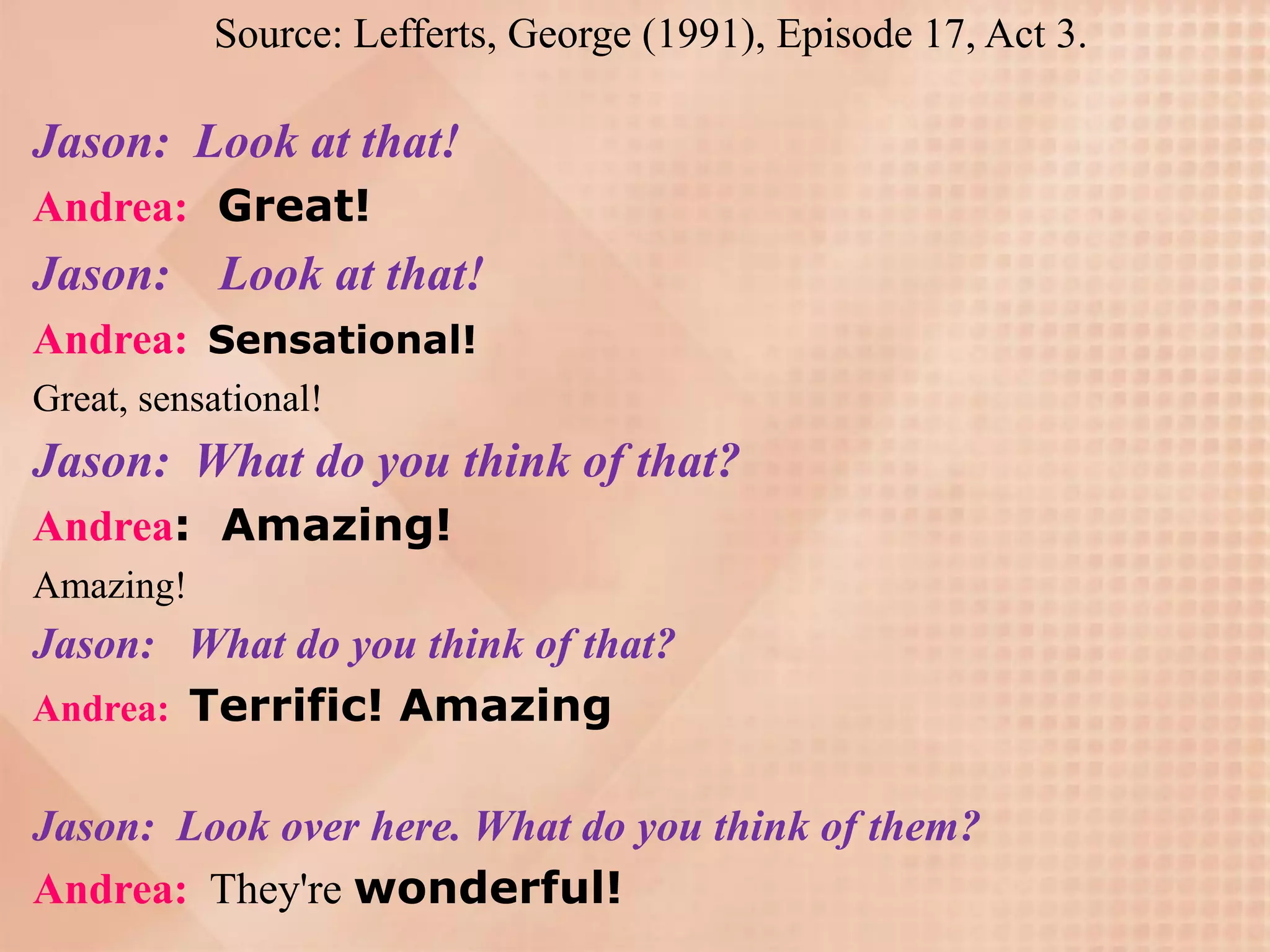
Presents examples of adjectives in a network, referencing dialogues to illustrate adjective expressions.
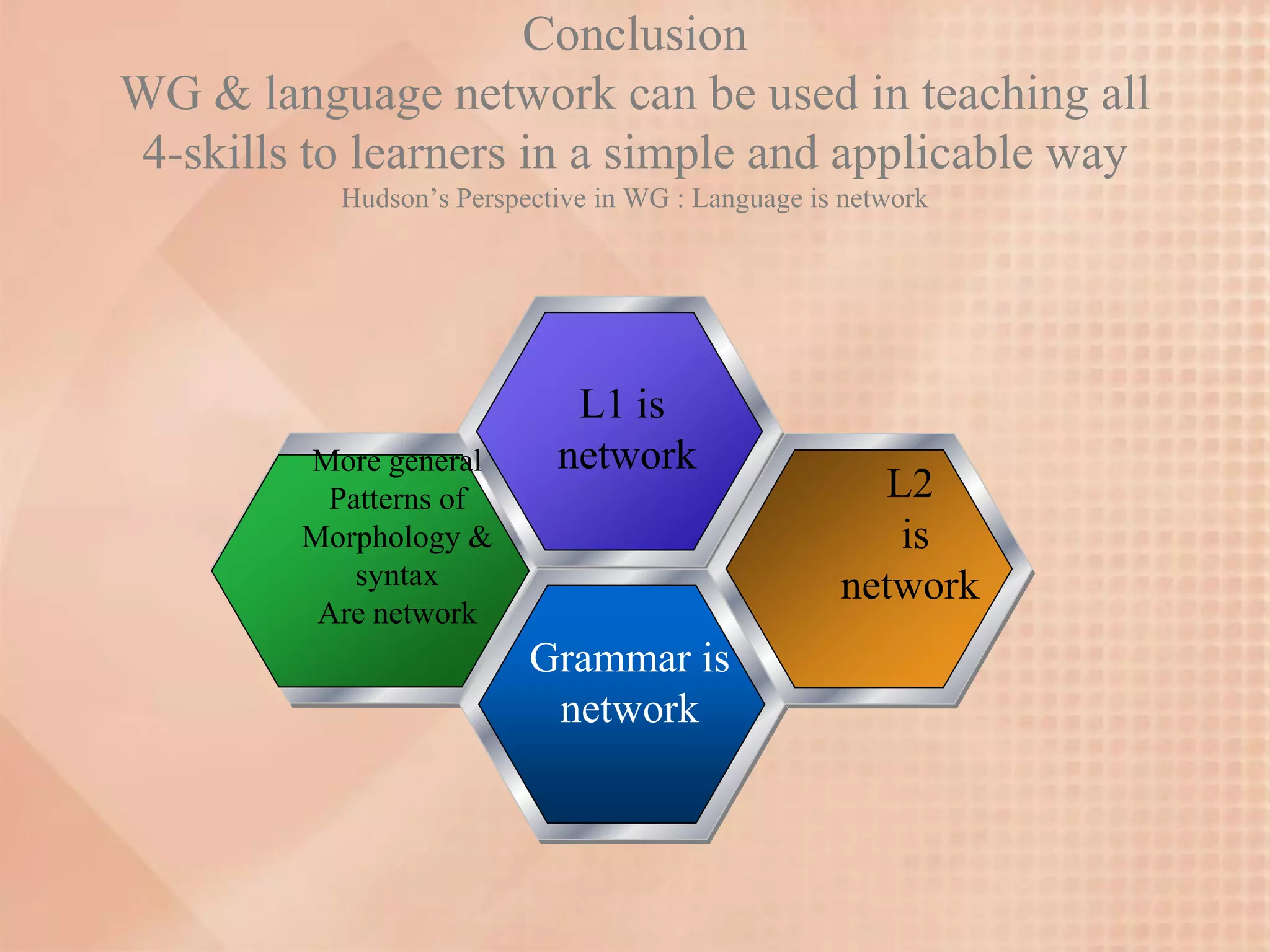
Summarizes the application of Word Grammar in teaching four skills and the foundational network of language.Lists references and sources used, detailing important literature in Cognitive Linguistics and Word Grammar.
This paper ispresented in partial fulfillment of
the requirements for the course
General Linguistics for TESL
Faculty of Education
University of Malaya
Dr. Jessie Grace U. Rubrico, Facilitator
PBGS 6304, Semester 2, AY 2009-2010
April 2010
3.
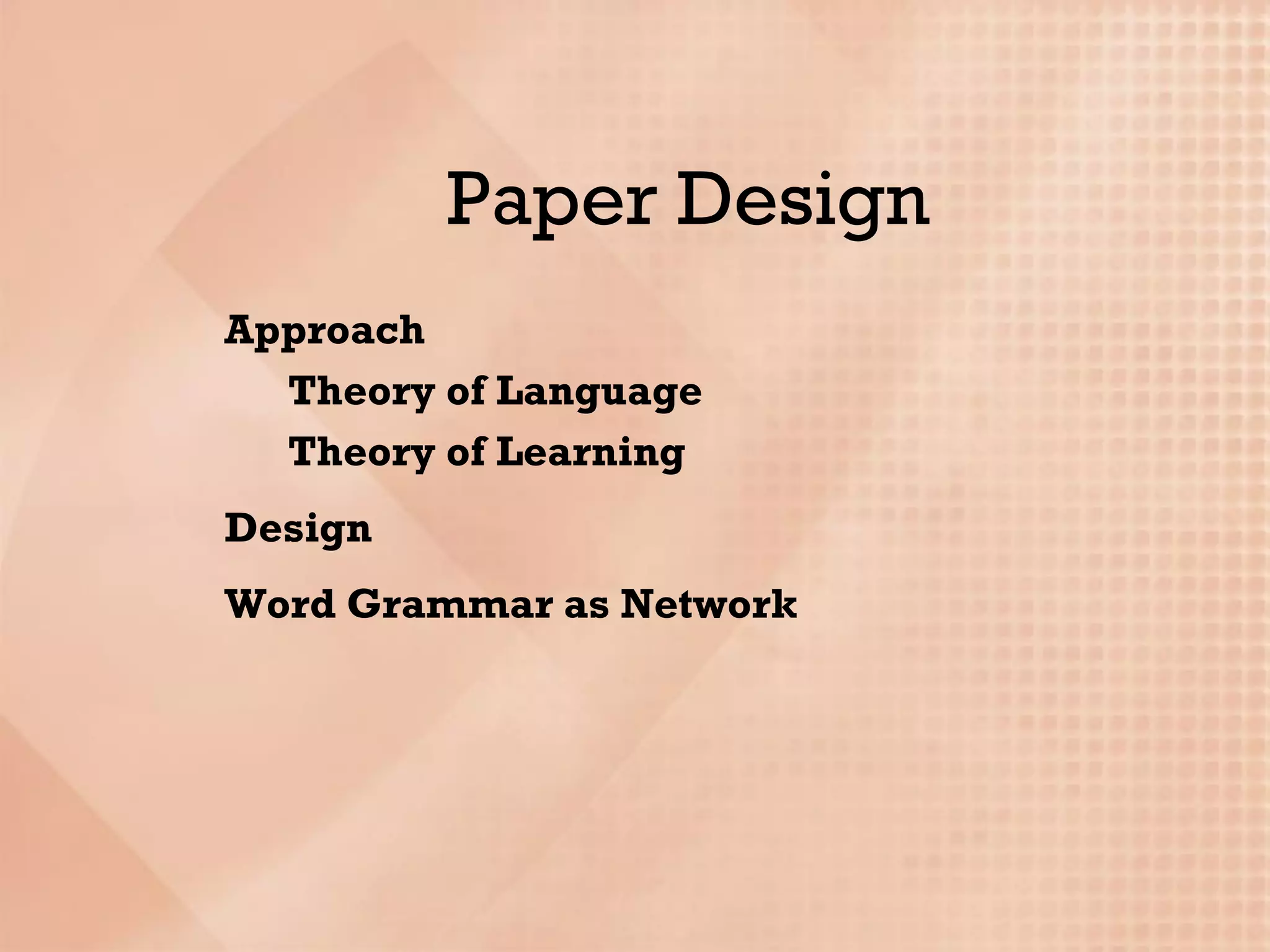
Paper Design
Approach
Theory of Language
Theory of Learning
Design
Word Grammar as Network
4.
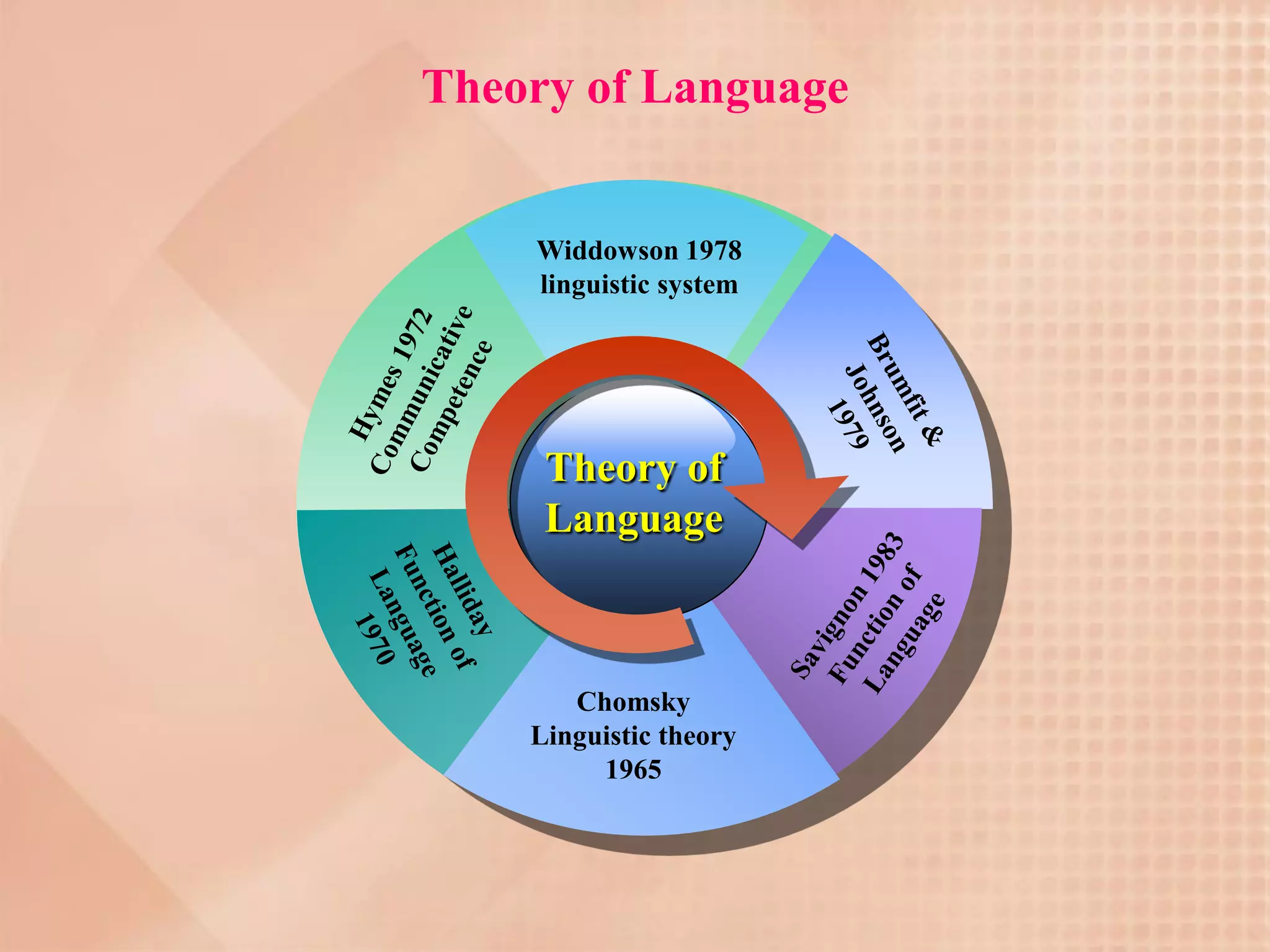
Theory of Language
Widdowson 1978
linguistic system
Theory of
Language
Chomsky
Linguistic theory
1965
5.
Approach
Theory of Learning
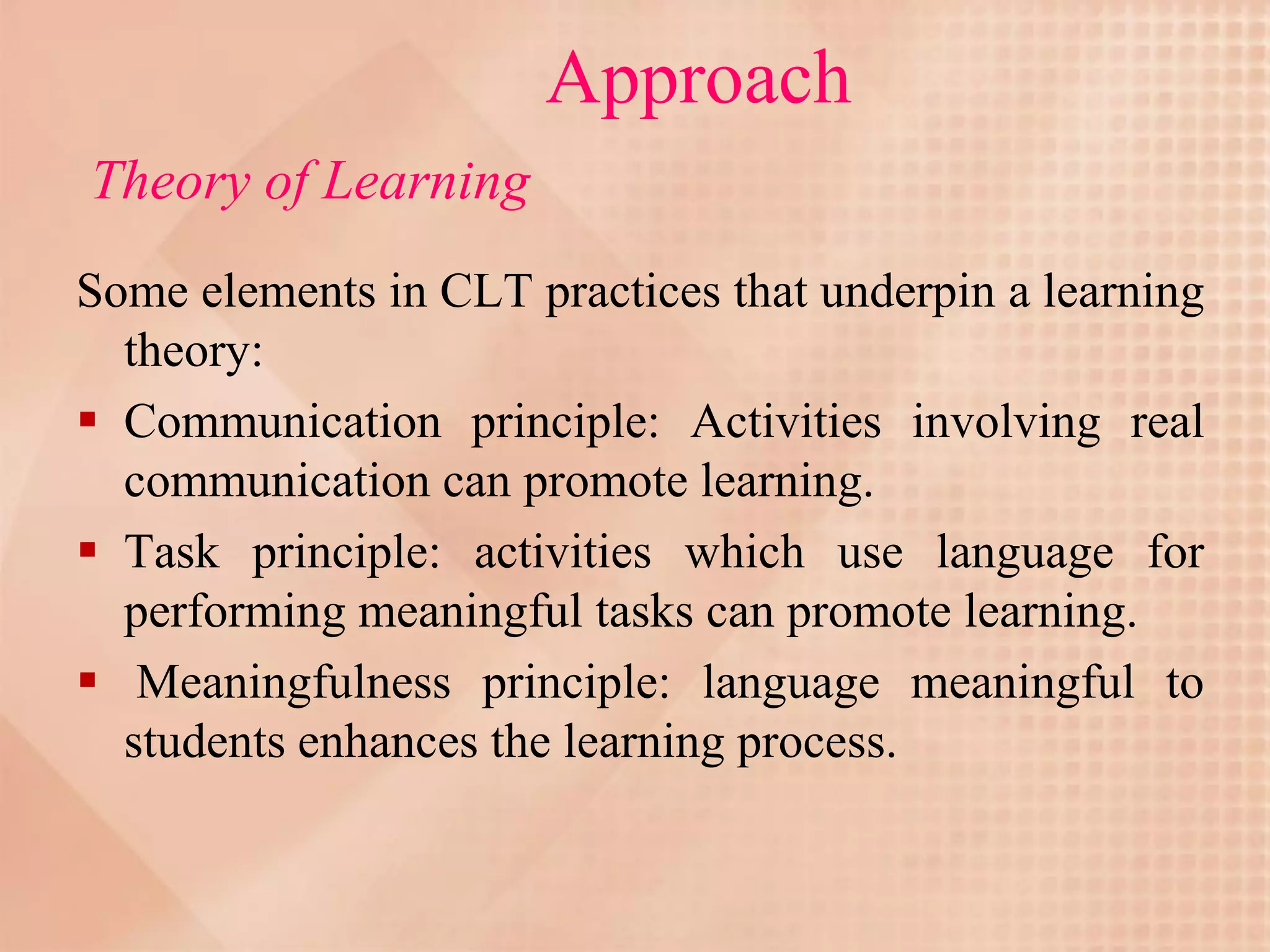
Someelements in CLT practices that underpin a learning
theory:
Communication principle: Activities involving real
communication can promote learning.
Task principle: activities which use language for
performing meaningful tasks can promote learning.
Meaningfulness principle: language meaningful to
students enhances the learning process.
6.
Characteristics of communicativeview of Language
Language is a system for expression of meaning
Primary function of language is to allow communication
Structure of language reflects its functional & communicative uses
Unit of Language is not only grammatical and structural features
7.
CLT practices referto special conditions needed to promote
second language learning rather than language acquisition
processes. Moreover, learners should be engaged in
meaningful and authentic language use not merely
mechanical practice of patterns in language (Littlewood
1981; Johnson 1982).
Littlewood (1984) and Johnson (1984) represent an
alternative theory which is compatible with CLT- a skill –
learning model of language learning.
This theory involves both cognitive and behavioral aspects
that describe acquisition of competence in a language as an
example of skill development.
8.
Objectives
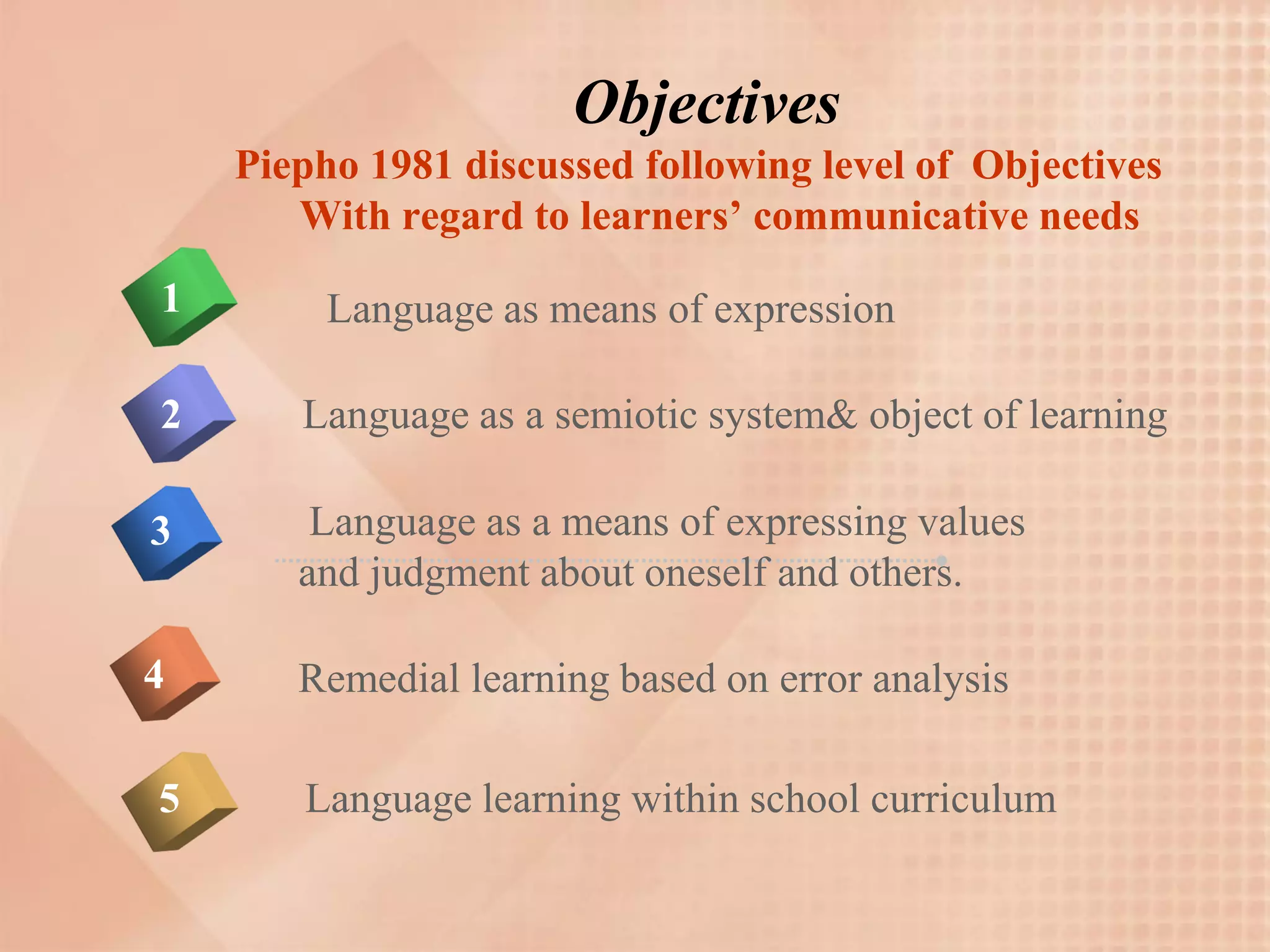
Piepho 1981 discussed following level of Objectives
With regard to learners’ communicative needs
1 Language as means of expression
2 Language as a semiotic system& object of learning
3 Language as a means of expressing values
and judgment about oneself and others.
4 Remedial learning based on error analysis
5 Language learning within school curriculum
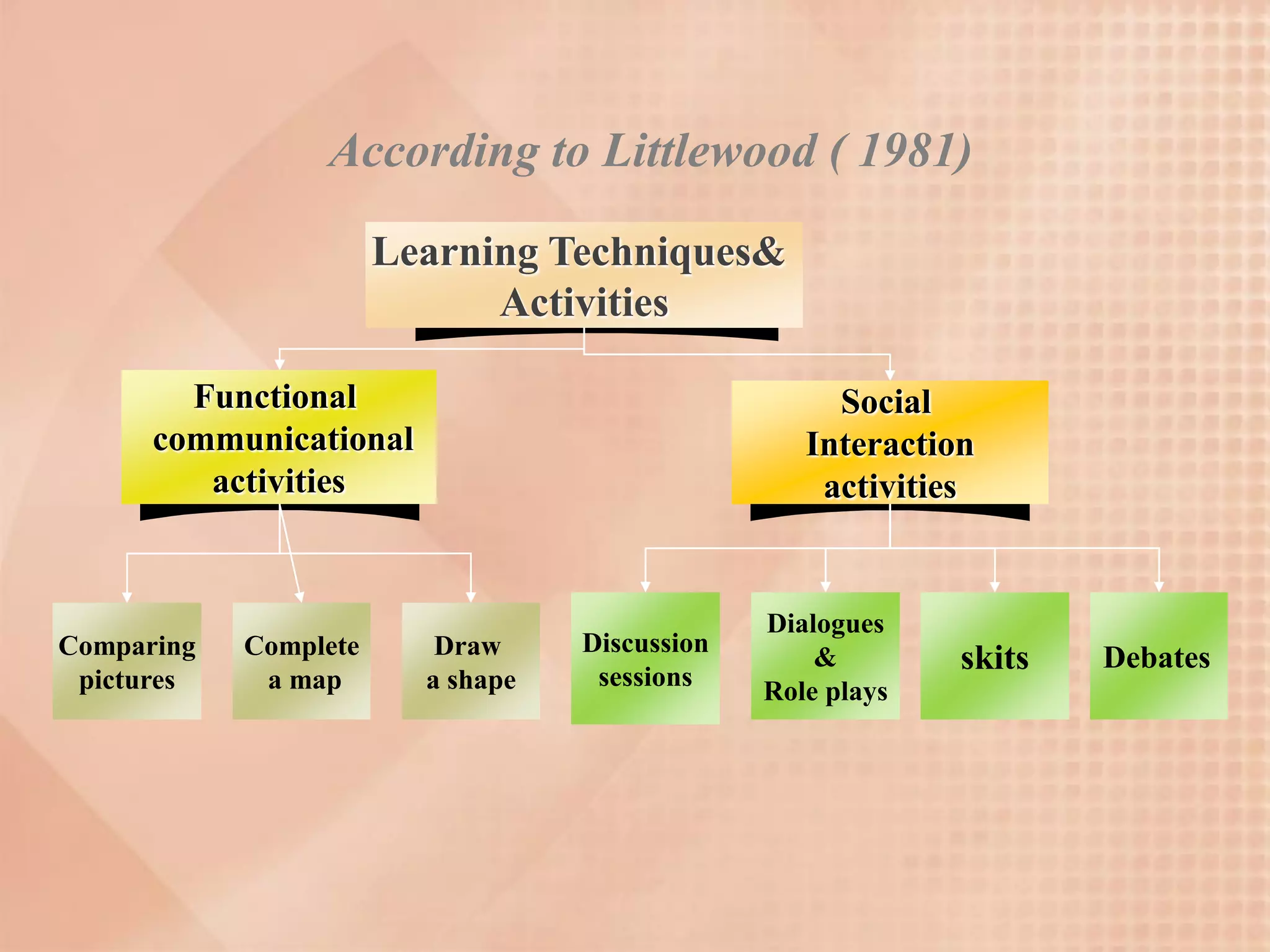
According to Littlewood( 1981)
Learning Techniques&
Activities
Functional Social
communicational Interaction
activities activities
Dialogues
Comparing Complete Draw Discussion
sessions
& skits Debates
pictures a map a shape Role plays
11.
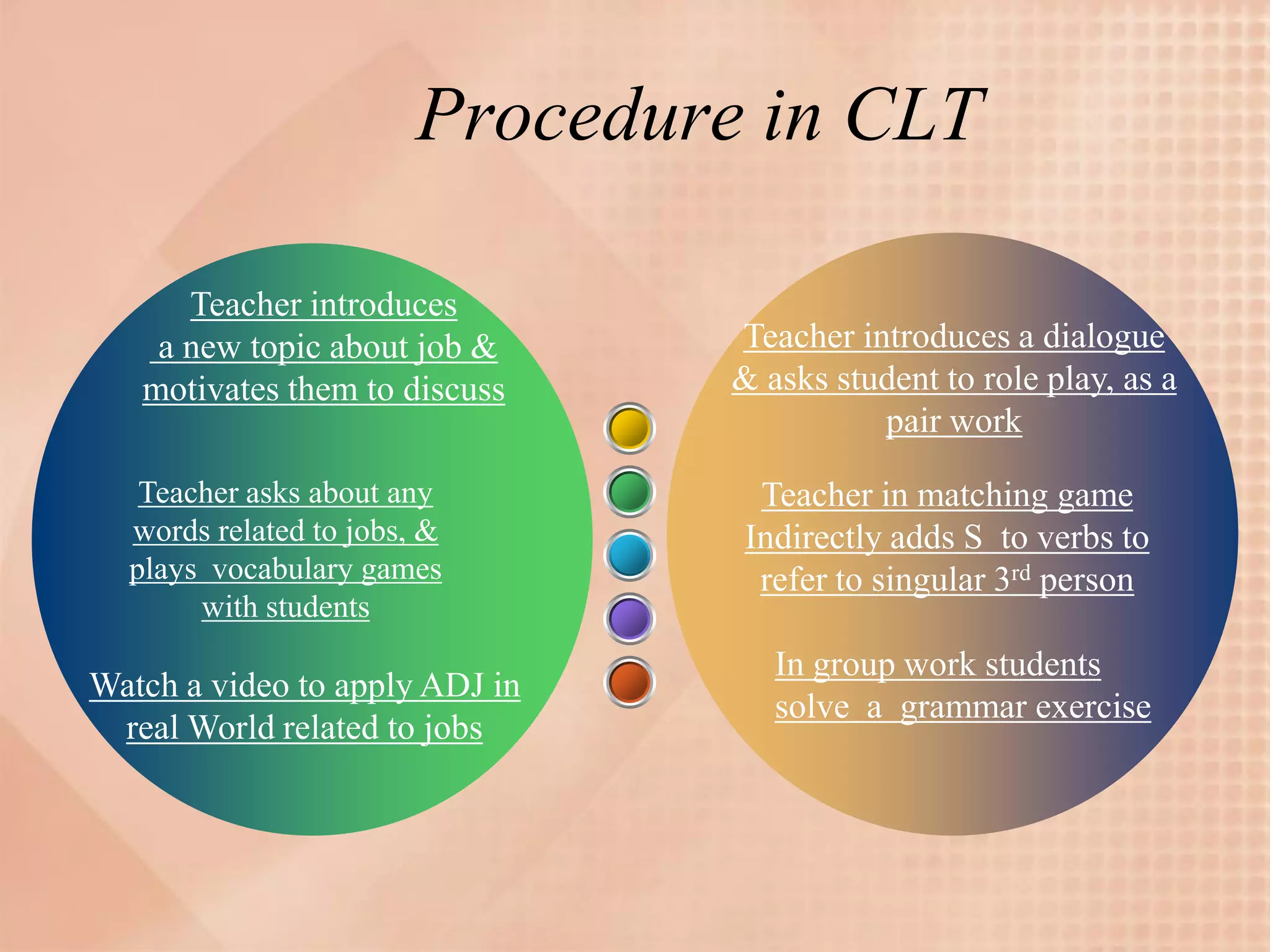
Procedure in CLT
Teacher introduces
a new topic about job & Teacher introduces a dialogue
motivates them to discuss & asks student to role play, as a
pair work
Teacher asks about any Teacher in matching game
words related to jobs, & Indirectly adds S to verbs to
plays vocabulary games refer to singular 3rd person
with students
In group work students
Watch a video to apply ADJ in
solve a grammar exercise
real World related to jobs
12.
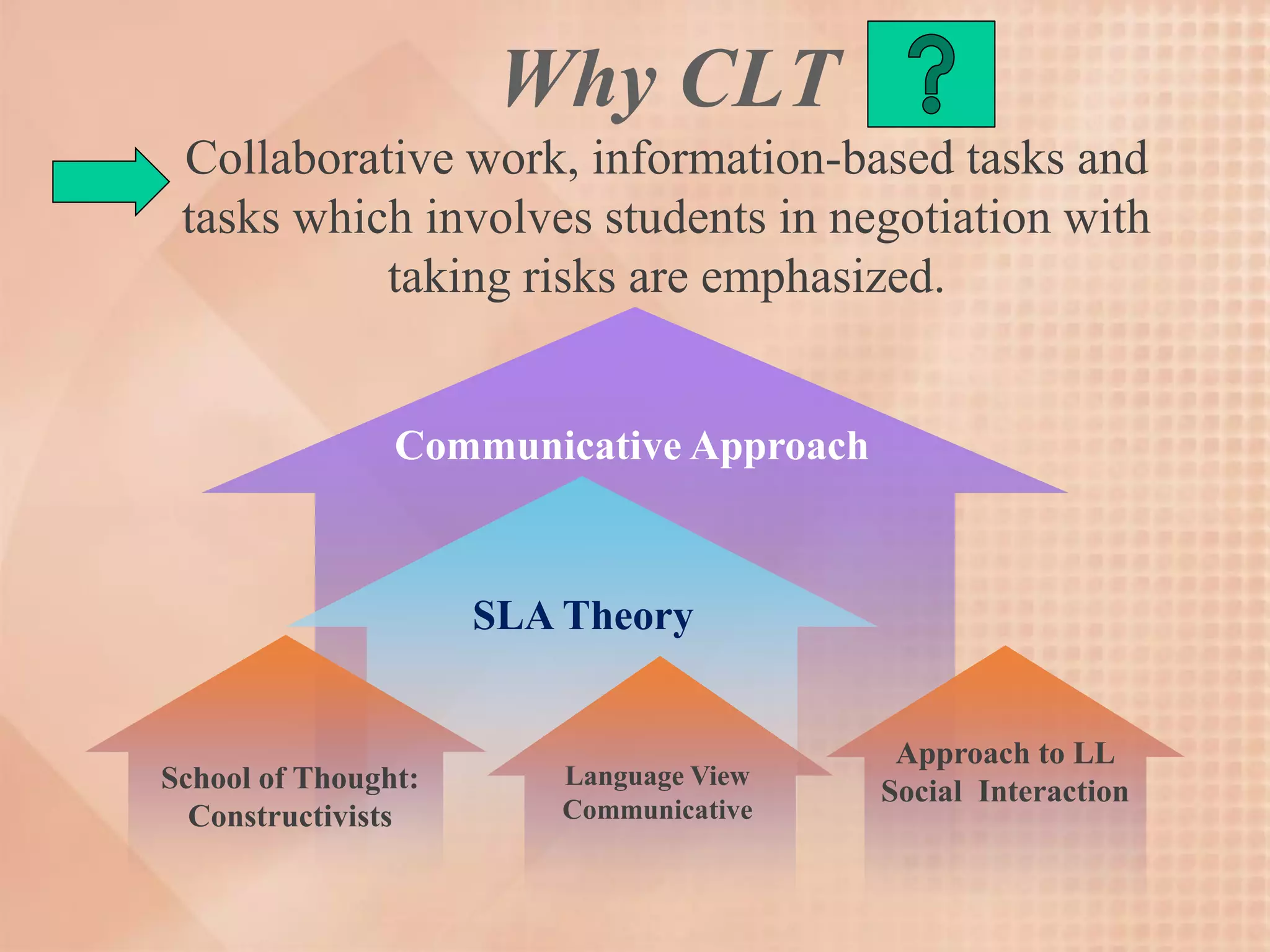
Why CLT
Collaborativework, information-based tasks and
tasks which involves students in negotiation with
taking risks are emphasized.
Communicative Approach
SLA Theory
Approach to LL
School of Thought: Language View
Social Interaction
Constructivists Communicative
13.
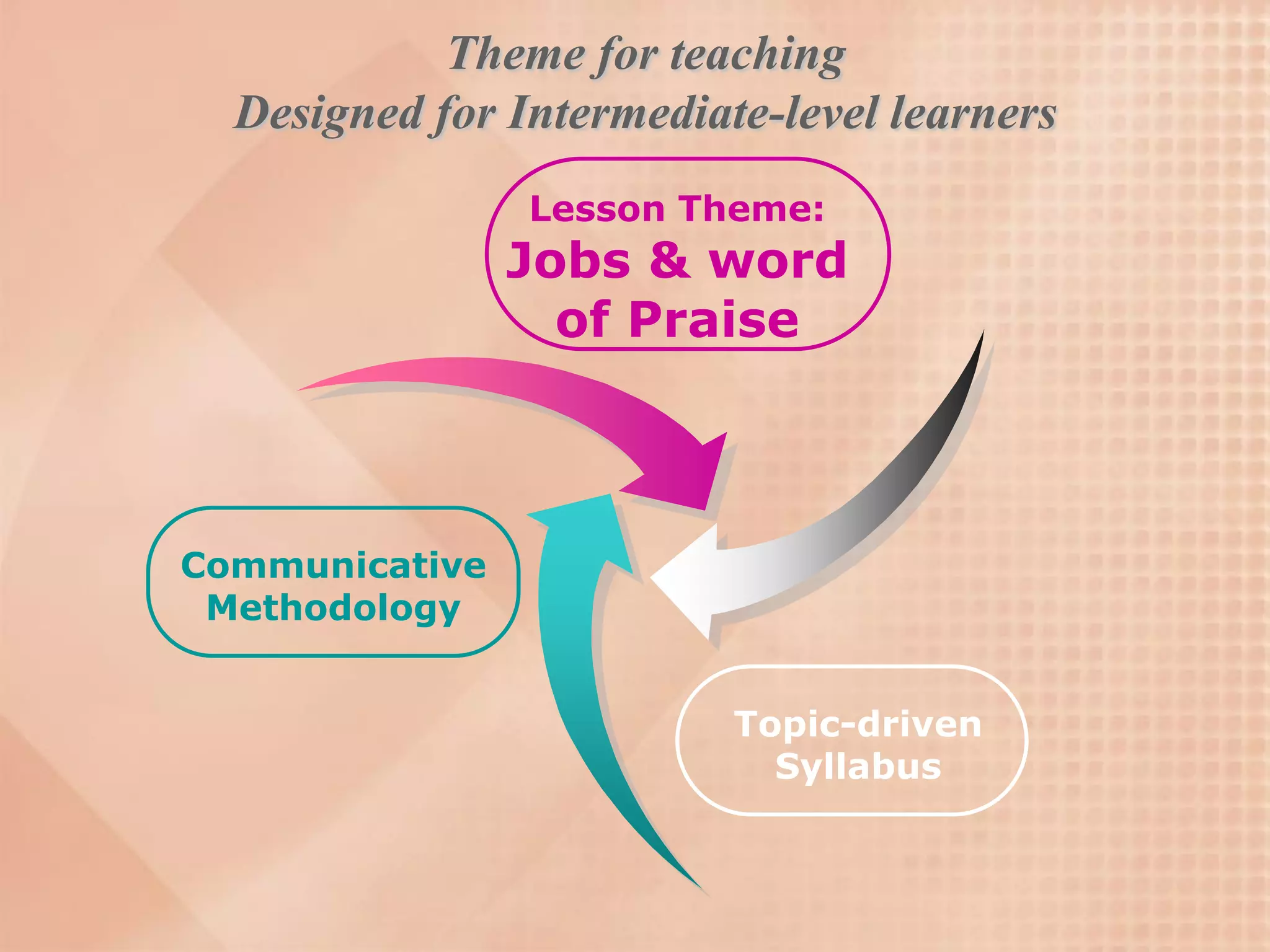
Theme for teaching
Designed for Intermediate-level learners
Lesson Theme:
Jobs & word
of Praise
Communicative
Methodology
Topic-driven
Syllabus
14.
Learning Techniques
1 Complete a diagram, sorting, game & jigsaw exercises
2 Class Discussion about real world topic (jobs)
3 Grammar in communicative contexts with matching exercise
4 Dialogue & Role play
5 Fun speaking activity after watching a video
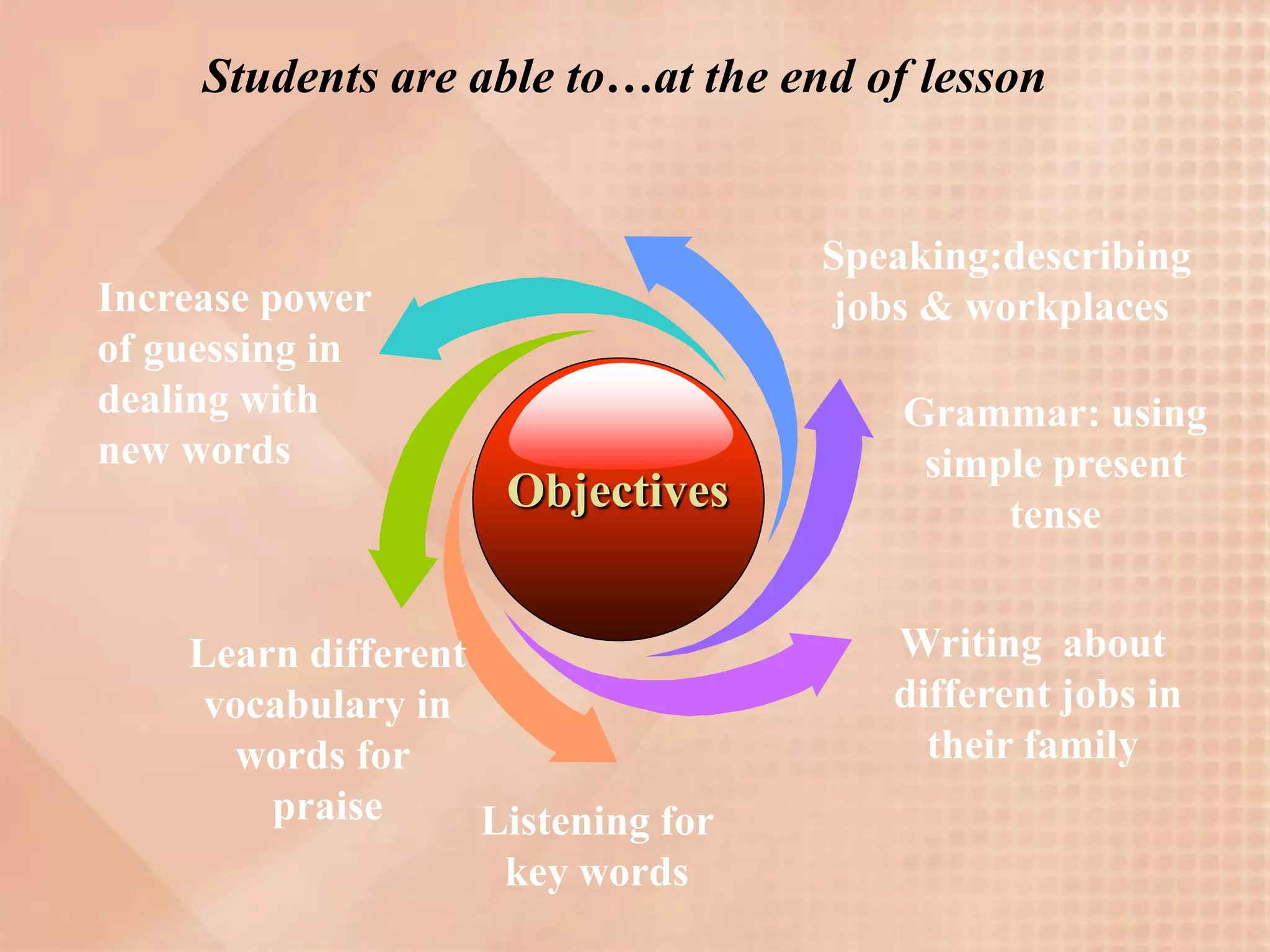
15.
Students are ableto…at the end of lesson
Speaking:describing
Increase power jobs & workplaces
of guessing in
dealing with Grammar: using
new words simple present
Objectives tense
Learn different Writing about
vocabulary in different jobs in
words for their family
praise Listening for
key words
16.
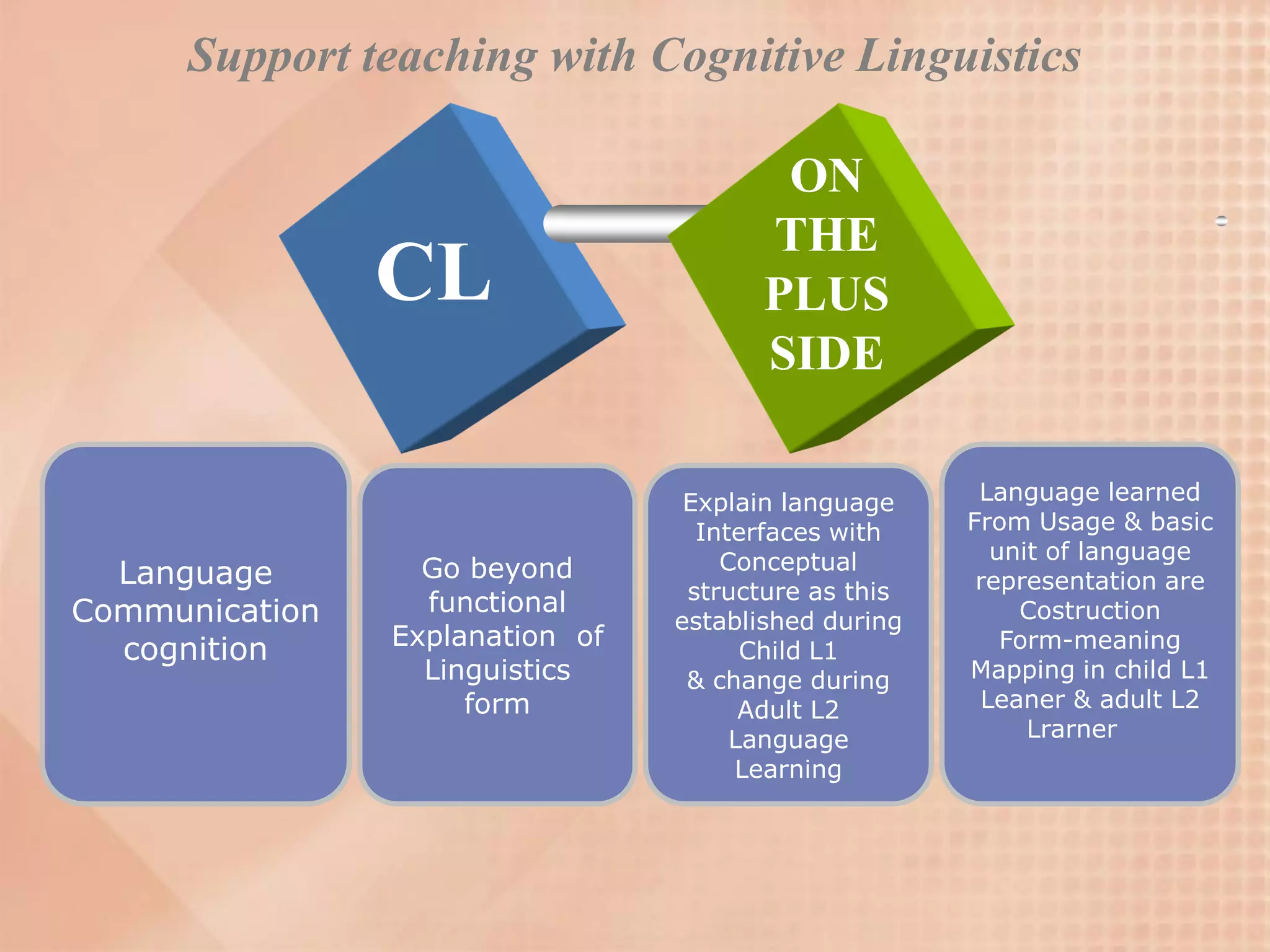
Support teaching withCognitive Linguistics
ON
THE
CL PLUS
SIDE
Explain language Language learned
Interfaces with From Usage & basic
Conceptual unit of language
Language Go beyond representation are
functional structure as this
Communication established during Costruction
Explanation of Form-meaning
cognition Child L1
Linguistics & change during Mapping in child L1
form Adult L2 Leaner & adult L2
Language Lrarner
Learning
17.
Hudsons’Word Grammar
WG
Language is just knowlege
Language network
Language is (symbolic) network
Language is based on usage
Meanings are embedded in culture
Grammar & vocabulary follow very similar pattern
in acquisition
WG Theories
• early1980s - Hudson first used WG (Hudson 1984);
basically, a theory of grammar where words played a
significant role -the only units of syntax; the largest
units of morphology.
• has developed around three decades by borrowing
ideas from a selection of other theories of language
structure (e.g., Systemic Functional Grammar,
Generative Grammar, artificial intelligence,
psycholinguistics and sociolinguistics).
20.
WG and combinationof 3 Super-Lexicons
• Language is a cognitive network of 3 units:
form, words and sounds.
(Hudson;1984; Goldberg, 1995: Langacker, 2000).
• no ‘rules’ but there are plenty ‘of generalization’.
• WG ‘isa’ relation; e.g. CAT isa Noun, This relation carries the
basic logic of generalization called ‘ inheritance,’
Through the Teaching Procedure in a Linguistic way
terrific
Adjective
wonderful fantastic
great
Dependent
Dancer
ADJ Category
39.
outstanding
Adjective
marvelous super
excellent
Dependent
Photographer
ADJ Category
Watch a video to practice these
Adjective neighbors
40.
Source: Lefferts, George(1991), Episode 17, Act 3.
Jason: Look at that!
Andrea: Great!
Jason: Look at that!
Andrea: Sensational!
Great, sensational!
Jason: What do you think of that?
Andrea: Amazing!
Amazing!
Jason: What do you think of that?
Andrea: Terrific! Amazing
Jason: Look over here. What do you think of them?
Andrea: They're wonderful!
41.
Jason: Oooh, lookat them!
Andrea: All right!
They're fabulous!
Wonderful, fabulous!
Jason: Check this out. What do you think of him?
Andrea; He's marvelous!
Jason: Ooh! Listen to that!
Andrea: Wow! He's incredible!
Marvelous, incredible!
Jason: Look at him!
Andrea: He's fantastic!
Jason: Look at him!
Andrea: He's super!
Jason and Andrea: Fantastic, super!
Conclusion
WG & languagenetwork can be used in teaching all
4-skills to learners in a simple and applicable way
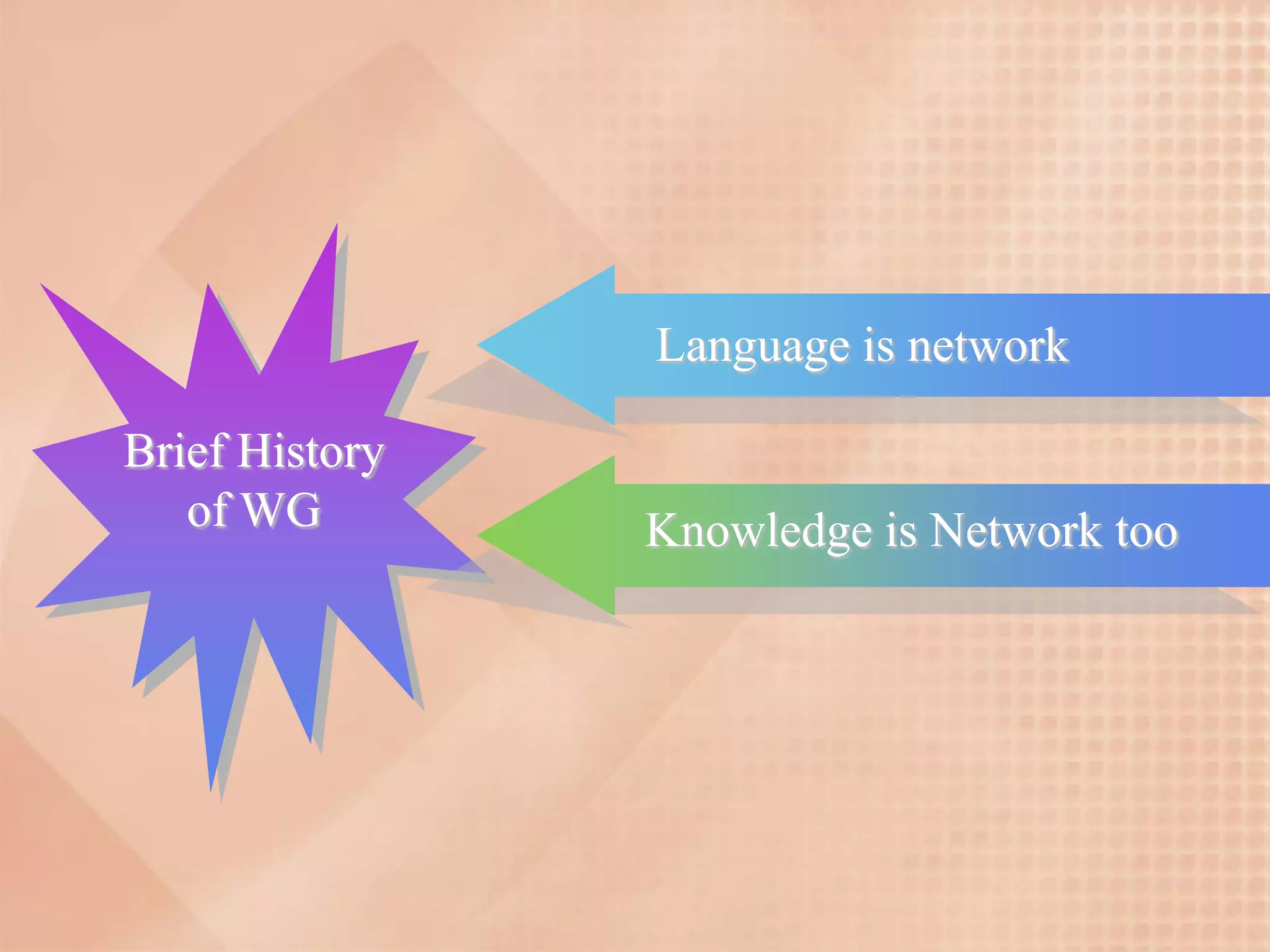
Hudson’s Perspective in WG : Language is network
L1 is
More general network
Patterns of L2
Morphology & is
syntax network
Are network
Grammar is
network
44.
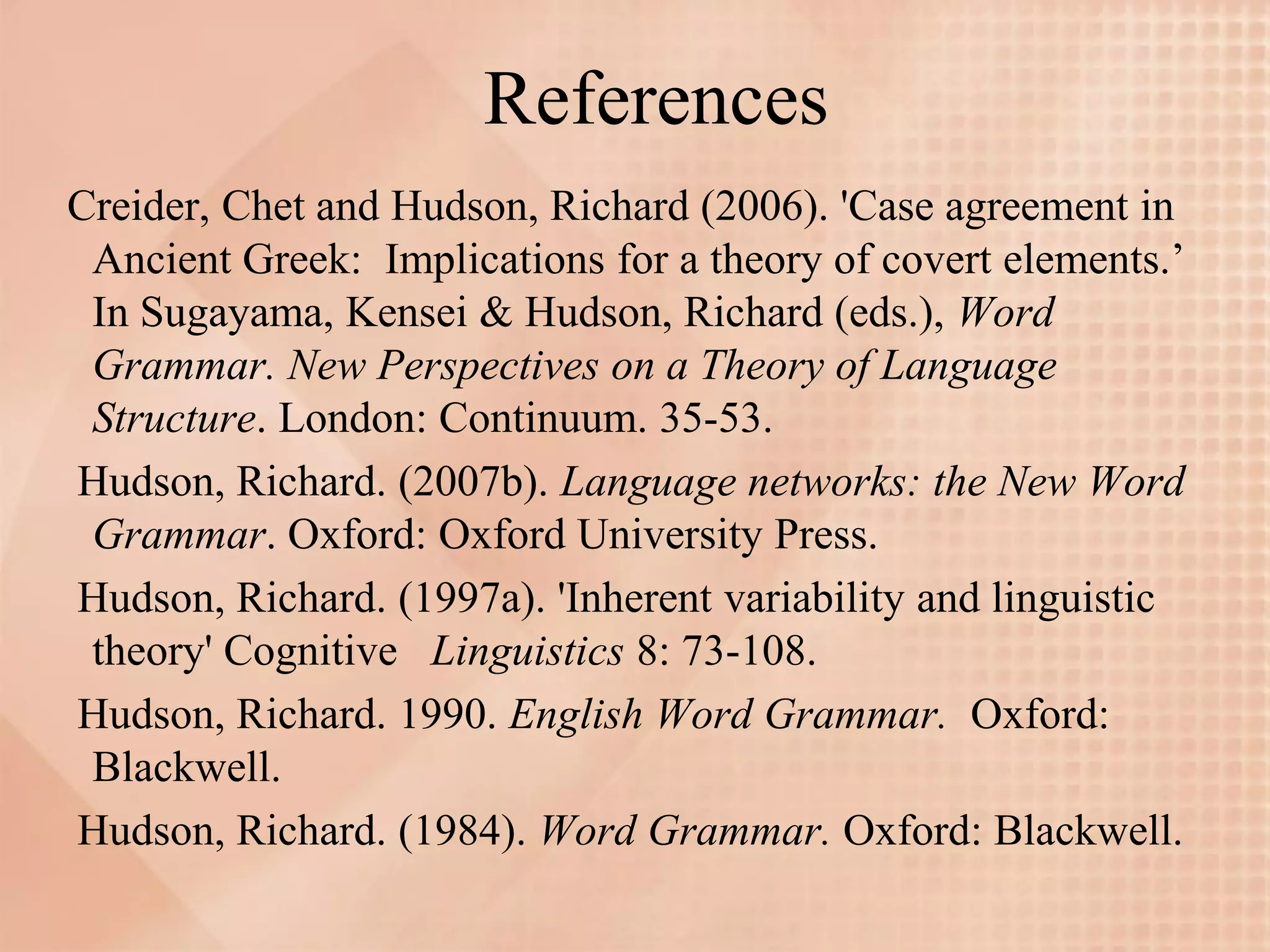
References
Creider, Chet andHudson, Richard (2006). 'Case agreement in
Ancient Greek: Implications for a theory of covert elements.’
In Sugayama, Kensei & Hudson, Richard (eds.), Word
Grammar. New Perspectives on a Theory of Language
Structure. London: Continuum. 35-53.
Hudson, Richard. (2007b). Language networks: the New Word
Grammar. Oxford: Oxford University Press.
Hudson, Richard. (1997a). 'Inherent variability and linguistic
theory' Cognitive Linguistics 8: 73-108.
Hudson, Richard. 1990. English Word Grammar. Oxford:
Blackwell.
Hudson, Richard. (1984). Word Grammar. Oxford: Blackwell.
45.
Lefferts, George (Writer)& Sedwich, Anne and M. Mazuer
(Directors).(1991) Photo finish [Episode 17]. In A.
Cooperman (Producer), Family Album USA. New York:
Maxwell Macmillan International Publishing Group.
Richards, J.C., Hull, J., & Proctor, S. (2005). Interchange 1
(3rd ed.). Cambridge: Cambridge University Press.
Robinson, P. and N. Ellis (eds). 2008. Hand Book Of
Cognitive Linguistics & Second Language Acquisition.
By Rutledge: Taylor & Francis