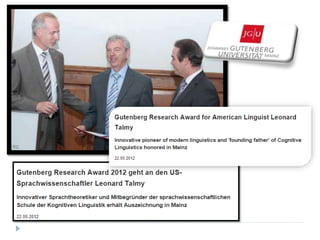
Leonard Talmy
Liliya Yakupova
MSU, Faculty of Foreign Languages and Area Studies
Moscow
2015
Cognitive Linguistics
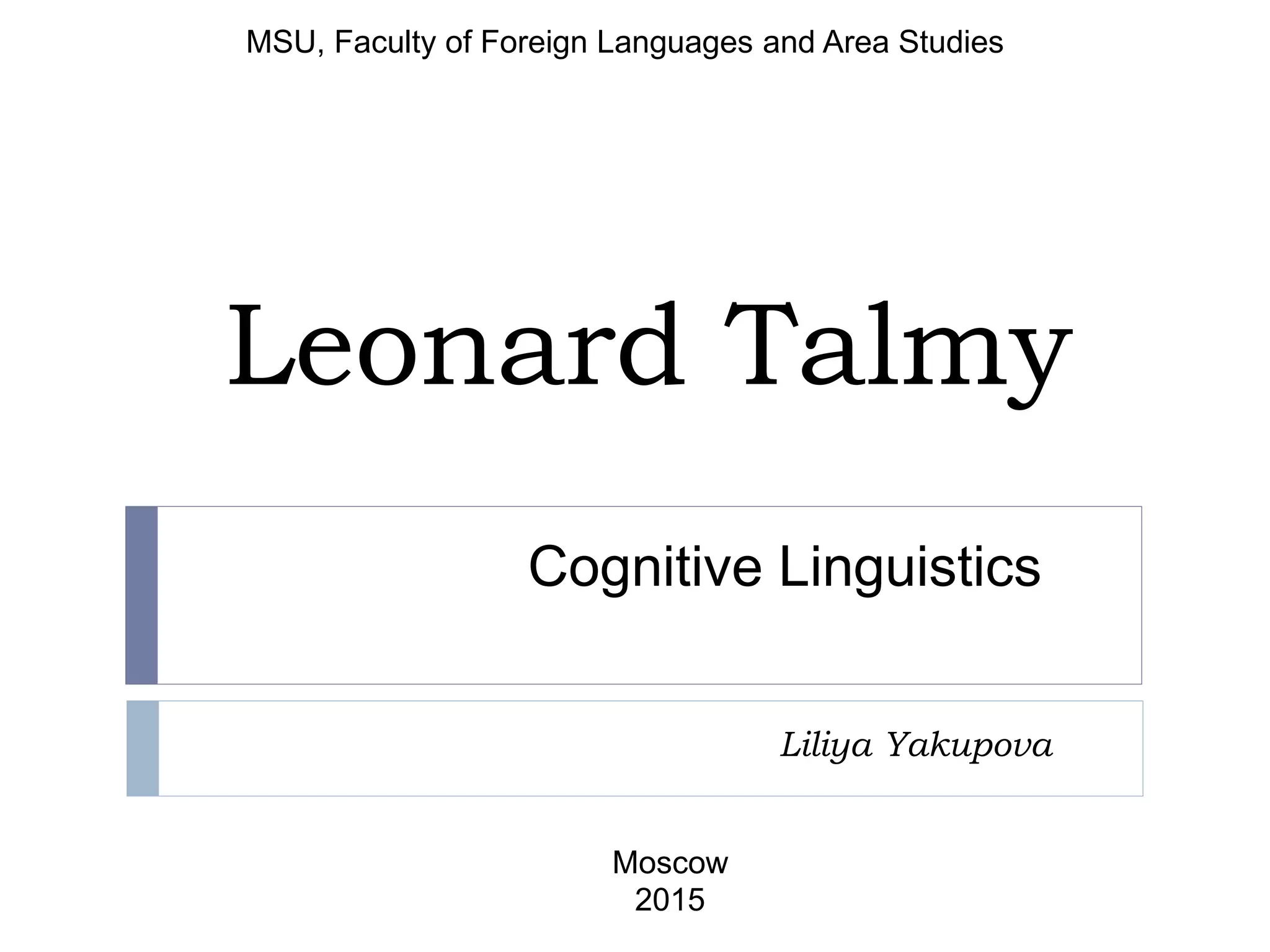
L. Talmy
the State University of
New York in Buffalo
photo: Uwe Feuerbach
Publications
Books:
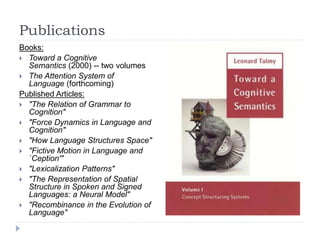
 Toward a Cognitive
Semantics (2000) -- two volumes
 The Attention System of
Language (forthcoming)
Published Articles:
 "The Relation of Grammar to
Cognition"
 "Force Dynamics in Language and
Cognition"
 "How Language Structures Space"
 "Fictive Motion in Language and
`Ception'"
 "Lexicalization Patterns"
 "The Representation of Spatial
Structure in Spoken and Signed
Languages: a Neural Model"
 "Recombinance in the Evolution of
Language"
Talmy’s Cognitive Linguistics
 Language as a cognitive system shares
some of its fundamental features with other
cognitive systems (e.g. visual perception,
attention).
 Language also has some unique features
which distinguish it from other cognitive
systems.
“Toward a Cognitive Semantics. Volume 1”
revision by Pavel Stranák
 1) the grammatical and lexical
subsystems of language;
 2) the system of space and time in
language:
• “fictive motion”
• the structuring of space by language
…
“Fictive Motion” / The Fictivity Theory
“The mountain range goes
from Canada to Mexico.”
“The sun is shining into the
cave.”
(similar to Lakoff and Johnson’s approach)
 3) attention:
• How does omitting or mentioning of
participants of situations influence the
meaning of a sentence?
• “figure” and “ground” relations
 4) Force and Causation / Force
Dynamics
Force Dynamics
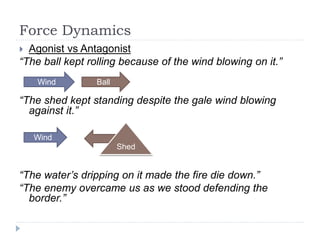
 Agonist vs Antagonist
“The ball kept rolling because of the wind blowing on it.”
“The shed kept standing despite the gale wind blowing
against it.”
“The water’s dripping on it made the fire die down.”
“The enemy overcame us as we stood defending the
border.”
Wind Ball
Wind
Shed
Force Dynamics
 A) autonomous
Ex. “The ball’s hitting it made the lamp
topple.”
 B) agentive
Ex. “I made the lamp topple by hitting it with
the ball.”

L. Talmy's Cognitive Linguistics

  • 1.
    Leonard Talmy Liliya Yakupova MSU,Faculty of Foreign Languages and Area Studies Moscow 2015 Cognitive Linguistics
  • 2.
    L. Talmy the StateUniversity of New York in Buffalo photo: Uwe Feuerbach
  • 3.
    Publications Books:  Toward aCognitive Semantics (2000) -- two volumes  The Attention System of Language (forthcoming) Published Articles:  "The Relation of Grammar to Cognition"  "Force Dynamics in Language and Cognition"  "How Language Structures Space"  "Fictive Motion in Language and `Ception'"  "Lexicalization Patterns"  "The Representation of Spatial Structure in Spoken and Signed Languages: a Neural Model"  "Recombinance in the Evolution of Language"
  • 7.
    Talmy’s Cognitive Linguistics Language as a cognitive system shares some of its fundamental features with other cognitive systems (e.g. visual perception, attention).  Language also has some unique features which distinguish it from other cognitive systems.
  • 8.
    “Toward a CognitiveSemantics. Volume 1” revision by Pavel Stranák  1) the grammatical and lexical subsystems of language;  2) the system of space and time in language: • “fictive motion” • the structuring of space by language …
  • 9.
    “Fictive Motion” /The Fictivity Theory “The mountain range goes from Canada to Mexico.” “The sun is shining into the cave.” (similar to Lakoff and Johnson’s approach)
  • 10.
     3) attention: •How does omitting or mentioning of participants of situations influence the meaning of a sentence? • “figure” and “ground” relations  4) Force and Causation / Force Dynamics
  • 11.
    Force Dynamics  Agonistvs Antagonist “The ball kept rolling because of the wind blowing on it.” “The shed kept standing despite the gale wind blowing against it.” “The water’s dripping on it made the fire die down.” “The enemy overcame us as we stood defending the border.” Wind Ball Wind Shed
  • 12.
    Force Dynamics  A)autonomous Ex. “The ball’s hitting it made the lamp topple.”  B) agentive Ex. “I made the lamp topple by hitting it with the ball.”