Dr. Jessie Grace U. Rubrico
Facilitator
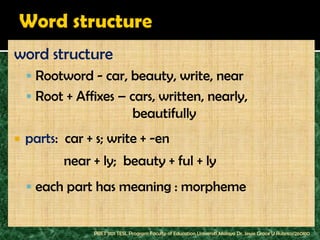
word structure
     Rootword - car, beauty, write, near
     Root + Affixes – cars, written, nearly,
                                beautifully
   parts: car + s; write + -en
           near + ly; beauty + ful + ly
     each part has meaning : morpheme


                PBET 1101 TESL Program Faculty of Education Universiti Malaya Dr. Jessie Grace U Rubrico/260810
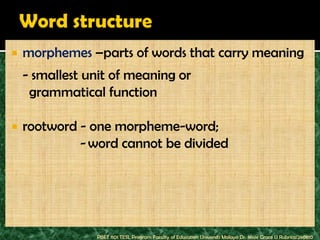
   morphemes –parts of words that carry meaning
    - smallest unit of meaning or
     grammatical function

   rootword - one morpheme-word;
             - word cannot be divided


                PBET 1101 TESL Program Faculty of Education Universiti Malaya Dr. Jessie Grace U Rubrico/260810
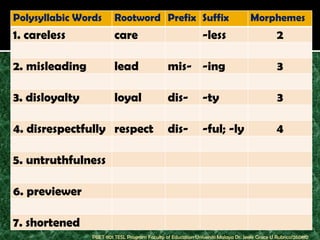
Polysyllabic Words       Rootword Prefix Suffix                                      Morphemes
1. careless              care                                   -less                            2

2. misleading            lead                    mis- -ing                                       3

3. disloyalty            loyal                   dis-           -ty                              3

4. disrespectfully respect                       dis-           -ful; -ly                        4

5. untruthfulness

6. previewer

7. shortened
                PBET 1101 TESL Program Faculty of Education Universiti Malaya Dr. Jessie Grace U Rubrico/260810
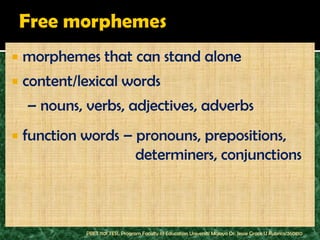
   morphemes that can stand alone
   content/lexical words
    – nouns, verbs, adjectives, adverbs
   function words – pronouns, prepositions,
                     determiners, conjunctions


             PBET 1101 TESL Program Faculty of Education Universiti Malaya Dr. Jessie Grace U Rubrico/260810
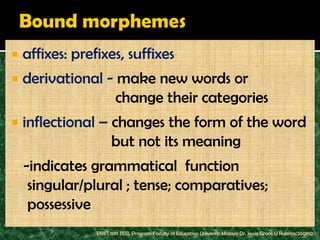
   affixes: prefixes, suffixes
   derivational - make new words or
                   change their categories
   inflectional – changes the form of the word
                   but not its meaning
    -indicates grammatical function
     singular/plural ; tense; comparatives;
     possessive
                 PBET 1101 TESL Program Faculty of Education Universiti Malaya Dr. Jessie Grace U Rubrico/260810
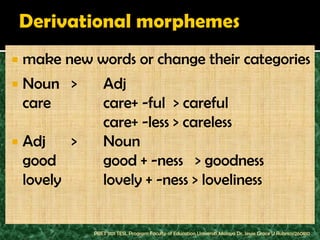
   make new words or change their categories
   Noun >         Adj
    care           care+ -ful > careful
                   care+ -less > careless
   Adj    >       Noun
    good           good + -ness > goodness
    lovely         lovely + -ness > loveliness


               PBET 1101 TESL Program Faculty of Education Universiti Malaya Dr. Jessie Grace U Rubrico/260810
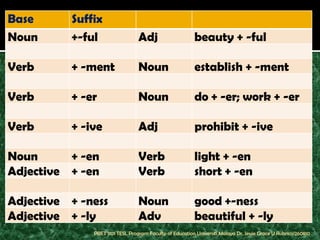
Base      Suffix
Noun      +-ful                  Adj                      beauty + -ful

Verb      + -ment                Noun                     establish + -ment

Verb      + -er                  Noun                     do + -er; work + -er

Verb      + -ive                 Adj                      prohibit + -ive

Noun      + -en                  Verb                     light + -en
Adjective + -en                  Verb                     short + -en

Adjective + -ness                Noun                     good +-ness
Adjective + -ly                  Adv                      beautiful + -ly
              PBET 1101 TESL Program Faculty of Education Universiti Malaya Dr. Jessie Grace U Rubrico/260810
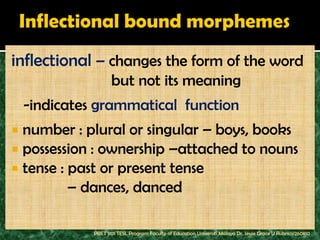
inflectional – changes the form of the word
                     but not its meaning
    -indicates grammatical function
   number : plural or singular – boys, books
   possession : ownership –attached to nouns
   tense : past or present tense
            – dances, danced

              PBET 1101 TESL Program Faculty of Education Universiti Malaya Dr. Jessie Grace U Rubrico/260810
   bound to nouns [Noun +] -
     –‘s / s’ (possessive) : Mary’s, the childrens’
     - s (plural), books, boys
   bound to verbs [Verb +]
     -s (3rd person, singular) – dances, watches
     -ing (present participle) – dancing, watching
     -ed (past tense) – danced, watched
     -en/-ed (past participle) - they’ve done it
   bound to adjectives [Adj +]
    –er : darker
    -est : darkest
                PBET 1101 TESL Program Faculty of Education Universiti Malaya Dr. Jessie Grace U Rubrico/260810
   /indefiniteness/ - a before a consonant - a boy
                      an before a vowel - an apple
▪   /plural/
▪   cat + /plural/ -[s] after voiceless segment: [kæts]
▪   dog + /plural/- [z] after voiced segment : [dɔgz]
                                                  [dɒgz]
▪   judge + /plural/-[әz] after voiced segment
   sheep + /plural/ - sheep + Ø : sheep
   man + /plural/ - æ > ε         : men
                      (suppletion)
                PBET 1101 TESL Program Faculty of Education Universiti Malaya Dr. Jessie Grace U Rubrico/260810
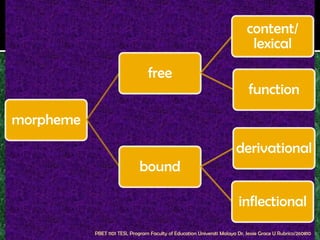
content/
                                                                              lexical
                                  free
                                                                              function

morpheme
                                                                         derivational
                              bound

                                                                          inflectional
           PBET 1101 TESL Program Faculty of Education Universiti Malaya Dr. Jessie Grace U Rubrico/260810
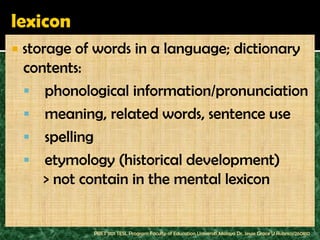
   storage of words in a language; dictionary
    contents:
     phonological information/pronunciation
     meaning, related words, sentence use
     spelling
     etymology (historical development)
       > not contain in the mental lexicon


              PBET 1101 TESL Program Faculty of Education Universiti Malaya Dr. Jessie Grace U Rubrico/260810
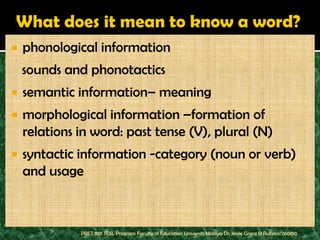
   phonological information
    sounds and phonotactics
   semantic information– meaning
   morphological information –formation of
    relations in word: past tense (V), plural (N)
   syntactic information -category (noun or verb)
    and usage


              PBET 1101 TESL Program Faculty of Education Universiti Malaya Dr. Jessie Grace U Rubrico/260810
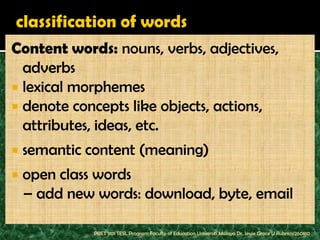
Content words: nouns, verbs, adjectives,
  adverbs
 lexical morphemes
 denote concepts like objects, actions,
  attributes, ideas, etc.
   semantic content (meaning)
   open class words
    – add new words: download, byte, email

              PBET 1101 TESL Program Faculty of Education Universiti Malaya Dr. Jessie Grace U Rubrico/260810
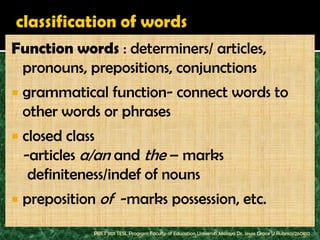
Function words : determiners/ articles,
 pronouns, prepositions, conjunctions
   grammatical function- connect words to
    other words or phrases
   closed class
    -articles a/an and the – marks
     definiteness/indef of nouns
   preposition of -marks possession, etc.
               PBET 1101 TESL Program Faculty of Education Universiti Malaya Dr. Jessie Grace U Rubrico/260810
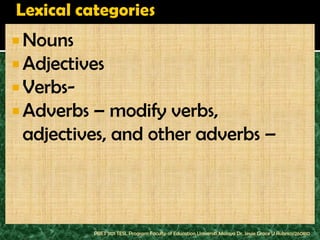
 Nouns
 Adjectives
 Verbs-
 Adverbs – modify verbs,
 adjectives, and other adverbs –


            PBET 1101 TESL Program Faculty of Education Universiti Malaya Dr. Jessie Grace U Rubrico/260810
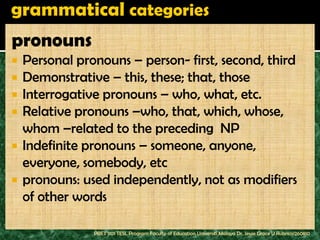
pronouns
   Personal pronouns – person- first, second, third
   Demonstrative – this, these; that, those
   Interrogative pronouns – who, what, etc.
   Relative pronouns –who, that, which, whose,
    whom –related to the preceding NP
   Indefinite pronouns – someone, anyone,
    everyone, somebody, etc
   pronouns: used independently, not as modifiers
    of other words

                PBET 1101 TESL Program Faculty of Education Universiti Malaya Dr. Jessie Grace U Rubrico/260810
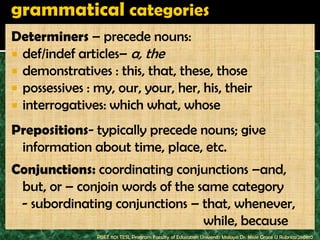
Determiners – precede nouns:
 def/indef articles– a, the
 demonstratives : this, that, these, those
 possessives : my, our, your, her, his, their
 interrogatives: which what, whose

Prepositions- typically precede nouns; give
 information about time, place, etc.
Conjunctions: coordinating conjunctions –and,
 but, or – conjoin words of the same category
 - subordinating conjunctions – that, whenever,
                                 while, because
                PBET 1101 TESL Program Faculty of Education Universiti Malaya Dr. Jessie Grace U Rubrico/260810
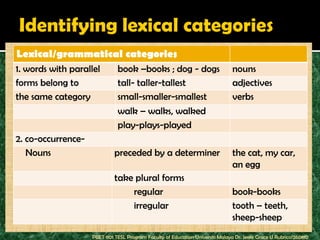
Lexical/grammatical categories
1. words with parallel         book –books ; dog - dogs                          nouns
forms belong to                tall- taller-tallest                              adjectives
the same category              small-smaller-smallest                            verbs
                               walk – walks, walked
                               play-plays-played
2. co-occurrence-
   Nouns                     preceded by a determiner                            the cat, my car,
                                                                                 an egg
                             take plural forms
                                 regular                                         book-books
                                 irregular                                       tooth – teeth,
                                                                                 sheep-sheep
                    PBET 1101 TESL Program Faculty of Education Universiti Malaya Dr. Jessie Grace U Rubrico/260810
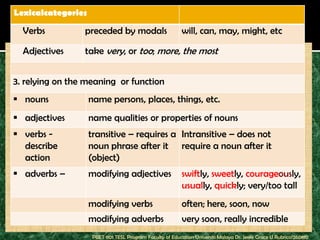
Lexicalcategories

  Verbs          preceded by modals                         will, can, may, might, etc

  Adjectives     take very, or too; more, the most


3. relying on the meaning or function
 nouns             name persons, places, things, etc.
 adjectives        name qualities or properties of nouns
 verbs -           transitive – requires a Intransitive – does not
  describe          noun phrase after it require a noun after it
  action            (object)
 adverbs –         modifying adjectives                    swiftly, sweetly, courageously,
                                                            usually, quickly; very/too tall
                    modifying verbs                         often; here, soon, now
                    modifying adverbs                       very soon, really incredible
                     PBET 1101 TESL Program Faculty of Education Universiti Malaya Dr. Jessie Grace U Rubrico/260810
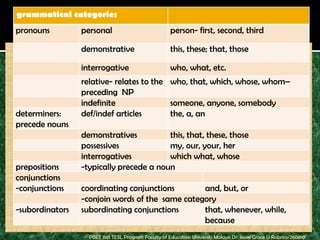
grammatical categories
pronouns         personal                             person- first, second, third

                 demonstrative                        this, these; that, those

                 interrogative                        who, what, etc.
                 relative- relates to the who, that, which, whose, whom–
                 preceding NP
                 indefinite               someone, anyone, somebody
determiners:     def/indef articles       the, a, an
precede nouns
                 demonstratives          this, that, these, those
                 possessives             my, our, your, her
                 interrogatives          which what, whose
prepositions     -typically precede a noun
conjunctions
-conjunctions    coordinating conjunctions       and, but, or
                 -conjoin words of the same category
-subordinators   subordinating conjunctions      that, whenever, while,
                                                 because
                   PBET 1101 TESL Program Faculty of Education Universiti Malaya Dr. Jessie Grace U Rubrico/260810
McGregor, William B. 2009. Linguistics: An
 Introduction. London: Continuum International
 Publishing Group.
O'Grady, William D., Archibald, John, [eds.] (2009).
  Contemporary Linguistic Analysis: An Introduction,
  6th edition. Ontario: Pearson Education Canada.
Yule G. 2006. The study of language. Cambridge:
 CUP.


              PBET 1101 TESL Program Faculty of Education Universiti Malaya Dr. Jessie Grace U Rubrico/260810

Morphology

  • 1.
    Dr. Jessie GraceU. Rubrico Facilitator
  • 2.
    word structure  Rootword - car, beauty, write, near  Root + Affixes – cars, written, nearly, beautifully  parts: car + s; write + -en near + ly; beauty + ful + ly  each part has meaning : morpheme PBET 1101 TESL Program Faculty of Education Universiti Malaya Dr. Jessie Grace U Rubrico/260810
  • 3.
    morphemes –parts of words that carry meaning - smallest unit of meaning or grammatical function  rootword - one morpheme-word; - word cannot be divided PBET 1101 TESL Program Faculty of Education Universiti Malaya Dr. Jessie Grace U Rubrico/260810
  • 4.
    Polysyllabic Words Rootword Prefix Suffix Morphemes 1. careless care -less 2 2. misleading lead mis- -ing 3 3. disloyalty loyal dis- -ty 3 4. disrespectfully respect dis- -ful; -ly 4 5. untruthfulness 6. previewer 7. shortened PBET 1101 TESL Program Faculty of Education Universiti Malaya Dr. Jessie Grace U Rubrico/260810
  • 5.
    morphemes that can stand alone  content/lexical words – nouns, verbs, adjectives, adverbs  function words – pronouns, prepositions, determiners, conjunctions PBET 1101 TESL Program Faculty of Education Universiti Malaya Dr. Jessie Grace U Rubrico/260810
  • 6.
    affixes: prefixes, suffixes  derivational - make new words or change their categories  inflectional – changes the form of the word but not its meaning -indicates grammatical function singular/plural ; tense; comparatives; possessive PBET 1101 TESL Program Faculty of Education Universiti Malaya Dr. Jessie Grace U Rubrico/260810
  • 7.
    make new words or change their categories  Noun > Adj care care+ -ful > careful care+ -less > careless  Adj > Noun good good + -ness > goodness lovely lovely + -ness > loveliness PBET 1101 TESL Program Faculty of Education Universiti Malaya Dr. Jessie Grace U Rubrico/260810
  • 8.
    Base Suffix Noun +-ful Adj beauty + -ful Verb + -ment Noun establish + -ment Verb + -er Noun do + -er; work + -er Verb + -ive Adj prohibit + -ive Noun + -en Verb light + -en Adjective + -en Verb short + -en Adjective + -ness Noun good +-ness Adjective + -ly Adv beautiful + -ly PBET 1101 TESL Program Faculty of Education Universiti Malaya Dr. Jessie Grace U Rubrico/260810
  • 9.
    inflectional – changesthe form of the word but not its meaning -indicates grammatical function  number : plural or singular – boys, books  possession : ownership –attached to nouns  tense : past or present tense – dances, danced PBET 1101 TESL Program Faculty of Education Universiti Malaya Dr. Jessie Grace U Rubrico/260810
  • 10.
    bound to nouns [Noun +] - –‘s / s’ (possessive) : Mary’s, the childrens’ - s (plural), books, boys  bound to verbs [Verb +] -s (3rd person, singular) – dances, watches -ing (present participle) – dancing, watching -ed (past tense) – danced, watched -en/-ed (past participle) - they’ve done it  bound to adjectives [Adj +] –er : darker -est : darkest PBET 1101 TESL Program Faculty of Education Universiti Malaya Dr. Jessie Grace U Rubrico/260810
  • 11.
    /indefiniteness/ - a before a consonant - a boy an before a vowel - an apple ▪ /plural/ ▪ cat + /plural/ -[s] after voiceless segment: [kæts] ▪ dog + /plural/- [z] after voiced segment : [dɔgz] [dɒgz] ▪ judge + /plural/-[әz] after voiced segment  sheep + /plural/ - sheep + Ø : sheep  man + /plural/ - æ > ε : men (suppletion) PBET 1101 TESL Program Faculty of Education Universiti Malaya Dr. Jessie Grace U Rubrico/260810
  • 12.
    content/ lexical free function morpheme derivational bound inflectional PBET 1101 TESL Program Faculty of Education Universiti Malaya Dr. Jessie Grace U Rubrico/260810
  • 13.
    storage of words in a language; dictionary contents:  phonological information/pronunciation  meaning, related words, sentence use  spelling  etymology (historical development) > not contain in the mental lexicon PBET 1101 TESL Program Faculty of Education Universiti Malaya Dr. Jessie Grace U Rubrico/260810
  • 14.
    phonological information sounds and phonotactics  semantic information– meaning  morphological information –formation of relations in word: past tense (V), plural (N)  syntactic information -category (noun or verb) and usage PBET 1101 TESL Program Faculty of Education Universiti Malaya Dr. Jessie Grace U Rubrico/260810
  • 15.
    Content words: nouns,verbs, adjectives, adverbs  lexical morphemes  denote concepts like objects, actions, attributes, ideas, etc.  semantic content (meaning)  open class words – add new words: download, byte, email PBET 1101 TESL Program Faculty of Education Universiti Malaya Dr. Jessie Grace U Rubrico/260810
  • 16.
    Function words :determiners/ articles, pronouns, prepositions, conjunctions  grammatical function- connect words to other words or phrases  closed class -articles a/an and the – marks definiteness/indef of nouns  preposition of -marks possession, etc. PBET 1101 TESL Program Faculty of Education Universiti Malaya Dr. Jessie Grace U Rubrico/260810
  • 17.
     Nouns  Adjectives Verbs-  Adverbs – modify verbs, adjectives, and other adverbs – PBET 1101 TESL Program Faculty of Education Universiti Malaya Dr. Jessie Grace U Rubrico/260810
  • 18.
    pronouns  Personal pronouns – person- first, second, third  Demonstrative – this, these; that, those  Interrogative pronouns – who, what, etc.  Relative pronouns –who, that, which, whose, whom –related to the preceding NP  Indefinite pronouns – someone, anyone, everyone, somebody, etc  pronouns: used independently, not as modifiers of other words PBET 1101 TESL Program Faculty of Education Universiti Malaya Dr. Jessie Grace U Rubrico/260810
  • 19.
    Determiners – precedenouns:  def/indef articles– a, the  demonstratives : this, that, these, those  possessives : my, our, your, her, his, their  interrogatives: which what, whose Prepositions- typically precede nouns; give information about time, place, etc. Conjunctions: coordinating conjunctions –and, but, or – conjoin words of the same category - subordinating conjunctions – that, whenever, while, because PBET 1101 TESL Program Faculty of Education Universiti Malaya Dr. Jessie Grace U Rubrico/260810
  • 20.
    Lexical/grammatical categories 1. wordswith parallel book –books ; dog - dogs nouns forms belong to tall- taller-tallest adjectives the same category small-smaller-smallest verbs walk – walks, walked play-plays-played 2. co-occurrence- Nouns preceded by a determiner the cat, my car, an egg take plural forms regular book-books irregular tooth – teeth, sheep-sheep PBET 1101 TESL Program Faculty of Education Universiti Malaya Dr. Jessie Grace U Rubrico/260810
  • 21.
    Lexicalcategories Verbs preceded by modals will, can, may, might, etc Adjectives take very, or too; more, the most 3. relying on the meaning or function  nouns name persons, places, things, etc.  adjectives name qualities or properties of nouns  verbs - transitive – requires a Intransitive – does not describe noun phrase after it require a noun after it action (object)  adverbs – modifying adjectives swiftly, sweetly, courageously, usually, quickly; very/too tall modifying verbs often; here, soon, now modifying adverbs very soon, really incredible PBET 1101 TESL Program Faculty of Education Universiti Malaya Dr. Jessie Grace U Rubrico/260810
  • 22.
    grammatical categories pronouns personal person- first, second, third demonstrative this, these; that, those interrogative who, what, etc. relative- relates to the who, that, which, whose, whom– preceding NP indefinite someone, anyone, somebody determiners: def/indef articles the, a, an precede nouns demonstratives this, that, these, those possessives my, our, your, her interrogatives which what, whose prepositions -typically precede a noun conjunctions -conjunctions coordinating conjunctions and, but, or -conjoin words of the same category -subordinators subordinating conjunctions that, whenever, while, because PBET 1101 TESL Program Faculty of Education Universiti Malaya Dr. Jessie Grace U Rubrico/260810
  • 23.
    McGregor, William B.2009. Linguistics: An Introduction. London: Continuum International Publishing Group. O'Grady, William D., Archibald, John, [eds.] (2009). Contemporary Linguistic Analysis: An Introduction, 6th edition. Ontario: Pearson Education Canada. Yule G. 2006. The study of language. Cambridge: CUP. PBET 1101 TESL Program Faculty of Education Universiti Malaya Dr. Jessie Grace U Rubrico/260810