Propuesta K-12


     October 23, 2012
Análisis de Necesidades
                                 Herbolich

Apuntar a las Necesidades              Necesidades de Aprendizaje
              Objetivo     Subjetivo    ¿Cómo vamos a llegar desde el punto
Necesidades   HW, CW,      Destino      de partida hasta nuestro destino ?
              texto, IBO                1.   Nuevo para el aprendiz
Carencias     Social Skills Punto de    2.   Relacionado con el aprendiz
              Study habits partida      3.   Nuevo léxico
              Motivation                4.   ¿Va a operar?
                                        5.   Divertido
                   ?
¿Qué                                    6.   Evaluaciones amigables
queremos?
¿Que necesita mejorar?
• Habilidades: LSRW
• Metas de Aprendizaje
    – Producto
    – Proceso
    – Progreso vs Crecimiento
•   Plan Instruccional
•   Adaptaciones
•   Efectividad de Evaluaciones
•   Monitorear and adjustar
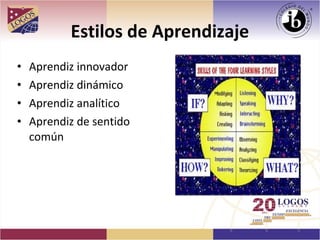
Estilos de Aprendizaje
•   Aprendiz innovador
•   Aprendiz dinámico
•   Aprendiz analítico
•   Aprendiz de sentido
    común
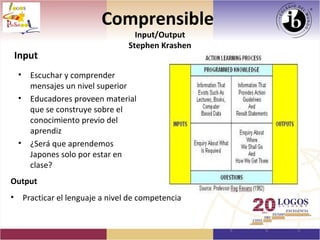
Comprensible
                                       Input/Output
                                     Stephen Krashen
    Input
    •     Escuchar y comprender
          mensajes un nivel superior
    •     Educadores proveen material
          que se construye sobre el
          conocimiento previo del
          aprendiz
    •     ¿Será que aprendemos
          Japones solo por estar en
          clase?
Output
•       Practicar el lenguaje a nivel de competencia
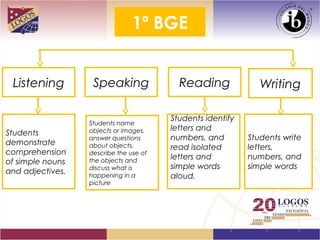
1º BGE


 Listening         Speaking               Reading              Writing

                                        Students identify
                  Students name
                  objects or images,    letters and
Students
                  answer questions      numbers, and        Students write
demonstrate       about objects,        read isolated       letters,
comprehension     describe the use of
                                        letters and         numbers, and
of simple nouns   the objects and
                  discuss what is       simple words        simple words
and adjectives.   happening in a        aloud.
                  picture
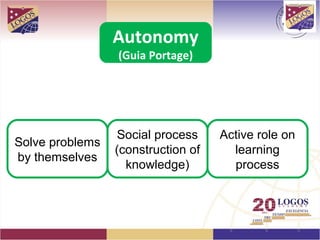
Autonomy
                 (Guia Portage)


                  Social process    Active role on
Solve problems
                 (construction of     learning
by themselves
                   knowledge)         process
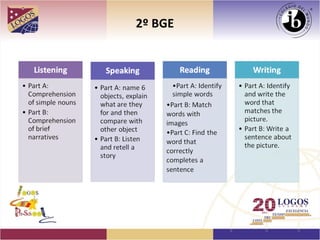
2º BGE
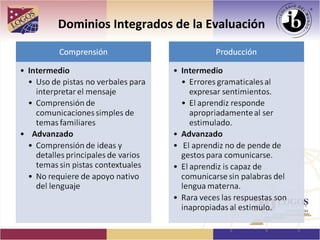
Dominios Integrados de la Evaluación
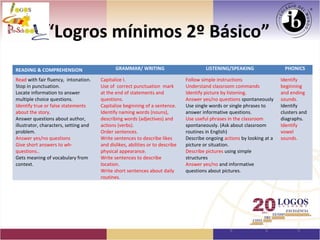
“Logros mínimos 2º Básico”
READING & COMPREHENSION                       GRAMMAR/ WRITING                           LISTENING/SPEAKING                 PHONICS

Read with fair fluency, intonation.    Capitalize I.                            Follow simple instructions                 Identify
Stop in punctuation.                   Use of correct punctuation mark          Understand classroom commands              beginning
Locate information to answer           at the end of statements and             Identify picture by listening.             and ending
multiple choice questions.             questions.                               Answer yes/no questions spontaneously      sounds.
Identify true or false statements      Capitalize beginning of a sentence.      Use single words or single phrases to      Identify
about the story.                       Identify naming words (nouns),           answer informative questions.              clusters and
Answer questions about author,         describing words (adjectives) and        Use useful phrases in the classroom        diagraphs.
illustrator, characters, setting and   actions (verbs).                         spontaneously. (Ask about classroom        Identify
problem.                               Order sentences.                         routines in English)                       vowel
Answer yes/no questions                Write sentences to describe likes        Describe ongoing actions by looking at a   sounds.
Give short answers to wh-              and dislikes, abilities or to describe   picture or situation.
questions..                            physical appearance.                     Describe pictures using simple
Gets meaning of vocabulary from        Write sentences to describe              structures
context.                               location.                                Answer yes/no and informative
                                       Write short sentences about daily        questions about pictures.
                                       routines.
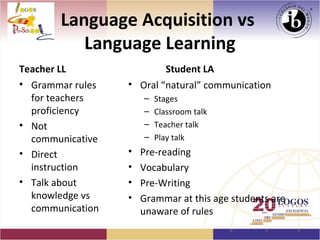
Language Acquisition vs
          Language Learning
Teacher LL                   Student LA
• Grammar rules   • Oral “natural” communication
  for teachers        –   Stages
  proficiency         –   Classroom talk
• Not                 –   Teacher talk
  communicative       –   Play talk
• Direct          •   Pre-reading
  instruction     •   Vocabulary
• Talk about      •   Pre-Writing
  knowledge vs    •   Grammar at this age students are
  communication       unaware of rules
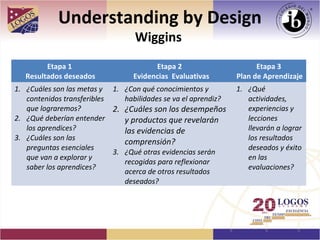
Understanding by Design
                                  Wiggins
         Etapa 1                        Etapa 2                       Etapa 3
   Resultados deseados            Evidencias Evaluativas        Plan de Aprendizaje
1. ¿Cuáles son las metas y 1. ¿Con qué conocimientos y          1. ¿Qué
   contenidos transferibles    habilidades se va el aprendiz?      actividades,
   que lograremos?          2. ¿Cuáles son los desempeños          experiencias y
2. ¿Qué deberían entender      y productos que revelarán           lecciones
   los aprendices?             las evidencias de                   llevarán a lograr
3. ¿Cuáles son las                                                 los resultados
                               comprensión?
   preguntas esenciales                                            deseados y éxito
                            3. ¿Qué otras evidencias serán
   que van a explorar y                                            en las
                               recogidas para reflexionar
   saber los aprendices?                                           evaluaciones?
                               acerca de otros resultados
                               deseados?
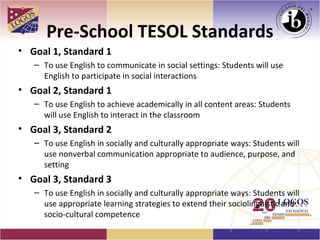
Pre-School TESOL Standards
• Goal 1, Standard 1
   – To use English to communicate in social settings: Students will use
     English to participate in social interactions
• Goal 2, Standard 1
   – To use English to achieve academically in all content areas: Students
     will use English to interact in the classroom
• Goal 3, Standard 2
   – To use English in socially and culturally appropriate ways: Students will
     use nonverbal communication appropriate to audience, purpose, and
     setting
• Goal 3, Standard 3
   – To use English in socially and culturally appropriate ways: Students will
     use appropriate learning strategies to extend their sociolinguistic and
     socio-cultural competence
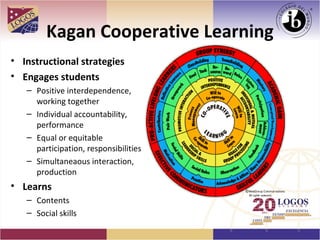
Kagan Cooperative Learning
• Instructional strategies
• Engages students
   – Positive interdependence,
     working together
   – Individual accountability,
     performance
   – Equal or equitable
     participation, responsibilities
   – Simultaneaous interaction,
     production
• Learns
   – Contents
   – Social skills
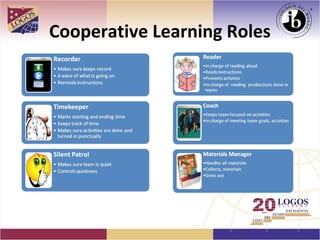
Cooperative Learning Roles
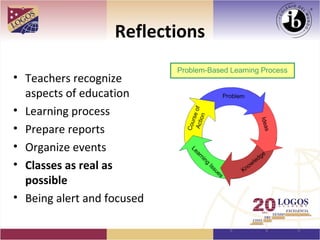
Reflections

• Teachers recognize
  aspects of education
• Learning process
• Prepare reports
• Organize events
• Classes as real as
  possible
• Being alert and focused
Common European
                   Framework A1
• Can understand and use familiar everyday expressions
  and very basic phrases aimed at the satisfaction of needs
  of a concrete type.
• Can introduce him/herself and others and can ask and
  answer questions about personal details such as where
  he/she lives, people he/she knows and things he/she has.
• Can interact in a simple way provided the other person
  talks slowly and clearly and is prepared to help.
Common European
                    Framework A2
• Can understand sentences and frequently used expressions
  related to areas of most immediate relevance (e.g. very basic
  personal and family information, shopping, local geography,
  employment).
• Can communicate in simple and routine tasks requiring a
  simple and direct exchange of information on familiar and
  routine matters.
• Can describe in simple terms aspects of his/her background,
  immediate environment and matters in areas of immediate
  need.
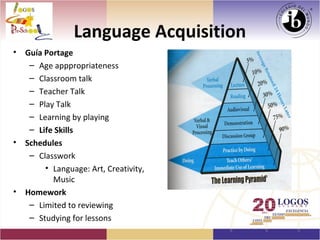
Language Acquisition
•   Guía Portage
     – Age apppropriateness
     – Classroom talk
     – Teacher Talk
     – Play Talk
     – Learning by playing
     – Life Skills
•   Schedules
     – Classwork
         • Language: Art, Creativity,
           Music
•   Homework
     – Limited to reviewing
     – Studying for lessons
Cognitive Science
                        Language Acquisition
•   Modularity
     – Do children learn language using a "mental organ," some of whose principles of
       organization are not shared with other cognitive systems such as perception, motor
       control, and reasoning (Chomsky, 1975, 1991; Fodor, 1983)?
     – Or is language acquisition just another problem to be solved by general intelligence, in
       this case, the problem of how to communicate with other humans over the auditory
       channel (Putnam, 1971; Bates, 1989)?
•   Human Uniqueness combinatorial rule system
•   Language and Thought Language acquisition, then, would be learning to
    think, not just learning to talk. Cognitive psychology has shown that
    people think not just in words but in images
•   Learning and Innateness The mind consisted of sensory-motor abilities
    plus a few simple laws of learning governing gradual changes in an
    organism's behavioral repertoire.
FINLAND
• First among
   – OECD
       • Organization for Economic Cooperation and Development
   – PISA
       • Program for International Student Assessment
          – International test for 15 year olds in language, math and science
• A model of modern
   – Equity
   – Quality
   – Partipation
Círculos de Calidad
Staff                   Director
• Proactivity           • Training
• Involvement              –   TOEFL iBT
                           –   CEF
• Communication
                           –   Reflections
• Ludic Activities
                           –   Methodologies
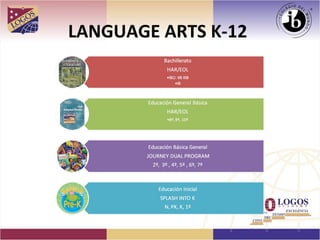
LANGUAGE ARTS K-12

K 12 proposal oct 23, 2012

  • 1.
    Propuesta K-12 October 23, 2012
  • 2.
    Análisis de Necesidades Herbolich Apuntar a las Necesidades Necesidades de Aprendizaje Objetivo Subjetivo ¿Cómo vamos a llegar desde el punto Necesidades HW, CW, Destino de partida hasta nuestro destino ? texto, IBO 1. Nuevo para el aprendiz Carencias Social Skills Punto de 2. Relacionado con el aprendiz Study habits partida 3. Nuevo léxico Motivation 4. ¿Va a operar? 5. Divertido ? ¿Qué 6. Evaluaciones amigables queremos?
  • 3.
    ¿Que necesita mejorar? •Habilidades: LSRW • Metas de Aprendizaje – Producto – Proceso – Progreso vs Crecimiento • Plan Instruccional • Adaptaciones • Efectividad de Evaluaciones • Monitorear and adjustar
  • 4.
    Estilos de Aprendizaje • Aprendiz innovador • Aprendiz dinámico • Aprendiz analítico • Aprendiz de sentido común
  • 5.
    Comprensible Input/Output Stephen Krashen Input • Escuchar y comprender mensajes un nivel superior • Educadores proveen material que se construye sobre el conocimiento previo del aprendiz • ¿Será que aprendemos Japones solo por estar en clase? Output • Practicar el lenguaje a nivel de competencia
  • 6.
    1º BGE Listening Speaking Reading Writing Students identify Students name objects or images, letters and Students answer questions numbers, and Students write demonstrate about objects, read isolated letters, comprehension describe the use of letters and numbers, and of simple nouns the objects and discuss what is simple words simple words and adjectives. happening in a aloud. picture
  • 7.
    Autonomy (Guia Portage) Social process Active role on Solve problems (construction of learning by themselves knowledge) process
  • 8.
  • 9.
    Dominios Integrados dela Evaluación
  • 10.
    “Logros mínimos 2ºBásico” READING & COMPREHENSION GRAMMAR/ WRITING LISTENING/SPEAKING PHONICS Read with fair fluency, intonation. Capitalize I. Follow simple instructions Identify Stop in punctuation. Use of correct punctuation mark Understand classroom commands beginning Locate information to answer at the end of statements and Identify picture by listening. and ending multiple choice questions. questions. Answer yes/no questions spontaneously sounds. Identify true or false statements Capitalize beginning of a sentence. Use single words or single phrases to Identify about the story. Identify naming words (nouns), answer informative questions. clusters and Answer questions about author, describing words (adjectives) and Use useful phrases in the classroom diagraphs. illustrator, characters, setting and actions (verbs). spontaneously. (Ask about classroom Identify problem. Order sentences. routines in English) vowel Answer yes/no questions Write sentences to describe likes Describe ongoing actions by looking at a sounds. Give short answers to wh- and dislikes, abilities or to describe picture or situation. questions.. physical appearance. Describe pictures using simple Gets meaning of vocabulary from Write sentences to describe structures context. location. Answer yes/no and informative Write short sentences about daily questions about pictures. routines.
  • 11.
    Language Acquisition vs Language Learning Teacher LL Student LA • Grammar rules • Oral “natural” communication for teachers – Stages proficiency – Classroom talk • Not – Teacher talk communicative – Play talk • Direct • Pre-reading instruction • Vocabulary • Talk about • Pre-Writing knowledge vs • Grammar at this age students are communication unaware of rules
  • 12.
    Understanding by Design Wiggins Etapa 1 Etapa 2 Etapa 3 Resultados deseados Evidencias Evaluativas Plan de Aprendizaje 1. ¿Cuáles son las metas y 1. ¿Con qué conocimientos y 1. ¿Qué contenidos transferibles habilidades se va el aprendiz? actividades, que lograremos? 2. ¿Cuáles son los desempeños experiencias y 2. ¿Qué deberían entender y productos que revelarán lecciones los aprendices? las evidencias de llevarán a lograr 3. ¿Cuáles son las los resultados comprensión? preguntas esenciales deseados y éxito 3. ¿Qué otras evidencias serán que van a explorar y en las recogidas para reflexionar saber los aprendices? evaluaciones? acerca de otros resultados deseados?
  • 13.
    Pre-School TESOL Standards •Goal 1, Standard 1 – To use English to communicate in social settings: Students will use English to participate in social interactions • Goal 2, Standard 1 – To use English to achieve academically in all content areas: Students will use English to interact in the classroom • Goal 3, Standard 2 – To use English in socially and culturally appropriate ways: Students will use nonverbal communication appropriate to audience, purpose, and setting • Goal 3, Standard 3 – To use English in socially and culturally appropriate ways: Students will use appropriate learning strategies to extend their sociolinguistic and socio-cultural competence
  • 14.
    Kagan Cooperative Learning •Instructional strategies • Engages students – Positive interdependence, working together – Individual accountability, performance – Equal or equitable participation, responsibilities – Simultaneaous interaction, production • Learns – Contents – Social skills
  • 15.
  • 16.
    Reflections • Teachers recognize aspects of education • Learning process • Prepare reports • Organize events • Classes as real as possible • Being alert and focused
  • 17.
    Common European Framework A1 • Can understand and use familiar everyday expressions and very basic phrases aimed at the satisfaction of needs of a concrete type. • Can introduce him/herself and others and can ask and answer questions about personal details such as where he/she lives, people he/she knows and things he/she has. • Can interact in a simple way provided the other person talks slowly and clearly and is prepared to help.
  • 18.
    Common European Framework A2 • Can understand sentences and frequently used expressions related to areas of most immediate relevance (e.g. very basic personal and family information, shopping, local geography, employment). • Can communicate in simple and routine tasks requiring a simple and direct exchange of information on familiar and routine matters. • Can describe in simple terms aspects of his/her background, immediate environment and matters in areas of immediate need.
  • 19.
    Language Acquisition • Guía Portage – Age apppropriateness – Classroom talk – Teacher Talk – Play Talk – Learning by playing – Life Skills • Schedules – Classwork • Language: Art, Creativity, Music • Homework – Limited to reviewing – Studying for lessons
  • 20.
    Cognitive Science Language Acquisition • Modularity – Do children learn language using a "mental organ," some of whose principles of organization are not shared with other cognitive systems such as perception, motor control, and reasoning (Chomsky, 1975, 1991; Fodor, 1983)? – Or is language acquisition just another problem to be solved by general intelligence, in this case, the problem of how to communicate with other humans over the auditory channel (Putnam, 1971; Bates, 1989)? • Human Uniqueness combinatorial rule system • Language and Thought Language acquisition, then, would be learning to think, not just learning to talk. Cognitive psychology has shown that people think not just in words but in images • Learning and Innateness The mind consisted of sensory-motor abilities plus a few simple laws of learning governing gradual changes in an organism's behavioral repertoire.
  • 21.
    FINLAND • First among – OECD • Organization for Economic Cooperation and Development – PISA • Program for International Student Assessment – International test for 15 year olds in language, math and science • A model of modern – Equity – Quality – Partipation
  • 22.
    Círculos de Calidad Staff Director • Proactivity • Training • Involvement – TOEFL iBT – CEF • Communication – Reflections • Ludic Activities – Methodologies
  • 23.